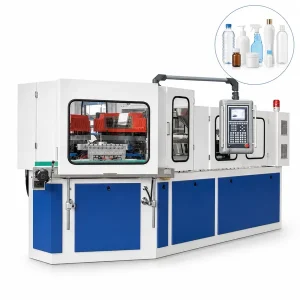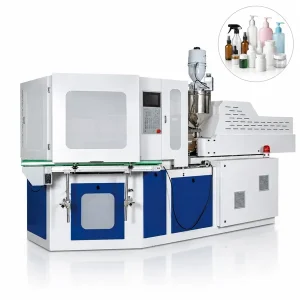
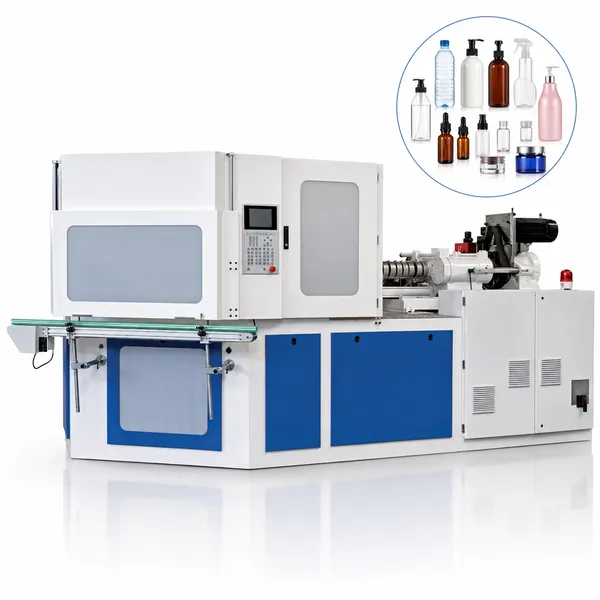
EP-ZQ80 注塑吹塑机

The EP-ZQ80 is Korea Ever-Power’s heavy-duty 3-station 注塑吹塑机, engineered for large-scale Korean pharmaceutical contract manufacturing, Korean household chemical production and Korean industrial packaging where 20-cavity output at 10 ml, 12-cavity output at 100 ml and 800 KN injection clamping are the commercial requirements. Two premium features distinguish the ZQ80 from the ZQ40 and ZQ60: a standard high-precision angle divider that synchronises mould opening and closing with turret lift for improved cycle repeatability and indexing accuracy, and a standard dual hydraulic system that raises energy savings to 20–30% below industry-standard machines — compared to 10–20% on the lower ZQ models. The 55 mm screw, 466 g shot weight, 800 × 400 mm platen and 4+N barrel temperature zones serve the large preform masses and complex mould layouts that high-cavity Korean pharmaceutical production demands. At 4.5 × 1.6 × 2 m and 10 tonnes, the ZQ80 is a heavy industrial platform suited to purpose-built Korean packaging factory floors.

分类:

产品概述

The EP-ZQ80 occupies a specific and commercially important position in Korea Ever-Power's 注塑吹塑机 range: the first model in the ZQ series where the engineering investment steps up to a dual hydraulic system and a high-precision angle divider as standard equipment — two structural features that define the ZQ80 as a genuine heavy-duty platform rather than a scaled-up version of the mid-range ZQ60. Korean packaging factory operators who evaluate the ZQ80 on clamping force alone (800 KN, against the ZQ60's 600 KN) are looking at only part of the picture. The more significant commercial advantages come from the angle divider's cycle repeatability improvement and the dual hydraulic system's energy efficiency gain — two features that compound their value over years of production at the ZQ80's 20-cavity, 10 ml output rate.

ZQ80型注塑吹塑一体机

The high-precision angle divider synchronises the injection mould's opening and closing motion with the turret's vertical lift cycle. On machines without this feature — including the ZQ40 and ZQ60 — these two mechanical events are sequential: the mould closes fully, then the turret lifts, then it rotates, then it lowers, then the mould opens. The angle divider allows the mould closing motion and turret lowering to begin overlapping at a precisely calibrated angular position, reducing the time lost to sequential waiting between events. The result is improved effective throughput at the same nominal dry cycle and significantly better indexing repeatability — the turret returns to exactly the same angular position at each cycle, which is directly measurable as tighter cavity-to-cavity weight consistency and more uniform neck OD distribution across all 20 cavities. For Korean pharmaceutical GMP qualification where all cavities must individually pass dimensional and weight specifications, this repeatability advantage is commercially significant.

The dual hydraulic system separates injection-side hydraulics from blow-side hydraulics into two independent circuits, each optimised for its own pressure and flow rate requirements. This separation eliminates the cross-system pressure fluctuations that occur in single-circuit machines when injection clamping demand and blow clamping demand coincide, and allows both systems to operate simultaneously at full capacity without sharing hydraulic flow. The energy efficiency gain from this architecture is 20–30% below industry-standard machines — higher than the 10–20% on the ZQ40 and ZQ60 because the dual circuit allows the pump on the less-loaded side to reduce to near-idle during phases when only one side is active. At the ZQ80's 55 KW total power and Korean electricity rates, the 20–30% energy saving over a ZQ80 competitor machine represents a substantial annual operating cost advantage.

Technical Specifications — EP-ZQ80

The following parameters are Korea Ever-Power's rated engineering specifications for the EP-ZQ80. Utility supply sizing — particularly the higher electrical demand of 55 KW total power and the 4 M³/h cooling water requirement — should be confirmed with the site preparation checklist during installation planning. Parameters are for reference; specifications may be updated without prior notice.

物品 单元 EP-ZQ80
注射系统
螺纹直径 毫米 55
螺杆长径比 22:1
Injection Weight g 466
加热功率 千瓦 18
Number of Barrel Zones 4+N
Injection Stroke 毫米 180
夹紧系统
Clamping Force — Injection 克努尔特人 800
Opening Stroke — Injection 毫米 140
Clamping Force — Blowing 克努尔特人 120
Opening Stroke — Blowing 毫米 140
Rotary Table Lift Height 毫米 70
模具
Max Platen Size (L×W) 毫米 800 × 400
Mould Thickness 毫米 280
Max Bottle Diameter 毫米 120
Max Bottle Height 毫米 220
Suitable Bottle Volume ml 1 – 2,000
Stripping Stroke 毫米 230
Power, Utilities and Dimensions
Hydraulic Pressure 兆帕 14
Motor Power (Dual) 千瓦 18.5 + 18.5
Dry Cycle s 4
总功率 千瓦 55
Operating Power Ratio % 52 – 70
Min. Air Pressure 兆帕 0.7 – 1.2
Compressed Air Capacity M³/min 0.7
Cooling Water Flow M³/h 4
冷却水压力 兆帕 0.3 – 0.4
Dimensions (L×W×H) M 4.5 × 1.6 × 2
机器重量 Ton 10

EP-ZQ80 Cavity Count Reference by Bottle Volume

(For reference only — actual cavity count depends on bottle geometry and mould design)

Volume per Bottle 10毫升 30毫升 60 ml 100毫升 250 ml 500 ml 1,000 ml
最大龋洞 20 18 14 12 8 5 – 6 3 – 4

Parameters are for reference only. Korea Ever-Power reserves the right to modify specifications without notice.

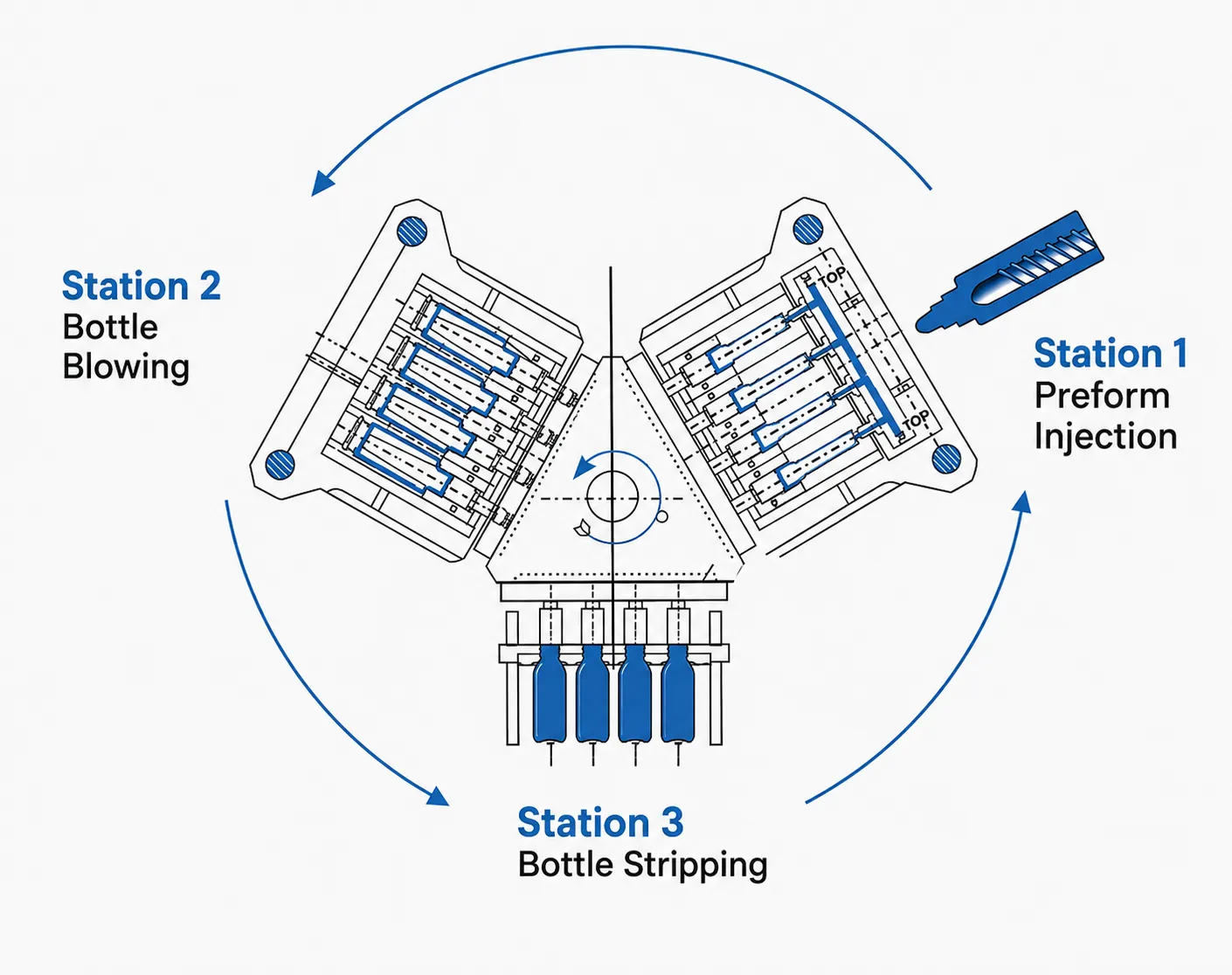
EP-ZQ80 Working Principle: 3-Station Process at Scale

EP-ZQ80 3-station injection blow molding process — 800KN injection clamping preform injection blow moulding bottle stripping with high-precision angle divider synchronising mould open-close with turret lift

The EP-ZQ80 operates on the same 3-station rotary turret principle as the full ZQ series. What makes the ZQ80's process execution distinctly more precise is the high-precision angle divider that coordinates the mould open/close motion with the turret's vertical lift. The ZQ80's 3-station process at 20-cavity 10 ml scale produces approximately 18,000 bottles per operating hour — roughly 43% more than the ZQ60 at the same format, at the same 4-second dry cycle.

Station 1 — Preform Injection with High-Precision Angle Divider

Molten HDPE, PP, PS or ABS resin is injected at 466 g shot weight through a 55 mm screw into the 20-cavity preform mould at 800 KN injection clamping. The 4+N barrel zone configuration on the ZQ80 — compared to 3+N on the ZQ40 and ZQ60 — provides finer temperature gradient control along the barrel length. At 466 g shot weight (versus the ZQ60's 383 g maximum), the resin residence time in the barrel is longer and temperature uniformity across the full shot mass matters more: the additional zone allows the zone closest to the gate to be held at a slightly lower temperature to prevent over-shear and gate burning in high-viscosity materials such as HDPE at 20-cavity injection, where the gate system resistance is at its maximum across the entire mould runner network. After the injection phase, the angle divider coordinates the mould opening motion with the beginning of the turret lift — a motion overlap of approximately 0.3–0.5 seconds per cycle that reduces effective cycle time below what the 4-second dry cycle alone would suggest at high cavity counts.

Station 2 — Blow Moulding with Dual Hydraulic Support

The 20 mandrels rotate to the blow station, each carrying a precision-formed 10 ml preform at residual injection temperature. At the blow station, 120 KN blow clamping force holds the 20-cavity blow mould against air inflation pressure. The dual hydraulic system's second circuit serves the blow station independently of the injection-side circuit, meaning that the blow clamping pressure is not subject to fluctuation from injection-side demand peaks. This hydraulic independence produces consistent blow air distribution across all 20 cavities simultaneously — at high cavity counts, uneven hydraulic pressure to the blow station produces visible wall thickness variation between the first and last cavity to receive blow pressure. The ZQ80's dual circuit eliminates this source of inter-cavity variation that single-circuit machines experience at 18–20 cavity production.

Station 3 — Bottle Stripping and Output

Finished bottles are stripped from the 20 mandrels at the stripping station with a 230 mm stripping stroke and deposited on the output conveyor. At 20-cavity 10 ml production, the ZQ80 delivers approximately 20 bottles to the conveyor every 4 seconds — a flow rate that the downstream conveyor, labelling and inspection equipment must be sized to accommodate. Korea Ever-Power's production line planning team advises on conveyor speed, accumulation buffer length and downstream inspection equipment selection to match the ZQ80's output rate at each cavity configuration. The ZQ80's standard CE-certified safety guarding includes all conveyor integration points, ensuring compliance with Korean industrial safety regulations at the installation site.

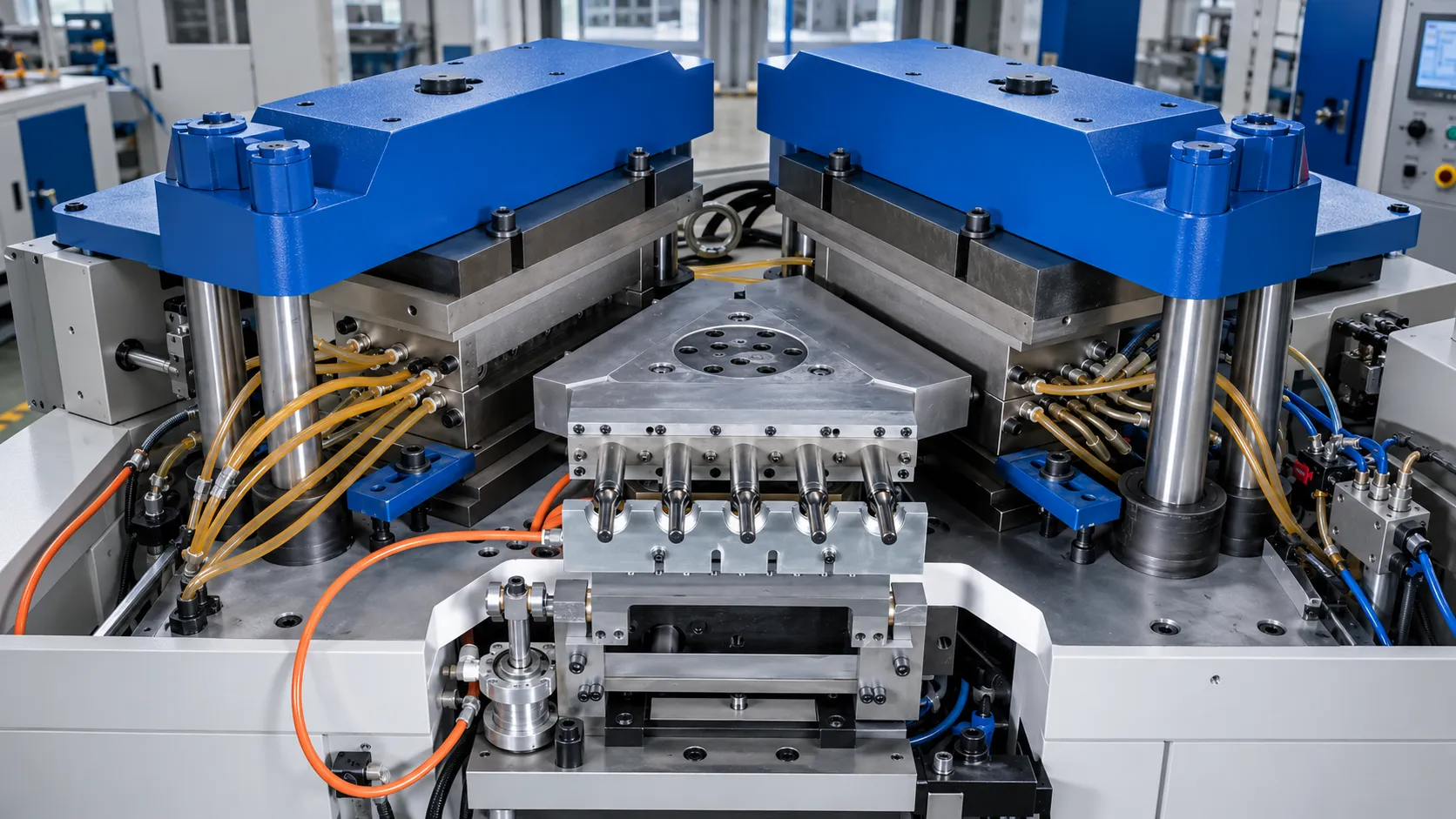
EP-ZQ80 Premium Engineering Features: Angle Divider and Dual Hydraulics Explained

EP-ZQ80 internal structure — high-precision angle divider synchronising mould opening-closing with turret lift dual hydraulic system for injection and blow circuits 800KN heavy-duty European IBM machine

Two engineering features make the ZQ80 a genuinely different platform from the ZQ40 and ZQ60, not simply a larger version of them. Understanding these features helps Korean packaging engineers justify the ZQ80 investment over the ZQ60 at the same cavity count or explain the ZQ80's cavity count and cycle repeatability advantages at high-volume Korean pharmaceutical production.

High-Precision Angle Divider: Synchronised Motion Control

On a conventional 3-station IBM machine without an angle divider, the mechanical sequence is fully sequential: injection mould closes and holds, injection fires, screw recovers, mould opens, turret lifts, turret rotates 120 degrees, turret lowers, mould closes again. Each step waits for the previous to complete before beginning. On the ZQ80 with high-precision angle divider, the mould closing motion and the turret lowering motion are partially overlapped at a precisely calibrated relative angular position. The angle divider — a precision mechanical indexing component that controls the relative phase between the rotary turret's angular position and the mould clamping cylinder's travel — allows the mould to begin closing as the turret completes its final rotation and descent, rather than waiting for full turret stop before beginning the close. The practical effect at 20-cavity production is twofold: effective throughput increases because lost waiting time between events is eliminated, and repeatability improves because the angle divider ensures the turret always stops at exactly the same angular position before final close — producing consistent mandrel-to-cavity registration across all 20 cavities on every cycle, measurable as tighter cavity-to-cavity weight standard deviation in production samples.

Dual Hydraulic System: Independent Circuit Energy Efficiency

The ZQ80's standard dual hydraulic system divides the machine's hydraulic demands into two independent circuits: Circuit A serves the injection clamping and injection screw (18.5 KW motor), and Circuit B serves the blow clamping, stripping and turret lift mechanisms (18.5 KW motor). Each circuit operates at its own pressure and flow rate, sized specifically for the loads it serves. When Circuit A is in its high-demand injection phase, Circuit B's load is at blow hold — a lower-pressure, lower-flow state. Because the two circuits do not share capacity, Circuit B's pump automatically reduces load during this phase, saving energy. The reverse applies when Circuit B's stripping and turret rotation phase is at peak demand: Circuit A has completed injection and its pump reduces to near-idle recovery. This alternating load-sharing across two dedicated circuits produces the 20–30% energy saving versus single-circuit competitors at the same machine scale — a saving that compounds significantly over years of two-shift Korean factory production. For Korean factories participating in Korean government energy efficiency incentive programmes, the dual hydraulic system's documented energy performance advantage is a qualifying factor for energy-efficient industrial equipment classification.

Injection Blow Molding vs Injection Stretch Blow Moulding: Platform Selection at Scale

Korea Ever-Power manufactures both the ZQ-series IBM machines and the HGY-series ISBM machines, including the 4工位ISBM机器系列. At the ZQ80 scale of investment, the IBM vs ISBM decision is worth reviewing carefully because the capital deployment is substantial in either direction.

Selection Criterion IBM (EP-ZQ80) ISBM(HGY系列)
初级材料 HDPE, LDPE, PP, PS, ABS, EVA, PCTG PET、PETG、Tritan、PC、PP、PCTG
最大龋洞数为 10 毫升 20 (EP-ZQ80) 最多 12(HGY 系列)
琴颈精细加工 Injection-moulded — highest precision Injection-moulded — highest precision
Bottle wall clarity Good (non-oriented) — opaque or translucent formats Glass-like clarity (biaxially oriented PET)
Energy saving vs. industry 20–30% (dual hydraulic) 30–40% (servo drive)
Scrap / flash generated
Wide-mouth jar production Excellent — IBM native capability Achievable with conditioning adjustment
Korean pharma GMP CRC neck Excellent — injection-moulded precision Excellent — injection-moulded precision

At the ZQ80's investment scale, the IBM vs ISBM decision typically comes down to material: if the Korean factory's product portfolio is predominantly HDPE and PP pharmaceutical containers, wide-mouth household chemical packaging, and ABS or PS cosmetic jars — the ZQ80 is the right platform. If the portfolio requires crystal-clear PET cosmetic serums or CSD-resistant PET beverage containers in significant volume — the HGY-series ISBM machines are appropriate. Korea Ever-Power's engineering team at isbm-blow-molding.com can review production specifications and provide a technology recommendation before purchase commitment.

EP-ZQ80 Application Fields

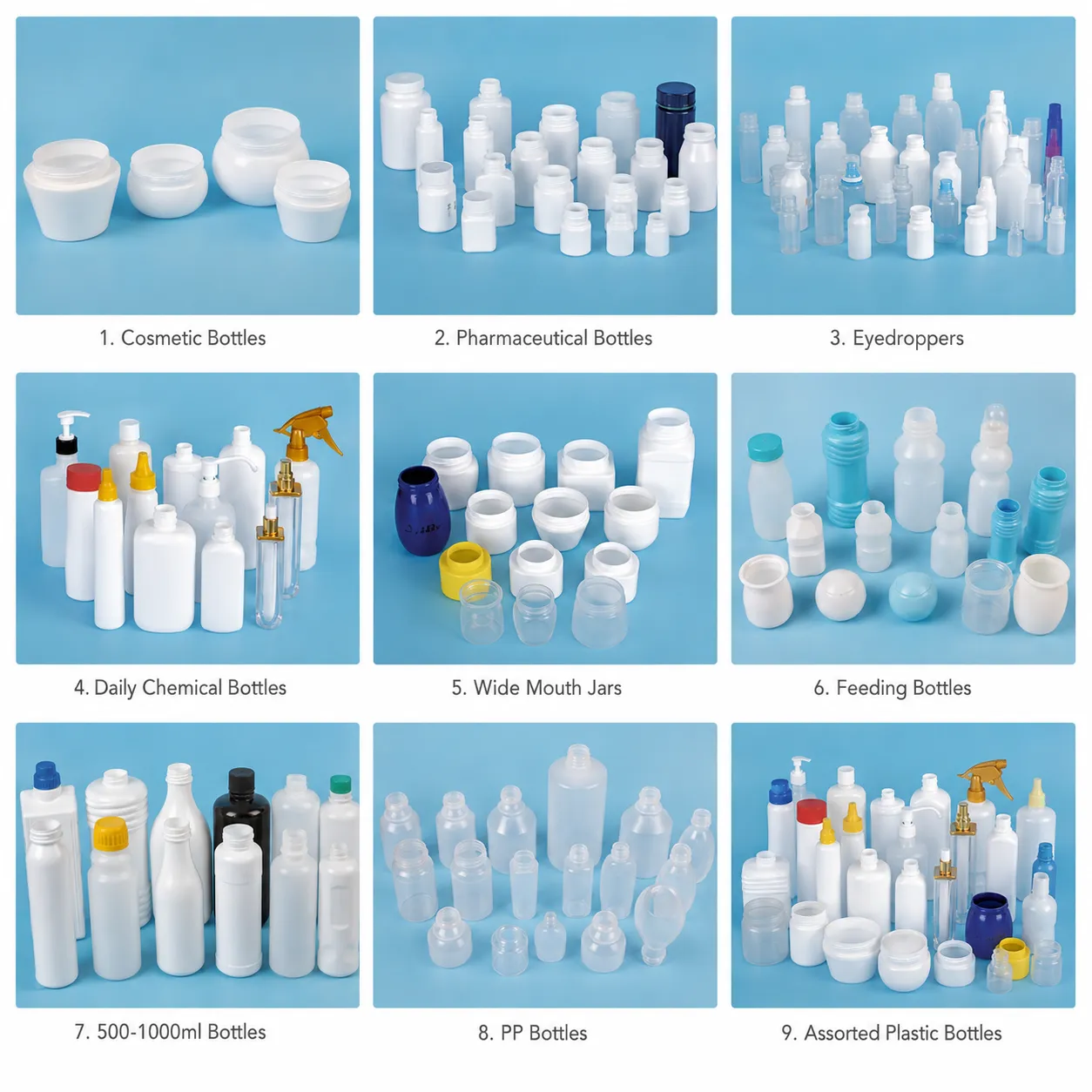
HDPE PP pharmaceutical bottles — EP-ZQ80 20 cavity 10ml ophthalmic eye drop bottle 12 cavity 100ml oral medicine container Korean GMP pharmaceutical packaging CRC neck

High-Volume Pharmaceutical Packaging

The ZQ80's 20-cavity 10 ml and 12-cavity 100 ml configurations serve Korean pharmaceutical contract packaging operations that require the highest HDPE and PP container output per shift — Korean multi-national pharma contract fillers, Korean hospital supply chain packagers and Korean clinical trial material producers who need 15,000–18,000 unit doses per operating hour from a single machine. The injection-moulded neck precision across all 20 cavities supports Korean GMP container qualification at KFDA and ICH Q6A dimensional standards simultaneously.

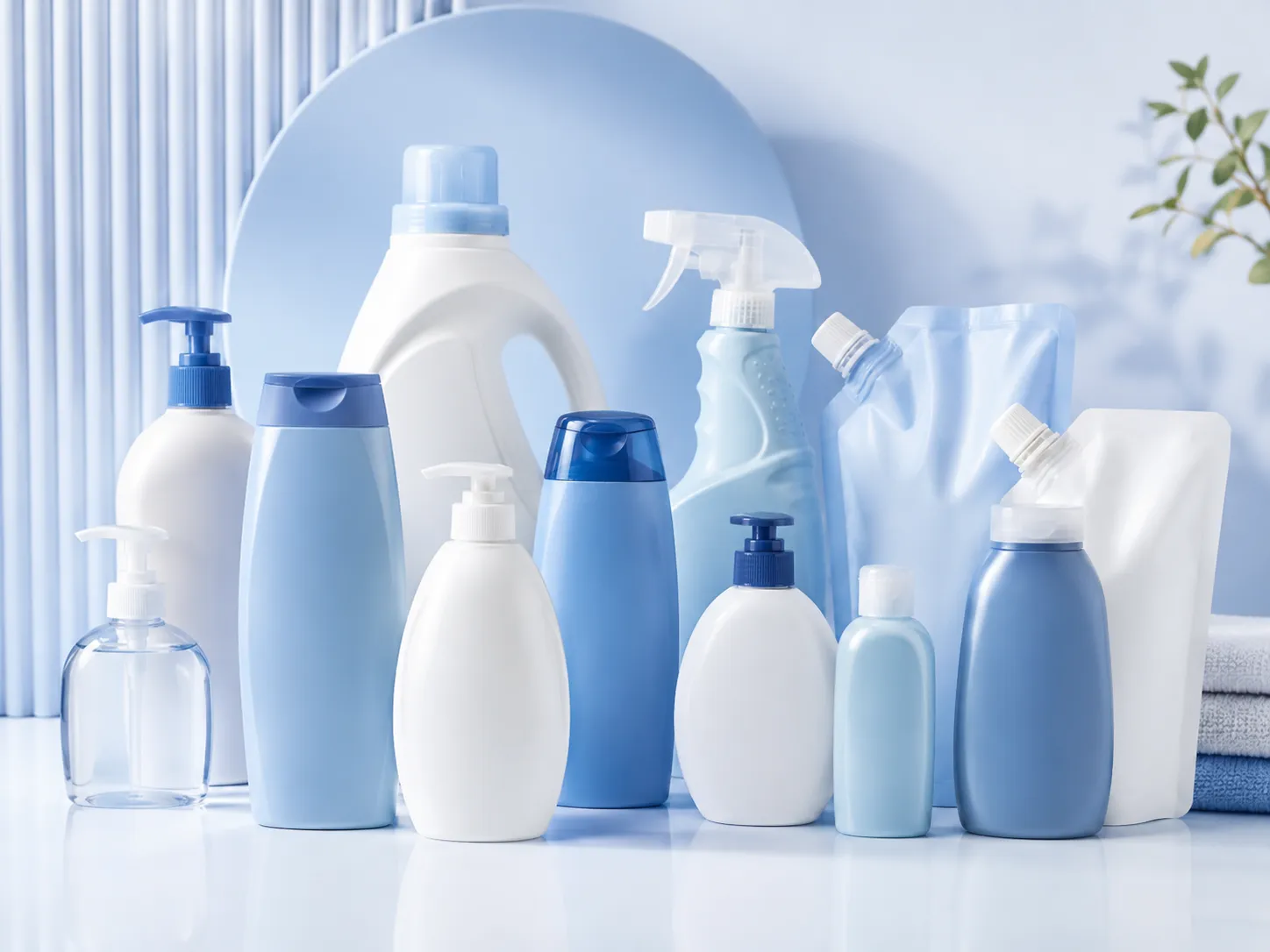
HDPE PP household chemical daily chemical bottle produced on EP-ZQ80 IBM machine — 5 cavity 500ml shampoo 6 cavity 500ml conditioner 3 cavity 1000ml cleaning product Korean household packaging

Household Chemical and Personal Care

HDPE and PP containers at 5–6 cavities at 500 ml and 3–4 cavities at 1,000 ml for Korean shampoo, conditioner, body wash, liquid laundry detergent and household surface cleaner. At the ZQ80's output rate for mid-volume formats, a Korean daily chemical OEM factory running 5-cavity 500 ml produces approximately 4,500 bottles per operating hour — sufficient for Korean national brand volumes that the ZQ60's 3-cavity 500 ml output cannot match without a second machine.

Wide-mouth jar HDPE PP ABS cosmetic jar food container wide-mouth bottle produced on EP-ZQ80 IBM machine — Korean cosmetic wide-mouth jar Korean food jar Korean condiment jar large cavity Korean packaging

Wide-Mouth Jars and Industrial Packaging

ABS, PP and HDPE wide-mouth cosmetic jars at 8-cavity 250 ml for Korean premium cream and mask packaging, Korean food-grade wide-mouth jars for Korean honey, Korean kimchi paste and Korean sesame paste at the same 8-cavity 250 ml configuration, and Korean industrial reagent containers at 3–4 cavities 1,000 ml. The ZQ80's 800 × 400 mm platen accommodates complex wide-mouth mould geometries with embossed brand logos and shoulder recesses that require larger platen area than the ZQ60 provides.

Essential Matching Components for the EP-ZQ80

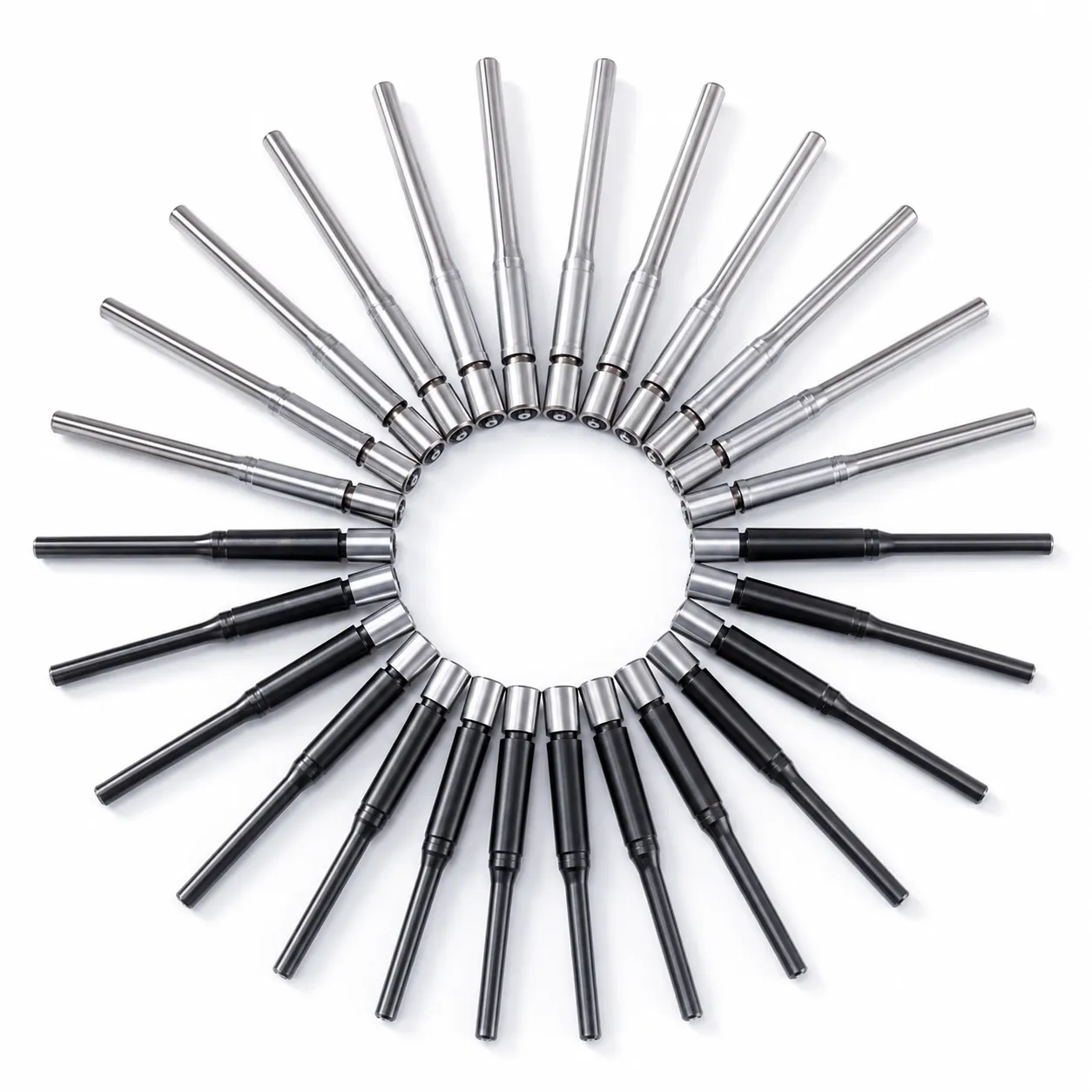
ZQ80 injection blow molding machine mould set — 20 cavity injection mould hot runner mandrel set blow mould in S136 stainless steel for high-volume pharmaceutical cosmetic household chemical packaging production

  • ZQ80 IBM Mould Set — 20-Cavity Precision Tooling
    The ZQ80's 800 × 400 mm platen and 280 mm mould thickness specification allow mould layouts not achievable on smaller platforms. Korea Ever-Power manufactures ZQ80-compatible 20-cavity 10 ml mould sets using S136 stainless steel (HRC 50–52) for all injection cavity bodies and core rods — the highest corrosion resistance and mirror-polish capability available in pharmaceutical-grade IBM tooling. At 20 cavities, the hot runner network design is the most complex in the ZQ series: gate balance across 20 drops must be achieved within ±2% flow variation to ensure equal preform weight across all cavities. Korea Ever-Power's ZQ80 mould engineering team verifies gate balance by flow simulation before CNC machining and confirms it with a 500-piece production trial before shipment, with cavity-by-cavity weight data in the delivery documentation package.
  • Oil-Free Air Compressor (0.7–1.2 MPa, minimum 1.0 M³/min recommended)
    Although the ZQ80's minimum compressed air capacity specification is 0.7 M³/min — matching the ZQ40 and ZQ60 specification — Korea Ever-Power recommends sizing the air compressor to 1.0–1.2 M³/min for ZQ80 installations. The ZQ80's 20-cavity blow station inflates 20 preforms simultaneously per cycle; at 4-second cycle time and standard pharmaceutical 10 ml HDPE blow pressure (0.7–0.9 MPa), the air volume per cycle is approximately 40% higher than at ZQ60's 14-cavity output, creating a demand profile that benefits from an air receiver buffer sized to 300 litres minimum and a compressor with the capacity to maintain line pressure during the ZQ80's simultaneous 20-cavity blow event.
  • Dual-Circuit Mould Temperature Controllers and Chiller
    The ZQ80's dual hydraulic system architecture benefits from a matching approach to mould temperature control: two independent mould temperature controller units, one dedicated to the injection mould circuit and one to the blow mould circuit, allow each circuit to be held at its own optimal temperature without interaction. The injection mould circuit on a ZQ80 running 20-cavity HDPE at 466 g shot weight runs at 15–25°C to minimise cycle time. The blow mould circuit at 20 cavities runs at 8–18°C. With a shared single-unit controller, reducing one circuit's temperature setpoint can affect the other's response; independent units eliminate this interaction. Total cooling water demand is 4 M³/h at 0.3–0.4 MPa — the same as the ZQ60 specification, but the ZQ80's higher heat load from 55 KW total power (vs ZQ60's 37 KW) means the chiller capacity should be sized for the full 55 KW installed power as the worst-case thermal load.

Why Choose Korea Ever-Power for the EP-ZQ80?

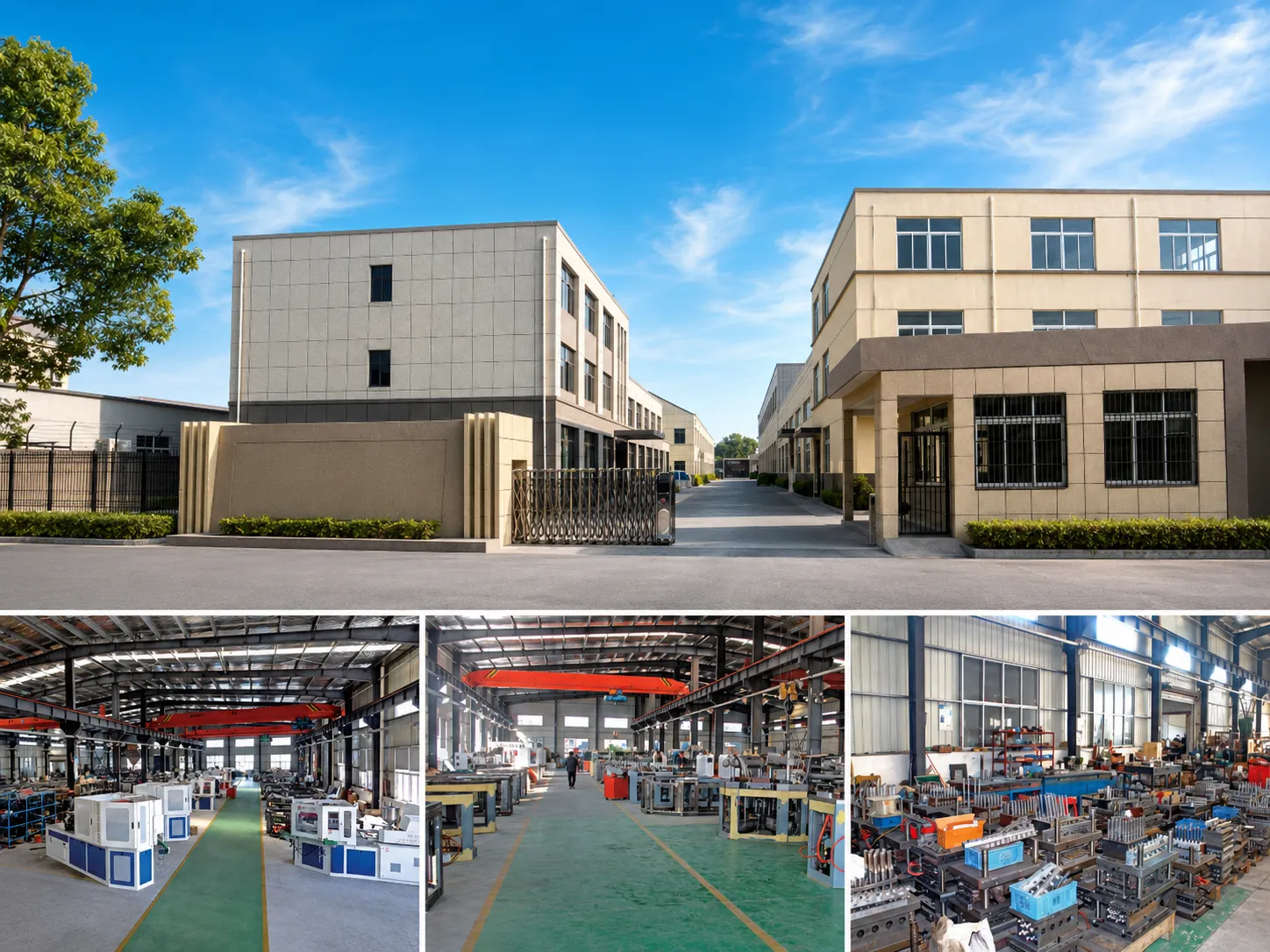
Korea Ever-Power injection blow molding machine manufacturing workshop — ZQ80 heavy-duty IBM machine production precision assembly and quality control with engineering team

  • 800 KN at 20–30% above industry standard: The ZQ80's European structural architecture delivers injection clamping 20–30% above comparable-class machines, supported by the dual hydraulic system that provides this force at 20–30% lower energy consumption than single-circuit competitors — a combination not common in the Korean heavy-duty IBM market.
  • High-precision angle divider as standard: On many competing machines at this price range, the angle divider is an optional upgrade. Korea Ever-Power includes it as standard on the ZQ80, ZQ110 and ZQ135, ensuring that customers receive the full cycle repeatability and inter-cavity consistency benefit from the first production day without upgrade negotiation or additional cost.
  • Integrated machine and mould manufacture: The ZQ80's 20-cavity mould set is the most complex tooling in the QZ series. Korea Ever-Power's ability to design, manufacture and trial the mould on the exact same platform the customer will receive — verified by cavity-by-cavity weight and dimensional data in the delivery package — is a significant advantage over purchasing machine and mould separately from different vendors.
  • CE and ISO 9001:2015 certified: The EP-ZQ80 carries CE marking for European conformity and is manufactured under ISO 9001:2015. The full documentation package — CE Declaration, operation manual, hydraulic and electrical schematics, spare parts catalogue, mould dimensional report — is included with every ZQ80 delivery as standard.
  • Scalable platform — clear path to ZQ110 and ZQ135: Korean factories that commission the ZQ80 and subsequently need to expand to 24-cavity (ZQ110) or 30-cavity (ZQ135) can do so within the same machine architecture, training framework and spare parts ecosystem. No re-qualification of an entirely different machine platform is required when moving between ZQ models.
  • 24×7 remote diagnostic and on-site support: At ZQ80 production rates, unplanned machine stoppage is commercially costly. Korea Ever-Power's 24-hour service hotline with remote PLC diagnostic access resolves most control and process issues without waiting for an engineer site visit. For hardware issues requiring physical inspection, Korea Ever-Power maintains a dedicated ZQ80 spare parts stock for express dispatch to Korean production facilities.

Frequently Asked Questions — EP-ZQ80

Q1: What does the high-precision angle divider on the ZQ80 do that the ZQ60 cannot?

The angle divider synchronises the mould open/close motion with the turret's vertical lift and rotation — allowing these mechanical events to overlap partially rather than executing fully sequentially. On the ZQ60 without this feature, the mould must fully open before the turret begins to lift; on the ZQ80 with the angle divider, the mould opening motion can begin as the turret starts its lift at a precisely calibrated relative phase angle. The practical benefit is twofold: effective throughput improves at the same nominal dry cycle because lost sequential waiting time is eliminated, and indexing repeatability improves because the turret always reaches the same angular position at mandrel-cavity registration — measurable as tighter cavity-to-cavity weight standard deviation across all 20 cavities in production sampling.


Q2: What exactly is the dual hydraulic system and what energy saving does it deliver?

The ZQ80's dual hydraulic system consists of two fully independent hydraulic circuits, each with its own 18.5 KW motor, pump, valve bank and pressure regulation: Circuit A serves injection clamping and the injection screw; Circuit B serves blow clamping, stripping and turret lift. Because the two circuits serve loads that peak at different points in the cycle, each circuit's pump can reduce to partial or near-idle load when its served function is in the low-demand phase of the cycle. The total result is 20–30% lower energy consumption versus competitor machines of the same clamping class that use a single shared circuit — compared to 10–20% on the single-circuit ZQ40 and ZQ60. For a ZQ80 at 55 KW total installed power on a Korean two-shift production schedule of 3,500 operating hours per year, a 25% energy saving versus a competitor machine at the same output represents a substantial annual electricity cost reduction at Korean industrial electricity rates.


Q3: Why does the ZQ80 have 4+N barrel zones while the ZQ40 and ZQ60 have 3+N?

At 466 g shot weight through a 55 mm screw, the resin residence time in the ZQ80's barrel is longer and the temperature gradient between the feed zone and the gate zone is larger than on smaller-shot machines. The additional fourth zone on the ZQ80 — immediately before the gate — allows the process engineer to hold this section at a slightly different setpoint from the third zone, creating a finer temperature gradient approaching the gate. For HDPE at 20-cavity injection, where the hot runner network resistance is highest in the ZQ series, this gate-zone temperature adjustment controls melt viscosity at the gate face to reduce gate freeze-off variation and gate blush across all 20 cavities simultaneously. In practice, the 4+N zones give the ZQ80 operator a process control parameter that directly improves gate quality and shot weight consistency at the high-cavity counts for which the ZQ80 is designed.


Q4: What is the actual hourly and daily output of the ZQ80 at 20-cavity 10 ml pharmaceutical production?

At 4-second dry cycle and 88% practical production efficiency (accounting for shift startup, minor adjustments and brief stoppages), the ZQ80 delivers approximately 900 cycles per operating hour. At 20 cavities and 10 ml per cavity: approximately 18,000 bottles per operating hour. On a Korean two-shift day of 14 production hours, that is approximately 252,000 bottles per day. On a 250-day Korean production year at this rate: approximately 63 million 10 ml pharmaceutical containers per year from a single ZQ80 machine. This output rate is approximately 43% higher than the ZQ60 at 14-cavity 10 ml and approximately twice the ZQ40 at 9-cavity 10 ml. Korean pharmaceutical contract packagers who fill 10 ml ophthalmic containers for multiple brand clients typically find the ZQ80 the correct scale of IBM investment when daily demand exceeds 150,000 units per product line.


Q5: What electrical supply does the EP-ZQ80 require for Korean factory installation?

The EP-ZQ80 requires a 55 KW total installed power supply at 380V / 3-phase / 50 Hz. The dual motor configuration is 18.5 KW + 18.5 KW for the two hydraulic circuits, plus 18 KW barrel heating. Korea Ever-Power recommends sizing the ZQ80's dedicated factory circuit at 65 KW to provide startup headroom above the rated total power. A 100A / 380V three-phase circuit with appropriate main breaker, contactor and earthing in accordance with Korean KS C IEC 60364 industrial wiring standards is the standard ZQ80 electrical supply specification. Given the dual motor startup sequence, soft-start or star-delta motor starters for both hydraulic motors are recommended to limit startup current inrush on the Korean factory distribution panel.


Q6: Can the ZQ80 be installed in a Korean pharmaceutical ISO Class 8 cleanroom environment?

Yes. The ZQ80 is suited to installation in a Korean pharmaceutical production area designed for ISO Class 8 or Korean GMP Annex 1 Grade D ambient air conditions. The machine's hydraulic system uses pharmaceutical-compatible food-grade hydraulic oil on request, and the production mould area can be fitted with local HEPA positive-pressure supply air. The dual hydraulic system's reduced heat output per unit of productive work (20–30% energy saving) also means the ZQ80 generates less waste heat into the cleanroom environment per bottle produced than a single-circuit competitor at the same output — a practical benefit for cleanroom HVAC sizing. Korea Ever-Power provides a cleanroom-compatible machine configuration specification and can assist with cleanroom layout planning during installation preparation at the Korean site.


Q7: What floor space does the EP-ZQ80 production cell require?

The EP-ZQ80 machine footprint is 4.5 × 1.6 m (7.2 m²) with a machine height of 2 m and a weight of 10 tonnes requiring adequate floor load capacity (typically 1,500 kg/m² minimum structural floor rating). A complete ZQ80 production cell including output conveyor (3–4 m extending from machine), oil-free compressor, dual chiller units, two mould temperature controllers, electrical panel and operator station requires approximately 40–50 m² of floor space depending on conveyor layout. Korea Ever-Power provides a dimensioned floor plan drawing for each ZQ80 installation to assist Korean factory layout planning and civil engineering coordination. For Korean factories installing the ZQ80 as a second machine alongside an existing ZQ60 or ZQ40, the side-by-side footprint comparison and shared utility routing are included in the pre-installation planning service.


Q8: When should a Korean factory choose the ZQ110 instead of the ZQ80?

The ZQ110 becomes the correct choice over the ZQ80 under three conditions. First, cavity count: if the production programme requires more than 20 cavities at 10 ml or more than 18 cavities at 30 ml — the ZQ110 supports 24 cavities at 10 ml and proportionally higher counts at larger volumes. Second, platen size: if the mould layout for the primary production format physically exceeds the ZQ80's 800 × 400 mm platen — the ZQ110 provides a larger platen with 1,100 KN injection clamping force to hold the larger mould set. Third, production growth: if the Korean factory's three-year output forecast shows demand growth that will exceed the ZQ80's 18,000 bottles/hour ceiling at 10 ml format within the investment horizon, the ZQ110 at initial installation avoids a second machine purchase cycle within a short period. For formats above 250 ml where cavity count per machine is inherently limited by platen area, the ZQ80 and ZQ110 are often complementary rather than alternative choices.


Q9: What preventive maintenance schedule does Korea Ever-Power recommend for the EP-ZQ80?

Korea Ever-Power recommends the following ZQ80 preventive maintenance schedule for Korean two-shift production. Daily: check hydraulic oil level in both circuits, verify barrel zone temperatures against setpoints, inspect mandrel surfaces for scoring, clear any resin buildup at the gate area. Weekly: check all hydraulic line fittings for seepage, verify mould temperature controller readings against thermocouple calibration, clean and lubricate turret rotation bearings. Monthly: inspect and replace hydraulic oil filter cartridges on both circuits if contaminated, check and adjust angle divider mechanical backlash setting, verify all limit switch positions against ZQ80 setup record. Every 3,000 operating hours (approximately annually at two-shift operation): complete hydraulic oil change on both circuits, screw and barrel dimensional check (wear measurement), barrel zone heating element resistance check, full machine electrical insulation test. Korea Ever-Power's field engineering team provides the complete ZQ80 preventive maintenance checklist in the delivery documentation package and covers the full schedule during the installation training programme.


Q10: Can the EP-ZQ80 run CRC pharmaceutical neck finishes across all 20 cavities simultaneously?

Yes. The ZQ80's 800 KN injection clamping force and high-precision angle divider are both important factors for 20-cavity CRC neck production. CRC-compatible neck geometry requires the injection mould's neck cavity to hold precisely against injection pressure across all 20 cavities without any local flash at the thread or lower-skirt engagement feature — flash at these points prevents the CRC closure from engaging correctly and produces rejection at the Korean GMP filling line's CRC engagement check. At 20 cavities, the cumulative projected area of all neck cavities resisting injection pressure is approximately 40% higher than at 14 cavities, making the ZQ80's 800 KN clamping a proportionally more important safety margin for flash-free CRC neck production than on the ZQ60 at 14 cavities. The angle divider's repeatability improvement additionally ensures that all 20 mandrels register to the same cavity position on every cycle — a registration consistency that CRC neck geometry, with its tightly toleranced thread pitch and skirt profile, specifically benefits from.


Customer Reviews and Field Feedback

"We run the ZQ80 on 20-cavity 10 ml PP ophthalmic containers for a Korean hospital supply chain contract. The cavity-to-cavity weight consistency from day one was better than anything we had on our previous IBM machines — all 20 cavities within ±0.08 g on the first-article check. The angle divider was something I had read about but never seen in production; the difference in indexing precision at 20 cavities is visible. The documentation package for our GMP supplier file was complete and the Korea Ever-Power engineer stayed four days for installation."

Nam Hyun-soo, Technical Director, Pharmaceutical Container Contract Manufacturing, Gyeonggi-do (Mid 2025)


"The dual hydraulic system genuinely delivers on the energy claim. We measured our electricity consumption for the first three months — our ZQ80 at 20-cavity 10 ml uses 28% less electricity per 1,000 bottles than our old single-circuit machine at 16-cavity production of the same bottle. The ZQ80 output is 25% higher per hour. So we are producing more and paying less per unit in electricity. That combination was not what I expected from a machine at this scale."

Oh Sang-jun, Plant Manager, Korean HDPE Pharmaceutical Packaging, Incheon (Late 2024)


"We use the ZQ80 for our 100 ml CRC HDPE medicine bottle, 12 cavities. The 800 KN clamping on CRC necks across 12 cavities is noticeably more stable than our previous 600 KN machine — we had occasional flash-related CRC engagement failures at the filling line with the old machine. Since moving to the ZQ80, that failure mode has not reappeared in eight months of production. The dual hydraulic independence also means our blow pressure is steady; we measured less than 0.3% variation in bottle weight across the 12 cavities."

Lim Jae-kyung, QA Director, Korean GMP Pharmaceutical Packaging, Cheongju (Early 2025)


"We run 5-cavity 500 ml HDPE shampoo and 8-cavity 250 ml PP conditioner on the ZQ80 alternating on shifts. The mould change is smoother than on our ZQ60 — the larger mould handling jig Korea Ever-Power supplied with the ZQ80 makes the heavy 20-cavity set manageable for two operators. Changeover runs about 3 hours 45 minutes with the ZQ80 training protocol. Power consumption is about 30% less per bottle than our old extrusion blow moulding line at equivalent output, and we eliminated the flash trimming station entirely."

Jeon Min-woo, Production Manager, Korean Household Chemical OEM, Busan (Mid 2024)


"The ZQ80 is in our cleanroom pharmaceutical production area. Korea Ever-Power provided a cleanroom-compatible configuration with food-grade hydraulic oil and assisted with our local HEPA supply air integration above the mould station. Our HVAC engineer noted the ZQ80's heat output per production hour is lower than the competitor machine we previously evaluated — consistent with the dual hydraulic energy claim. Eight months in service without a cleanroom-related maintenance issue."

Park So-yeon, Facilities Engineering Manager, Korean GMP Pharmaceutical Site, Seoul (Early 2025)


"We are running 18-cavity 30 ml HDPE oral liquid vials. The ZQ80 produces approximately 16,200 vials per hour at our line. We evaluated two other machines in the same clamping class before choosing the ZQ80 — the angle divider as standard, the dual hydraulic system documentation and the complete mould qualification report in the delivery package were the deciding factors. Fifteen months in operation, no unplanned stoppages. Maintenance costs have been exactly what Korea Ever-Power projected in the pre-sale technical discussion."

Choi Won-gi, Operations Director, Pharmaceutical Contract Packaging, Daejeon (Late 2024)

Related Products

3站
3 站 ISBM 机器
One-step injection stretch blow moulding machines with 3-station rotary turret — compact footprint, fast dry cycle, ideal for PET and PETG small-to-medium bottle production.
Browse 3-Station ISBM →
4站
4站ISBM机器
4-station ISBM with dedicated conditioning station — enables non-round, oval and flat bottle production with uniform wall thickness, including ASB-12M and AOKI-compatible platforms.
Browse 4-Station ISBM →
6站
6站ISBM机器
High-output 6-station twin-injection ISBM platform — near-double throughput versus 4-station at equivalent footprint, suited to mid-to-large Korean beverage, cosmetic and pharmaceutical volume lines.
Browse 6-Station ISBM →
Tooling
ISBM机器模具
Custom one-step injection stretch blow moulds in S136 stainless steel — compatible with Korea Ever-Power HGY series, Japanese ASB-12M, AOKI 250 and ASB-70DPH platforms. 1–28 cavity configurations.
Browse ISBM Moulds →

编辑:Cxm

其他信息

编辑

CXM