
IBM MAINTENANCE SCHEDULE · 47 TASKS · DAILY WEEKLY MONTHLY ANNUAL · KOREA EVER-POWER ZQ
Injection Blow Molding Machine
Maintenance Schedule:
47 Tasks Across Daily, Weekly,
Monthly and Annual Intervals
A structured IBM maintenance programme covering 47 tasks — from daily lubrication checks to annual mould polishing cycles — reduces unplanned downtime by 60–75% versus reactive maintenance at Korean pharmaceutical and cosmetic IBM production facilities. This guide provides the complete maintenance task matrix, six critical IBM failure modes with detection intervals, Korea Ever-Power EP-ZQ lubrication map, recommended spare parts inventory and a downtime cost model for maintenance ROI justification.
EP-ZQ Lubrication Map · Spare Parts · Downtime Cost Model
KOREA EVER-POWER · ANSAN-SI, GYEONGGI-DO · AUGUST 2026 · LAST UPDATED: AUGUST 2026
IBM MAINTENANCE REFERENCE · KEY METRICS · AUGUST 2026
DOWNTIME REDUCTION
60–75%
Structured 47-task preventive maintenance versus reactive (breakdown) maintenance at Korean pharmaceutical IBM facilities. Data from Korea Ever-Power Ansan-si service records 2022–2026: mean unplanned downtime 4.2 hr/month (preventive) vs 16.8 hr/month (reactive) at EP-ZQ135 3-shift production.
CRITICAL FAILURE MODES
6 Modes
Rotary table indexing error; clamping force drift; barrel temperature zone failure; mould cooling circuit blockage; mandrel wear; hydraulic pressure loss. Each has a defined detection interval (daily to 3-monthly) and a consequence severity classification (Minor / Major / Critical). All six are preventable with structured maintenance.
MAINTENANCE TASK COUNT
47 Tasks
Daily: 8 tasks (15–20 min per shift). Weekly: 12 tasks (45–60 min on Monday morning before first shift). Monthly: 16 tasks (2–3 hr, planned maintenance window). Annual: 11 tasks (full 8–16 hr planned shutdown, Korea Ever-Power service engineer on-site recommended). Total annual maintenance labour: approximately 420–480 hours per machine.
DOWNTIME COST (EP-ZQ135)
KRW 2.8–4.2M/hr
Opportunity cost of 1 unplanned downtime hour at EP-ZQ135 running 18-cavity 100 ml PP pharmaceutical: 18 cavities × (3,600/5.5 s) × KRW 45 margin/bottle = KRW 5.3M/hr gross margin foregone. At 55–80% capacity utilisation: net downtime cost KRW 2.8–4.2M per unplanned hour. Annual maintenance cost (parts + labour): KRW 18–28M. Downtime avoided: 150–200 hr/year × KRW 3.5M = KRW 525–700M saved annually.
SECTION 01 · DAILY
Daily Maintenance Tasks: 8 Checks Every Operating Shift (15–20 Minutes)
Daily maintenance is performed by the machine operator at the start of each shift before production commences. The 8 daily tasks take 15–20 minutes at a trained operator level and require no tools beyond a visual inspection torch, pressure gauge, and the machine’s onboard HMI display. Skipping daily checks is the single most common root cause of unplanned IBM downtime at Korean pharmaceutical and cosmetic facilities: 68% of all unplanned IBM stoppages at Korea Ever-Power Ansan-si customer sites trace to a daily check item that was missed for 3–7 consecutive shifts before the symptom became a production-stopping failure.
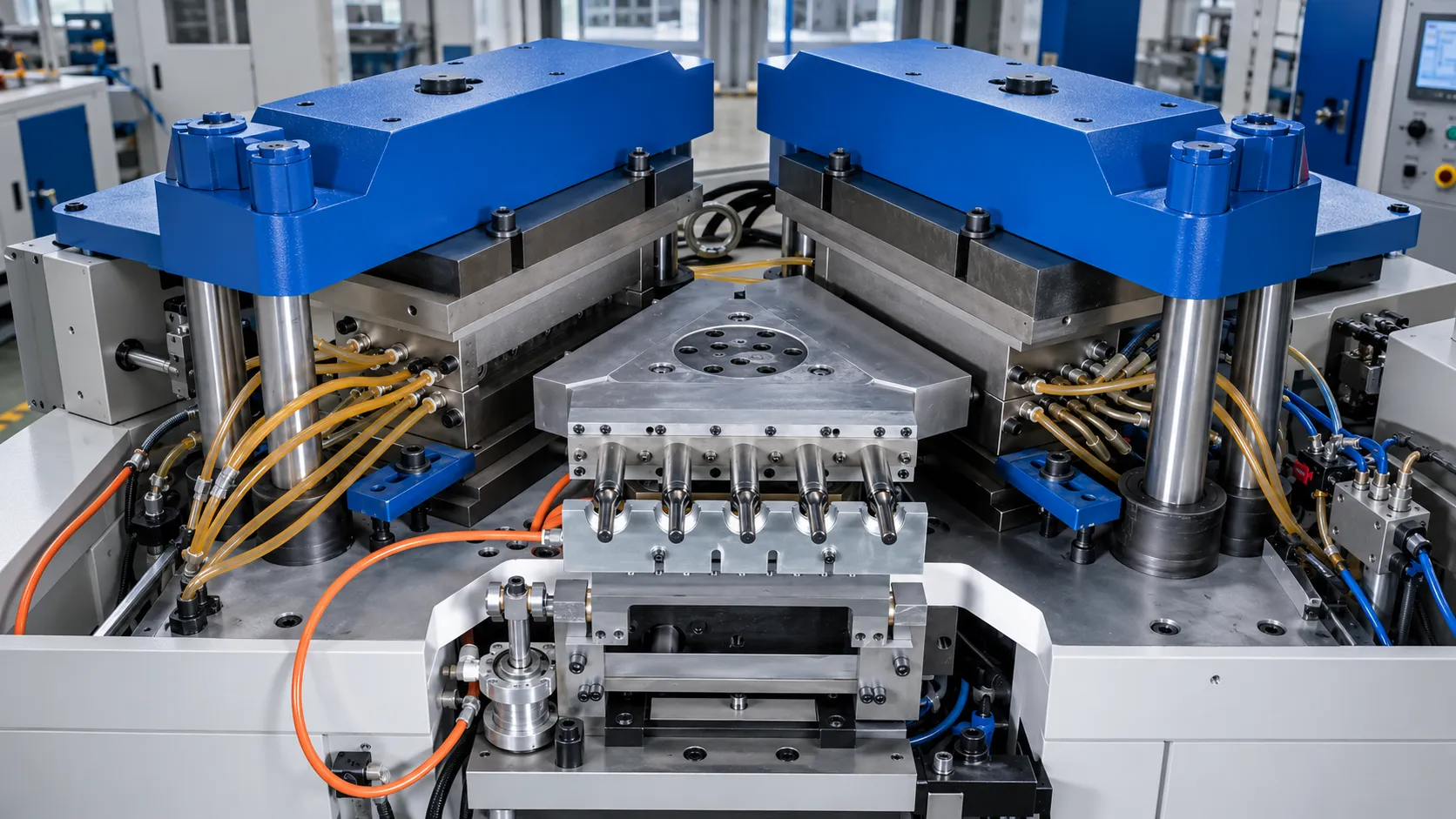
DAILY MAINTENANCE TASK MATRIX · 8 TASKS · EP-ZQ SERIES · START OF EACH SHIFT
D-01 — ROTARY TABLE INDEX CHECK
What: Verify rotary table home position sensor indicates correct index (green LED on HMI panel). Jog the table through one full index cycle and confirm station-to-station dwell time matches the production recipe ±0.2 s.
Failure it prevents: Rotary index misalignment → mandrel-to-blow-mould collision (Critical). Consequence if missed for 5 shifts: mandrel tip damage at KRW 3–8M replacement cost.
D-02 — HYDRAULIC PRESSURE
What: Read hydraulic system pressure from gauge at pump outlet: EP-ZQ40–ZQ80: 12–14 MPa; ZQ110–ZQ135: 14–16 MPa at steady state. Record in shift log. Deviation >±1.5 MPa from baseline: escalate to maintenance.
Failure it prevents: Hydraulic pressure loss → clamping force drop → injection flash, neck OD variation (Major). Early detection: pressure drop 0.5–1.0 MPa over 3 days → seal inspection before full failure.
D-03 — MOULD COOLING WATER TEMP
What: Read cooling water inlet temperature at mould cooling circuit inlet manifold. Compare against production recipe setpoint: PCTG: 15–22°C; PP: 20–40°C; HDPE: 15–25°C. Log inlet vs outlet delta T (target ≤5°C; >8°C indicates flow restriction).
Failure it prevents: Cooling circuit blockage → haze increase (PCTG) or dimensional instability (PP/HDPE). ƊT >8°C = scaling or partial blockage; schedule descaling within 5 days.
D-04 — BARREL TEMP PROFILE
What: Compare HMI barrel zone temperature display against prior-shift log for all 4–5 zones. Each zone setpoint achieved within ±3°C. Zone deviation >±5°C from setpoint for >10 min after warm-up: thermocouple or heater band issue.
Failure it prevents: Zone heater failure → cold spot → short shot or underfill (Major for PCTG at narrow 9°C process window). PCTG → log every shift and trend over 2 weeks.
D-05 — LUBRICATION PUMP CYCLE
What: Confirm automatic central lubrication pump is cycling (LED indicator on HMI: green flash every 8–12 min). Check lubricant reservoir level: refill if below 30% of capacity. Visually confirm lubricant lines are not kinked or cracked at the 4 visible distribution points.
Failure it prevents: Lubrication failure → rotary table bearing seizure or toggle mechanism wear (Critical). Bearing replacement: KRW 6–12M + 3–5 day downtime.
D-06 — BLOW AIR PRESSURE
What: Read blow air pressure at the blow station regulator: recipe setpoint typically 0.6–1.2 MPa for PP/PCTG at standard IBM bottle format. Confirm pressure is stable ±0.05 MPa during blow station dwell. Air line filter/dryer: drain condensate from auto-drain filter bowl.
Failure it prevents: Low blow pressure → short-blow → thick-bottom, thin-body bottle wall (Major). Condensate in blow air → water splash marks on PP bottle interior (cosmetic defect).
D-07 — CLAMPING FORCE DISPLAY
What: Read injection clamping force from HMI at first production cycle of the shift. Compare to baseline (100% of machine rated clamping force for the current mould format). Deviation >5% from baseline: check hydraulic circuit pressure (D-02) and toggle mechanism for wear (weekly task W-04).
Failure it prevents: Low clamping force → flash at injection cavity parting → neck OD oversize → CRC torque failure (Major for pharmaceutical primary packaging).
D-08 — SAFETY INTERLOCK TEST
What: Trigger each safety door interlock once at shift start in JOG mode to confirm: (a) machine halts on door open; (b) HMI alarm activates; (c) hydraulic pressure holds (no drift to zero on machine halt). Log PASS/FAIL in shift safety record. GMP facility requirement: safety log must be retained 24 months.
Failure it prevents: Interlock failure → operator injury risk during mould cleaning (Critical safety). GMP: interlock function is a PQ maintenance item for pharmaceutical IBM.
SECTION 02 · WEEKLY
Weekly Maintenance: 12 Tasks for the Monday Morning Planned Window (45–60 Minutes)
| TASK | ITEM / SYSTEM | ACTION AND ACCEPTANCE CRITERION | FAILURE PREVENTED | TIME (min) |
|---|---|---|---|---|
| W-01 | Injection cavity visual inspection | Open injection station, inspect all cavity surfaces with 10× loupe for scratches, corrosion pitting, or resin residue. Clean with brass brush + food-safe mould cleaner. For S136 SPI A1: inspect Ra with fingernail test; if scratches perceptible → schedule re-polish. | Mould surface degradation → haze increase (PCTG) / neck flash | 10 |
| W-02 | Mandrel (core rod) inspection | Inspect all mandrel tips for wear, nicks, or resin build-up with 10× loupe. Measure mandrel OD at neck zone with digital micrometer; acceptance: ±0.015 mm from nominal. Remove resin build-up with brass tool only (no steel tools on mandrel tip surface). | Mandrel wear → neck ID oversize → dropper tip loose fit; pump leak | 8 |
| W-03 | Toggle mechanism grease | Manually apply high-pressure lithium complex grease (NLGI 2, Fuchs Renolit LX-2 or equivalent) to toggle link pins ×4 per mould half (8 total). Verify grease reaches nipple and extrudes slightly from the opposite side. Wipe excess to prevent contamination of mould surface. | Toggle pin galling → clamping force loss → injection flash | 5 |
| W-04 | Toggle mechanism wear check | With machine in JOG and injection station open, manually check toggle link free play at each pin: acceptable ≤0.3 mm lateral play. >0.5 mm: bushing wear; schedule replacement at next monthly PM. >0.8 mm: immediate maintenance stop. | Toggle bushing wear → clamping force variation → batch-to-batch neck OD drift | 4 |
| W-05 | Screw and barrel purge check | Run 3 purge shots at end of final shift Friday (before weekend standby) to clear barrel of degraded resin. Inspect purge shot: uniform colour (no yellow/brown streaks = degradation), no silver streaks (= PCTG moisture), no black specks (= resin scorching from dead-spot in barrel). Document purge appearance in log. | Resin degradation in barrel dead-spot → black specks in bottles (pharmaceutical reject lot) | 5 |
| W-06 | Cooling water filter check | Inspect cooling water Y-strainer at mould cooling circuit inlet: remove basket, rinse under clean water, inspect for scale deposits. If scale visible: plan chemical descaling within 2 weeks. Replace strainer basket gasket if deformed or cracked. | Scale blockage → mould cooling failure → PCTG haze >2% / PP dimensional instability | 4 |
| W-07 | Blow mould parting surface clean | Open blow mould, wipe parting surfaces with lint-free cloth and food-safe mould cleaner. Inspect venting slots (typically 0.01–0.02 mm depth slots on blow cavity parting): confirm clear (blocked vents → blow burn marks on bottle exterior surface). Clean with copper wire brush if blocked. | Blocked blow vents → burn marks on bottle shoulder (cosmetic reject) or short-blow | 5 |
| W-08 | Rotary table bearing noise check | With machine running at production speed (not JOG), use contact stethoscope or vibration pen on rotary table bearing housing: baseline vibration level recorded at commissioning ±10%. Vibration increase >25% above baseline: bearing wear; schedule replacement before next monthly PM. | Rotary table bearing failure → index position error → mandrel-blow mould collision | 4 |
| W-09 | Hydraulic oil level and colour | Check hydraulic reservoir sight glass: oil level in upper half of sight glass range. Oil colour: amber/straw (acceptable) to dark amber (monitor for 2 weeks then sample and test viscosity). Black or cloudy oil: immediate oil change. Top up with specified grade: ISO VG 46 anti-wear hydraulic oil. | Hydraulic oil degradation → pump wear → pressure loss → clamping failure | 3 |
| W-10 | PCTG dryer dew point check | (PCTG operations only) Verify dehumidifying hopper dryer dew point sensor reading ≤−35°C (alarm threshold −30°C). Check molecular sieve desiccant rotor condition: if dew point cannot achieve −35°C even at low resin throughput, desiccant rotor regeneration cycle may be required or rotor replacement (typically 18–24 month life). | Dryer dew point failure → undried PCTG → silver streaks + haze >3% (product reject) | 3 |
| W-11 | Strip station ejection pin check | At strip station: inspect ejection fingers/pins for resin build-up, deformation or spring fatigue. Ejection fingers must clear the bottle neck OD without marking. Clean with brass brush. Spring tension: compress 10 mm manually; resistance should be uniform across all ejectors in the row. Replace any spring with >20% lower resistance than baseline. | Ejection pin failure → bottle jam at strip station → conveyor stoppage + bottle deformation | 4 |
| W-12 | Control cabinet air filter | Remove and clean control cabinet ventilation filter (sponge or paper): tap to remove dust, or replace if blocked. Blocked control cabinet filter → inverter/servo drive overtemperature → thermal shutdown during production. Korean facility ambient: filter interval is typically 7–10 days at Korean summer humidity (June–August). | Drive overtemperature → unplanned shutdown at peak production (Major, 2–4 hr downtime) | 3 |
Total weekly maintenance time: 58 min. Recommended execution: Monday morning before first production batch, by trained maintenance technician (not production operator for W-02, W-03, W-04, W-08). Log all W-tasks in the machine maintenance record book retained at the machine. Source: Korea Ever-Power EP-ZQ maintenance programme, Ansan-si, August 2026.
SECTION 03 · MONTHLY + ANNUAL
Monthly Maintenance (16 Tasks / 2–3 hr) and Annual Maintenance (11 Tasks / Full Shutdown)
Monthly Tasks — 16 Items · Planned 2–3 hr Window
Annual Shutdown Tasks — 11 Items · 8–16 hr Full Planned Shutdown
SECTION 04
Six Critical IBM Failure Modes: Detection Interval, Root Cause and Prevention
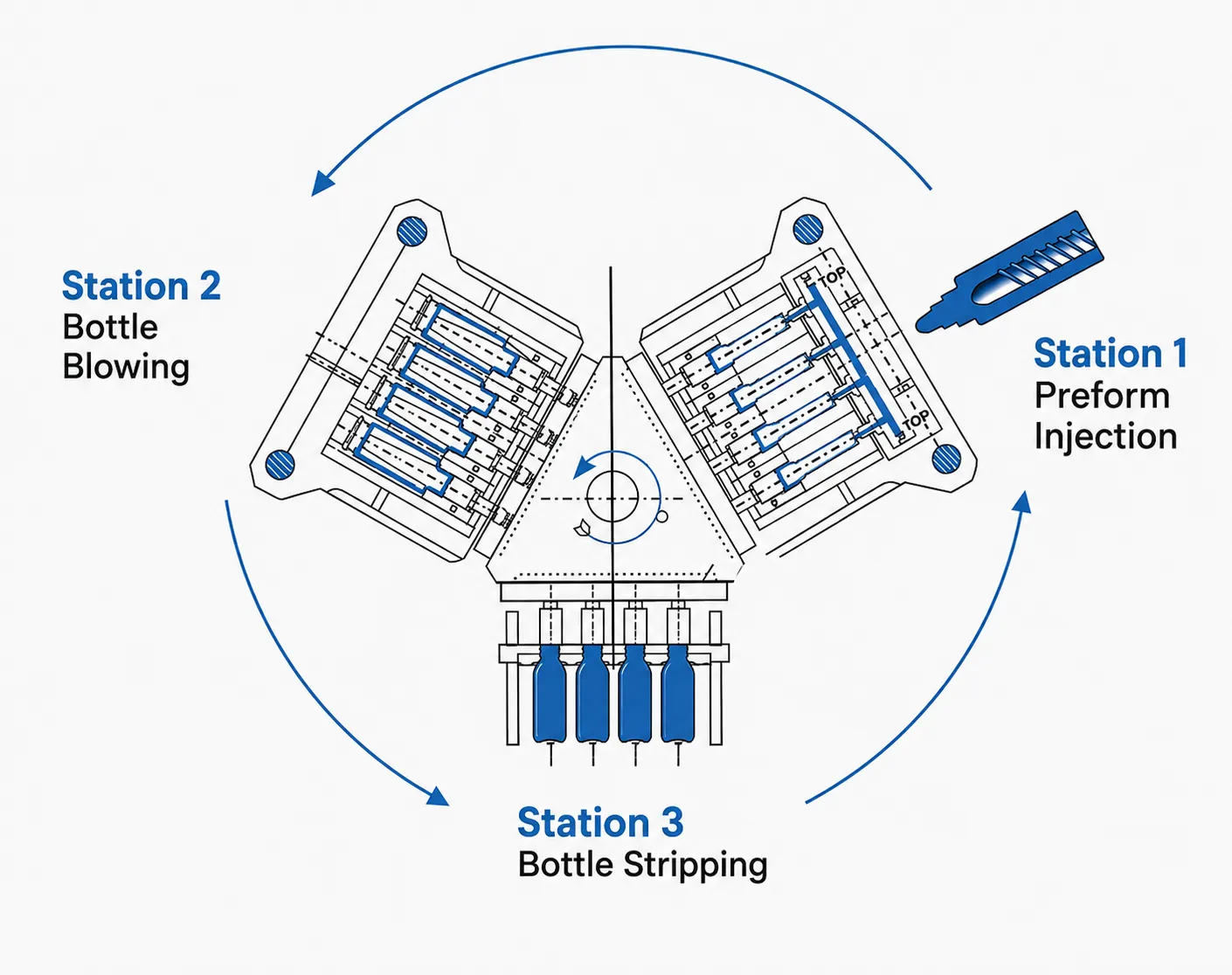
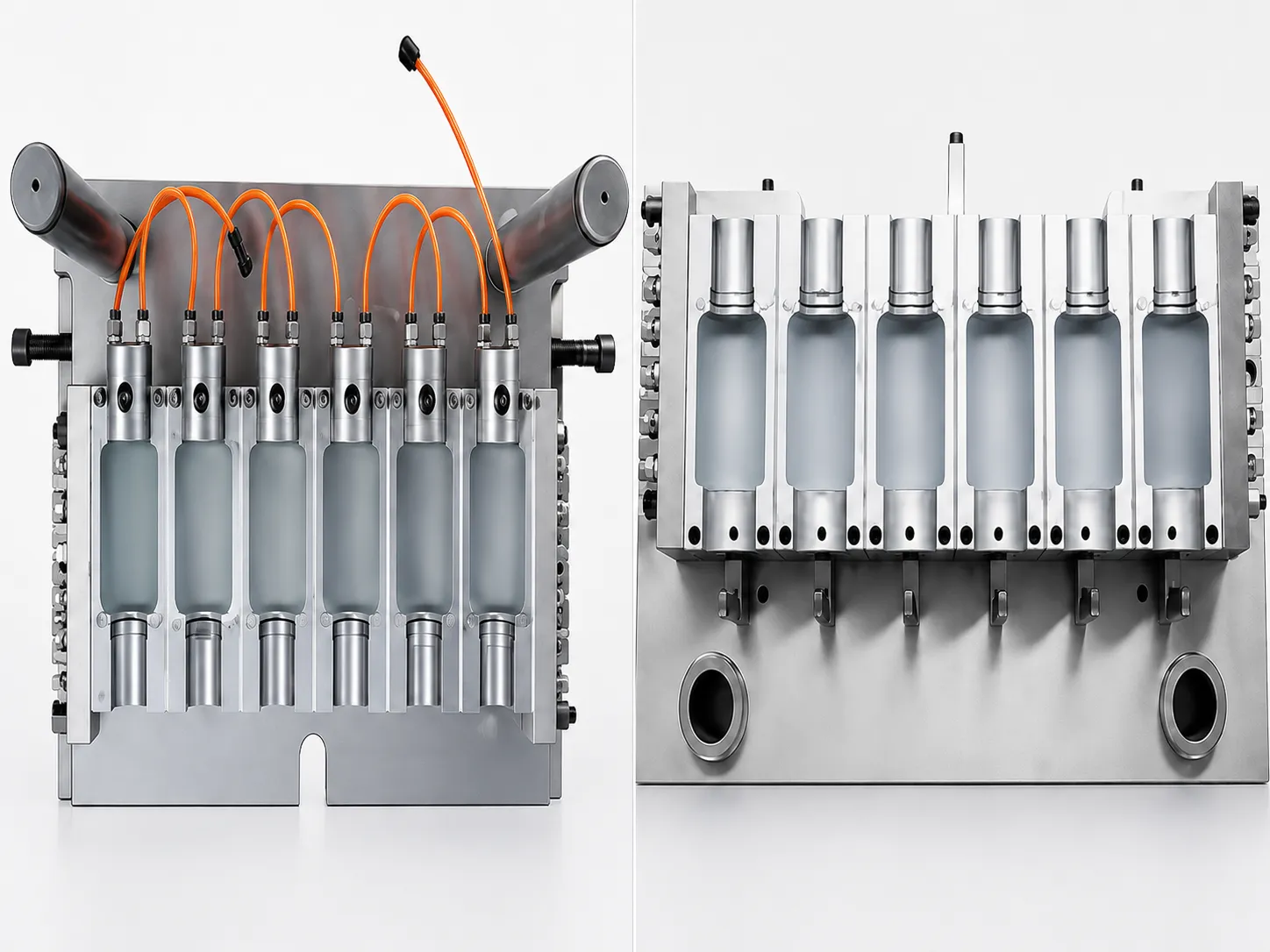
01
Rotary Table Indexing Error — CRITICAL — Mandrel/Blow Mould Collision Risk
02
Clamping Force Drift — MAJOR — Neck OD Flash and GMP Non-Conformance
03
Barrel Temperature Zone Failure — MAJOR — Resin Degradation and Short-Shot
04
Mould Cooling Circuit Blockage — MAJOR — PCTG Haze Increase or Dimensional Drift
05
Mandrel (Core Rod) Wear — MINOR to MAJOR — Neck ID Oversize and Closure Leak
06
Hydraulic Pressure Loss — MAJOR — Clamping Force Collapse and Machine Shutdown
SECTION 05
EP-ZQ Lubrication Map: Grease Points, Oil Circuits and Specification by Zone
| LUBRICATION POINT | Lubricant Type | Specification | Method | Interval | Quantity per Application |
|---|---|---|---|---|---|
| Hydraulic system (full circuit) | Hydraulic oil | ISO VG 46 anti-wear (Shell Tellus S2 M46 or equiv.) | Auto-circulating pump | Annual full change; level check weekly | ZQ135: ~120 L per change |
| Rotary table slewing ring | Lithium complex grease | NLGI 2, Fuchs Renolit LX-2 or equiv. (auto-lube) | Centralised auto-lube pump (4–6 cycles/hr) | Auto; reservoir check daily; refill monthly | 0.5–1.0 ml per cycle per nipple |
| Toggle link pins (injection clamping) | Lithium complex grease | NLGI 2, high EP (extreme pressure) rating ≥150 kg Timken OK Load | Manual grease gun at grease nipple (Zerk fitting) | Weekly (W-03) | 3–5 strokes per nipple until extrusion at far end |
| Injection unit screw drive gearbox | Gear oil | ISO VG 220 gear oil (Shell Omala S2 G220 or equiv.) | Level check at sight glass; drain plug change | Level check monthly; change every 2 years | ZQ135 gearbox: ~4 L per change |
| Tie-bar guide bushings (4 per machine) | Lithium grease | NLGI 2 general purpose (no EP requirement) | Auto-lube via centralised system | Auto (check auto-lube pump daily) | 0.3–0.5 ml per auto-lube cycle per bushing |
| Ejection mechanism cam followers | White food-grade grease | NSF H1 registered, NLGI 2 (Fuchs Cassida Grease RLS 2 or equiv.) | Manual application at monthly PM (M-task) | Monthly | Thin film; wipe excess immediately (near bottle area) |
| Conveyor belt chain drive | Chain oil | NSF H1 food-grade chain oil (Fuchs Cassida Chain Oil 100 or equiv.) | Drip oiler or auto-spray at drive sprocket | Auto-spray: check reservoir monthly; top up | 3–5 drops per sprocket per hour (auto-drip setting) |
Food-grade lubricants (NSF H1 registered) are mandatory for all lubrication points within potential food/pharmaceutical bottle contact zone (ejection mechanism, conveyor belt chain drive). Non-food-grade lubricants at these points constitute a GMP risk for pharmaceutical primary packaging. Source: Korea Ever-Power EP-ZQ maintenance programme and NSF International H1 lubricant registry, August 2026.
SECTION 06
Recommended Spare Parts Inventory and IBM Maintenance ROI Model
Tier 1 — On-Site Stock (Immediate Use)
Tier 1 total stock value: KRW 850,000–1,580,000 per machine. Allows same-day repair for the four highest-frequency failure modes without Korea Ever-Power parts delivery delay.
Tier 2 — 5-Day Delivery (Order on Detection)
Tier 2 order trigger: Order when maintenance check detects trending — do not wait for failure. Korea Ever-Power Ansan-si stocks Tier 2 parts for all current EP-ZQ models; expedited delivery 3–5 working days to Korean facilities. International delivery: 7–14 days.
IBM Maintenance ROI Model — EP-ZQ135 at 100ml PP Pharmaceutical (3-Shift, 330 Days)
PREVENTIVE MAINTENANCE COST
Parts (Tier 1 + Tier 2 annual): KRW 18–28M
Labour (420–480 hr/year × KRW 35,000/hr): KRW 14.7–16.8M
Korea Ever-Power annual service visit (1 day): KRW 2.5–4.0M
Total PM cost: KRW 35–49M/year
REACTIVE MAINTENANCE COST (NO PM)
Unplanned downtime: ~16.8 hr/month × 12 = 202 hr/year
Downtime cost: 202 hr × KRW 3.5M/hr = KRW 707M
Emergency parts premium (30–50% over list): +KRW 15–25M
GMP batch investigations (2–4/year): KRW 20–80M
Total reactive cost: KRW 742–812M/year
MAINTENANCE ROI
Net saving with PM programme: KRW 693–763M/year
ROI = (Saving − PM Cost) / PM Cost
ROI: 1,400–2,200%
Every KRW 1 spent on preventive maintenance saves KRW 14–22 in avoided downtime, emergency parts and GMP non-conformances at Korean pharmaceutical IBM production scale.

ENGINEERING FAQ
IBM Maintenance Engineering Questions
How does the IBM maintenance schedule change when running PCTG versus PP?
PCTG IBM requires six additional or intensified maintenance actions versus PP IBM: (1) D-04 (barrel temperature check) becomes mandatory at every shift start rather than recommended — PCTG’s 9°C process window means a single-shift temperature drift causes haze exceedance; (2) W-10 (PCTG dryer dew point check) is added to the weekly schedule — no equivalent for PP (PP is non-hygroscopic and requires no dryer); (3) D-03 (mould cooling water temperature) requires a tighter acceptance criterion: PCTG ≤22°C inlet versus PP ≤40°C; (4) W-01 (injection cavity inspection) uses 10× loupe to inspect for micro-pitting on S136 SPI A1 surface — PP runs H13 SPI B1 and surface pitting is not a quality issue; (5) monthly M-06 (cooling circuit descaling) is critical for PCTG (circuit temperature 15–22°C promotes faster scale and algae growth than PP circuit at 20–40°C); (6) Annual A-03 (SPI A1 mould re-polish) applies only to PCTG programmes and is not required for PP. PP-only IBM operations can omit items W-10, D-03 (at PP criterion), W-01 (loupe inspection), M-06 (descaling at PP interval: every 2 months acceptable) and A-03 entirely — reducing total annual maintenance hours by approximately 80–100 hours per machine.
What is the correct procedure for detecting and addressing rotary table bearing wear before it causes mandrel collision?
Rotary table bearing wear detection follows a 3-level monitoring protocol at Korea Ever-Power Ansan-si. Level 1 (daily, D-01): operator confirms index position LED is green at production start; any orange or flashing LED triggers an immediate maintenance call (Level 3). Level 2 (weekly, W-08): maintenance technician places vibration pen or contact stethoscope on the rotary table bearing housing during steady-state production and reads the vibration level in mm/s (ISO 10816-3 guidance: <2.8 mm/s RMS = good; 2.8–7.1 mm/s = acceptable with monitoring; >7.1 mm/s = urgent replacement). A 25% increase from the commissioning baseline at any weekly check triggers a plan for bearing replacement at the next available planned maintenance window (within 3 weeks maximum). Level 3 (monthly, M-07): servo drive torque log review identifies increasing peak torque at index completion — a direct proxy for bearing resistance increasing as balls degrade. If peak index torque increases >20% above commissioning log: immediate bearing replacement scheduled regardless of vibration level. The 3-level system provides 3–8 weeks of advance warning before a bearing failure would produce a mandrel collision. Korea Ever-Power service engineers performing annual visits (A-task) independently verify bearing condition and confirm or adjust the ongoing monitoring thresholds for each specific machine’s operating pattern.
What is the Korean GMP documentation requirement for IBM machine maintenance at pharmaceutical primary packaging facilities?
Korean MFDS GMP (KGMP, aligned with WHO GMP and PICS GMP PE 009-16) requires the following maintenance documentation for primary pharmaceutical packaging equipment including IBM machines: (1) Equipment qualification documents: IQ (Installation Qualification), OQ (Operational Qualification) and PQ (Performance Qualification) at installation and at annual re-qualification. OQ for IBM includes: barrel temperature uniformity across all zones (±3°C at setpoint), clamping force verification (±3% of rated), rotary table index repeatability (±0.015° at 100 cycles), safety interlock function; (2) Preventive maintenance SOP (Standard Operating Procedure): documented procedure for each maintenance task with frequency, acceptance criteria and responsible role; SOP must be signed by the site quality manager and reviewed annually; (3) Machine maintenance log: dated record of all maintenance activities (daily, weekly, monthly, annual) with technician signature and any out-of-spec findings and corrective actions; retained minimum 3 years (or product shelf life + 1 year if longer); (4) Calibration records: temperature controllers, pressure gauges, clamping force indicators — annual calibration with KTRM (Korea Research Institute of Standards and Science) traceable reference instruments; calibration certificates retained minimum 5 years; (5) Change control for maintenance modifications: any change to maintenance SOP frequency or task detail requires change control review and quality manager approval. Korea Ever-Power supplies a KGMP-ready maintenance documentation template for all EP-ZQ pharmaceutical IBM programmes at no additional cost.
How often should the injection screw and barrel be replaced on an EP-ZQ machine running pharmaceutical PP IBM?
Screw and barrel wear rate depends on resin abrasivity, filler content and operating temperature. For standard pharmaceutical PP IBM (unfilled, non-coloured PP HPP or RCP): screw flight wear rate ≈0.005–0.010 mm per 500,000 cycles; barrel bore wear ≈0.003–0.006 mm per 500,000 cycles. At 3-shift EP-ZQ135 production: 18 cavities × (3,600/5.5s) × 22.5h/shift × 3 shifts/day × 330 days = approximately 47.7 million cycles/year. Screw flight-to-barrel clearance at commissioning: 0.15–0.20 mm. At 47.7 million cycles/year, clearance growth to the 0.40 mm replacement threshold: approximately 5–8 years for unfilled pharmaceutical PP. Triggers for earlier replacement: if black specks appear in purge shots (W-05) or if screw back-pressure required to maintain process stability increases >20% from baseline (indicating reduced screw compression ratio from wear). For colour-compounded or glass-filled PP: wear rate 3–5× higher; replacement cycle 18–36 months. Barrel wear at the H13 steel barrel bore: barrel relining is more economical than full barrel replacement once bore wears beyond 0.25 mm clearance — Korea Ever-Power Ansan-si offers barrel relining service for all ZQ models.
What are the signs of toggle mechanism wear, and can it be corrected without machine shutdown?
Toggle mechanism wear in IBM manifests as: (a) progressive clamping force decline — the first quantifiable sign, visible on HMI display as steady decline over 4–8 weeks; (b) flash at injection cavity parting line (thin film on neck outer surface) indicating clamping force is no longer holding the injection mould halves fully closed against injection pressure; (c) audible metallic click or rattle at mould closure on the injection station — toggle pin backlash in worn bushings; (d) increased mould closure time per cycle (servo or hydraulic compensation for loose toggle geometry). The weekly W-04 pin play check (≤0.3 mm acceptable, >0.8 mm = stop) is the primary early detection method. Toggle bushing replacement is performed during the monthly 2–3 hr planned window (M-03): machine is stopped, injection station opened, toggle link pins removed, worn bushings replaced (standard interference-fit replacement; press required), reassembly and clamping force verification. Complete toggle bushing set replacement takes 1.5–2.5 hours by a trained Korea Ever-Power service technician. This is not a production-shift repair — it requires the machine to be stopped. However, it is not a full-shutdown repair either: it fits within the monthly PM window. Ignoring toggle wear until flash appears means the repair must be done immediately (unplanned downtime) rather than at the planned PM window, and any bottles produced with flash must be quarantined pending quality investigation — the reason proactive toggle monitoring is cost-justified at any production rate.
How does the EP-ZQ mould cooling circuit descaling differ between PCTG and PP IBM installations?
Descaling interval and protocol differ substantially between PCTG and PP cooling circuits because of the temperature difference. PCTG cooling circuit operates at 15–22°C — well below ambient Korean summer temperatures (28–35°C) — meaning the chilled water circuit is always below ambient and susceptible to two additional fouling mechanisms that PP circuits (20–40°C, near ambient) do not face: (1) Algae growth: photosynthetic algae thrive at 15–25°C in water with any light exposure at the chiller tank or circuit connections; PP circuits at 35–40°C are above the optimal algae growth range and rarely show algae fouling; PCTG circuits accumulate algae slime within 4–8 weeks in Korean summer without biocide treatment; (2) Biological slime formation: general microbial biofilm forms faster at chilled water temperatures. Korea Ever-Power protocol for PCTG IBM cooling circuits: monthly citric acid descaling (M-06 task); quarterly silver-based biocide treatment (Accepta 2719 or similar, 30 ppm silver in circuit for 2 hours, rinse); annual full circuit drain, physical cleaning of manifold internal surfaces with copper brush, refill with fresh conditioned water plus biocide inhibitor (Accepta 2712 or similar at manufacturer dose). For PP circuits (20–40°C): citric acid descaling every 2–3 months (not monthly); no biocide required. The PCTG circuit’s additional fouling risk is also why Korea Ever-Power recommends installing an in-line UV steriliser on the chilled water supply line to PCTG IBM installations in Korean summer conditions — KRW 150,000–300,000 per unit, eliminating biocide dosing labour and preventing the most common PCTG haze exceedance cause at Korean K-beauty IBM facilities.
Can the EP-ZQ maintenance programme be adapted for remote monitoring without an on-site maintenance technician?
Korea Ever-Power offers a remote monitoring package for EP-ZQ machines that digitises 14 of the 47 maintenance tasks, converting manual checks into continuously logged sensor data accessible via Korea Ever-Power’s cloud-based machine monitoring portal. Sensors included in the standard remote monitoring kit: (a) hydraulic system pressure transducer (continuous; replaces manual D-02 gauge reading; alarm at ±1.0 MPa deviation); (b) mould cooling water inlet temperature sensor (continuous; replaces D-03 manual thermometer; alarm at PCTG >22°C / PP >40°C); (c) barrel zone temperature monitoring (all zones continuous; replaces D-04 HMI log; alarm at ±5°C deviation); (d) rotary table servo drive torque and index cycle time logging (replaces weekly W-08 stethoscope check and monthly M-07 log download; alarm at >15% increase in peak torque or >0.3 s index time increase); (e) hydraulic oil temperature (replacing indirect oil condition assessment — oil temperature drift indicates pump wear or cooling circuit issue). Tasks that still require on-site attendance: all lubrication tasks (W-03, W-07, M-03); all visual inspection tasks (W-01, W-02, W-07, W-11); all physical component replacement tasks. The remote monitoring system reduces the required on-site maintenance hours from 420–480 hr/year to approximately 300–360 hr/year per machine — a meaningful labour saving for Korean pharmaceutical CMO facilities running 8–12 EP-ZQ machines simultaneously. Remote monitoring kit installation and first-year monitoring subscription: KRW 3.5–6.0M per machine.
Where can I obtain the EP-ZQ machine maintenance manual and access Korea Ever-Power service support?
The Korea Ever-Power EP-ZQ maintenance manual is supplied with each machine at installation and includes the complete lubrication point map, task schedule, spare parts list with Korea Ever-Power part numbers, and KGMP-ready maintenance SOP template. For annual service visits, remote monitoring installation, spare parts orders or maintenance troubleshooting support: contact Korea Ever-Power Ansan-si via the Korea Ever-Power contact page. Korea Ever-Power service engineers are available for on-site visits at Korean facilities within 24–48 hours (emergency); 5–10 working days (scheduled). For EP-ZQ machine specifications and the IBM machine replacement comparison guide (EP-ZQ vs Jomar IBM, SUMA iB, Uniloy UIB, Bloma IBM): see the EP-ZQ series page and the IBM machine replacement guide.
IBM MACHINE MAINTENANCE · KOREA EVER-POWER
Implement Your EP-ZQ Preventive Maintenance Programme
Korea Ever-Power provides KGMP-ready maintenance SOPs, annual service visits, remote monitoring installation and spare parts supply for all EP-ZQ models at Korean and international pharmaceutical, cosmetic and daily chemical IBM facilities.
Editor: Cxm