
IBM CAVITY COUNT · ENGINEERING FORMULA · PLATEN WIDTH SHOT WEIGHT CLAMPING · KOREA EVER-POWER ZQ
How to Calculate
Onteloiden määrä for an
Injection Blow Molding Machine:
The Engineer’s Formula
IBM cavity count is determined by three independent physical constraints: platen width (mandrel pitch), maximum injection weight (shot weight limit), and injection clamping force (per-cavity lock-up requirement). The correct cavity count is the minimum value produced by all three constraints. This guide provides the complete formula, five worked examples from 10 ml to 1,000 ml, the full EP-ZQ series cavity count table, and the five most costly calculation errors in pharmaceutical IBM procurement.
10ml → 1,000ml · ZQ40–ZQ135 Worked Examples
KOREA IKUISESTI VALTA · ANSAN-SI, GYEONGGI-DO · ELOKUU 2026 · VIIMEISIN PÄIVITETTY: ELOKUU 2026
IBM CAVITY COUNT · KEY FORMULA REFERENCE · AUGUST 2026
PLATEN CONSTRAINT
n₁ = ⌊W₀ ÷ p⌋
W₀ = effective platen width (mm). p = mandrel centre-to-centre pitch (mm) = neck OD + 12–18 mm clearance gap. Most commonly the binding constraint for small bottles (10–60 ml) on lower-tonnage machines.
SHOT WEIGHT CONSTRAINT
n₂ = ⌊S₀ ÷ w₁⌋
S₀ = machine max injection weight (g). w₁ = single-cavity preform weight (g). Most commonly the binding constraint for large bottles (250–1,000 ml) where preform weight is high relative to machine shot capacity.
CLAMPING CONSTRAINT
n₃ = ⌊F₀ ÷ f₁⌋
F₀ = machine injection clamping force (kN). f₁ = clamping force required per cavity (kN) = function of cavity projected area and injection pressure. Rarely the binding constraint at standard pharmaceutical IBM parameters; becomes binding at very high injection speed or thick-wall PP.
FINAL CAVITY COUNT
n = min(n₁, n₂, n₃)
The cavity count is the minimum of all three constraints. Ignoring any one constraint produces an invalid cavity count. The most common procurement error is calculating only n₁ (platen constraint) and ignoring n₂ (shot weight) for large-format bottles — resulting in tooling orders that cannot run at the specified cavity count.
OSA 01
The Three Physical Constraints That Determine IBM Cavity Count
IBM cavity count is not a single calculation — it is the minimum of three independent physical constraints, each derived from a different machine parameter. Procurement teams and mould designers who calculate only one constraint (typically platen width) and ignore the other two produce cavity count specifications that are either physically impossible (injection weight exceeded) or dimensionally non-compliant (neck OD out of tolerance from under-clamped injection). This section explains the physics of each constraint before the formula is applied.
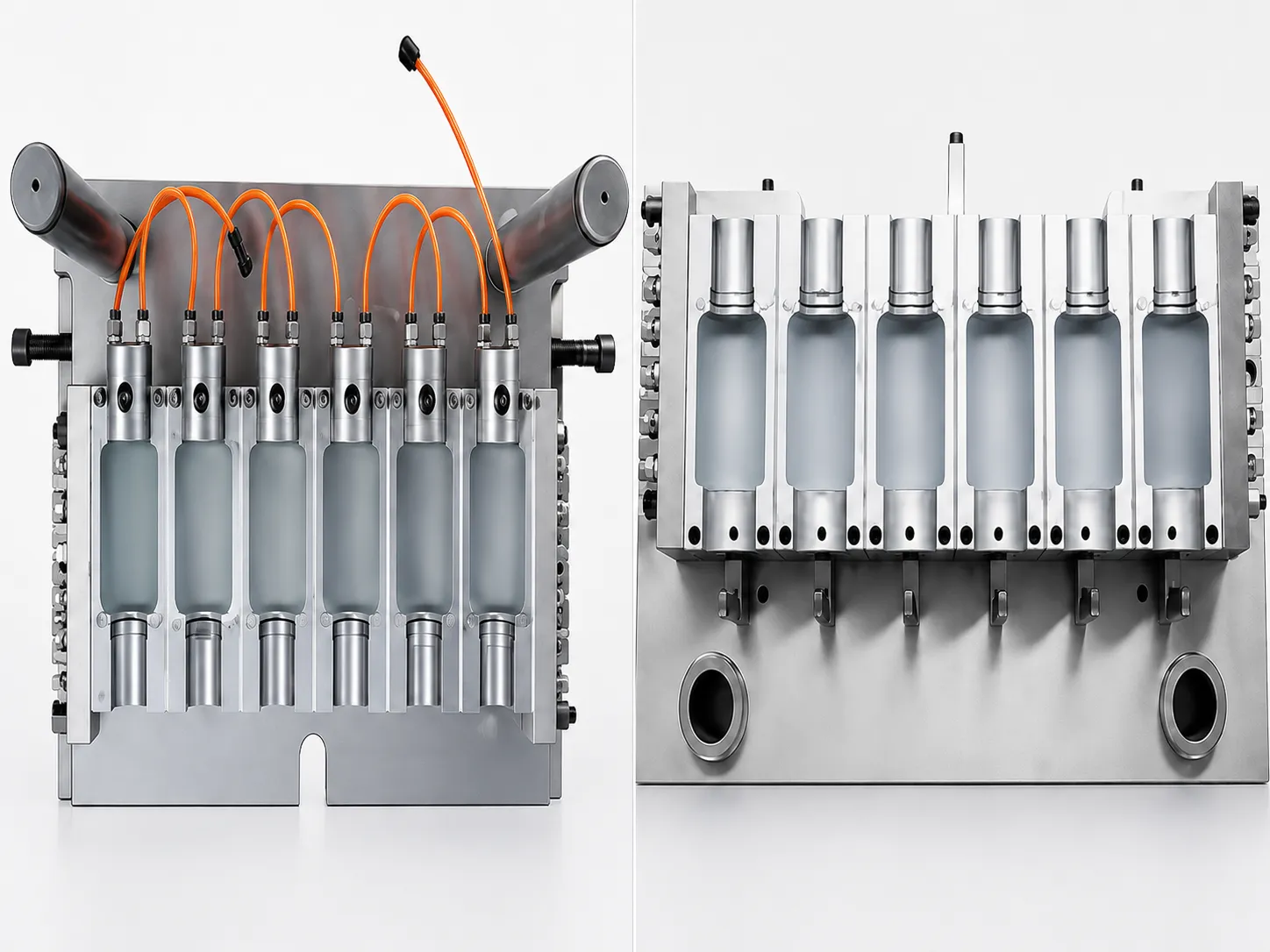
CONSTRAINT 1: PLATEN WIDTH
n₁ = ⌊W₀ / p⌋
CONSTRAINT 2: SHOT WEIGHT
n₂ = ⌊S₀ / w₁⌋
CONSTRAINT 3: CLAMPING FORCE
n₃ = ⌊F₀ / f₁⌋
OSA 02
Step-by-Step Cavity Count Calculation Method
Follow these five steps in order for every IBM cavity count calculation. Steps 1–3 calculate each constraint independently. Step 4 identifies the binding constraint. Step 5 verifies the result against the Korea Ever-Power EP-ZQ machine specification data.
Determine mandrel pitch (p) from neck OD specification
p (mm) = Neck OD (mm) + centre-to-centre clearance gap (12–18 mm). Use 12 mm for standard pharmaceutical IBM mandrels (tight spacing, precision-aligned mandrel array); use 15–16 mm for standard cosmetic and daily chemical IBM; use 18 mm for large mandrel diameters (above 40 mm neck OD) where the mandrel body wall requires wider spacing. Confirmation: Korea Ever-Power Ansan-si mould engineering confirms pitch per bottle 3D model at quotation stage. Esimerkki: 28 mm neck OD, 15 mm gap → p = 43 mm. 22 mm neck OD (10 ml dropper), 16 mm gap → p = 38 mm.
Calculate n₁ (platen width constraint)
n₁ = ⌊W₀ / p⌋ where W₀ = total platen width − 2 × edge margin (35 mm each side standard). Example for ZQ135 at 10 ml dropper (p = 38 mm): W₀ = 1,300 − 70 = 1,230 mm. n₁ = ⌊1,230 / 38⌋ = ⌊32.4⌋ = 32. Korea Ever-Power ZQ135 confirms 30 cavities at 10 ml (edge margin is slightly larger at 40–45 mm per side at full 1,300 mm platen): 1,300 − 90 = 1,210 mm; ⌊1,210/38⌋ = 31.8 → 30 after mould frame structure allowance. The confirmed ZQ135 cavity count of 30 at 10 ml includes the actual mould frame structural allowance; the formula gives the upper estimate and the Korea Ever-Power specification confirms the actual achievable count.
Calculate n₂ (shot weight constraint)
n₂ = ⌊S₀ / w₁⌋ where S₀ = machine maximum injection weight (g) and w₁ = preform weight per cavity (g). Preform weight estimation: w₁ ≈ finished bottle weight × 1.05–1.08 (sprue weight typically 5–8% of shot). Finished bottle weight = material density (g/cm³) × wall volume (cm³). Simpler method: use the target bottle wall weight directly (most pharmaceutical bottle specs include finished bottle weight; add 5% for sprue). Example for ZQ135 at 100 ml pharmaceutical PP bottle: Finished bottle weight 33 g → preform weight w₁ = 33 × 1.06 = 35 g. S₀ = 650 g. n₂ = ⌊650 / 35⌋ = ⌊18.6⌋ = 18. Korea Ever-Power ZQ135 specification confirms 18 cavities at 100 ml. ✓
Calculate n₃ (clamping force constraint) and find minimum
n₃ = ⌊F₀ / f₁⌋ where f₁ = injection pressure (MPa) × cavity neck projected area (mm²) / 1,000. For 28 mm neck OD: projected area = π/4 × 28² = 616 mm². At 100 MPa injection pressure: f₁ = 100 × 616 / 1,000 = 61.6 kN per cavity. For ZQ135 (F₀ = 1,350 kN): n₃ = ⌊1,350 / 61.6⌋ = ⌊21.9⌋ = 21. Final cavity count n = min(n₁, n₂, n₃) = min(platen result, 18, 21) = 18 (shot weight is binding for 100 ml ZQ135). If platen gives 20 and shot weight gives 18 and clamping gives 21: n = 18 — the shot weight constraint determines the cavity count for this format.
Verify against Korea Ever-Power EP-ZQ specification data
Cross-check the calculated cavity count n against the Korea Ever-Power ZQ-series confirmed cavity count table (Section 04 below). Korea Ever-Power’s confirmed cavity counts incorporate actual mould frame allowances and platen edge margins from production tooling at Ansan-si — they are more accurate than the formula estimate for standard pharmaceutical and cosmetic IBM formats. If the calculated n exceeds the Korea Ever-Power confirmed count by more than 2 cavities, re-examine the edge margin allowance (W₀) and preform weight estimate (w₁). If the formula gives a lower count than the Korea Ever-Power specification, verify that the bottle weight used in the calculation matches the actual target bottle weight specification.
OSA 03
Five Worked Examples: 10 ml to 1,000 ml with Binding Constraint Identified
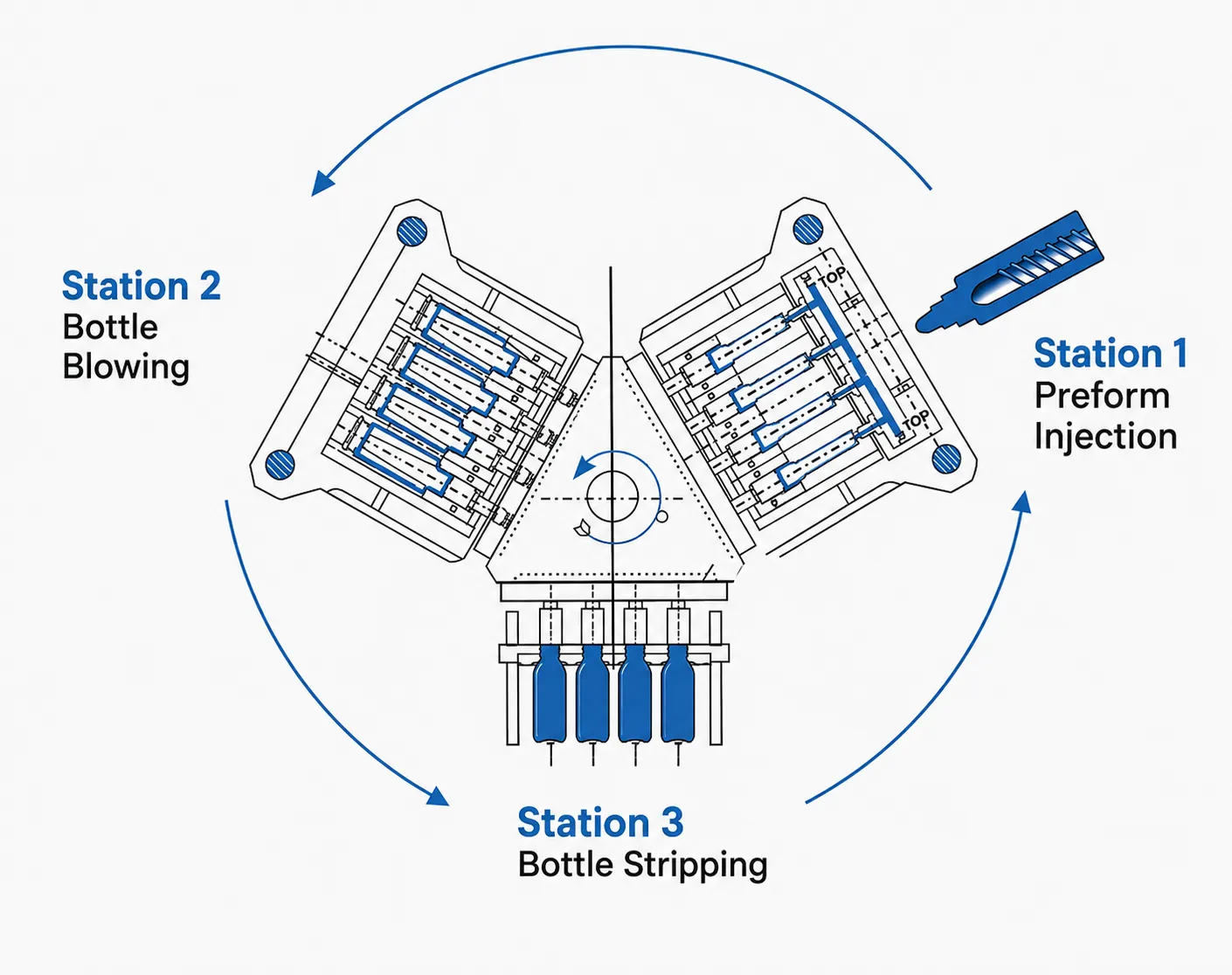
FIVE WORKED EXAMPLES · IBM CAVITY COUNT CALCULATION · EP-ZQ SERIES
| MUOTO | Neck OD / Pitch | Preform Wt (g) | ZQ-malli | n₁ Platen | n₂ Shot Wt | n₃ Clamp | Binding | Final n |
|---|---|---|---|---|---|---|---|---|
| 10 ml PCTG dropper (K-beauty) | 22mm OD / 38mm | 4.5 g | ZQ135 | ⌊1,210/38⌋=31 | ⌊650/4.5⌋=144 | ⌊1350/38⌋=35 | PLATEN | 30* |
| 30 ml PP oral liquid syrup | 24mm OD / 40mm | 8 g | ZQ110 | ⌊1,030/40⌋=25 | ⌊540/8⌋=67 | ⌊1100/45⌋=24 | CLAMP/PLATEN | 22† |
| 100 ml PP oral solid tablet | 28mm OD / 43mm | 35 g | ZQ135 | ⌊1,210/43⌋=28 | ⌊650/35⌋=18 | ⌊1350/62⌋=21 | SHOT WT | 18 |
| 500 ml PP shampoo (daily chem.) | 28mm OD / 43mm | 60 g | ZQ135 | ⌊1,210/43⌋=28 | ⌊650/60⌋=10 | ⌊1350/62⌋=21 | SHOT WT | 10 |
| 1,000 ml PP sports hydration | 38mm OD / 56mm | 80 g | ZQ135 | ⌊1,210/56⌋=21 | ⌊650/80⌋=8 | ⌊1350/84⌋=16 | SHOT WT | 8 |
* ZQ135 at 10ml: platen formula gives 31; Korea Ever-Power confirmed specification is 30 — 1 fewer due to actual mould frame structural allowance at full platen width. † ZQ110 at 30ml: Korea Ever-Power confirmed specification is 22 (consistent with both platen and clamping at this format). f₁ values: 10ml neck 22mm projected area 380mm² × 100MPa/1000 = 38kN; 30ml neck 24mm = 45kN; 100/500ml neck 28mm = 62kN; 1000ml neck 38mm = 113mm² × 100MPa ÷ 1000 = 113 kN → wait: f₁ = 100 × π/4 × 38² /1000 = 100 × 1134/1000 = 113 kN; n₃ = ⌊1350/113⌋ = 11; shot weight binds first at 8. Source: Korea Ever-Power EP-ZQ specification data, Ansan-si, August 2026.
OSA 04
EP-ZQ Full Series Cavity Count Reference Table — Korea Ever-Power Confirmed Data
All cavity counts below are confirmed from Korea Ever-Power ZQ-series product specification data (Ansan-si, August 2026). These values incorporate actual mould frame structural allowances, mandrel pitch spacing from production tooling, and are verified against shot weight and clamping constraints for each format. Use these values directly for production planning; use the formula in Section 02 for non-standard formats not listed below.
| PULLON TILAVUUS | ZQ40 400kN / 190–260g |
ZQ60 600kN / 260–383g |
ZQ80 800kN / 466g |
ZQ110 1,100kN / 540g |
ZQ135 1,350kN / 650g |
|---|---|---|---|---|---|
| 10 ml | 9 | 14 | 20 | 24 | 30 |
| 30 ml | 8 | 12 | 18 | 22 | 26 |
| 60 ml | 6 | 10 | 14 | 18 | 22 |
| 100 ml | 4 | 8 | 12 | 14 | 18 |
| 250 ml | 3 | 5 | 8 | 10 | 14 |
| 500 ml | 2 | 3 | 5–6 | 8 | 10 |
| 1 000 ml | 1 | 2 | 3–4 | 6 | 8 |
Source: Korea Ever-Power ZQ-series product specification data, Ansan-si, August 2026. Values are maximum achievable cavity counts at standard pharmaceutical PP/HDPE bottle preform weights. Cavity count for non-standard bottle weights (heavier wall, special geometry) must be calculated using the formula in Section 02. ZQ80 500ml and 1000ml shown as a range reflecting bottle wall weight variation (5–6 cavities at 500ml and 3–4 cavities at 1000ml depend on specific bottle weight between 65–80g).
OSA 05
Five Costly Cavity Count Calculation Errors in Pharmaceutical IBM Procurement
Calculating only the platen constraint and ordering tooling for a shot-weight-impossible cavity count
The most common and costly error. Example: 500 ml PP shampoo bottle on ZQ135. Platen calculation: ⌊1,210/43⌋ = 28 cavities. Shot weight calculation: ⌊650/60⌋ = 10 cavities. A procurement team that orders a 14-cavity mould for 500 ml bottles on ZQ135 receives a mould that requires 14 × 60 g = 840 g total shot — 29% above ZQ135’s 650 g maximum. The mould cannot run at 14 cavities on ZQ135. Retrofit cost: either reduce the mould to 10 active cavities (wasting 4 cavity positions), or upgrade to a larger machine (not available in ZQ series for this format). Prevention: always calculate n₂ before ordering tooling for bottles above 100 ml.
Using finished bottle weight instead of preform weight in the shot weight constraint
Preform weight is finished bottle weight plus sprue weight (5–8% of shot for standard pharmaceutical IBM gates). Example: 100 ml PP tablet bottle finished weight 33 g. Using 33 g directly: n₂ = ⌊650/33⌋ = 19 cavities. Correct preform weight 35 g (33 × 1.06): n₂ = ⌊650/35⌋ = 18 cavities. The error produces one extra cavity that exceeds shot weight when the sprue is included — causing short-shot at cavity 19 at commercial production speed. Korea Ever-Power confirms that n₂ = 18 at 100 ml on ZQ135 is the correct value including sprue allowance.
Assuming cavity count scales linearly with platen size across machine models
ZQ110 platen is 1,100 mm (1.0× ZQ135’s 1,300 mm × 0.85). But ZQ110 shot weight is 540 g versus ZQ135’s 650 g (0.83×). At 100 ml PP pharmaceutical (35 g preform): ZQ110 n₂ = ⌊540/35⌋ = 15; ZQ135 n₂ = 18 (1.2× more). At 10 ml PCTG dropper (4.5 g preform): ZQ110 n₁ = ⌊1,030/38⌋ = 27; ZQ135 n₁ = ⌊1,210/38⌋ = 31 (1.15× more — but actual is 24 vs 30). Cavity count does not scale linearly across models because both platen and shot weight constraints are active simultaneously — whichever grows more slowly between models becomes the binding constraint and limits the cavity count gain.
Specifying dual-row mandrel layout to circumvent the platen width constraint
Some procurement teams, having calculated n₁ from the platen width, propose dual-row mandrel layouts (two rows of mandrels on the platen, offset, to double cavity count from the same platen width). Dual-row IBM mandrel tooling is not standard practice and has significant limitations: (a) the 3-station rotary index mechanism is designed for a single row of mandrels — dual-row requires a non-standard rotary table that increases mandrel indexing inertia and angular positioning error; (b) dual-row mould tooling cost is 2.5–3.5× standard single-row tooling; (c) cavity-to-cavity temperature uniformity across two rows is significantly more difficult to achieve, increasing wall thickness variation and haze variation for PCTG. Korea Ever-Power does not recommend dual-row mandrel IBM for standard pharmaceutical or cosmetic programmes. Select a larger ZQ model if platen width limits single-row cavity count for the application.
Selecting machine model based on cavity count alone without checking machine height for the facility
ZQ135 at 18 cavities / 100 ml is the highest-output pharmaceutical IBM machine on the market — but it is 2.4 m tall and requires a minimum 3.0 m ceiling clearance (plus 0.5 m service overhead = 3.5 m total for preferred access). Pharmaceutical procurement teams selecting ZQ135 for a Korean GMP cleanroom with 2.7 m ceiling find that ZQ135 (2.4 m) leaves only 0.3 m overhead — below the 0.5 m minimum service standard. The correct alternative is ZQ110 (2.2 m, 14 cavities at 100 ml, fits 2.7 m ceiling with 0.5 m overhead exactly). Cavity count optimisation must always be evaluated alongside machine height for the target facility. The full machine height vs ceiling height compatibility matrix is in the EP-ZQ-sarja product pages.
OSA 06
Cavity Count vs Annual Output: Production Planning Model
Once cavity count n is established, annual output is calculated from cycle time, operating hours and mechanical efficiency. This model converts IBM cavity count into annual production volume for procurement justification and facility planning.
ANNUAL OUTPUT FORMULA · IBM PRODUCTION PLANNING MODEL
where:
n = cavity count (bottles per cycle)
t₃ = total cycle time (seconds) = dry cycle time + cooling extension (typically: 3.5s dry + 1.5–3.5s cooling = 5–7s total at 100ml format)
H₀ = annual operating hours = shifts/day × hours/shift × production days/year
η = mechanical efficiency factor (0.88–0.93 for IBM at 3-shift pharmaceutical production)
| MUOTO | ZQ-malli | Cavities (n) | Cycle (s) | Bottles/hr | Bottles/day (3 shifts) | Annual (330 days) |
|---|---|---|---|---|---|---|
| 10ml PCTG dropper | ZQ135 | 30 | 5.0 s | ~19,700 | ~1,300,000 | ~428M |
| 100ml PP oral solid | ZQ135 | 18 | 5.5 s | ~10,800 | ~714,000 | ~193M |
| 100ml PP oral solid | ZQ110 | 14 | 5.5 s | ~8,400 | ~556,000 | ~150M |
| 500ml PP shampoo | ZQ135 | 10 | 6.5 s | ~5,100 | ~337,000 | ~91M |
| 1,000ml PP sports | ZQ135 | 8 | 7.5 s | ~3,500 | ~231,000 | ~63M |
Annual output = n × (3,600/t₃) × 22.5h/shift × 3 shifts/day × 330 days/year × 0.90 efficiency. Source: Korea Ever-Power ZQ-series specification and production data, Ansan-si, August 2026.
TEKNIIKAN UKK
Onteloiden laskennan suunnitteluun liittyviä kysymyksiä
Why does Korea Ever-Power confirm 30 cavities at 10ml on ZQ135 when the formula gives 31–32?
The formula n₁ = ⌊W₀/p⌋ gives an upper estimate based on a geometric calculation of mandrel positions within the effective platen width. The formula uses W₀ = total platen width − estimated edge margin (typically assumed 70 mm total = 35 mm per side). The Korea Ever-Power confirmed cavity count of 30 at 10 ml for ZQ135 incorporates the actual mould frame structural allowance, which for the 1,300 mm platen at full-width 30-cavity mandrel array requires slightly more edge margin than the formula assumes — approximately 45 mm per side (90 mm total), giving effective W₀ = 1,300 − 90 = 1,210 mm, and n₁ = ⌊1,210/38⌋ = 31.8, which rounds down to 30 after the actual mould frame structure allowance within the 1,210 mm effective width. The Korea Ever-Power specification is the authoritative reference; the formula gives the upper theoretical estimate. Use the formula for non-standard formats; use the Korea Ever-Power specification table for standard formats.
How is mandrel pitch determined for a non-standard bottle with a neck OD between standard pharmaceutical sizes?
Mandrel pitch p = neck OD + centre-to-centre clearance gap. The clearance gap is determined by the mandrel body diameter at the injection station — the mandrel body (between the neck area and the base) has a slightly larger diameter than the neck OD to provide core support during injection. The clearance gap must accommodate: (a) the injection cavity wall thickness between adjacent mandrel positions (minimum steel wall approximately 6–8 mm each side for adequate structural rigidity); (b) the mandrel body diameter excess over neck OD (typically 1–3 mm on each side). Total minimum clearance = 2 × (6 mm cavity wall + 2 mm mandrel body excess) = 16 mm. For standard pharmaceutical 20–38 mm neck OD, Korea Ever-Power Ansan-si mould engineering uses 14–18 mm pitch clearance. For a non-standard neck OD (e.g. 25 mm for a specific Korean cosmetic pump dispenser): contact Korea Ever-Power with the bottle 3D model; the Ansan-si mould engineering team confirms the mandrel pitch and therefore the cavity count within 5 working days at no cost.
Does running fewer cavities than the machine maximum improve bottle quality?
Running fewer cavities than the machine maximum improves some quality parameters at the cost of output efficiency. Positive effects of reduced cavity count on the same machine: (a) reduced total injection weight per cycle — shot fill at 70–80% of machine maximum rather than 95–100% provides more consistent fill pressure across cavities, potentially improving weight uniformity by 1–2%; (b) lower injection pressure requirement — reduces per-cavity clamping load, potentially improving neck OD Cpk by 0.05–0.10 Cpk units at low-cavity count; (c) more thermal headroom in the barrel — screw recovers faster per cycle, reducing barrel heat build-up variation at reduced cavity count. Negative effects: direct reduction in output per hour proportional to cavity count reduction. In practice, Korea Ever-Power recommends running the full confirmed cavity count with validated process parameters rather than reducing cavity count for quality. Quality issues at full cavity count indicate a process parameter problem (mould temperature, injection speed, resin moisture) rather than a cavity count problem. Reduce cavity count only as a temporary measure during process troubleshooting, not as a permanent quality strategy.
Can I run a lower-cavity mould on a larger ZQ machine to increase output per cycle?
Yes, within the machine’s mechanical compatibility range. A 14-cavity mould designed for ZQ110 can typically be installed and run on ZQ135 if: (a) the mould bolt-hole pattern matches ZQ135 platen (Korea Ever-Power designs moulds with standardised bolt patterns across ZQ110 and ZQ135 for this reason); (b) the mould thickness is within ZQ135 daylight range; (c) the injection cavity mandrel pitch is compatible with ZQ135 rotary table index geometry. Running a 14-cavity ZQ110 mould on ZQ135 does not increase cavity count — it still runs 14 cavities. The advantage is access to ZQ135’s higher shot weight capacity (useful if the 14-cavity mould runs a heavier bottle than ZQ110 can handle) and ZQ135’s greater clamping force. It does not add cavities. To increase output per cycle, a new mould designed to the maximum cavity count for the target machine must be commissioned. Korea Ever-Power confirms mould interchangeability between ZQ models at quotation stage.
Why does the ZQ80 show a range (5–6 cavities at 500ml; 3–4 at 1000ml) rather than a fixed number?
The ZQ80 ranges at 500 ml and 1,000 ml reflect the shot weight constraint’s sensitivity to bottle wall weight at these large formats. ZQ80 maximum shot weight is 466 g. At 500 ml: a lightweight PP shampoo bottle at 55 g preform gives n₂ = ⌊466/55⌋ = 8 — but wait, also check platen: 800mm platen at 500ml format with 33mm OD and 50mm pitch: n₁ = ⌊730/50⌋ = 14. Shot weight binds at 8. However, a heavier 500ml pharmaceutical HDPE bottle at 70 g preform: n₂ = ⌊466/70⌋ = 6. A lighter 500 ml daily chemical bottle at 80 g preform (thick wall): n₂ = ⌊466/80⌋ = 5. Hence the range 5–6 reflects the range of preform weights for 500 ml bottles that are within ZQ80’s realistic application scope. ZQ135 at 500 ml is confirmed at 10 cavities (Korea Ever-Power specification) for the standard preform weight of 60 g. At preform weight deviating significantly from 60 g, the calculation must be re-run. Korea Ever-Power recommends providing the finished bottle weight specification with the cavity count inquiry for all formats above 250 ml.
How does adding cavities mid-programme (after commercial launch) work on an EP-ZQ machine?
Adding cavities to an existing EP-ZQ IBM programme requires a new mould with the increased cavity count — cavities cannot be added to an existing mould post-manufacture (IBM injection cavity and core rod positions are machined into the mould base at fixed pitch positions during initial manufacture). The process: (1) commission a new mould at the target increased cavity count, verified against all three constraints for the ZQ model; (2) run T1 trial on new mould; (3) qualify new mould under OQ/PQ protocols; (4) retire or keep in reserve the lower-cavity mould. The lower-cavity mould can be retained as the backup mould for use during new mould maintenance or re-polishing intervals — this is standard practice at Korean pharmaceutical IBM CMO operations. Mould cost for adding from 14 to 18 cavities (ZQ110 to ZQ135 scale-up scenario): commission new 18-cavity ZQ135 mould; 14-cavity ZQ110 mould becomes the backup or is repurposed for a smaller-format bottle.
What is the relationship between cavity count and mould lead time and cost?
Mould cost and lead time scale approximately linearly with cavity count for standard pharmaceutical IBM formats. Korea Ever-Power Ansan-si indicative tooling parameters: 6-cavity ZQ60 mould (PP pharmaceutical, H13 SPI B1): KRW 12–18M, 45–55 working days. 14-cavity ZQ110 mould (PP pharmaceutical, H13 SPI B1): KRW 22–32M, 50–60 working days. 18-cavity ZQ135 mould (PP pharmaceutical, H13 SPI B1): KRW 28–40M, 55–65 working days. S136 SPI A1 (PCTG luxury cosmetic): add KRW 8–15M and 10–15 days vs H13 SPI B1. 30-cavity ZQ135 PCTG S136 SPI A1 (10 ml dropper): KRW 35–55M, 65–80 working days. These are indicative ranges; actual cost depends on bottle geometry complexity, neck thread design, surface finish specification and mould material. Contact Korea Ever-Power Ansan-si for a formal tooling quotation within 5 working days of receiving the bottle 3D model.
Where can I verify cavity counts and get a machine recommendation for my specific bottle?
Korean ikuinen voima EP-ZQ ruiskupuhallusmuovauskoneiden sarja pages provide confirmed cavity counts and full machine specifications for all five models (ZQ40, ZQ60, ZQ80, ZQ110, ZQ135). The IBM-koneen vaihto-opas contains cavity count comparison data against Jomar IBM, SUMA iB, Uniloy UIB and Bloma IBM at each tonnage class — useful for buyers comparing EP-ZQ cavity count against their existing or specified machine. For cavity count verification on a specific bottle: send the bottle 3D CAD file, target resin, and desired annual volume to Korea Ever-Power Ansan-si. Korea Ever-Power Ansan-si mould engineering confirms the cavity count, binding constraint and recommended ZQ model within 5 working days at no cost. Contact via the form at Korea Ever-Power contact page.
IBM CAVITY COUNT VERIFICATION · KOREA EVER-POWER
Verify Your IBM Cavity Count Before Ordering Tooling
Send Korea Ever-Power your bottle 3D CAD, target resin, bottle wall weight and annual volume. Korea Ever-Power Ansan-si mould engineering confirms cavity count, binding constraint and ZQ model recommendation within 5 working days at no cost.
Toimittaja: Cxm