IBM 与 EBM · 流程对比 · 韩国 Ever-Power

IBM 与 EBM:12 个主要区别
解释

注塑吹塑和挤出吹塑是韩国包装行业两大主要的吹塑工艺——然而,它们服务于不同的容器市场,瓶颈精度各异,材料浪费程度不同,所需的资本投资也不同。本指南从12个技术和商业因素对这两种工艺进行比较,旨在帮助韩国包装工程师根据具体的生产需求,毫不含糊地选择合适的工艺。

12项技术比较
韩国工厂经济学
GMP和药品合规性

韩国永动力工程部 · 安山市 · 2026年7月


IBM 与 EBM——概览

±0.05 毫米

IBM颈部外径公差——与EBM的±0.15–0.25毫米相比

零闪光

IBM材料利用率——EBM产生7-15%闪粉废料

最多 30

IBM 腔体容量为 10 毫升 — EBM 通常为 1-4 个腔体,小尺寸

12

本指南中比较了技术和商业因素

1. IBM 与 EBM:根本的流程差异

Injection blow molding and extrusion blow molding both produce hollow plastic containers by inflating softened resin against a mould cavity with compressed air. That is where the similarity ends. The fundamental difference between the two processes lies in how the preform — the intermediate shape that is subsequently inflated into a bottle — is created. In IBM, the preform is injection moulded around a core rod with precision tooling that defines the neck geometry exactly. In EBM, the preform is a hollow tube of extruded plastic (the parison) that is clamped by the blow mould and inflated, with the neck geometry formed by the mould’s parting line rather than by a dedicated precision tool.

This single difference — injection-moulded preform versus extruded parison — cascades into twelve measurable technical and commercial differences that determine which process is correct for a Korean packaging factory’s specific container requirements. The twelve differences are not subjective preferences; they are engineering realities that flow directly from the process physics. Understanding them removes the ambiguity from the IBM vs EBM decision for Korean pharmaceutical, household chemical, cosmetic and food packaging operations.

在大多数应用领域,IBM 和 EBM 并非竞争工艺——它们服务于不同的容器市场。IBM 在韩国小型药品容器和精密封盖包装领域占据主导地位。EBM 则在韩国大型工业容器、塑料桶以及需要一体式把手的容器领域占据主导地位。只有在中等容量范围内,工艺选择才会变得真正模糊不清:例如 250-1000 毫升的韩国家用化学品容器、100-500 毫升的韩国食品罐以及韩国化妆品广口包装——在这些领域,两种工艺在技术上都可行,但在产品质量、运营成本和资本需求方面存在差异,韩国工厂工程师需要了解这些差异才能做出合理的投资决策。

2. 区别 1 和 2:颈部精度和零闪光
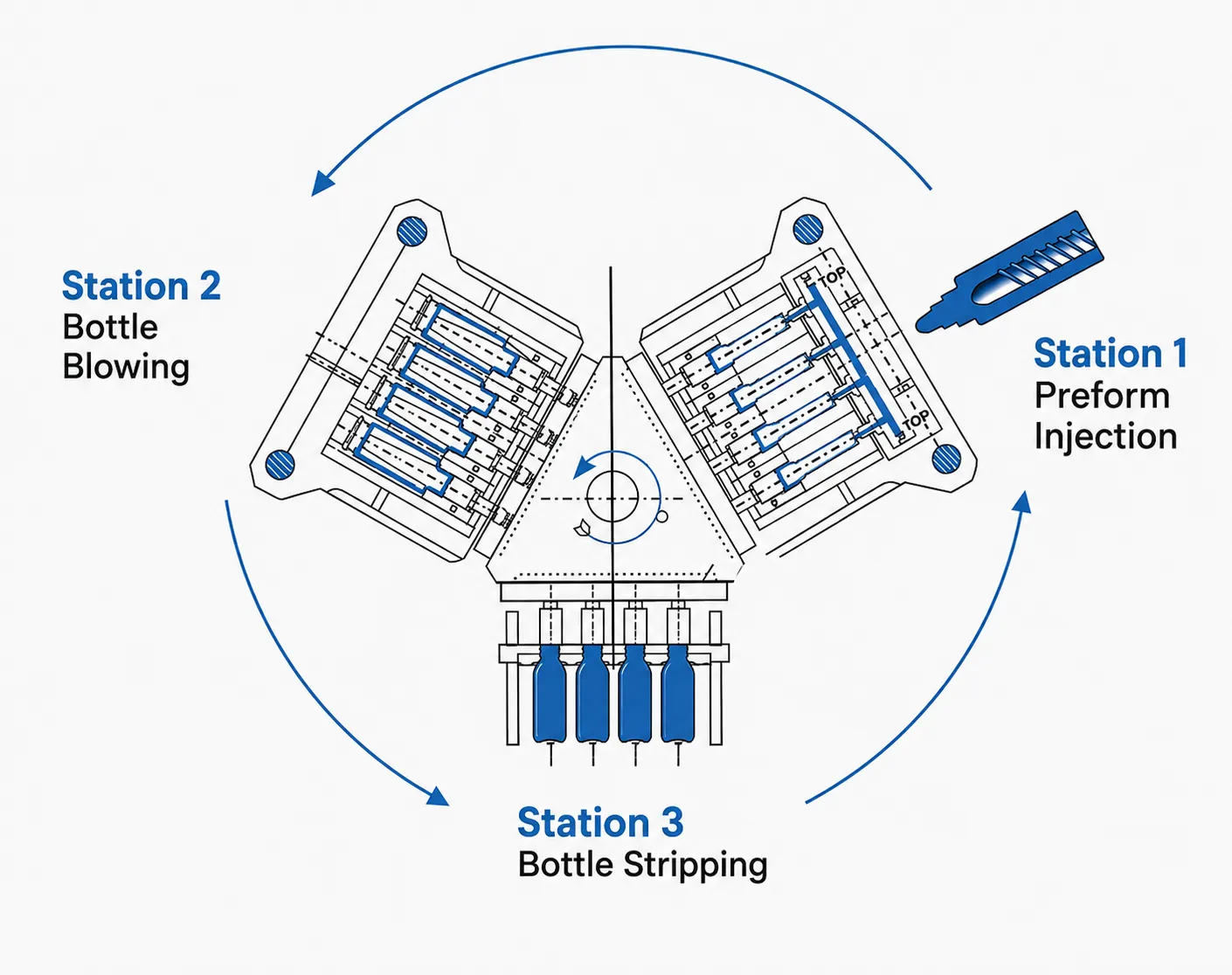
Injection blow molding 3-station process — Station 1 preform injection around core rod producing injection-moulded neck finish at ±0.05mm OD tolerance, Station 2 blow moulding with zero flash generation, Station 3 stripping — contrasted with extrusion blow molding parison clamping that generates neck flash and base flash requiring trim operation
IBM 三工位工艺流程展示了芯棒在注塑和吹塑过程中始终保持颈部几何形状——芯棒在两个阶段都穿过颈部,这意味着颈部由注塑模具一次性成型,且不会受到吹塑压力的影响。这在电子束熔化(EBM)工艺中是无法实现的,因为吹塑模具的分型线会穿过颈部区域,产生飞边,而这些飞边必须在每个循环后进行修剪。

区别 1 — 颈部表面光洁度精度:±0.05 毫米 vs ±0.15–0.25 毫米

In IBM, the core rod passes through the neck zone during both the injection phase and the blow phase. The neck’s thread OD, bore diameter, sealing surface and thread profile are all defined at Station 1 by the injection mould insert — a precision-machined steel tool that maintains ±0.02 mm dimensional tolerance on the neck cavity. Because the neck is formed by injection and the core rod holds its geometry throughout the blow phase, the blow pressure at Station 2 never contacts the neck surfaces. The finished bottle’s neck is dimensionally identical to the injection mould cavity — ±0.05 mm OD tolerance across all cavities, on every cycle.

In EBM, the neck geometry is formed by the blow mould’s parting line — the seam where the two halves of the blow mould meet around the extruded parison. The parting line must close around the parison at the neck position, and the dimensional accuracy of the neck is limited by the precision of the parting line closure and the variation in parison thickness at the neck zone. EBM neck OD tolerance is typically ±0.15–0.25 mm — three to five times wider than IBM. For Korean pharmaceutical CRC closures that require ±0.06 mm neck OD tolerance for push-and-turn engagement, and for Korean pump-dispenser closures that require ±0.08 mm neck OD for crimp-ferrule seal integrity, EBM neck precision is insufficient without secondary neck finishing operations (reaming or trimming) that add cycle time, equipment cost and scrap risk.

区别 2 — 闪光灯生成:零与 7–15% 快门重量

在IBM工艺中,瓶坯中树脂的含量与成品瓶所需的树脂量完全一致。模具边界处没有任何多余的材料——注塑模具能够精确填充,当瓶坯在2号工位进行吹塑时,聚合物会从瓶坯重新分配到瓶身,没有任何材料超出吹塑模腔。零飞边是IBM工艺的结构特性,而非质量指标——由于没有多余的型坯材料需要挤压,因此IBM工艺在物理上不可能产生飞边。

In EBM, flash is unavoidable. The extruded parison must extend beyond the top and bottom of the blow mould to allow the mould to close around it and pinch the excess off. Flash forms at the neck pinch-off (above the thread finish) and at the base pinch-off (below the base panel), accounting for 7–15% of the shot weight depending on bottle geometry and parison programming. This flash is either discarded as scrap or returned to the extruder as regrind — both options carry costs. Scrap flash increases resin cost per bottle; regrind adds process steps, consumes energy, and introduces resin quality risks (molecular weight reduction, colour change, increased brittleness on the third and fourth regrind cycle) that affect the final bottle’s mechanical properties. For Korean pharmaceutical production specifically, flash from EBM trim operations generates plastic particles that represent a contamination risk in cleanroom production environments — a risk that IBM’s zero-flash process eliminates entirely.

3. 差异 3 和 4:材料利用率和壁厚均匀性

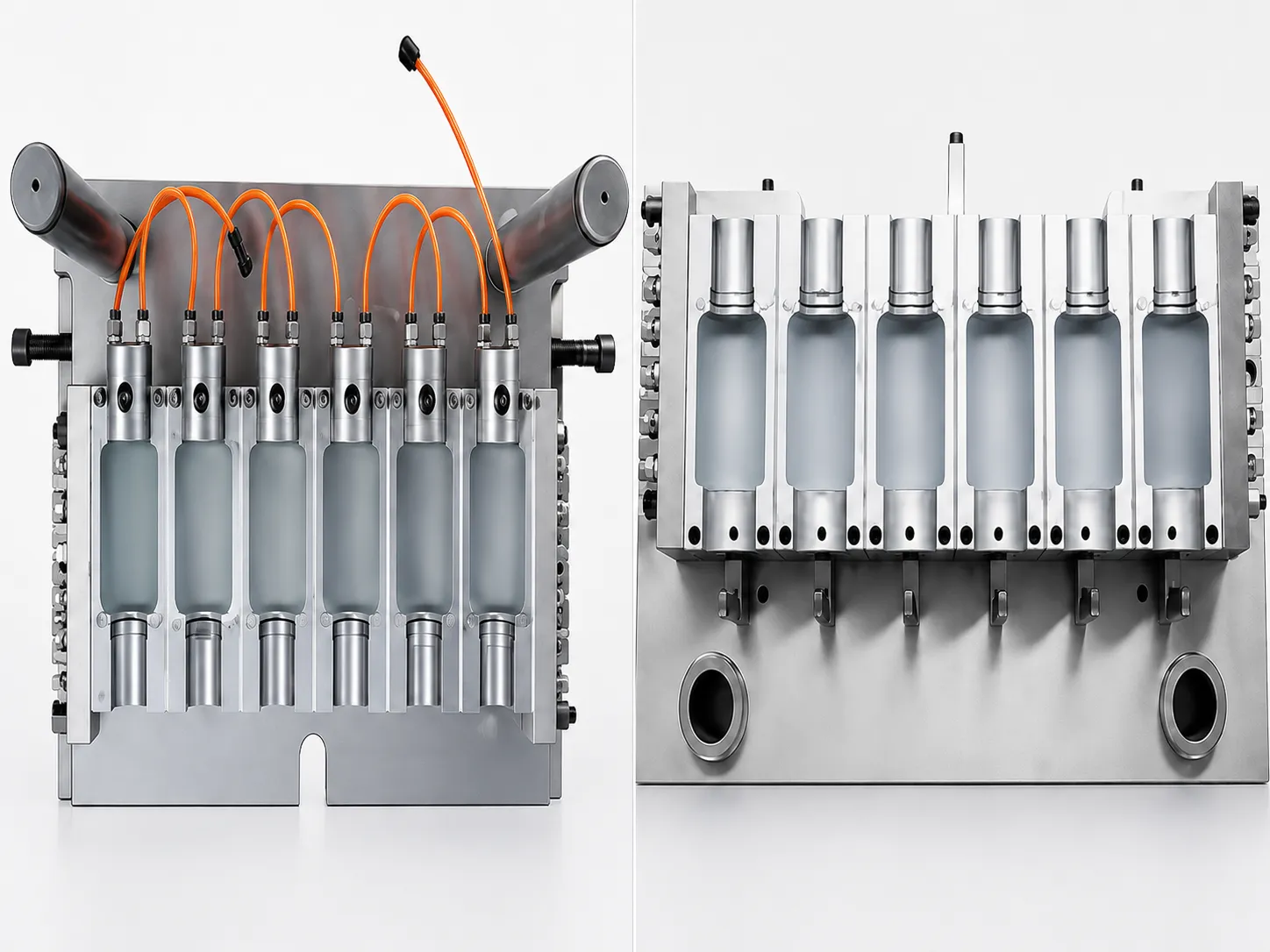
IBM injection blow molding mould set — 14-cavity injection mould with hot runner manifold and core rods producing preforms with precisely defined wall thickness distribution that translates to uniform bottle wall in the blow station — contrasted with EBM parison thickness variation requiring parison programming to compensate
IBM模具组展示了精密注塑型腔和芯杆几何形状,这些几何形状决定了吹塑阶段之前预成型件的壁厚分布。由于预成型件是按照预定的几何形状注塑成型的,因此成品瓶壁厚在每个点上都是可预测的,并且在每次循环中都保持一致。在电子束熔化(EBM)工艺中,型坯壁厚取决​​于挤出机输出和型坯头模口间隙——其中任何一个因素的变化都会导致成品瓶壁厚的变化,这需要对型坯进行编程补偿。

差异 3 — 材料利用率:100% 与 85–93%

IBM’s zero-flash production means that every gram of resin injected at Station 1 appears in the finished bottle at Station 3. Material utilisation is 100%. The cost of resin in an IBM production run is the cost of the finished bottles plus the cost of the injection system runner material (which in hot runner systems is retained in the hot runner manifold and never solidifies, eliminating runner scrap entirely). In Korean HDPE pharmaceutical production where resin cost is the largest variable cost component, 100% material utilisation is a significant operating advantage over EBM.

EBM(电子束熔融)材料的利用率取决于瓶身几何形状和型坯编程:采用标准颈底捏合工艺的简单圆柱形瓶会产生相当于7-10%注塑重量的飞边;而具有大底板或椭圆形截面的复杂几何形状瓶则可能产生接近15%的飞边。以韩国HDPE价格1400-1800韩元/公斤计算,韩国EBM生产线生产100万个500毫升瓶子(约合22吨HDPE,每个瓶子22克),10%的飞边率相当于约2.2吨HDPE飞边——每百万个瓶子的材料成本为310万-400万韩元。对于一家年产2000万个500毫升瓶子的韩国日用化学品工厂而言,仅EBM飞边材料的成本就高达6200万-8000万韩元——这是一项每年都会产生的成本,而IBM则完全消除了这项成本。

差异 4 — 壁厚均匀性:预成型件定义与型坯编程

In IBM, the wall thickness distribution of the finished bottle is defined by the preform geometry — itself defined by the injection mould cavity and core rod dimensions. The preform’s wall thickness at each axial position is fixed by the mould tooling, not by a dynamic process parameter. This means IBM wall thickness consistency is a tooling characteristic: once the mould is correctly designed and manufactured, the wall thickness distribution is repeatable cycle to cycle, cavity to cavity, and shift to shift without operator adjustment. IBM bottle wall thickness coefficient of variation (CV%) is typically 3–6% across all cavities in a multi-cavity mould. In EBM, wall thickness is controlled by parison programming — a dynamic process where the die gap of the extruder head varies continuously during parison extrusion to produce a parison that, when inflated against the blow mould, produces the target wall thickness at each point. Parison programming is a skilled adjustment process that requires trained EBM operators to maintain; wall thickness CV% in Korean EBM production is typically 8–15%, and higher during startup and after material lot changes. For Korean food-grade containers where wall thickness uniformity directly affects stack compression strength (required for Korean retail pallet display), and for Korean pharmaceutical containers where wall thickness affects chemical permeation rate calculations in Korean KFDA container qualification, IBM’s tooling-defined wall uniformity is a measurable quality advantage over EBM’s operator-dependent parison programming.

4. 差异 5 和 6:容量范围和输出速率

The container volume range and output rate differences between IBM and EBM reflect the two processes’ different architectures — IBM’s multi-cavity precision approach versus EBM’s high-volume large-format capability.

产量/输出系数 IBM 循证医学
最小实用体积 1毫升——微型制药 约 30–50 毫升 — 坯料稳定性极限
最大音量(标准) 2000毫升 500升以上(工业桶)
10毫升的空腔 最多 30 (ZQ135) 1–4(型腔稳定性限制多腔)
产量为 10 毫升(瓶/小时) 最多约27,000 约3000-6000
500毫升的空腔 5–8(IBM) 2–4(循证医学)
产量:500毫升(瓶/小时) 约5400-7200(6-8骑兵) 约3200-4800人(2-4骑兵)

区别 5 — 容器容积范围

IBM’s effective volume range is 1–2,000 ml, with the lower end constrained by the minimum practical injection shot weight for a stable preform and the upper end constrained by the blow mould size that can be accommodated on the turret platform. EBM’s lower volume limit is approximately 30–50 ml, because very small parisons are unstable during extrusion — they sag, thin unevenly, and produce unacceptable wall thickness variation when inflated. Below 50 ml, EBM cannot reliably produce consistent bottles; IBM is the only blow molding process for Korean pharmaceutical ampoules and mini-bottles at 1–30 ml. EBM’s upper volume range is practically unlimited — industrial EBM machines produce jerry cans, drums and automotive fuel tanks at 5–500 litres, which IBM cannot approach.

区别 6 — 小幅面输出速率

At small container formats (10–100 ml) IBM’s multi-cavity advantage is most pronounced. A 30-cavity IBM machine at 10 ml produces approximately 27,000 bottles per hour at a 4-second cycle — an output rate that an EBM machine with 4 cavities at a 6-second cycle produces approximately 2,400 bottles per hour. This 11-to-1 output ratio at the smallest formats means that a Korean pharmaceutical factory requiring 20 million 10 ml containers per year needs one ZQ135 IBM machine running two Korean shifts, versus approximately ten EBM machines at equivalent cavities running the same schedule. The IBM investment is higher per machine but dramatically lower per unit of annual capacity at small formats. At larger formats (500 ml+), IBM’s cavity count advantage narrows: IBM at 6 cavities and EBM at 4 cavities produce within 30–50% of each other’s output, making the economics comparison more dependent on the operating cost differences (flash, scrap, operator skill) than on raw output rate.

5. 差异 7 和 8:容器设计能力

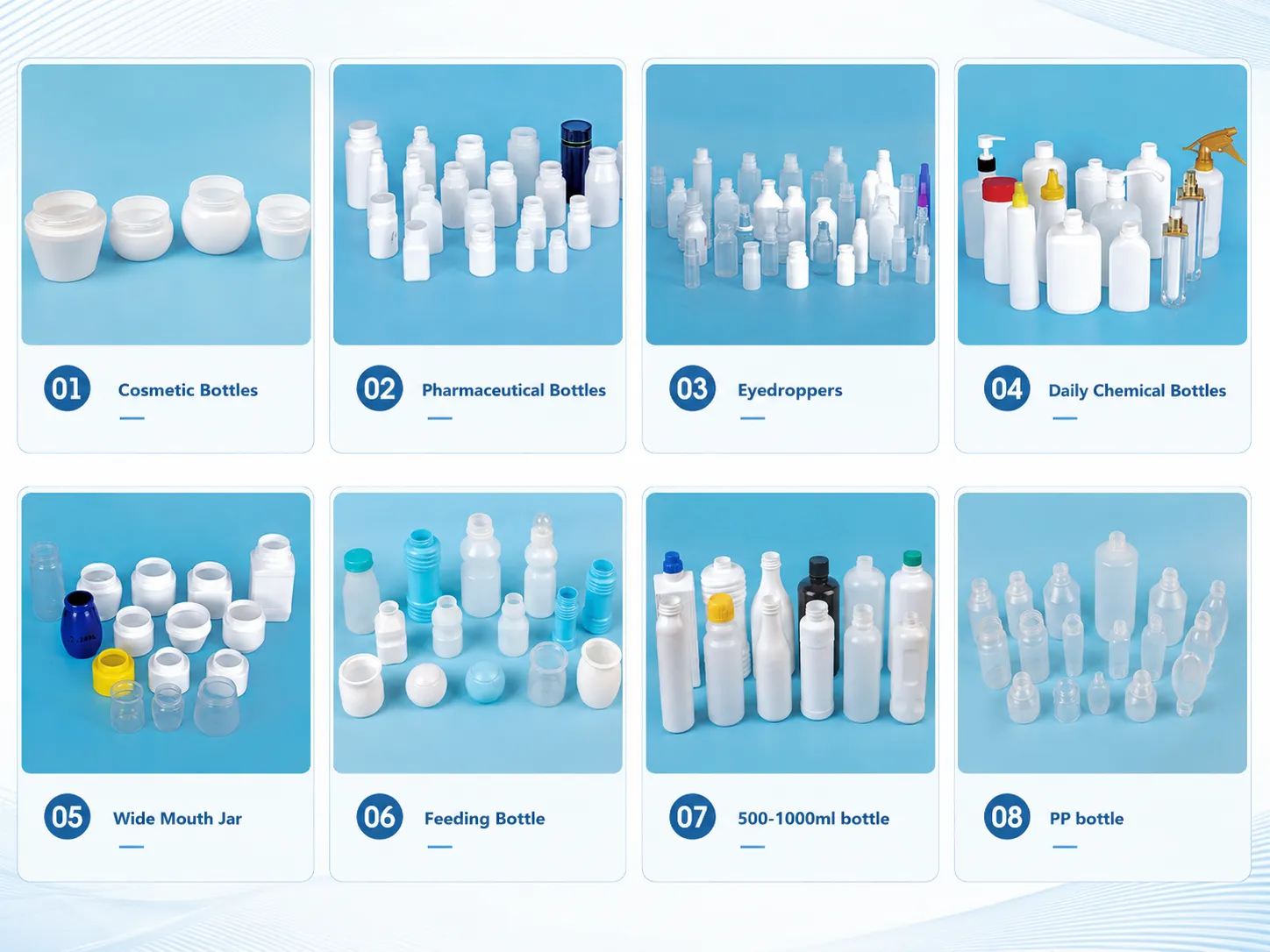
IBM injection blow molded bottle range — wide-mouth jar, narrow-neck pharmaceutical bottle, cosmetic container, household chemical bottle showing IBM-native container design capabilities including zero base seam, injection-moulded neck, uniform wall thickness — contrasted with EBM capability for wide-body containers with integral handles
IBM-native container design range — from narrow-neck 10 ml pharmaceutical vials to wide-mouth 250 ml cosmetic jars. IBM’s zero-base-seam and injection-moulded neck give it a clean exterior surface without the horizontal seam line that EBM produces at the base pinch-off zone — a design advantage for Korean premium cosmetic and pharmaceutical packaging where surface quality affects brand perception.

区别 7 — 一体式手柄功能

EBM’s parison clamping architecture allows the blow mould to include a handle cavity that is integral with the bottle body — the parison is clamped to include the handle loop and inflated to fill both the bottle body and the handle simultaneously. This produces a handle that is structurally continuous with the bottle wall, with no weld line or adhesive joint — the correct design for Korean household chemical containers above 2 litres (cleaning fluid, laundry detergent, bulk bleach) and Korean food containers (cooking oil, vinegar, soy sauce) at 2–5 litres where a handle is both functionally necessary and ergonomically expected by Korean consumers. IBM’s rotary turret architecture does not permit integral handles: the core rod passes through the container’s interior throughout the process, and a handle that bridges from one side of the container to the other would prevent core rod extraction at Station 3. Korean IBM containers above 1 litre typically use a post-production applied handle (a separately moulded PP grip clipped or heat-staked onto the IBM bottle after production) rather than an integral handle — a two-component approach that adds assembly cost and eliminates the structural continuity of the EBM integral handle. For Korean containers where an integral handle is the design requirement, EBM remains the correct process regardless of the other advantages IBM offers.

区别 8 — 表面处理和基接缝

IBM containers have no base seam and no parting-line witness marks on the body walls. Because the IBM blow mould does not have a parting line that crosses the container body — the core rod provides the interior surface and the blow mould provides only the outer cavity surface — the IBM bottle’s exterior is defined entirely by the blow mould cavity surface. Surface quality of an IBM blow mould at the body can be polished to Ra ≤ 0.05 μm (mirror finish), producing a bottle body that is visually indistinguishable from a glass container when moulded in high-clarity PS or PCTG. EBM containers have a horizontal base seam at the pinch-off line, a vertical parting line on the body where the two mould halves meet, and in some cases a trim mark at the neck where the neck flash was removed. These seam lines are acceptable in utility packaging (household chemical, agricultural, industrial) but are a visual quality concern for Korean premium cosmetic jars and Korean pharmaceutical containers where label panels are designed to exactly cover the parting line and the base seam is visible from shelf-side. IBM’s seam-free exterior is a design quality advantage that supports Korean premium packaging positioning without surface finishing operations after moulding.

6. 差异 9 和 10:监管合规性和机器投资

差异 9 — 韩国药品 GMP 合规性

韩国药品包装容器的生产受韩国食品药品安全部 (KFDA) 的药品包装法规约束,该法规对药品密封系统所用瓶颈的尺寸公差有明确规定。韩国药品密封标准——特别是针对儿童安全盖 (CRC) 容器、压盖小瓶和泵式药瓶——要求瓶颈外径公差在 ±0.06–0.08 毫米以内,以确保密封件能够正常工作并通过韩国 GMP 认证测试。IBM 工艺本身即可满足这些公差要求。而电子束熔化 (EBM) 工艺则需要对瓶颈进行二次加工(例如扩孔、修边或模后瓶颈校准)才能达到这些公差,这会增加药品级 EBM 生产的设备投入、生产周期和废品率风险。

Additionally, Korean GMP pharmaceutical production environments classify particle generation as a contamination risk. IBM’s zero-flash production eliminates the flash trim station that EBM requires — a mechanical trimming operation that generates plastic particles from the flash removal. In Korean pharmaceutical ISO Class 8 cleanroom environments, operating an EBM flash trim station requires the trim station to be enclosed and exhausted to prevent particles from reaching the fill zone — an engineering requirement that IBM production avoids entirely. Korean pharmaceutical contract packaging facilities that have transitioned from EBM to IBM report elimination of particle-related batch rejection events as a primary quality benefit alongside the neck precision improvement.

差异 10 — 机器投资:IBM 与 EBM

IBM机器的入门级购置成本高于同等输出的同格式EBM机器。韩国Ever-Power 注塑吹塑机 at the ZQ60 level (14 cavities, 37 KW) represents a higher investment than a comparable Korean EBM machine at 2-cavity 500 ml production. This investment difference is most significant for startup Korean packaging factories with limited capital and long production run lengths at a single format — where EBM’s simpler architecture and lower upfront cost may justify the higher per-bottle operating cost of flash management and lower output rate. The IBM vs EBM investment calculus changes when Korean factories account for: (a) the trim station cost that EBM requires but is not included in the EBM machine price; (b) the annual flash material cost at Korean resin prices; (c) the additional operator required for the EBM trim station versus IBM’s single-operator production; and (d) the neck calibration equipment that Korean pharmaceutical EBM requires. When these downstream costs are included, the IBM vs EBM total cost of ownership comparison over a 5-year production plan typically favours IBM for Korean pharmaceutical applications and for Korean household chemical production above 2 million units per year.

成本因素 IBM 循证医学
机器购置价格 更高 降低
需要修整站 是的——额外增加1500万至4000万韩元。
年度闪粉材料成本(500毫升,500万单位) 每年1500万至2500万韩元
每台机器的操作人员 1 1台机器 + 1个修整工位 = 2
五年总拥有成本(制药) 降低 包含所有运营成本时,价格更高。

7. 差异 11 和 12:能源效率和碳足迹

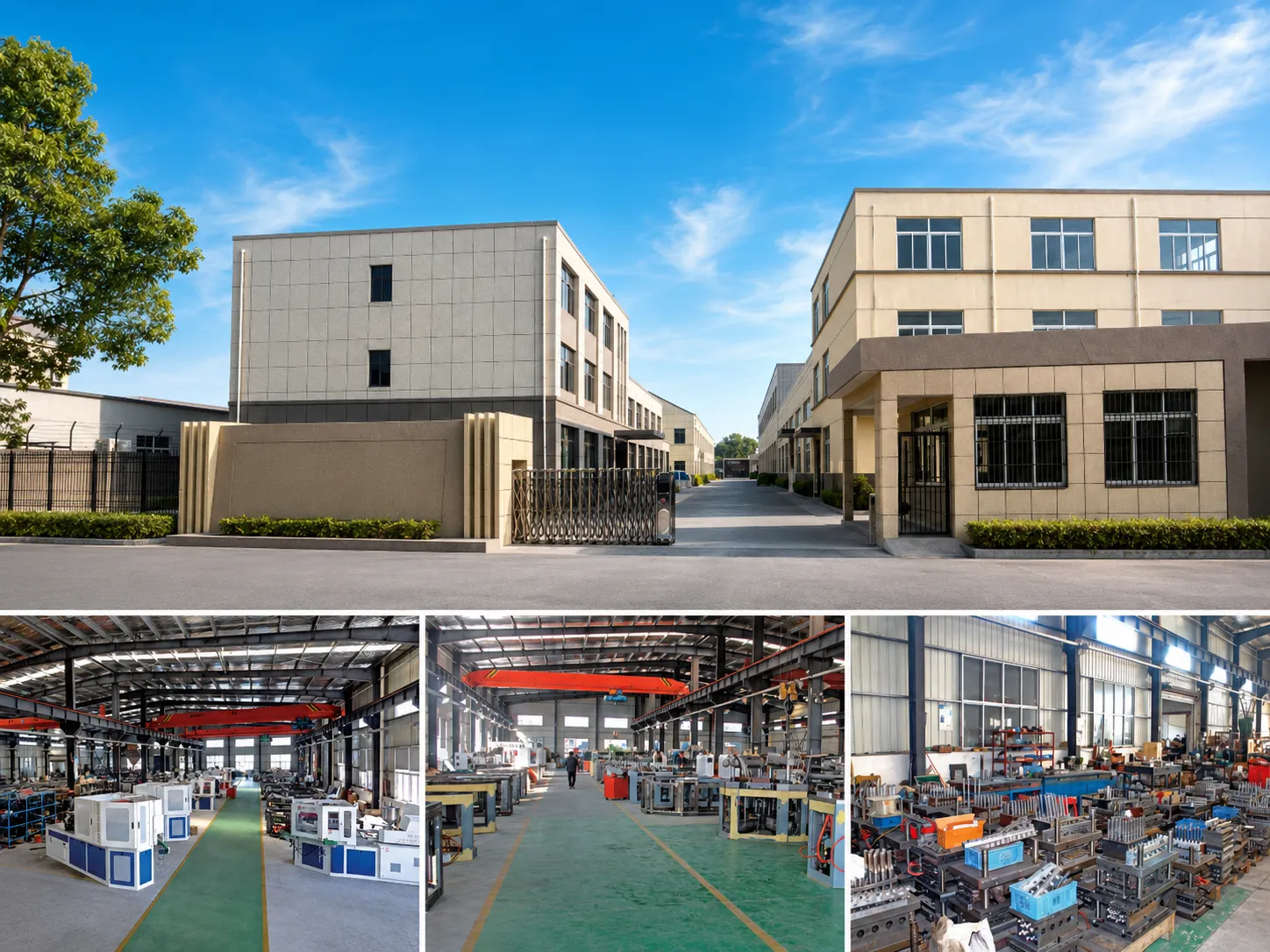
Korea Ever-Power injection blow molding machine manufacturing workshop — ZQ series IBM machines with dual hydraulic system producing 20-30% energy saving versus EBM machines at equivalent output, reducing Korean factory electricity consumption and carbon footprint for Korean industrial energy efficiency reporting
Korea Ever-Power’s ZQ series IBM machines use a dual hydraulic system (standard on ZQ80, ZQ110 and ZQ135) that delivers 20–30% lower electricity consumption per 1,000 bottles versus single-circuit competitor IBM machines and versus EBM machines at equivalent formats. Energy efficiency is an increasingly important selection factor for Korean factories subject to Korean government industrial energy reporting requirements.

差异 11 — 每 1000 瓶的能耗

每千瓶成品能耗是韩国包装工厂最相关的能耗比较指标,因为它考虑了IBM和EBM两种机器的产量差异——如果不根据产量进行标准化,仅比较机器总能耗会错误地低估生产效率更高的机器。以500毫升HDPE洗发水瓶的生产为例,韩国Ever-Power公司的机器能耗为每千瓶成品瓶的能耗。 IBM EP-ZQ60 机器 running 3-cavity 500 ml at 37 KW total power produces approximately 2,700 bottles per hour — energy consumption of approximately 13.7 kWh per 1,000 bottles. A Korean EBM machine running 2-cavity 500 ml at 25 KW produces approximately 1,800 bottles per hour — energy consumption of approximately 13.9 kWh per 1,000 bottles. At this format, the energy difference is small. However, Korea Ever-Power’s ZQ80 and above machines add a dual hydraulic system that reduces actual operating power to 52–70% of rated total power during production — measured by Korean customers at 20–30% less electricity per 1,000 bottles versus competitor single-circuit IBM and EBM at the same format. For a Korean factory subject to Korean Ministry of Industry Energy Efficiency targets, this documented energy advantage directly improves the factory’s energy intensity reporting.

区别 12 — 闪磨和再生料的碳足迹

IBM’s zero-flash production eliminates a carbon cost that EBM carries on every production run: the embodied carbon in the flash material that is either scrapped or reprocessed. Scrapped HDPE flash at a typical Korean EBM facility represents wasted embodied carbon from resin production, transport and processing — approximately 1.9 kg CO₂e per kg of HDPE according to Korean LCA (Life Cycle Assessment) data for HDPE packaging. At 10% flash on a 500 ml Korean EBM bottle (22g bottle weight, 2.2g flash per bottle), approximately 4.2g CO₂e is wasted per bottle in flash material alone. At 20 million bottles per year, this is approximately 84 tonnes CO₂e per year — a Scope 3 emission that Korean packaging brands increasingly need to account for in Korean ESG reporting. IBM eliminates this flash carbon cost entirely, giving Korean IBM packaging producers a specific and quantifiable carbon advantage for Korean corporate ESG supply chain disclosure that EBM packaging cannot match.

8. IBM 与 EBM 在韩国包装工厂决策框架方面的比较

以上十二项差异可归纳为韩国包装工厂的一个简单的决策框架。该框架包含三个阶段——按顺序回答每个阶段的问题,并在得到第一个明确答案后停止。

1号门:是否需要一体式把手?

如果答案为“是”,则使用 E​​BM。IBM 无法生成整数句柄。任何其他因素均不能凌驾于此之上。如果答案为“否”,则继续执行第二道关卡。

闸门 2:容器容积是否大于 2,000 毫升?

If YES — use EBM. IBM’s practical ceiling is 2,000 ml; above this, EBM or ISBM large-format machines are required. If NO — proceed to Gate 3.

第三道门:容器是否需要韩国制药GMP颈部精度、零闪蒸或小尺寸高腔数?

如果对其中任何一项的回答是“是”,则选择 IBM 产品。韩国的药品包装容器、韩国的精密密封包装以及韩国的大批量小规格生产都通过第三道关卡最终选择 IBM 产品。如果对所有问题的回答都是“否”,则比较 IBM 和 EBM 在特定规格和年产量下的总拥有成本,因为两者在技术上都可行,最终决策取决于经济效益。

For Korean factories in the ambiguous zone — primarily Korean household chemical at 250–1,000 ml and Korean cosmetic wide-mouth jars at 50–250 ml — the economic comparison should include: IBM machine price versus EBM machine price plus trim station; annual flash material cost at the production volume and Korean HDPE price; operator headcount (IBM: one per machine; EBM: one machine + one trim station); neck calibration equipment for Korean pharmaceutical-grade EBM; and the 5-year mould amortisation for each process. Korea Ever-Power’s application engineers provide a formatted IBM vs EBM cost comparison template for Korean factories evaluating this decision at specific production volumes — available through the Korea Ever-Power enquiry process. For the full range of Korea Ever-Power’s IBM machine options from entry-level to flagship, the 4工位ISBM机器系列 涵盖以PET为基础的应用,其中要求的是晶体透明度,而不是HDPE/PP加工。

常见问题解答

Q1 — 韩国工厂能否在同一生产车间同时运行 IBM 和 EBM 系统?

是的,许多韩国包装厂正是这样做的。IBM 和 EBM 并非相互替代,而是互补的工艺,分别适用于不同的容器规格。一家韩国合同包装厂需要同时生产 10 毫升的药用眼药水(IBM)和 5 升带一体式把手的 HDPE 清洁液(EBM),因此需要两台机器,因为没有单一工艺能够正确生产这两种容器。由于两台机器共用基础设施——压缩空气供应(两种工艺均使用吹气)、冷却水循环系统以及韩国标准的 380V 三相电源——这意味着它们可以在同一韩国工厂的同一车间内共存,并共享公用设施,从而降低了同时运营这两种机器的韩国工厂的单台机器基础设施成本。员工培训要求则有所不同:IBM 操作员需要在同一台机器上管理注塑参数、料筒温度和吹气参数等集成设置;而 EBM 操作员则需要管理挤出、型坯编程和修边站等三个独立的功能。同时生产 IBM 和 EBM 的韩国工厂通常会为每种工艺分别设置操作员培训课程,而不是对所有操作员进行两种工艺的交叉培训,因为两种工艺的物理特性差异很大,交叉培训会在关键的参数设置阶段造成混乱,而不是提高灵活性。

Q2 — 对于韩国工厂而言,与 EBM 相比,IBM 的最大实际缺点是什么?

The biggest practical disadvantage of IBM versus EBM for Korean factories is the mould set cost and format change economics at large container formats. An IBM mould set for 500 ml shampoo at 6 cavities — including the injection mould, core rods, blow mould and stripping fixtures — costs significantly more than an EBM blow mould for 500 ml at 4 cavities, because IBM tooling requires three matched mould components (injection mould, blow mould, stripping tool) versus EBM’s single blow mould. For Korean contract packaging factories that produce 20–30 different container formats in small volumes per format — each requiring a dedicated mould set — the IBM mould investment per format is a significant capital commitment. Korean EBM contract packagers with 30 SKUs can carry 30 EBM blow moulds at a reasonable tooling investment; Korean IBM contract packagers carrying 30 IBM mould sets face a proportionally higher tooling inventory cost. The IBM mould investment disadvantage narrows as production volume per format increases — at high annual volumes per format, the IBM operating cost advantages (zero flash, higher output, lower operator cost) create a total cost per bottle that is lower than EBM, recouping the higher mould investment within 1–3 years depending on annual volume. At low annual volume per format (below 500,000 units per format per year), EBM tooling economics typically prevail.

Q3 — 为什么所有 EBM 奶瓶上都有 EBM 底部接缝,可以消除它吗?

The EBM base seam — the horizontal raised line at the bottom of an EBM container where the two blow mould halves pinch the parison closed — is an unavoidable feature of the EBM process. The extruded parison must extend below the base of the blow mould cavity so that the mould halves can close around it and pinch it closed to form the sealed base. The amount of parison extending below the cavity at pinch-off becomes the base flash — which is removed by the trim station — and the pinch line itself leaves a small raised seam mark at the container base. This base seam cannot be eliminated without changing the process fundamentally. The seam height can be minimised by very precise EBM mould closure alignment and sharp pinch-off edge machining (achievable to approximately 0.1 mm raised height at best), but the seam cannot be reduced to zero in EBM as the pinch-off is a structural requirement of the process. IBM bottles have no base seam because there is no pinch-off: the preform base is injection moulded closed at Station 1 and simply inflates to the blow mould base profile at Station 2 without any pinching action. The IBM gate witness mark at the interior base is typically less than 0.5 mm in diameter and is not visible from outside the container. For Korean cosmetic brands specifying premium packaging where the base is visible to Korean consumers (transparent containers displayed upside-down in Korean department store cosmetic fixtures), IBM’s base seam elimination is a specific visual quality requirement that EBM cannot satisfy.

Q4 — 对于 500 毫升的韩国家用化学品 HDPE 容器,IBM 还是 EBM 更好?

For Korean household chemical HDPE containers at 500 ml, IBM is better when annual production volume exceeds approximately 2 million units per format per year; EBM may be better below this threshold. The economic break-even point depends on the specific Korean factory’s cost structure, but the key factors are as follows. At 2 million 500 ml units per year: IBM at 6 cavities (ZQ80 platform) produces approximately 7,200 bottles per hour and runs approximately 278 hours per year at this volume — a very low machine utilisation that makes the IBM machine investment difficult to justify unless the machine runs multiple other formats in the remaining hours. EBM at 4 cavities produces approximately 4,800 bottles per hour and runs approximately 417 hours — similarly low utilisation but at lower machine capital. At 10 million 500 ml units per year: IBM runs approximately 1,389 hours per year (40% of Korean two-shift annual hours), with zero flash, no trim station and higher output quality — the IBM operating cost advantage compounds and the machine investment per unit of output is justifiable. At 20 million units per year: IBM is clearly the superior economic choice — a single ZQ80 at 6-cavity 500 ml can produce 20 million units in approximately 2,778 hours (approximately 79% of two-shift Korean annual hours), with no flash cost, no trim station operator, and no neck calibration requirement. A Korean household chemical factory at this volume using EBM would need approximately 4 machines plus 4 trim stations to match this output, at a higher combined capital and operating cost. The Korean household chemical production threshold where IBM replaces EBM on economic grounds is typically 3–5 million units per year per format — Korean national brand shampoo and household cleaner lines that have been identified as IBM migration candidates by Korean packaging engineers reviewing their operating cost structure against the IBM investment case.

Q5 — 韩国 EBM 工厂过渡到 IBM 生产需要多长时间?

A Korean packaging factory transitioning from EBM to IBM production for a specific container format typically completes the full transition in 6–10 months from IBM machine order to GMP-qualified production. The timeline breaks down as follows. Months 1–2: IBM machine order and mould design. The IBM mould set design is substantially more complex than the EBM blow mould it replaces — three components (injection mould, blow mould, stripping tool) must be designed as an integrated system, and mould flow simulation is required for the injection mould to verify gate balance across all cavities. Months 2–4: IBM machine manufacture and mould manufacture proceed in parallel. Korea Ever-Power’s standard ZQ60 machine manufacturing time is 60–75 days; injection mould manufacture is 45–55 days. Months 4–5: Machine installation and commissioning at the Korean factory. Korea Ever-Power engineers install and commission the machine in 3–5 days, and operator training covers the IBM process parameters, mould change procedure, and quality inspection protocol over an additional 3–4 days. Months 5–6: IBM production trial and first-article qualification. The IBM machine produces trial bottles for Korean GMP container qualification documentation — dimensional report, closure engagement test, chemical compatibility test (for Korean pharmaceutical transition), and filled stability test. Months 6–10: Korean GMP qualification review by the Korean pharmaceutical brand customer or Korean KFDA notification (for Korean pharmaceutical containers). The limiting factor for Korean pharmaceutical IBM transitions is not the machine or mould manufacture — it is the Korean GMP qualification review timeline, which is typically 3–6 months from first-article sample submission to commercial production approval for Korean pharmaceutical container changes.

Q6 — IBM 能否加工与 EBM 相同的材料?

IBM and EBM share compatibility with the principal Korean commodity thermoplastics — HDPE, PP and LDPE are processable on both platforms. The key material compatibility differences are: IBM processes ABS, PS and PCTG as standard IBM materials; these are technically processable in EBM but rarely used because they are single-layer commodity materials where IBM’s precision cavity produces better surface quality and dimensional consistency than EBM’s parison clamping. EBM processes multi-layer co-extrusion materials that IBM cannot — a 6-layer EVOH barrier parison for Korean condiment packaging requiring oxygen barrier cannot be produced in an IBM process because the IBM injection mould cannot produce a multi-layer preform with barrier layers. EBM’s co-extrusion capability makes it the only viable process for Korean barrier packaging (Korean tomato sauce, Korean kimchi base, Korean ready-to-eat meal packaging) where the container must include an EVOH or nylon oxygen barrier layer. IBM’s material range is inherently single-layer; multi-layer IBM is possible but rare and requires specialised injection manifold tooling. For Korean single-layer commodity packaging in HDPE, PP and ABS — which represents the large majority of Korean IBM applications — IBM and EBM are both material-compatible, and the process choice is determined by the dimensional, output and economic factors described in the other eleven differences above.

IBM机器查询

正在为您的韩国生产线评估 IBM 和 EBM 系统?

韩国 Ever-Power 提供 IBM 与 EBM 的总拥有成本分析、腔体数量规划以及针对特定韩国集装箱规格和年产量的生产线经济性比较。

请求 IBM 与 EBM 分析

相关资源

IBM 与 EBM 在 20 个腔体上的对比
EP-ZQ80 注塑吹塑机
800 KN · 20 cavities at 10 ml · Zero flash · Standard dual hydraulic · Produces approximately 15,800 bottles/hour at 10 ml — vs EBM’s 2,400–4,000/hour at equivalent format.


IBM 与 EBM 在 24 个腔体上的对比
EP-ZQ110 注塑吹塑机
1,100 KN · 24 个腔体,每个腔体容量为 10 ml · 4+N 个筒体区域 · 22+22 KW 双液压 · 一台机器可替代 8-10 台 EBM 机器,每台机器的药品产量为 10 ml。


IBM流程指南
什么是注塑吹塑成型?IBM完整指南
IBM工艺流程完整说明——三工位工作原理、材料、应用及韩国制药和日用化学品工厂ZQ机器选型指南。



编辑:Cxm


工厂虚拟现实之旅

标签: