IBM vs. EBM: 12 keskeistä eroa
Selitetty
Ruiskupuhallusmuovaus ja ekstruusiopuhallusmuovaus ovat kaksi tärkeintä puhallusmuovausprosessia korealaisissa pakkausmateriaaleissa – mutta ne palvelevat eri pakkausmarkkinoita, tuottavat erilaisia kaulan tarkkuuksia, tuottavat erilaisia materiaalihukkaa ja oikeuttavat erilaisia pääomainvestointeja. Tässä oppaassa vertaillaan molempia prosesseja 12 teknisen ja kaupallisen tekijän osalta, jotta korealaiset pakkausinsinöörit voivat valita oikean prosessin jokaiseen tuotantovaatimukseen ilman epäselvyyksiä.
Korean tehdastaloustiede
GMP ja lääkemääräystenmukaisuus
Korea Ever-Power Engineering Desk · Ansan-si · Heinäkuu 2026
IBM vs. EBM – Yhteenveto
±0,05 mm
IBM:n kaulan ulkohalkaisijan toleranssi – verrattuna EBM:n ±0,15–0,25 mm:iin
Nolla salamaa
IBM:n materiaalien käyttöaste — EBM tuottaa 7–15%:n romukappaletta
Jopa 30
IBM-ontelot 10 ml:n tilavuudella — EBM tyypillisesti 1–4 ontelota pienessä formaatissa
12
Tässä oppaassa vertaillaan teknisiä ja kaupallisia tekijöitä
1. IBM vs. EBM: Perustavanlaatuinen prosessiero
Injection blow molding and extrusion blow molding both produce hollow plastic containers by inflating softened resin against a mould cavity with compressed air. That is where the similarity ends. The fundamental difference between the two processes lies in how the preform — the intermediate shape that is subsequently inflated into a bottle — is created. In IBM, the preform is injection moulded around a core rod with precision tooling that defines the neck geometry exactly. In EBM, the preform is a hollow tube of extruded plastic (the parison) that is clamped by the blow mould and inflated, with the neck geometry formed by the mould’s parting line rather than by a dedicated precision tool.
This single difference — injection-moulded preform versus extruded parison — cascades into twelve measurable technical and commercial differences that determine which process is correct for a Korean packaging factory’s specific container requirements. The twelve differences are not subjective preferences; they are engineering realities that flow directly from the process physics. Understanding them removes the ambiguity from the IBM vs EBM decision for Korean pharmaceutical, household chemical, cosmetic and food packaging operations.
IBM ja EBM eivät ole kilpailevia prosesseja useimmissa sovelluksissa – ne palvelevat eri pakkausmarkkinoita. IBM hallitsee korealaisten lääketeollisuuden pienpakkausten ja korealaisten tarkkuussuljinpakkausten markkinoita. EBM hallitsee korealaisten suurten teollisuuspakkausten, jerrykanistrien ja kiinteitä kahvoja vaativien astioiden markkinoita. Prosessivalinta on aidosti epäselvä vain keskikokoisissa pakkauksissa: korealaisissa kotitalouskemikaalien 250–1 000 ml:n pakkauksissa, korealaisissa elintarvikepurkeissa 100–500 ml:n pakkauksissa ja korealaisissa leveäsuisissa kosmetiikkapakkauksissa – joissa molemmat prosessit ovat teknisesti kykeneviä, mutta eroavat toisistaan laadun, käyttökustannusten ja pääomavaatimusten suhteen tavoilla, jotka korealaisten tehtaan insinöörien on ymmärrettävä voidakseen tehdä perustellun investointipäätöksen.
2. Erot 1 ja 2: Kaulan tarkkuus ja nolla välähdystä
Ero 1 — Kaulan viimeistelyn tarkkuus: ±0,05 mm vs. ±0,15–0,25 mm
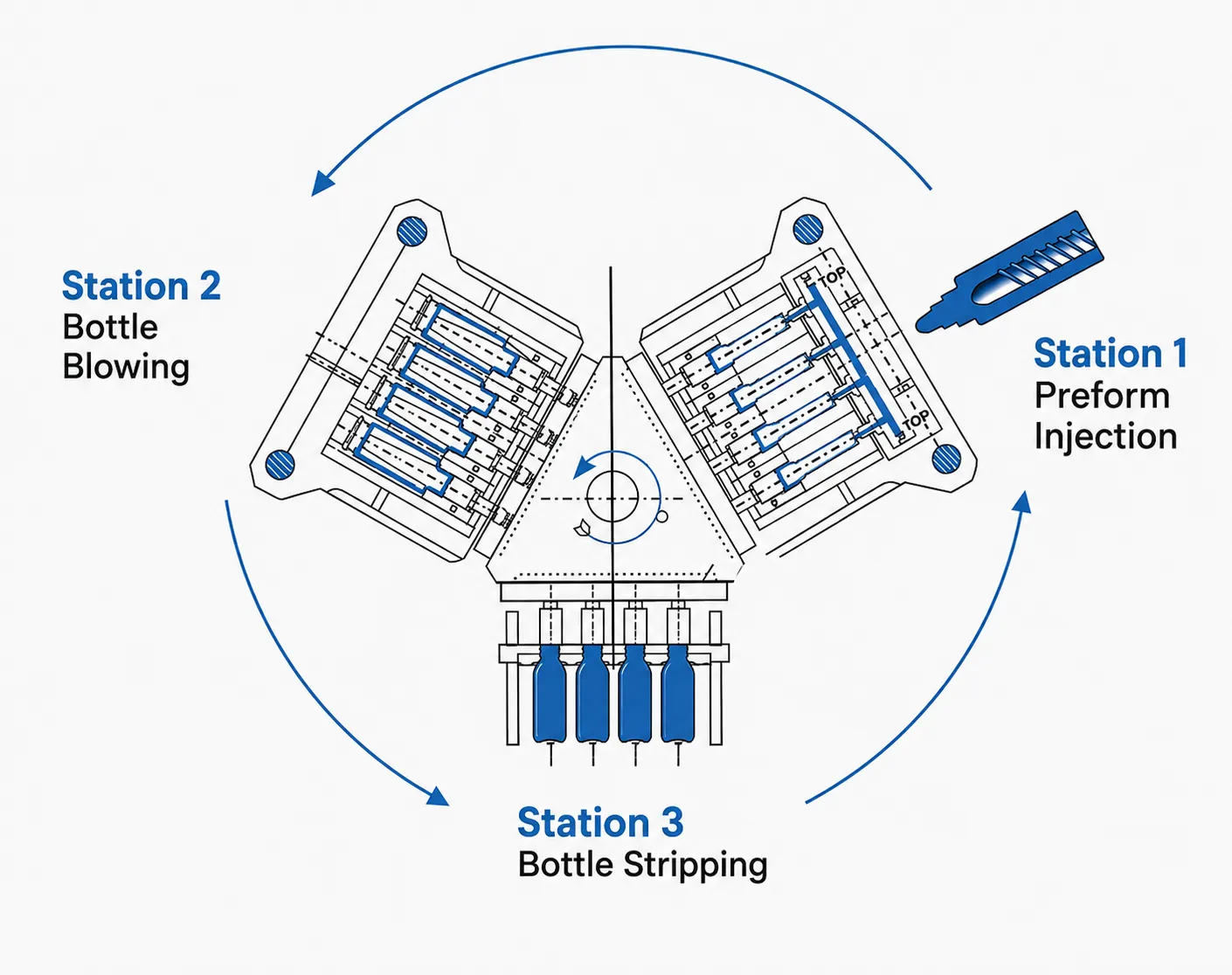
In IBM, the core rod passes through the neck zone during both the injection phase and the blow phase. The neck’s thread OD, bore diameter, sealing surface and thread profile are all defined at Station 1 by the injection mould insert — a precision-machined steel tool that maintains ±0.02 mm dimensional tolerance on the neck cavity. Because the neck is formed by injection and the core rod holds its geometry throughout the blow phase, the blow pressure at Station 2 never contacts the neck surfaces. The finished bottle’s neck is dimensionally identical to the injection mould cavity — ±0.05 mm OD tolerance across all cavities, on every cycle.
In EBM, the neck geometry is formed by the blow mould’s parting line — the seam where the two halves of the blow mould meet around the extruded parison. The parting line must close around the parison at the neck position, and the dimensional accuracy of the neck is limited by the precision of the parting line closure and the variation in parison thickness at the neck zone. EBM neck OD tolerance is typically ±0.15–0.25 mm — three to five times wider than IBM. For Korean pharmaceutical CRC closures that require ±0.06 mm neck OD tolerance for push-and-turn engagement, and for Korean pump-dispenser closures that require ±0.08 mm neck OD for crimp-ferrule seal integrity, EBM neck precision is insufficient without secondary neck finishing operations (reaming or trimming) that add cycle time, equipment cost and scrap risk.
Ero 2 — Salaman generointi: Nolla vs. 7–15% laukauksen painosta
IBM:ssä aihio sisältää täsmälleen valmiin pullon tarvitseman hartsimäärän. Muotin reunoilla ei ole ylimääräistä materiaalia – ruiskuvalumuotti täyttyy tarkasti, ja kun aihio täytetään asemalla 2, polymeeri jakautuu aihiosta pulloon eikä materiaalia ylitä puhallusmuotin onteloa. Puristuksen puuttuminen on IBM:n prosessin rakenteellinen ominaisuus, ei laatusaavutus – IBM:n on fyysisesti mahdotonta tuottaa puristusta, koska ei ole ylimääräistä aihiomateriaalia, jota voitaisiin puristaa.
In EBM, flash is unavoidable. The extruded parison must extend beyond the top and bottom of the blow mould to allow the mould to close around it and pinch the excess off. Flash forms at the neck pinch-off (above the thread finish) and at the base pinch-off (below the base panel), accounting for 7–15% of the shot weight depending on bottle geometry and parison programming. This flash is either discarded as scrap or returned to the extruder as regrind — both options carry costs. Scrap flash increases resin cost per bottle; regrind adds process steps, consumes energy, and introduces resin quality risks (molecular weight reduction, colour change, increased brittleness on the third and fourth regrind cycle) that affect the final bottle’s mechanical properties. For Korean pharmaceutical production specifically, flash from EBM trim operations generates plastic particles that represent a contamination risk in cleanroom production environments — a risk that IBM’s zero-flash process eliminates entirely.
3. Erot 3 ja 4: Materiaalin käyttöaste ja seinämän paksuuden tasaisuus
Ero 3 — Materiaalin käyttö: 100% vs. 85–93%
IBM’s zero-flash production means that every gram of resin injected at Station 1 appears in the finished bottle at Station 3. Material utilisation is 100%. The cost of resin in an IBM production run is the cost of the finished bottles plus the cost of the injection system runner material (which in hot runner systems is retained in the hot runner manifold and never solidifies, eliminating runner scrap entirely). In Korean HDPE pharmaceutical production where resin cost is the largest variable cost component, 100% material utilisation is a significant operating advantage over EBM.
EBM-materiaalin käyttöaste riippuu pullon geometriasta ja aihio-ohjelmoinnista: yksinkertaiset lieriömäiset pullot, joissa on vakiokaula ja pohjan nipistysreikä, tuottavat purkausta, joka on 7–101 TP3T ruiskutuspainosta; monimutkaiset geometriat, joissa on suuret pohjapaneelit tai soikeat poikkileikkaukset, voivat tuottaa lähes 151 TP3T purkausta. Korealaisen HDPE:n hinnalla 1 400–1 800 Etelä-Korean wonia/kg ja korealaisella EBM:n tuotantoerällä, joka on miljoona 500 ml:n pulloa (noin 22 tonnia HDPE:tä, 22 g pulloa kohden), 10%:n purkausnopeus vastaa noin 2,2 tonnia HDPE:tä – materiaalikustannukset 3,1–4,0 miljoonaa Etelä-Korean wonia miljoonaa pulloa kohden. Vuositasolla pelkästään EBM:n purkausmateriaalikustannukset ovat 62–80 miljoonaa Etelä-Korean wonia – toistuvat vuotuiset kulut, jotka IBM eliminoi kokonaan.
Ero 4 — Seinämän paksuuden tasaisuus: Esimuotin määrittämä vs. Parison-ohjelmoitu
In IBM, the wall thickness distribution of the finished bottle is defined by the preform geometry — itself defined by the injection mould cavity and core rod dimensions. The preform’s wall thickness at each axial position is fixed by the mould tooling, not by a dynamic process parameter. This means IBM wall thickness consistency is a tooling characteristic: once the mould is correctly designed and manufactured, the wall thickness distribution is repeatable cycle to cycle, cavity to cavity, and shift to shift without operator adjustment. IBM bottle wall thickness coefficient of variation (CV%) is typically 3–6% across all cavities in a multi-cavity mould. In EBM, wall thickness is controlled by parison programming — a dynamic process where the die gap of the extruder head varies continuously during parison extrusion to produce a parison that, when inflated against the blow mould, produces the target wall thickness at each point. Parison programming is a skilled adjustment process that requires trained EBM operators to maintain; wall thickness CV% in Korean EBM production is typically 8–15%, and higher during startup and after material lot changes. For Korean food-grade containers where wall thickness uniformity directly affects stack compression strength (required for Korean retail pallet display), and for Korean pharmaceutical containers where wall thickness affects chemical permeation rate calculations in Korean KFDA container qualification, IBM’s tooling-defined wall uniformity is a measurable quality advantage over EBM’s operator-dependent parison programming.
4. Erot 5 ja 6: Äänenvoimakkuusalue ja lähtönopeus
The container volume range and output rate differences between IBM and EBM reflect the two processes’ different architectures — IBM’s multi-cavity precision approach versus EBM’s high-volume large-format capability.
| Tilavuus / Tuotantokerroin | IBM | EBM |
|---|---|---|
| Pienin käytännöllinen tilavuus | 1 ml — mikrolääke | ~30–50 ml — aihion stabiiliusraja |
| Suurin äänenvoimakkuus (vakio) | 2 000 ml | 500 litraa+ (teollisuustynnyrit) |
| Reiät 10 ml:ssa | Jopa 30 (ZQ135) | 1–4 (muoviputken stabiilius rajoittaa monionteloiden muodostumista) |
| Tuotto 10 ml (pulloa/tunti) | Jopa ~27 000 | ~3 000–6 000 |
| Reiät 500 ml:ssa | 5–8 (IBM) | 2–4 (EBM) |
| Tuotto 500 ml:lla (pulloa/tunti) | ~5 400–7 200 (6–8 sotilasta) | ~3 200–4 800 (2–4 sotilasta) |
Ero 5 — Säiliön tilavuusalue
IBM’s effective volume range is 1–2,000 ml, with the lower end constrained by the minimum practical injection shot weight for a stable preform and the upper end constrained by the blow mould size that can be accommodated on the turret platform. EBM’s lower volume limit is approximately 30–50 ml, because very small parisons are unstable during extrusion — they sag, thin unevenly, and produce unacceptable wall thickness variation when inflated. Below 50 ml, EBM cannot reliably produce consistent bottles; IBM is the only blow molding process for Korean pharmaceutical ampoules and mini-bottles at 1–30 ml. EBM’s upper volume range is practically unlimited — industrial EBM machines produce jerry cans, drums and automotive fuel tanks at 5–500 litres, which IBM cannot approach.
Ero 6 — Tulostusnopeus pienissä formaateissa
At small container formats (10–100 ml) IBM’s multi-cavity advantage is most pronounced. A 30-cavity IBM machine at 10 ml produces approximately 27,000 bottles per hour at a 4-second cycle — an output rate that an EBM machine with 4 cavities at a 6-second cycle produces approximately 2,400 bottles per hour. This 11-to-1 output ratio at the smallest formats means that a Korean pharmaceutical factory requiring 20 million 10 ml containers per year needs one ZQ135 IBM machine running two Korean shifts, versus approximately ten EBM machines at equivalent cavities running the same schedule. The IBM investment is higher per machine but dramatically lower per unit of annual capacity at small formats. At larger formats (500 ml+), IBM’s cavity count advantage narrows: IBM at 6 cavities and EBM at 4 cavities produce within 30–50% of each other’s output, making the economics comparison more dependent on the operating cost differences (flash, scrap, operator skill) than on raw output rate.
5. Erot 7 ja 8: Konttisuunnitteluominaisuudet
Ero 7 — Integroidun kahvan ominaisuus
EBM’s parison clamping architecture allows the blow mould to include a handle cavity that is integral with the bottle body — the parison is clamped to include the handle loop and inflated to fill both the bottle body and the handle simultaneously. This produces a handle that is structurally continuous with the bottle wall, with no weld line or adhesive joint — the correct design for Korean household chemical containers above 2 litres (cleaning fluid, laundry detergent, bulk bleach) and Korean food containers (cooking oil, vinegar, soy sauce) at 2–5 litres where a handle is both functionally necessary and ergonomically expected by Korean consumers. IBM’s rotary turret architecture does not permit integral handles: the core rod passes through the container’s interior throughout the process, and a handle that bridges from one side of the container to the other would prevent core rod extraction at Station 3. Korean IBM containers above 1 litre typically use a post-production applied handle (a separately moulded PP grip clipped or heat-staked onto the IBM bottle after production) rather than an integral handle — a two-component approach that adds assembly cost and eliminates the structural continuity of the EBM integral handle. For Korean containers where an integral handle is the design requirement, EBM remains the correct process regardless of the other advantages IBM offers.
Ero 8 — Pinnan viimeistely ja pohjasauma
IBM containers have no base seam and no parting-line witness marks on the body walls. Because the IBM blow mould does not have a parting line that crosses the container body — the core rod provides the interior surface and the blow mould provides only the outer cavity surface — the IBM bottle’s exterior is defined entirely by the blow mould cavity surface. Surface quality of an IBM blow mould at the body can be polished to Ra ≤ 0.05 μm (mirror finish), producing a bottle body that is visually indistinguishable from a glass container when moulded in high-clarity PS or PCTG. EBM containers have a horizontal base seam at the pinch-off line, a vertical parting line on the body where the two mould halves meet, and in some cases a trim mark at the neck where the neck flash was removed. These seam lines are acceptable in utility packaging (household chemical, agricultural, industrial) but are a visual quality concern for Korean premium cosmetic jars and Korean pharmaceutical containers where label panels are designed to exactly cover the parting line and the base seam is visible from shelf-side. IBM’s seam-free exterior is a design quality advantage that supports Korean premium packaging positioning without surface finishing operations after moulding.
6. Erot 9 ja 10: Määräystenmukaisuus ja koneinvestoinnit
Ero 9 — Korean lääkealan GMP-vaatimustenmukaisuus
Korean lääkepakkaustuotantoa säätelevät Korean KFDA:n (elintarvike- ja lääketurvallisuusministeriö) lääkepakkausmääräykset, jotka määrittelevät lääkepakkausten suljinjärjestelmien kanssa käytettävien pakkausten kaulapintojen mittatoleranssit. Korean lääkepakkausten suljinstandardit – erityisesti lapsiturvallisten suljinjärjestelmien (CRC) pakkausten, rypytyskorkkisten injektiopullojen ja pumppuannostelijoiden lääkepullojen osalta – edellyttävät kaulan ulkohalkaisijan toleransseja ±0,06–0,08 mm, jotta suljin toimii tarkoitetulla tavalla ja läpäisee Korean GMP-hyväksyntätestauksen. IBM täyttää nämä toleranssit johdonmukaisesti natiivina prosessiominaisuutena. EBM-tuotanto vaatii toissijaista kaulan viimeistelyä (avartaminen, leikkaaminen tai muotin jälkeinen kaulan kalibrointi) näiden toleranssien saavuttamiseksi, mikä lisää laitteita, sykliaikaa ja hylkyriskiä lääkelaatuisten EBM-tuotantoon.
Additionally, Korean GMP pharmaceutical production environments classify particle generation as a contamination risk. IBM’s zero-flash production eliminates the flash trim station that EBM requires — a mechanical trimming operation that generates plastic particles from the flash removal. In Korean pharmaceutical ISO Class 8 cleanroom environments, operating an EBM flash trim station requires the trim station to be enclosed and exhausted to prevent particles from reaching the fill zone — an engineering requirement that IBM production avoids entirely. Korean pharmaceutical contract packaging facilities that have transitioned from EBM to IBM report elimination of particle-related batch rejection events as a primary quality benefit alongside the neck precision improvement.
Ero 10 — Koneinvestoinnit: IBM vs. EBM
IBM-koneilla on korkeammat aloitustason pääomakustannukset kuin vastaavan tehon omaavilla EBM-koneilla samassa formaatissa. Korea Ever-Power ruiskupuhallusmuovauskone at the ZQ60 level (14 cavities, 37 KW) represents a higher investment than a comparable Korean EBM machine at 2-cavity 500 ml production. This investment difference is most significant for startup Korean packaging factories with limited capital and long production run lengths at a single format — where EBM’s simpler architecture and lower upfront cost may justify the higher per-bottle operating cost of flash management and lower output rate. The IBM vs EBM investment calculus changes when Korean factories account for: (a) the trim station cost that EBM requires but is not included in the EBM machine price; (b) the annual flash material cost at Korean resin prices; (c) the additional operator required for the EBM trim station versus IBM’s single-operator production; and (d) the neck calibration equipment that Korean pharmaceutical EBM requires. When these downstream costs are included, the IBM vs EBM total cost of ownership comparison over a 5-year production plan typically favours IBM for Korean pharmaceutical applications and for Korean household chemical production above 2 million units per year.
| Kustannustekijä | IBM | EBM |
|---|---|---|
| Koneen ostohinta | Korkeampi | Alentaa |
| Trimmausasema vaaditaan | Ei | Kyllä — 15–40 miljoonaa Etelä-Korean wonia lisää |
| Vuosittaiset salamamateriaalikustannukset (500 ml, 5 miljoonaa yksikköä) | Nolla | 15–25 miljoonaa Etelä-Korean wonia/vuosi |
| Käyttäjät konetta kohden | 1 | 1 kone + 1 trimmausasema = 2 |
| 5 vuoden kokonaiskustannukset (lääketeollisuus) | Alentaa | Korkeampi, kun kaikki käyttökustannukset sisältyvät |
7. Erot 11 ja 12: Energiatehokkuus ja hiilijalanjälki
Ero 11 — Energiankulutus 1 000 pulloa kohden
Energiankulutus tuhatta valmista pulloa kohden on tärkein energiankulutuksen vertailumittari korealaisille pakkaustehtaille, koska se ottaa huomioon IBM:n ja EBM:n tuotantonopeuseron – koneiden kokonaiskulutuksen vertaaminen ilman tuotannon normalisointia rankaisisi virheellisesti tuottavampaa konetta. 500 ml:n HDPE-shampoopullojen tuotannossa Korea Ever-Power EP-ZQ60 IBM-kone running 3-cavity 500 ml at 37 KW total power produces approximately 2,700 bottles per hour — energy consumption of approximately 13.7 kWh per 1,000 bottles. A Korean EBM machine running 2-cavity 500 ml at 25 KW produces approximately 1,800 bottles per hour — energy consumption of approximately 13.9 kWh per 1,000 bottles. At this format, the energy difference is small. However, Korea Ever-Power’s ZQ80 and above machines add a dual hydraulic system that reduces actual operating power to 52–70% of rated total power during production — measured by Korean customers at 20–30% less electricity per 1,000 bottles versus competitor single-circuit IBM and EBM at the same format. For a Korean factory subject to Korean Ministry of Industry Energy Efficiency targets, this documented energy advantage directly improves the factory’s energy intensity reporting.
Ero 12 — Flashin ja Regrindin hiilijalanjälki
IBM’s zero-flash production eliminates a carbon cost that EBM carries on every production run: the embodied carbon in the flash material that is either scrapped or reprocessed. Scrapped HDPE flash at a typical Korean EBM facility represents wasted embodied carbon from resin production, transport and processing — approximately 1.9 kg CO₂e per kg of HDPE according to Korean LCA (Life Cycle Assessment) data for HDPE packaging. At 10% flash on a 500 ml Korean EBM bottle (22g bottle weight, 2.2g flash per bottle), approximately 4.2g CO₂e is wasted per bottle in flash material alone. At 20 million bottles per year, this is approximately 84 tonnes CO₂e per year — a Scope 3 emission that Korean packaging brands increasingly need to account for in Korean ESG reporting. IBM eliminates this flash carbon cost entirely, giving Korean IBM packaging producers a specific and quantifiable carbon advantage for Korean corporate ESG supply chain disclosure that EBM packaging cannot match.
8. IBM vs. EBM -päätöskehys korealaisille pakkaustehtaille
Yllä olevat kaksitoista eroa tiivistyvät yksinkertaiseksi päätöksentekokehykseksi korealaisille pakkaustehtaille. Kehyksessä on kolme porttia – vastaa kuhunkin järjestyksessä ja pysähdy ensimmäiseen lopulliseen vastaukseen.
Portti 1: Tarvitaanko integroitu kahva?
Jos KYLLÄ – käytä EBM:ää. IBM ei voi valmistaa integroituja kahvoja. Mikään muu tekijä ei korvaa tätä. Jos EI – siirry portille 2.
Portti 2: Onko säiliön tilavuus yli 2 000 ml?
If YES — use EBM. IBM’s practical ceiling is 2,000 ml; above this, EBM or ISBM large-format machines are required. If NO — proceed to Gate 3.
Portti 3: Vaatiiko pakkaus korealaisen lääketeollisuuden GMP-kaulan tarkkuutta, ei välähdyksiä tai suurta onteloiden määrää pienissä muodoissa?
Jos vastasit KYLLÄ johonkin kohtaan, käytä IBM:ää. Korealaiset lääkepakkaukset, korealaiset tarkkuussuljinpakkaukset ja korealaiset suuren volyymin pienimuotoiset tuotantotuotteet päätyvät kaikki IBM:lle portin 3 kautta. Jos vastasit kaikkiin EI, vertaile IBM:n ja EBM:n kokonaiskustannuksia kyseisen formaatin ja vuosittaisen volyymin osalta, koska molemmat ovat teknisesti toteuttamiskelpoisia ja päätös on taloudellinen.
For Korean factories in the ambiguous zone — primarily Korean household chemical at 250–1,000 ml and Korean cosmetic wide-mouth jars at 50–250 ml — the economic comparison should include: IBM machine price versus EBM machine price plus trim station; annual flash material cost at the production volume and Korean HDPE price; operator headcount (IBM: one per machine; EBM: one machine + one trim station); neck calibration equipment for Korean pharmaceutical-grade EBM; and the 5-year mould amortisation for each process. Korea Ever-Power’s application engineers provide a formatted IBM vs EBM cost comparison template for Korean factories evaluating this decision at specific production volumes — available through the Korea Ever-Power enquiry process. For the full range of Korea Ever-Power’s IBM machine options from entry-level to flagship, the 4-asemainen ISBM-konesarja kattaa PET-pohjaiset sovellukset, joissa vaaditaan kristallinkirkkautta HDPE/PP-käsittelyn sijaan.
Usein kysytyt kysymykset
IBM-konekysely
IBM:n ja EBM:n vertailu korealaiselle tuotantolinjallesi?
Korea Ever-Power tarjoaa IBM:n ja EBM:n välisen kokonaiskustannusanalyysin, lokeroiden lukumäärän suunnittelun ja tuotantolinjojen taloudellisuusvertailun tietyille korealaisille konttiformaateille ja vuotuisille tuotantomäärille.
Aiheeseen liittyvät resurssit
EP-ZQ80 Ruiskupuhallusmuovauskone
800 KN · 20 cavities at 10 ml · Zero flash · Standard dual hydraulic · Produces approximately 15,800 bottles/hour at 10 ml — vs EBM’s 2,400–4,000/hour at equivalent format.
EP-ZQ110 Ruiskupuhallusmuovauskone
1 100 kN · 24 onteloa 10 ml:n lääkemäärällä · 4+N tynnyrivyöhykettä · 22+22 kW:n kaksoishydraulinen teho · Yksi kone korvaa 8–10 EBM-konetta 10 ml:n lääkemäärällä.
Mikä on ruiskupuhallusmuovaus? Täydellinen IBM-opas
Täydellinen IBM:n prosessiselitys — kolmiasemainen toimintaperiaate, materiaalit, sovellukset ja ZQ-koneen valintaopas korealaisille lääke- ja kotitalouskemikaalitehtaille.