IBM洗衣液 · 碱性HDPE ESCR · 衣物柔顺剂 · 韩国EVER-POWER
IBM洗涤剂:
洗衣瓶 注塑吹塑成型指南
Korean laundry detergent and fabric softener IBM covers the 300–800 ml concentrated and premium bottle format where IBM’s precision pour neck, alkaline-grade HDPE ESCR and zero body parting line satisfy Korean national laundry brand packaging specifications. This guide covers HDPE alkaline ESCR selection, Korean detergent neck standards, fabric softener and baby laundry IBM specifications, and ZQ series selection for Korean laundry IBM production.
38/400 倾倒口 ±0.05 毫米
300–800 毫升 IBM Optimum
韩国 EVER-POWER · 京畿道安山市 · 2026年7月
工艺参考 · 韩国洗衣液 IBM 关键参数
碱性pH范围
8.5–10.5
韩国洗衣液的pH值比洗洁精更偏碱性,采用不同的ESCR机制
HDPE密度目标
0.955–0.962
IBM碱性洗衣液的密度范围比ESCR级洗洁精更高(g/cm³)。
ZQ110 输出量 @ 500ml
约9600美元/小时
8个腔体 · 5.0秒 · 约3360万件/年 韩国两班制洗衣粉生产
IBM VOLUME OPTIMUM
300–800 毫升
浓缩型韩国洗衣液 IBM 系列——800 毫升以上带手柄的属于 EBM 领域
第 01 节
韩国洗衣液 IBM 市场概览
Korean laundry detergent and fabric care IBM occupies a distinct segment of the Korean household IBM container market — concentrated liquid detergent in 300–800 ml handleless bottles, fabric softener in 300–600 ml pump or flip-top bottles, and baby laundry hypoallergenic liquid in 500–700 ml. These formats sit at the boundary of IBM’s practical size range and benefit specifically from IBM’s precise pour neck, zero body parting line and alkaline ESCR-grade HDPE — characteristics that Korean national laundry brands (LG H&H, Aekyung, P&G Korea, Henkel Korea) specify in their Korean contract packaging requirements. The broader Korean household chemical IBM context is covered in the 家用化学品 IBM 指南.
韩国洗衣 IBM 市场细分——销量、规格和应用
浓缩洗涤剂
300–600 毫升 · 38/400 倾倒口
韩国高端浓缩洗衣液(3倍至5倍浓缩配方)。小容量IBM包装——一瓶即可替代1-1.5升标准洗衣液。兼具韩国便捷性和高端定位。韩国快速增长的城市公寓市场。
标准液体洗涤剂
500–800 毫升 · 38/400 或 38/410
韩国超市出售的中档洗衣液。IBM ZQ110 4-8槽洗衣液涵盖了这一价位。800毫升以上带把手的洗衣液:EBM。无把手的800毫升IBM ZQ110 4槽洗衣液也适用。
织物柔顺剂
300–600 毫升 · 28/410 泵
韩国高端衣物柔顺剂,带泵头。酸性配方(pH 3-5)——与碱性洗涤剂相比,其对人体的残留物(ESCR)影响不同。IBM 精密泵颈对于韩国 28/410 型泵在韩国自动化灌装线上的适配至关重要。
婴儿洗衣
500–700 毫升 · 38/400 倾倒或按压
韩国低敏婴儿洗衣液——符合最高外观和纯度要求。采用零闪点IBM基底(无HDPE颗粒污染风险)。包装通过韩国环保标志认证,且无需提供韩国MSDS(材料安全数据表)。
IBM’s position in the Korean laundry detergent bottle market is centred on the 300–800 ml range where pump precision, body appearance and alkaline ESCR combine as selection criteria. The adjacent IBM 指南 涵盖相关的 200–500 毫升规格,许多韩国家用 IBM 生产商在全年的生产计划中,都在同一台 ZQ 机器上运行洗衣皂和洗洁精模具组。
第 02 节
用于碱性洗涤剂的HDPE等级选择
选择韩国洗衣液HDPE ESCR容器时,需要了解两种不同的失效机制,这两种机制并非都适用于洗洁精IBM容器。第一种机制——表面活性剂ESCR(与洗洁精相同)——是由洗衣液中的阴离子表面活性剂(LAS、SLES,pH值为10-25%)渗透HDPE晶体界面并在高应力区域产生应力裂纹成核所致。第二种机制——碱性抗氧化剂皂化——是洗衣液特有的,洗洁精中不存在:在pH值为8.5-10.5时,碱性洗衣液配方会水解(皂化)HDPE中基于脂肪酸酯的抗氧化剂包,导致容器壁接触区域出现表面脆化,表现为表面泛白和微裂纹,且与机械应力无关。
机制 1 — 表面活性剂 ESCR(洗洁精和洗涤剂)
洗衣液中的阴离子表面活性剂(LAS 15–20%,SLES 10–15%)能够渗透到高密度聚乙烯(HDPE)的晶体边界区域,降低残余成型应力和填充物压力下裂纹扩展的表面能垒。这与洗洁精的ESCR机制相同,可通过选择低MI值、高分子量、高结合分子密度的HDPE(MI 0.5–1.0,密度0.955–0.960 g/cm³)来解决。在标准表面活性剂浓度下,韩国洗衣液的ASTM D1693 F50测试要求10% Igepal在23°C下至少固化200小时。
机制 2 — 碱性抗氧化皂化(洗涤剂特有)
在 pH 8.5–10.5 的条件下,碱性洗衣液配方会逐渐皂化(水解)基于脂肪酸酯化学的 HDPE 抗氧化分子(例如,在高碱性环境下的 Irganox 1010)。抗氧化保护的丧失会导致 HDPE 链断裂氧化,从而产生表面脆化和微裂纹,在韩国常温储存 12–18 个月后,容器肩部和主体会出现明显的表面泛白现象。这种机制在洗洁精 pH 7–9 的条件下不存在——它在 pH 值高于 8.0 时开始激活,并在 pH 值高于 9.0 时加速。
HDPE等级要求 — 韩国洗衣液 IBM 应用
小米系列
0.5–1.0
与洗洁精ESCR等级相同——表面活性剂ESCR抗性高分子量
密度
0.955–0.962
g/cm³——比洗洁精的硬度范围略高,适用于较大规格的洗衣液瓶
抗氧化剂类型
受阻酚
适用于 pH > 9.0 的韩国洗衣液的耐水解稳定抗氧化剂——请向韩国 HDPE 供应商确认
ESCR F50靶点
≥ 200 小时
ASTM D1693 标准,10% Igepal 材料,23°C 下测试——韩国洗衣产品零售保质期至少为 24 个月
第 03 节
韩国洗涤剂容器规格和瓶颈标准
| 格式/产品 | 脖子 | 关闭 | 身体宽度 | ZQ REC。 | 笔记 |
|---|---|---|---|---|---|
| 300毫升浓缩洗涤剂 | 38/400 | 翻盖式倾倒盖 | 约62毫米 | ZQ80 | 韩国浓缩5倍配方。适用于8-10颗蛀牙 ZQ80。韩国药房及线上高端渠道有售。 |
| 500毫升衣物柔顺剂 | 28/410 | 泵式分配器 | 约68毫米 | ZQ80–ZQ110 | 泵颈——与洗洁精一样,需要满足 IBM 28/410 的精度要求。酸性 pH 配方。 |
| 500–600毫升液体洗涤剂★ | 38/400 | 量杯倾倒量 | 约70–75毫米 | ZQ110 | 韩国最大容量洗衣机,IBM规格。ZQ110,6-8个烘干腔。韩国大型超市标准SKU。 |
| 500-700毫升婴儿洗衣液 | 38/400 | 倾倒盖或泵 | 约68–75毫米 | ZQ110 | 韩国低敏配方。零闪光强制要求。符合韩国环保标志包装认证标准。 |
| 700–800 毫升标准洗涤剂 | 38/400 | 量杯倾倒量 | 约78–82毫米 | ZQ110–ZQ135 | 无手柄设计的IBM容量上限。超过800毫升带手柄设计:属于EBM领域。 |
★ 500–600 ml liquid laundry detergent with 38/400 pour neck at ZQ110 is the core Korean laundry IBM application. The 38/400 pour neck (OD 38.0 mm, ±0.05 mm from IBM injection moulding) allows a precision-fit Korean measure pour cap — the cap’s built-in measuring chamber requires the bottle neck OD to be within ±0.08 mm for leak-free cap sealing. IBM achieves this; EBM neck OD variability of ±0.20–0.30 mm produces Korean measure-pour cap leakage events at Korean laundry filling lines.
第 04 节
IBM 与 EBM 之争,争夺韩国洗衣液瓶市场
韩国洗衣液包装采用IBM标准还是EBM标准,其逻辑与洗洁精包装相同——IBM标准适用于300-800毫升无把手的精密瓶颈包装,EBM标准适用于1升以上带把手的家庭装。韩国洗衣液包装有两个洗洁精包装所不具备的IBM标准要求:一是计量倾倒盖的密封性要求(需要IBM标准的瓶颈精度),二是韩国婴儿洗衣液包装对零闪粉的要求(低过敏性婴儿产品包装中不得有碎屑污染)。
IBM对韩国洗涤剂的优势
- ▸量杯式瓶盖密封: Korean liquid detergent measure-pour caps (integrated measuring chamber) require 38/400 neck OD within ±0.08 mm for leak-free performance. IBM delivers ±0.05 mm — EBM’s ±0.20–0.30 mm variability causes Korean detergent cap leak events at the filling line and during Korean consumer use.
- ▸零车身分型线: Korean laundry brand sleeve labels (full-body 360° heat-shrink for Korean detergent design) conform perfectly to IBM’s parting-line-free body. EBM’s longitudinal body parting line creates a visible line under Korean laundry sleeve labels at Korean retail lighting.
- ▸婴儿洗衣零闪光: 韩国婴儿洗衣液低过敏配方容器必须在生产过程中零潜在污染——IBM 零边角料架构消除了 EBM 边角料在每个生产周期中产生的 HDPE 颗粒风险。
EBM 在以下情况下仍然适用于韩国洗衣:
- ▸需要把手: 韩国1.5升以上家庭装洗衣液,配有符合人体工学的侧把手,其结构设计采用EBM工艺——IBM工艺无法制造一体式空心把手。韩国大型超市Emart/Homeplus销售的韩国经济型家庭装洗衣液通常都采用EBM工艺。
- ▸容量超过 800 毫升: 韩国标准液体洗衣液 1-2 升装在韩国大型超市商品渠道——EBM 在该容量下的生产成本优势比 IBM 显著,并且手柄便利性使 EBM 成为韩国价值市场的理想选择。
- ▸年销量极高,但利润率很低: Korean private-label supermarket laundry at 100M+ units/year commodity pricing — EBM’s lower machine cost per cavity may outweigh IBM’s quality advantages for lowest-price Korean private-label channel.
第 05 节
IBM洗涤剂HDPE容器工艺参数
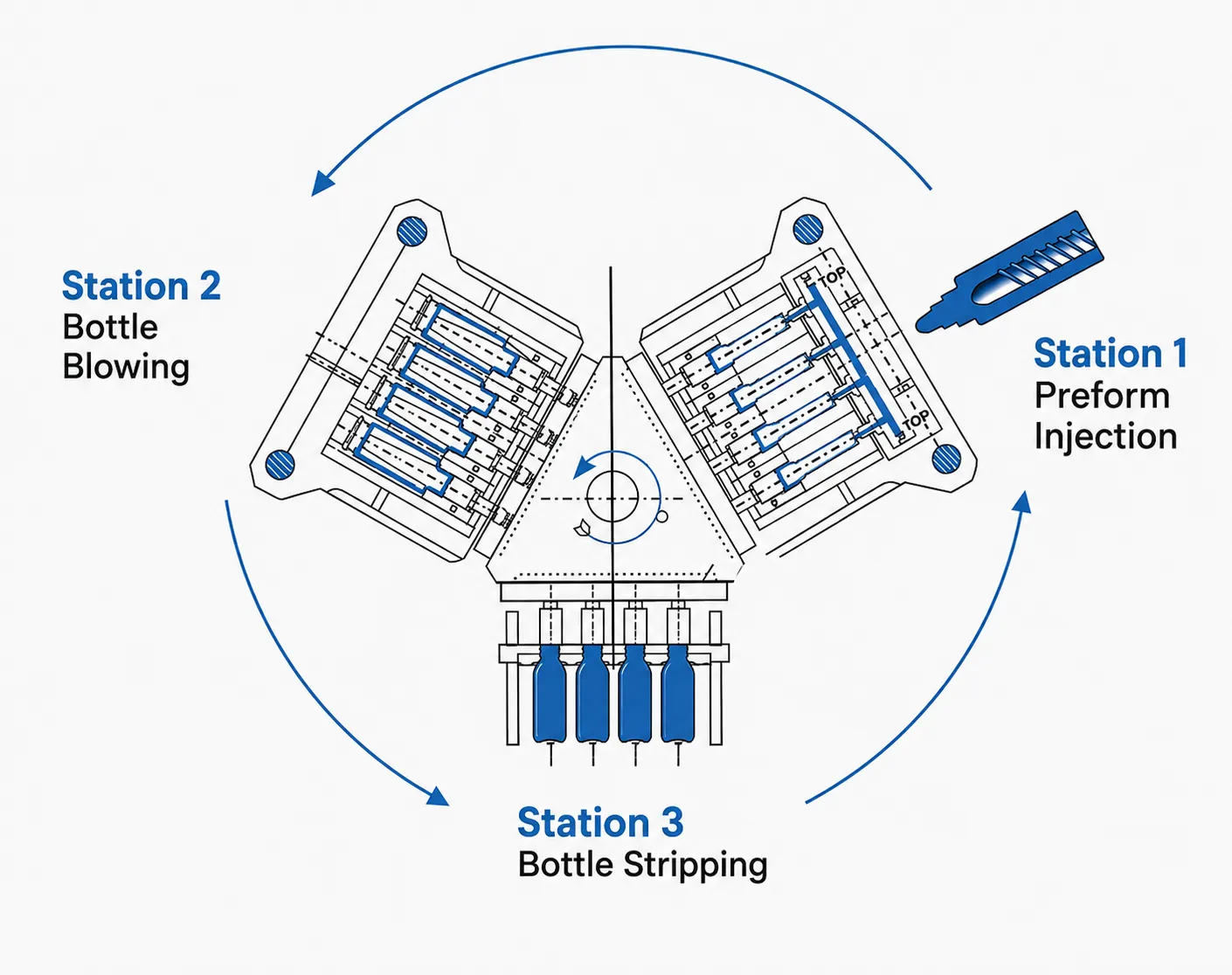
容量为 500–800 毫升的洗衣液吹塑成型容器处于该系列容器容量范围的上限——与容量为 300–500 毫升的洗洁精相比,更大的容器容积、更宽的外径和更重的预成型坯都会延长生产周期。韩国洗衣液吹塑成型容器的工艺优化重点在于通过控制吹塑模具的水温来最大限度地缩短吹塑停留时间,同时保持底部区域的尺寸稳定性。
更大的预制件注射重量——需要 ZQ110
A 600 ml HDPE laundry detergent container at 0.75 mm average wall weighs approximately 24–28 g. At 6 cavities on ZQ110: 6 × 26g = 156g shot weight — within ZQ110’s 500g rated shot weight with comfortable headroom. The same 6-cavity 600 ml mould on ZQ80 (250g shot weight limit): 156g = 62% of ZQ80 limit — feasible but leaves limited margin for larger format or heavier wall targets. Korea Ever-Power recommends ZQ110 for 6-cavity 600 ml detergent to preserve shot weight headroom for future wall thickness adjustments without machine change.
更长的吹风停留时间——600-800毫升宽体直径
600毫升韩国洗衣液(瓶身外径约75毫米)的吹塑停留时间为2.0-2.8秒,而300毫升洗洁精(瓶身外径约62毫米)的吹塑停留时间为1.4-2.0秒。瓶身较宽意味着与吹塑模具接触的壁面总面积更大,因此容器需要更长时间才能充分固化,从而确保在3号工位无变形脱模。将吹塑模具冷却水温度从22°C降低到14°C,可使600毫升容器的吹塑停留时间缩短约0.3-0.4秒。这是一个有效的优化方法,但需要验证瓶底平整度(模具温度越低,瓶底区域固化速度越快,但均匀性越差),确保其符合±0.3毫米的平整度标准。
38/400 颈部注射口平衡 — 比 28/410 更宽
38/400 韩国洗衣液的灌注颈口比 28/410 洗洁精的灌注颈口更宽——更大的颈口允许在热流道喷嘴处设置更大的注料口,从而缩短注料时间(38/400 比 28/410 缩短 0.1 秒,这是由于喷嘴剪切速率较低),但需要略高的保压压力才能使更宽的颈口横截面充满。韩国 Ever-Power 公司针对每种颈口尺寸校准热流道喷嘴处的注料口直径,以优化所有型腔的灌注均匀性——在同一台 ZQ 注塑机上,38/400 洗衣液 IBM 的注料口直径通常比 28/410 洗洁精 IBM 的注料口直径大 0.1-0.2 毫米。
第 06 节
IBM 织物柔顺剂和婴儿洗衣应用
韩国 IBM 织物柔顺剂——酸性 pH 值考量
韩国织物柔顺剂(pH 3-5,调节剂浓度为 5-15%,柠檬酸浓度为 0.5-2%)与碱性洗衣液相比,对高密度聚乙烯 (HDPE) 的化学环境不同。pH 3-5 的酸性织物柔顺剂不会触发碱性抗氧化皂化机制——主要的 ESCR 驱动因素是阳离子表面活性剂(DSDMAC、DEQA 织物柔顺剂,浓度为 5-15%),其对 HDPE ESCR 的侵蚀性低于阴离子 LAS。
韩国婴儿洗衣 IBM — 纯度和认证要求
韩国婴儿低敏洗衣液(pH 6.5-7.5,无酶,无香料)是韩国IBM家用产品中纯度和认证要求最严格的产品——其文件级别可与韩国温和配方的药品IBM相媲美:
- ▸零闪蒸强制执行——韩国婴儿品牌质量保证政策禁止任何可能在灌装前产生污染初级容器颗粒的生产过程。
- ▸用于婴儿用品接触容器的韩国产高密度聚乙烯(HDPE)食品接触材料需符合韩国食品药品安全部(MFDS)的正面清单要求,与食品接触用HDPE材料相同,适用于婴儿用品接触容器。
- ▸韩国生态标签(환경표지)包装兼容性:IBM HDPE单一材料容器+PP盖符合韩国环境部回收分类中易于回收的韩国包装标准——这是获得韩国生态标志认证的婴儿洗衣产品的必要条件。
- ▸容器消毒:一些韩国婴儿洗衣品牌要求空容器必须经过清洁认证(残留颗粒计数≤韩国婴儿产品规格)——IBM容器无需修剪操作,因此在灌装韩国标准产品前无需进行空气冲洗步骤,自然满足此要求。
第 07 节
韩国洗涤剂 IBM 包装趋势
浓缩形式增长
Korean laundry brands have shifted marketing investment toward 3× and 5× concentrated formats at 300–500 ml — the same wash loads as 1.5–2.5 L standard. This shift plays to IBM’s strengths: smaller IBM containers at 300–500 ml achieve higher cavity counts (ZQ80 at 8–10 cavities vs ZQ110 at 4–6 for 600 ml) and faster cycle times (4.6 s vs 5.2 s) — lower unit production cost at IBM scale. Korean concentrated detergent is also a premium-priced channel (KRW 12,000–22,000 per unit) where IBM’s superior neck precision and clean appearance commands a price premium over EBM containers at Korean retail.
PCR HDPE集成
根据韩国环境部绿色采购指南,韩国洗衣品牌正在其韩国IBM洗涤剂容器中引入10-30%消费后回收(PCR)HDPE混合物,以履行韩国ESG报告目标。PCR HDPE与原生HDPE以20%的浓度混合,可保持IBM的加工性能(混合后的MI值约为0.8-1.2,具体取决于PCR来源)和ESCR性能,适用于pH值为8.5-9.5的标准韩国洗衣剂。但需要注意的是,PCR HDPE来源的稳定性存在差异,因此需要使用原生HDPE载体来维持混合后的MI值在IBM加工所需的0.7-1.2范围内。在韩国品牌获得批准之前,Korea Ever-Power会在交付前使用客户提供的PCR/原生混合物进行生产试验,以验证PCR混合物的加工性能和ESCR。
补充装系统采用
继韩国洗洁精补充装系统取得成功之后,韩国洗衣液补充装系统(耐用型IBM主瓶+补充袋)也正在韩国市场获得认可。韩国洗衣液补充装IBM容器规格:壁厚至少0.85毫米(可承受泵/瓶盖组件的重复冲击),ESCR F50 ≥ 400小时(韩国补充装周期内可承受24-36个月的连续配方接触),瓶颈螺纹耐磨性经20次组装/拆卸循环测试。韩国洗衣液补充装的IBM容器与一次性韩国洗衣液IBM容器采用相同的ZQ110平台生产——更高的规格意味着略高的HDPE等级成本和略长的吹塑停留时间,但无需增加机器设备投资。
第 08 节
IBM ZQ系列产品选型,适用于韩国洗衣店
| ZQ 型号 | 300毫升浓缩液(每小时) | 500毫升织物柔顺剂。(每小时) | 600 毫升洗涤剂 ★ (cav/hr) | 韩国洗衣店简介 |
|---|---|---|---|---|
| EP-ZQ60 | 10 / ~8,700 | 5 / ~4,100 | 4 / ~3,000 | 韩国精品有机洗衣店,韩国小型婴儿洗衣初创公司 |
| EP-ZQ80 | 14 / ~12,200 | 6–8 / 约5,800 | 4–5 / 约3,500 | 韩国中档浓缩洗涤剂OEM,韩国高档衣物柔顺剂 |
| EP-ZQ110 ★ | 18+ / ~15,700 | 8 / ~7,200 | 6–8 / 约5,400 | 韩国国民品牌标准洗涤剂,韩国主要织物护理OEM厂商,婴儿洗衣国民品牌 |
| EP-ZQ135 | 20+ / ~17,400 | 10 / ~9,000 | 8–10 / 约7,200 | 韩国洗衣集团旗舰企业,韩国合同包装业务年洗衣量超过6000万台 |
★ ZQ110 at 6–8 cavities for 600 ml laundry detergent is the Korean national brand laundry IBM production standard. Annual capacity at 6 cav, 5.2s: ~28.5M units/year Korean 2-shift. At 8 cav: ~38M units/year — within the annual volume range of Korea’s top-5 liquid laundry detergent SKUs.
工程常见问题解答
IBM洗衣液——工程问题
Q 01
对于HDPE IBM容器的选择,碱性洗涤剂的ESCR与洗洁精表面活性剂的ESCR有何不同?
Alkaline laundry detergent produces HDPE container failure through two mechanisms simultaneously, while dish soap produces failure through one. The first mechanism — surfactant ESCR — operates identically in both: anionic surfactants (LAS, SLES) at 10–25% concentration penetrate HDPE crystal boundaries, reduce crack propagation surface energy and enable stress crack initiation at moulding residual stress zones. This is the mechanism addressed by selecting low-MI high-molecular-weight HDPE (MI 0.5–1.0) and is common to both dish soap and laundry detergent IBM. The second mechanism — alkaline antioxidant hydrolysis — is specific to laundry detergent at pH 8.5–10.5 and absent at dish soap pH 7–9. At pH above 8.0, hydroxide ions saponify ester-based antioxidant molecules at the HDPE surface — specifically fatty acid ester antioxidants like Irganox 1010 (pentaerythritol tetrakis(3-(3,5-di-tert-butyl-4-hydroxyphenyl)propanoate)). Loss of antioxidant protection in the HDPE surface zone reduces oxidative stability and allows chain scission at stress concentration points, producing surface embrittlement and whitening over 12–24 months of Korean ambient storage. The solution is to specify HDPE with a hindered phenol antioxidant that does not contain labile ester bonds at the phenol ring — grades using secondary antioxidants based on thiodipropionic acid diesters (DSTDP, DLTDP) provide better alkaline pH stability than primary antioxidant-only packages. In practical Korean HDPE procurement: Korean HDPE suppliers targeting HDPE for laundry detergent blow moulding explicitly note “suitable for alkaline detergent” on their technical data sheets — use only these grades for Korean laundry detergent IBM at pH above 9.0. Grades suitable for dish soap (pH 7–9) are not automatically qualified for alkaline laundry detergent (pH 9–10.5) without antioxidant package verification.
Q 02
韩国洗涤剂颈部标准采用什么标准?这些标准对 500-600 毫升洗涤剂的 ZQ 腔数有何影响?
Korean laundry detergent IBM uses two primary neck standards: 38/400 (pour cap) for liquid laundry detergent and 28/410 (pump) for fabric softener. The 38/400 neck OD is 38.0 mm nominal — approximately 10 mm wider than the 28/410 dish soap neck at 28.0 mm. This wider neck has a significant impact on ZQ machine platen cavity count for large-format laundry detergent IBM. For a 600 ml HDPE laundry detergent container with body OD ~75 mm: the 38/400 neck zone itself occupies a 45–48 mm footprint in the IBM injection mould cavity (neck OD + required neck insert steel around the thread = 38.0 + 5–7 mm each side). On the ZQ110 turret platen (diameter approximately 520 mm usable radius), a linear arrangement of 38/400 neck cavities at ~80 mm pitch allows 6 cavities maximum in a 2-row arrangement — versus 8 cavities for the same 600 ml body OD with 28/410 neck. The 38/400 neck’s wider steel requirement around the neck insert is therefore the binding platen constraint for large Korean laundry detergent at 500–800 ml, overriding the body OD constraint. Korea Ever-Power provides the cavity layout drawing for each container+neck+machine combination at the enquiry stage — the platen layout calculation for 38/400 laundry detergent IBM is routinely done for ZQ80, ZQ110 and ZQ135 to confirm achievable cavity count before project commitment. Practical recommendation: for Korean 600 ml 38/400 laundry detergent IBM at ZQ110, plan for 6 cavities as the realistic maximum and verify with Korea Ever-Power’s platen layout service before mould investment.
Q 03
IBM 能否生产出具有商业可行性的 1 升装洗衣液容器(包含多个腔室)?
IBM can produce 1-litre laundry detergent containers but at cavity counts (2–4 cavities on ZQ135) that limit annual output to approximately 12–18M units/year at 2-shift Korean operation — borderline for Korean national brand flagship SKU volumes. The constraints that limit 1-litre IBM cavity count are the intersection of three factors at 1 L container size. First, platen size: a 1-litre HDPE laundry container body OD is approximately 88–95 mm — at 80–90 mm pitch spacing between cavity centres, the ZQ135’s platen (largest Korea Ever-Power model) accommodates a maximum of 4 cavities in a 2×2 arrangement. Second, shot weight: 1-litre HDPE at 0.8 mm average wall = approximately 50–60 g per container; 4 cavities × 55 g = 220 g total shot weight — below ZQ135’s 750g limit with headroom, but approaching ZQ110’s 500g limit at 4 cavities. Third, blow dwell: 1-litre body OD at 90 mm requires blow dwell of 3.0–4.0 s for adequate base zone solidification — producing a total cycle time of 6.5–8.0 s, significantly longer than 500 ml (5.0–5.5 s). At 4 cavities, 7.0-second cycle, ZQ135: 4 × (3600÷7.0) × 0.88 × 3,500 hr = ~6.4M units/year. For Korean 1-litre laundry at volumes above 15M/year, EBM with handle is the correct commercial decision — IBM 1-litre handleless is economically viable only for Korean premium concentrated 1-litre formats where the per-unit IBM quality premium (precision neck, no body parting line) justifies the lower production rate.
Q 04
为什么韩国婴儿洗衣液的IBM容器规格比标准洗涤剂的IBM容器规格更严格?
Korean baby laundry IBM container specifications are stricter than standard Korean detergent IBM across five dimensions. First, zero flash: standard Korean laundry detergent may accept EBM containers at value channel price points, but Korean baby laundry brand QA policies consistently specify IBM to eliminate the EBM trim particle contamination risk — no Korean baby product brand has accepted EBM primary containers at any Korean channel since the 2021 Korean consumer plasticiser contamination scare in baby products. Second, HDPE food contact material certification: Korean baby laundry brands specify the container HDPE as food-contact grade with full Korean MFDS positive list additive documentation — the same documentation level as Korean food packaging IBM, not just Korean household chemical IBM. Third, additive restriction: Korean baby laundry brands restrict HDPE masterbatch colourant to food-grade pigments only (no industrial dye colourants), and restrict UV stabilisers to food-contact-listed grades — stricter than adult laundry brands which use industrial-grade colour and UV packages. Fourth, colour consistency: Korean baby laundry brands typically specify white or light pastel container colours (white, pale blue, pale green) with Delta E ≤ 1.5 across Korean production batches — achieved by IBM’s closed-loop masterbatch dosing, not by commodity hand-dosing used in lower-specification EBM household laundry production. Fifth, container certification documentation: Korean baby laundry IBM containers require a container specification sheet (signed by Korea Ever-Power applications engineering) confirming HDPE grade, additive package, production process (IBM, zero trim) and dimensional compliance — a documentation package that Korean adult laundry contracts do not require. This five-point stricter specification set is standard Korea Ever-Power pre-delivery documentation for Korean baby laundry IBM projects and is included in Korea Ever-Power’s Korean baby laundry container qualification package without additional documentation charge.
Q 05
韩国织物柔顺剂配方化学成分如何影响IBM容器材料的选择(与洗衣液相比)?
Korean fabric softener and Korean laundry detergent present different chemical environments for HDPE IBM containers — primarily because fabric softener is acidic (pH 3–5) while laundry detergent is alkaline (pH 8.5–10.5), and because fabric softener uses cationic surfactants while laundry detergent uses anionic surfactants. These chemistry differences produce three material selection implications for Korean fabric softener IBM versus Korean laundry detergent IBM. First, antioxidant package: at acidic pH 3–5, Korean fabric softener does not cause alkaline antioxidant saponification — the ester-based antioxidant packages that must be avoided for alkaline laundry detergent (Irganox 1010 in alkaline environment) are perfectly stable in fabric softener at pH 3–5. Standard HDPE antioxidant packages (Irganox 1010 or 1076) are acceptable for Korean fabric softener IBM without pH-specific antioxidant selection. Second, ESCR from cationic surfactants: cationic surfactants (quaternary ammonium compounds DSDMAC, DEQA at 5–15% in Korean fabric softener) have lower HDPE ESCR aggressiveness than anionic LAS at equivalent concentration — because the cationic surfactant’s positive charge is partially repelled by HDPE’s non-polar surface, reducing interfacial penetration. Korean fabric softener IBM at 10% DSDMAC produces F50 ESCR failures at longer timeframes than Korean dish soap at 20% LAS — allowing slightly higher MI HDPE (MI up to 2.0) while maintaining acceptable ESCR for 24-month Korean fabric softener shelf life. Third, container appearance in the Korean context: Korean fabric softener containers (premium pricing, Korean premium personal care channel) are marketed on appearance. IBM’s zero body parting line and consistent surface finish are particularly important for Korean fabric softener because Korean premium brands use transparent or translucent sleeve labels (from which the HDPE container surface is partially visible) — an EBM body parting line showing through a transparent Korean fabric softener sleeve label is a Korean brand acceptance rejection reason regardless of the functional ESCR compliance of the container.
Q 06
What are the Korean measure-pour cap sealing requirements that make IBM’s neck precision commercially critical for laundry detergent?
Korean liquid laundry detergent is dispensed using a measure-pour cap — a cap with an integrated dosing chamber (typically 40–100 ml) that the Korean consumer fills by inverting the bottle, then pours into the Korean washing machine drum. The measure-pour cap’s dosing chamber is sealed against the bottle neck by an internal elastomeric sealing ring that contacts the neck’s sealing land (the flat annular surface at the neck’s top edge). For leak-free performance, this elastomeric seal must contact the sealing land uniformly around the full 360° neck circumference — a sealing condition that requires the sealing land to be flat (≤ 0.05 mm deviation from plane) and the neck OD to be within the cap manufacturer’s specified engagement range (typically nominal ±0.08–0.10 mm). IBM’s injection-moulded 38/400 neck achieves both: sealing land flatness ≤ 0.03 mm (controlled by the injection mould’s neck insert machining tolerance of ±0.01 mm) and neck OD ±0.05 mm across all production cavities. EBM’s 38/400 neck produced by blow pressure action has a sealing land flatness of 0.05–0.20 mm (variable with blow pressure and parison distribution cycle-to-cycle) and neck OD of ±0.20–0.35 mm — frequently outside the measure-pour cap sealing engagement range on a fraction of production containers. The commercial consequence of a Korean measure-pour cap sealing failure is significant: Korean liquid laundry detergent leaking from a loose measure-pour cap at Korean retail produces a Korean product contamination event (laundry detergent dripping onto Korean pharmacy or hypermarket shelf), a Korean brand quality non-conformance report from the Korean retailer, and a customer complaint rate that triggers Korean brand internal quality investigation. Korea Ever-Power documents 38/400 neck sealing land flatness and OD values in the pre-delivery production trial dimensional report for each Korean laundry detergent IBM project — confirming that all production cavities meet the Korean measure-pour cap manufacturer’s sealing engagement specification before Korean brand approval is issued.
IBM 咨询洗衣液 · 韩国 EVER-POWER
计划在IBM生产韩国洗衣液吗?
韩国 Ever-Power 为韩国国家洗衣品牌和韩国洗衣 IBM OEM 包装生产商提供碱性 HDPE 等级验证、38/400 计量倾倒盖颈部尺寸认证和 ZQ110 生产试验。