
IBM vs EBM: 12 differenze chiave
Spiegazione
Lo stampaggio a soffiaggio a iniezione e lo stampaggio a soffiaggio per estrusione sono i due principali processi di stampaggio a soffiaggio utilizzati nel settore degli imballaggi in Corea, ma si rivolgono a mercati di contenitori diversi, producono colli con una precisione differente, generano diversi livelli di scarto di materiale e giustificano investimenti di capitale differenti. Questa guida confronta entrambi i processi in base a 12 fattori tecnici e commerciali, in modo che gli ingegneri del packaging coreani possano scegliere il processo più adatto a ciascuna esigenza produttiva senza ambiguità.
Economia industriale coreana
GMP e conformità farmaceutica
Redazione tecnica di Ever-Power Korea · Ansan-si · Luglio 2026
IBM contro EBM: un confronto a colpo d'occhio.
±0,05 mm
Tolleranza OD del collo IBM — rispetto a ±0,15–0,25 mm in EBM
Zero Flash
Utilizzo dei materiali IBM: EBM genera scarti di memoria flash 7-15%.
Fino a 30
Cavità IBM a 10 ml — EBM tipicamente 1–4 cavità nel formato piccolo
12
In questa guida vengono confrontati i fattori tecnici e commerciali.
1. IBM vs EBM: la differenza fondamentale nel processo
Injection blow molding and extrusion blow molding both produce hollow plastic containers by inflating softened resin against a mould cavity with compressed air. That is where the similarity ends. The fundamental difference between the two processes lies in how the preform — the intermediate shape that is subsequently inflated into a bottle — is created. In IBM, the preform is injection moulded around a core rod with precision tooling that defines the neck geometry exactly. In EBM, the preform is a hollow tube of extruded plastic (the parison) that is clamped by the blow mould and inflated, with the neck geometry formed by the mould’s parting line rather than by a dedicated precision tool.
This single difference — injection-moulded preform versus extruded parison — cascades into twelve measurable technical and commercial differences that determine which process is correct for a Korean packaging factory’s specific container requirements. The twelve differences are not subjective preferences; they are engineering realities that flow directly from the process physics. Understanding them removes the ambiguity from the IBM vs EBM decision for Korean pharmaceutical, household chemical, cosmetic and food packaging operations.
Nella maggior parte delle applicazioni, i processi IBM ed EBM non sono in competizione tra loro: si rivolgono a mercati di contenitori diversi. IBM domina il mercato coreano dei contenitori farmaceutici di piccolo formato e degli imballaggi con chiusura di precisione. EBM domina il mercato coreano dei contenitori industriali di grande formato, delle taniche e dei contenitori con maniglie integrate. La scelta del processo diventa realmente ambigua solo nella fascia media: contenitori per prodotti chimici per uso domestico da 250-1.000 ml, vasetti per alimenti da 100-500 ml e imballaggi cosmetici a bocca larga. In questi casi, entrambi i processi sono tecnicamente validi, ma differiscono in termini di qualità, costi operativi e fabbisogno di capitale, aspetti che gli ingegneri delle fabbriche coreane devono comprendere per poter prendere una decisione di investimento giustificata.
2. Differenze 1 e 2: precisione del collo e zero flash
Differenza 1 — Precisione della finitura del collo: ±0,05 mm contro ±0,15–0,25 mm
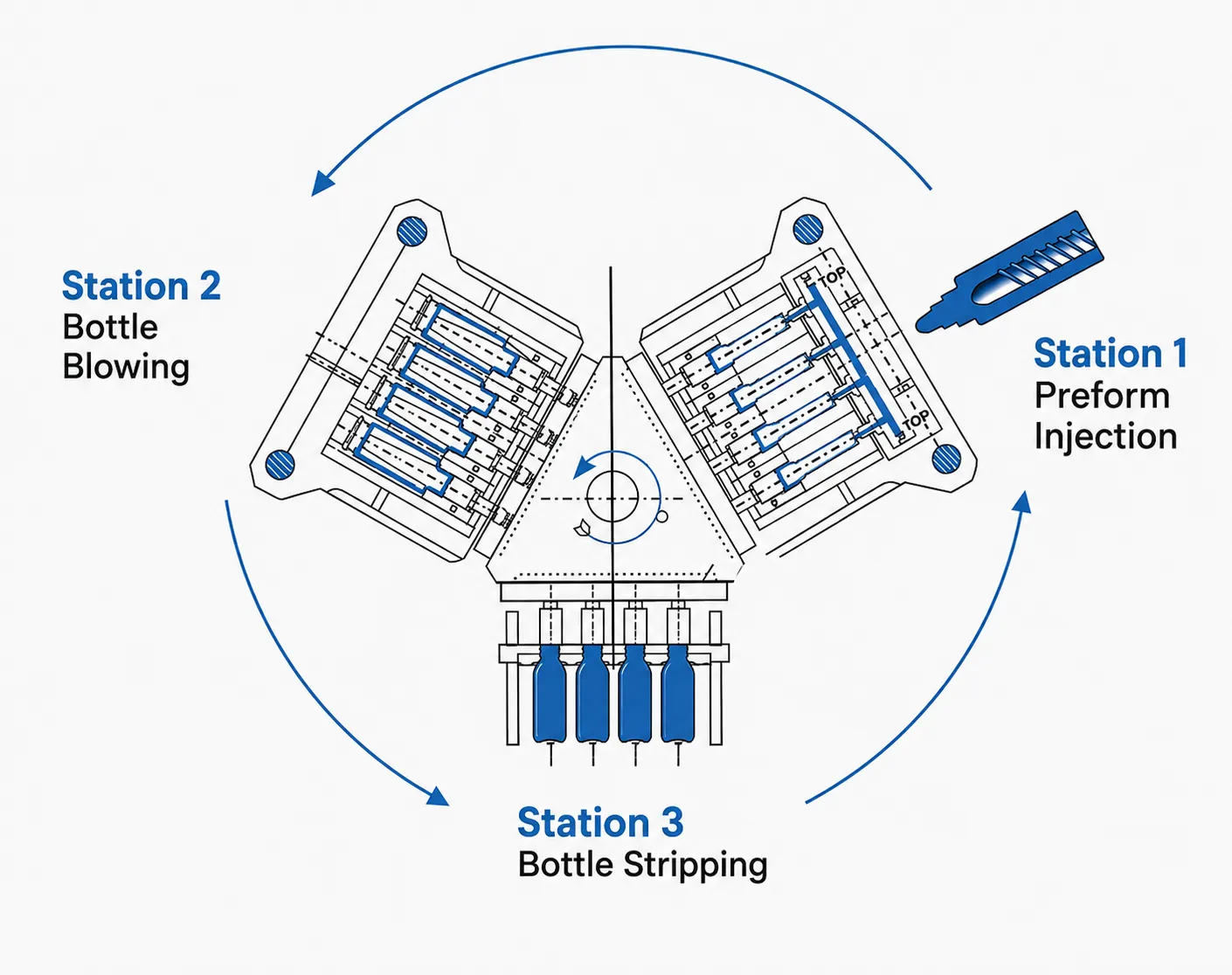
In IBM, the core rod passes through the neck zone during both the injection phase and the blow phase. The neck’s thread OD, bore diameter, sealing surface and thread profile are all defined at Station 1 by the injection mould insert — a precision-machined steel tool that maintains ±0.02 mm dimensional tolerance on the neck cavity. Because the neck is formed by injection and the core rod holds its geometry throughout the blow phase, the blow pressure at Station 2 never contacts the neck surfaces. The finished bottle’s neck is dimensionally identical to the injection mould cavity — ±0.05 mm OD tolerance across all cavities, on every cycle.
In EBM, the neck geometry is formed by the blow mould’s parting line — the seam where the two halves of the blow mould meet around the extruded parison. The parting line must close around the parison at the neck position, and the dimensional accuracy of the neck is limited by the precision of the parting line closure and the variation in parison thickness at the neck zone. EBM neck OD tolerance is typically ±0.15–0.25 mm — three to five times wider than IBM. For Korean pharmaceutical CRC closures that require ±0.06 mm neck OD tolerance for push-and-turn engagement, and for Korean pump-dispenser closures that require ±0.08 mm neck OD for crimp-ferrule seal integrity, EBM neck precision is insufficient without secondary neck finishing operations (reaming or trimming) that add cycle time, equipment cost and scrap risk.
Differenza 2 — Generazione del flash: Zero vs 7–15% di peso dello scatto
Nel processo IBM, la preforma contiene esattamente la quantità di resina necessaria per la bottiglia finita. Non vi è materiale in eccesso in corrispondenza dei bordi dello stampo: lo stampo a iniezione si riempie con precisione e, quando la preforma viene gonfiata alla Stazione 2, il polimero si ridistribuisce dalla preforma alla bottiglia senza che alcun materiale fuoriesca dalla cavità dello stampo a soffiaggio. L'assenza di bave è una caratteristica strutturale del processo IBM, non un risultato qualitativo: è fisicamente impossibile per IBM generare bave perché non vi è materiale di preforma in eccesso che possa essere schiacciato.
In EBM, flash is unavoidable. The extruded parison must extend beyond the top and bottom of the blow mould to allow the mould to close around it and pinch the excess off. Flash forms at the neck pinch-off (above the thread finish) and at the base pinch-off (below the base panel), accounting for 7–15% of the shot weight depending on bottle geometry and parison programming. This flash is either discarded as scrap or returned to the extruder as regrind — both options carry costs. Scrap flash increases resin cost per bottle; regrind adds process steps, consumes energy, and introduces resin quality risks (molecular weight reduction, colour change, increased brittleness on the third and fourth regrind cycle) that affect the final bottle’s mechanical properties. For Korean pharmaceutical production specifically, flash from EBM trim operations generates plastic particles that represent a contamination risk in cleanroom production environments — a risk that IBM’s zero-flash process eliminates entirely.
3. Differenze 3 e 4: Utilizzo del materiale e uniformità dello spessore della parete
Differenza 3 — Utilizzo del materiale: 100% vs 85–93%
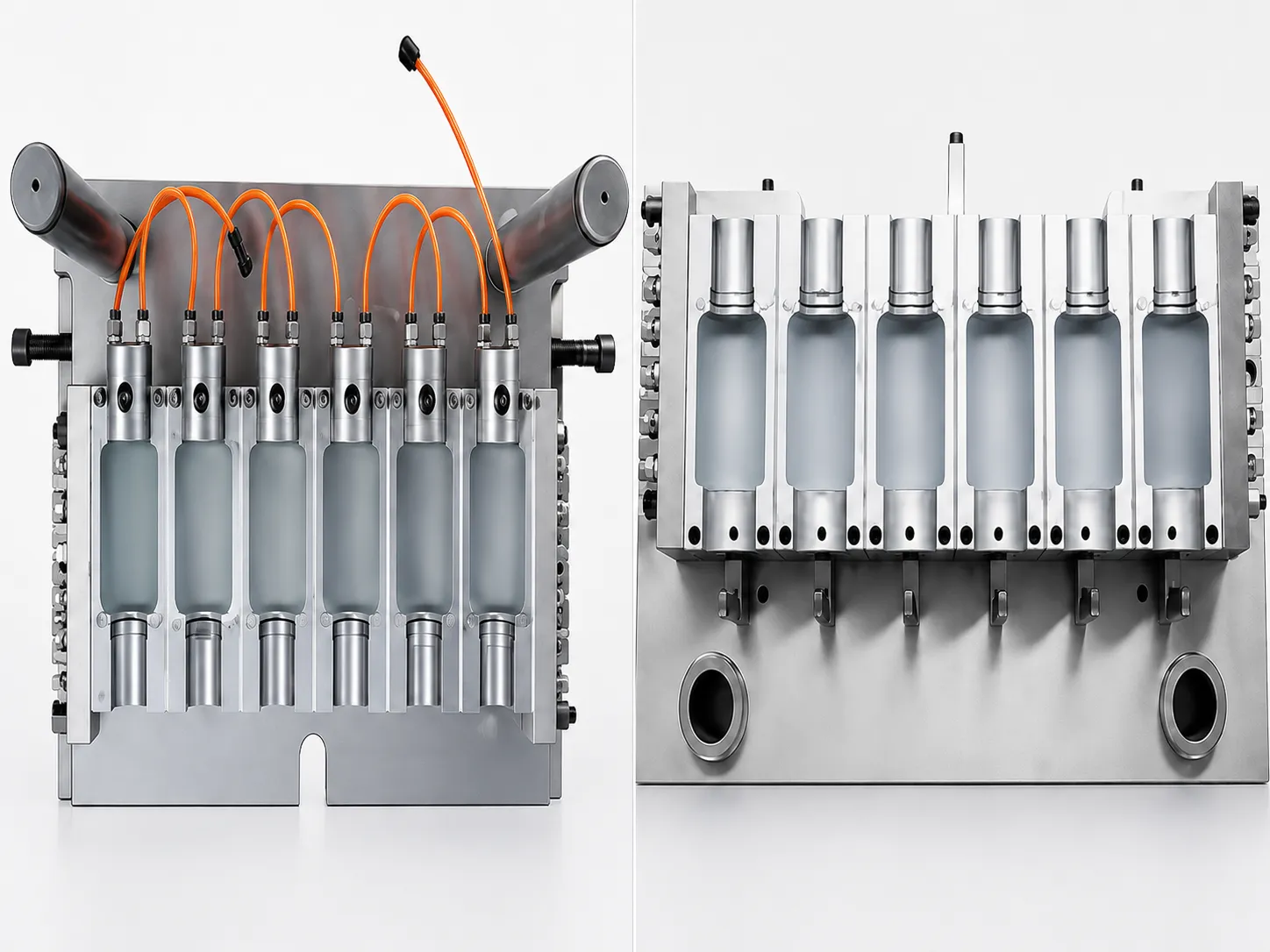
IBM’s zero-flash production means that every gram of resin injected at Station 1 appears in the finished bottle at Station 3. Material utilisation is 100%. The cost of resin in an IBM production run is the cost of the finished bottles plus the cost of the injection system runner material (which in hot runner systems is retained in the hot runner manifold and never solidifies, eliminating runner scrap entirely). In Korean HDPE pharmaceutical production where resin cost is the largest variable cost component, 100% material utilisation is a significant operating advantage over EBM.
L'utilizzo del materiale nella tecnologia EBM dipende dalla geometria della bottiglia e dalla programmazione del preformato: bottiglie cilindriche semplici con collo e base standard producono una quantità di materiale in eccesso pari a 7-10% del peso di iniezione; geometrie complesse con pannelli di base di grandi dimensioni o sezioni trasversali ovali possono generare una quantità di materiale in eccesso che si avvicina a 15%. Considerando i prezzi coreani dell'HDPE di 1.400-1.800 KRW/kg e una produzione coreana di 1 milione di bottiglie da 500 ml tramite EBM (circa 22 tonnellate di HDPE a 22 g per bottiglia), una quantità di materiale in eccesso pari a 10% rappresenta circa 2,2 tonnellate di HDPE in eccesso, con un costo del materiale di 3,1-4 milioni di KRW per milione di bottiglie. Annualizzato per una fabbrica coreana di prodotti chimici per la casa che produce 20 milioni di bottiglie da 500 ml all'anno, il solo costo del materiale in eccesso per la tecnologia EBM è di 62-80 milioni di KRW, un costo annuale ricorrente che IBM elimina completamente.
Differenza 4 — Uniformità dello spessore della parete: definita dalla preforma rispetto a quella programmata dal preformato
In IBM, the wall thickness distribution of the finished bottle is defined by the preform geometry — itself defined by the injection mould cavity and core rod dimensions. The preform’s wall thickness at each axial position is fixed by the mould tooling, not by a dynamic process parameter. This means IBM wall thickness consistency is a tooling characteristic: once the mould is correctly designed and manufactured, the wall thickness distribution is repeatable cycle to cycle, cavity to cavity, and shift to shift without operator adjustment. IBM bottle wall thickness coefficient of variation (CV%) is typically 3–6% across all cavities in a multi-cavity mould. In EBM, wall thickness is controlled by parison programming — a dynamic process where the die gap of the extruder head varies continuously during parison extrusion to produce a parison that, when inflated against the blow mould, produces the target wall thickness at each point. Parison programming is a skilled adjustment process that requires trained EBM operators to maintain; wall thickness CV% in Korean EBM production is typically 8–15%, and higher during startup and after material lot changes. For Korean food-grade containers where wall thickness uniformity directly affects stack compression strength (required for Korean retail pallet display), and for Korean pharmaceutical containers where wall thickness affects chemical permeation rate calculations in Korean KFDA container qualification, IBM’s tooling-defined wall uniformity is a measurable quality advantage over EBM’s operator-dependent parison programming.
4. Differenze tra 5 e 6: Intervallo di volume e frequenza di uscita
The container volume range and output rate differences between IBM and EBM reflect the two processes’ different architectures — IBM’s multi-cavity precision approach versus EBM’s high-volume large-format capability.
| Fattore di volume/output | IBM | EBM |
|---|---|---|
| Volume minimo pratico | 1 ml — microfarmaceutico | ~30–50 ml — limite di stabilità della parità |
| Volume massimo (standard) | 2.000 ml | 500 L+ (fusti industriali) |
| Cavità a 10 ml | Fino a 30 (ZQ135) | 1–4 (la stabilità del parison limita la multicavità) |
| Produzione di 10 ml (flaconi/ora) | Fino a circa 27.000 | ~3.000–6.000 |
| Cavità a 500 ml | 5–8 (IBM) | 2–4 (EBM) |
| Produzione di 500 ml (bottiglie/ora) | ~5.400–7.200 (6-8 cavalleria) | ~3.200–4.800 (2-4 cavalleria) |
Differenza 5 — Intervallo di volume del contenitore
IBM’s effective volume range is 1–2,000 ml, with the lower end constrained by the minimum practical injection shot weight for a stable preform and the upper end constrained by the blow mould size that can be accommodated on the turret platform. EBM’s lower volume limit is approximately 30–50 ml, because very small parisons are unstable during extrusion — they sag, thin unevenly, and produce unacceptable wall thickness variation when inflated. Below 50 ml, EBM cannot reliably produce consistent bottles; IBM is the only blow molding process for Korean pharmaceutical ampoules and mini-bottles at 1–30 ml. EBM’s upper volume range is practically unlimited — industrial EBM machines produce jerry cans, drums and automotive fuel tanks at 5–500 litres, which IBM cannot approach.
Differenza 6: Velocità di stampa nei piccoli formati
At small container formats (10–100 ml) IBM’s multi-cavity advantage is most pronounced. A 30-cavity IBM machine at 10 ml produces approximately 27,000 bottles per hour at a 4-second cycle — an output rate that an EBM machine with 4 cavities at a 6-second cycle produces approximately 2,400 bottles per hour. This 11-to-1 output ratio at the smallest formats means that a Korean pharmaceutical factory requiring 20 million 10 ml containers per year needs one ZQ135 IBM machine running two Korean shifts, versus approximately ten EBM machines at equivalent cavities running the same schedule. The IBM investment is higher per machine but dramatically lower per unit of annual capacity at small formats. At larger formats (500 ml+), IBM’s cavity count advantage narrows: IBM at 6 cavities and EBM at 4 cavities produce within 30–50% of each other’s output, making the economics comparison more dependent on the operating cost differences (flash, scrap, operator skill) than on raw output rate.
5. Differenze 7 e 8: Capacità di progettazione dei contenitori
Differenza 7: possibilità di inserimento di una maniglia integrata.
EBM’s parison clamping architecture allows the blow mould to include a handle cavity that is integral with the bottle body — the parison is clamped to include the handle loop and inflated to fill both the bottle body and the handle simultaneously. This produces a handle that is structurally continuous with the bottle wall, with no weld line or adhesive joint — the correct design for Korean household chemical containers above 2 litres (cleaning fluid, laundry detergent, bulk bleach) and Korean food containers (cooking oil, vinegar, soy sauce) at 2–5 litres where a handle is both functionally necessary and ergonomically expected by Korean consumers. IBM’s rotary turret architecture does not permit integral handles: the core rod passes through the container’s interior throughout the process, and a handle that bridges from one side of the container to the other would prevent core rod extraction at Station 3. Korean IBM containers above 1 litre typically use a post-production applied handle (a separately moulded PP grip clipped or heat-staked onto the IBM bottle after production) rather than an integral handle — a two-component approach that adds assembly cost and eliminates the structural continuity of the EBM integral handle. For Korean containers where an integral handle is the design requirement, EBM remains the correct process regardless of the other advantages IBM offers.
Differenza 8 — Finitura superficiale e giunzione della base
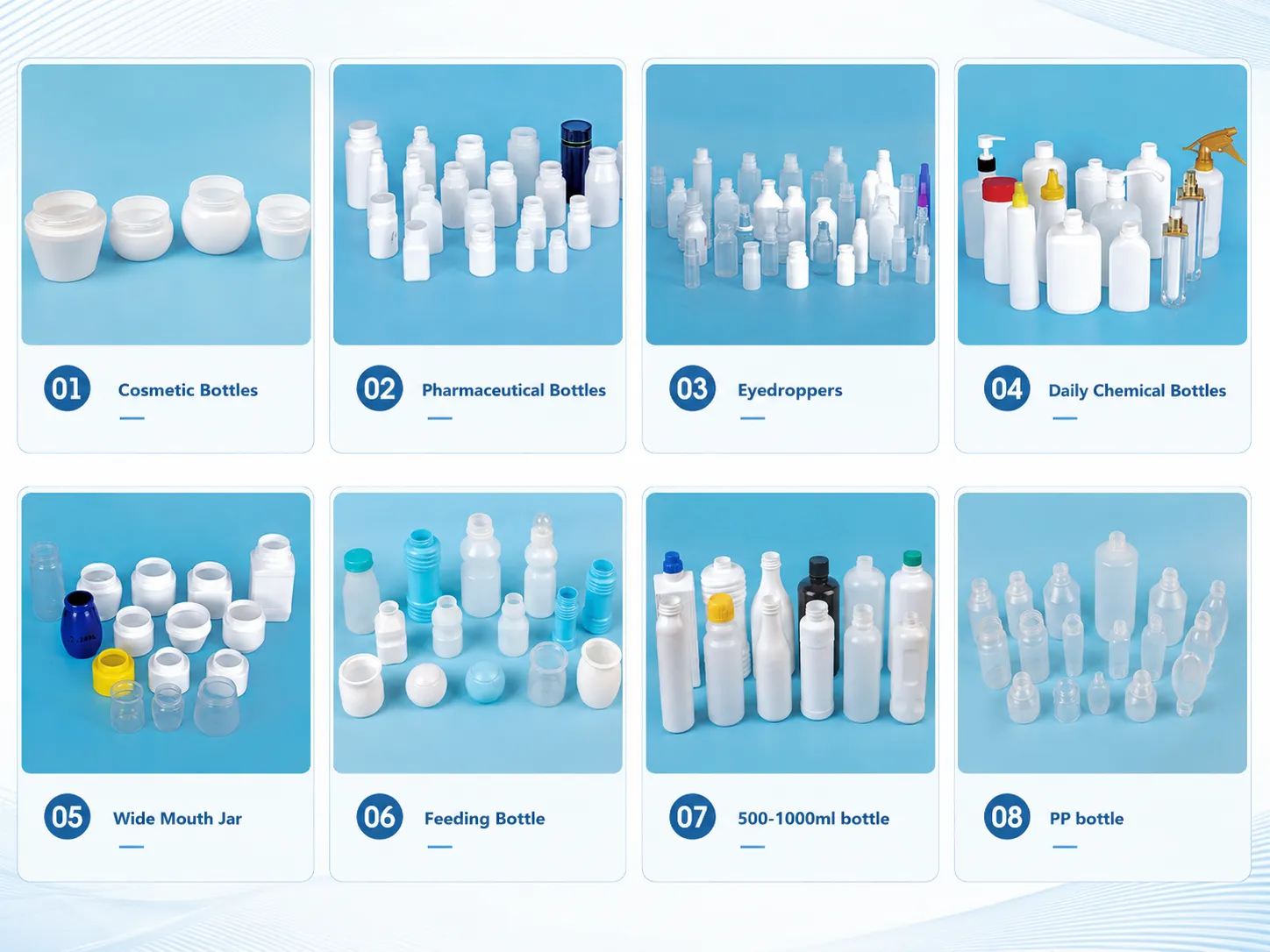
IBM containers have no base seam and no parting-line witness marks on the body walls. Because the IBM blow mould does not have a parting line that crosses the container body — the core rod provides the interior surface and the blow mould provides only the outer cavity surface — the IBM bottle’s exterior is defined entirely by the blow mould cavity surface. Surface quality of an IBM blow mould at the body can be polished to Ra ≤ 0.05 μm (mirror finish), producing a bottle body that is visually indistinguishable from a glass container when moulded in high-clarity PS or PCTG. EBM containers have a horizontal base seam at the pinch-off line, a vertical parting line on the body where the two mould halves meet, and in some cases a trim mark at the neck where the neck flash was removed. These seam lines are acceptable in utility packaging (household chemical, agricultural, industrial) but are a visual quality concern for Korean premium cosmetic jars and Korean pharmaceutical containers where label panels are designed to exactly cover the parting line and the base seam is visible from shelf-side. IBM’s seam-free exterior is a design quality advantage that supports Korean premium packaging positioning without surface finishing operations after moulding.
6. Differenze 9 e 10: Conformità normativa e investimenti in macchinari
Differenza 9: Conformità alle norme GMP del settore farmaceutico coreano
La produzione di contenitori farmaceutici in Corea è regolamentata dalle normative coreane KFDA (Ministero della Sicurezza Alimentare e Farmaceutica) in materia di confezionamento farmaceutico, che specificano le tolleranze dimensionali per le finiture del collo dei contenitori utilizzati con i sistemi di chiusura farmaceutica. Gli standard coreani per le chiusure farmaceutiche, in particolare per i contenitori CRC (chiusura a prova di bambino), i flaconi con tappo a crimpare e i flaconi farmaceutici con dosatore a pompa, richiedono tolleranze del diametro esterno del collo di ±0,06–0,08 mm affinché la chiusura funzioni come previsto e superi i test di qualificazione GMP coreani. IBM soddisfa costantemente queste tolleranze come capacità di processo nativa. La tecnologia EBM richiede una finitura secondaria del collo (alesatura, rifilatura o calibrazione del collo post-stampaggio) per raggiungere queste tolleranze, aggiungendo attrezzature, tempi di ciclo e rischio di scarti alla produzione EBM di grado farmaceutico.
Additionally, Korean GMP pharmaceutical production environments classify particle generation as a contamination risk. IBM’s zero-flash production eliminates the flash trim station that EBM requires — a mechanical trimming operation that generates plastic particles from the flash removal. In Korean pharmaceutical ISO Class 8 cleanroom environments, operating an EBM flash trim station requires the trim station to be enclosed and exhausted to prevent particles from reaching the fill zone — an engineering requirement that IBM production avoids entirely. Korean pharmaceutical contract packaging facilities that have transitioned from EBM to IBM report elimination of particle-related batch rejection events as a primary quality benefit alongside the neck precision improvement.
Differenza 10 — Investimento in macchinari: IBM vs EBM
Le macchine IBM hanno un costo di capitale iniziale più elevato rispetto alle macchine EBM di pari output per lo stesso formato. Una Ever-Power coreana macchina per stampaggio a iniezione e soffiaggio at the ZQ60 level (14 cavities, 37 KW) represents a higher investment than a comparable Korean EBM machine at 2-cavity 500 ml production. This investment difference is most significant for startup Korean packaging factories with limited capital and long production run lengths at a single format — where EBM’s simpler architecture and lower upfront cost may justify the higher per-bottle operating cost of flash management and lower output rate. The IBM vs EBM investment calculus changes when Korean factories account for: (a) the trim station cost that EBM requires but is not included in the EBM machine price; (b) the annual flash material cost at Korean resin prices; (c) the additional operator required for the EBM trim station versus IBM’s single-operator production; and (d) the neck calibration equipment that Korean pharmaceutical EBM requires. When these downstream costs are included, the IBM vs EBM total cost of ownership comparison over a 5-year production plan typically favours IBM for Korean pharmaceutical applications and for Korean household chemical production above 2 million units per year.
| Fattore di costo | IBM | EBM |
|---|---|---|
| Prezzo di acquisto della macchina | Più alto | Inferiore |
| Stazione di trim necessaria | NO | Sì — da 15 a 40 milioni di KRW in più |
| Costo annuale del materiale flash (500 ml, 5 milioni di unità) | Zero | 15–25 milioni di KRW/anno |
| Operatori per macchina | 1 | 1 macchina + 1 stazione di rifinitura = 2 |
| Costo totale di proprietà a 5 anni (settore farmaceutico) | Inferiore | Più alto se si includono tutti i costi operativi |
7. Differenze 11 e 12: efficienza energetica e impronta di carbonio
Differenza 11 — Consumo energetico per 1.000 bottiglie
Il consumo energetico per 1.000 bottiglie finite è la metrica di confronto energetico più rilevante per le fabbriche di imballaggi coreane, perché tiene conto della differenza di velocità di produzione tra IBM ed EBM: confrontare il consumo energetico totale della macchina senza normalizzare per la produzione penalizzerebbe erroneamente la macchina più produttiva. Nella produzione di flaconi di shampoo in HDPE da 500 ml, una macchina coreana Ever-Power Macchina IBM EP-ZQ60 running 3-cavity 500 ml at 37 KW total power produces approximately 2,700 bottles per hour — energy consumption of approximately 13.7 kWh per 1,000 bottles. A Korean EBM machine running 2-cavity 500 ml at 25 KW produces approximately 1,800 bottles per hour — energy consumption of approximately 13.9 kWh per 1,000 bottles. At this format, the energy difference is small. However, Korea Ever-Power’s ZQ80 and above machines add a dual hydraulic system that reduces actual operating power to 52–70% of rated total power during production — measured by Korean customers at 20–30% less electricity per 1,000 bottles versus competitor single-circuit IBM and EBM at the same format. For a Korean factory subject to Korean Ministry of Industry Energy Efficiency targets, this documented energy advantage directly improves the factory’s energy intensity reporting.
Differenza 12 — Impronta di carbonio del flash e del riciclo
IBM’s zero-flash production eliminates a carbon cost that EBM carries on every production run: the embodied carbon in the flash material that is either scrapped or reprocessed. Scrapped HDPE flash at a typical Korean EBM facility represents wasted embodied carbon from resin production, transport and processing — approximately 1.9 kg CO₂e per kg of HDPE according to Korean LCA (Life Cycle Assessment) data for HDPE packaging. At 10% flash on a 500 ml Korean EBM bottle (22g bottle weight, 2.2g flash per bottle), approximately 4.2g CO₂e is wasted per bottle in flash material alone. At 20 million bottles per year, this is approximately 84 tonnes CO₂e per year — a Scope 3 emission that Korean packaging brands increasingly need to account for in Korean ESG reporting. IBM eliminates this flash carbon cost entirely, giving Korean IBM packaging producers a specific and quantifiable carbon advantage for Korean corporate ESG supply chain disclosure that EBM packaging cannot match.
8. Quadro decisionale IBM vs EBM per le fabbriche di imballaggi coreane
Le dodici differenze sopra elencate si riducono a un semplice schema decisionale per le fabbriche di imballaggi coreane. Lo schema prevede tre fasi: rispondere a ciascuna in ordine e fermarsi alla prima risposta definitiva.
Cancello 1: È necessaria una maniglia integrata?
Se SÌ, utilizzare EBM. IBM non può produrre maniglie integrali. Nessun altro fattore prevale su questo. Se NO, procedere al Gate 2.
Cancello 2: Il volume del contenitore è superiore a 2.000 ml?
If YES — use EBM. IBM’s practical ceiling is 2,000 ml; above this, EBM or ISBM large-format machines are required. If NO — proceed to Gate 3.
Fase 3: Il contenitore richiede la precisione del collo conforme alle norme GMP farmaceutiche coreane, l'assenza di bave o un elevato numero di cavità in formato ridotto?
Se la risposta è SÌ a una qualsiasi di queste domande, scegliete IBM. I contenitori farmaceutici coreani, gli imballaggi con chiusura di precisione coreani e la produzione coreana di grandi volumi in piccolo formato si traducono tutti in soluzioni IBM tramite il Gate 3. Se la risposta è NO a tutte le domande, confrontate il costo totale di proprietà (TCO) di IBM e EBM per il formato specifico e il volume annuo, poiché entrambe le opzioni sono tecnicamente valide e la decisione è di natura economica.
For Korean factories in the ambiguous zone — primarily Korean household chemical at 250–1,000 ml and Korean cosmetic wide-mouth jars at 50–250 ml — the economic comparison should include: IBM machine price versus EBM machine price plus trim station; annual flash material cost at the production volume and Korean HDPE price; operator headcount (IBM: one per machine; EBM: one machine + one trim station); neck calibration equipment for Korean pharmaceutical-grade EBM; and the 5-year mould amortisation for each process. Korea Ever-Power’s application engineers provide a formatted IBM vs EBM cost comparison template for Korean factories evaluating this decision at specific production volumes — available through the Korea Ever-Power enquiry process. For the full range of Korea Ever-Power’s IBM machine options from entry-level to flagship, the Gamma di macchine ISBM a 4 stazioni Copre le applicazioni basate su PET in cui è richiesta la trasparenza cristallina piuttosto che la lavorazione di HDPE/PP.
Domande frequenti
Richiesta informazioni sulla macchina IBM
Valutare IBM vs. EBM per la vostra linea di produzione coreana?
Korea Ever-Power offre un'analisi del costo totale di proprietà (TCO) tra IBM ed EBM, una pianificazione del numero di cavità e un confronto economico delle linee di produzione per specifici formati di container coreani e volumi di produzione annuali.
Risorse correlate
Macchina per stampaggio a iniezione e soffiaggio EP-ZQ80
800 KN · 20 cavities at 10 ml · Zero flash · Standard dual hydraulic · Produces approximately 15,800 bottles/hour at 10 ml — vs EBM’s 2,400–4,000/hour at equivalent format.
Macchina per stampaggio a iniezione e soffiaggio EP-ZQ110
1.100 kN · 24 cavità da 10 ml · 4+N zone del cilindro · Doppio sistema idraulico da 22+22 kW · Una singola macchina sostituisce 8-10 macchine EBM con una produzione farmaceutica di 10 ml.
Cos'è lo stampaggio a iniezione-soffiaggio? Guida completa IBM
Spiegazione completa del processo IBM: principio di funzionamento a 3 stazioni, materiali, applicazioni e guida alla selezione della macchina ZQ per le fabbriche coreane di prodotti farmaceutici e chimici per la casa.