IBM VS ISBM · PROCESS COMPARISON · PHARMA COSMETIC BEVERAGE · KOREA EVER-POWER ZQ
Injection Blow Molding
vs Injection Stretch
Blow Molding: Which Process
Produces Better Bottles at Lower Cost?
IBM and ISBM are not competing technologies — they are complementary processes that dominate different application segments. IBM excels at neck OD precision (±0.05 mm), no-parting-line body aesthetics, and the PP/HDPE/PCTG material range. ISBM excels at PET biaxial orientation, ultra-thin wall and the commodity beverage volume market. This guide gives buyers the technical basis to select the correct process before specifying a machine.
ISBM: PET Biaxial · 80,000+ bph · Commodity Beverage
EP-ZQ Series · ZQ40–ZQ135 · Korea Ever-Power
KOREA EVER-POWER · ANSAN-SI, GYEONGGI-DO · AUGUST 2026 · LAST UPDATED: AUGUST 2026
IBM VS ISBM · KEY DECISION DATA · VERIFIED AUGUST 2026
IBM NECK OD PRECISION
±0.05 mm
IBM injection-formed neck vs ISBM blow-formed neck at ±0.15–0.20 mm. The ±0.05 mm IBM precision is required for pharmaceutical child-resistant closure (CRC) consistent application torque and for cosmetic pump dispenser neck engagement. ISBM neck at ±0.15–0.20 mm is adequate for PET screw-cap beverage.
MATERIAL RANGE
PP HDPE PCTG
IBM processes PP, PCTG, HDPE, LDPE, PS, ABS, EVA, PLA — the full pharmaceutical and cosmetic resin range. ISBM is optimised for PET and PP (biaxially oriented) — PET ISBM dominates beverage; PP ISBM used for pharmaceutical and cosmetic at commodity scale. IBM cannot process PET competitively (low stretch ratio). ISBM cannot process PCTG or HDPE at equivalent quality.
IBM PRODUCTION RATE
3K–31K bph
IBM production rate: ZQ40 at 9-cavity 10ml → ~5,200 bph; ZQ135 at 30-cavity 10ml → ~21,600 bph. ISBM production rate: 10,000–80,000 bph (PET 500ml beverage, multi-cavity rotary ISBM). IBM is not a commodity beverage machine; ISBM is not a pharmaceutical precision packaging machine. Each is optimised for its application segment.
CORRECT CHOICE
IBM or ISBM?
IBM: pharmaceutical primary packaging, cosmetic luxury dropper/serum/pump, daily chemical premium PP format, reusable beverage. ISBM: commodity PET water/carbonated/juice beverage, mid-tier PP pharmaceutical oral solid at high volume, commodity detergent and food at PET scale. When in doubt: if neck OD tolerance matters or resin is non-PET — IBM.
SECTION 01
Process Principles: How IBM and ISBM Form Bottles Differently — and Why It Matters
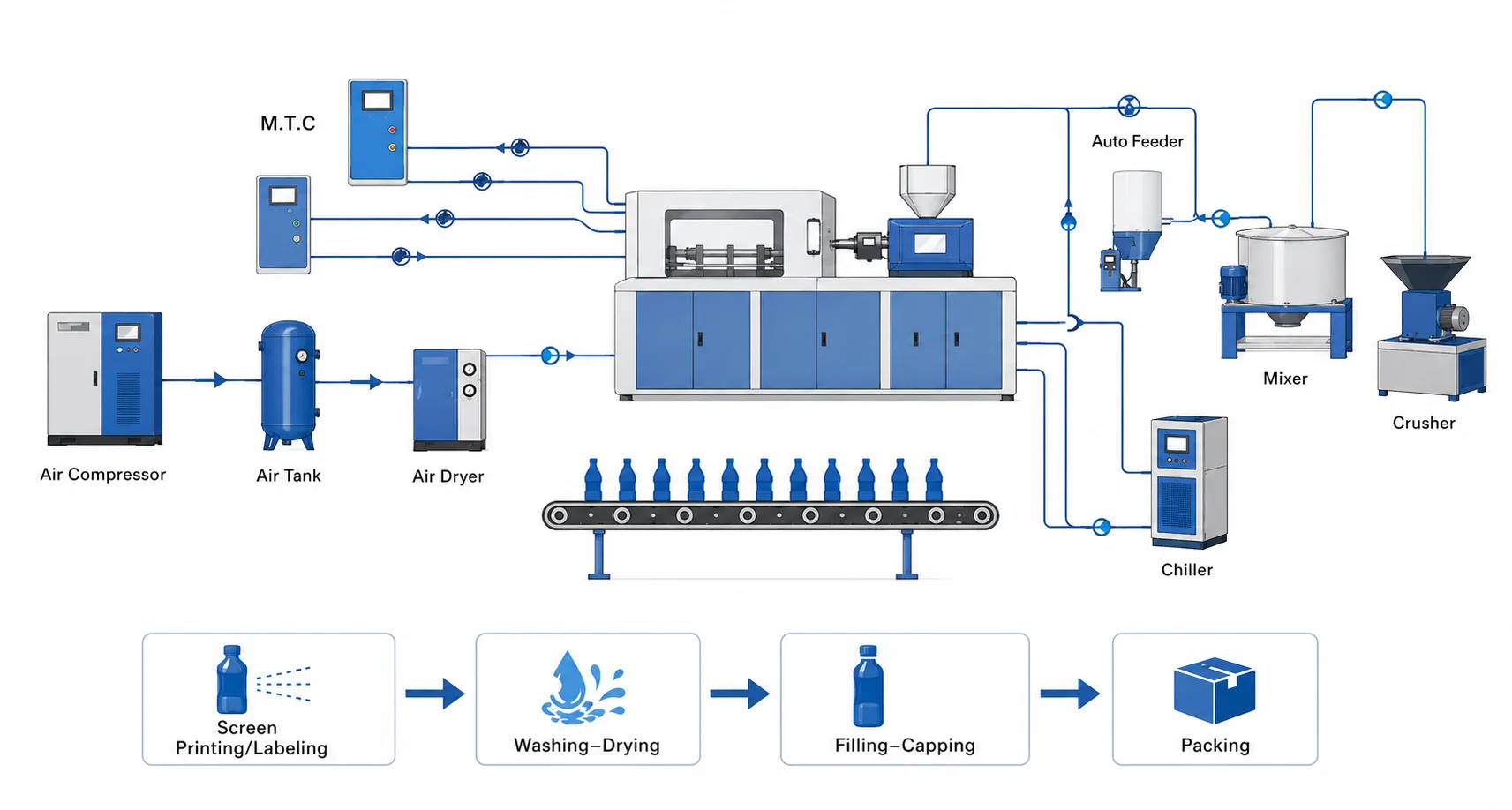
IBM (Injection Blow Molding) and ISBM (Injection Stretch Blow Molding) share a common starting point — both form a plastic preform or parison by injection moulding — but then diverge completely in how that preform becomes a finished bottle. The divergence in forming mechanism is the root cause of every downstream difference: material range, neck precision, wall thickness distribution, optical quality, production rate and tooling economics.
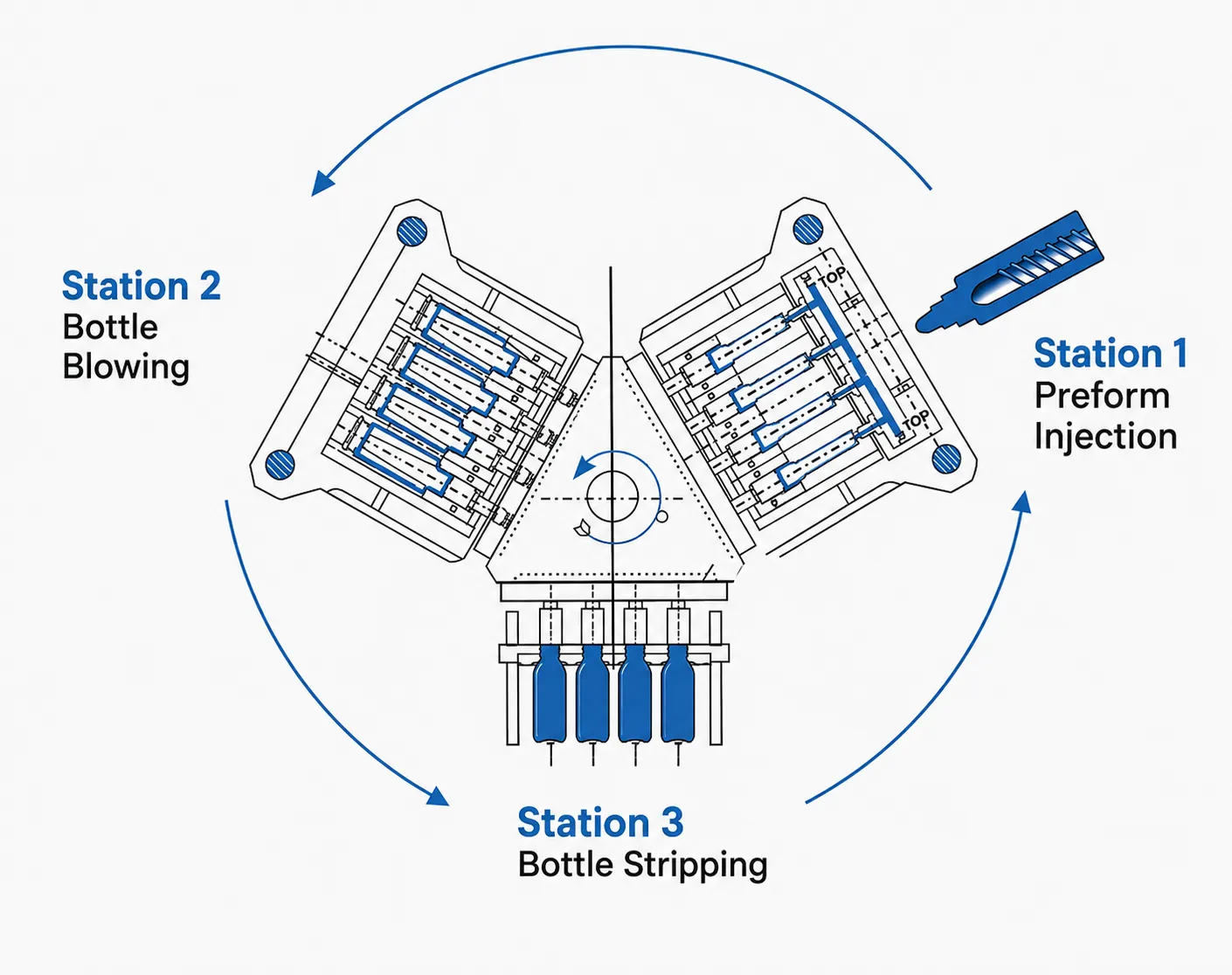
IBM — INJECTION BLOW MOLDING
3-Station Simultaneous · No Preform Storage
Station 1 — Injection
Molten resin injected into precision injection cavity + core rod (mandrel) to form the preform (parison) in the shape of the final bottle neck and upper shoulder. Neck OD, thread form and inner bore are fully formed and dimensionally fixed at injection. Preform remains on mandrel throughout.
Station 2 — Blow
Mandrel indexes to blow station. Blow mould closes around the still-hot preform. Compressed air (0.6–1.2 MPa) inflates the preform radially (no axial stretch rod) to the final bottle body shape. Blow ratio: body OD / neck OD = 1.5–3.0× typically. Wall thickness determined by preform wall distribution.
Station 3 — Strip
Finished bottle stripped from mandrel. All 3 stations operate simultaneously — every machine cycle produces n (cavity count) finished bottles with zero flash, no parting-line trim and no post-processing. Key IBM constraint: body OD cannot be larger than roughly 2–3× neck OD (mandrel withdrawal geometry).
ISBM — INJECTION STRETCH BLOW MOLDING
1-Stage or 2-Stage · Biaxial Stretch · PET Optimised
Stage 1 — Preform Injection (or Supply)
PET preform injection-moulded (1-stage: in-machine; 2-stage: separate IM machine, preform cooled and stored). Preform is typically long and narrow (for PET 500ml water bottle: 90–100 mm long, 21–24 mm OD body). Neck is finished at injection and must not be distorted in the reheat + stretch stages.
Stage 2 — Reheat (2-stage only)
In 2-stage ISBM, stored PET preforms are reheated in an IR oven to the PET stretch temperature (95–115°C for amorphous PET, above Tg ≈75°C). Neck temperature must be kept below Tg to preserve neck dimensions. Achieving uniform body-zone heating while protecting the neck is the critical process challenge in 2-stage ISBM.
Stage 3 — Stretch + Blow
Mechanical stretch rod pushes axially downward (axial stretch ratio 2.5–4.0×) while compressed air inflates radially (radial stretch ratio 2.5–3.5×). Total biaxial stretch ratio (axial × radial) up to 14×. This biaxial stretching orients PET molecular chains, generating the barrier, clarity and mechanical properties of PET beverage bottles. IBM cannot use a stretch rod (mandrel occupies the neck); ISBM cannot achieve IBM’s neck precision (reheat distortion risk).
SECTION 02
Material Range: What Each Process Can and Cannot Run — and Why
| MATERIAL | IBM | 1-Stage ISBM | 2-Stage ISBM | PREFERRED PROCESS & RATIONALE |
|---|---|---|---|---|
| PET | ✗ Limited | ✓ Excellent | ✓ Industry Standard | 2-stage ISBM: PET beverage, food. IBM cannot stretch PET (mandrel blocks stretch rod; PET blow-only has poor clarity and barrier vs biaxially oriented PET ISBM). |
| PP | ✓ Preferred | ✓ Viable | ⚠ Difficult | IBM preferred for pharmaceutical and cosmetic PP (neck OD ±0.05mm precision). 1-stage ISBM PP viable for mid-tier pharmaceutical at volume. 2-stage PP ISBM difficult (narrow stretch window, process instability). |
| HDPE | ✓ Preferred | ✗ Not viable | ✗ Not viable | IBM only for HDPE. HDPE cannot be biaxially stretched via ISBM (no stable orientation temperature window above crystallisation). HDPE IBM for pharmaceutical oral solid, topical and daily chemical. |
| PCTG | ✓ Preferred | ✗ Not viable | ✗ Not viable | IBM only for PCTG glass-look luxury cosmetic and pharmaceutical dropper bottles. PCTG does not orient under biaxial stretch (amorphous copolyester, no orientation-locking crystallisation). S136 SPI A1 IBM mould achieves haze <2% ASTM D1003. |
| LDPE | ✓ Viable | ✗ Not viable | ✗ Not viable | IBM for LDPE ophthalmic dropper bottles (squeeze-flexible, sterility-compatible). Not viable for ISBM (no orientation capability). |
| PLA | ✓ Viable | ✓ Viable | ⚠ Limited | Both IBM and 1-stage ISBM viable for PLA sustainable packaging. IBM PLA for cosmetic; ISBM PLA for beverage. Process temperature care required (PLA narrow processing window, moisture sensitivity similar to PCTG). |
| PS / ABS | ✓ IBM Viable | ✗ Not viable | ✗ Not viable | IBM for specialist cosmetic or technical packaging requiring PS or ABS properties. Neither material biaxially orients via ISBM. Limited pharmaceutical use (migration compliance concerns). |
SECTION 03
Neck OD Precision: The Decisive Difference for Pharmaceutical and Cosmetic Closure Systems
Neck outer diameter (OD) tolerance is the single most important dimensional parameter for pharmaceutical and cosmetic packaging — and the single largest technical advantage IBM holds over ISBM. The neck OD tolerance determines whether a closure system (child-resistant cap, tamper-evident band, pump dispenser, dropper tip) achieves consistent engagement force, torque and tamper-evidence across all containers in a production batch.
NECK OD PRECISION COMPARISON · IBM vs ISBM · MECHANISM AND CONSEQUENCE
IBM — Injection-Formed Neck
ISBM — Injection-Formed + Reheat-Constrained Neck
The Closure System Tolerance Chain
Pharmaceutical child-resistant closure (CRC) engagement specification for a 28mm continuous-thread closure: neck OD tolerance ±0.05mm (equivalent to ±2 sigma of IBM production distribution). At IBM ±0.05mm, all bottles from all cavities engage the CRC within specification. At 2-stage ISBM ±0.15mm, approximately 4–7% of bottles fall outside the ±0.05mm CRC engagement window, producing inconsistent torque and potential CRC activation failure — a pharmaceutical packaging quality non-conformance requiring batch investigation under GMP. This is the fundamental reason pharmaceutical packaging engineers specify IBM over ISBM for all products requiring child-resistant or pharmaceutical precision closures.
SECTION 04
Wall Thickness, Optical Quality and Body Aesthetics: Where Each Process Leads
IBM Wall Thickness Control
IBM wall thickness is determined by the preform (parison) wall profile at injection, which is set by the cavity geometry. The parison blows radially without axial stretch, so wall thickness thins proportionally to the radial blow ratio (body OD / mandrel OD). For a 30 mm body OD bottle on a 15 mm mandrel (blow ratio 2.0×): if parison wall is 1.6 mm, body wall ≈ 1.6/2.0 = 0.80 mm. Wall thickness uniformity: CV ≤5% across the body circumference at IBM (injection-formed parison has uniform radial wall; radial blow is symmetric). IBM achieves 0.50–1.20 mm body wall depending on format. Minimum: approximately 0.5 mm at small dropper vial (5–15 ml). Maximum: approximately 1.5 mm at large daily chemical bottle (500–1000 ml, lower blow ratio). IBM cannot achieve the ultra-thin walls of PET ISBM (0.15–0.25 mm) because IBM has no axial stretch to thin the parison before radial blow.
ISBM Wall Thickness and Biaxial Barrier
ISBM biaxial stretch (axial × radial) thins PET preform wall from typically 3.0–4.5 mm (preform body wall) to 0.15–0.35 mm (PET 500ml bottle body wall at total stretch ratio 6–10×). This extreme thinning is only possible because biaxial molecular orientation locks the PET chain alignment, providing mechanical strength equivalent to a much thicker unoriented film. ISBM wall uniformity: CV ≤8% is typical for commercial 2-stage PET ISBM at 500ml water bottle. PET ISBM ultra-thin wall delivers: CO2 barrier for carbonated beverages (biaxially oriented PET CO2 permeability 0.05–0.15 cm³·mm/m²·day·atm versus PP IBM 5–15× higher); O2 barrier for juice; PET clarity at 0.20–0.30 mm wall (haze 0.5–1.5% ASTM D1003 for commodity PET).
Optical Clarity: IBM PCTG vs PET ISBM
PET ISBM clarity: 0.5–1.5% haze ASTM D1003 at 0.20–0.30 mm commodity PET body wall — this is the reference standard clarity for consumer beverage packaging. IBM PCTG clarity: 0.8–1.6% haze ASTM D1003 at 0.50–0.60 mm body wall with S136 SPI A1 tooling — slightly higher absolute haze than commodity PET at equal wall, but within the <2% luxury cosmetic threshold and visually equivalent to glass under retail lighting. IBM PP/HDPE: 20–80% haze (opaque–translucent) — not clarity applications. PET ISBM for cosmetic (luxury K-beauty PCTG IBM vs commodity PET ISBM clarity): PCTG IBM with S136 SPI A1 matches PET ISBM clarity while processing a resin that PET ISBM cannot produce (PCTG ISBM is not viable; PET IBM is not competitive).
Body Aesthetics: Parting Line and Design Freedom
IBM bottles have no body parting line — the body is formed by symmetric radial blow in a closed mould with no parison pinch point on the body. Body surface is 360° seamless. This is critical for pharmaceutical label adhesion (no parting-line ridge disrupting PSL contact), cosmetic luxury aesthetics (glass-look dropper vials cannot have a visible ridge) and direct-print UV inkjet (360° smooth surface for full-register print). ISBM bottles also have no body parting line on the main body (the blow mould split is at the bottom and is minimal). Both IBM and ISBM produce bodies superior to EBM (which has a prominent body parting line). The IBM advantage over 1-stage ISBM is the neck OD precision and non-PET material range — not the body aesthetics, where both are parting-line-free.
SECTION 05
Production Rate, Tooling Cost and Volume Economics: IBM vs ISBM at Equal Annual Volume
| ECONOMIC PARAMETER | IBM — EP-ZQ135 PP 18-Cavity @100ml |
1-Stage ISBM PP (Pharma/Cosmetic scale) |
2-Stage PET ISBM (Beverage scale) |
|---|---|---|---|
| Output rate (bph) | ~11,700 bph | 5,000–15,000 bph | 20,000–80,000 bph |
| Annual output (3 shifts) | ~193M bottles/year | 85–260M bottles/year | 350M–1.4B bottles/year |
| Tooling cost (per format) | KRW 12–22M (H13 SPI B1) KRW 22–38M (S136 SPI A1) |
KRW 18–35M (preform IM mould + blow mould set) | KRW 8–20M (PET preform IM mould, commodity grade) |
| Resin unit cost (per kg) | PP: KRW 1,400–1,800 PCTG: KRW 3,800–5,200 |
PP ISBM: KRW 1,400–1,800 | PET: KRW 1,200–1,600 |
| Neck OD Cpk at commercial | Cpk ≥1.33 (pharmaceutical GMP criterion) | Cpk 1.0–1.33 (1-stage only, no reheat) | Cpk 0.7–1.1 (2-stage: reheat variation) |
| Right application | Pharma (all), cosmetic (all), daily chemical premium PP, beverage premium PP/PCTG | Mid-tier pharma PP at volume, cosmetic where PET is specified | Commodity PET water, CSD, juice, detergent at billion-unit volume |
SECTION 06
Application Decision Framework: Six Questions to Determine IBM or ISBM for Your Bottle
Answer these six questions in order. The first question that produces a definitive answer determines the correct process. Stop at the first definitive answer and do not continue to the remaining questions.
Is the resin PET?
Yes → ISBM (2-stage for beverage commodity; 1-stage for pharmaceutical or cosmetic PET where neck precision is secondary). PET cannot be competitively processed by IBM. Stop here.
No → Continue to Q2.
Does the closure system require neck OD tolerance ≤±0.10 mm?
Yes → IBM (pharmaceutical CRC, cosmetic pump dispenser, dropper tip interference fit, spray actuator engagement). IBM achieves ±0.02–0.05 mm; ISBM 2-stage achieves ±0.10–0.20 mm. Stop here.
No → Continue to Q3.
Is the resin HDPE or PCTG?
Yes → IBM (HDPE and PCTG cannot be processed by ISBM; IBM only). Stop here.
No → Continue to Q4.
Is body wall thickness below 0.40 mm required?
Yes → ISBM (ultra-thin wall PET beverage; IBM minimum body wall approximately 0.45–0.50 mm for structural integrity at IBM blow ratios). Stop here.
No → Continue to Q5.
Is annual volume above 500 million PP or LDPE bottles per year from a single product line?
Yes → Consider 1-stage ISBM PP (1-stage ISBM PP at pharmaceutical/cosmetic scale can match IBM output at ultra-high volume; evaluate neck OD Cpk requirement per Q2 first).
No (below 500M/year per line) → IBM (IBM machine ROI, tooling flexibility and neck OD precision favour IBM below 500M per line). Continue to Q6 for confirmation.
Is the application pharmaceutical GMP primary packaging?
Yes → IBM (Cpk ≥1.33 neck OD, IQ/OQ/PQ validation, USP Class VI resin, no-parting-line PSL surface — all point to IBM for pharmaceutical primary packaging regardless of volume below 500M/year per line). View the EP-ZQ series for machine selection.
No → IBM or 1-stage ISBM are both viable for non-pharmaceutical applications at this stage — make the final selection based on total cost of ownership analysis including tooling, resin, energy and closure system compatibility cost.
ENGINEERING FAQ
IBM vs ISBM Engineering Questions
Can IBM process PET to produce PET pharmaceutical bottles?
IBM can technically process PET (PET is melt-injectable), but cannot produce competitive pharmaceutical PET bottles because: (1) IBM without axial stretch cannot induce PET biaxial orientation — unoriented PET IBM bottles are cloudy (haze 20–50%), brittle, and have poor barrier compared to ISBM-oriented PET; (2) IBM blow-only PET at 260–280°C barrel generates acetaldehyde at levels above FDA/EFSA food contact limits unless very carefully managed — pharmaceutical regulatory risk; (3) PET crystallises rapidly at IBM blow station temperatures, causing mould fouling and surface whitening on the blown bottle. In practice, pharmaceutical buyers do not specify IBM for PET bottles. Pharmaceutical PET pharmaceutical packaging — where it exists, e.g. oral liquid PET bottle — uses 1-stage ISBM PP. The dominant pharmaceutical IBM resins are PP and HDPE. Korea Ever-Power does not offer EP-ZQ machines for PET IBM and does not recommend PET for IBM applications.
Is 1-stage ISBM a viable alternative to IBM for pharmaceutical PP bottles at high volume?
1-stage ISBM PP is a viable alternative to IBM PP for pharmaceutical applications where neck OD tolerance of ±0.10 mm or better is achievable. 1-stage ISBM (also called integrated IBM in some literature) retains the preform on a mandrel through to the blow stage without a separate reheat cycle — so it avoids the neck distortion risk of 2-stage ISBM reheat. 1-stage ISBM PP neck OD: ±0.05–0.10 mm — better than 2-stage ISBM, comparable to IBM at the low end. For pharmaceutical oral solid tablet containers where CRC torque consistency requires ±0.05 mm: IBM is preferred (confirmed ±0.02–0.05 mm). For pharmaceutical oral liquid bottles where screw cap torque variation of ±0.10 mm is acceptable: 1-stage ISBM PP is a viable alternative. For cosmetic where PCTG is required: 1-stage ISBM is not viable (PCTG does not stretch-orient). The correct choice between IBM and 1-stage ISBM PP ultimately depends on closure system tolerance, resin specification and annual volume — not on a blanket process preference.
Why can’t ISBM process HDPE? It is commonly blow-moulded by EBM.
HDPE cannot be biaxially stretch-blow-moulded (ISBM) because HDPE crystallises rapidly as it cools below approximately 130°C — which occurs faster than the biaxial stretch-blow cycle can be completed at any practical production rate. HDPE’s crystallisation is so rapid that by the time the preform has cooled from injection and been placed in the blow mould, the HDPE body zone has already exceeded the maximum stretch temperature and lost its ductility for biaxial orientation. HDPE can be blow-moulded by EBM (extrusion blow moulding) where the parison is blown immediately from the extruder at full melt temperature with no cooling interval — but EBM produces HDPE bottles with the characteristic body parting line and ±0.15–0.25 mm neck OD variation that disqualifies EBM HDPE from pharmaceutical precision closure applications. IBM is the only blow-moulding process that can produce HDPE pharmaceutical bottles with ±0.05 mm neck OD and no body parting line — because IBM forms the preform and blows it at melt temperature without any cooling or reheat interval, matching HDPE’s processing requirements exactly. This is why HDPE IBM is the preferred process for pharmaceutical HDPE primary containers where precision closure engagement is required.
What is the maximum body OD achievable by IBM relative to the neck OD?
IBM body OD is constrained by the mandrel withdrawal geometry: the finished bottle must be stripped from the mandrel (core rod) at Station 3, which requires the body minimum internal diameter to be equal to or larger than the mandrel OD at any point along the bottle body. In practice, the useful body OD maximum is approximately 2.5–3.0× the neck OD for standard IBM bottle geometries. For a 28 mm neck: maximum body OD approximately 70–84 mm. For a 38 mm neck (wide-mouth sports bottle): maximum body OD approximately 95–114 mm. Bodies wider than 3.0× neck OD require either a collapsible mandrel design (expensive, complex) or a reduction to shoulder taper to allow mandrel extraction — both are viable but add tooling cost. Korea Ever-Power Ansan-si designs IBM bottle mandrel geometry to the specific bottle 3D model: send bottle CAD for IBM feasibility review. ISBM has no equivalent body OD constraint relative to neck OD — the stretch rod is withdrawn before the bottle is ejected, and the blow mould can accommodate arbitrary body OD. This is why large-body-OD / narrow-neck-OD bottles (wine bottles, large wide-body water bottles) are ISBM rather than IBM.
What is the IBM minimum and maximum bottle volume range?
IBM bottle volume range on Korea Ever-Power EP-ZQ series: minimum approximately 1 ml (ophthalmic dropper, ZQ40, LDPE, very small mandrel — specialist application); practical minimum for commercial pharmaceutical: 5 ml (ophthalmic dropper, ZQ40/ZQ60, LDPE or PCTG, 20–24 cavities). Standard pharmaceutical minimum: 10 ml (eye serum dropper, ZQ40, 9 cavities, or ZQ135 30 cavities PCTG). Standard maximum: 2,000 ml on ZQ60; 5,000 ml on ZQ135 (large daily chemical or food supplement container — very low blow ratio at large volume, mandrel withdrawal is the constraint). Practical daily chemical maximum: 1,000 ml (ZQ80, 2 cavities). Above 1,000 ml: IBM tooling and cycle cost per litre becomes unfavourable versus EBM; EBM is preferred for HDPE jerricans and large PP daily chemical above 1,000 ml. ISBM (PET 2-stage) minimum approximately 50 ml; maximum approximately 20,000 ml (large PET water jugs). IBM and ISBM overlap most closely in the 30–500 ml pharmaceutical and cosmetic segment — which is where the IBM vs ISBM process selection decision is most actively made.
Can a single IBM machine produce multiple different bottle formats?
Yes, with mould changeover. Korea Ever-Power EP-ZQ series IBM machines are designed for mould changeover between formats using the same machine: different injection cavity + core rod + blow mould sets are installed for each bottle format. Changeover time: approximately 4–8 hours for a full mould set change on EP-ZQ80 or ZQ110 at Ansan-si (includes mould installation, temperature stabilisation, and first-off QC check). Multiple format moulds for the same machine can be purchased progressively — a pharmaceutical buyer starting with 100 ml tablet bottles can add 60 ml and 250 ml format moulds later without changing the machine. Mould interchangeability constraint: all format moulds for a given ZQ model must be within the ZQ model’s injection weight, platen dimensions and blow station stroke envelope. Korea Ever-Power confirms format compatibility at tooling quotation stage.
For a Korean pharmaceutical company currently using PET ISBM bottles for oral liquid products, is switching to PP IBM beneficial?
This is one of the most common evaluation scenarios in Korean pharmaceutical packaging. The answer depends on three factors specific to the product and facility: (1) Neck OD tolerance requirement: if the oral liquid product uses a pump dispenser or CRC requiring ±0.05 mm neck OD, PET 2-stage ISBM at ±0.15 mm is likely causing capping line inconsistency — switch to IBM PP is technically beneficial. If the product uses a standard screw cap with wide engagement band (acceptable at ±0.15 mm), PET ISBM neck precision is adequate and switching has no neck-dimension benefit. (2) Regulatory compliance: Korean MFDS oral liquid containers in PET require EU 10/2011 or FDA 21 CFR 177.1480 PET compliance documentation. PP IBM requires FDA 21 CFR 177.1520 and Ph.Eur. 3.1.3 — both are well-established and straightforward to document with Korea Ever-Power’s documentation package. Neither resin has a regulatory compliance advantage in Korea. (3) Chemical compatibility: some oral liquid pharmaceutical formulations — particularly those with high-concentration alcohol, complex flavouring agents or ethanol-based vehicles — have better compatibility in PP than PET (PET can absorb certain flavour compounds from liquid formulations, shifting taste profile over shelf life; PP has lower sorption). For alcohol-based oral liquid, PP IBM may provide a shelf-life quality advantage over PET ISBM. Korea Ever-Power recommends a 6-week accelerated stability study (40°C, 75% RH) in PP IBM bottle vs current PET container before committing to the switch.
Where can I find IBM machine specifications and detailed application guides for pharmaceutical, cosmetic and daily chemical IBM?
The Korea Ever-Power EP-ZQ injection blow molding machine series page provides full technical specifications for each EP-ZQ model (ZQ40 through ZQ135), including confirmed cavity counts at each bottle volume format, machine dimensions, power requirements and material compatibility. The IBM machine replacement guide compares Korea Ever-Power EP-ZQ against Jomar IBM, SUMA iB, Uniloy UIB and Bloma IBM across all tonnage classes — useful for buyers currently operating American-style IBM machines evaluating European IBM alternatives. For IBM machine selection support specific to your bottle volume, resin and annual production requirement, contact Korea Ever-Power Ansan-si for a 48-hour feasibility assessment.
IBM MACHINE SELECTION · KOREA EVER-POWER
Confirmed IBM Is the Right Process? Evaluate the EP-ZQ Series.
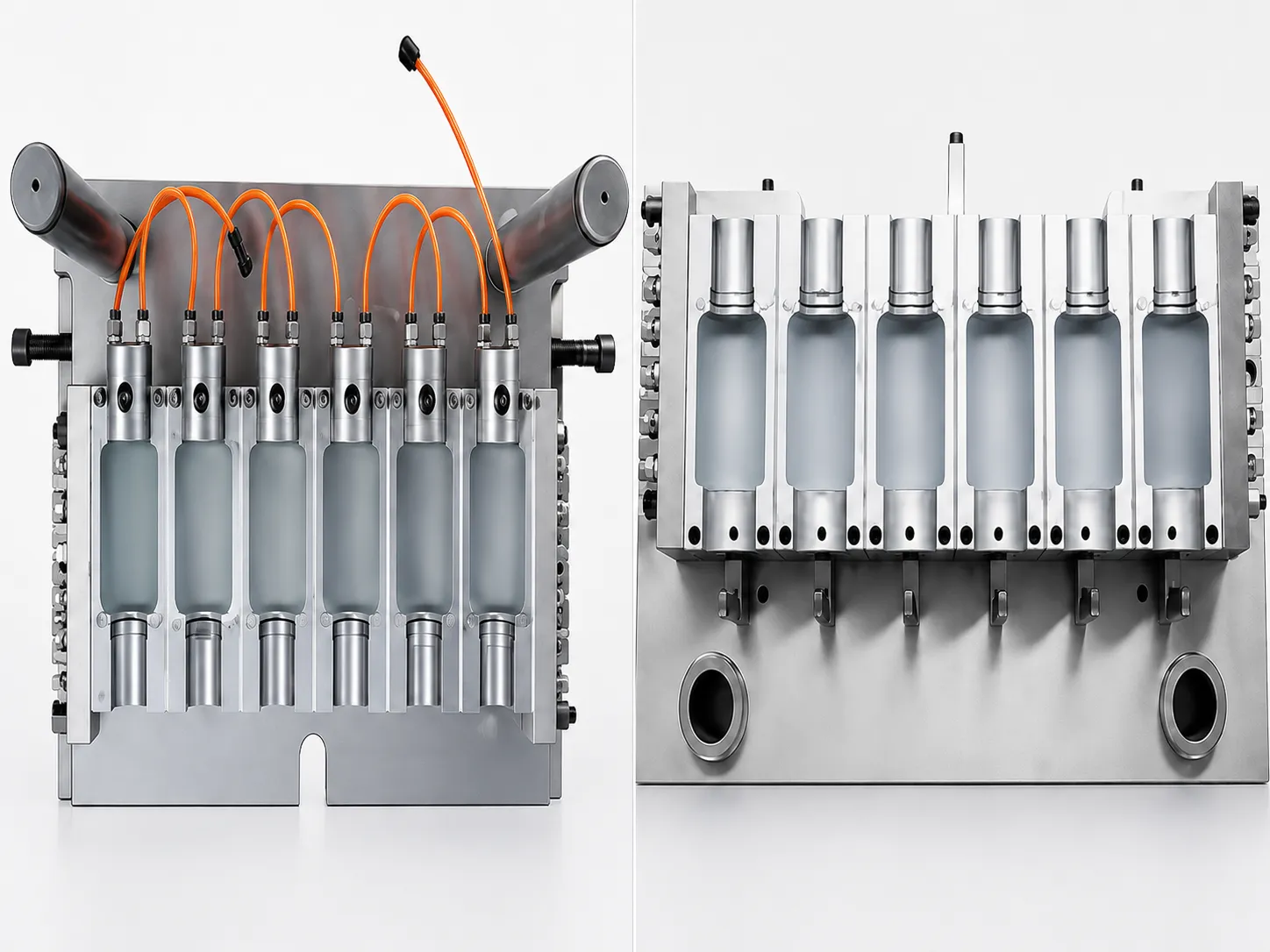
Send Korea Ever-Power your bottle format, resin, required cavity count and annual volume. We return a machine model recommendation, tooling cost estimate and production feasibility report within 48 hours.
Editor: Cxm