眼科用IBM · 眼药水容器 · 韩国KFDA · 韩国Ever-Power

HDPE滴眼液瓶 IBM:
韩国生产指南

韩国 10 毫升 HDPE 眼科容器是韩国产量最高的药品 IBM 包装规格,也是技术要求最高的规格之一:滴管盖啮合精度为 ±0.05 毫米,填充液透明度为 0.30-0.40 毫米壁厚,符合韩国食品药品监督管理局 (KFDA) 眼科颗粒物标准,年产量达数亿个,这使得 ZQ110 和 ZQ135 机器成为韩国眼科包装生产经济的核心。

10毫升龋齿计数经济学
滴管盖颈精密
韩国食品药品监督管理局眼科资格

韩国永动力工程部 · 安山市 · 2026年7月


韩国眼科IBM——参考数据

10毫升

标准韩国眼科包装盒——IBM规格,年需求量最高

5亿+

韩国眼科用品年度需求量估计——隐形眼镜、干眼症、处方药

±0.05 毫米

IBM颈部外径公差——滴管盖啮合需要±0.06毫米的窗口。

约23,800/小时

ZQ135 30腔手术——韩国单机眼科IBM手术产量最高

1. Korean Ophthalmic Market and IBM’s Role

Korean HDPE ophthalmic eye drop bottles — 10ml injection blow molded pharmaceutical container with dropper cap 13/415 neck finish, 0.35mm body wall translucency for fill-level inspection, produced by Korea Ever-Power ZQ80 ZQ110 at 20-24 cavity Korean pharmaceutical ophthalmic IBM production for Korean KFDA ophthalmic container qualification
韩国产10毫升高密度聚乙烯(HDPE)眼科用药瓶采用注塑吹塑工艺生产——其13/415滴管颈口径公差为±0.05毫米,便于滴管盖的啮合;0.30-0.40毫米的瓶壁厚度便于半透明观察瓶内液位;注塑成型的瓶底从外部看不到接缝或浇口痕迹。注塑吹塑工艺(IBM)每次循环可生产20-30个型腔,是唯一能够同时以制药质量和经济规模生产韩国眼科用药瓶的吹塑工艺。

Korea’s ophthalmic pharmaceutical market is among the largest and fastest-growing in East Asia. Three structural factors drive Korean ophthalmic container demand above what Korea’s population size alone would suggest: the world’s highest rate of contact lens wear per capita (approximately 42% of Korean adults aged 20–40 wear contact lenses, generating daily artificial tear and contact lens solution demand), the exceptionally high Korean screen time (Korean workers average 9.4 hours per day of screen exposure, driving rapidly growing dry-eye disease prevalence), and Korea’s nationally covered ophthalmic prescription reimbursement system (Korean National Health Insurance covers most ophthalmic prescription medications, lowering the price barrier to ophthalmic pharmaceutical use). These three factors together produce an estimated 500+ million annual ophthalmic container demand in Korea, split between prescription ophthalmic (antibiotics, anti-inflammatory, antiglaucoma), OTC artificial tears, and contact lens care products — all requiring 10 ml HDPE IBM containers.

IBM工艺是韩国眼科容器生产的标准工艺,因为10毫升眼科用药瓶规格能够同时发挥IBM工艺的各项技术优势:注塑成型瓶颈精度为±0.05毫米(滴管盖啮合精度要求为±0.06毫米),零飞边(符合韩国食品药品监督管理局(KFDA)眼科颗粒物标准),最多可生产30个模腔(年需求量超过5亿支时,生产成本经济效益显著),以及厚度为0.30-0.40毫米的半透明HDPE瓶壁(无需透明度要求即可进行灌装液位检测)。其他任何吹塑工艺都无法在10毫升规格下同时实现这四项优势。IBM工艺在韩国药品生产中的更广泛应用情况详见…… IBM 医药指南本文重点关注 10 毫升 HDPE 眼科容器的生产。

2. 10毫升高密度聚乙烯眼科容器规格
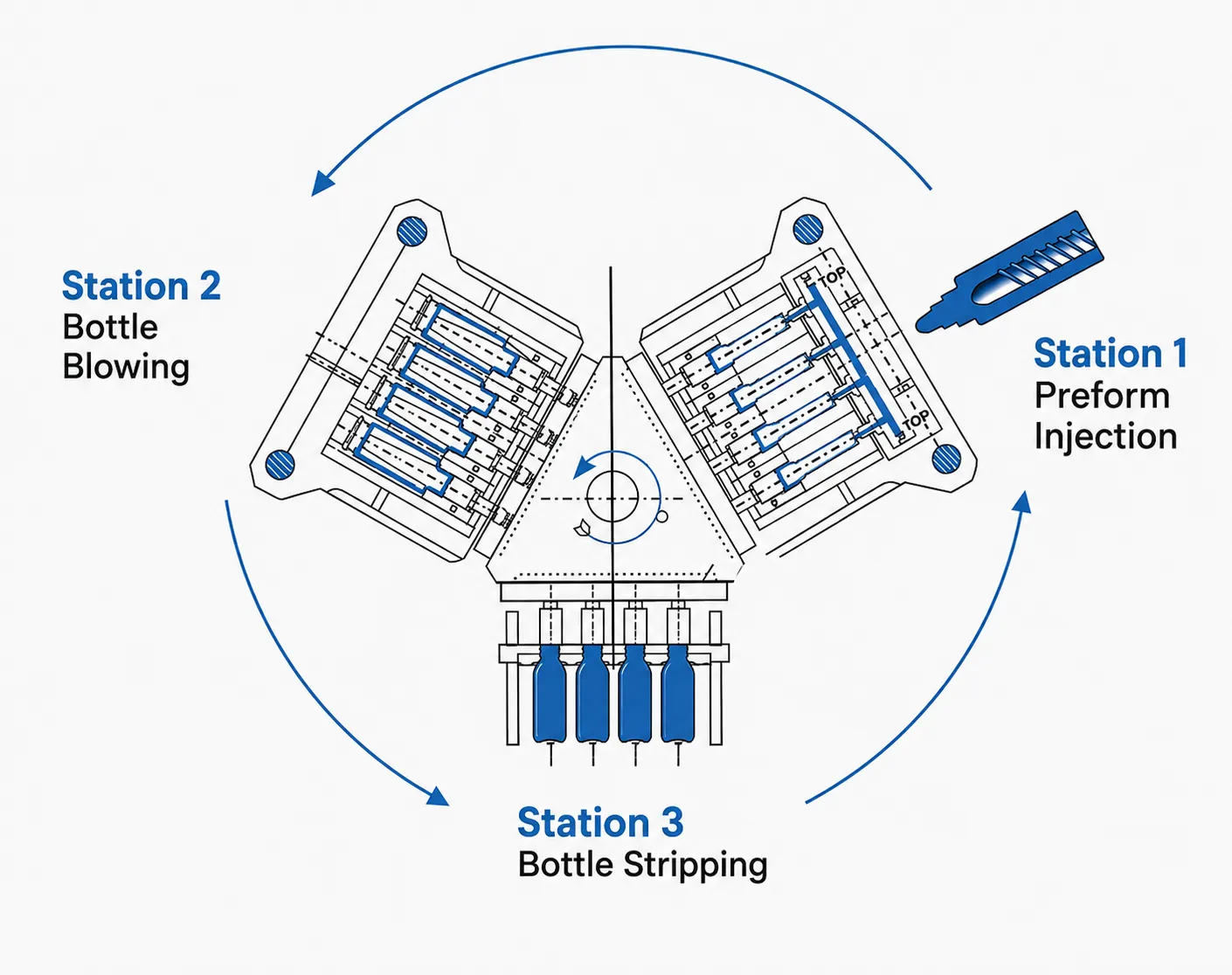
IBM 3-station process for 10ml ophthalmic HDPE container — Station 1 injection at 800-1350KN of 10ml preform with 13/415 dropper neck insert, Station 2 blow moulding to 25mm body diameter 45mm height, Station 3 stripping — 20-30 cavity simultaneous production on Korea Ever-Power ZQ80 ZQ110 ZQ135 for Korean ophthalmic pharmaceutical HDPE IBM production
IBM 三工位工艺应用于 10 毫升眼科容器的生产——三个工位同时运行,1 号工位注塑成型 20-30 个眼科瓶坯,2 号工位吹塑成型上一周期的 20-30 个瓶子,3 号工位脱模成型上上一周期的 20-30 个成品瓶。正是由于这种并行运行,IBM 的 30 腔注塑机才能实现每小时约 23,800 个眼科瓶的生产效率,尽管每个工位的运行时间仅需几秒钟。

韩国 10 毫升 HDPE 眼科容器在韩国各大制药品牌中遵循高度标准化的尺寸规格——这种标准化是由与韩国滴管盖制造商提供的滴管盖系统的兼容性以及针对标准 10 毫升眼科规格尺寸优化的韩国制药灌装线规格所驱动的。

方面 规格 功能/需求依据
颈部饰面 13/415 GPI 标准韩国眼科滴管盖接口——兼容韩国滴管盖和CRC眼科滴管盖供应商
颈部外径公差 13.00 毫米 ±0.05 毫米 滴管盖卡扣配合公差范围——IBM原生,所有凹槽均为±0.05毫米
钻孔 ID 9.0 毫米 ±0.04 毫米 滴管嵌件外径啮合——由IBM注塑模具中的芯杆外径定义
容器高度 42–52 毫米 韩国灌装线夹具兼容性及韩国药房配药托盘尺寸
身体最大直径 22–28 毫米 韩国药房配药托盘的行间距——最大28毫米,以兼容标准韩国托盘。
体壁厚度 0.30–0.40 毫米 用于灌装液位检查的半透明度;10 ml 容量下,HDPE 的半透明度≤0.40 mm。
体积精度 10.0 毫升 ±0.5 毫升 韩国KFDA眼科灌装量公差——IBM容器上的灌装标记位置必须在23°C下反映此公差。
瓶子重量 2.5–4.5克 HDPE IBM,壁厚0.30–0.40毫米——比同等EBM工艺更轻;腔间重量CV%≤4%规格

The 13/415 neck finish specification is critical for Korean ophthalmic IBM mould design: the 13 mm nominal neck OD and 415 thread count (15 threads per inch) are the international standard for ophthalmic dropper closures adopted by Korean ophthalmic pharmaceutical brands and Korean dropper cap manufacturers. IBM container moulds for Korean ophthalmic production must specify 13/415 neck inserts in the injection mould to the same dimensional accuracy as the Korean dropper cap tooling — ±0.02 mm on the neck OD at the injection mould neck cavity insert ensures that the finished IBM bottle’s ±0.05 mm neck OD tolerance is achieved with process margin on both sides of the dropper cap engagement window.

3. IBM 颈部精度,用于滴管帽啮合

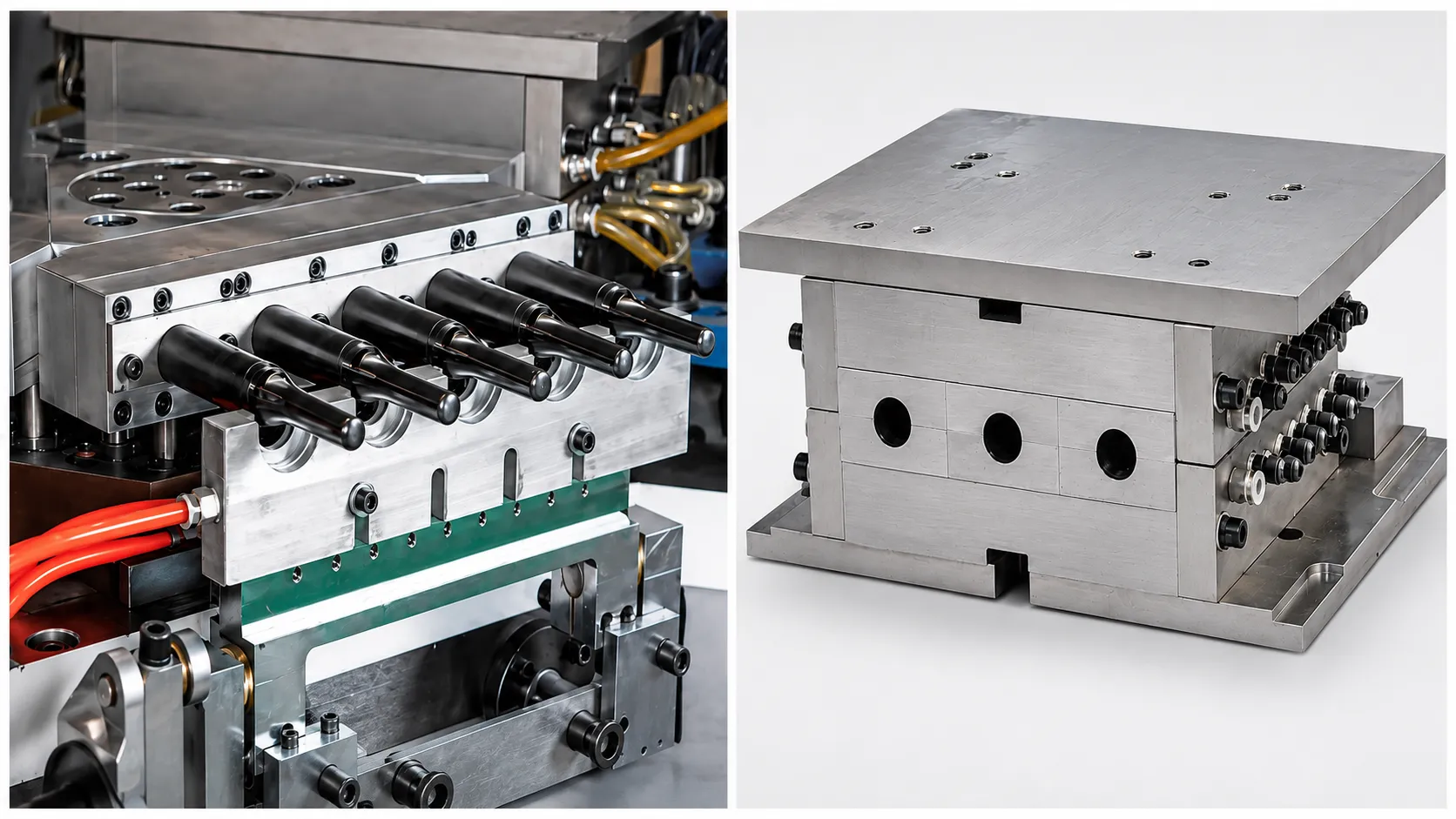
IBM injection blow molding mould precision — 13/415 ophthalmic neck insert in injection mould core rod assembly showing ±0.02mm neck OD cavity tolerance producing ±0.05mm IBM bottle neck OD across all 20-30 production cavities — Korea Ever-Power pharmaceutical ophthalmic mould S136 stainless steel neck insert for Korean KFDA ophthalmic dropper cap engagement qualification
IBM ophthalmic neck precision — the injection mould’s 13/415 neck insert (S136 stainless, HRC 50–52) defines the ophthalmic container neck at ±0.02 mm cavity dimensional tolerance, producing ±0.05 mm neck OD on finished IBM bottles across all 20–30 production cavities. The core rod holds the 9.0 mm bore ID throughout both injection and blow phases, ensuring the dropper insert engagement diameter is identical to the injection mould’s core rod OD regardless of blow air pressure variation between cycles.

The Korean ophthalmic dropper cap system has two precision interface points with the IBM container neck: the outer snap-fit or thread engagement between the dropper cap skirt and the neck OD, and the inner bore engagement between the dropper insert’s controlled orifice body and the neck bore ID. Both interfaces require dimensional precision that IBM provides natively through its injection mould tooling and core rod mechanism.

外侧卡扣式接口:颈部外径±0.05毫米

Korean ophthalmic dropper caps engage the IBM bottle neck at the 13 mm OD by a circumferential bead on the cap skirt that snaps over the neck’s retaining flange. This snap-fit engagement provides: tamper evidence (the bead breaks an induction seal or deforms the retaining flange on first opening), child resistance (some Korean ophthalmic CRC formats require push-and-turn action), and closure retention during Korean pharmacy dispensing handling (the cap must remain attached to the bottle when tapped on a Korean pharmacy dispensing tray). The snap-fit mechanism’s function depends on the interference between the cap bead inner diameter and the bottle neck flange OD — the designed interference is typically 0.08–0.15 mm (the cap bead is 0.08–0.15 mm smaller in diameter than the neck flange OD). With IBM’s ±0.05 mm neck OD tolerance, the interference varies between 0.08–0.15 mm ±0.05 mm across all cavities — always within the range where snap-fit engagement occurs without cap opening force being excessive for Korean pharmacists or patients. With EBM’s ±0.15–0.25 mm neck OD tolerance, the interference variation of ±0.15–0.25 mm would produce, at the low end, engagement that is either absent (cap falls off) or, at the high end, engagement that requires destructive force to open — neither acceptable in Korean ophthalmic pharmaceutical distribution.

内孔接口:滴管插入孔口精度为±0.04毫米

The dropper insert — the controlled-orifice component that produces a consistent 25–35 microlitre drop volume per squeeze — seats inside the IBM bottle neck bore, with its outer body in contact with the bore inner surface. The drop volume delivered by the dropper insert depends on two factors: the orifice diameter (controlled by the dropper insert mould tooling) and the bore-insert interference fit (controlled by the IBM bore ID versus the dropper insert OD). If the IBM bore is too small (below nominal), the dropper insert compresses inward and distorts the orifice geometry — producing smaller drop volumes than specified. If the IBM bore is too large (above nominal), the dropper insert can tilt within the bore, creating asymmetric orifice orientation that produces erratic drop trajectory in Korean patient use. IBM’s core rod defines the bore ID at ±0.04 mm across all cavities through the direct mechanical relationship between the core rod OD and the bore it forms during injection — the bore is not blown, not stretched, not dependent on air pressure, and does not vary with process parameter fluctuation at the blow station.

4. 用于眼科IBM的HDPE等级和加工

韩国眼科用 HDPE IBM 使用的树脂规格比一般制药用 IBM 更窄——薄壁(0.30–0.40 毫米)、高腔数(20–30 个腔)、长热流道路径以及韩国 KFDA 可萃取物要求的组合,使得大多数韩国眼科 IBM 应用的可用 HDPE 等级范围缩小到 190°C/2.16 千克时的 MI 0.3–0.5 和密度 0.950–0.960 克/立方厘米。

树脂等级规格

  • MI:0.3–0.5 克/10 分钟(190°C / 2.16 千克)
  • 密度:0.950–0.960 克/立方厘米
  • 添加剂:仅限韩国食品药品安全部(KFDA)认可清单上的产品
  • 不含紫外线稳定剂,不含滑爽剂
  • 抗氧化剂:AO-1010 或 AO-168 ≤0.05%
  • 韩国食品药品监督管理局(KFDA)要求进行药品联系声明

加工参数(ZQ80/ZQ110)

  • 料筒:175→195→210→215→215℃
  • 注射压力:90–130 MPa
  • 填充时间:0.6–1.0 秒(薄壁)
  • 保持:50–65% 峰值,0.4–0.8 秒
  • 吹气压力:0.5–0.8 兆帕
  • 吹气停留时间:0.7–1.2 秒
  • 模具温度:12–22°C

关键质量检查

  • 颈部外径:13.00 ±0.05 毫米 — 所有腔体
  • 孔径:9.0 ±0.04 毫米 — 所有腔体
  • 瓶重:±4% CV%(各腔体)
  • 墙体半透明度:通过目测填充水平检查
  • 滴管帽啮合方式:100% 在线卡扣式
  • 颗粒物:符合韩国食品药品监督管理局(KFDA)眼科标准

墙体半透明度和高密度聚乙烯等级的相互作用: Korean ophthalmic containers must allow Korean pharmacists and Korean patients to visually inspect the liquid fill level — a requirement that limits HDPE wall thickness to ≤0.40 mm at the body panel, where HDPE’s semi-crystalline structure transmits sufficient light at this thickness for fill-level judgement. At 0.50 mm body wall, standard HDPE at density 0.955 g/cm³ becomes opaque enough that fill-level inspection is unreliable. The 0.30–0.40 mm body wall is a design constraint that the IBM mould designer must achieve through the preform geometry and blow ratio — and that the IBM operator must verify in production through periodic wall thickness measurement at the minimum body wall location using ultrasonic gauge measurement.

5. 韩国KFDA眼科容器资质要求

韩国食品药品安全部(KFDA)对眼科药品容器的认证要求比一般药品容器的要求更为严格,尤其体现在两个方面:颗粒物污染标准和相容性测试时长。这些更严格的要求反映了眼科给药途径的特殊性——眼表对颗粒物和化学物质的刺激高度敏感,因此韩国食品药品安全部(KFDA)制定了相应的眼科产品安全标准。

眼科颗粒物标准(韩国食品药品监督管理局/韩国药典)

Korean Pharmacopoeia (KP) aligns with USP <790> for visible particulates in ophthalmic preparations and USP <788> for sub-visible particulate matter in ophthalmic preparations. For Korean IBM ophthalmic container qualification, particulate testing applies in two stages: container wash-extract testing (empty containers filled with purified water, agitated and examined for visible particulate and sub-visible particulate count) and filled product testing (Korean ophthalmic formulation filled into IBM containers examined at end of proposed shelf life). IBM container wash-extract particulate limits per KP ophthalmic container test: visible particles — absent (zero visible particles in wash extract when examined under Korean Pharmacopoeia visible inspection method); sub-visible particles per KP (aligned with USP <788>): ≤25 particles/ml ≥10 μm, ≤3 particles/ml ≥25 μm. IBM’s zero-flash production eliminates the most significant source of sub-visible particulate in blow-moulded pharmaceutical containers — the plastic fines generated by EBM flash trimming. Korea Ever-Power’s pharmaceutical IBM documentation package includes a reference statement on IBM’s zero-flash architecture for use in the Korean pharmaceutical container qualification documentation that addresses Korean KFDA questions on particle contamination prevention during container production.

眼科 IBM 容器兼容性测试持续时间

Korean KFDA ophthalmic pharmaceutical container compatibility testing requires a 24-month accelerated stability study at 40°C/75% RH — 12 months longer than the 12-month standard for most oral pharmaceutical container compatibility studies. The longer study period reflects the Korean KFDA position that ophthalmic formulations’ complex mixture of active ingredients, preservatives (benzalkonium chloride, thimerosal, or preservative-free buffer systems) and buffering agents creates a more complex extractable interaction profile with HDPE than simple aqueous solutions. Korean IBM ophthalmic packaging producers should plan for 24-month compatibility studies — which means beginning the filled container compatibility study immediately upon first IBM production at qualification conditions, so that the 24-month study result is available within the overall Korean ophthalmic product development timeline without delaying the KFDA submission.

6. IBM为韩国眼科产品生产搭建的洁净室

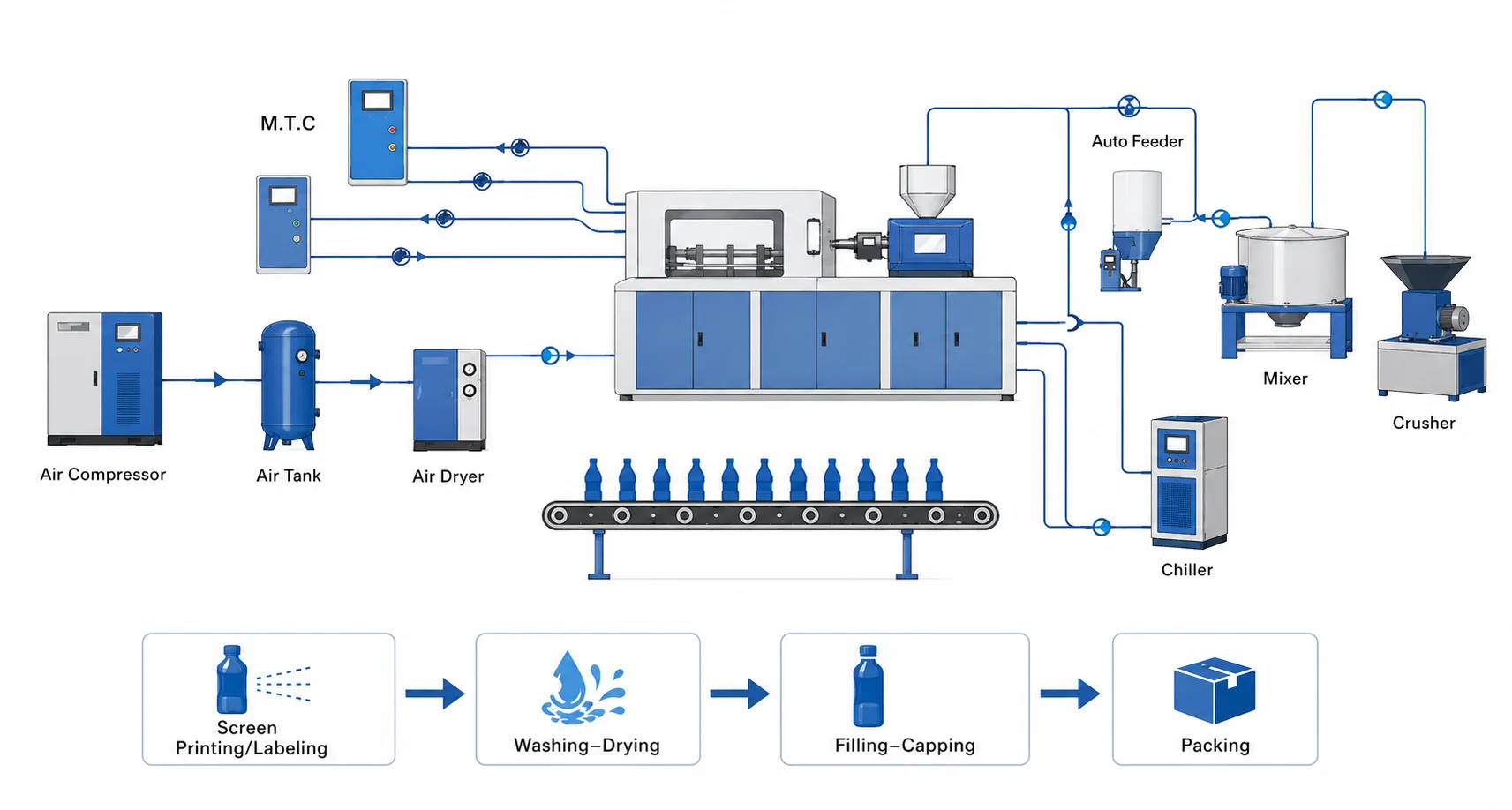
Korea Ever-Power IBM ophthalmic pharmaceutical production line — ZQ series machine with HEPA positive-pressure cleanroom enclosure over mould area dual chiller mould temperature controllers oil-free air compressor output conveyor for Korean KFDA ophthalmic container production in ISO Class 8 cleanroom environment
韩国 Ever-Power IBM 眼科生产线组件——韩国 KFDA 眼科容器生产的完整生产单元包括 ZQ 系列机器,其模具站和输出输送机上方设有 HEPA 防护罩,无油压缩机(眼科级空气供应的必要条件),用于独立注塑和吹塑模具温度回路的双冷却器,以及 HEPA 过滤的输出输送机,以保持清洁直至码垛站。

韩国眼科用IBM容器的生产通常在ISO 8级(相当于韩国GMP D级)洁净室环境中进行。眼科用IBM容器生产的特定洁净室要求——与制药用IBM容器指南中描述的通用制药用IBM容器洁净室设置有所不同——反映了韩国眼科用容器对颗粒物更高的敏感性。

  • 霉菌检测站上方设有高效空气过滤器(HEPA)送风口: The IBM machine’s mould area — where containers are formed and where the core rods deposit finished containers onto the output conveyor — should receive HEPA-filtered supply air at ≥0.45 m/s face velocity downward into the open mould area. This positive-pressure HEPA supply air prevents airborne particles from entering the open container mouth during the time between stripping (Station 3) and cap application at the downstream Korean pharmaceutical filling line. The HEPA enclosure over the mould station is specified as a separate engineering item in the Korean ophthalmic IBM cell design — Korea Ever-Power provides connection points and dimensional data for the HEPA enclosure installation on the ZQ machine outline drawings.
  • 无油压缩空气——强制性要求: 用于韩国眼科容器IBM吹塑成型的压缩空气必须在使用点无油——符合ISO 8573-1 0级标准(油雾和油蒸气)。吹塑站IBM吹气中的油污会在充气过程中接触HDPE预成型件内部,并成为成品容器中的可萃取污染物。韩国眼科IBM生产商必须指定使用无油螺杆式压缩机(而非带有下游过滤器的油润滑往复式压缩机),并且必须按照韩国制药压缩空气质量监测规程,通过定期监测颗粒物和油蒸气来验证机器连接点的无油状态。
  • 输出输送机HEPA过滤器罩: 韩国眼科用药容器从3号工位的IBM机器排出后,会沿着输出传送带移动,然后被收集到袋子或托盘中,运往韩国制药灌装线。为了保持容器从IBM机器出口到收集点的清洁度,该传送带段也应采用高效空气过滤器(HEPA)封闭。传送带的HEPA封闭装置通常安装成隧道式,配备正压HEPA送风系统,并在传送带出口处设有过滤排气装置。如果没有传送带封闭装置,韩国眼科用药容器在传送过程中会积聚空气中的颗粒物,这些颗粒物会沉降到敞开的容器口,导致灌装后的容器中出现肉眼不可见的颗粒物。

7. 韩国眼科IBM龋齿计数经济学

Cavity count selection for Korean ophthalmic IBM is the highest-impact single investment decision — because the Korean ophthalmic container market’s 500M+ annual unit demand requires matching machine cavity count to annual production volume with enough precision that the machine runs at 70–90% utilisation (below 60% utilisation wastes capital; above 90% utilisation creates production risk from unscheduled maintenance). The following analysis compares three ZQ models for a Korean ophthalmic contract packaging factory with a specific annual volume requirement.

范围 ZQ80(20 骑兵) ZQ110(24 骑兵) ZQ135(30 杯)
瓶/小时(88% 有效) ~15,840 ~19,000 ~23,760
瓶装/韩式两班制(14小时) ~221,760 ~266,000 ~332,640
瓶/年(250天) 约5540万 约6650万 约8320万
年产量2亿台的机器 4台机器 3台机器 3 台机器(72% util.)
需要韩国食品药品监督管理局(KFDA)的资质 4台机器的资格 3台机器资格 3台机器的资质(单价最低)

根据腔数经济性分析表,对于一家年产量为2亿支10毫升眼科代工包装商而言,30腔的ZQ135与24腔的ZQ110所需机器数量相同(均为3台),但ZQ135的利用率仅为72%,而ZQ110为100%——这为计划外维护、规格变更停机以及年度需求增长提供了生产余量,无需额外购置第四台机器。此外,较高的腔数也最大限度地减少了韩国食品药品监督管理局(KFDA)的机器认证次数(ZQ135需要3次认证,而ZQ80需要4次)——每次机器认证需要16-24周的测试时间和大量的文档成本。对于希望在保持生产冗余的同时最大限度减少KFDA机器认证次数的韩国眼科代工包装企业而言,在年产量相同的情况下,ZQ135或ZQ110显然比多台ZQ80机器更值得投资。韩国Ever-Power公司 EP-ZQ110 是韩国眼科合同包装商最常见的起始平台,每台机器的年产量在 5000 万至 8000 万件之间。

8. 韩国眼科IBM生产用ZQ系列选型

对于韩国眼科专用集成显微镜(IBM)的生产而言,ZQ系列机型的选择不仅取决于产量和购置成本,还需要考虑制药行业特有的因素:韩国食品药品监督管理局(KFDA)的认证与具体的机器型号和龋洞数量挂钩。以下指南充分考虑了这一制药行业特有的限制。

韩国眼科初创公司/试生产 → ZQ60(14个腔体)

年产量低于2500万件。适用于韩国制药初创公司、韩国眼科产品线试生产以及为进入韩国市场的国际眼科品牌提供韩国合同生产服务(CMO)的试生产。ZQ60的投资适合年产量低于2500万件的情况,但需要周密的未来规划:对于已在韩国食品药品监督管理局(KFDA)注册的现有眼科产品,从ZQ60升级到ZQ80需要向KFDA提交新的设备变更通知,并在新设备上进行验证——这一过程需要3-6个月。预计在3年内产量增长至3000万件以上的韩国眼科包装生产商应从一开始就启用ZQ80,并接受初期较低的利用率,从而避免验证过渡成本。

韩国中型眼科 → ZQ80(20 个龋洞,3000 万至 5500 万台/年)

The ZQ80’s dual hydraulic system (20–30% energy saving) and high-precision angle divider (standard at ZQ80+) make it the entry point for Korean ophthalmic production where energy efficiency and inter-cavity consistency are KFDA qualification requirements. At 20-cavity 10 ml production, ZQ80 produces approximately 55M ophthalmic bottles per Korean two-shift year — sufficient for Korean mid-scale pharmaceutical manufacturers serving Korean domestic ophthalmic market without export requirements.

韩国大型眼科设备 → ZQ110 / ZQ135(每台机器年产量 5500 万至 8300 万+ 台)

为跨国眼科品牌提供服务的韩国药品合同包装商、韩国药品出口商以及为韩国医院供应链提供全国性服务的韩国本土眼科药品制造商,都需要生产 ZQ110 或 ZQ135 产品,才能达到其商业模式所需的产量和韩国食品药品监督管理局 (KFDA) 的认证效率。 全系列注塑吹塑机 涵盖韩国所有眼科药品生产规模,从初创企业到国家级药品供应。

常见问题解答

Q1 — 10 毫升眼科用 IBM 容器与其他药品用 IBM 容器在技术上有何不同?

10 ml ophthalmic IBM containers have four specific technical requirements that distinguish them from other pharmaceutical IBM containers. First, dual precision neck interface: ophthalmic containers require precision at both the outer neck OD (dropper cap snap-fit engagement at ±0.05 mm) and the inner neck bore (dropper insert orifice body at ±0.04 mm) simultaneously — most other pharmaceutical IBM containers require only outer neck OD precision for closure engagement. Second, body wall translucency: ophthalmic containers must allow visual fill-level inspection at 0.30–0.40 mm body wall — the thinnest wall specification in pharmaceutical IBM and one that requires specific preform design and blow ratio optimisation. Third, stricter particulate standards: Korean KFDA ophthalmic sub-visible particulate limits (≤25 particles/ml ≥10 μm) are more stringent than general pharmaceutical container particulate limits, requiring HEPA-enclosed production and oil-free compressed air at the IBM machine. Fourth, 24-month compatibility study: Korean KFDA ophthalmic container compatibility testing requires 24-month accelerated stability at 40°C/75% RH versus 12 months for most oral pharmaceutical containers — doubling the qualification timeline for the compatibility component. Together, these four characteristics make 10 ml ophthalmic IBM the most technically demanding standard pharmaceutical IBM format, and the format where Korea Ever-Power’s pharmaceutical IBM expertise provides the most value in guiding mould design, machine specification and qualification documentation preparation.

Q2 — 同一台 IBM 机器和模具能否生产 10 毫升和 15 毫升的眼科容器?

Yes, but with important constraints. IBM moulds are specific to a container geometry — the injection mould, blow mould, and stripping tool are all designed and manufactured for a specific container shape, volume and neck finish. Running both 10 ml and 15 ml ophthalmic containers on the same IBM machine requires two separate mould sets (one per container format) with a mould change procedure between formats. The IBM machine is format-flexible by design: Korea Ever-Power’s ZQ series machines accommodate any mould set within the machine’s platen dimensions and shot weight range, so a ZQ80 qualified for 10 ml ophthalmic can also run a 15 ml ophthalmic mould set after a mould change. However, each container format requires its own Korean KFDA pharmaceutical container qualification — the 10 ml qualification does not extend to 15 ml because the container drawing, neck dimensions, volume and wall thickness all differ between formats. Korean pharmaceutical IBM producers who produce multiple ophthalmic formats on the same machine must maintain separate KFDA qualification documentation for each format, including separate cavit-by-cavity dimensional reports and separate compatibility test reports. Mould change time between ophthalmic IBM formats on the ZQ series is typically 3–5 hours for trained operators — the heaviest component of ophthalmic mould change is the 20–30 cavity injection mould assembly, which requires a floor-mounted crane rated for 80–150 kg (depending on cavity count) at the customer’s facility.

Q3 — How does Korean KFDA validate the IBM ophthalmic container’s dropper cap engagement across all cavities?

韩国KFDA眼科滴管盖的药品容器认证,是通过容器技术文件中记录的三项测试验证的。首先是尺寸合规性:所有容器的颈部外径必须在±0.05 mm的规格范围内——通过测量三个生产批次中每个容器的30个容器(每个容器共90次测量)进行验证,并确认所有测量值均在规格范围内,无异常值。其次是滴管盖功能性测试:将200个容器装满蒸馏水,盖上指定的韩国滴管盖,并测试以下项目:(a)在10N轴向拉力下(模拟韩国药剂师的操作)的瓶盖保持力;(b)瓶盖的开启力在规格范围内(不会过紧,导致患者需要过大的力才能打开);(c)滴管口的滴液量为25–35 μl/滴,符合韩国药品制剂要求。第三,感应密封完整性(如适用):采用感应箔密封的容器按照 ASTM F2096 气泡测试进行测试,确认 100% 测试单元的密封性。韩国 Ever-Power 公司在标准文档包中提供生产试生产后的交付前功能性滴管盖啮合测试结果——韩国制药品牌质量保证团队可将这些结果用作其 KFDA 容器认证技术文件中的首批功能性测试数据,从而缩短机器安装后编制认证文件所需的时间。

Q4 — 韩国眼科IBM容器中滴管盖脱落的原因是什么?如何纠正?

Korean ophthalmic IBM container dropper cap retention failure — where the dropper cap separates from the bottle during Korean pharmacy dispensing handling or Korean patient use — has two root causes from the IBM container side. First, neck OD below specification minimum: if the IBM container neck OD is below 12.95 mm (13.00 mm nominal minus 0.05 mm tolerance minimum), the dropper cap’s retention bead does not engage the neck flange with sufficient interference — the bead slides over the flange without snapping into the retention groove, producing a container that appears capped but releases under minor handling force. Diagnostic: measure all cavities’ neck OD. If specific cavities are consistently below 12.95 mm, the problem is the injection mould neck insert for those cavities — either dimensional error in the insert or wear in the insert after extended production. Corrective action: regrind or replace the undersized neck cavity insert. Second, neck flange profile insufficiently defined: if the injection mould’s neck insert flange radius or flange height is below specification — typically from tool wear after 2–3 million cycles in a high-production ophthalmic mould — the dropper cap bead has no sharp flange edge to engage against, producing low retention force even when neck OD is within specification. Diagnostic: visual inspection of the neck flange profile under 10× magnification, comparing to the original mould drawing. Corrective action: neck insert regrind to restore flange sharpness (possible 2–3 times before insert replacement is required) or neck insert replacement. Korea Ever-Power’s mould service team provides neck insert inspection and regrind services for Korean ophthalmic IBM moulds under the machine’s standard service contract.

Q5 — 一家韩国眼科药品合同包装商每年需要多少台 ZQ110 机器才能生产 3 亿个容器?

A Korean ophthalmic contract packager targeting 300 million 10 ml containers per year on ZQ110 machines (24 cavities, approximately 19,000 bottles per hour at 88% efficiency, approximately 66.5M containers per Korean two-shift year per machine) needs: 300M ÷ 66.5M ≈ 4.5 machines — in practice, 5 ZQ110 machines at 90% of capacity, or 4 ZQ110 machines at 113% of capacity (impossible without a third Korean shift). The practical recommendation for a 300M unit annual requirement on ZQ110 is 5 machines, giving 332.5M annual capacity at 90% utilisation — 10.8% headroom for unscheduled maintenance and demand growth. Five ZQ110 machines also require 5 Korean KFDA machine qualifications. An alternative — and commercially more efficient — approach for a 300M annual target is 4 ZQ135 machines: 4 × 83.2M = 332.8M annual capacity at 90% utilisation, with the same 5 million units headroom but only 4 KFDA machine qualifications (saving one qualification cycle). Korea Ever-Power’s application engineering team runs these comparative machine count analyses for Korean ophthalmic contract packaging facilities evaluating total cost of ownership, KFDA qualification cost and production flexibility between multiple ZQ110 and fewer ZQ135 configurations.

Q6 — 韩国眼科用 IBM 容器能否采用着色(琥珀色)HDPE 制成,用于紫外线敏感配方?

Yes, but pigmented Korean ophthalmic IBM containers require additional qualification steps versus natural HDPE ophthalmic containers. Amber HDPE for Korean ophthalmic IBM uses iron oxide-based amber masterbatch at 0.3–0.8% LDR in HDPE — iron oxide is on the Korean KFDA positive list for pharmaceutical packaging materials as an approved colourant. The pigment addition affects: extractables profile (additional extractables testing required for the pigmented grade versus natural HDPE — the amber masterbatch carrier resin and dispersion additives must be evaluated for Korean KFDA extractables compliance separately from the base HDPE resin); body wall translucency (amber pigment reduces visible light transmission further than natural HDPE at the same wall thickness, which is acceptable for UV-sensitive Korean ophthalmic formulations that require UV protection but means fill-level inspection must use a lightbox or specific lighting condition); and IBM processing (the masterbatch must be well-dispersed in the HDPE before IBM processing — poor dispersion creates visible pigment streaks in the amber bottle wall at the thin body panel zone, which is an appearance defect for Korean pharmacy dispensing). Korean ophthalmic pharmaceutical products that specify amber IBM containers typically include photosensitive Korean ophthalmic antibiotic preparations, certain Korean anti-inflammatory ophthalmic drops with UV-degradable active ingredients, and Korean ophthalmic diagnostic agents. The Korean pharmaceutical brand’s photostability data for the active ingredient (ICH Q1B photostability testing) should confirm whether an amber container is required or whether natural HDPE (which absorbs UV below 320 nm inherently at 0.35 mm wall) provides sufficient UV protection at the Korean ophthalmic product’s proposed storage conditions.

眼科 IBM 查询

计划在韩国生产IBM眼科容器?

韩国 Ever-Power 为韩国眼科药品和非处方眼科护理包装提供 10 毫升眼科 IBM 模具设计、韩国 KFDA 认证文件、洁净室生产单元规划和 ZQ 系列机器选型,适用于所有年产量。

请求眼科IBM咨询

相关资源

中型眼科IBM
EP-ZQ80 注塑吹塑机
800 KN · 20 个腔体,每个腔体 10 ml 眼科用药 · 角度分割器 + 双液压标准 · 韩国两班制每年约 5500 万个韩国眼科用药容器。


巨型眼科IBM
EP-ZQ135 注塑吹塑机
1,350 KN · 30 个 10 毫升眼科用容器 · 6+N 个桶区 · 37+37 KW · 每年约 8300 万个韩国眼科容器 — 韩国国家医院供应链规模。


材料指南
HDPE注塑吹塑成型:完整加工指南
HDPE IBM 加工指南 - 等级选择(MI 0.3–0.8)、料筒温度设置、壁厚规格以及用于制药和家用化学品 IBM 的 ZQ 系列选择。


编辑:Cxm


工厂虚拟现实之旅

标签: