HDPE Eye Drop Bottle IBM:
Korean Production Guide
Korean 10 ml HDPE ophthalmic containers are the highest-volume pharmaceutical IBM format in Korea and one of the most technically demanding: dropper cap engagement precision at ±0.05 mm, fill-level transparency at 0.30–0.40 mm body wall, KFDA ophthalmic particulate compliance, and multi-hundred-million-unit annual volume requirements that place the ZQ110 and ZQ135 machines at the centre of Korean ophthalmic packaging production economics.
Dropper Cap Neck Precision
KFDA Ophthalmic Qualification
Korea Ever-Power Engineering Desk · Ansan-si · July 2026
Korean Ophthalmic IBM — Reference Data
10 ml
Standard Korean ophthalmic container — the IBM format with highest annual demand
500M+
Estimated Korean annual ophthalmic container demand — contact lens, dry eye, prescription
±0.05 mm
IBM neck OD tolerance — dropper cap engagement requires ±0.06 mm window
~23,800/h
ZQ135 at 30 cavities — highest single-machine Korean ophthalmic IBM output
1. Korean Ophthalmic Market and IBM’s Role

Korea’s ophthalmic pharmaceutical market is among the largest and fastest-growing in East Asia. Three structural factors drive Korean ophthalmic container demand above what Korea’s population size alone would suggest: the world’s highest rate of contact lens wear per capita (approximately 42% of Korean adults aged 20–40 wear contact lenses, generating daily artificial tear and contact lens solution demand), the exceptionally high Korean screen time (Korean workers average 9.4 hours per day of screen exposure, driving rapidly growing dry-eye disease prevalence), and Korea’s nationally covered ophthalmic prescription reimbursement system (Korean National Health Insurance covers most ophthalmic prescription medications, lowering the price barrier to ophthalmic pharmaceutical use). These three factors together produce an estimated 500+ million annual ophthalmic container demand in Korea, split between prescription ophthalmic (antibiotics, anti-inflammatory, antiglaucoma), OTC artificial tears, and contact lens care products — all requiring 10 ml HDPE IBM containers.
IBM is the Korean ophthalmic container process standard because the 10 ml ophthalmic format uniquely benefits from every IBM technical advantage simultaneously: injection-moulded neck at ±0.05 mm (dropper cap engagement requires ±0.06 mm), zero flash (KFDA ophthalmic particulate compliance), multi-cavity output up to 30 cavities (production economics at 500M+ unit annual demand), and translucent HDPE body wall at 0.30–0.40 mm (fill-level inspection without transparency requirements). No other blow molding process delivers all four advantages at the 10 ml format. The broader context of IBM for Korean pharmaceutical production is covered in the pharmaceutical IBM guide; this article focuses specifically on 10 ml HDPE ophthalmic container production.
2. 10 ml HDPE Ophthalmic Container Specifications
Korean 10 ml HDPE ophthalmic containers follow a remarkably standardised dimensional specification across Korean pharmaceutical brands — standardisation driven by compatibility with dropper cap systems supplied by Korean dropper cap manufacturers and by Korean pharmaceutical filling line specifications that are optimised for the standard 10 ml ophthalmic format dimensions.
| Dimension | Specification | Function / Requirement Basis |
|---|---|---|
| Neck finish | 13/415 GPI | Standard Korean ophthalmic dropper cap interface — compatible with Korean dropper cap and CRC ophthalmic cap suppliers |
| Neck OD tolerance | 13.00 mm ±0.05 mm | Dropper cap snap-fit engagement tolerance window — IBM native, ±0.05 mm across all cavities |
| Bore ID | 9.0 mm ±0.04 mm | Dropper insert outer diameter engagement — defined by core rod OD in IBM injection mould |
| Container height | 42–52 mm | Korean filling line gripper compatibility and Korean pharmacy dispensing tray dimension |
| Body max diameter | 22–28 mm | Korean pharmacy dispensing unit-dose tray row spacing — max 28 mm for standard Korean tray compatibility |
| Body wall thickness | 0.30–0.40 mm | Translucency for fill-level inspection; ≤0.40 mm for sufficient HDPE translucency at 10 ml volume |
| Volume accuracy | 10.0 ml ±0.5 ml | Korean KFDA ophthalmic fill volume tolerance — fill mark position on IBM container must reflect this tolerance at 23°C |
| Bottle weight | 2.5–4.5 g | HDPE IBM at 0.30–0.40 mm body wall — lighter than EBM equivalent; cavity-to-cavity weight CV% ≤4% specification |
The 13/415 neck finish specification is critical for Korean ophthalmic IBM mould design: the 13 mm nominal neck OD and 415 thread count (15 threads per inch) are the international standard for ophthalmic dropper closures adopted by Korean ophthalmic pharmaceutical brands and Korean dropper cap manufacturers. IBM container moulds for Korean ophthalmic production must specify 13/415 neck inserts in the injection mould to the same dimensional accuracy as the Korean dropper cap tooling — ±0.02 mm on the neck OD at the injection mould neck cavity insert ensures that the finished IBM bottle’s ±0.05 mm neck OD tolerance is achieved with process margin on both sides of the dropper cap engagement window.
3. IBM Neck Precision for Dropper Cap Engagement
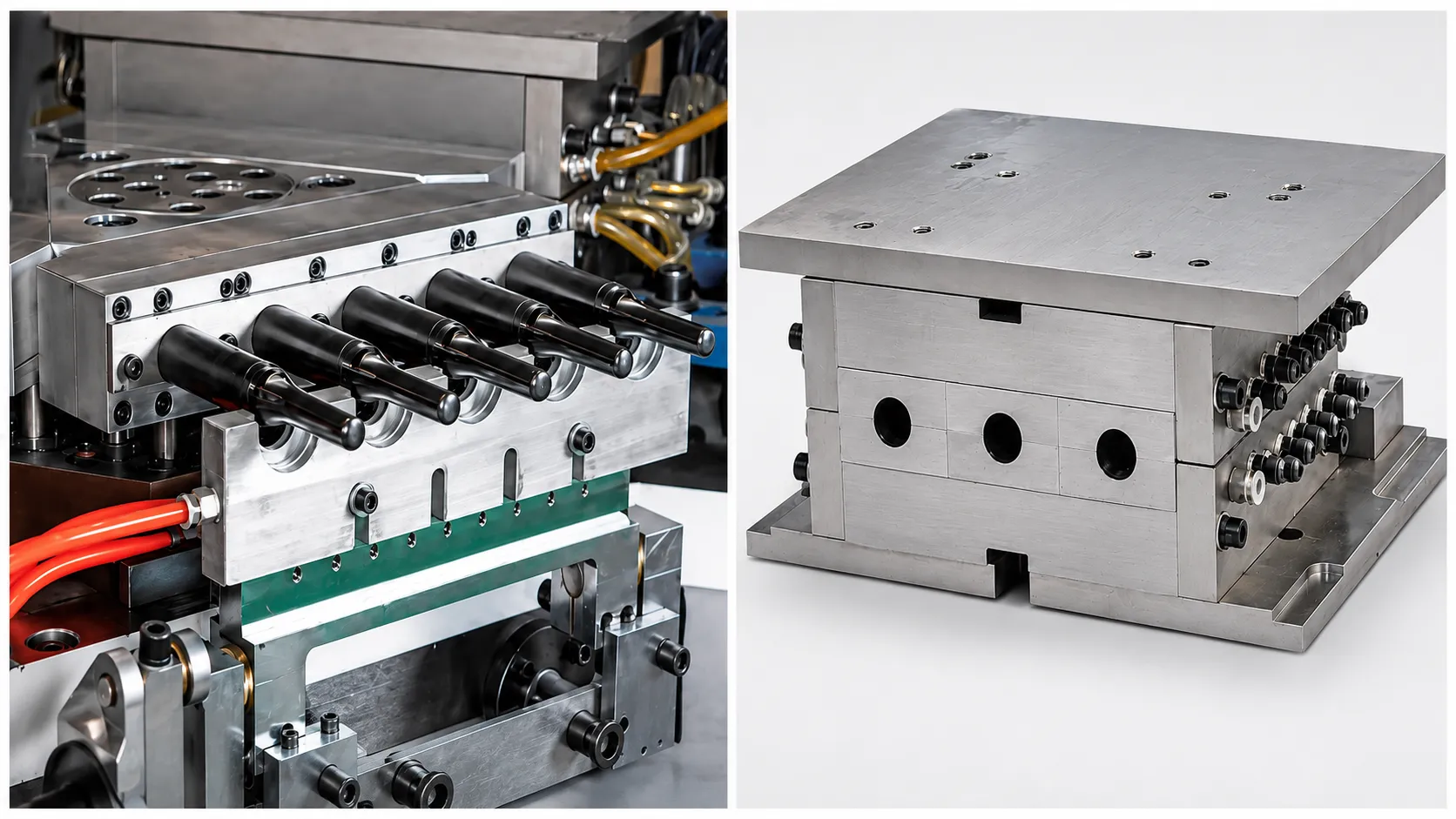
The Korean ophthalmic dropper cap system has two precision interface points with the IBM container neck: the outer snap-fit or thread engagement between the dropper cap skirt and the neck OD, and the inner bore engagement between the dropper insert’s controlled orifice body and the neck bore ID. Both interfaces require dimensional precision that IBM provides natively through its injection mould tooling and core rod mechanism.
Outer Snap-Fit Interface: Neck OD ±0.05 mm
Korean ophthalmic dropper caps engage the IBM bottle neck at the 13 mm OD by a circumferential bead on the cap skirt that snaps over the neck’s retaining flange. This snap-fit engagement provides: tamper evidence (the bead breaks an induction seal or deforms the retaining flange on first opening), child resistance (some Korean ophthalmic CRC formats require push-and-turn action), and closure retention during Korean pharmacy dispensing handling (the cap must remain attached to the bottle when tapped on a Korean pharmacy dispensing tray). The snap-fit mechanism’s function depends on the interference between the cap bead inner diameter and the bottle neck flange OD — the designed interference is typically 0.08–0.15 mm (the cap bead is 0.08–0.15 mm smaller in diameter than the neck flange OD). With IBM’s ±0.05 mm neck OD tolerance, the interference varies between 0.08–0.15 mm ±0.05 mm across all cavities — always within the range where snap-fit engagement occurs without cap opening force being excessive for Korean pharmacists or patients. With EBM’s ±0.15–0.25 mm neck OD tolerance, the interference variation of ±0.15–0.25 mm would produce, at the low end, engagement that is either absent (cap falls off) or, at the high end, engagement that requires destructive force to open — neither acceptable in Korean ophthalmic pharmaceutical distribution.
Inner Bore Interface: Dropper Insert Orifice at ±0.04 mm
The dropper insert — the controlled-orifice component that produces a consistent 25–35 microlitre drop volume per squeeze — seats inside the IBM bottle neck bore, with its outer body in contact with the bore inner surface. The drop volume delivered by the dropper insert depends on two factors: the orifice diameter (controlled by the dropper insert mould tooling) and the bore-insert interference fit (controlled by the IBM bore ID versus the dropper insert OD). If the IBM bore is too small (below nominal), the dropper insert compresses inward and distorts the orifice geometry — producing smaller drop volumes than specified. If the IBM bore is too large (above nominal), the dropper insert can tilt within the bore, creating asymmetric orifice orientation that produces erratic drop trajectory in Korean patient use. IBM’s core rod defines the bore ID at ±0.04 mm across all cavities through the direct mechanical relationship between the core rod OD and the bore it forms during injection — the bore is not blown, not stretched, not dependent on air pressure, and does not vary with process parameter fluctuation at the blow station.
4. HDPE Grade and Processing for Ophthalmic IBM
Korean ophthalmic HDPE IBM uses a narrower resin specification than general pharmaceutical IBM — the combination of thin body wall (0.30–0.40 mm), high cavity count (20–30 cavities), long hot runner paths, and Korean KFDA extractables requirements creates a specification set that narrows the usable HDPE grade range to MI 0.3–0.5 at 190°C/2.16 kg and density 0.950–0.960 g/cm³ for the majority of Korean ophthalmic IBM applications.
Resin Grade Specification
- MI: 0.3–0.5 g/10min (190°C / 2.16 kg)
- Density: 0.950–0.960 g/cm³
- Additives: KFDA positive list only
- No UV stabilisers, no slip agents
- Antioxidant: AO-1010 or AO-168 ≤0.05%
- KFDA pharmaceutical contact declaration required
Processing Parameters (ZQ80/ZQ110)
- Barrel: 175→195→210→215→215°C
- Injection pressure: 90–130 MPa
- Fill time: 0.6–1.0 s (thin wall)
- Hold: 50–65% peak, 0.4–0.8 s
- Blow air: 0.5–0.8 MPa
- Blow dwell: 0.7–1.2 s
- Mould temperature: 12–22°C
Critical Quality Checks
- Neck OD: 13.00 ±0.05 mm — all cavities
- Bore ID: 9.0 ±0.04 mm — all cavities
- Bottle weight: ±4% CV% across cavities
- Wall translucency: pass visual fill-level check
- Dropper cap engagement: 100% snap-fit on line
- Particulate: pass KFDA ophthalmic standard
Wall translucency and HDPE grade interaction: Korean ophthalmic containers must allow Korean pharmacists and Korean patients to visually inspect the liquid fill level — a requirement that limits HDPE wall thickness to ≤0.40 mm at the body panel, where HDPE’s semi-crystalline structure transmits sufficient light at this thickness for fill-level judgement. At 0.50 mm body wall, standard HDPE at density 0.955 g/cm³ becomes opaque enough that fill-level inspection is unreliable. The 0.30–0.40 mm body wall is a design constraint that the IBM mould designer must achieve through the preform geometry and blow ratio — and that the IBM operator must verify in production through periodic wall thickness measurement at the minimum body wall location using ultrasonic gauge measurement.
5. Korean KFDA Ophthalmic Container Qualification Requirements
Korean KFDA ophthalmic pharmaceutical container qualification requirements are more stringent than general pharmaceutical container requirements in two specific areas: particulate contamination standards and compatibility testing duration. These stricter requirements reflect the ophthalmic route of administration — the ocular surface is highly sensitive to particulate and chemical insults, and Korean KFDA ophthalmic product safety standards are calibrated accordingly.
Ophthalmic Particulate Standards (KFDA / Korean Pharmacopoeia)
Korean Pharmacopoeia (KP) aligns with USP <790> for visible particulates in ophthalmic preparations and USP <788> for sub-visible particulate matter in ophthalmic preparations. For Korean IBM ophthalmic container qualification, particulate testing applies in two stages: container wash-extract testing (empty containers filled with purified water, agitated and examined for visible particulate and sub-visible particulate count) and filled product testing (Korean ophthalmic formulation filled into IBM containers examined at end of proposed shelf life). IBM container wash-extract particulate limits per KP ophthalmic container test: visible particles — absent (zero visible particles in wash extract when examined under Korean Pharmacopoeia visible inspection method); sub-visible particles per KP (aligned with USP <788>): ≤25 particles/ml ≥10 μm, ≤3 particles/ml ≥25 μm. IBM’s zero-flash production eliminates the most significant source of sub-visible particulate in blow-moulded pharmaceutical containers — the plastic fines generated by EBM flash trimming. Korea Ever-Power’s pharmaceutical IBM documentation package includes a reference statement on IBM’s zero-flash architecture for use in the Korean pharmaceutical container qualification documentation that addresses Korean KFDA questions on particle contamination prevention during container production.
Compatibility Testing Duration for Ophthalmic IBM Containers
Korean KFDA ophthalmic pharmaceutical container compatibility testing requires a 24-month accelerated stability study at 40°C/75% RH — 12 months longer than the 12-month standard for most oral pharmaceutical container compatibility studies. The longer study period reflects the Korean KFDA position that ophthalmic formulations’ complex mixture of active ingredients, preservatives (benzalkonium chloride, thimerosal, or preservative-free buffer systems) and buffering agents creates a more complex extractable interaction profile with HDPE than simple aqueous solutions. Korean IBM ophthalmic packaging producers should plan for 24-month compatibility studies — which means beginning the filled container compatibility study immediately upon first IBM production at qualification conditions, so that the 24-month study result is available within the overall Korean ophthalmic product development timeline without delaying the KFDA submission.
6. IBM Cleanroom Setup for Korean Ophthalmic Production
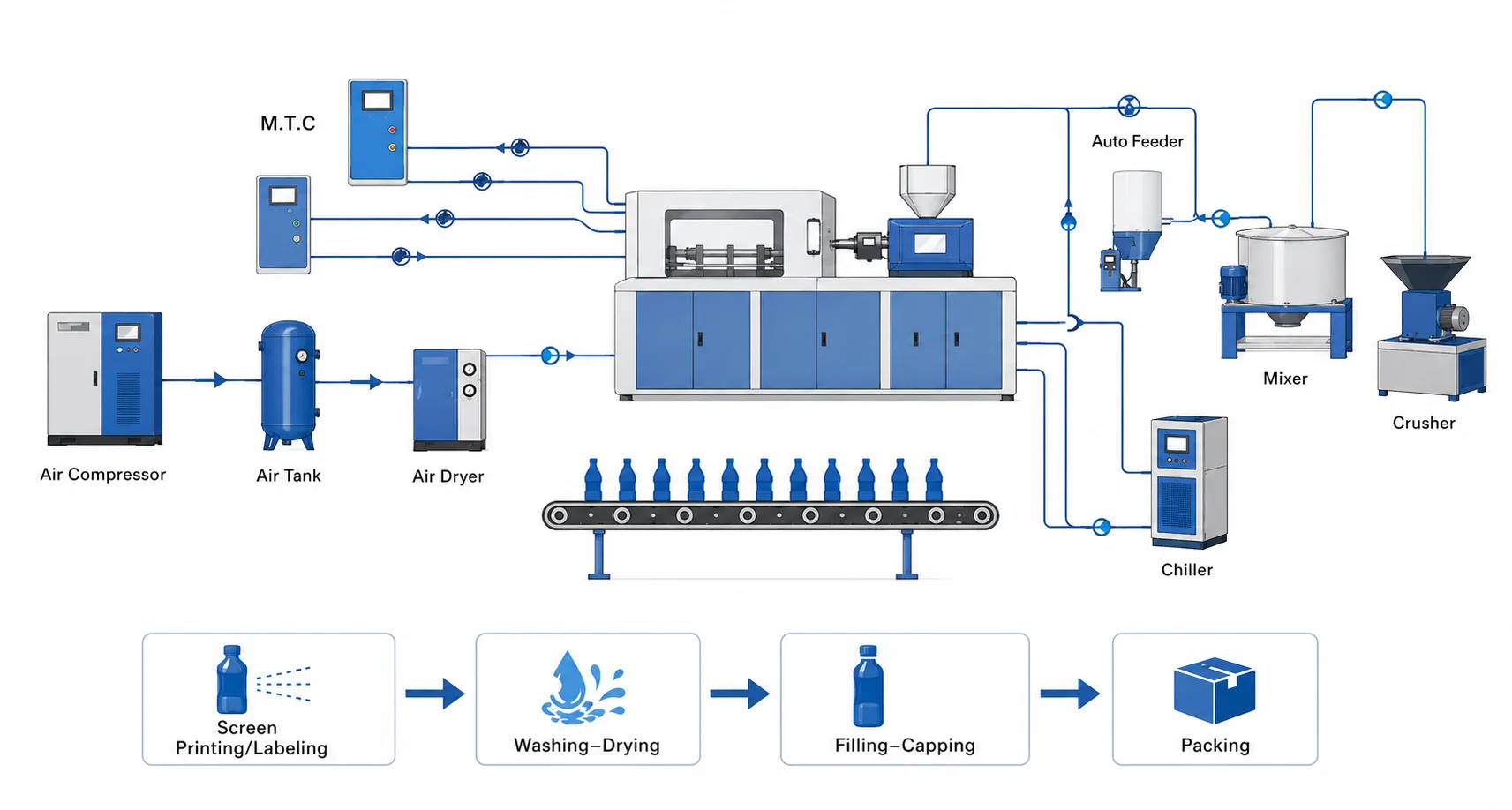
Korean ophthalmic IBM production is typically conducted in ISO Class 8 (Korean GMP Grade D equivalent) cleanroom environments. The specific cleanroom requirements for ophthalmic IBM container production — distinct from the general pharmaceutical IBM cleanroom setup described in the pharmaceutical IBM guide — reflect the higher particulate sensitivity of Korean ophthalmic containers.
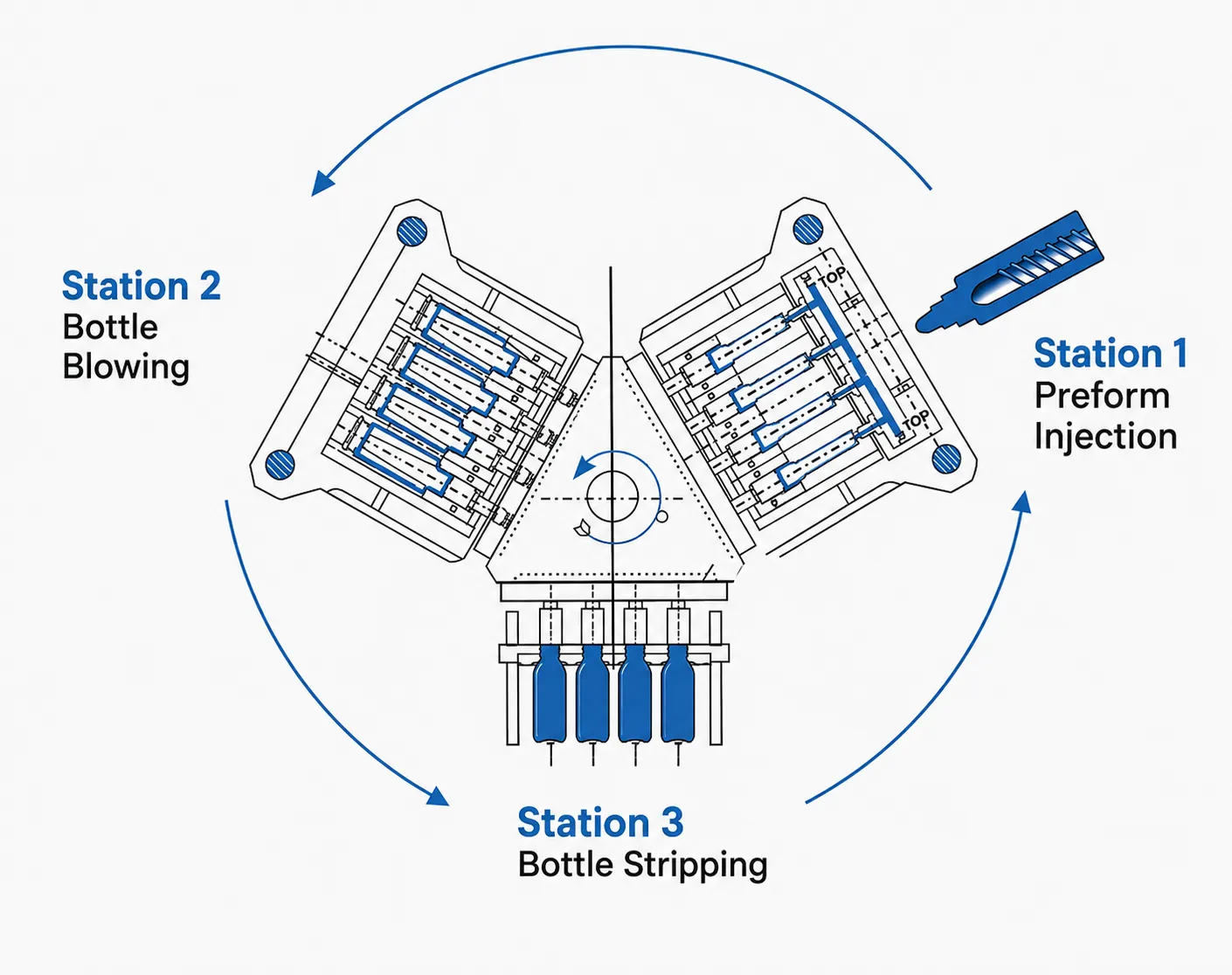
- HEPA supply air over mould station: The IBM machine’s mould area — where containers are formed and where the core rods deposit finished containers onto the output conveyor — should receive HEPA-filtered supply air at ≥0.45 m/s face velocity downward into the open mould area. This positive-pressure HEPA supply air prevents airborne particles from entering the open container mouth during the time between stripping (Station 3) and cap application at the downstream Korean pharmaceutical filling line. The HEPA enclosure over the mould station is specified as a separate engineering item in the Korean ophthalmic IBM cell design — Korea Ever-Power provides connection points and dimensional data for the HEPA enclosure installation on the ZQ machine outline drawings.
- Oil-free compressed air — mandatory: Compressed air used for IBM blow moulding of Korean ophthalmic containers must be oil-free at the point of use — ISO 8573-1 Class 0 for oil aerosol and oil vapour. Oil contamination of the IBM blow air at the blow station contacts the interior of the HDPE preform during inflation and becomes an extractable contaminant in the finished container. Korean ophthalmic IBM producers must specify oil-free screw compressors (not oil-lubricated reciprocating compressors with downstream filters), and must verify oil-free status at the machine connection point with regular particulate and oil vapour monitoring per Korean pharmaceutical compressed air quality monitoring protocols.
- Output conveyor HEPA enclosure: Korean ophthalmic containers exiting the IBM machine at Station 3 travel on an output conveyor before being collected into bags or trays for transport to the Korean pharmaceutical filling line. This conveyor section should also be HEPA-enclosed to maintain container cleanliness from the IBM machine exit to the collection point. The conveyor HEPA enclosure is typically installed as a tunnel with positive-pressure HEPA supply air and a filtered exhaust at the conveyor exit. Without conveyor enclosure, Korean ophthalmic IBM containers can accumulate airborne particulate during the conveyor transit that then settles into the open container mouth and contributes to sub-visible particulate counts in the filled container.
7. Cavity Count Economics for Korean Ophthalmic IBM
Cavity count selection for Korean ophthalmic IBM is the highest-impact single investment decision — because the Korean ophthalmic container market’s 500M+ annual unit demand requires matching machine cavity count to annual production volume with enough precision that the machine runs at 70–90% utilisation (below 60% utilisation wastes capital; above 90% utilisation creates production risk from unscheduled maintenance). The following analysis compares three ZQ models for a Korean ophthalmic contract packaging factory with a specific annual volume requirement.
| Parameter | ZQ80 (20 cav) | ZQ110 (24 cav) | ZQ135 (30 cav) |
|---|---|---|---|
| Bottles/hour (88% eff.) | ~15,840 | ~19,000 | ~23,760 |
| Bottles/Korean 2-shift day (14 hr) | ~221,760 | ~266,000 | ~332,640 |
| Bottles/year (250 days) | ~55.4M | ~66.5M | ~83.2M |
| Machines for 200M units/year | 4 machines | 3 machines | 3 machines (72% util.) |
| KFDA qualifications required | 4 machine quals | 3 machine quals | 3 machine quals (lowest per unit) |
The cavity count economics table shows that for a Korean ophthalmic contract packager targeting 200M annual 10 ml units, the ZQ135 at 30 cavities requires the same number of machines as the ZQ110 at 24 cavities (3 machines in both cases) but runs at 72% utilisation versus 100% — providing production headroom for unscheduled maintenance, format change downtime, and annual demand growth without requiring a fourth machine purchase. The number of Korean KFDA machine qualifications is also minimised at the higher cavity count (3 qualifications at ZQ135 versus 4 at ZQ80) — each machine qualification represents 16–24 weeks of testing timeline and significant documentation cost. For Korean ophthalmic contract packaging facilities seeking to minimise their total number of KFDA machine qualifications while maintaining production redundancy, the ZQ135 or ZQ110 is clearly the correct investment over multiple ZQ80 machines at equivalent annual output. The Korea Ever-Power EP-ZQ110 is the most common starting platform for Korean ophthalmic contract packagers whose annual volume is in the 50M–80M unit range per machine.
8. ZQ Series Selection for Korean Ophthalmic IBM Production
For Korean ophthalmic IBM production, the selection between ZQ series models involves not just output rate and capital cost, but a pharmaceutical-specific consideration: the Korean KFDA qualification is tied to the specific machine model and cavity count. The following guidance accounts for this pharmaceutical-specific constraint.
Korean Ophthalmic Startup / Trial Production → ZQ60 (14 cavities)
Annual volume below 25M units. Korean pharmaceutical startup companies, Korean ophthalmic product line pilot runs, Korean CMO trial production for international ophthalmic brands entering Korea. The ZQ60 investment is appropriate for volumes below 25M units but requires careful future planning: upgrading from ZQ60 to ZQ80 for an existing KFDA-registered Korean ophthalmic product requires a new Korean KFDA machine change notification and qualification at the new machine — a 3–6 month process. Korean ophthalmic packaging producers who anticipate growing to 30M+ units within 3 years should commission ZQ80 from the start and accept the initial lower utilisation, avoiding the qualification transition cost.
Korean Mid-Scale Ophthalmic → ZQ80 (20 cavities, 30M–55M units/year)
The ZQ80’s dual hydraulic system (20–30% energy saving) and high-precision angle divider (standard at ZQ80+) make it the entry point for Korean ophthalmic production where energy efficiency and inter-cavity consistency are KFDA qualification requirements. At 20-cavity 10 ml production, ZQ80 produces approximately 55M ophthalmic bottles per Korean two-shift year — sufficient for Korean mid-scale pharmaceutical manufacturers serving Korean domestic ophthalmic market without export requirements.
Korean Large-Scale Ophthalmic → ZQ110 / ZQ135 (55M–83M+ units/year per machine)
Korean pharmaceutical contract packagers serving multi-national ophthalmic brands, Korean pharmaceutical exporters, and Korean national ophthalmic manufacturers serving Korean hospital supply chains at national scale — all require ZQ110 or ZQ135 production to achieve the output volumes and KFDA qualification efficiency that their business model demands. The full injection blow molding machine range covers all Korean ophthalmic production scales from startup to national-scale pharmaceutical supply.
Frequently Asked Questions
Ophthalmic IBM Enquiry
Planning Korean Ophthalmic Container IBM Production?
Korea Ever-Power provides 10 ml ophthalmic IBM mould design, Korean KFDA qualification documentation, cleanroom production cell planning and ZQ series machine selection for Korean ophthalmic pharmaceutical and OTC eye care packaging at all annual production volumes.
Related Resources
EP-ZQ80 Injection Blow Molding Machine
800 KN · 20 cavities at 10 ml ophthalmic · Angle divider + dual hydraulic standard · ~55M Korean ophthalmic containers per Korean two-shift year.
EP-ZQ135 Injection Blow Molding Machine
1,350 KN · 30 cavities at 10 ml ophthalmic · 6+N barrel zones · 37+37 KW · ~83M Korean ophthalmic containers per year — Korean national hospital supply chain scale.
HDPE Injection Blow Molding: Complete Processing Guide
Full HDPE IBM processing guide — grade selection (MI 0.3–0.8), barrel temperature setup, wall thickness specification and ZQ series selection for pharmaceutical and household chemical IBM.