
IBM Çevrim Süresi · ZQ Makine Parametreleri · Soğutma Bekleme Süresi · PP HDPE PCTG · Kore Ever-Power
IBM Döngü Süresi Optimizasyonu:
ZQ Makine Parametreleri PP, HDPE ve PCTG için
IBM çevrim süresi, makine saati başına IBM konteyner üretimini doğrudan belirler ve birim başına IBM üretim maliyetinin temel itici gücüdür. Beş temel ZQ IBM çevrim süresi bileşenini (enjeksiyon dolumu, enjeksiyon bekleme süresi, şişirme ve bekleme süresi, istasyon indeksi ve sıyırma) ve bunların her birinin Kore Ever-Power ZQ makinelerinde PP, HDPE ve PCTG malzemeleri için nasıl optimize edildiğini anlamak, IBM üretim mühendisliği ve program maliyet modellemesi için çok önemlidir.
PP • HDPE • PCTG Bekleme Süresi
ZQ40 • ZQ60 • ZQ80 • ZQ110 Çıkışı
KOREA EVER-POWER · ANSAN-SI, GYEONGGI-DO · TEMMUZ 2026
IBM Çevrim Süresi · ZQ Makine Bileşeni Özeti
TOPLAM IBM DÖNGÜSÜ
4,0 saniye – 25 saniye
Kore Ever-Power ZQ makinelerinde toplam IBM çevrim süresi aralığı: 4,0 saniye (ZQ kuru çevrim minimum, tamamen elektrikli ZQ60HE) ila 25+ saniye (kalın duvarlı ve uzun üfleme bekleme süreli büyük HDPE endüstriyel kap ZQ135). Standart PP kozmetik IBM: 5–8 saniye. Standart HDPE yağlayıcı 1L: 7–10 saniye. PCTG ilaç şişesi: 5–7 saniye. Geniş ağızlı takviye kavanozu PP: 8–14 saniye
BASKIN BİLEŞEN
Üflemeli Duraklama
Üfleme istasyonundaki bekleme süresi (soğutma bekleme süresi), çoğu IBM konteyner formatı için IBM çevrim süresinin baskın bileşenidir: Toplam ZQ IBM çevrim süresinin -70%'si üfleme istasyonundaki soğutma bekleme süresidir. IBM şişe boyutsal stabilitesinden (üfleme istasyonunda duvar katılaşması) ödün vermeden üfleme bekleme süresini azaltmak, Kore Ever-Power ZQ programlarında IBM çevrim süresi optimizasyonunun temel kaldıraçıdır. Birincil araç: Üfleme istasyonu ısı akışını artırmak için ZQ üfleme kalıbı soğutma suyu sıcaklığını düşürmek (standart 15°C'den 10-12°C'ye).
İKİNCİL KOL
Enjeksiyon Dolumu
Enjeksiyon dolumu + bekleme süresi (İstasyon 1 süresi), IBM döngüsünün ikinci en büyük bileşenidir (tipik olarak ince duvarlı PP IBM'de toplam döngünün -45%'si). Şunlarla optimize edilir: daha hızlı enjeksiyon dolum hızı (flaşsız dolum için kabul edilebilir PP kesme hızı dahilinde); minimum enjeksiyon tutma basıncı bekleme süresi (sadece kapı donana kadar); ve bozulma olmadan hızlı dolum için optimum namlu sıcaklığı. ZQ enjeksiyon süresi hedefi: standart PP IBM için 1,5-3,5 saniye, HDPE IBM için 2,5-5,0 saniye.
ZQ MAKİNE FAKTÖRÜ
Endeks Zamanı
ZQ istasyonlar arası indeksleme süresi (ZQ makine tablasının ve çekirdek çubuk düzeneğinin 1. istasyondan 2. istasyona ve 3. istasyona mekanik dönüşü), IBM döngüsü başına 0,8–2,0 saniye katkıda bulunur (sabit ZQ makine mekanik parametresi, ayarlanabilir değil). ZQ60HE tamamen elektrikli servo indeksleme, hidrolik ZQ standardına göre 1,0–1,5 saniyeye karşılık 0,5–0,8 saniyelik indeksleme süresi elde eder. ZQ60HE'de, ZQ60 hidrolik modeline kıyasla döngü başına toplam 0,5 s × 3 istasyon = 1,5 s indeksleme süresi tasarrufu sağlanır.
BÖLÜM 01
IBM Üretim Döngüsü Bileşenleri: ZQ Makine Üretim Döngüsünün Anatomisi
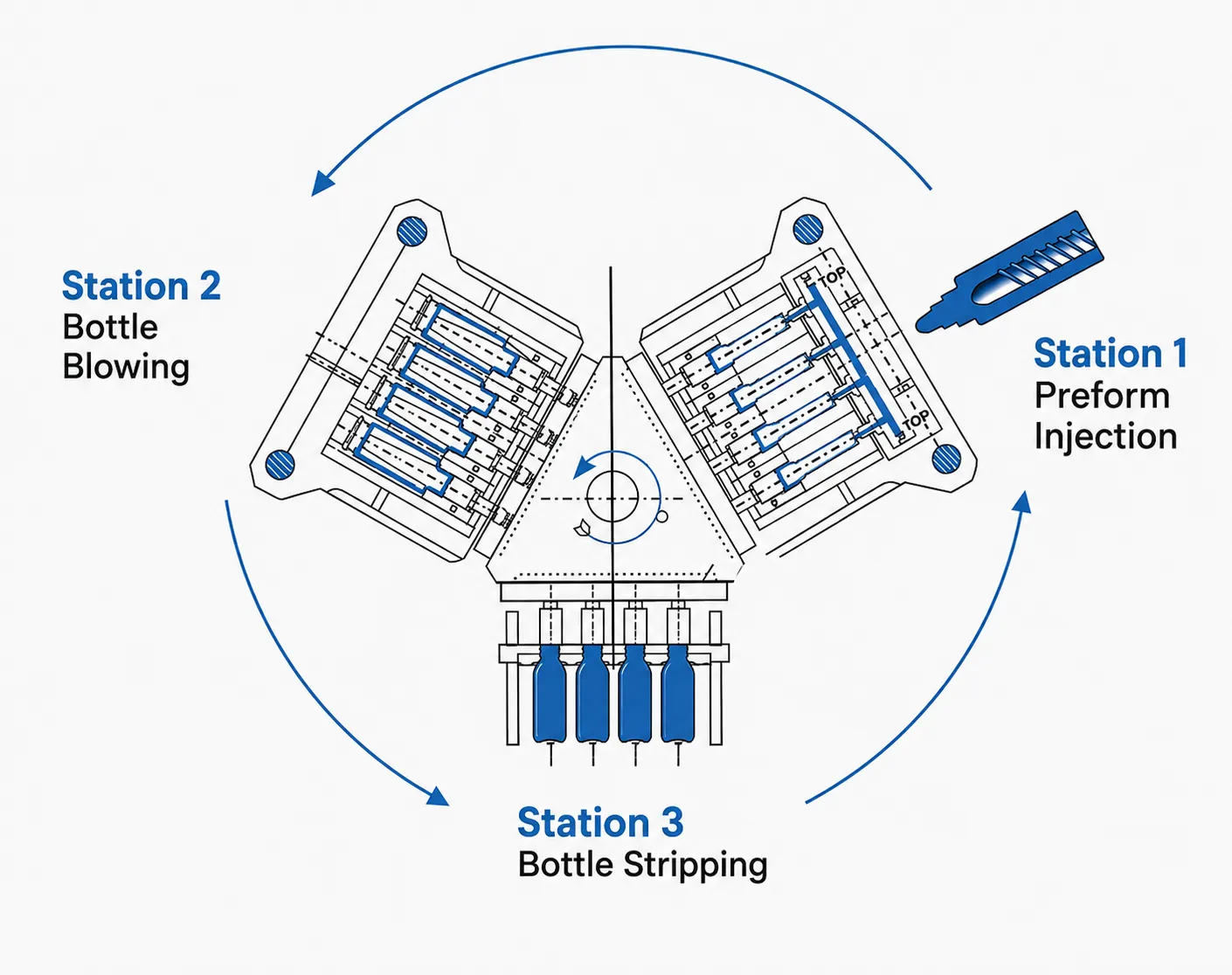
Her Kore'nin Sonsuz Gücü ZQ IBM makinesi Üretim döngüsü, saatte üretilen konteyner sayısını belirleyen toplam IBM döngü süresini oluşturan beş ardışık zaman bileşeninden oluşur. Her bileşenin fizik (polimer dolum dinamikleri, ısı transferi) ve makine mekaniği (ZQ aktüatör hızı) tarafından belirlenen minimum bir zaman tabanı ve IBM konteyner kalitesini üretim verimliliğiyle dengeleyen optimum bir değeri vardır. IBM döngü süresi optimizasyonu, üretim koşullarında IBM konteyner boyut, duvar veya yüzey kalitesinden ödün vermeden her bir bileşeni fiziksel minimumuna doğru azaltma işlemidir.
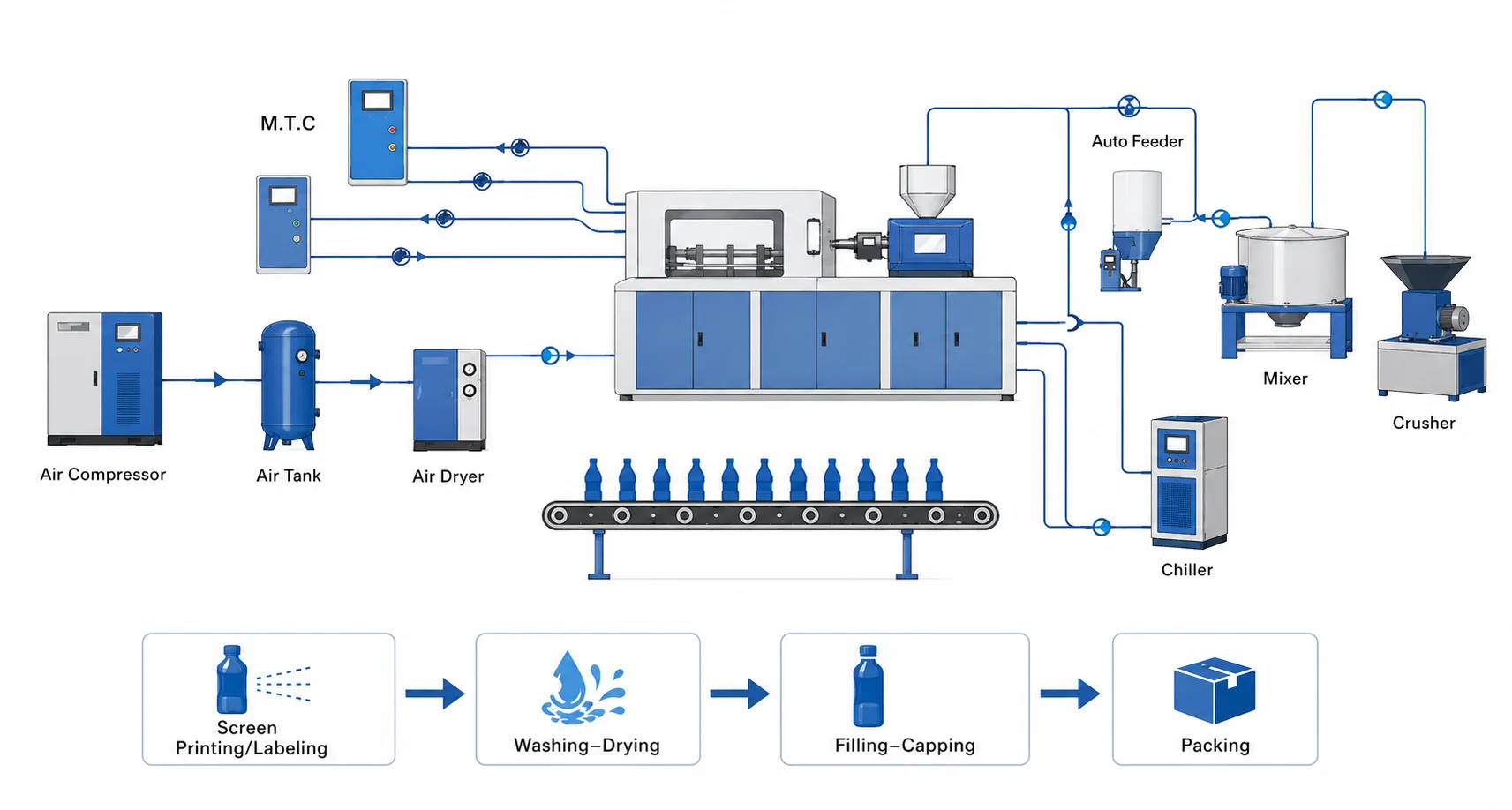
ZQ IBM Çevrim Süresi · Beş Bileşen ve Tipik Değerler
1. Enjeksiyon Dolumu
PP: 0,8–2,5 s (MFR 15–25 g/10 dk, 220–235°C). HDPE: 1,5–4,0 s (MFR 0,3–1,0 g/10 dk, 200–220°C). PCTG: 1,0–2,0 s (MFR 8–15 g/10 dk, 245–260°C). Dolum süresi, ön kalıp hacmi ve polimer viskozitesiyle orantılıdır. Minimum süre, kalıp ağzı flaşı ve eksik dolum riskiyle sınırlıdır.
2. Enjeksiyon Dolgu Bekleme Süresi
0,5–2,0 s (tüm polimerler için). Enjeksiyon dolumundan sonraki basınç tutma fazı: Enjeksiyon boşluğunda eriyik katılaşırken PP/HDPE/PCTG hacimsel büzülmesini telafi eder. Süre, kalıp giriş donma süresiyle belirlenir (kalıp giriş donduktan sonra, daha fazla paketlemenin ön kalıp üzerinde hiçbir etkisi yoktur). Minimum: 0,5 s (ince kalıp girişi, yüksek MFR PP); maksimum: 2,0 s (kalın kalıp girişi, düşük MFR HDPE)
3. Şişirilmiş Enflasyon + Bekleme
PP: 2,0–8,0 s (ince duvarlı kozmetik 2,0–4,0 s; geniş ağızlı takviye kavanozu 6,0–8,0 s). HDPE: 4,0–15,0 s (1 L yağlayıcı 4,0–7,0 s; 5 L endüstriyel 10–15 s). PCTG: 3,0–6,0 s. Üfleme bekleme süresi = baskın çevrim bileşeni. Polimerin duvar kalınlığı, termal iletkenliği ve kalıp soğutma kapasitesi tarafından belirlenir.
4. İstasyon Endeksi
ZQ standart hidrolik: Dönüş başına 1,0–1,5 s (çekirdek çubuk tertibatı İstasyon 1→2→3 ve geri döner). ZQ60HE tamamen elektrikli servo: İndeks başına 0,5–0,8 s (servo motor daha hızlı tepki verir). 3 istasyonlu ZQ: Döngü başına 3 indeks (S1→S2, S2→S3, S3→S1). Toplam indeks: Hidrolik 3,0–4,5 s; elektrikli 1,5–2,4 s. Sabit mekanik parametre, prosesle ayarlanamaz.
5. Sökme + Çıkarma
0,5–1,5 saniye. IBM şişesi, 3. İstasyonda (sıyırma istasyonu) çekirdek çubuktan ayrılır: IBM şişesi şişirme kalıbında veya sıyırma plakasında tutulurken çekirdek çubuk geri çekilir, ardından çıkış konveyörüne fırlatılır. Süre, ZQ sıyırma mekanizmasının hızı (hidrolik veya servo aktüatör) tarafından belirlenir. Minimum: 0,5 saniye (ZQ40 tamamen elektrikli ince duvarlı hafif PP IBM şişesi); maksimum: 1,5 saniye (ZQ135 ağır HDPE kova)
BÖLÜM 02
Üfleme İstasyonu Bekleme Süresi Optimizasyonu: Soğutma Suyu ve Kalıp Sıcaklığı
Soğutma Suyu Sıcaklığı: Birincil Üfleme Bekleme Kolu
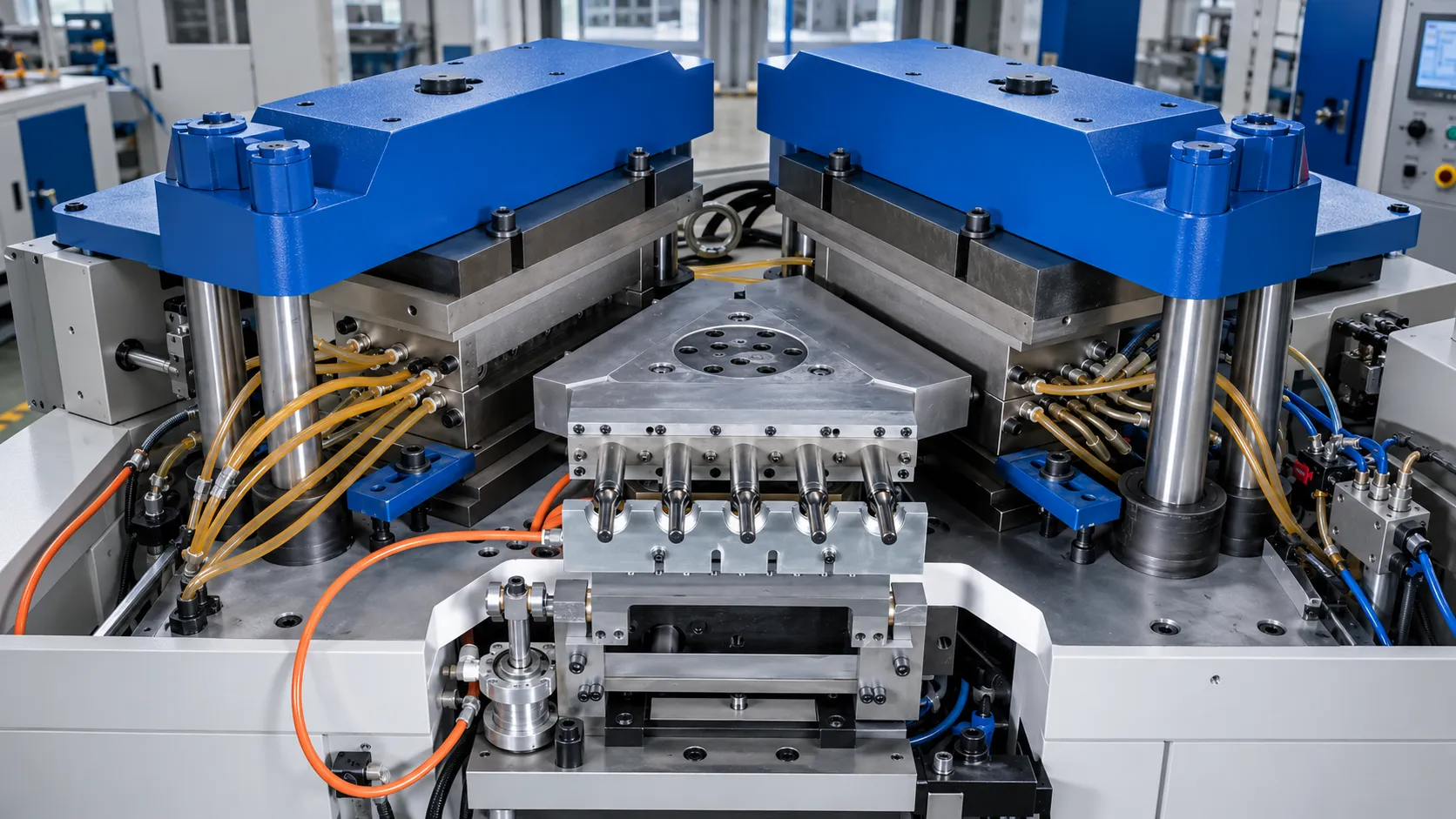
ZQ IBM şişirme kalıbı soğutma suyu sıcaklığı, şişirme istasyonunda bekleme süresi optimizasyonu için birincil kontrol değişkenidir çünkü soğutma suyu sıcaklığı, şişirme istasyonunda IBM şişe duvarından ısı çekimi için termal itici gücü doğrudan belirler. Şişirme boşluğu duvarındaki IBM şişirme kalıbı ısı akısı (Q): Q = k × (T_duvar − T_soğutucu) / kalınlık, burada k = kalıp çeliğinin termal iletkenliği (H13: 25–28 W/m·K), T_duvar = IBM şişe duvarı temas sıcaklığı, T_soğutucu = soğutma suyu sıcaklığı, kalınlık = soğutma kanalı ile boşluk yüzeyi arasındaki H13 kalıp duvar kalınlığıdır. Soğutma suyu sıcaklığının 18°C'den 12°C'ye düşürülmesi, sıcaklık itici gücünü (T_duvar − T_soğutucu) 6°C artırır (188°C duvar temas sıcaklığında PP IBM için yaklaşık 170°C'den 176°C'ye itici güç) — bu da her °C düşüş için ısı akısını yaklaşık 3,5% artırır. 0,8 mm gövde duvar kalınlığına sahip PP IBM kozmetik şişesi için, 18°C soğutma sıvısında 3,0 saniyelik üfleme bekleme süresiyle: sıcaklığın 12°C'ye düşürülmesi, minimum bekleme süresini yaklaşık 2,5 saniyeye düşürür (−0,5s, 17% üfleme bekleme süresi azalması) — bu, üfleme bekleme süresi kontrol istasyonu süresi olsaydı 17% ZQ çevrim süresi azalmasına eşdeğerdir. Soğutma suyu sıcaklığı minimumu: Kore Ever-Power standardı ZQ üfleme kalıbı soğutma suyu sıcaklığı tabanı 10°C'dir — 10°C'nin altında, Kore yaz neminde (Temmuz-Ağustos aylarında RH 70–90%) ZQ üfleme kalıbı boşluğunun dış yüzeylerinde nem yoğunlaşması riski vardır; bu da H13 kalıbının dış yüzeyinde paslanmaya ve üfleme istasyonunda IBM şişe boşluğuna nem damlacıklarının düşmesine neden olabilir. ZQ şişirme kalıp soğutma suyu akış hızı: Etkin ısı transferi için ZQ şişirme kalıp soğutma kanallarında (Reynolds sayısı >10.000) türbülanslı akışı koruyacak yeterli akış hızı gereklidir — Korea Ever-Power, ZQ standart IBM şişirme kalıp kanalları için soğutma devresi başına minimum 5 L/dak debi belirtmektedir.
Minimum Üfleme Bekleme Süresi: Kalite Kısıtlaması
Minimum IBM şişirme istasyonu bekleme süresi, IBM şişe kalite kısıtlaması tarafından belirlenir; bu, IBM şişe duvarının soğutulmuş şişirme kalıbı boşluğu yüzeyine temas etmesi gereken minimum süredir ve bu süre sonunda IBM şişe, boyut deformasyonu (çarpılma, duvar çökmesi, taban batması) olmadan sıyırma istasyonundan atılmaya dayanacak kadar yeterince katılaşır. Kore Ever-Power ZQ'da minimum şişirme bekleme süresi doğrulaması: kademeli bekleme süresi azaltma testi. Muhafazakar bir bekleme süresinden (örneğin ZQ60'ta 500 ml PP kozmetik IBM için 4,0 s) başlayarak, şişirme bekleme süresini 0,2 saniyelik adımlarla azaltın ve her adımda IBM şişeyi ölçün: gövde dış çapı yuvarlaklığı (IBM şişe gövde dış çapı 4 pozisyonda ölçülür, yuvarlaklık hedefi ≤0,5 mm varyasyon); taban düzlüğü (IBM şişe tabanı düz bir yüzeye yerleştirilir, taban altındaki boşluk ≤0,3 mm geçer not alır); Şişe gövdesinin dış çapındaki değişim (IBM şişe gövdesi dış çapı, şişenin çıkarılmasından 30 dakika, 1 saat ve 2 saat sonra ölçülür: 30 dakika ile 2 saat arasında ≤0,2 mm'lik değişim, üfleme istasyonunda yeterli katılaşmayı gösterir; >0,5 mm'lik değişim, sıyırma istasyonunda IBM şişesinin yetersiz soğutulduğunu gösterir). Minimum kabul edilebilir üfleme bekleme süresi: IBM şişe gövdesinin yuvarlaklığı, taban düzlüğü ve boyutsal kararlılığının yukarıdaki kriterlerin tümünü karşıladığı en kısa bekleme süresi, üretim varyasyonu için ek olarak 0,3-0,5 saniyelik bir güvenlik payı eklenerek belirlenir. Korea Ever-Power, ZQ T1/T2 denemesi sırasında her konteyner formatı için minimum üfleme bekleme süresini belirler ve bunu ticari üretim sırasında ayarlanamayan bir proses parametresi olarak ZQ IBM makine üretim kurulum sayfasında belgeler.
BÖLÜM 03
Enjeksiyon İstasyonu Optimizasyonu: Dolum Hızı, Namlu Sıcaklığı ve Giriş Noktası
ZQ'da Enjeksiyon Dolum Hızı Optimizasyonu
ZQ IBM enjeksiyon dolum hızı (ZQ piston hızı mm/s veya enjeksiyon hacim hızı cm³/s), enjeksiyon dolum süresini ve dolayısıyla İstasyon 1 çevrim katkısını doğrudan kontrol eder. Optimum dolum hızı şu dengeyi sağlar: minimum dolum süresi (İstasyon 1'den en hızlı IBM çevrim katkısı) ile kalite kısıtlamaları (aşırı dolum basıncından kaynaklanan enjeksiyon boşluğu ayırma çizgisinde çapak olmaması; yetersiz dolum hızından kaynaklanan ince ön kalıp gövde bölümlerinde kısa atış olmaması; yüksek dolum hızında aşırı kesme ısınmasından kaynaklanan akış izleri veya yayılma olmaması). Standart PP IBM için Korea Ever-Power ZQ enjeksiyon dolum hızı optimizasyonu: orta dolum hızından (ZQ piston 30 mm/s) başlayarak, ön kalıp ağırlık tutarlılığını (20 ardışık atış boyunca boşluk başına hedef ≤±0,5% ağırlık değişimi) ve ön kalıp görsel kalitesini (aşırı kesmeden kaynaklanan yayılma izleri olmaması; çok yavaş dolumdan kaynaklanan soğuk kaynak dikişi olmaması) izlerken 5 mm/s'lik adımlarla 40-50 mm/s'ye kadar artırılır. Optimum PP IBM dolum hızı: Standart PP kozmetik IBM (ZQ40/ZQ60) için tipik olarak 35–55 mm/s ZQ piston hızı, 10–25 g PP preform için 0,8–1,5 saniye dolum süresi sağlar. HDPE IBM dolum hızı: HDPE MFR 0,3–1,0 g/10 dk için daha düşük ZQ piston hızı (10–25 mm/s) gereklidir (düşük MFR HDPE, enjeksiyon boşluğu basıncını ZQ makine hidrolik sisteminin tepe limitinin altında tutmak ve hızlı dolum sonunda basınç artışından kaynaklanan kalıp çapaklarını önlemek için daha yavaş dolum hızı gerektirir). HDPE IBM dolum süresi: 50–250 g HDPE yağlayıcı preform için tipik olarak 2,0–4,0 saniye. Enjeksiyon dolum hızına giriş boyutu etkisi: Daha büyük IBM girişi (IBM için pim giriş çapı 1,5–3,0 mm, enjeksiyon kalıplama için 0,5–1,5 mm) aynı enjeksiyon basıncında daha hızlı polimer akışına olanak tanır ve aşırı kesme ısınması olmadan daha hızlı dolum hızı sağlar; IBM kalıp giriş boyutu, üretim koşullarında optimum dolum hızına olanak sağlamak için Kore Ever-Power kalıp mühendisliği tarafından enjeksiyon boşluğu girişinde tasarlanmıştır.
Enjeksiyon Paketleme Bekleme Süresinin En Aza İndirilmesi
ZQ IBM enjeksiyon kalıplama bekleme süresi (enjeksiyon dolumundan sonraki tutma basıncı aşaması, enjeksiyon bekleme süresi olarak da adlandırılır), IBM enjeksiyon kalıbının donması için yeterince uzun olmalıdır (kalıp, ZQ enjeksiyon soğuma süresinde katılaşarak eriyiğin enjeksiyon boşluğundan geri akışını önler), ancak kalıp donma süresini aşmamalıdır, çünkü kalıp donma süresinin ötesindeki ek bekleme süresi, ZQ çevrim süresini tüketirken ön şekillendirme kalitesine hiçbir değer katmaz. ZQ makinelerinde IBM enjeksiyon kalıbı için kalıp donma süresi: ZQ enjeksiyon boşluğunda IBM pim kalıbı (1,5–3,0 mm dış çap) (Korea Ever-Power Ansan-si üretiminde kalıp takım sıcaklığı yaklaşık 40–60°C sabit durum): 1,5–2,5 mm dış çap için PP kalıp donma süresi yaklaşık 0,5–1,0 saniye. HDPE kalıp donma süresi: 0,8–1,5 saniye. Bu nedenle minimum enjeksiyon kalıplama bekleme süresi: 0,5–1,5 saniye. Korea Ever-Power ZQ kalıp bekleme süresi doğrulaması: kalıp kesme testi — ZQ kalıp bekleme süresini 0,1 saniyelik adımlarla azaltın; IBM şişe ön kalıbında ağırlık azalması (>0,5% adım başına) veya giriş bölgesinde görsel çökme izi varsa, paketleme basıncı serbest bırakılmadan önce giriş donmamıştır. ZQ paketleme bekleme süresini, giriş donma süresi + 0,2 saniye güvenlik payı olarak ayarlayın. Paketleme bekleme süresini fazla ayarlamak (IBM üreticilerinde yaygın muhafazakar uygulama): birçok ZQ IBM makine kurulumu 2-3 saniye (muhafazakar) paketleme bekleme süresi kullanırken, optimize edilmiş Kore Ever-Power ZQ kurulumu standart PP IBM için 0,7-1,2 saniye paketleme bekleme süresini hedeflemektedir. Gereksiz paketleme bekleme süresinden 1,0-2,0 saniye tasarruf etmek, üfleme bekleme süresinin azaltılmasından sonraki en büyük ikinci IBM çevrim süresi optimizasyon fırsatıdır.
BÖLÜM 04
Polimer Spesifik IBM Döngü Stratejileri: PP, HDPE ve PCTG
| POLİMER | ANAHTAR DÖNGÜ KISITLAMASI | OPTİMİZASYON STRATEJİSİ | TIPİK ZQ OPTİMİZE EDİLMİŞ DÖNGÜ |
|---|---|---|---|
| PP homopolimeri (MFR 15–25 g/10 dk) | Duvar kristalleşmesi için üfleme bekleme süresi (PP kristalleşmesinin başlangıcı 125–135°C; sıyırma işleminden önce Tg + güvenlik marjının altına soğutulmalıdır). Yüksek MFR nedeniyle enjeksiyon dolumu hızlıdır — enjeksiyon nadiren döngüyü kısıtlar. | Üfleme bekleme süresini en aza indirin: 10–12°C soğutma suyu kullanın. ZQ enjeksiyon istasyonunda paralel soğutma (enjeksiyon bekleme süresi boyunca enjeksiyon boşluğunu 15–20°C su ile soğutun). 40–55 mm/s ZQ piston hızıyla hızlı dolum. Minimum paketleme bekleme süresi 0,6–0,8 saniye. | 500 ml PP kozmetik: Toplam döngü süresi 5,5–7,0 saniye. 300 ml PP el dezenfektanı: 5,0–6,5 saniye. 100 ml PP serum: 4,5–5,5 saniye. |
| HDPE (MFR 0,3–1,0 g/10 dk, yağlayıcı/tarım kimyasalı sınıfı) | Hem enjeksiyon dolumu (yavaş dolum düşük MFR HDPE: 2–4 saniye) hem de üfleme bekleme süresi (kalın duvarlı HDPE yağlayıcı kabı: 5–15 saniye) döngüyü kısıtlar. HDPE 120–125°C'de kristalleşir; daha kalın duvar, orantılı olarak daha uzun soğutma gerektirir. | Agresif şişirme kalıplama soğutması: 10–12°C su. Kalın duvarlı HDPE için şişirme kalıplama tabanında BeCu eklentisi. Hidrolik basınç limiti dahilinde dolum hızını en üst düzeye çıkarın. Dolum süresini en aza indirmek için eşdeğer ESCR için mümkün olan en yüksek HDPE MFR'yi seçin. | 1 litre HDPE motor yağı: 8–12 saniye. 5 litre HDPE şanzıman yağı: 15–22 saniye. 250 ml HDPE fren hidroliği: 6–9 saniye. |
| PCTG (MFR 8–15 g/10 dk, amorf) | Amorf katılaşma için Tg 80°C'nin altında üfleme bekleme süresi (kristalleşme geçişi yok - PCTG, Tg boyunca sürekli soğur; üfleme bekleme süresi, kalıptan çıkarmadan önce IBM şişesinin Tg + 20°C'nin altında güvenli bir sıcaklıkta olmasını sağlamalıdır). PCTG yüzeyinde bulanıklığı önlemek için PP/HDPE'ye kıyasla daha yüksek kalıp sıcaklığı (18–25°C) gereklidir. | Kalıp sıcaklığı 18–22°C (daha düşük olmamalı; bulanıklık riski). Hızlı soğutma için ince PCTG IBM duvarı (0,5–0,8 mm) tercih edilir. Hızlı PCTG enjeksiyon dolumu: MFR 8–15 g/10dk, 35–50 mm/s ZQ ram hızına olanak tanır. Namlu sıcaklığı 245–260°C (düşük viskozite, daha hızlı dolum ve üfleme istasyonunda yeterli ön şekillendirme sıcaklığı için sıcak dolum). | 30 ml PCTG serum şişesi: 4,5–6,0 sn. 100 ml PCTG antiseptik: 5,5–7,0 sn. 300 ml PCTG takviyesi: 7,0–9,0 sn |
BÖLÜM 05
IBM Çevrim Süresi Referans Verileri: Konteyner Formatına Göre ZQ Makine Çıktısı
| KONTEYNER FORMATI | ZQ MODELİ | ÇÜRÜKLER | OPTİMİZE EDİLMİŞ DÖNGÜ(LER) | ÇIKIŞ (şişe/saat) |
|---|---|---|---|---|
| 100 ml PP el dezenfektanı (0,8 mm duvar kalınlığı) | ZQ40 | 10 | 5.2–5.6s | ~6.400–6.900 |
| 500 ml PP kozmetik sprey (0,75 mm duvar kalınlığı) | ZQ60 | 8 | 5,5–7,0 saniye | ~4.100–5.200 |
| 30 ml PCTG serum flakonu (0,6 mm duvar kalınlığı) | ZQ40 | 10 | 4,8–6,0 saniye | ~6.000–7.500 |
| 1 litre HDPE motor yağı (1,8 mm duvar kalınlığı) | ZQ80 | 2 | 8,5–12,0 saniye | ~600–850 |
| 2270 ml PP protein tozu kavanozu (2,8 mm duvar kalınlığı) | ZQ110 | 2 | 12–16 yaş | ~450–600 |
| 20 litrelik HDPE endüstriyel yağlama maddesi kovası (3,2 mm duvar kalınlığı) | ZQ135 | 1 | 20-28 yaş arası | ~130–180 |
BÖLÜM 06
ZQ60HE Tam Elektrikli IBM ile ZQ60 Hidrolik: Çevrim Süresi Karşılaştırması
ZQ60HE Tam Elektrikli IBM Döngüsünün Avantajları
Kore Ever-Power ZQ60HE tamamen elektrikli IBM makinesi, elektrikli servo aktüatör performansı ile hidrolik aktüatör arasındaki farktan kaynaklanan üç nedenden dolayı ZQ60 hidrolik makineye göre daha kısa çevrim süreleri elde eder. Daha hızlı istasyon indeksi: ZQ60HE servo motor istasyon indeksi süresi indeks başına 0,5–0,8 saniye iken, ZQ60 hidrolik makinede bu süre 1,0–1,5 saniyedir. 3 istasyonlu ZQ IBM için, çevrim başına toplam indeks süresi: ZQ60HE 1,5–2,4 saniye iken, ZQ60 hidrolik makinede bu süre 3,0–4,5 saniyedir. İndeks süresi tasarrufu: Çevrim başına 1,5–2,1 saniye. 500 ml PP kozmetik IBM'de (ZQ60 optimize edilmiş çevrim 6,0 saniye): ZQ60HE toplam çevrimi (4,0 s kontrollü süre + 1,5 s elektrikli indeks = 5,5 s iken, ZQ60 4,0 s kontrollü süre + 3,0 s hidrolik indeks = 7,0 s) — ZQ60HE avantajı çevrim başına 1,5 saniye ≈ 21% daha hızlıdır. Daha hızlı enjeksiyon: ZQ60HE servo enjeksiyonu, daha hızlı dolum hızı tepkisi (servo motor, ZQ kontrol cihazının enjeksiyon hızı profilini hassas bir şekilde takip eder) ve dolum sonunda daha kısa enjeksiyon yavaşlaması sağlar (servo, dolum sonunda enjeksiyon basıncını daha hassas bir şekilde düşürerek aşırı basınçtan kaynaklanan flaş riskini azaltır). Servo enjeksiyonlu dolgu: Servo motor, programlanmış tutma basıncını hidrolik basınç oransal valf varyasyonuna karşı hassas bir şekilde korur (hidrolik sistemde ±2–5% basınç hatası, servo ±0,1–0,3% hatası), bu da ZQ60HE'nin ZQ60 hidrolik sisteme kıyasla minimum dolgu süresini azaltmasına olanak tanır. Hassas üfleme valfi: ZQ60HE elektrikli üfleme hava valfi, hidrolik IBM üfleme valfinden daha hassas bir şekilde açılır ve kapanır, bu da daha hızlı üfleme şişirme dizisi sağlar. Standart PP kozmetik IBM için ZQ60HE'nin ZQ60 hidrolik sisteme göre net çevrim süresi avantajı: 15–25% daha kısa çevrim, eşit boşluk sayısında eşdeğer çıktı artışı sağlar.
ZQ60HE ve ZQ60: Çıkış Gücü ve Ekonomiklik
ZQ60HE tamamen elektrikli sistemin çevrim süresi avantajı, eşit kalıp boşluğu sayısı ve eşit üretim vardiya saatlerinde ölçülebilir bir çıktı artışına dönüşerek IBM konteyner birim üretim maliyetini düşürmektedir. 500 ml PP kozmetik IBM (8 boşluklu kalıp) için ZQ60HE ve ZQ60 çıktı karşılaştırması: ZQ60HE çevrimi 5,5 saniye: 8 × 3.600 / 5,5 = 5.236 şişe/saat. ZQ60 hidrolik çevrimi 7,0 saniye: 8 × 3.600 / 7,0 = 4.114 şişe/saat. ZQ60HE avantajı: 1.122 ilave şişe/saat = 27% çıktı artışı. Günde 16 saat üretim, yılda 300 gün çalışma ile: ZQ60HE'den ZQ60'a kıyasla ek IBM şişeleri = 1.122 × 16 × 300 = makine başına yılda 5,4 milyon ek 500 ml PP kozmetik IBM şişesi. ZQ60HE enerji verimliliği: ZQ60HE tamamen elektrikli servo motorun enerji tüketimi, IBM döngüsü başına ZQ60 hidrolik makineye göre yaklaşık 30–501 TP3T daha düşüktür (hidrolik ZQ pompası üretim sırasında sürekli çalışırken, servo motor yalnızca aktüatör hareketi sırasında çalışır) — Kore endüstriyel elektriğinin 120 KRW/kWh ve 16 saatlik Kore üretim gününde yılda 3–6 milyon KRW enerji tasarrufu, ZQ60HE sermaye primini kısmen telafi eder. ZQ60HE sermaye maliyeti primi: Korea Ever-Power ZQ60HE tamamen elektrikli IBM makinesi, ZQ60 hidrolik eşdeğerine göre daha yüksek fiyatlandırılmıştır (tipik ZQ60HE primi, ZQ60 hidrolik satın alma fiyatının yaklaşık 15–251 TP3T üzerindedir). Korea Ever-Power, program sorgulama aşamasında müşterinin yıllık IBM hacmine ve Kore veya ihracat pazarı IBM konteyner birim değerine bağlı olarak ZQ60HE ve ZQ60 hidrolik sistem seçimi kararı için geri ödeme analizi sunmaktadır.
MÜHENDİSLİK SIKÇA SORULAN SORULAR
IBM Döngü Süresi Optimizasyonu Mühendisliği Soruları
Soru 01
Aynı ZQ makinesinde kalıp sayısı arttırıldığında IBM işlem süresi neden uzar?
Aynı ZQ makinesinde, ZQ IBM programları düşükten yüksek boşluk sayısına sahip kalıplara yükseltildiğinde, boşluk sayısının artmasıyla IBM çevrim süresinin de artması Kore Ever-Power Ansan-si'de sıkça gözlemlenen bir durumdur ve bu durum, çevrim süresini boşluk sayısının doğrusal olmayan bir fonksiyonu haline getiren iki birbiriyle ilişkili etkiden kaynaklanmaktadır. Birincisi, enjeksiyon ağırlığı ve enjeksiyon dolum süresi: daha yüksek boşluk sayısı = ZQ enjeksiyon çevrimi başına daha yüksek toplam ön kalıp enjeksiyon ağırlığı (daha fazla boşluk = enjeksiyon başına daha fazla polimer enjeksiyonu). Sabit ZQ enjeksiyon piston hızı (mm/s) ile, daha yüksek enjeksiyon ağırlığı daha uzun enjeksiyon dolum süresi gerektirir (dolum süresi ≈ enjeksiyon ağırlığı ÷ enjeksiyon hacim akış hızı). ZQ60, aynı enjeksiyon piston hızı 45 mm/s'de 6 boşluklu 500 ml PP kozmetik IBM'den 8 boşluklu IBM'ye geçerse: enjeksiyon ağırlığı 33% artar (atış başına 6 ön kalıptan 8 ön kalıba); enjeksiyon dolum süresi de orantılı olarak yaklaşık 33% artar (1,2 s'den 1,6 s'ye). Bu enjeksiyon dolum süresindeki artış, ZQ çevrim süresine 0,4 saniye ekler; üfleme bekleme süresi (3,5 s) kontrol istasyonu süresi olarak kalırsa bu bir sorun teşkil etmez (paralel istasyon mimarisi, üfleme bekleme süresi > enjeksiyon dolum + paketleme ise üfleme bekleme süresinin kontrol ettiği anlamına gelir). İkincisi, üfleme kalıbı soğutma alanı ve sıcaklık dağılımı: daha yüksek boşluk sayısı, üfleme kalıbında aynı anda daha fazla IBM şişesi anlamına gelir. ZQ üfleme kalıbı soğutma suyu akış hızı, boşluk sayısıyla orantılı olarak artırılmazsa (daha fazla IBM şişe duvar alanından kaynaklanan artan soğutma yükü), ortalama üfleme kalıbı soğutma suyu sıcaklığı artar (soğutma yükü arttıkça soğutma suyu çıkış sıcaklığı yükselir), bu da IBM şişe duvarından kalıba olan ısı akışını azaltır. Daha yüksek soğutma yükünden kaynaklanan artan üfleme kalıbı sıcaklığı, yeterli IBM şişe katılaşması için minimum üfleme istasyonu bekleme süresini uzatır. Örnek: 12°C soğutma girişi / 16°C çıkışında ZQ60 6 boşluklu 500 ml PP IBM (minimum 2,8 saniyelik üfleme bekleme süresiyle yeterli soğutma). 2 boşluk eklenmesi (8 boşluklu): aynı soğutma suyu akış hızı, 12°C giriş / 19°C çıkış sıcaklığı üretir (daha yüksek soğutma yükünden kaynaklanan ΔT artışı) — daha yüksek kalıp sıcaklığından kaynaklanan azalan termal itici kuvvet nedeniyle minimum üfleme bekleme süresi 2,8 saniyeden 3,2 saniyeye (0,4 saniye daha uzun) çıkar. Korea Ever-Power, boşluk sayısı değişiminde soğutma akışındaki artış gereksinimini ele alıyor: ZQ soğutucu akış vanası ayarlanarak ZQ60 soğutma suyu akış hızı 6 L/dak'dan (6 boşluklu) 8 L/dak'ya (8 boşluklu) çıkarıldı, 12°C giriş / 16°C çıkış sıcaklığı korundu ve 8 boşluklu sistemde de 6 boşluklu sistemdeki gibi 2,8 saniyelik minimum üfleme bekleme süresi muhafaza edildi. Ticari üretime geçmeden önce yeni boşluk sayısında IBM şişe sonrası fırlatma stabilitesi testi ile bunun doğrulanması, Korea Ever-Power'ın standart uygulamasıdır.
Soru 02
Kore Ever-Power ZQ40 yazıcısında 100 ml PP kozmetik şişeleri için elde edilebilecek minimum IBM çevrim süresi nedir?
Korea Ever-Power ZQ40'ın 100 ml PP kozmetik IBM şişesi (PP homopolimer MFR 20–25 g/10 dk, 0,7–0,8 mm gövde duvarı, 24/410 pompa boynu, standart silindirik gövde, 10 gözlü kalıp) için tam optimize edilmiş ZQ üretim koşullarında minimum IBM çevrim süresi yaklaşık 4,5–5,0 saniyedir. ZQ40 minimum çevrim süresi dağılımı: enjeksiyon dolumu 0,8 saniye (PP MFR 25 g/10 dk, 230°C namlu, 50 mm/s ZQ40 piston, 10 ön kalıp × 6–8 g = 60–80 g atış ağırlığı, ZQ40 enjeksiyon kapasitesinde dolum süresi 0,8 s); enjeksiyon paketleme bekleme süresi 0,6 saniye (standart 1,5 mm kapı dış çapında PP kapı donması: 0,5 s; güvenlik payı 0,1 s); İstasyon indeksi toplamı (ZQ40 hidrolik 3 istasyon × 1,0s = döngü başına 3,0s; ZQ40HE tamamen elektrikli 3 istasyon × 0,5s = döngü başına 1,5s): ZQ40 hidrolik 3,0s; ZQ40HE 1,5s; üfleme bekleme süresi 2,0–2,5s (100 ml PP IBM şişe, 0,7 mm duvar kalınlığı, 12°C soğutma suyu, Kore Ever-Power tarafından onaylanmış minimum üfleme bekleme süresi 0,7 mm PP gövde duvar kalınlığı ve 12°C üfleme kalıbında 2,0s); sıyırma + çıkarma 0,5s (hafif 100 ml PP IBM şişe, ZQ40 sıyırma mekanizması). ZQ40 hidrolik toplam minimum süre: enjeksiyon (0,8+0,6) + üfleme (2,0) + indeksleme (3,0) + sıyırma (0,5) = 6,9 saniye (çevrim süresi, herhangi bir istasyon süresinin maksimumu + indeksleme + sıyırma: maksimum (1,4s enjeksiyon, 2,0s üfleme) + 3,0 indeksleme + 0,5 sıyırma = 2,0 + 3,0 + 0,5 = 5,5 saniye). ZQ40HE tamamen elektrikli toplam minimum süre: 2,0 + 1,5 + 0,5 = 4,0 saniye. 4,0–4,5 saniye çevrim süresinde (ZQ40HE) 10 gözlü kalıpla: çıktı 10 × 3.600 / 4,2 = 8.571 şişe/saat. Korea Ever-Power, Ansan-si'deki ZQ40 10 hazneli tamamen elektrikli optimize edilmiş koşullarda 100 ml PP el dezenfektanı IBM için saatte yaklaşık 8.000-9.000 şişe üretim kapasitesine ulaşarak, Korea Ever-Power IBM programı üretim spesifikasyonlarında belirtilen hidrolik ZQ40 eşdeğeri için pratik üretim rakamı olan saatte 6.400-7.200 şişeyi doğrulamıştır.
Soru 03
ZQ IBM makinesine 4. bir istasyon eklemek işlem süresini iyileştirir mi?
Korea Ever-Power ZQ IBM makineleri hem 3 istasyonlu (enjeksiyon, üfleme, boşaltma) hem de 4 istasyonlu (enjeksiyon, şartlandırma/üfleme 1, üfleme 2/soğutma, boşaltma) konfigürasyonlarda mevcuttur. 4 istasyonlu ZQ IBM konfigürasyonu, IBM şişesinin 3 istasyonlu paralel bir döngü içinde enjeksiyon süresinden daha fazla üfleme istasyonu süresi gerektirdiği belirli durumlarda döngü süresi verimliliğini artırır. 3 istasyonlu IBM'de, kontrol istasyonu süresi (minimum döngü süresi) max(enjeksiyon süresi, üfleme süresi)'dir. Üfleme süresi >> enjeksiyon süresi ise — özellikle kalın duvarlı IBM kaplarında (HDPE yağlayıcı, PP protein kavanozu) üfleme bekleme süresinin enjeksiyon dolum süresinin 3-5 katı olduğu durumlarda sıklıkla olduğu gibi — enjeksiyon istasyonu döngünün büyük bir bölümünde boştadır (üfleme istasyonunun tamamlanmasını bekler). 4 istasyonlu ZQ IBM mimarisi, enjeksiyon ve üfleme arasına bir İstasyon 2 (sıcaklık şartlandırma veya ön üfleme) ekler, böylece döngü üfleme istasyonu işini iki istasyona böler: İstasyon 2 ilk üfleme şişirme işlemini + 50% üfleme bekleme süresini gerçekleştirir; 3. İstasyon kalan 50% üfleme bekleme süresini + sıyırma işlemini yapar; 4. İstasyon sıyırma + boşaltma işlemini yapar. 4 istasyonlu sistemin avantajı: Eğer 2. İstasyon üfleme bekleme süresi, 3 istasyonlu sistemin toplam üfleme bekleme süresinin 50%'sine eşitse, 4 istasyonlu sistemde kontrol istasyonunun süresi = maks(enjeksiyon, 50% üfleme, sıyırma) olur. Eğer enjeksiyon süresi artık 50% üfleme süresine eşit veya ondan büyükse, çevrim süresi enjeksiyon (üfleme değil) tarafından belirlenir ve ZQ makinesi maksimum enjeksiyon tarafı verimliliğinde çalışır. Örnek: ZQ110'da 2270 ml PP protein kavanozu IBM: enjeksiyon süresi 2,8 s; 3 istasyonlu üfleme bekleme süresi 12 s. 3 istasyonlu çevrim: maks(2,8, 12) + indeks + sıyırma = 12 + 2,0 + 1,0 = 15 s. 4 istasyonlu çevrim: istasyon başına 50% üfleme = 6 s; max(2.8, 6.0, 1.0) + indeks = 6.0 + 2.5 = 8.5s — 4 istasyonlu çevrim 8.5s'ye karşılık 3 istasyonlu 15s = ZQ110 4 istasyonlu konfigürasyonda kalın duvarlı PP protein kavanozu IBM için 43% çevrim süresi azalması. Kore Ever-Power ZQ110 ve ZQ135 IBM makineleri, üfleme bekleme süresinin 3 istasyonlu çevrim süresine hakim olduğu geniş ağızlı kavanoz ve kalın duvarlı endüstriyel kap IBM programları için 4 istasyonlu olarak yapılandırılabilir. 4 istasyonlu IBM ayrıca, gerekli olan çekirdek çubuk sayısını da iki katına çıkarır (her IBM şişesi 4 istasyonda aynı anda iki istasyon işgal eder), bu da çekirdek çubuk eklenmesi nedeniyle IBM kalıp takım maliyetini, yalnızca 3 istasyonlu çekirdek çubuk setine kıyasla yaklaşık 30–50% artırır.
Soru 04
Korea Ever-Power, üretim döngüsü süresinin kısaltılmasının IBM şişelerinin kalitesini tehlikeye atmadığını nasıl doğruluyor?
Korea Ever-Power Ansan-si IBM çevrim süresi azaltma doğrulama protokolü, her çevrim süresi adım değişikliğinde yapılandırılmış bir ölçüm dizisi aracılığıyla çevrim süresi azaltmanın IBM şişe boyutsal stabilitesini, duvar dağılımını veya yüzey kalitesini tehlikeye atmadığını doğrular. Üfleme bekleme süresi azaltma doğrulama protokolü (en yaygın ZQ çevrim süresi optimizasyonu): üretim temel bekleme süresinden (kararlı olduğu doğrulandı) başlayarak, üfleme istasyonu bekleme süresini 0,2-0,5 saniyelik adımlarla azaltın. Her adımda, azaltılmış bekleme süresinde her boşluktan 50 ardışık IBM şişesi üretin, ardından şunları ölçün: (A) Çıkarma işleminden 2 dakika sonra IBM şişe gövdesi dış çapının yuvarlaklığı: dijital kumpas ile 4 çevresel pozisyonda ölçülür; 4 pozisyon arasında hedef ≤0,5 mm varyasyon. Azaltılmış bekleme süresi adımında IBM şişesinin yuvarlaklığının yetersiz olması, o bekleme süresi için üfleme istasyonunda yetersiz duvar katılaşmasını gösterir - IBM şişesi, duvardaki artık termal gradyan nedeniyle çıkarıldıktan sonra deforme olur. (B) Çıkarma işleminden 2 dakika sonra IBM şişe tabanının düzlüğü: IBM şişesini düz bir referans yüzeye yerleştirin, şişe tabanının altındaki maksimum boşluğu mastar ile ölçün; Hedef ≤0,3 mm boşluk. Taban eğriliği, azaltılmış üfleme bekleme süresinde IBM şişe tabanının tamamen katılaşmadığını gösterir. (C) IBM şişe gövdesi OD'sinin 30 dakika ve 2 saat sonraki zamansal kararlılığı: 30 dakika ve 2 saat sonra 4 pozisyonda gövde OD'sini yeniden ölçün. 30 dakika ve 2 saat ölçümü arasında gövde OD'sinde >0,2 mm'lik değişim, üfleme istasyonunda yetersiz katılaşmadan kaynaklanan önemli bir öksürme sonrası büzülmeyi gösterir. Her bekleme adımında geçme kriteri: tüm üç ölçüm, tüm boşluklar için aynı anda kriterleri geçer. Çevrim süresi optimizasyonu bekleme limiti, tüm kriterlerin geçtiği en kısa bekleme süresidir, eksi 0,2 saniyelik güvenlik payı. Bu bekleme süresi, üretim minimum üfleme bekleme süresi olarak ayarlanır ve ZQ makine üretim kurulum sayfasına kaydedilir. Enjeksiyon paketleme bekleme süresinin azaltılması için aynı protokol uygulanır: Her paketleme bekleme süresi azaltma adımında IBM şişe ön kalıbının ağırlığı tutarlılık açısından kontrol edilir (±0,5% hedefi).
Soru 05
IBM makinelerinde renk masterbatch ilavesinin doğal reçineye kıyasla çevrim süresi üzerindeki etkisi nedir?
Renk masterbatch ilavesi (tipik olarak Kore Ever-Power ZQ gravimetrik dozaj ünitesinde PP veya HDPE taşıyıcı masterbatch'in 1–4% yüklemesi), baz reçine işleme ile karşılaştırıldığında IBM çevrim süresi üzerinde genellikle küçük bir etkiye sahiptir, ancak IBM çevrim süresini uzatabilen veya ZQ proses ayarlaması gerektirebilen belirli masterbatch türleri ve yükleme seviyeleri vardır. TiO2 beyaz masterbatch (beyaz PP IBM kozmetik ve ev kimyasal şişeleri için standart: 3% masterbatch ilavesinde PP taşıyıcıda 2,0–3,0% TiO2 yüklemesi): TiO2 beyaz masterbatch, PP IBM enjeksiyon akışını hafifçe azaltır (TiO2 dolgu maddesi, IBM işleme sıcaklığında PP erime viskozitesini 5–10% artırır) — ZQ dolum süresinde küçük bir artış (3% karbon siyahı), PP viskozitesinde hafif bir artış, eşdeğer dolum süresini korumak için küçük bir ZQ namlu sıcaklığı ayarlaması (+3–5°C) gerektirebilir. Sedefli veya metalik masterbatch (premium kozmetik IBM için PP taşıyıcıda 1–3% mika pulu veya alüminyum pulu): mika pulu parçacıkları (en boy oranı 20:1–50:1, parçacık boyutu 10–100 μm), IBM enjeksiyon boşluğunda PP eriyik akışını hafifçe azaltır (hizalanmış mika pulları, dar halka şeklindeki ön kalıp gövde geçitlerinde akışı kısıtlar). ZQ IBM proses ayarlaması, sedefli PP için: Enjeksiyon dolum hızını 10–15% azaltın ve namlu sıcaklığını 3–5°C artırın, böylece ön kalıp duvarındaki mika plakacık yönelim desenlerinden kaynaklanan akış izleri olmadan IBM ön kalıbının tamamen dolumu sağlanır. IBM üfleme bekleme süresi, standart 1–3% yüklemede sedefli ana karışım tarafından etkilenmez. Isıya duyarlı ana karışım (yüksek sıcaklığa duyarlı konsantrasyonda organik pigment): PP IBM'deki bazı organik pigmentler 240°C'nin üzerinde bozulur ve ZQ namlu sıcaklığı yönetimi gerektirir (ısıya duyarlı organik kırmızı, turuncu ve sarı pigment ana karışımı için Zone 3 nozulunda namlu tepe sıcaklığını ≤235°C ile sınırlayın) — bu sıcaklık kısıtlaması, biraz daha uzun IBM enjeksiyon dolum süresi gerektirebilir (erime viskozitesi 235°C'de 240°C'ye göre biraz daha yüksektir), ancak tipik olarak <0,2 saniyelik IBM çevrim süresi etkisi olur.
Soru 06
Korea Ever-Power, yeni bir program için yıllık IBM makine kapasitesi kullanımını nasıl hesaplıyor?
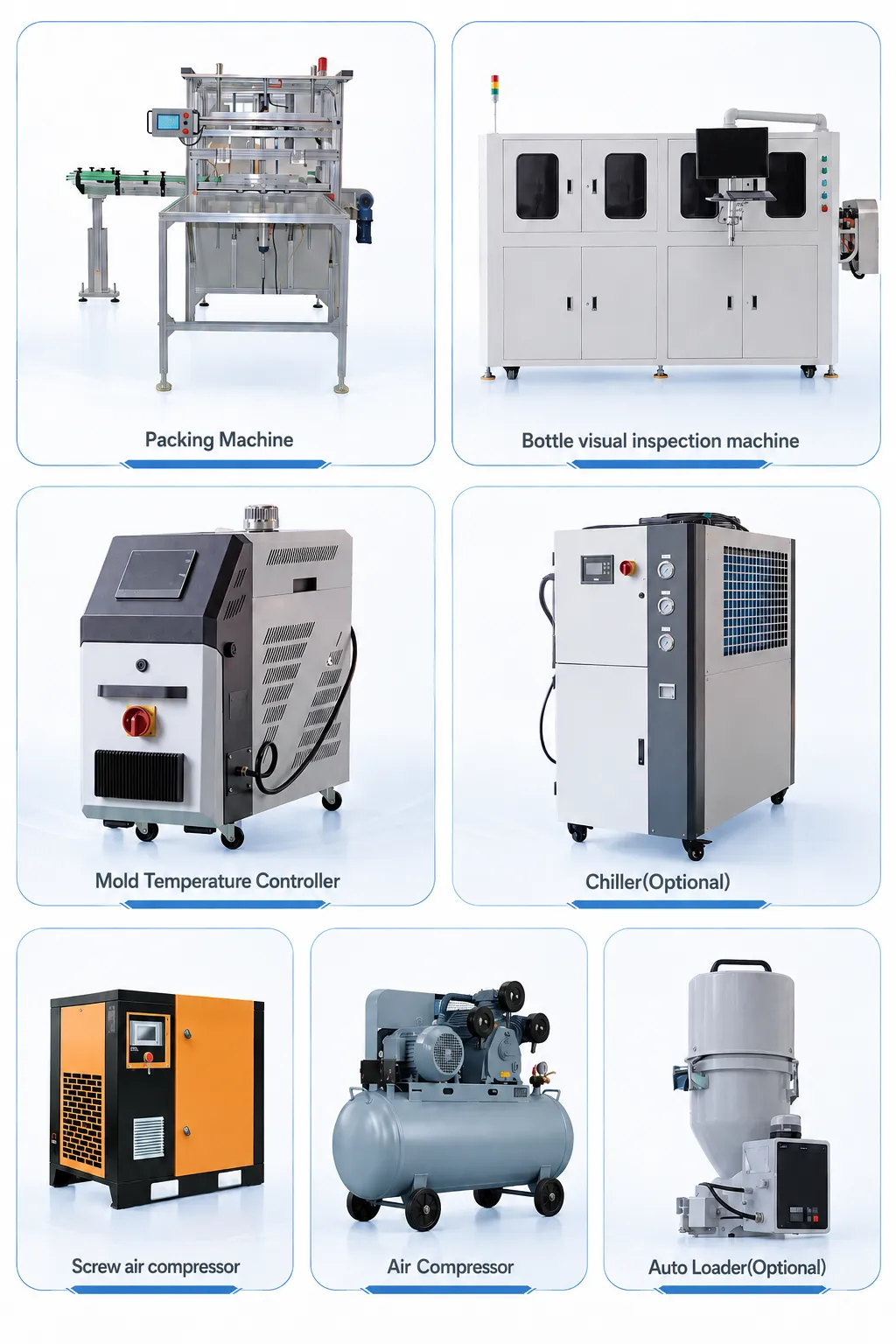
Korea Ever-Power Ansan-si, ZQ makinesinin teorik çıktısını, planlı duruş sürelerini ve üretim verimliliği faktörlerini dikkate alan yapılandırılmış bir çıktı ve verimlilik modeli kullanarak yeni program ticari üretim planlaması için IBM makine kapasite kullanımını hesaplar. Yıllık IBM makine kullanılabilir süresi: Korea Ever-Power Ansan-si standart üretim takvimi = yılda 300 üretim günü × günde 16 üretim saati (günde iki 8 saatlik vardiya, başlatma, ısınma, hat değiştirme ve vardiya sonu temizliği için günde 2 saat) = yılda 4.800 makine saati kullanılabilir. Bu, planlı duruş süreleri çıkarılmadan önceki maksimum kullanılabilir IBM makine süresidir. Planlı duruş süresi kesintileri: planlı önleyici bakım (ZQ makinesi PM: ayda 8 saat × 12 ay = yılda 96 saat); renk ve reçine değişimi (haftada ortalama 2 değişim × her biri 0,5 saat × 50 hafta = yılda 50 saat); Kalıp değişimi (ortalama 1 değişim/ay × 2 saat = 24 saat/yıl); resmi tatiller ve Kore yasal kapanışları (2 vardiyalı çalışmayı etkileyen yaklaşık 12 Kore ulusal tatili = 24 saat/yıl). Toplam planlanan duruş süresi: 96 + 50 + 24 + 24 = 194 saat/yıl. Net planlanan üretim süresi: 4.800 − 194 = 4.606 saat/yıl. Üretim verimliliği (OEE performans faktörü: planlanan üretim süresi boyunca gerçek IBM çıktısı ile teorik çıktı arasındaki oran): Kore Ever-Power ZQ IBM standart OEE performansı yaklaşık 85–90% (10–15% planlanmamış mikro duruşlar, kısa reçine besleme kesintileri, sıyırma istasyonunda IBM şişe sıkışması, kalite kontrol beklemeleri). Net IBM makine etkin üretim süresi: 4.606 × 0,87 (OEE orta noktası) = yılda 4.007 etkin üretim saati. IBM makinesinin yıllık üretim miktarı hesaplaması: Etkin üretim saatleri (4.007) × ZQ makinesinin üretim miktarı (optimize edilmiş çevrimde şişe/saat) = ZQ makinesi başına yıllık IBM şişe üretimi. Örnek olarak, optimize edilmiş 4.500 şişe/saat üretim kapasitesine sahip ZQ60 8 hazneli PP 500 ml kozmetik IBM makinesi için: yıllık üretim = 4.007 × 4.500 = ZQ60 makinesi başına yılda 18 milyon adet 500 ml PP kozmetik IBM şişesi. Korea Ever-Power programının kapasite kullanım oranı: Yeni programın yıllık hacim gereksinimi / (ZQ makinesi başına yıllık üretim miktarı). Yeni program yılda 5 milyon adet 500 ml PP kozmetik IBM şişesi gerektiriyorsa: kapasite kullanım oranı = 5.000.000 / 18.000.000 = bir ZQ60 makinesinin 27,81 TP3T'si. Korea Ever-Power, Ansan-si program planlama aşamasında program kapasite kullanım yüzdesine bağlı olarak özel veya paylaşımlı ZQ IBM makine kullanım süresi sunmaktadır.
IBM CYCLE TIME ENGINEERING · KOREA EVER-POWER
IBM Döngü Süresi Optimizasyonu Desteğine mi İhtiyacınız Var?
Korea Ever-Power Ansan-si, ZQ40'tan ZQ135'e kadar tüm PP, HDPE ve PCTG IBM konteyner programları için ZQ IBM makine çevrim süresi mühendisliği, üfleme bekleme süresi optimizasyonu ve üretim kapasitesi modellemesi hizmetleri sunmaktadır.
Editör: Cxm