HDPE注塑吹塑成型:
完整处理指南
HDPE是韩国注塑吹塑工艺中最广泛使用的材料——它广泛应用于韩国医药容器、日用化学品包装和食品级广口瓶的生产,其耐化学性、合规性和加工可靠性是其他同等成本的注塑吹塑材料无法比拟的。本指南涵盖HDPE等级选择、料筒温度设置、壁厚规格以及韩国医药和日用化学品注塑吹塑生产的应用要求。
枪管温度设置
韩国制药和家用IBM
韩国永动力工程部 · 安山市 · 2026年7月
HDPE IBM——关键参数概览
170–220°C
HDPE IBM 料筒温度范围——进料至注塑喷嘴
MI 0.2–2.0
医药级高密度聚乙烯IBM的熔体流动速率范围(190°C / 2.16 kg)
0.3–1.5 毫米
HDPE IBM 壁厚——从医药用薄壁到重型家用化学品
韩国食品药品监督管理局(KFDA)· 美国食品药品监督管理局(FDA)
HDPE 医药接触合规性——低析出物,广泛的耐化学性
1. Why HDPE Is IBM’s Core Material
高密度聚乙烯(HDPE)是韩国注塑吹塑成型中最广泛使用的材料——这并非因为它是唯一选择,而是因为其优异的耐化学性、合规性、加工可靠性和性价比,比任何其他同类注塑吹塑材料都更能满足韩国医药和日用化学品包装的需求。韩国制药厂生产10毫升眼科用药瓶、韩国日用化学品生产商灌装500毫升洗发水瓶以及韩国食品级玻璃罐生产商灌装250毫升调味品容器,出于相同的原因,他们都选择HDPE作为主要的注塑吹塑成型材料,只是壁厚和等级规格有所不同。
HDPE’s relevance to IBM specifically — rather than extrusion blow molding or injection moulding — comes from a combination of its processability and its application requirements. HDPE processes cleanly on IBM machines: it has a wide processing window (melt temperature 170–230°C), low melt viscosity at processing temperature relative to its solid-state stiffness, good flow through multi-cavity hot runner systems, and reliable release from core rods at the stripping station. HDPE containers produced by IBM have injection-moulded neck precision that HDPE containers produced by extrusion blow molding do not — and this precision is the specific reason that Korean pharmaceutical CRC containers, Korean pump-dispenser household chemical bottles and Korean threaded-cap food jars are made by IBM rather than EBM at the production volumes where IBM’s cavity count economics are favourable.
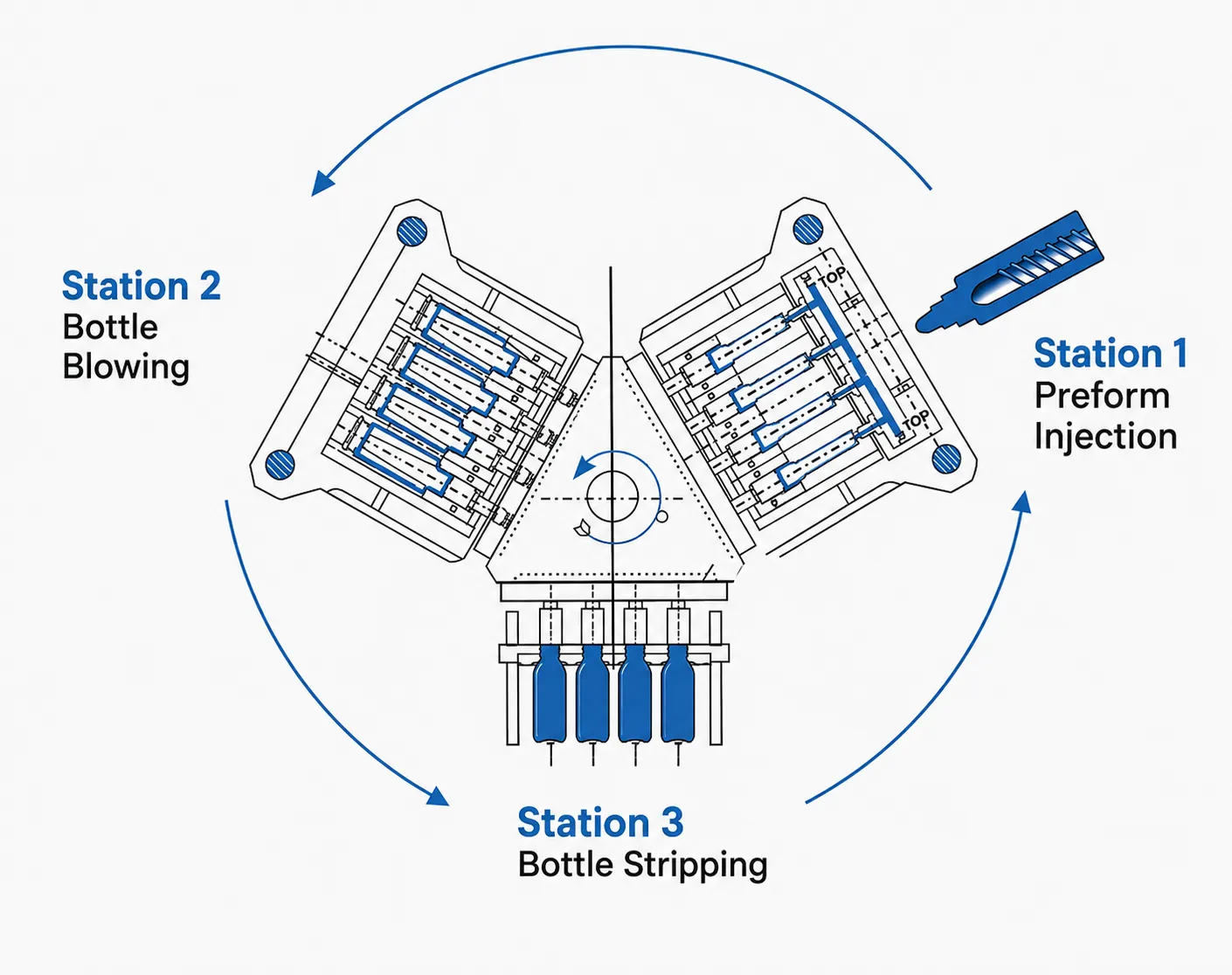
Understanding HDPE’s properties and processing requirements in the IBM context — grade selection, barrel temperature setup, wall thickness specification and quality indicators — is the foundational knowledge for Korean IBM production engineers and Korean packaging buyers who specify HDPE IBM containers. The IBM流程指南 详细介绍了 3 工位 IBM 工艺;本指南特别关注该工艺中的 HDPE。
2. IBM用HDPE等级选择
熔体流动速率:主要牌号选择参数
熔体流动速率 (MI)——根据 ASTM D1238 标准在 190°C/2.16 kg 条件下测定——是 IBM 应用中最重要的 HDPE 等级选择参数。MI 与分子量呈反比关系:MI 值越低,意味着分子量越高,从而具有更好的耐化学性、拉伸强度和抗环境应力开裂性 (ESCR),但注塑加工难度也越大。MI 值越高,意味着分子量越低,注塑加工越容易,但机械性能和耐化学性较差。
| HDPE MI系列 | IBM 处理 | ESCR(F50) | 韩国 IBM 应用 |
|---|---|---|---|
| MI 0.1–0.3 | 困难——高注射压力 | >200 小时 | 农用化学品容器,工业用厚壁容器 |
| MI 0.3–0.8 | 优良——医药级 | 100–200 小时 | 韩国制药(眼药水、口服液、CRC药物) |
| MI 0.8–1.5 | 优质——家用化学品级 | 50–100 小时 | 韩国洗发水、护发素、家用清洁剂 |
| MI 1.5–3.0 | 简易型——符合食品级标准 | 20–50 小时 | 韩国食品罐,通用包装,保质期短的容器 |
密度和添加剂的考虑因素
用于IBM应用的高密度聚乙烯(HDPE)的密度通常在0.945–0.965 g/cm³范围内。密度越高,结晶度越高——结晶度越高,耐化学性越好(结晶区域对大多数溶剂和活性药物成分不渗透),刚性也越高(这对10毫升的药瓶至关重要,因为药瓶在封盖过程中必须承受挤压而不变形)。低密度HDPE(0.940–0.950 g/cm³)的柔韧性和抗冲击性略好,更适合用于韩国家用化学品容器,因为这些容器在使用过程中容易受到挤压,或者在灌装过程中掉落在韩国工厂的地板上。
Korean pharmaceutical-grade HDPE for IBM containers must meet specific additive requirements. Permitted additives for Korean KFDA-regulated pharmaceutical packaging include antioxidants (typically AO-1010 or AO-168 at ≤0.1%) and processing stabilisers — but exclude UV stabilisers (which can migrate into pharmaceutical products), slip agents (which reduce coefficient of friction and can interfere with Korean pharmaceutical label adhesion), and most nucleating agents (which affect crystallisation rate and can alter extractable profiles in Korean pharmaceutical compatibility testing). Korean IBM packaging producers should verify with their HDPE resin supplier that the resin formulation meets Korean KFDA positive list requirements for pharmaceutical contact materials before committing to a resin grade for pharmaceutical production — and should obtain the resin supplier’s Korean KFDA declaration or FDA Drug Master File reference as part of their Korean pharmaceutical container qualification documentation.
3. IBM HDPE 加工参数
HDPE IBM processing parameters on Korea Ever-Power’s ZQ series require setup across five process areas: barrel temperature profile, injection fill parameters, blow parameters, cooling and stripping. Each area’s setpoints depend on the HDPE grade (MI and density), the cavity count, and the container wall thickness specification. The parameters below represent starting-point guidance for Korean IBM operators setting up HDPE production for the first time; final production parameters must be determined by trial and adjusted for each specific grade, mould and machine combination.
料筒温度曲线(ZQ系列,HDPE MI 0.3–0.8)
| 桶区 | 温度(摄氏度) | 功能 |
|---|---|---|
| 区域 1 — 饲料 | 170–180 | 启动熔化;防止过早熔化和进料区架桥 |
| 第二区——过渡区 | 185–200 | 完全熔化;形成均匀熔体 |
| 3区——计量 | 200–215 | 达到目标熔体粘度;确保熔体温度均匀性 |
| 4+区 — 闸门进出(仅限4+N区) | 205–215 | 微调浇口入口温度;控制热流道浇口处的熔体粘度 |
| 喷射喷嘴 | 210–220 | 最高熔化温度;确保所有型腔同时完全填充 |
注射填充和吹气参数
注射填充: 医药级高密度聚乙烯(HDPE)注塑坯(MI 0.3–0.8)在注塑机处的注射压力为80–140 MPa,具体数值取决于型腔数量和流道阻力。型腔数量较多(20–30个型腔)和热流道路径较长时,需要使用该范围的上限值才能实现所有型腔的同步填充。医药级薄壁型(壁厚0.3–0.5 mm)的填充时间目标为0.8–1.5秒,家用化学品级厚壁型(壁厚0.6–1.0 mm)的填充时间目标为1.5–2.5秒。保压压力通常为峰值注射压力的50–70%,保压时间为0.5–1.5秒,以填充浇口并防止芯棒尖端附近较厚预成型坯壁段出现缩痕。
螺丝回收: HDPE IBM螺杆在回压过程中的背压应保持在5–15 MPa,既足以确保熔体均匀性并防止空气滞留(空气滞留会导致成品瓶出现银色条纹),又足够低以避免浇口区过度剪切加热导致分子量下降。螺杆转速:医药级HDPE为80–120 RPM;对于熔体本身已均匀且无需高剪切力的高粘度HDPE,则应采用较低的转速(60–80 RPM)。
吹气参数: HDPE IBM blow air pressure is typically 0.5–0.9 MPa for pharmaceutical thin-wall containers (0.3–0.5 mm) and 0.7–1.2 MPa for household chemical heavy-wall (0.6–1.0 mm). Blow dwell time — the time the air pressure is maintained with the blow mould closed — should be 0.8–1.5 seconds for thin-wall pharmaceutical and 1.5–2.5 seconds for heavy-wall household chemical. Insufficient dwell time causes bottle base shrinkage after ejection (the HDPE base is still too hot and soft when ejected and deforms under its own weight). The ZQ series’ 4-second dry cycle provides adequate dwell time for standard pharmaceutical HDPE wall thickness without extending the production cycle.
4. HDPE IBM 应用的壁厚规格
Wall thickness is the single most impactful design parameter in HDPE IBM containers — it determines chemical barrier performance, mechanical strength, material cost per bottle, and blow cycle time. Wall thickness specification for HDPE IBM should be set at the minimum thickness that meets the container’s functional requirements, rather than defaulting to a heavy wall that adds material cost and extends cycle time without functional benefit.
韩国制药(10-100毫升)
目标体壁厚度:0.3–0.5 毫米
薄壁设计可最大限度降低单位材料成本;0.3毫米厚的HDPE瓶壁厚度足以满足大多数配方对药物活性成分的耐化学性要求;注塑成型的瓶颈厚度为0.8-1.2毫米,以确保密封完整性;瓶底厚度为0.4-0.6毫米,便于堆叠压缩。韩国食品药品安全部(KFDA)的认证测试必须确认在规定的壁厚下,瓶内物质与化学物质的相容性。
韩国家用化学品(250–1,000 毫升)
目标体壁厚度:0.5–0.9 毫米
韩国家用化学品容器采用更厚的壁厚设计,旨在满足两项要求:抗跌落性(韩国的灌装生产线和零售分销过程中,250-1000毫升的瓶子会多次被摔落)和抗挤压性(韩国家用化学品分配器要求瓶子在泵压作用下保持形状)。0.5-0.9毫米的厚度范围兼顾了这些要求和材料成本。
韩国食品级广口瓶(100–500毫升)
目标体壁厚度:0.6–1.0 毫米
韩国食品级广口瓶(用于盛装蜂蜜、调味品和食用油)需要满足以下壁厚要求:在高温灌装条件下保持螺纹外径(HDPE 在 60°C 以上会软化;壁厚越厚,螺纹保持性越好);便于韩国零售货架顶部装载;以及在韩国超市配送中心使用韩国食品级托盘搬运时能够抵抗侧向挤压。
壁厚变化: 在HDPE IBM中,瓶内壁厚差异(最薄区域与最厚区域之间的差异)以及瓶间壁厚差异(多腔模具中不同腔间的差异)都是需要关注的规格问题。瓶内壁厚差异:目标值为瓶身最薄区域与最厚肩部或底部过渡区域之间的标称壁厚≤±15%。腔间壁厚差异:目标值为模具中最轻和最重腔之间的标称平均瓶重≤±5%,该重量是衡量壁厚均匀性的主要指标。腔间重量差异超过±8%通常表明热流道浇口不平衡——这是模具侧的问题,需要在热流道歧管处进行浇口调整,而不是机器工艺调整。
5. 韩国制药 HDPE IBM 应用
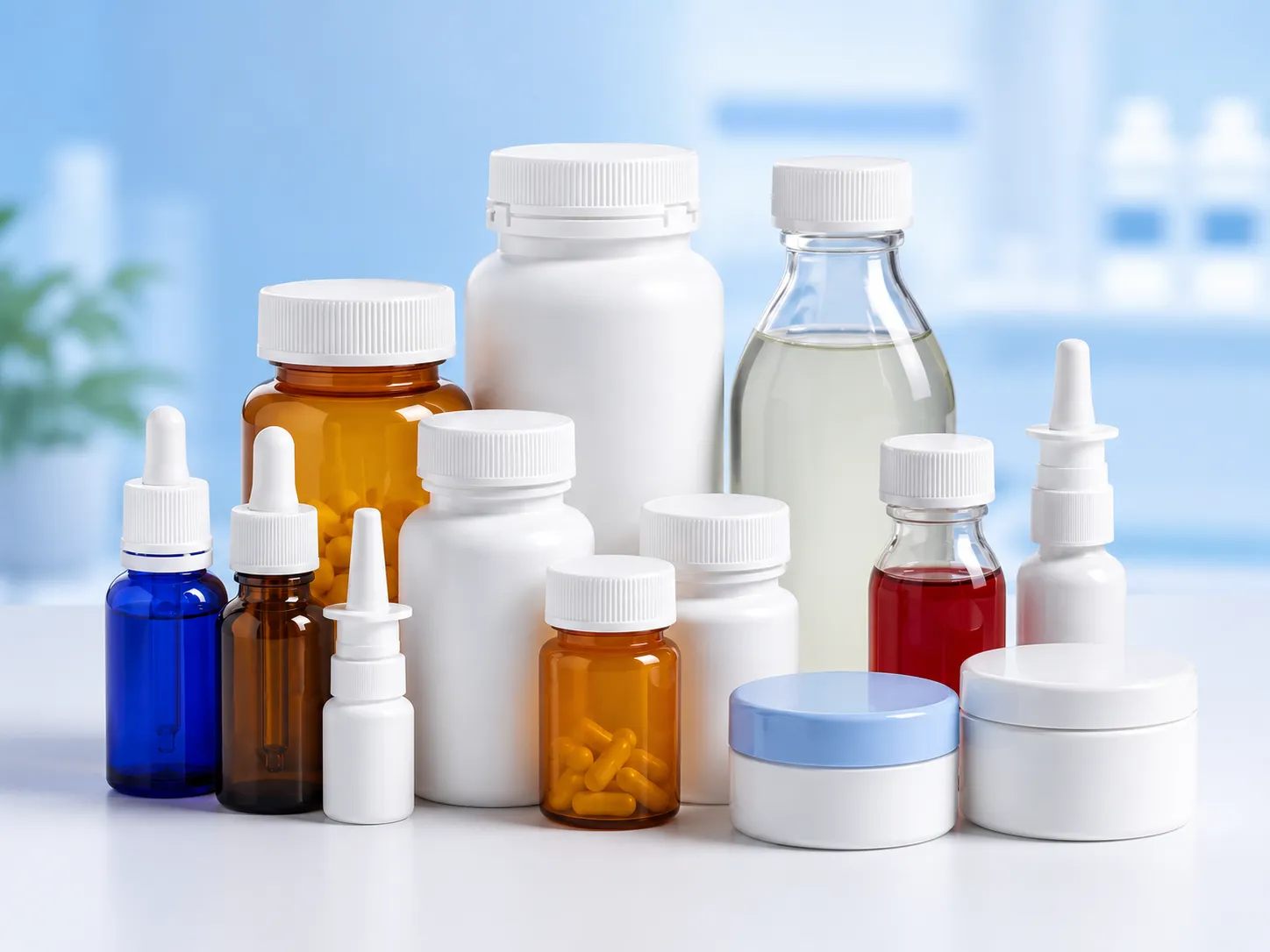
韩国医药用高密度聚乙烯(HDPE)包装箱的生产主要集中在三种规格,这三种规格的包装箱合计占韩国医药初级包装总量的绝大部分。了解每种规格的具体要求,有助于韩国医药用包装箱运营商选择合适的材料等级并制定加工方案。
10毫升眼药水(滴眼液)瓶
韩国10毫升高密度聚乙烯(HDPE)眼科用药瓶是容量最大、精度要求最高的药品包装规格。韩国食品药品监督管理局(KFDA)对眼科用药容器的规范要求如下:总萃取物含量低于1 μg/ml(根据韩国药典塑料容器测试标准);颗粒物含量低于韩国KFDA规定的颗粒物限量(未经额外清洁步骤的EBM快速修整容器不符合要求);螺纹外径公差为±0.05毫米,以便与韩国眼科用药滴管盖啮合;瓶壁厚度均匀,瓶身具有足够的透明度,便于目视检查液位——这是眼科用药容器的一项特殊要求,即瓶身HDPE壁厚≤0.4毫米(更薄的瓶壁允许更多光线透过HDPE,便于检查液位)。韩国眼科用药包装规格的HDPE等级:粘度指数(MI)0.3–0.5,密度0.950–0.960克/立方厘米,不含紫外线稳定剂,仅使用KFDA认可的抗氧化剂。生产:韩国 Ever-Power ZQ80(20 个腔)或 ZQ110(24 个腔)是韩国最常见的制药眼科 IBM 平台,每小时可生产 15,800 至 19,000 瓶,周期为 4 秒。
100毫升CRC药瓶
Korean CRC (child-resistant closure) HDPE medicine bottles at 100 ml are the second most important pharmaceutical IBM format. CRC containers require IBM — not EBM — because CRC cap engagement depends on ±0.05 mm neck OD tolerance that EBM cannot consistently achieve. The Korean CRC cap’s push-and-turn mechanism operates by compressing the skirt’s ratchet teeth against the bottle neck’s engagement bead as the cap is pushed down — this engagement requires the neck bead OD to be within ±0.06 mm of the nominal CRC cap design dimension across all production cavities and all production shifts. IBM’s injection-moulded neck provides this consistency; EBM’s blown neck does not. HDPE grade for Korean CRC IBM: MI 0.5–0.8, density 0.955–0.965 g/cm³, stiff enough for the bead to resist deformation under CRC push force without cracking. Korea Ever-Power’s ZQ80 at 12-cavity 100 ml CRC produces approximately 6,800 bottles per hour — sufficient for Korean major pharmaceutical brands producing 15–25 million CRC medicine bottles per year from a single machine.
6. 韩国家用化学品 HDPE IBM 应用
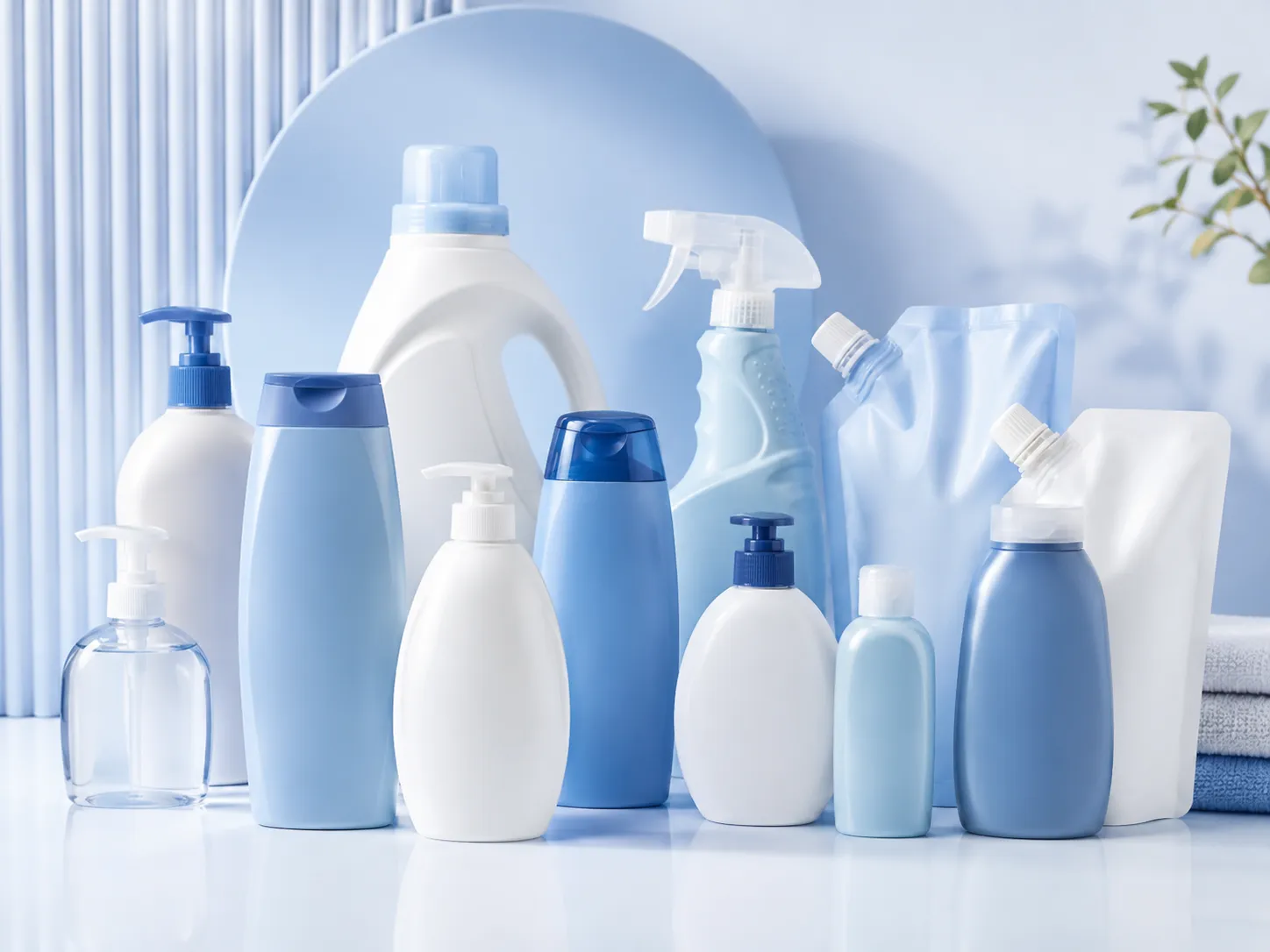
Korean household chemical HDPE IBM production uses heavier-grade HDPE than Korean pharmaceutical production — higher MI for easier injection at larger shot weights, lower density for better drop resistance at the larger container sizes. The specific requirements driving Korean household chemical HDPE IBM grade selection include environmental stress crack resistance (ESCR) — the most common failure mode in Korean household chemical HDPE containers. ESCR failure occurs when a surfactant-containing product (shampoo, conditioner, cleaning detergent, dishwashing liquid) contacts the HDPE container wall and acts as a stress cracking agent, reducing the polymer’s resistance to crack initiation and propagation at residual stress concentrations in the container wall. Korean household chemical HDPE must have F50 ESCR (time for 50% of specimens to crack in a surfactant stress test) of at least 50 hours at the selected wall thickness — typically achieved with MI 0.8–1.5 grades at 0.5–0.9 mm wall.
Korean pump-dispenser household chemical containers (shampoo, conditioner, liquid hand soap) require specific neck geometry at the pump-mounting zone — the pump’s down-tube must seal against the bottle neck’s inner bore at the pump support ledge, and the pump’s closure collar must snap or thread onto the bottle neck without deforming it. IBM’s injection-moulded neck provides the dimensional consistency for pump-collar engagement that Korean household chemical filling lines require for zero-leakage, zero-cross-thread at production line speeds of 80–120 bottles per minute. Korea Ever-Power’s ZQ series EP-ZQ80 6腔500毫升装每小时可生产约5400瓶泵式500毫升HDPE洗发水容器——足以满足韩国国民品牌洗发水OEM工厂的需求,这些工厂使用一台机器每年可生产1000万至1200万个500毫升的容器。
7. HDPE、PP 和 ABS 在 IBM 应用中的比较:韩国应用案例对比
韩国IBM生产线主要使用三种材料,比例各不相同:HDPE(用量最大,用于医药和家用化学品)、PP(次要用料,用于热灌装和冷轧复合包装)以及ABS(用于化妆品罐和高端包装容器)。了解何时应选择哪种材料,以及何时应以PP或ABS替代HDPE,可以避免规格不足(本应使用PP的地方却使用了HDPE)和规格过高(HDPE功能足够的地方却使用了ABS)。
| 属性/要求 | 高密度聚乙烯 | PP | ABS |
|---|---|---|---|
| 韩国药房小包装(10-30毫升) | 最好的 | 好的 | 不常见 |
| 热灌装温度高于70°C | 变形 | 最好的 | 不宜 |
| 韩妆的表面处理/光泽 | 低光泽,蜡质 | 缓和 | 高光泽——镜面效果 |
| 广口化妆品罐 | 功能 | 好的 | 高端——韩妆标准 |
| 耐化学性(表面活性剂) | 优良(ESCR ≥50小时) | 出色的 | 好——避免使用强溶剂 |
| 韩国食品药品监督管理局(Korean FDA)食品接触合规性 | 是的——低萃取物 | 是的 | 非标准 |
| 树脂每公斤价格(韩国市场) | 最低 | +15–25% | +60–100% |
The Korean IBM material selection guideline: use HDPE as the default for all Korean pharmaceutical small-format containers and all Korean household chemical containers where hot-fill is not required and cosmetic appearance is not the primary specification. Switch to PP when the fill temperature exceeds 65°C (Korean hot-fill food, Korean sterilised pharmaceutical) or when autoclavable pharmaceutical containers are specified. Switch to ABS for Korean cosmetic jars where high surface gloss, solid tactile weight and K-Beauty brand premium appearance are the primary specifications — ABS’s higher resin cost is justified in Korean cosmetic packaging where per-unit container cost is 5–10× higher than pharmaceutical or household chemical packaging and the container’s appearance directly affects the Korean brand’s perceived value.
8. ZQ系列机器在HDPE IBM生产中的应用
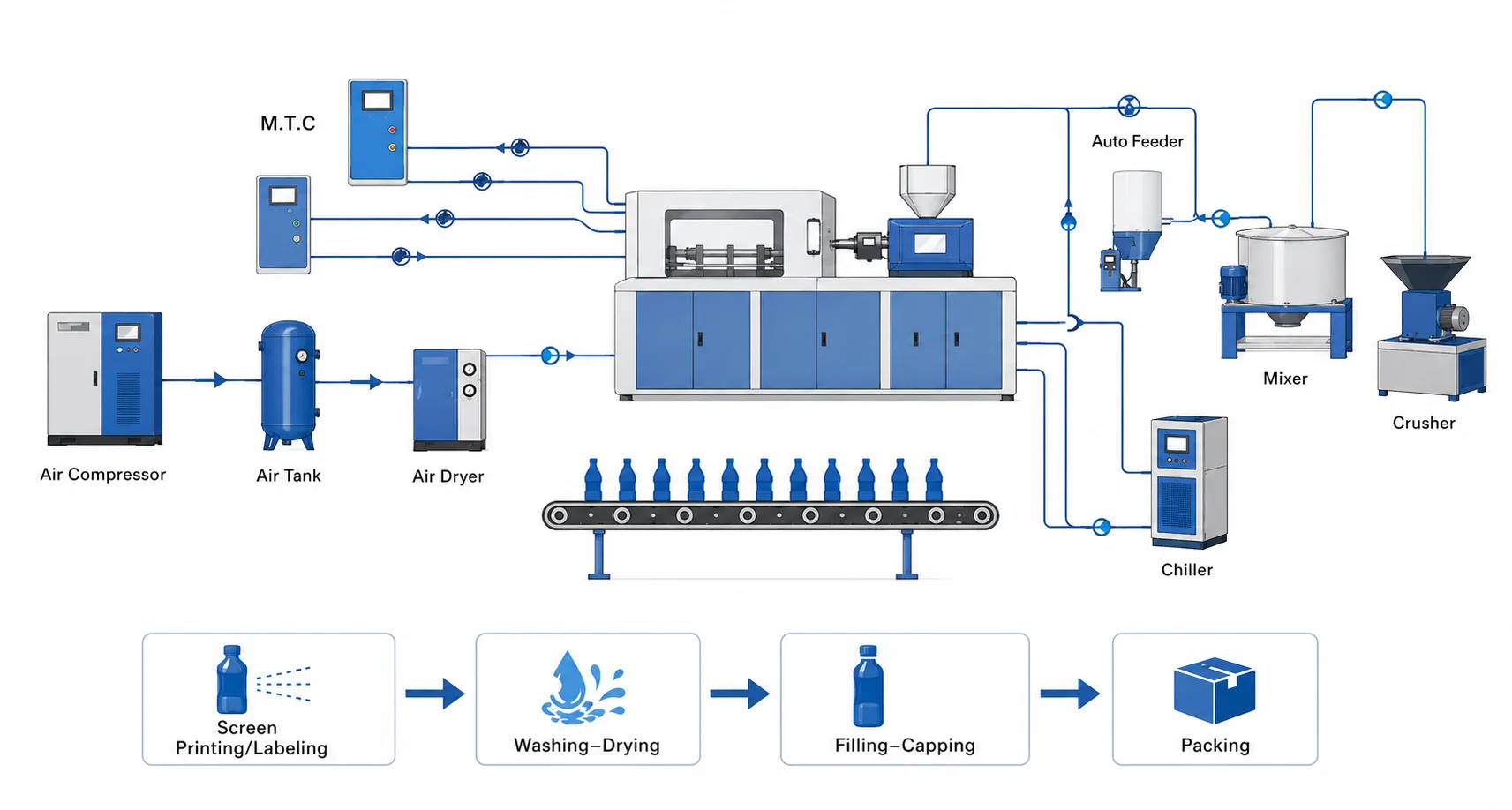
The correct ZQ model for Korean HDPE IBM production depends on annual unit volume at the primary container format. Korea Ever-Power’s 注塑吹塑机 该系列产品提供五款适用于 HDPE 的型号——以下决策框架专门适用于 HDPE 制药和家用化学品的生产量。
| 年产量(10毫升高密度聚乙烯) | 推荐型号 | 龋齿 | 韩国高密度聚乙烯(HDPE)背景 |
|---|---|---|---|
| 低于每年1500万辆 | EP-ZQ40 | 9 @ 10毫升 | 韩国制药初创公司、韩国合同生产机构试验、韩国特种高密度聚乙烯包装 |
| 每年1500万至3000万台 | EP-ZQ60 | 14 @ 10毫升 | 韩国中型制药、韩国地区家用化学品、韩国食品高密度聚乙烯 |
| 每年3000万至5000万台 | EP-ZQ80 | 20个,每个10毫升 | 韩国大型制药公司、韩国国民品牌日用化学品、韩国K-Beauty HDPE |
| 每年5000万至6500万台 | EP-ZQ110 | 24 @ 10毫升 | 韩国大型医药合同包装,韩国主要消费品高密度聚乙烯 |
| 每年超过6500万台 | EP-ZQ135 | 30个,每个10毫升 | 韩国大型制药企业,韩国国家品牌HDPE年产量最高 |
For Korean HDPE 500 ml household chemical production, the selection rule shifts: apply the same volume thresholds but map against 500 ml cavity counts (ZQ40: 3 cavities → ~2,700/hr; ZQ60: 3 cavities → ~2,700/hr; ZQ80: 6 cavities → ~5,400/hr; ZQ110: 6–8 cavities → ~5,400–7,200/hr; ZQ135: 8 cavities → ~7,200/hr). The ZQ80 at 6-cavity 500 ml is the most common Korean household chemical IBM platform — it produces approximately 10–12 million 500 ml HDPE shampoo or cleaning product bottles per Korean two-shift year, covering most Korean national brand household chemical OEM annual volume requirements from a single machine. Korea Ever-Power’s application engineers can provide a specific volume-to-model matching analysis for Korean factories evaluating HDPE IBM investment at any annual production scale.
常见问题解答
HDPE IBM 机器询价
韩国制药或家用化学品生产需要指定高密度聚乙烯(HDPE)IBM容器吗?
韩国永力公司为韩国 HDPE IBM 制药和家用化学品包装业务提供 HDPE 等级选择指导、壁厚规格、腔数规划和 ZQ 系列机器选择,适用于所有生产规模。
相关资源
EP-ZQ60 注塑吹塑机
600 KN · 14 个腔体,容量为 10 ml HDPE · 韩国中型制药 · 3+N 个桶区,适用于 HDPE MI 0.3–1.5 · 无闪蒸 · 每小时约 11,100 瓶,容量为 10 ml。
EP-ZQ110 注塑吹塑机
1,100 KN · 24 个腔体,容量为 10 ml HDPE · 4+N 个桶区 · 22+22 KW 双液压 · 韩国大型制药 HDPE — 每小时生产约 19,000 瓶,容量为 10 ml。
IBM 与 EBM:12 个主要区别
为什么 HDPE 医药和家用化学品容器由 IBM 而不是 EBM 生产——颈部精度、零飞边、产量和韩国工厂经济性在 12 个因素上进行了比较。