
PET Packaging Industry Trends 2025–2030 — What Blow Moulding Producers Need to Know
Five years ago, a PET bottle producer choosing an ISBM machine was primarily making a decision about output rate and container format. Today, that same decision carries a different weight — because the packaging landscape around PET is shifting in ways that make some machine configurations future-proof and others increasingly misaligned with where markets are heading. The forces shaping PET packaging through 2030 are not abstract trends: they are already visible in brand procurement specifications, regulatory timelines, consumer research, and the investment decisions of leading packaging companies in Korea, Japan, Southeast Asia, and export-facing markets.
This article identifies the five structural PET packaging trends e blow moulding industry trends that will have the greatest impact on production decisions through 2030 — rPET integration (including the specific challenges of rPET ISBM machine processing), lightweighting, hot-fill expansion, fully electric machine adoption, and K-Beauty premiumisation. It also traces the arc of sustainable PET packaging from voluntary commitment to regulatory requirement, and frames the future of blow moulding in terms that translate into specific machine investment decisions that can be made today. Each trend is connected to actionable ISBM machine selection implications — so this article is equally useful to a brand procurement manager evaluating a packaging partner’s capabilities and to a blow moulding producer planning their next capital expenditure.
The PET Bottle Market — Growth Drivers to 2030
The global PET bottle market is one of the few packaging segments where demand growth is structurally supported by multiple independent forces operating simultaneously. Several of these forces are specific to Asia — and particularly to Korea, Southeast Asia, and the broader markets that Korean packaging manufacturers serve through export — making them especially relevant for ISBM producers planning investment through the end of the decade.
Rising Middle-Class Consumption in Southeast Asia
The expansion of middle-class purchasing power across Vietnam, Indonesia, Thailand, the Philippines, and Malaysia is driving demand for packaged beverages, personal care products, and pharmaceutical OTC containers that were previously either unavailable to consumers or priced above market reach. PET bottles are the beneficiary of this expansion in all three categories — as the lowest-cost packaging format that provides the clarity, safety, and convenience that the rising middle class expects. Regional beverage brands are establishing production in these markets rather than exporting from higher-cost manufacturing bases, and local ISBM equipment adoption is accelerating correspondingly.
K-Beauty Export Growth and Packaging Demand
Korean cosmetic exports — the K-Beauty category — have sustained remarkable growth across North America, Europe, and Asia over the past decade, and the packaging quality expectations that Korean cosmetic brands apply domestically travel with their products into export markets. International retailers and online marketplaces now expect the same PETG clarity, surface quality, and pump fitment precision in Korean cosmetic packaging that Korean consumers receive. This is a direct demand driver for ISBM production capability in the premium cosmetic packaging segment — precisely the segment that the one-step ISBM process is most suited to serve.
Pharmaceutical Packaging Growth
The pharmaceutical sector’s demand for PET and PC containers — eye droppers, oral solution bottles, nasal spray containers — is driven by population ageing in Korea and Japan, expanding OTC drug markets across Southeast Asia, and increasing outsourcing of pharmaceutical container production from legacy glass to lighter, safer, and more cost-effective PET. This trend supports GMP-compatible ISBM machine adoption (particularly electric drive) and is a durable growth driver independent of consumer spending cycles.
Trend 1 — rPET Integration: From Optional to Required
Recycled PET (rPET) — post-consumer PET resin recovered from collected bottles, cleaned, depolymerised or mechanically recycled, and reprocessed into pellets suitable for blow moulding — has moved from a voluntary sustainability initiative to a formal regulatory requirement in key markets. The European Union’s Single-Use Plastics Directive includes mandatory minimum recycled content requirements for PET beverage bottles of 25% by 2025 and 30% by 2030. Korea’s own plastic waste reduction framework is moving in the same direction, with growing mandatory recycled content obligations expected to come into force within the planning horizon for machines purchased today.
How rPET Affects ISBM Machine Operation
Running rPET through an ISBM machine is not simply a material substitution — it requires process adjustments that flow directly from the properties of recycled versus virgin PET:
Lower IV — Reduced Molecular Weight
Mechanically recycled PET typically has an intrinsic viscosity (IV) of 0.70–0.76 dl/g compared to virgin bottle-grade PET at 0.74–0.84 dl/g. Lower IV means shorter chain length, less entanglement, and lower melt strength. The practical effect: rPET preforms blow more easily than virgin PET equivalents at the same temperature — which can lead to overstretch if process parameters are not adjusted. Conditioning temperature may need to be reduced by 3–5 °C compared to the virgin PET programme for the same preform design.
IV Variability — Lot-to-Lot Inconsistency
Virgin PET from a single supplier is highly consistent in IV and melt flow index across production lots. rPET from mechanical recycling is inherently variable — the feedstock (collected post-consumer bottles) varies in grade, contamination level, and thermal history. Production operations using rPET must test the IV of each incoming lot and adjust process parameters accordingly. Machines with precise, tightly controlled conditioning station temperature capability handle lot-to-lot rPET variability better than machines with coarse temperature control.
Colour and Clarity — Managing Yellow Tint
Mechanically recycled PET typically has a slightly yellow tint from accumulated chromophore contamination in the recycling stream. For clear bottle applications, 100% rPET may not be achievable without optical brighteners or acceptably matching the clarity of virgin PET. Blending rPET at 25–30% with virgin PET — the content range required by EU regulations — typically produces a bottle that is visually acceptable for standard beverage and household applications, though PETG clarity standards for premium cosmetics are not achievable with any rPET blend.
Machine selection implication: The tighter conditioning temperature control that the ISBM process provides — dual-surface barrel-and-core conditioning with PID zone control — is a genuine advantage for rPET production versus two-step REHB’s infrared reheating. The conditioning station’s ability to precisely maintain temperature within ±2 °C regardless of lot-to-lot rPET variability allows process adjustments to be made at the setpoint level rather than requiring preform redesign when a new rPET lot arrives.
Trend 2 — Lightweighting: More Biaxial Orientation, Less Resin
Lightweighting — reducing the resin content of a bottle while maintaining or improving its structural performance — is simultaneously a cost reduction strategy and a sustainability commitment. Major FMCG brands have made public pledges to reduce the resin content of their PET packaging by 15–25% by 2030 relative to 2020 baselines. For blow moulding producers serving these brands, lightweighting is no longer a request that arrives occasionally from sustainability-focused customers — it is increasingly a baseline expectation embedded in tender specifications.
Biaxial Orientation as the Enabler
The reason lightweighting is achievable in PET bottles without structural compromise is biaxial orientation: the 40–60% increase in tensile strength that the ISBM stretch-blow cycle produces means that a wall that is 20% thinner than the previous standard can achieve equivalent or superior top-load strength, drop resistance, and burst pressure. Lightweighting without biaxial orientation — simply making a thinner wall in an unoriented container — produces a structurally weaker bottle that fails in service. With consistent biaxial orientation, the lighter bottle is structurally sound.
This is a technical requirement that places additional pressure on ISBM machine performance: lightweighted preforms — which have thinner walls, less thermal mass, and less forgiving stretch ratios — are more sensitive to conditioning temperature variation than standard-weight preforms. A ±3 °C conditioning temperature variation that produces acceptable bottles at standard preform wall gauge may produce stress whitening or haze on a lightweighted preform that has 20% less material to absorb temperature non-uniformity. Precision conditioning station control is therefore more important, not less, as lightweighting progresses.
The Role of IV in Lightweighting
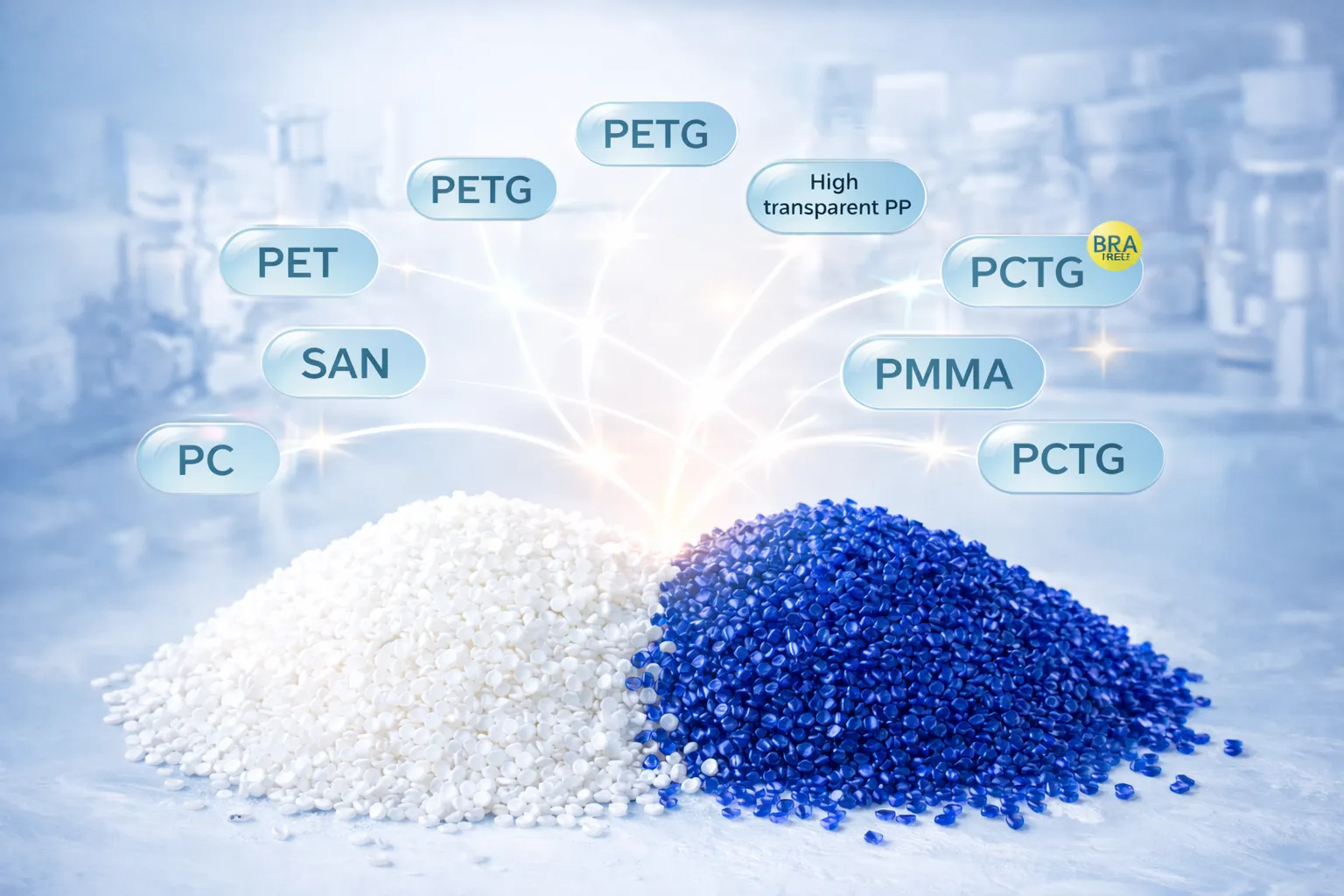
Achieving reliable orientation at reduced wall gauge requires higher IV resin — not lower. High IV (0.80–0.86 dl/g) PET has longer chain segments that entangle more extensively in the melt, providing better melt strength during injection filling, more stable preform geometry, and more efficient chain alignment during the stretch-blow cycle. Lightweighted bottle programmes that specify standard beverage-grade PET at IV 0.74–0.76 dl/g often fail not because of the wall gauge target, but because the resin molecular weight is insufficient for reliable orientation at that gauge. Specifying the correct high-IV resin grade is the first decision in a lightweighting programme, before preform design or machine parameters are addressed.
Trend 3 — Hot-Fill Expansion in Asian Beverage Markets
The ready-to-drink (RTD) beverage market in Asia — particularly the Korean barley tea, green tea, aloe vera drink, and juice categories — is a confirmed growth sector, and the preferred packaging format for ambient-shelf RTD beverages across the region is the hot-fill PET bottle. Hot-fill packaging preserves beverage quality without preservatives, aligns with consumer demand for clean-label products, and enables shelf storage without refrigeration — critical advantages in the distribution networks of Vietnam, Indonesia, Thailand, and other Southeast Asian markets where cold chain infrastructure is developing but not yet ubiquitous.
For a deeper technical understanding of what hot-fill packaging requires from the bottle and the machine, see our guide to hot-fill PET bottles — process, design, and machine requirements.
Semi-Automatic Hot-Fill as a Market Entry Gateway
The hot-fill market in Southeast Asia is characterised by a large number of regional brands — provincial beverage producers, agricultural cooperative processors, and private-label manufacturers — who are entering the ambient RTD category for the first time and need hot-fill production capability at volumes that do not justify a fully automatic heat-set line. The semi-automatic approach — a dedicated hot-fill machine such as the Korea Ever-Power HGS200B, producing 400–550 bottles per hour on a 1.25-litre hot-fill format — is the market entry path for these producers.
The trend implication is straightforward: demand for semi-automatic hot-fill machines — specifically machines with the extended stretching stroke (360 mm) and oil-heated mould circuit that hot-fill production requires — is structurally driven by the growth of the Asian ambient RTD category. This is a product segment where equipment investment decisions are being made right now, by producers who are launching new brands into a growing market rather than replacing existing capacity.
Trend 4 — Fully Electric ISBM Adoption: ESG, Energy Cost, and Precision
The transition from hydraulic to fully electric drive in injection moulding machines has been underway for twenty years in the general injection moulding industry. In ISBM specifically, this transition is accelerating for three reasons that are converging simultaneously in 2025–2030:
Rising Industrial Electricity Costs
Industrial electricity tariffs across Korea and Southeast Asia have risen significantly over the past five years and are expected to continue rising as carbon pricing mechanisms are introduced. The fully electric machine’s 35–42% lower energy consumption versus an equivalent hydraulic machine translates to meaningful annual cost savings that now justify the purchase price premium within 2–3 years on two-shift operations — a payback period that has shortened substantially as electricity costs have risen.
ESG Reporting and Scope 2 Emissions
Korean conglomerates and their suppliers, mid-size FMCG brands supplying to European and North American markets, and pharmaceutical companies operating under international GMP frameworks are all increasing their ESG reporting scope. The energy consumption of production equipment is increasingly measured, reported, and targeted for reduction. The fully electric ISBM machine’s lower energy footprint directly reduces Scope 2 (purchased electricity) emissions — the most immediately measurable production emission category.
Precision Requirements in Premium Segments
The growth of pharmaceutical ISBM (GMP cleanrooms requiring oil-free machines), premium cosmetic ISBM (Tritan ±1 °C control, shot weight CV < 0.5%), and baby product ISBM (BPA-free resins, GMP documentation) all favour the electric machine’s superior injection precision, lower contamination risk, and simpler GMP compliance documentation. The market segments that are growing fastest are precisely the segments where electric machine capability is the most commercially valuable.
O Máquina ISBM totalmente elétrica HGY50-V3-EV represents Korea Ever-Power’s response to this transition: 210 MPa injection pressure (31% above the hydraulic equivalent), ±0.1 g shot weight repeatability, 34.8 kW peak servo power at approximately 40% lower energy consumption than the hydraulic machine in production, and oil-free operation that simplifies GMP documentation for pharmaceutical and cosmetic productions. For new ISBM installations in 2025 and beyond, the question is no longer “why choose electric?” but increasingly “under what circumstances does hydraulic still make sense?” — a question whose answer is narrowing to commodity beverage production at high volume where cleanroom requirements do not apply and the lower capital cost of the hydraulic machine remains decisive.
Trend 5 — K-Beauty Premiumisation: PETG and Tritan Replacing Glass
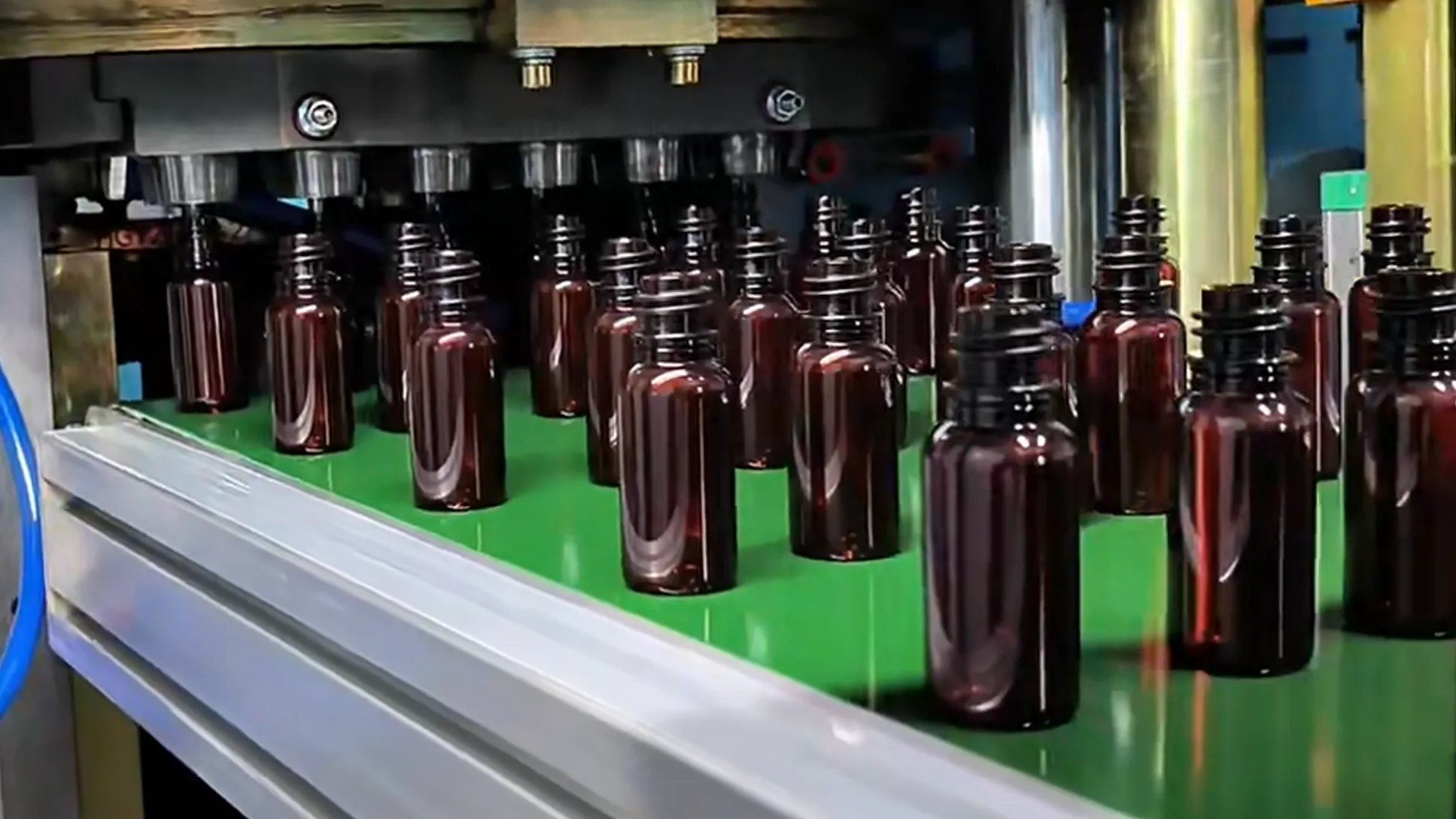
K-Beauty’s global expansion is creating sustained demand for cosmetic packaging that meets premium quality standards at a competitive price point relative to glass — the packaging material that premium cosmetics traditionally used and that the K-Beauty aesthetic aspires to match. PETG and Tritan, processed in ISBM machines, have emerged as the credible technical answer to this demand: both materials achieve haze values below 0.5% in ISBM-blown containers (versus 0.3–0.5% for commercial glass), both are lighter than glass (reducing shipping cost and e-commerce damage rate), and both can be produced in complex shapes that glass cannot achieve in small-to-medium production volumes without prohibitively expensive glass mould tooling.
Complex Shape Demand — The Design Differentiation Trend
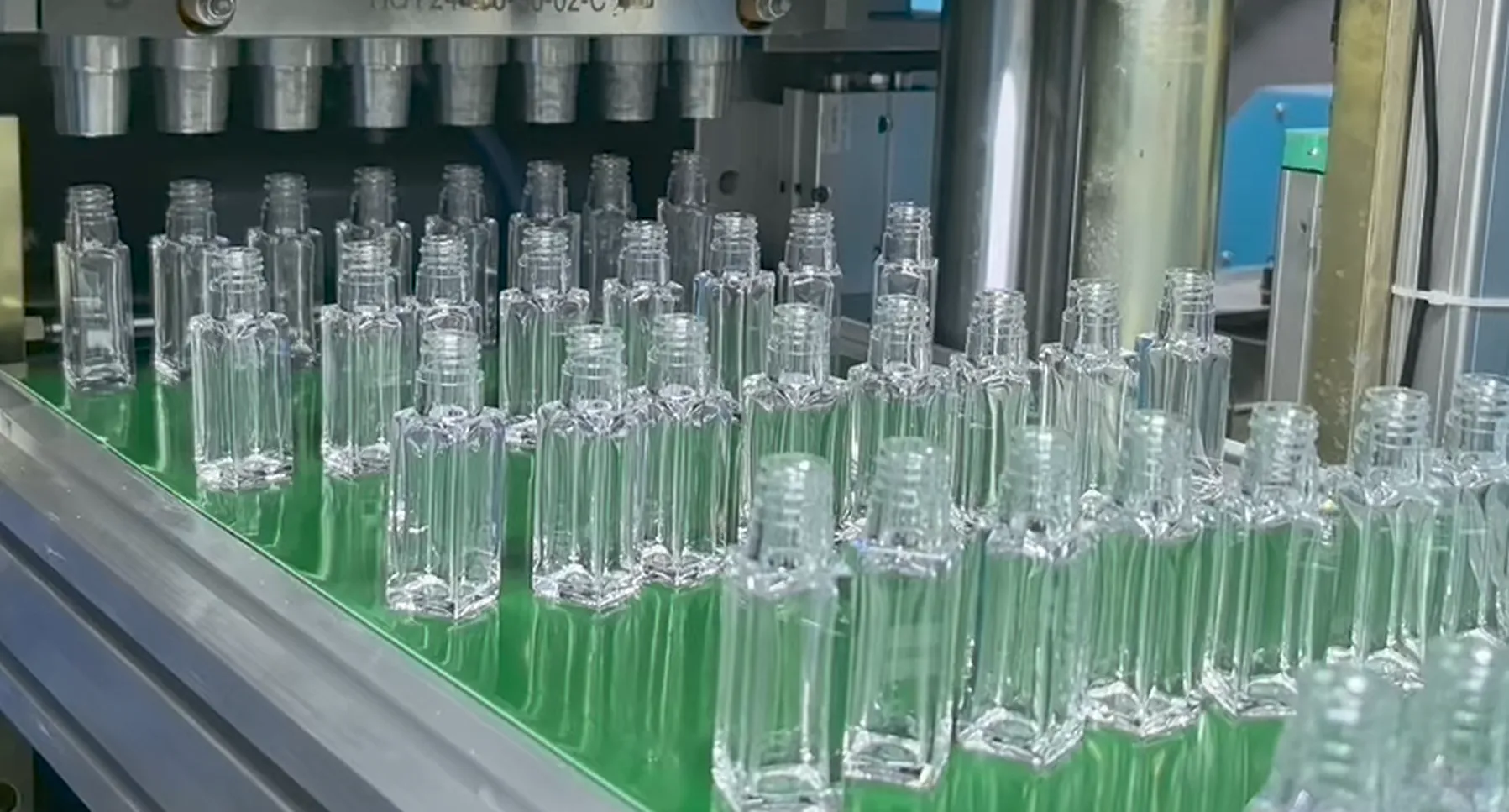
K-Beauty packaging is increasingly differentiated not just by material (PETG versus PET, Tritan versus glass) but by shape — oval cross-sections, faceted bodies, asymmetric shoulder profiles, deliberately off-axis neck placements, and architectural proportions that have no counterpart in the circular cross-section bottles that dominate beverage packaging. These shapes are achievable in ISBM blow moulding through the same stretch rod and blow pressure control that produces standard cylindrical containers, with the addition of more complex 5-axis machined cavity tooling and more careful material distribution analysis in the preform design phase.
The market implication is that Korean cosmetic ISBM producers who invest in the DFM capability, precision tooling, and material handling expertise for PETG and Tritan non-round containers are positioning for the premium segment of a growing export market — while those who remain in standard cylindrical PET are competing in the commodity end of a market that is bifurcating between commodity and premium.
What These Trends Mean for Machine Selection in 2025 and Beyond
Each of the five trends described above has a specific, actionable implication for ISBM machine investment decisions being made today. The table below consolidates these implications into a reference framework:
◆ Principais conclusões
The five PET packaging trends through 2030 — rPET, lightweighting, hot-fill expansion, electric adoption, and K-Beauty premiumisation — all point in the same direction for machine investment: higher precision, lower energy consumption, multi-resin capability, and oil-free operation. A machine purchased in 2025 that meets these criteria is aligned with where the market is heading. One that does not is already behind the curve on at least two or three of the trends that will define the industry by 2030.
Conclusão
The PET packaging industry is not in a period of incremental change — it is in a period of structural realignment driven by sustainability regulation, consumer expectation shifts in Asia’s growing middle-class markets, the K-Beauty export premium, pharmaceutical sector growth, and the economics of electric drive technology that have reached the payback threshold for most production profiles. Producers and brands who understand these trends and align their equipment investment decisions with them are building production capability that will serve them through the end of the decade. Those who make equipment decisions based only on current production requirements risk a machine obsolescence gap that will be expensive to address in a market where customer requirements are moving at regulatory speed.
Korea Ever-Power HGY series 3-station ISBM machines — including the fully electric HGY50-V3-EV and the Tritan-capable HGY150-V3 — are designed to align with every one of the five trends identified in this guide: rPET-capable conditioning station precision, high-IV resin and lightweighted preform handling, hot-fill variants in the HGS200B, electric drive as a standard option, and multi-resin capability across PET, PETG, PC, and Tritan. Contact Korea Ever-Power to discuss which machine configuration aligns with your production programme and the market segments you are targeting through 2030.
Sobre este artigo: Prepared by the Korea Ever-Power Editorial Team. Market trend assessments are based on publicly available industry research directions, regulatory documentation (EU Single-Use Plastics Directive, Korea MFDS packaging frameworks), and Korea Ever-Power’s customer and market observations. This article reflects trend directions rather than quantified market forecasts; readers should supplement this perspective with formal market research for investment decision support.
Leitura complementar: How to Choose an ISBM Machine — 8 Specifications | Hot-Fill PET Bottles — Process, Design, and Machine Requirements | Cosmetic PET Bottle Manufacturing — K-Beauty ISBM Guide
Editor: Cxm