
APLICAÇÃO INDUSTRIAL
Produção de galões de água de 5 litros: Guia ISBM de grande formato para engarrafadores coreanos
Os galões de água de 5 litros coreanos atendem aos canais de entrega em domicílio, escritórios e serviços de alimentação, que movimentam US$ 1,4 bilhão em volume anual de água mineral. A produção de galões ISBM de grande formato exige fixação robusta, projeto de base estrutural e integração de alças que diferem das garrafas de bebidas. Este guia aborda as plataformas de máquinas, a arquitetura dos moldes e as janelas de processo que os engarrafadores coreanos em Gangwon, Jeju, Cheongju e Gimhae utilizam para produzir galões de 3 a 5 litros com qualidade premium.
Neste guia
- Mercado coreano de água em grande formato
- Desafios físicos da produção de 5 litros
- Plataformas de máquinas para grandes formatos
- Projeto e orçamento de materiais para pré-formas de 5 litros
- Arquitetura de Base Estrutural
- Gerenciar estratégias de integração
- Janelas de processo de grande formato
- Resistência ao empilhamento e conformidade com o transporte
- Estudos de caso de engarrafadoras coreanas
- Conclusão
1. Mercado Coreano de Reservatórios de Água de Grande Formato
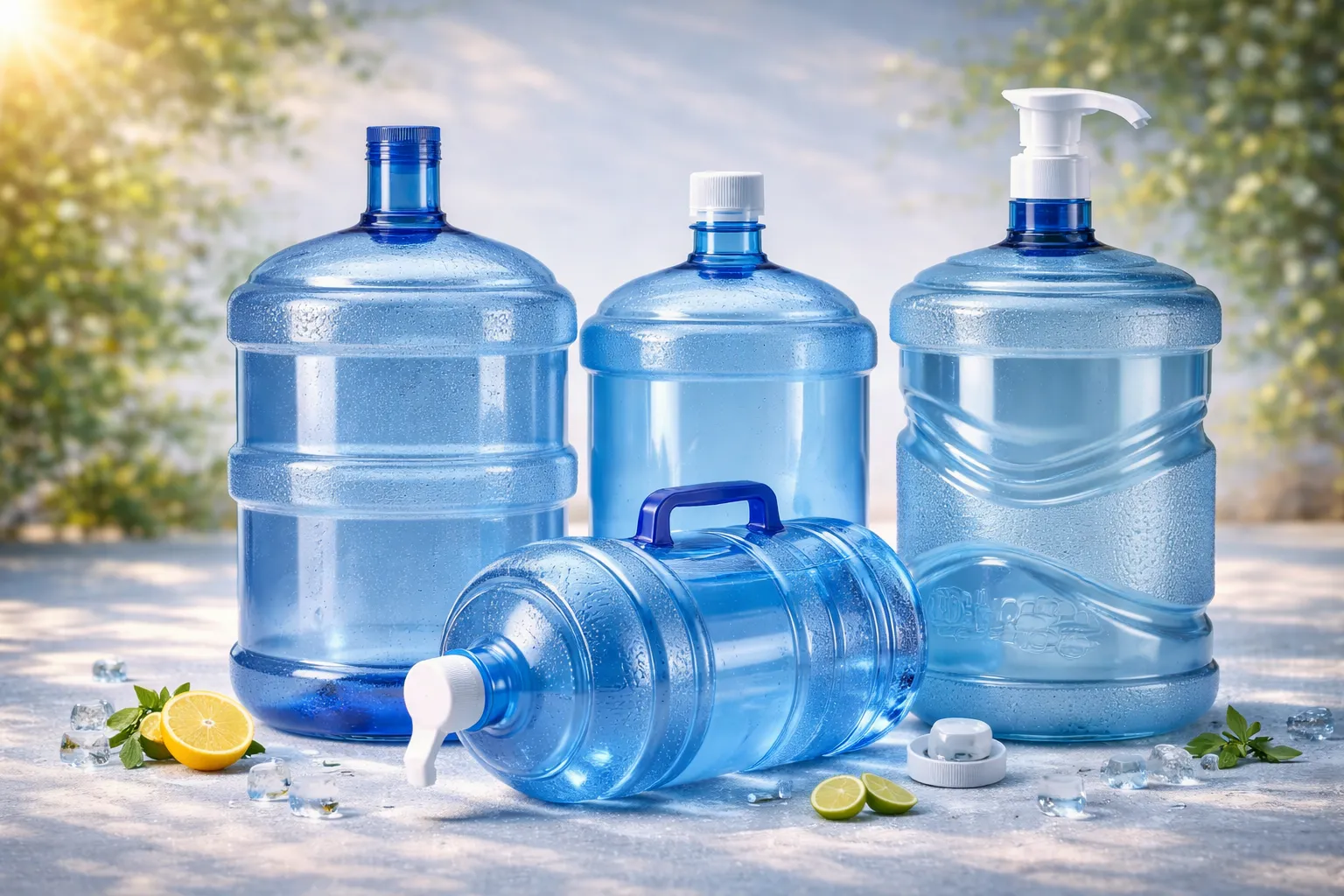
Galões de água coreanos de 5 litros em PET — o segmento de grande formato que atende aos canais de entrega em domicílio, refrigeradores de escritório e serviços de alimentação.
O consumo de água engarrafada na Coreia ultrapassou 3,6 bilhões de litros em 2024, com o segmento de embalagens de grande formato (galões de 3L, 5L e 6L) representando aproximadamente 281.030 toneladas em volume e 221.030 toneladas em receita. Esse segmento cresceu mais rapidamente do que a categoria de garrafas individuais entre 2020 e 2024, à medida que os consumidores coreanos migraram para serviços de entrega em domicílio e bebedouros de água em escritórios. As principais marcas incluem Jeju Samdasoo (água vulcânica de Jeju), Nongshim Baeksansoo (água da fonte da montanha Gangwon), Lotte Icis (água da fonte natural de Jeonbuk) e marcas próprias de redes de supermercados de desconto coreanas.
A garrafa PET de 5 litros ocupa uma posição estratégica na categoria de bebidas na Coreia. Nesse tamanho, o PET substitui o policarbonato (eliminado devido a preocupações com o BPA) e as pesadas garrafas retornáveis de policarbonato, além de caber em geladeiras domésticas e bebedouros de escritório. O formato é grande demais para consumo individual, mas pequeno o suficiente para ser manuseado com praticidade por um adulto em casa. A produção anual coreana de garrafas PET de 5 litros ultrapassou 180 milhões de unidades em 2024, distribuídas em aproximadamente 15 grandes fábricas de engarrafamento em Gangwon, Jeju, Cheongju e Gimhae.
A economia de produção difere fundamentalmente da fabricação de garrafas de água individuais. Um galão de 5 litros utiliza de 8 a 15 vezes mais material PET do que uma garrafa de 500 ml, custa de 10 a 18 vezes mais por unidade para produzir e ocupa de 25 a 40 segundos de tempo de ciclo, em comparação com 3 a 5 segundos para garrafas individuais. O número de cavidades cai de 8 a 12 em linhas de produção de bebidas padrão para 1 a 4 em linhas de grande formato. Essas diferenças estruturais exigem uma seleção de plataforma de máquina, arquitetura de molde e requisitos de janela de processo completamente diferentes.
2. Desafios físicos da produção de 5 litros
A impressão 3D de grande formato amplifica todas as variáveis de processo relevantes na produção de garrafas. A distribuição da espessura da parede torna-se mais difícil de controlar à medida que as taxas de estiramento aumentam, a geometria da base deve suportar de 5 a 7 kg de peso do produto e a própria pré-forma pesa de 120 a 180 gramas, em comparação com 15 a 25 gramas para formatos de bebidas. Quatro desafios físicos principais definem o escopo da produção de garrafas de 5 litros.
DESAFIO 1
Relações de alongamento extremas na base
Galões de 5 litros normalmente requerem um estiramento axial de 4,5 a 5,5 vezes e um estiramento circunferencial de 4,8 a 5,5 vezes para orientação biaxial completa. Essas proporções estão próximas do limite superior de processabilidade do PET. Um estiramento insuficiente na base produz zonas amorfas que aparecem como manchas brancas sob a luz; um estiramento excessivo produz afinamento da parede que compromete a integridade estrutural.
DESAFIO 2
Distribuição da espessura da parede ao longo de 300 mm de altura.
A altura típica de um galão de 5 litros atinge 280-320 mm, em comparação com 150-220 mm para garrafas de 500 ml. Manter uma espessura de parede uniforme ao longo desse comprimento estendido requer um condicionamento preciso da temperatura da pré-forma e um perfil de velocidade da haste de estiramento. A espessura de parede alvo é de 0,55-0,75 mm no corpo e 0,80-1,20 mm na base; a variação deve ficar dentro de ±0,10 mm.
DESAFIO 3
Carga estrutural de base
Um galão de 5 litros cheio pesa entre 5,2 e 5,4 kg, dependendo do peso da garrafa vazia. A base deve suportar essa carga em cenários de empilhamento de até 6 camadas de paletes (resultando em uma carga de aproximadamente 32 kg na base, considerando as garrafas da fileira inferior). A base petaloidal com geometria de 1,5 a 2,1 metros é a arquitetura dominante; o ângulo específico do pé e o raio de transição determinam a capacidade de carga.
DESAFIO 4
Tempo de ciclo dominado pelo resfriamento
Paredes mais espessas significam um tempo de resfriamento maior por ciclo, o que faz com que o resfriamento se torne a etapa limitante da produção, em vez da injeção ou do sopro. O tempo de ciclo típico para 5 litros é de 22 a 28 segundos, em comparação com 10 a 12 segundos para 500 ml. A densidade dos canais de resfriamento do molde, a temperatura do chiller e o design do inserto de resfriamento da base influenciam diretamente o tempo de ciclo. Uma otimização inadequada do resfriamento pode estender o tempo de ciclo para mais de 30 segundos e comprometer a viabilidade econômica da produção.
3. Plataformas de máquinas para grandes formatos
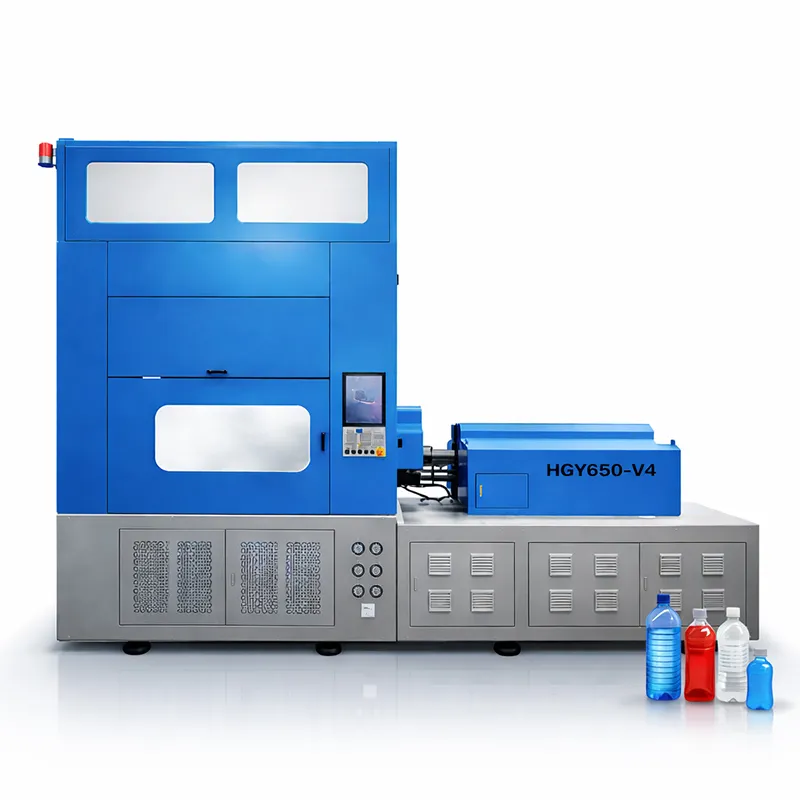
Plataforma premium de grande formato HGY650-V4 — projetada especificamente para a produção de embalagens de 2 a 5 litros com capacidade de fechamento de 650 kN.
A seleção de máquinas de grande formato exige três características estruturais: alta força de fechamento por injeção (450-700 kN para pré-formas de 5 litros com 1 a 4 cavidades), ampla abertura do molde (320-420 mm para acomodar geometrias de garrafas altas) e capacidade suficiente do compressor para a pressão de sopro sustentada de aproximadamente 10-20 bar durante 4-6 segundos por ciclo. Plataforma premium de grande formato HGY650-V4 é o modelo topo de linha da Ever-Power para este segmento.
NAVIO PRINCIPAL
HGY650-V4 para produção de 3 a 5 litros
Especificações: Força de fechamento por injeção de 650 kN, arquitetura de 4 estações com capacidade para 1 a 4 cavidades, espaço livre no molde de 450 mm para garrafas de até 400 mm de altura. Produtividade: 700 a 1.400 garrafas por hora, dependendo do número de cavidades. Aplicações recomendadas: galões premium de 3 litros, galões domésticos padrão de 5 litros e embalagens especiais para bebidas de grande porte.
NÍVEL MÉDIO
HGY250-V4 para segmento de 2 a 3 litros
Especificações: Máquina de injeção com força de fechamento de 250 kN, 4 estações com 2 a 4 cavidades, espaçamento entre moldes de 380 mm. Uso principal: garrafas de bebidas de 1,5 a 2 litros e recipientes de água de transição de 2 a 3 litros. Mais econômica que a HGY650-V4 quando o volume máximo da garrafa for inferior a 3 litros; 5 litros ultrapassa a capacidade de fechamento confiável desta plataforma.
A relação entre o número de cavidades e o volume de produção exige uma avaliação cuidadosa. Uma máquina capaz de produzir garrafas de 5 litros, operando com 2 cavidades, produz de 1.200 a 1.400 garrafas por hora; operando com 4 cavidades, a produção aumenta de 2.000 a 2.400 garrafas por hora, mas requer uma força de fechamento de injeção proporcionalmente maior e um custo de molde substancialmente mais elevado. A maioria dos fabricantes coreanos de garrafas de 5 litros utiliza de 2 a 3 cavidades, pois o custo do molde e a complexidade da troca de ferramentas com 4 cavidades superam o benefício em termos de produtividade para volumes de produção típicos de 15 a 30 milhões de unidades por ano por linha.
4. Orçamento de projeto e materiais para pré-formas de 5L
O design da pré-forma de 5 litros equilibra três variáveis: massa suficiente para o desenvolvimento completo da parede da garrafa, geometria adequada às taxas de estiramento da cavidade e acabamento do gargalo compatível com os designs dominantes de anel de alça de 55 mm ou 63 mm. A massa da pré-forma normalmente varia de 130 a 170 gramas, com valores mais altos para geometrias de cavidade com estiramento mais profundo e modelos com integração de alça.
| Volume da garrafa | Massa de pré-forma | Pré-forma OD | Comprimento da pré-forma | Especificação IV |
|---|---|---|---|---|
| 3L Premium | 85-110 g | 38-42 mm | 145-170 mm | 0,82-0,86 dL/g |
| 5L Padrão | 130-150 g | 42-48 mm | 170-200 mm | 0,82-0,86 dL/g |
| 5L com alça | 150-175 g | 44-50 mm | 180-210 mm | 0,84-0,88 dL/g |
| 6L a granel | 160-185 g | 46-52 mm | 200-225 mm | 0,84-0,88 dL/g |
A especificação de viscosidade intrínseca (VI) é mais importante para a produção de grandes formatos do que para a produção de bebidas. O estiramento prolongado durante o sopro exige PET de maior massa molecular para evitar o branqueamento por tensão em taxas de estiramento extremas. A resina padrão para bebidas com VI de 0,80 dL/g funciona para garrafas de 500 ml, mas produz resultados marginais para galões de 5 litros; a resina para garrafas com VI de 0,82 a 0,88 dL/g é especificada para garantir transparência consistente nas transições da base e do ombro. Para cálculos detalhados de dimensionamento de pré-formas, consulte nosso [inserir referência aqui]. guia de projeto de pré-formas.
!
Sensibilidade do custo da pré-forma na economia de 5L
Com uma massa de pré-forma de 150 g, o custo da resina PET representa de 65 a 75 toneladas por pré-forma (TP3T) do custo total de produção de garrafas, em comparação com 40 a 50 toneladas por pré-forma (TP3T) para garrafas de bebidas de 500 ml. Uma redução de 31 toneladas por pré-forma (TP3T) na massa da pré-forma por meio da otimização da geometria gera uma economia de 0,02 a 0,04 dólares por garrafa, o que se traduz em uma economia anual de 2 a 4 milhões de dólares em uma linha de produção de 100 milhões de garrafas. A otimização do design da pré-forma é a atividade de engenharia com o maior retorno sobre o investimento (ROI) na produção de garrafas de 5 litros.
5. Arquitetura de Base Estrutural
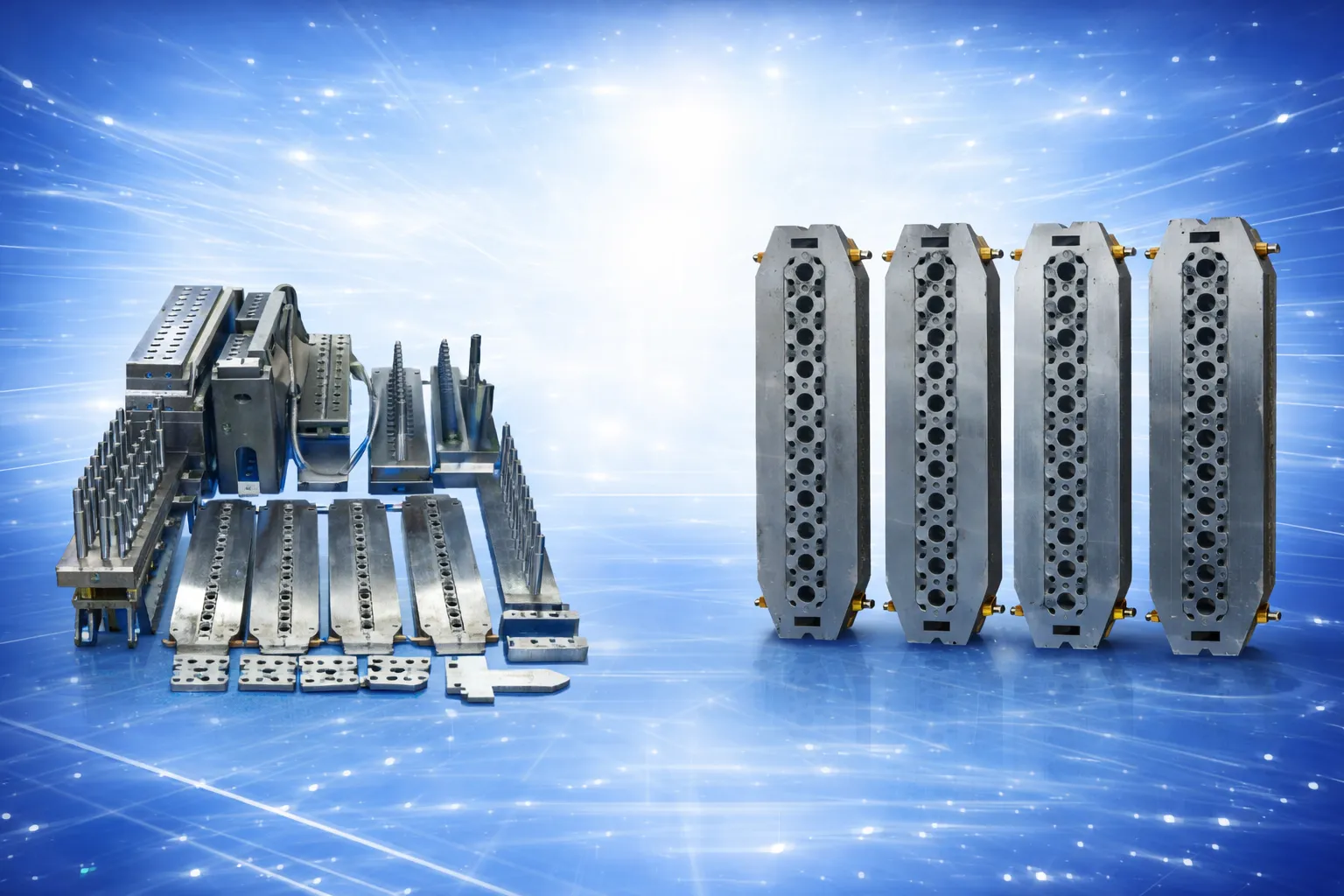
Molde de 5 litros com arquitetura de base petalóide — geometria de 1,5 a 2,1 metros que distribui a carga de empilhamento e controla o arqueamento da base.
A arquitetura da base determina se um galão de 5 litros permanece estável quando cheio, resiste ao empilhamento em paletes e evita a deformação da base durante o enchimento em altas temperaturas. Três arquiteturas de base predominam na produção coreana, cada uma com diferentes vantagens e desvantagens em termos de custo, desempenho e estética.
DOMINANTE
Base Petalóide (1,5 a 2,1 metros)
De cinco a sete pés simétricos irradiam de um ponto central, distribuindo a carga ao longo do ombro da garrafa e proporcionando estabilidade inerente ao empilhamento. Utilizado em aproximadamente 75% da produção coreana de garrafas de 5 litros. Vantagens: baixo custo de material, bom desempenho de empilhamento, design de molde consolidado. Limitação: ligeira complexidade visual no segmento premium do varejo, onde uma base lisa é preferida.
PREMIUM
Base em forma de cúpula de champanhe
Base côncava em forma de cúpula com borda periférica que proporciona uma superfície de apoio, inspirada na arquitetura de garrafas de vinho e champanhe premium. Requer um inserto para a base ou um material de base mais espesso para suportar o peso. Utilizada em marcas premium (aproximadamente 15% da produção coreana de 5 litros). Vantagens: estética limpa, sinal de marca premium. Desvantagem: custo de material mais elevado e design de molde mais complexo.
ESPECIALIDADE
Base plana em forma de disco com nervuras
Base quase plana com nervuras radiais para maior rigidez estrutural. Menos comum no mercado coreano (produção de aproximadamente 101.000 toneladas). Utilizada em contêineres a granel para o setor alimentício, onde a superfície de apoio máxima e estável é mais importante do que a estética do ponto de venda. Requer um controle cuidadoso da espessura da parede para evitar zonas de cristalização na base.
6. Gerenciar estratégias de integração
Um galão de 5 litros cheio pesa entre 5,2 e 5,4 kg, o suficiente para que consumidores domésticos e entregadores coreanos esperem uma alça ergonômica para transporte com uma só mão. A integração da alça apresenta três abordagens arquitetônicas, cada uma com implicações estéticas e de custo de produção.
Opções de arquitetura de gerenciamento:
- ▸Alça moldada integrada: A alça é formada durante o processo ISBM utilizando uma metade de molde dedicada com cavidade para a alça. Isso adiciona 15-20% ao tempo de ciclo e 20-30% ao custo do molde, mas resulta em um produto premium sem emendas.
- ▸Alça acoplada separadamente: A alça de HDPE ou PP é encaixada ou soldada por ultrassom à garrafa após a fabricação por imersão. Não há impacto no tempo de ciclo, mas adiciona uma estação de montagem subsequente e um custo de material de 0,03 a 0,06 USD por garrafa.
- ▸Alça em formato de anel para o pescoço: A alça de encaixe em PP prende-se ao redor do gargalo da garrafa através de um anel integrado. Montagem mais fácil, custo mais baixo, mas esteticamente indica um produto de baixo custo para o varejo.
- ▸Sem pega (pegada direta): Área de pega ergonômica moldada diretamente na garrafa, sem componente de alça separado. Comum em garrafas de 3 litros, onde o peso permite uma pegada direta; raro em garrafas de 5 litros ou mais.
As marcas premium coreanas (Jeju Samdasoo, Nongshim Baeksansoo, linha premium Lotte Icis) utilizam predominantemente alças moldadas integradas para sinalizar a qualidade superior do produto. Marcas de gama média e marcas próprias utilizam alças fixadas separadamente para reduzir custos. A alça com anel no gargalo é restrita a grandes volumes para o setor de serviços de alimentação e ao varejo de baixo custo. A escolha da integração na fase de projeto de uma nova linha determina os requisitos de arquitetura da máquina e do molde.
7. Janelas de Processo de Grande Formato
A produção de galões de 5 litros altera a janela de processo em comparação com a produção de bebidas. A pressão de sopro, a velocidade da haste de estiramento e o tempo de resfriamento da base operam em faixas diferentes das da fabricação típica de garrafas de bebidas. Compreender essas diferenças evita a abordagem de tentativa e erro que desperdiça dias durante o comissionamento de um novo produto.
Diretrizes para a janela de processo de 5L:
- ✓Pressão de sopro principal: 38-42 bar (em comparação com 28-35 bar para bebidas); maior pressão necessária para a distribuição completa do material.
- ✓Pressão pré-sopro: 10-14 bar (em comparação com 6-12 bar para bebidas); a pressão escalonada é fundamental para uma distribuição uniforme.
- ✓Velocidade da haste de estiramento: rampa de 0 para 1,4-1,6 m/s em 0,4-0,6 s (em comparação com 0,2-0,4 s para a bebida)
- ✓Temperatura de condicionamento da pré-forma: Corpo a 103-108°C, zona de apoio do pescoço a 95-100°C.
- ✓Temperatura do molde: Água gelada a 8-14°C (ligeiramente mais fria que a bebida para uma rápida fixação da base)
- ✓Tempo de resfriamento: 8-12 segundos no total (o limitador de taxa do ciclo)
- ✓Tempo total do ciclo: 22-28 segundos com 2-3 cavidades, 32-40 segundos com 4 cavidades e integração da alça
8. Resistência ao empilhamento e conformidade com o transporte
Na distribuição doméstica coreana, o empilhamento padrão em paletes de 6 camadas é utilizado. Isso permite acomodar 5 galões cheios (carga cumulativa de 26 a 27 kg) na garrafa inferior de cada coluna. A arquitetura da base, a distribuição nas paredes e a resina IV contribuem para a resistência à carga superior, que deve atender à especificação mínima de 35 a 40 kg com margem de segurança 25%.
Testes de conformidade para transporte padrão de 5 litros:
TESTE 1
Carga superior (compressão axial)
Teste: Garrafa cheia e tampada comprimida axialmente a 50 mm/min. Especificações para o mercado interno coreano: Peso mínimo de 35 a 40 kg antes de ocorrer a deformação. Especificações de exportação: Peso mínimo de 45 a 50 kg para contêineres de maior altura. Testar 30 garrafas por lote de produção.
TESTE 2
Impacto de queda (Preenchido, 1,2 m)
Teste: Garrafa cheia e tampada é solta de uma altura de 1,2 m sobre concreto em três orientações (base, lateral e gargalo para baixo). Critério de aprovação: Garrafas 20/20 sem vazamentos ou rachaduras estruturais. Simula quedas durante o manuseio em armazéns e durante a entrega.
TESTE 3
Vibração (Simulação de Transporte)
Teste: Unidades paletizadas submetidas ao perfil de vibração ASTM D999 durante 60 minutos, simulando o transporte rodoviário e ferroviário coreano. Critério de aprovação: Sem vazamentos, sem danos visíveis na garrafa, a aderência do rótulo foi mantida na amostra 100%.
9. Estudos de Caso de Engarrafadoras Coreanas
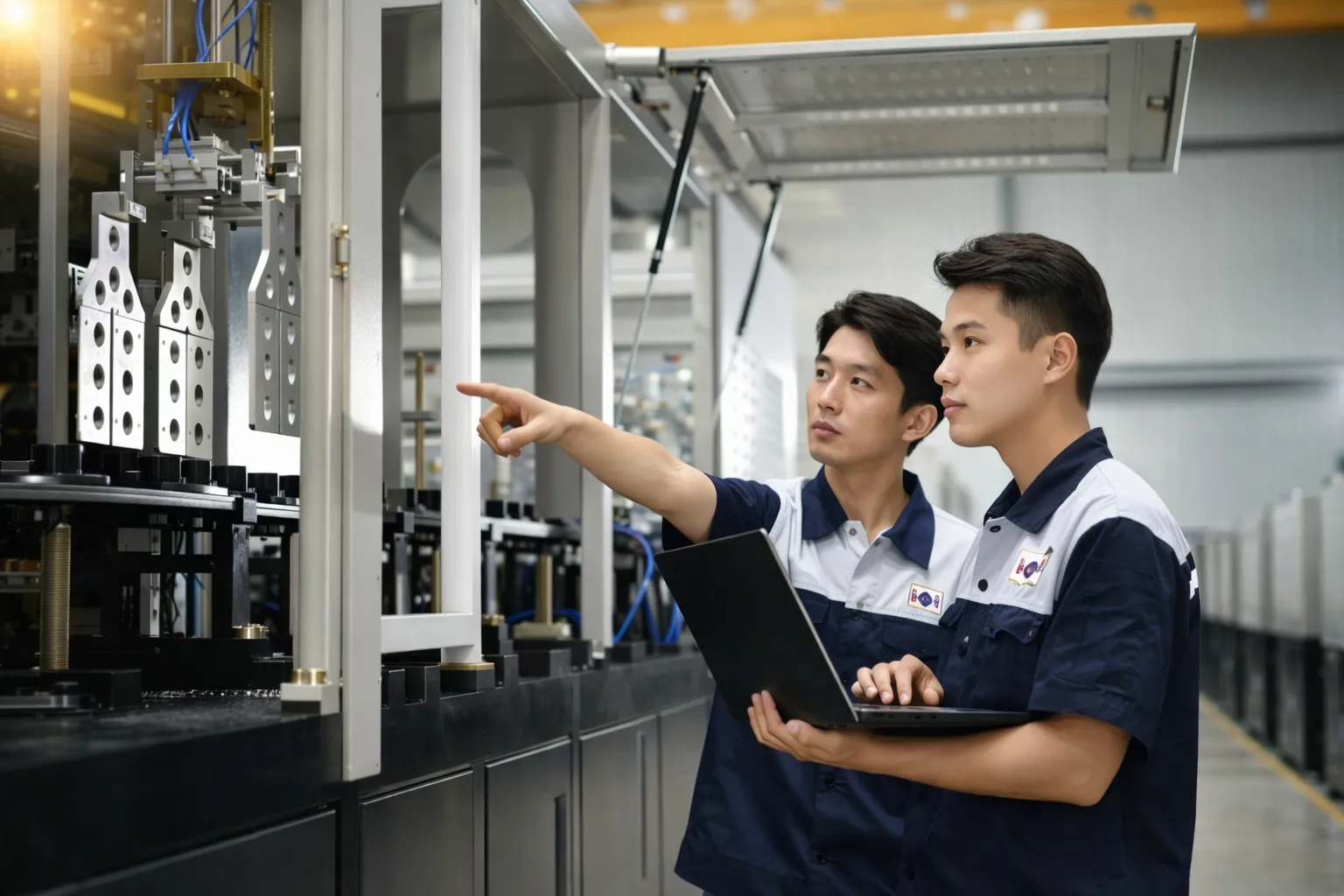
Fábrica coreana de engarrafamento de água em grande formato — os polos de Gangwon, Jeju e Cheongju produzem mais de 180 milhões de unidades de 5 litros anualmente.
Estudo de Caso 1 · Engarrafadora de Água Mineral Natural das Montanhas Gangwon
Linha Premium 5L com alça integrada (22 milhões de unidades/ano)
Desafio: Uma marca coreana premium exigia um galão de 5 litros com alça moldada integrada, distribuição de espessura de parede de ±0,08 mm e resistência à carga superior de 45 kg para exportação a varejistas premium japoneses. O fornecedor anterior, que utilizava uma máquina ASB japonesa de 4 cavidades, entregava uma resistência média à carga superior de 38 kg, abaixo da especificação para exportação.
Resultado: O modelo HGY650-V4, com moldes personalizados de 2 cavidades, incluindo cavidades integradas para alças, apresentou uma capacidade média de carga superior de 47 kg e consistência de espessura de parede de ±0,06 mm. A aceitação por varejistas japoneses garantiu um contrato anual de 3,2 milhões de unidades; a margem da marca premium coreana 7% foi aprimorada por meio da otimização da massa da pré-forma.
Estudo de Caso 2 · Engarrafadora de Água Vulcânica de Jeju
Transição para o segmento de refrigeradores de escritório de 3 litros (15 milhões de unidades/ano)
Desafio: Expansão para o segmento de refrigeradores de escritório de 3 litros com meta de custo rigorosa. A linha anterior apresentava dificuldades com um tempo de ciclo de 24 a 28 segundos, limitando a produção a 850 garrafas por hora em máquinas de 2 cavidades.
Resultado: A plataforma HGY250-V4, com circuito de resfriamento de base otimizado e arquitetura de base petalóide, proporcionou um tempo de ciclo de 18 a 20 segundos na configuração de 3 cavidades, produzindo 1.550 garrafas por hora. O custo unitário foi reduzido em 12% em comparação com a plataforma anterior; o segmento de refrigeradores para escritórios adicionou US$ 4,1 milhões em receita anual em 18 meses.
Estudo de Caso 3 · Engarrafadora de Marca Própria de Cheongju
Portfólio com múltiplos SKUs (3L / 5L / 6L) para redes de lojas de desconto
Desafio: Uma rede varejista de descontos precisava de uma linha flexível com múltiplos SKUs, compatível com formatos de 3L, 5L e 6L, e com rápida troca entre os SKUs para acompanhar os ciclos promocionais semanais.
Resultado: A HGY650-V4, com montagem de moldes QMC e biblioteca de receitas PLC, permitiu a troca de SKUs entre os três formatos em 90 a 110 minutos. A rotação semanal de SKUs atendeu ao calendário promocional do varejista; o contrato de marca própria expandiu de uma base de 20 milhões de unidades para 34 milhões de unidades anuais.
10. Conclusão
A produção de galões de água de 5 litros combina a mecânica robusta do ISBM (Sistema Integrado de Moldagem por Injeção), a arquitetura estrutural do molde e a engenharia de conformidade com o transporte em uma única aplicação que amplifica todas as variáveis do processo de fabricação de garrafas de bebidas padrão. As engarrafadoras coreanas em Gangwon, Jeju, Cheongju e Gimhae construíram uma capacidade de produção anual de mais de 180 milhões de unidades porque a disciplina de engenharia coreana corresponde à escala, precisão e exigências regulatórias que a produção em grande formato impõe.
A plataforma premium de grande formato HGY650-V4 representa o carro-chefe da Ever-Power para este segmento, oferecendo 650 kN de força de fechamento por injeção, 450 mm de espaço livre no molde e capacidade de cavidade integrada para alça. Combinada com arquitetura de base petalóide ou em formato de cúpula de champanhe, otimização da massa da pré-forma visando a faixa de 130-175 g e especificação de resina otimizada por IV de 0,82-0,88 dL/g, a plataforma oferece a resistência à carga superior, o desempenho de empilhamento e a economia de tempo de ciclo que os engarrafadores coreanos exigem para competir nos canais premium nacionais e de exportação.
Principais conclusões sobre a produção de galões de água de 5 litros
- ✓Mercado coreano de garrafas de 5 litros: mais de 180 milhões de unidades anualmente, categoria de água mineral avaliada em 1,4 bilhão de dólares.
- ✓Requisitos da máquina: força de fechamento da injeção de 450-700 kN, abertura do molde de 320-420 mm.
- ✓Especificações da pré-forma: massa de 130-175 g, diâmetro externo de 42-50 mm, volume intravenoso de 0,82-0,88 dL/g.
- ✓Relações de alongamento: 4,5-5,5× axial, 4,8-5,5× circunferencial (limite superior de processabilidade do PET)
- ✓Arquitetura base: petalóide (75%), cúpula champanhe (15%), disco plano (10%) de produção coreana
- ✓Opções de alça: moldada integrada (premium), fixada separadamente (nível intermediário), anel de pescoço (econômico)
- ✓Tempo de ciclo: 22-28 segundos em 2-3 cavidades; o resfriamento é o fator limitante da taxa, não a injeção ou o sopro.
- ✓Resistência à carga superior: 35-40 kg (padrão doméstico coreano), 45-50 kg (especificação para exportação).
Pronto para construir sua linha de produção de 5 litros?
Compartilhe suas especificações de volume de garrafa, meta de produção anual, opção de integração de alça e preferência de arquitetura de base. Nossa equipe de engenharia coreana retorna, em até 48 horas, uma recomendação completa de plataforma com arquitetura de molde, otimização de pré-formas e análise de custo projetado por garrafa.