
HGA.ES-2C100 Cosmetic & Daily Chemical Bottle Blow Molding Machine
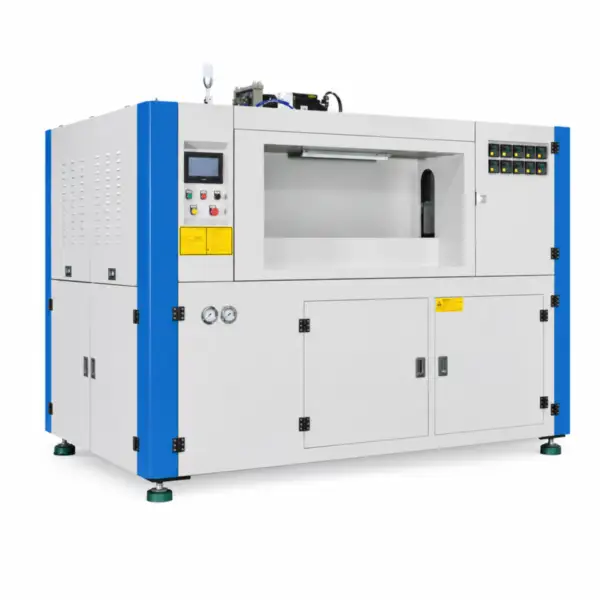
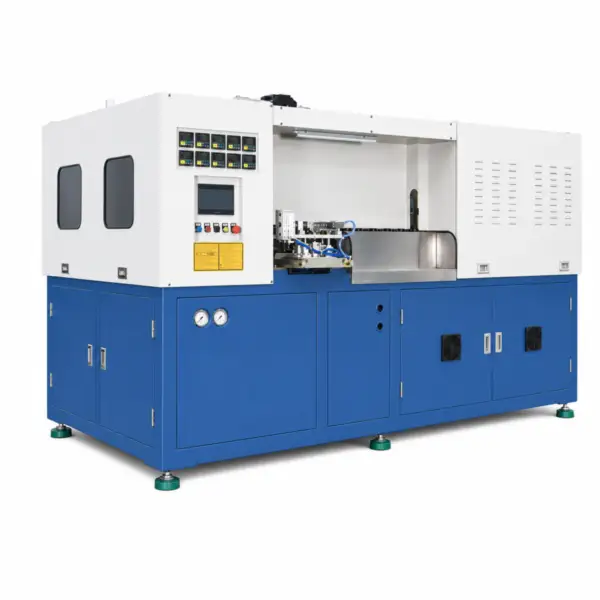
The Ever-Power HGA.ES-2C100 is a 2-cavity enhanced-servo automatic blow molding machine for cosmetic, personal care, and daily chemical bottle production. 2,400 bph, max 500 ml, max 80 mm body diameter, max 68 mm neck. 100 mm cavity pitch, 60-position preform holder. Machine size 2,900 x 1,525 x 1,930 mm, 2,000 kg. CE + ISO 9001:2015.
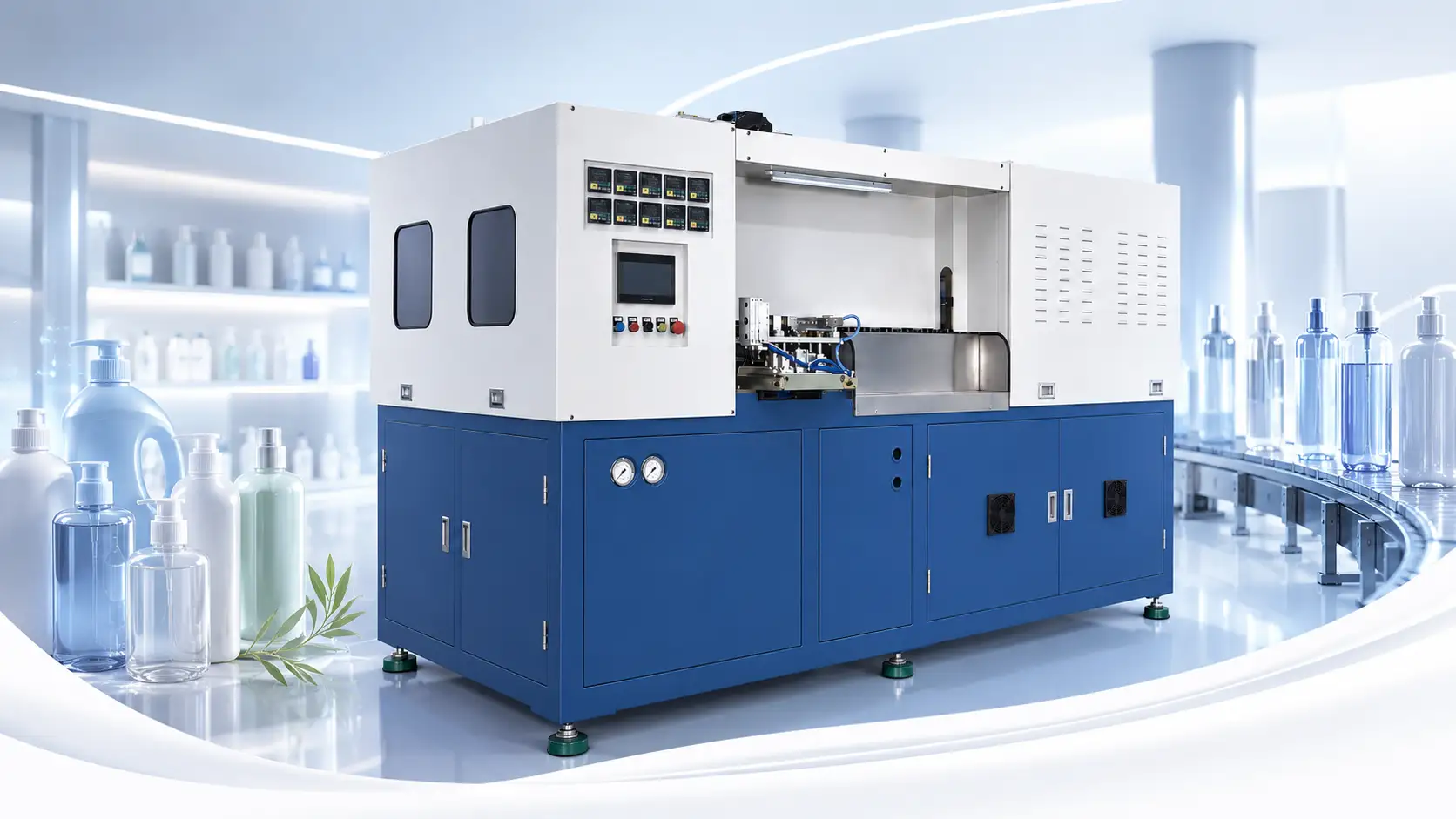
The HGA.ES series incorporates an enhanced servo motor configuration versus the standard HGA.AS series — delivering higher cycle speed, tighter dimensional repeatability, and faster servo response across all drive axes. The ES designation indicates this upgraded servo architecture, which is recommended where cycle speed and bottle-to-bottle dimensional consistency are primary production quality parameters.
Product Overview — HGA.ES-2C100 Enhanced Servo Cosmetic Blow Molding Machine
The Ever-Power HGA.ES-2C100 is a 2-cavity enhanced-servo automatic stretch blow molding machine built for cosmetic and daily chemical bottle production where cycle speed and dimensional repeatability are primary requirements. Operating at up to 2,400 bottles per hour on a 100 mm cavity pitch, it covers a broad cosmetic bottle range from 30 ml precision serum vials up to 500 ml daily chemical containers in PET and PETG — filling the gap between the 76.2 mm narrow-pitch 4-cavity configuration and the 114.3 mm wide-pitch 2-cavity machine.
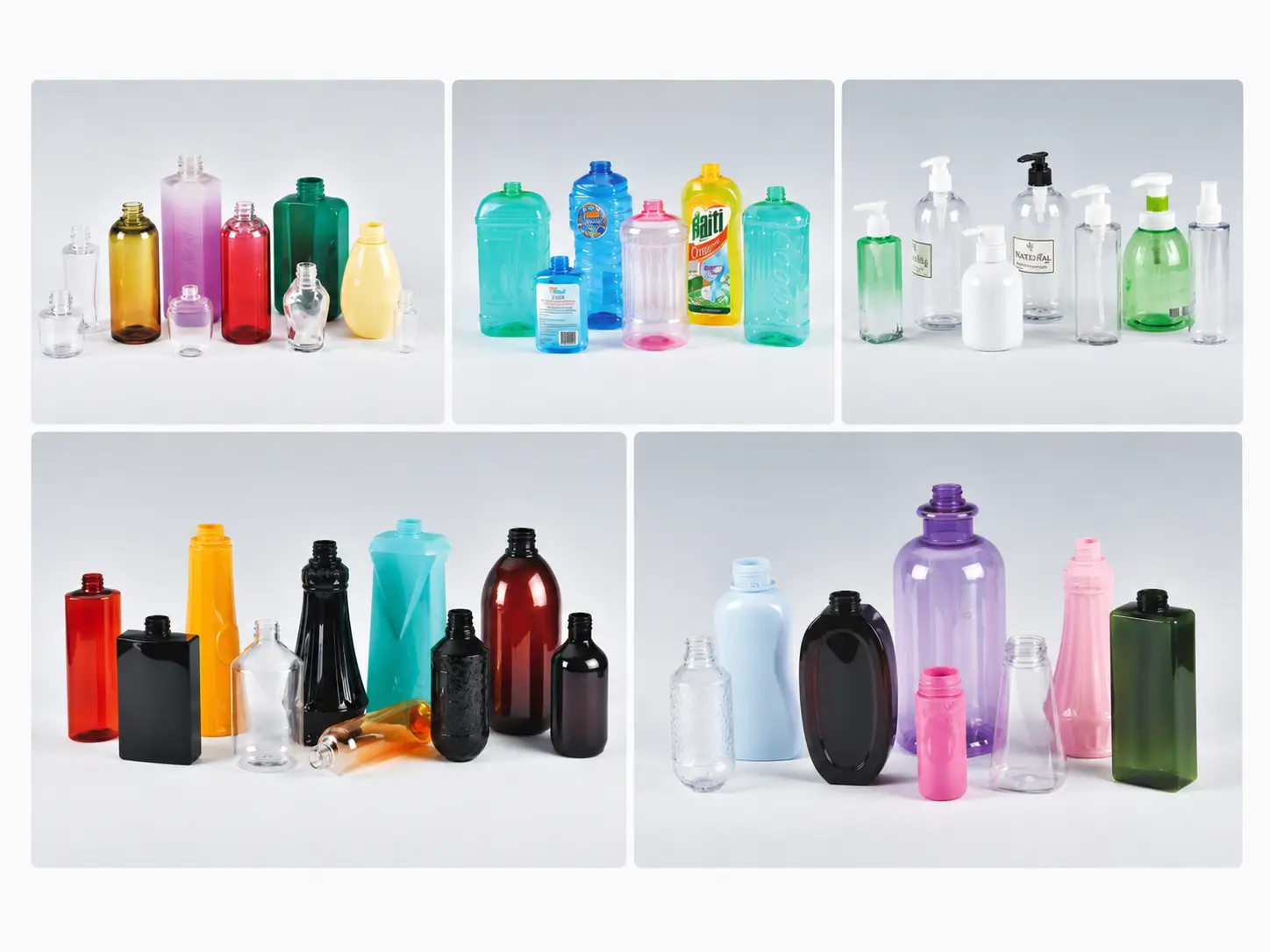
The 100 mm pitch and 80 mm maximum body diameter make the HGA.ES-2C100 the right selection for mid-size cosmetic dispensers and personal care containers — the bottle formats between the standard serum/toner range (76.2 mm pitch) and the wide-body lotion pump range (114.3 mm pitch). This includes oval and round facial cleanser bottles, shampoo travel sizes, mid-size lotion dispensers, and the growing category of premium cosmetic bottles with distinctive waisted or multi-panel profiles that require both adequate body width and high surface definition.
The ES enhanced servo configuration delivers higher drive response across injection, stretching, blow, and take-out axes — resulting in tighter cycle-to-cycle repeatability and faster servo recovery between cycles at sustained production rates. This makes the HGA.ES-2C100 particularly suitable for precision cosmetic applications where neck-finish dimensional consistency and wall-thickness uniformity across cavities are customer quality specifications rather than internal process targets.
Internationally sourced servo motors, digital infrared preform heating with zone-level control, and premium electrical components ensure stable multi-shift production across cosmetic and daily chemical manufacturing operations.
Technical Specifications — HGA.ES-2C100 Parameters
| Molding Configuration | |
| Clamping Stroke | 110 mm |
| Mold-Open Distance | 280 mm |
| Mold-Close Distance | 170 mm |
| Stretching Stroke | 350 mm |
| Preform Heating Distance | 50 mm |
| Cavity Pitch (Mold-Close) | 100 mm |
| Preform Holder Capacity | 60 positions |
| Number of Cavities | 2 |
| Container Specifications | |
| Max. Container Volume | 500 ml |
| Max. Neck Diameter | 68 mm |
| Max. Container Body Diameter | 80 mm |
| Max. Container Height | 200 mm |
| Compatible Materials | PET, PETG (including special-shaped and high-clarity formulations) |
| Production Performance | |
| Theoretical Output | 2,400 bph (bottles per hour) |
| Electrical System | |
| Max. Heating Power | 34 KW |
| Standard Operating Heating Power | 8 – 12 KW |
| Air System | |
| Low Pressure Operating Pressure | 7 kg/cm² |
| Low Pressure Air Consumption | 600 L/min |
| Blowing Pressure | 26 – 35 kg/cm² |
| High Pressure Air Consumption | 1,000 – 1,400 L/min |
| High Pressure Operating Pressure | 5 – 6 kg/cm² |
| Cooling Water | |
| Cooling Water Temperature | 8 – 10 °C |
| Cooling Water Flow Rate | 30 L/min |
| Machine Dimensions | |
| Machine Size (L x W x H) | 2,900 x 1,525 x 1,930 mm |
| Machine Weight | 2,000 kg |
Choosing Between the HGA.ES-2C100 and Adjacent HGA Models
The HGA.ES-2C100 fills the cavity pitch position between the 76.2 mm narrow-pitch 4-cavity machine and the 114.3 mm wide-pitch 2-cavity machine — covering the mid-size cosmetic and personal care bottle range that neither adjacent model can optimally serve.
| Parameter | HGA.AS-4C76.2 | HGA.ES-2C100 ★ | HGA.AS-2C114.3 |
|---|---|---|---|
| Cavities | 4 | 2 | 2 |
| Cavity Pitch | 76.2 mm | 100 mm | 114.3 mm |
| Max Body Dia. | 65 mm | 80 mm | 94 mm |
| Max Neck Dia. | 48 mm | 68 mm | 88 mm |
| Max Volume | 500 ml | 500 ml | 1,000 ml |
| Output | 4,000 bph | 2,400 bph | 2,000 bph |
| Drive | AS Standard Servo | ES Enhanced Servo | AS Standard Servo |
| Best Fit | High-volume serum toner, standard cosmetic 30–300 ml | Mid-size cosmetic dispensers, facial cleanser, oval/round 50–500 ml | Wide-body lotion pump, large cream jar, daily chemical 300–1,000 ml |
Performance Characteristics of the HGA.ES-2C100
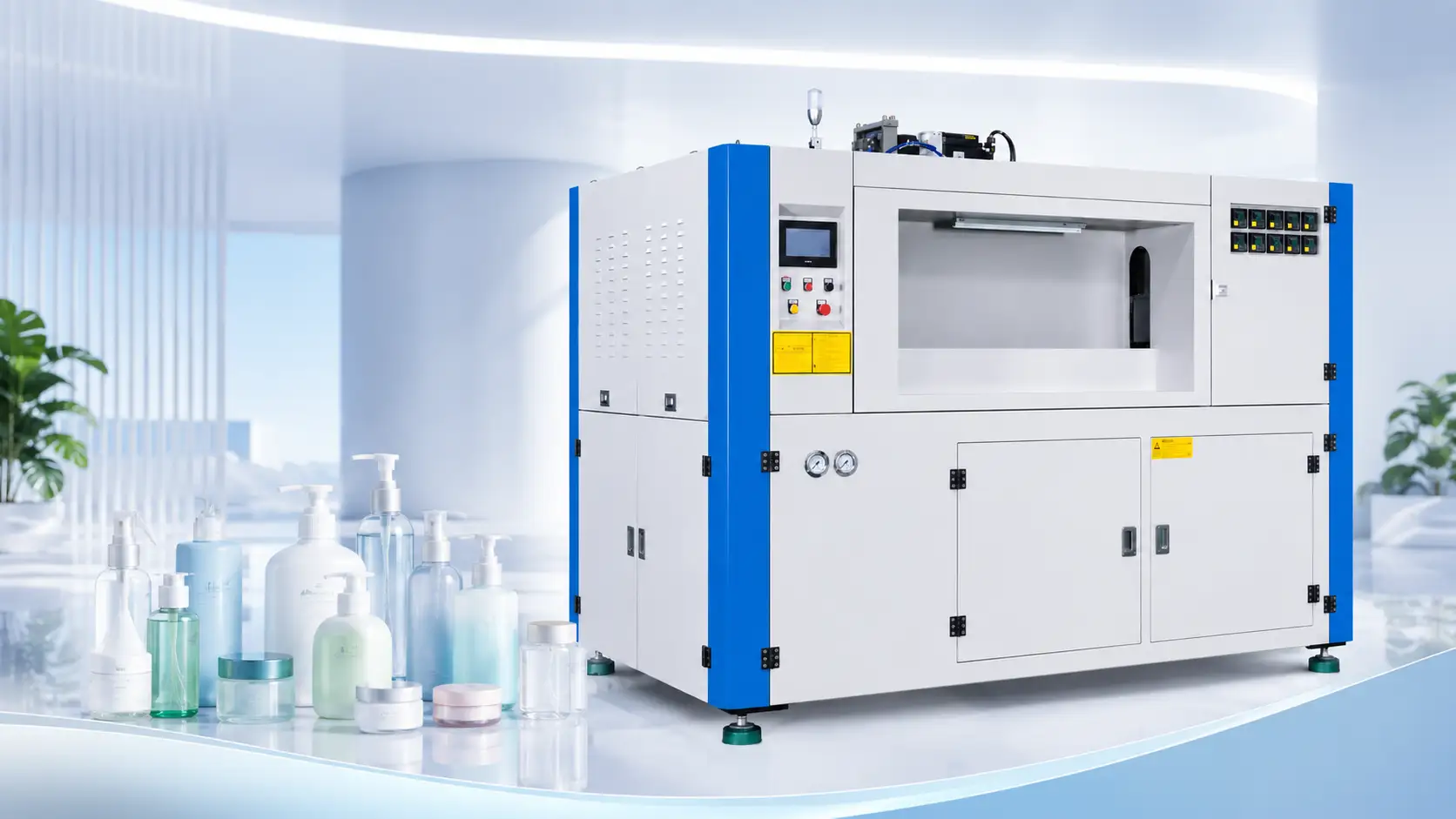
The ES enhanced servo configuration delivers improved response speed across all drive axes — injection, stretching, blow, and take-out — compared to the standard AS servo configuration. This translates to faster cycle completion, shorter inter-cycle dwell, and tighter shot-weight repeatability at sustained 2,400 bph output. For precision cosmetic bottle manufacturing where bottle-to-bottle dimensional consistency is a buyer quality specification, the ES configuration is the recommended choice.
The 100 mm cavity pitch and 80 mm maximum body diameter cover the mid-size cosmetic and personal care bottle range — oval facial cleansers, round lotion dispensers, cylindrical body wash containers, and mid-size daily chemical bottles — that neither the 76.2 mm narrow-pitch nor the 114.3 mm wide-pitch configurations can optimally produce. This is the pitch standard for the growing premium cosmetic dispenser category in 100 ml to 400 ml format range.
A digitally controlled infrared heating system with zone-level power control maintains uniform preform temperature across all 60 holder positions. Consistent preform temperature at the blow station directly determines wall-thickness uniformity and bottle optical clarity in PET and PETG cosmetic containers. The zone-level control system allows fine-tuning of temperature profile across preform height — important for oval and asymmetric cosmetic bottle profiles where wall distribution requirements vary between body sections.
The 68 mm maximum neck diameter is substantially larger than the 48 mm limit on the 76.2 mm pitch machine — enabling production of mid-size flip-top cosmetic bottles, wide-neck facial cleanser dispensers, and mid-format cream and gel containers that require a larger opening for viscous product dispensing. This neck diameter range covers a significant share of the premium cosmetic dispenser market that the narrow-pitch machine cannot serve.
At 2,900 x 1,525 x 1,930 mm and 2,000 kg, the HGA.ES-2C100 is the lightest and most compact machine in the HGA series covered here — lighter and lower than both the HGA.AS-2C114.3 (2,600 kg) and the HGA.AS-4C76.2 (4,000 kg). This compact footprint makes it well suited to production environments where floor space is at a premium, or where the machine needs to fit alongside an existing filling line without expanding the production bay.
The stretch blow process on the HGA.ES-2C100 handles asymmetric, faceted, and geometrically complex cosmetic bottles with demanding surface-quality requirements. The enhanced servo configuration — with faster response across all drive axes — is particularly beneficial on special-shaped bottles where precise timing of the stretch rod advance relative to blow pressure onset determines wall distribution quality in the bottle shoulder and base panel.
Applications — Mid-Size Cosmetic and Daily Chemical Bottles


Oval and round facial cleanser flip-top bottles, toner dispensers, and micellar water containers from 100 ml to 400 ml in PET and PETG. The 80 mm maximum body diameter and 68 mm neck diameter cover the standard oval facial care bottle formats that are too wide for the 76.2 mm pitch machine and do not require the full 114.3 mm pitch of the wide-body range.
Lotion pump bottles, body lotion containers, and hand cream dispensers from 150 ml to 500 ml. The 100 mm pitch and 80 mm body diameter serve the mid-size personal care dispenser category — larger than the serum/toner standard but smaller than the wide-body salon or household chemical format. PET for standard lotion; PETG for high-clarity premium personal care presentation.
Cosmetic containers requiring a neck diameter between 48 mm and 68 mm — a range the HGA.AS-4C76.2 cannot serve and that is well below the HGA.AS-2C114.3's 88 mm maximum. This includes premium pump dispensers, wide-neck essence bottles, and mid-size cream jars in PETG where optical clarity and neck-finish precision are the key quality parameters.
Asymmetric, faceted, waisted, and geometrically distinctive cosmetic bottles from 80 ml to 400 ml. The enhanced servo configuration on the HGA.ES-2C100 — with faster drive response across all axes — is specifically beneficial on special-shaped formats where precise timing of stretch and blow sequence timing determines wall distribution quality in complex bottle profiles.
Auxiliary Equipment Requirements
A complete HGA.ES-2C100 production line requires a high-pressure oil-free air compressor, an industrial chiller, and a low-pressure blower. The 2-cavity configuration has a lower high-pressure air requirement (1,000–1,400 L/min) than the 4-cavity HGA.AS-4C76.2 (4,000 L/min), making utility infrastructure requirements lower for the same production bay.
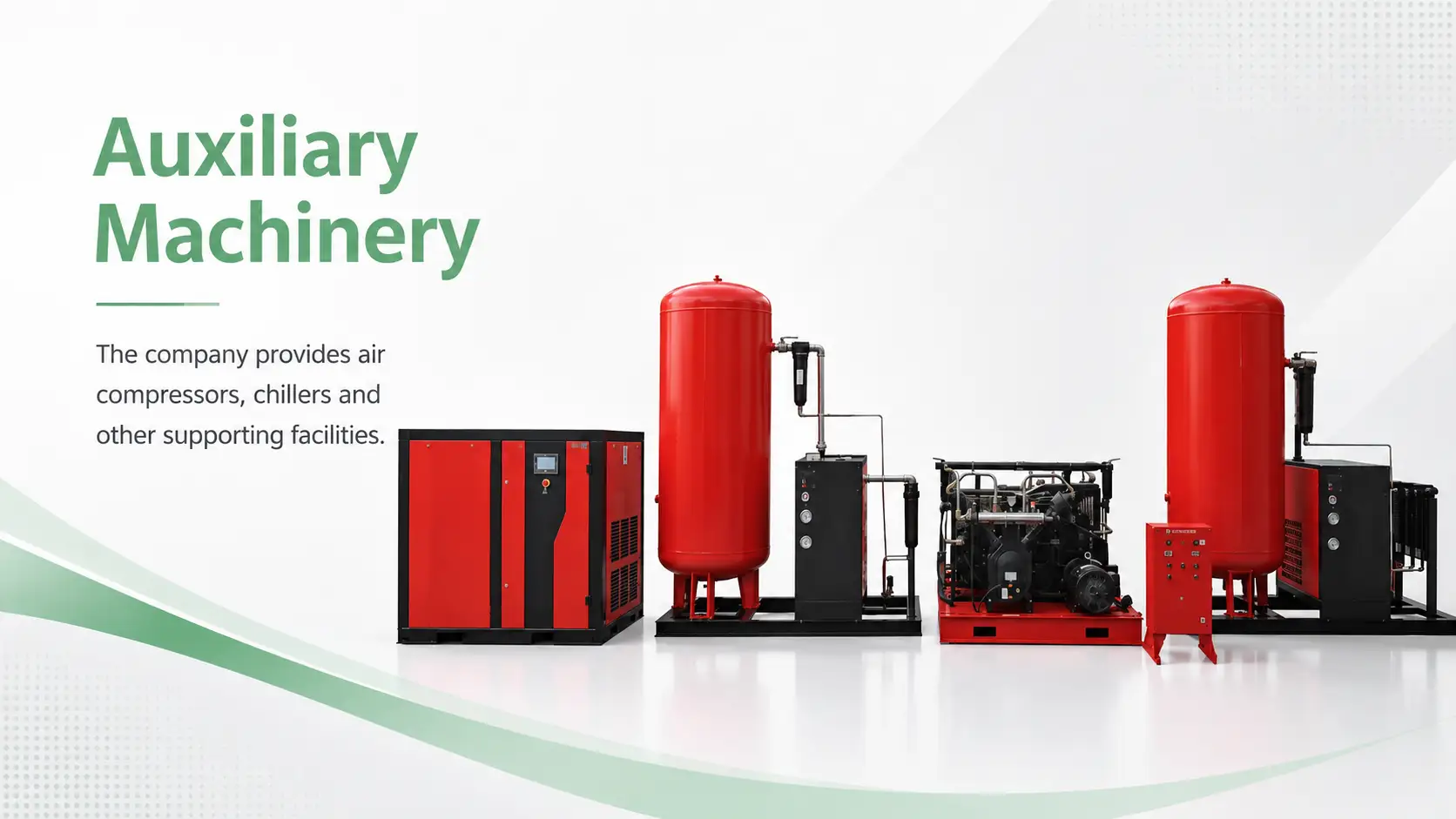
Blowing pressure: 26–35 kg/cm² · Min. flow: 1,000–1,400 L/min · Oil-free type recommended for cosmetic packaging
Cooling water: 8–10 °C · Min. flow: 30 L/min · Precise temperature control recommended for PETG clarity and wall consistency
Operating pressure: 7 kg/cm² · Flow: 600 L/min · For preform conveying, cooling air supply, and mold actuation
Production Quality and Certification
✅
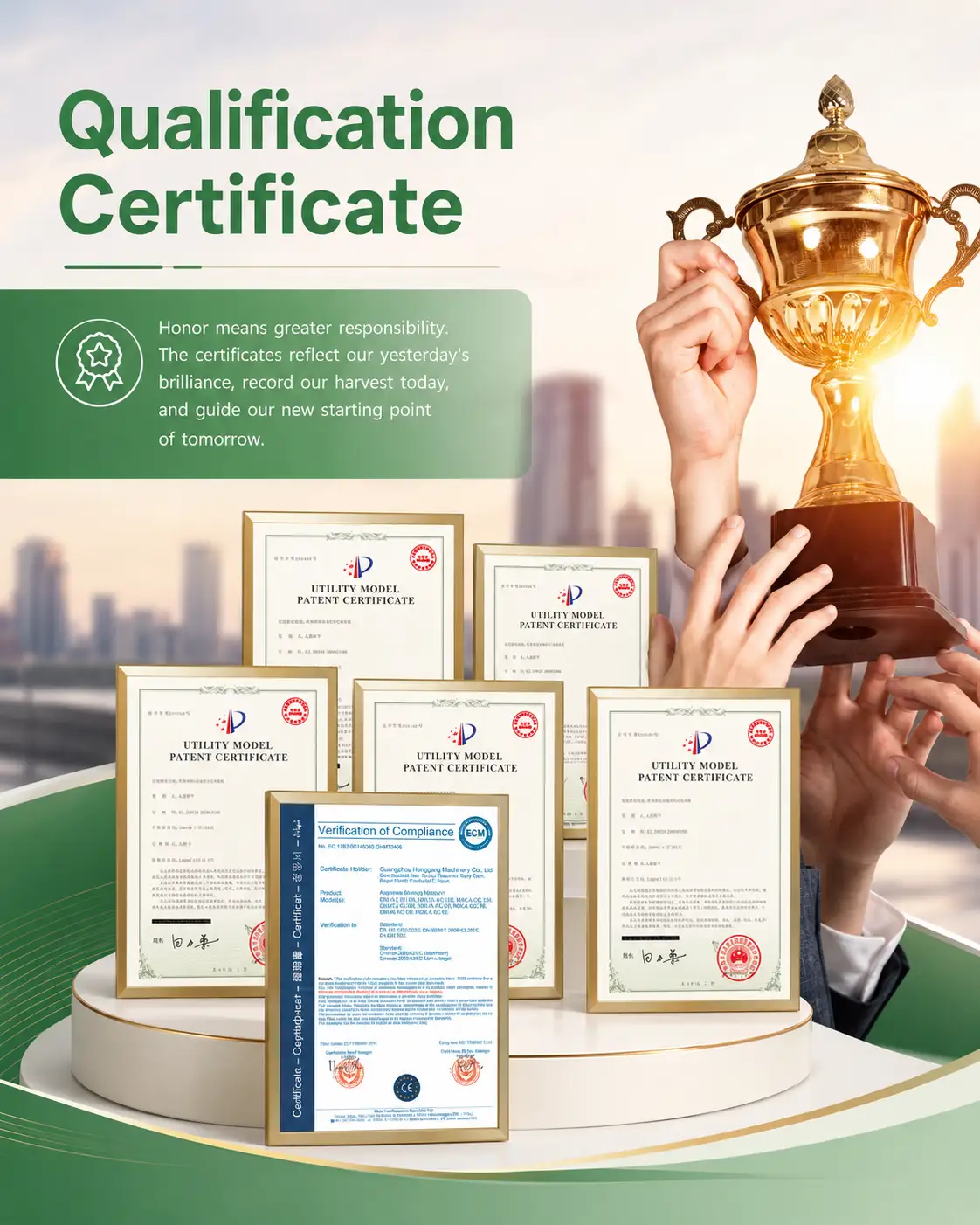
Every HGA series machine carries CE certification and is produced under ISO 9001:2015 quality management covering design, machining, assembly, and final testing.
🔧
Each machine undergoes a full acceptance run on buyer-specified preforms before shipment. First-production samples are inspected against dimension, clarity, and weight specs.
🏠
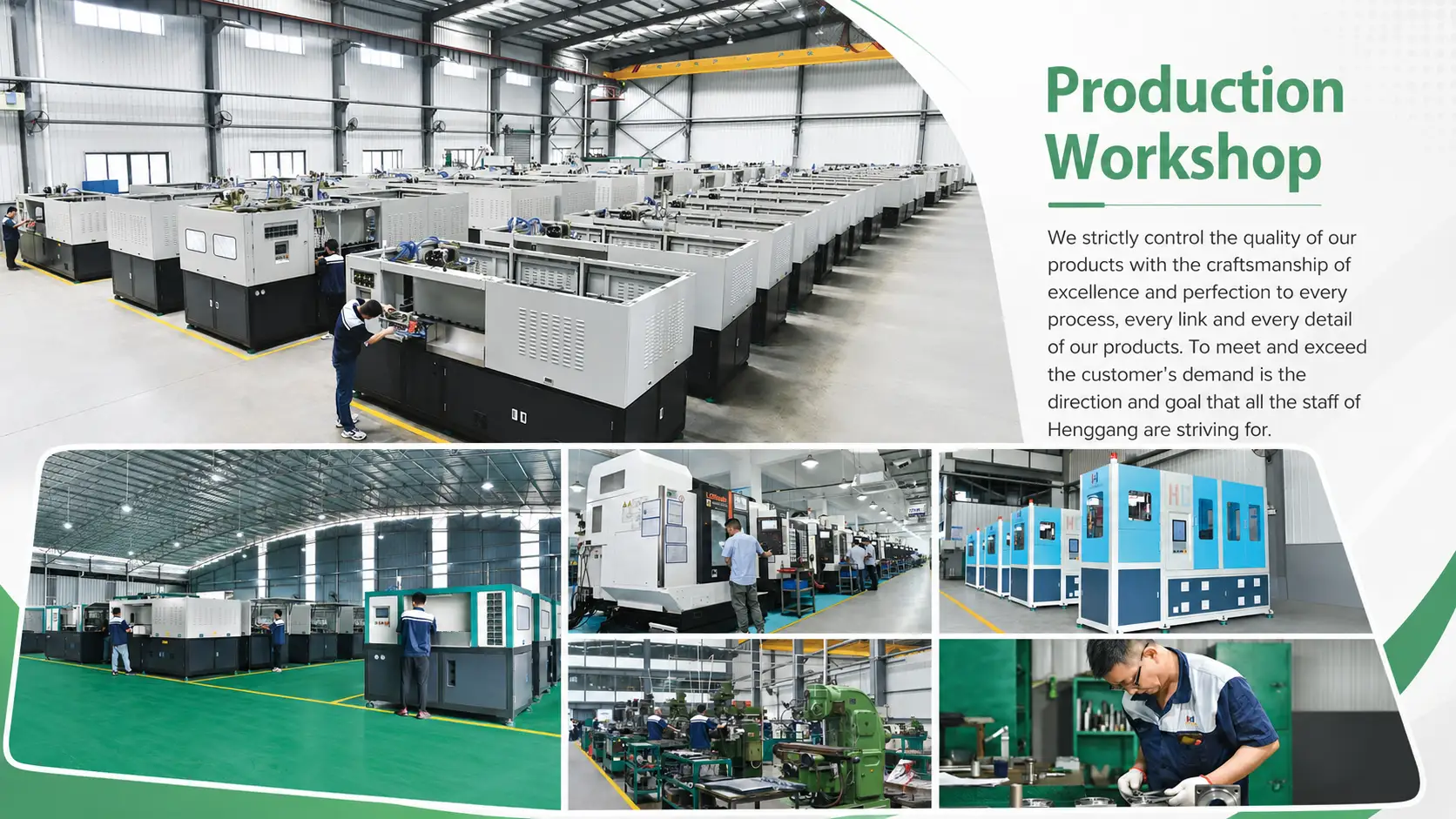
Established 2003, Ever-Power supplies blow molding machines to cosmetic, food, pharma, and daily chemical manufacturers across China and export markets.
👥
Factory-trained engineers handle installation, mold mounting, process parameter setup, and operator training at the customer facility before handover sign-off.
Customer Reviews — Ever-Power HGA Series Blow Molding Machines
Reviews collected from customers running Ever-Power HGA and HGY series machines in cosmetic, daily chemical, food, and pharmaceutical bottle production. Model references and installation periods are included where provided.
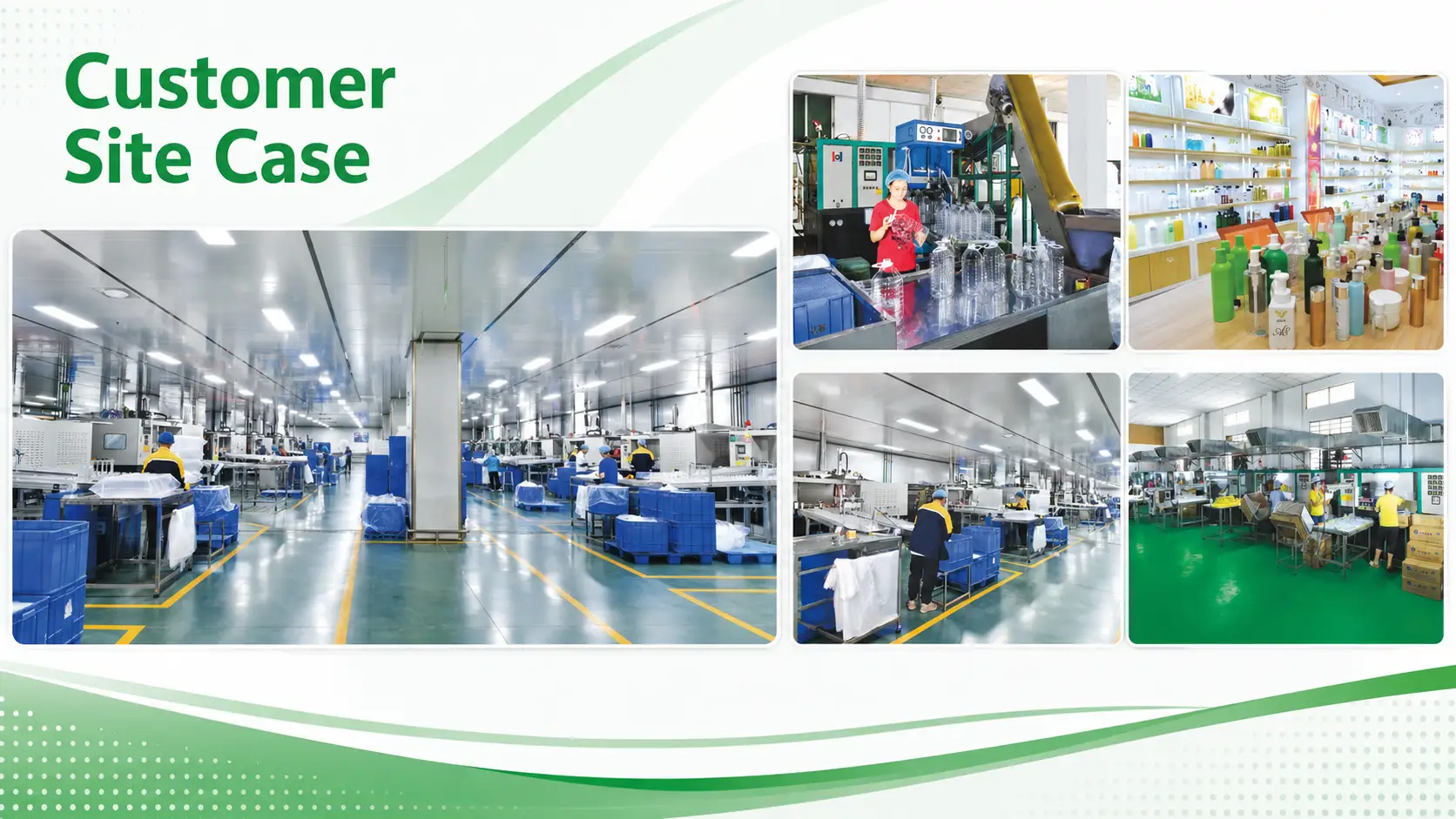
"We chose the ES series specifically for the enhanced servo configuration — our client requires dimensional tolerances on a 200 ml oval facial cleanser that our previous machine could not hold bottle-to-bottle. The HGA.ES machine holds the spec consistently across both cavities at production rate. After six months of two-shift operation, reject rate from dimensional non-conformance is under 0.3%."
Machine: HGA.ES-2C100
"We produce PETG lotion bottles and facial toner containers at 100 ml and 250 ml — mid-size formats that were too wide for our previous narrow-pitch machine and not wide enough to justify the 114.3 mm pitch unit. The HGA.ES-2C100 was exactly the model for our product range. The 80 mm body diameter and 68 mm neck give us the format flexibility we needed."
Machine: HGA.ES-2C100
"The compact footprint was a deciding factor for us — the machine fits alongside our existing filling line without expanding the bay. Output at 2,400 bph suits our production volume without requiring a second machine. We would have preferred a slightly longer preform holder for our PETG grade, but the zone-level heating control compensates adequately with parameter tuning."
Machine: HGA.ES series
"We produce PETG serum bottles and wide-mouth cream jars for export. Optical clarity and dimensional precision are non-negotiable. The Ever-Power machine meets both consistently. Support helped us dial in the preform temperature zone profile on commissioning day. Over eight months of two-shift operation without production-stopping issues."
Machine: HGA.ES series
FAQ — HGA.ES-2C100 Cosmetic Bottle Blow Molding Machine
Q1: What is the difference between HGA.ES and HGA.AS series?
Both series use the same stretch blow molding process for PET and PETG cosmetic and daily chemical bottles. The HGA.AS uses a standard servo drive configuration for stable, energy-efficient production. The HGA.ES incorporates an enhanced servo motor configuration across all drive axes — delivering higher cycle speed, faster servo response between cycles, and tighter shot-weight repeatability. The ES is recommended where bottle-to-bottle dimensional consistency is a buyer quality specification rather than an internal process target.
Q2: What bottle formats does the HGA.ES-2C100 produce that the adjacent models cannot?
The 100 mm pitch and 80 mm maximum body diameter serve mid-size cosmetic containers — oval facial cleansers, mid-size lotion pumps, wide-neck cosmetic dispensers — that the HGA.AS-4C76.2 (65 mm max body) cannot accommodate, and that are narrower than what the HGA.AS-2C114.3 (94 mm max body, 114.3 mm pitch) is optimised for. The 68 mm maximum neck diameter also serves a mid-range that neither adjacent model covers.
Q3: Can the HGA.ES-2C100 handle PETG for precision cosmetic bottles?
Yes. The zone-level digital infrared heating system provides the preform temperature precision PETG requires. The enhanced servo drive of the ES configuration also benefits PETG processing — faster servo response reduces the time between preform reaching blow temperature and the blow stage commencing, which matters for PETG where the thermal processing window is narrower than standard PET. Contact Ever-Power with your PETG grade for a preform temperature zone profile before ordering.
Q4: What compressed air specification is required?
Low pressure: 7 kg/cm² at 600 L/min for preform conveying and mold actuation. High pressure: 26–35 kg/cm² at 1,000–1,400 L/min for the blow cycle. An oil-free air compressor is recommended for cosmetic packaging. The 2-cavity 1,000–1,400 L/min high-pressure requirement is substantially lower than the 4-cavity HGA.AS-4C76.2 (4,000 L/min), reducing compressor capital cost for the same production bay.
Q5: What is the machine footprint and how does it compare to other HGA models?
2,900 mm (L) x 1,525 mm (W) x 1,930 mm (H), 2,000 kg — the most compact machine in the HGA series covered here. Smaller and lighter than both the HGA.AS-2C114.3 (2,660 x 1,660 x 2,150 mm, 2,600 kg) and the HGA.AS-4C76.2 (3,370 x 1,850 x 2,100 mm, 4,000 kg). Suitable for installations where floor space or load-bearing capacity is constrained.
Q6: What certifications does the machine carry?
CE marking and ISO 9001:2015 are standard on all HGA series machines. CE Declaration of Conformity available before order. Factory acceptance test report on buyer-specified preform and container format is supplied at delivery. Additional documentation available for pharmaceutical or food-grade cosmetic packaging on request.
Q7: Is on-site commissioning included?
Yes for domestic customers. A factory-trained engineer handles installation, mold mounting, process parameter setup including infrared zone profile calibration for the customer's resin grade, and operator training at the facility before handover sign-off.
Q8: What after-sales and spare parts support is available?
Remote technical support during business hours. Spare parts stocked with a minimum 5-year availability commitment. Engineers dispatched for on-site service for faults not resolvable remotely. Wear parts and consumables for all current HGA and HGA.ES series machines are held in inventory at Ever-Power's production facility.
Related Products and Further Resources
Request a Quote for HGA.ES-2C100
Send us your container specification, preform drawings, required output volume, and resin material. Our engineering team prepares a machine feasibility report and quotation within 2 business days.
Additional information
| Editor | Cxm |
|---|
Related products
-
HGA.FS-1CG150 Cosmetic & Daily Chemical Wide-Mouth Jar Blow Molding Machine
-
HGA.ES-4C100 Cosmetic & Daily Chemical Bottle Blow Molding Machine
-
HGA.ES-6C114 Cosmetic & Daily Chemical Bottle Blow Molding Machine
-
HGA.FS-1CG220 Cosmetic & Daily Chemical Wide-Mouth Jar Blow Molding Machine
-
HGA.ES-4C76 Cosmetic & Daily Chemical Bottle Blow Molding Machine
-
HGA.ES-4C100 Cosmetic & Daily Chemical Bottle Blow Molding Machine
-
HGA.ES-4C114.3 Cosmetic & Daily Chemical Bottle Blow Molding Machine
-
HGA.ES-4C130 Cosmetic & Daily Chemical Bottle Blow Molding Machine