HDPE Injection Blow Molding:
Complete Processing Guide
HDPE is the most widely processed material in Korean injection blow molding — it serves Korean pharmaceutical container production, Korean household chemical packaging and Korean food-grade wide-mouth jar production with the chemical resistance, regulatory compliance and processing reliability that no other IBM material matches at equivalent cost. This guide covers HDPE grade selection, barrel temperature setup, wall thickness specification and Korean application requirements for pharmaceutical and household chemical IBM production.
Barrel Temperature Setup
Korean Pharma and Household IBM
Korea Ever-Power Engineering Desk · Ansan-si · July 2026
HDPE IBM — Key Parameters at a Glance
170–220°C
HDPE IBM barrel temperature range — feed to injection nozzle
MI 0.2–2.0
Melt flow index range for pharmaceutical-grade HDPE IBM (190°C / 2.16 kg)
0.3–1.5 mm
HDPE IBM wall thickness — pharma thin-wall to heavy household chemical
KFDA · FDA
HDPE pharmaceutical contact compliance — low extractables, wide chemical resistance
1. Why HDPE Is IBM’s Core Material
High-density polyethylene (HDPE) is the most widely used material in Korean injection blow molding — not because it is the only option, but because its combination of chemical resistance, regulatory compliance, processing reliability and cost-to-performance ratio matches the requirements of Korean pharmaceutical and household chemical packaging better than any competing IBM material. Korean pharmaceutical factories producing 10 ml ophthalmic containers, Korean household chemical producers filling 500 ml shampoo bottles and Korean food-grade jar manufacturers filling 250 ml condiment containers all converge on HDPE as their primary IBM material for the same reasons, applied at different wall thickness and grade specifications.
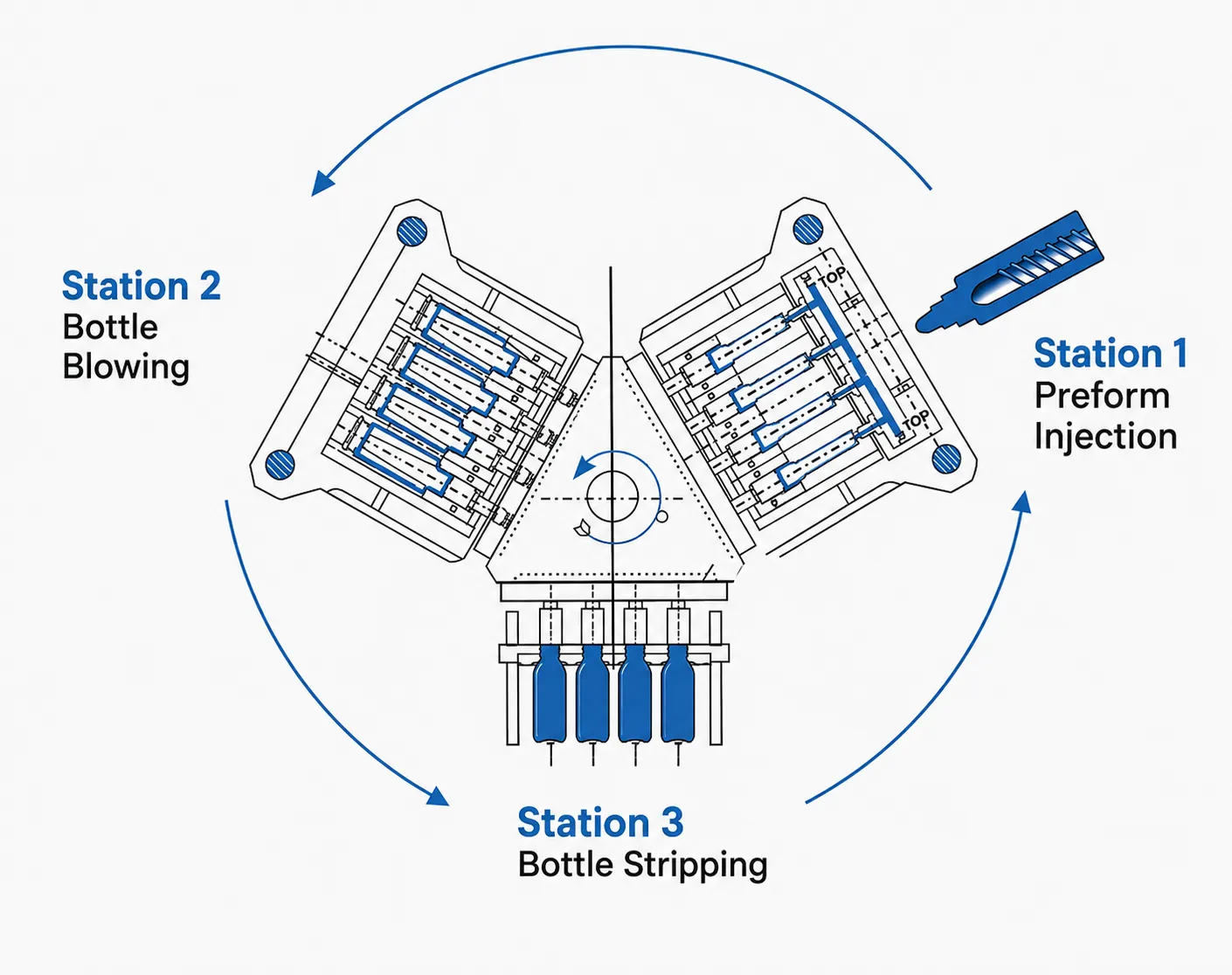
HDPE’s relevance to IBM specifically — rather than extrusion blow molding or injection moulding — comes from a combination of its processability and its application requirements. HDPE processes cleanly on IBM machines: it has a wide processing window (melt temperature 170–230°C), low melt viscosity at processing temperature relative to its solid-state stiffness, good flow through multi-cavity hot runner systems, and reliable release from core rods at the stripping station. HDPE containers produced by IBM have injection-moulded neck precision that HDPE containers produced by extrusion blow molding do not — and this precision is the specific reason that Korean pharmaceutical CRC containers, Korean pump-dispenser household chemical bottles and Korean threaded-cap food jars are made by IBM rather than EBM at the production volumes where IBM’s cavity count economics are favourable.
Understanding HDPE’s properties and processing requirements in the IBM context — grade selection, barrel temperature setup, wall thickness specification and quality indicators — is the foundational knowledge for Korean IBM production engineers and Korean packaging buyers who specify HDPE IBM containers. The IBM process guide covers the 3-station IBM process in detail; this guide focuses specifically on HDPE within that process.
2. HDPE Grade Selection for IBM
Melt Flow Index: The Primary Grade Selection Parameter
Melt flow index (MI) — measured at 190°C/2.16 kg per ASTM D1238 — is the single most important HDPE grade selection parameter for IBM applications. MI inversely correlates with molecular weight: lower MI means higher molecular weight chains, which means better chemical resistance, better tensile strength, better environmental stress crack resistance (ESCR), and more difficult injection processing. Higher MI means lower molecular weight chains, easier injection processing, but lower mechanical and chemical resistance properties.
| HDPE MI Range | IBM Processing | ESCR (F50) | Korean IBM Application |
|---|---|---|---|
| MI 0.1–0.3 | Difficult — high injection pressure | >200 h | Agricultural chemical containers, industrial heavy-wall |
| MI 0.3–0.8 | Excellent — pharmaceutical grade | 100–200 h | Korean pharmaceutical (eye drops, oral liquid, CRC medicine) |
| MI 0.8–1.5 | Good — household chemical grade | 50–100 h | Korean shampoo, conditioner, household cleaner |
| MI 1.5–3.0 | Easy — food-grade standard | 20–50 h | Korean food jars, general packaging, short shelf-life containers |
Density and Additive Considerations
HDPE density for IBM applications typically falls in the range 0.945–0.965 g/cm³. Higher density indicates higher crystallinity — more crystalline content produces better chemical resistance (the crystalline regions are impermeable to most solvents and active pharmaceutical ingredients) and higher stiffness (important for 10 ml pharmaceutical bottles that must resist compression during closure application without deforming). Lower density HDPE (0.940–0.950 g/cm³) is slightly more flexible and impact-resistant, preferred for Korean household chemical containers that are squeezed during use or dropped on Korean factory floors during filling operations.
Korean pharmaceutical-grade HDPE for IBM containers must meet specific additive requirements. Permitted additives for Korean KFDA-regulated pharmaceutical packaging include antioxidants (typically AO-1010 or AO-168 at ≤0.1%) and processing stabilisers — but exclude UV stabilisers (which can migrate into pharmaceutical products), slip agents (which reduce coefficient of friction and can interfere with Korean pharmaceutical label adhesion), and most nucleating agents (which affect crystallisation rate and can alter extractable profiles in Korean pharmaceutical compatibility testing). Korean IBM packaging producers should verify with their HDPE resin supplier that the resin formulation meets Korean KFDA positive list requirements for pharmaceutical contact materials before committing to a resin grade for pharmaceutical production — and should obtain the resin supplier’s Korean KFDA declaration or FDA Drug Master File reference as part of their Korean pharmaceutical container qualification documentation.
3. IBM Processing Parameters for HDPE
HDPE IBM processing parameters on Korea Ever-Power’s ZQ series require setup across five process areas: barrel temperature profile, injection fill parameters, blow parameters, cooling and stripping. Each area’s setpoints depend on the HDPE grade (MI and density), the cavity count, and the container wall thickness specification. The parameters below represent starting-point guidance for Korean IBM operators setting up HDPE production for the first time; final production parameters must be determined by trial and adjusted for each specific grade, mould and machine combination.
Barrel Temperature Profile (ZQ Series, HDPE MI 0.3–0.8)
| Barrel Zone | Temperature (°C) | Function |
|---|---|---|
| Zone 1 — Feed | 170–180 | Initiate melting; prevent premature melt and feed zone bridging |
| Zone 2 — Transition | 185–200 | Complete melting; build melt homogeneity |
| Zone 3 — Metering | 200–215 | Achieve target melt viscosity; ensure melt temperature uniformity |
| Zone 4+ — Gate approach (4+N only) | 205–215 | Fine-tune gate entry temperature; control melt viscosity at hot runner gate |
| Injection Nozzle | 210–220 | Maximum melt temperature; ensure full cavity fill at all cavities simultaneously |
Injection Fill and Blow Parameters
Injection fill: HDPE IBM at pharmaceutical grade (MI 0.3–0.8) requires injection pressure of 80–140 MPa at the injection unit, depending on cavity count and runner resistance. Higher cavity counts (20–30 cavities) and longer hot runner paths require the upper end of this range to achieve simultaneous fill across all cavities. Fill time should target 0.8–1.5 seconds for pharmaceutical thin-wall (0.3–0.5 mm wall) and 1.5–2.5 seconds for household chemical heavy-wall (0.6–1.0 mm wall). Hold pressure is typically 50–70% of peak injection pressure, held for 0.5–1.5 seconds to pack the gate and prevent sink marks at the thicker preform wall sections near the core rod tip.
Screw recovery: HDPE IBM screw back pressure should be maintained at 5–15 MPa during recovery — sufficient to ensure melt homogeneity and prevent air entrapment (which causes silver streaks in the finished bottle) but low enough to avoid excessive shear heating that degrades molecular weight at the gate zone. Screw speed: 80–120 RPM for pharmaceutical-grade HDPE; slower speeds (60–80 RPM) for high-MI (0.8+) grades where melt is already homogeneous without high shear.
Blow parameters: HDPE IBM blow air pressure is typically 0.5–0.9 MPa for pharmaceutical thin-wall containers (0.3–0.5 mm) and 0.7–1.2 MPa for household chemical heavy-wall (0.6–1.0 mm). Blow dwell time — the time the air pressure is maintained with the blow mould closed — should be 0.8–1.5 seconds for thin-wall pharmaceutical and 1.5–2.5 seconds for heavy-wall household chemical. Insufficient dwell time causes bottle base shrinkage after ejection (the HDPE base is still too hot and soft when ejected and deforms under its own weight). The ZQ series’ 4-second dry cycle provides adequate dwell time for standard pharmaceutical HDPE wall thickness without extending the production cycle.
4. Wall Thickness Specification for HDPE IBM Applications
Wall thickness is the single most impactful design parameter in HDPE IBM containers — it determines chemical barrier performance, mechanical strength, material cost per bottle, and blow cycle time. Wall thickness specification for HDPE IBM should be set at the minimum thickness that meets the container’s functional requirements, rather than defaulting to a heavy wall that adds material cost and extends cycle time without functional benefit.
Korean Pharmaceutical (10–100 ml)
Target body wall: 0.3–0.5 mm
Thin wall minimises material cost per unit; HDPE chemical resistance to pharmaceutical actives is adequate at 0.3 mm for most formulations; injection-moulded neck is 0.8–1.2 mm for closure integrity; base: 0.4–0.6 mm for stack compression. KFDA qualification testing must confirm chemical compatibility at the specified wall thickness.
Korean Household Chemical (250–1,000 ml)
Target body wall: 0.5–0.9 mm
Heavier wall for Korean household chemical containers addresses two requirements: drop resistance (Korean filling lines and retail distribution involve multiple handling events where 250–1,000 ml bottles are dropped) and squeeze resistance (Korean household chemical dispensers require the bottle to hold shape under pump dispensing force). The 0.5–0.9 mm range balances these requirements against material cost.
Korean Food-Grade Wide-Mouth Jar (100–500 ml)
Target body wall: 0.6–1.0 mm
Korean food-grade wide-mouth jars for honey, condiment and cooking oil require wall thickness that supports: thread OD retention under hot-fill conditions (HDPE softens above 60°C; thicker walls retain thread geometry better); top-load for Korean retail shelf stacking; and resistance to lateral crushing during Korean food-grade pallet handling at Korean supermarket distribution centres.
Wall thickness variation: In HDPE IBM, wall thickness variation within a single bottle (between the thinnest and thickest zones) and between bottles (cavity-to-cavity variation in a multi-cavity mould) are both specification concerns. Within-bottle variation: target ≤±15% of nominal wall thickness between the thinnest body wall zone and the thickest shoulder or base transition zone. Cavity-to-cavity variation: target ≤±5% of nominal mean bottle weight between the lightest and heaviest cavity in the mould, measured as the primary proxy for wall thickness uniformity. Cavity-to-cavity weight variation above ±8% typically indicates hot runner gate imbalance — a mould-side issue requiring gate adjustment at the hot runner manifold rather than a machine process adjustment.
5. Korean Pharmaceutical HDPE IBM Applications

Korean pharmaceutical HDPE IBM production is concentrated in three container formats that together account for the majority of Korean pharmaceutical primary packaging volume. Understanding the specific requirements for each format guides both grade selection and processing setup for Korean pharmaceutical IBM operators.
10 ml Ophthalmic (Eye Drop) Bottles
Korean 10 ml HDPE ophthalmic bottles are the highest-volume and most precision-demanding pharmaceutical IBM format. The Korean KFDA ophthalmic container specification requires: total extractables below 1 μg/ml per Korean Pharmacopoeia plastic container test; particulate matter below Korean KFDA particulate limits (this disqualifies EBM flash-trimmed containers without additional cleaning steps); thread OD tolerance ±0.05 mm for Korean ophthalmic dropper cap engagement; and wall thickness uniformity such that the body wall is sufficiently transparent to allow visual inspection of the liquid fill level — a unique requirement for ophthalmic containers that requires HDPE wall thickness at the body panel to be ≤0.4 mm (thinner walls allow more light transmission through HDPE for fill-level checking). HDPE grade for Korean ophthalmic IBM: MI 0.3–0.5, density 0.950–0.960 g/cm³, no UV stabilisers, KFDA-listed antioxidants only. Production: Korea Ever-Power ZQ80 at 20 cavities or ZQ110 at 24 cavities are the most common Korean pharmaceutical ophthalmic IBM platforms, producing 15,800–19,000 bottles per hour at 4-second cycle.
100 ml CRC Medicine Bottles
Korean CRC (child-resistant closure) HDPE medicine bottles at 100 ml are the second most important pharmaceutical IBM format. CRC containers require IBM — not EBM — because CRC cap engagement depends on ±0.05 mm neck OD tolerance that EBM cannot consistently achieve. The Korean CRC cap’s push-and-turn mechanism operates by compressing the skirt’s ratchet teeth against the bottle neck’s engagement bead as the cap is pushed down — this engagement requires the neck bead OD to be within ±0.06 mm of the nominal CRC cap design dimension across all production cavities and all production shifts. IBM’s injection-moulded neck provides this consistency; EBM’s blown neck does not. HDPE grade for Korean CRC IBM: MI 0.5–0.8, density 0.955–0.965 g/cm³, stiff enough for the bead to resist deformation under CRC push force without cracking. Korea Ever-Power’s ZQ80 at 12-cavity 100 ml CRC produces approximately 6,800 bottles per hour — sufficient for Korean major pharmaceutical brands producing 15–25 million CRC medicine bottles per year from a single machine.
6. Korean Household Chemical HDPE IBM Applications
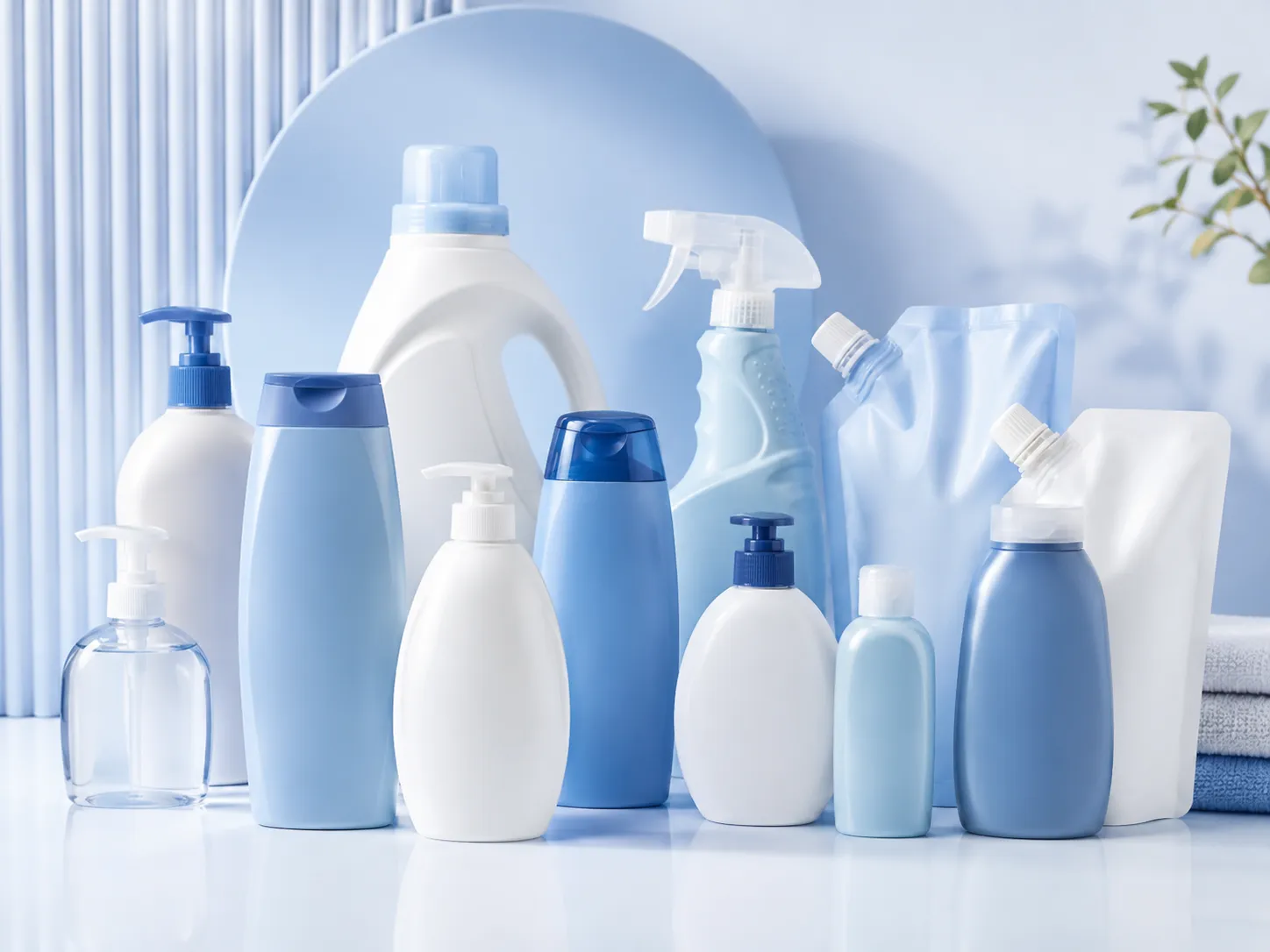
Korean household chemical HDPE IBM production uses heavier-grade HDPE than Korean pharmaceutical production — higher MI for easier injection at larger shot weights, lower density for better drop resistance at the larger container sizes. The specific requirements driving Korean household chemical HDPE IBM grade selection include environmental stress crack resistance (ESCR) — the most common failure mode in Korean household chemical HDPE containers. ESCR failure occurs when a surfactant-containing product (shampoo, conditioner, cleaning detergent, dishwashing liquid) contacts the HDPE container wall and acts as a stress cracking agent, reducing the polymer’s resistance to crack initiation and propagation at residual stress concentrations in the container wall. Korean household chemical HDPE must have F50 ESCR (time for 50% of specimens to crack in a surfactant stress test) of at least 50 hours at the selected wall thickness — typically achieved with MI 0.8–1.5 grades at 0.5–0.9 mm wall.
Korean pump-dispenser household chemical containers (shampoo, conditioner, liquid hand soap) require specific neck geometry at the pump-mounting zone — the pump’s down-tube must seal against the bottle neck’s inner bore at the pump support ledge, and the pump’s closure collar must snap or thread onto the bottle neck without deforming it. IBM’s injection-moulded neck provides the dimensional consistency for pump-collar engagement that Korean household chemical filling lines require for zero-leakage, zero-cross-thread at production line speeds of 80–120 bottles per minute. Korea Ever-Power’s ZQ series EP-ZQ80 at 6-cavity 500 ml produces approximately 5,400 bottles per hour of pump-compatible 500 ml HDPE shampoo containers — sufficient for Korean national brand shampoo OEM factories producing 10–12 million 500 ml units per year from a single machine.
7. HDPE vs PP vs ABS for IBM: Korean Application Comparison
Korean IBM production uses three principal materials in different proportions: HDPE (largest volume, pharmaceutical and household chemical), PP (secondary, hot-fill and CRC applications), and ABS (cosmetic jars, premium container applications). Understanding when each material is the correct choice — and when HDPE should be displaced by PP or ABS — prevents both under-specification (using HDPE where PP is required) and over-specification (using ABS where HDPE is functionally adequate).
| Property / Requirement | HDPE | PP | ABS |
|---|---|---|---|
| Korean pharma small format (10–30 ml) | Best | Good | Not typical |
| Hot-fill above 70°C | Deforms | Best | Not suitable |
| Surface finish / gloss for K-Beauty | Low gloss, waxy | Moderate | High gloss — mirror finish |
| Wide-mouth cosmetic jar | Functional | Good | Premium — K-Beauty standard |
| Chemical resistance (surfactants) | Excellent (ESCR ≥50h) | Excellent | Good — avoid strong solvents |
| Korean FDA food contact compliance | Yes — low extractables | Yes | Not standard |
| Resin cost per kg (Korean market) | Lowest | +15–25% | +60–100% |
The Korean IBM material selection guideline: use HDPE as the default for all Korean pharmaceutical small-format containers and all Korean household chemical containers where hot-fill is not required and cosmetic appearance is not the primary specification. Switch to PP when the fill temperature exceeds 65°C (Korean hot-fill food, Korean sterilised pharmaceutical) or when autoclavable pharmaceutical containers are specified. Switch to ABS for Korean cosmetic jars where high surface gloss, solid tactile weight and K-Beauty brand premium appearance are the primary specifications — ABS’s higher resin cost is justified in Korean cosmetic packaging where per-unit container cost is 5–10× higher than pharmaceutical or household chemical packaging and the container’s appearance directly affects the Korean brand’s perceived value.
8. ZQ Series Machine Selection for HDPE IBM Production
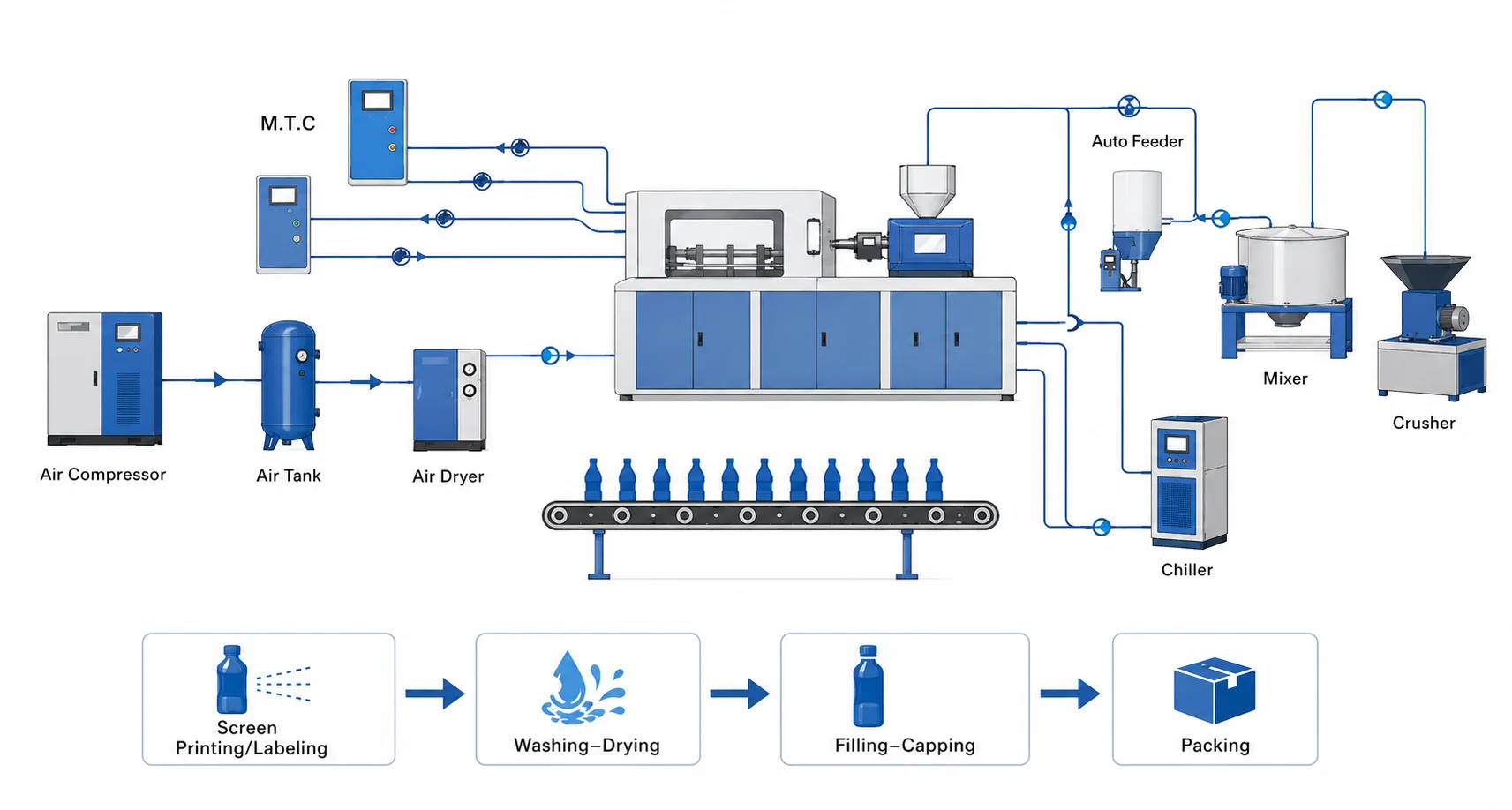
The correct ZQ model for Korean HDPE IBM production depends on annual unit volume at the primary container format. Korea Ever-Power’s injection blow molding machine range offers five HDPE-capable models — the decision framework below applies specifically to HDPE pharmaceutical and household chemical production volumes.
| Annual Volume (10ml HDPE) | Recommended Model | Cavities | Korean HDPE Context |
|---|---|---|---|
| Below 15M units/year | EP-ZQ40 | 9 @ 10ml | Korean pharmaceutical startup, Korean CMO trials, Korean specialty HDPE formats |
| 15M–30M units/year | EP-ZQ60 | 14 @ 10ml | Korean mid-scale pharmaceutical, Korean regional household chemical, Korean food HDPE |
| 30M–50M units/year | EP-ZQ80 | 20 @ 10ml | Korean large pharmaceutical, Korean national brand household chemical, Korean K-Beauty HDPE |
| 50M–65M units/year | EP-ZQ110 | 24 @ 10ml | Korean large-scale pharmaceutical contract packaging, Korean major consumer goods HDPE |
| Above 65M units/year | EP-ZQ135 | 30 @ 10ml | Korean mega-scale pharmaceutical, Korean national brand HDPE at highest annual volume |
For Korean HDPE 500 ml household chemical production, the selection rule shifts: apply the same volume thresholds but map against 500 ml cavity counts (ZQ40: 3 cavities → ~2,700/hr; ZQ60: 3 cavities → ~2,700/hr; ZQ80: 6 cavities → ~5,400/hr; ZQ110: 6–8 cavities → ~5,400–7,200/hr; ZQ135: 8 cavities → ~7,200/hr). The ZQ80 at 6-cavity 500 ml is the most common Korean household chemical IBM platform — it produces approximately 10–12 million 500 ml HDPE shampoo or cleaning product bottles per Korean two-shift year, covering most Korean national brand household chemical OEM annual volume requirements from a single machine. Korea Ever-Power’s application engineers can provide a specific volume-to-model matching analysis for Korean factories evaluating HDPE IBM investment at any annual production scale.
Frequently Asked Questions
HDPE IBM Machine Enquiry
Specifying HDPE IBM Containers for Korean Pharmaceutical or Household Chemical Production?
Korea Ever-Power provides HDPE grade selection guidance, wall thickness specification, cavity count planning and ZQ series machine selection for Korean HDPE IBM pharmaceutical and household chemical packaging operations at all production scales.
Related Resources
EP-ZQ60 Injection Blow Molding Machine
600 KN · 14 cavities at 10 ml HDPE · Korean mid-scale pharmaceutical · 3+N barrel zones for HDPE MI 0.3–1.5 · Zero flash · ~11,100 bottles/hour at 10 ml.
EP-ZQ110 Injection Blow Molding Machine
1,100 KN · 24 cavities at 10 ml HDPE · 4+N barrel zones · 22+22 KW dual hydraulic · Korean large-scale pharmaceutical HDPE — ~19,000 bottles/hour at 10 ml.
IBM vs EBM: 12 Key Differences
Why HDPE pharmaceutical and household chemical containers are produced by IBM rather than EBM — neck precision, zero flash, output rate and Korean factory economics compared across 12 factors.