PS IBM · CRYSTAL-CLEAR POLYSTYRENE · HIGH GLOSS · KOREA EVER-POWER ZQ SERIES
PS IBM:
Crystal-Clear Polystyrene Container Production Guide
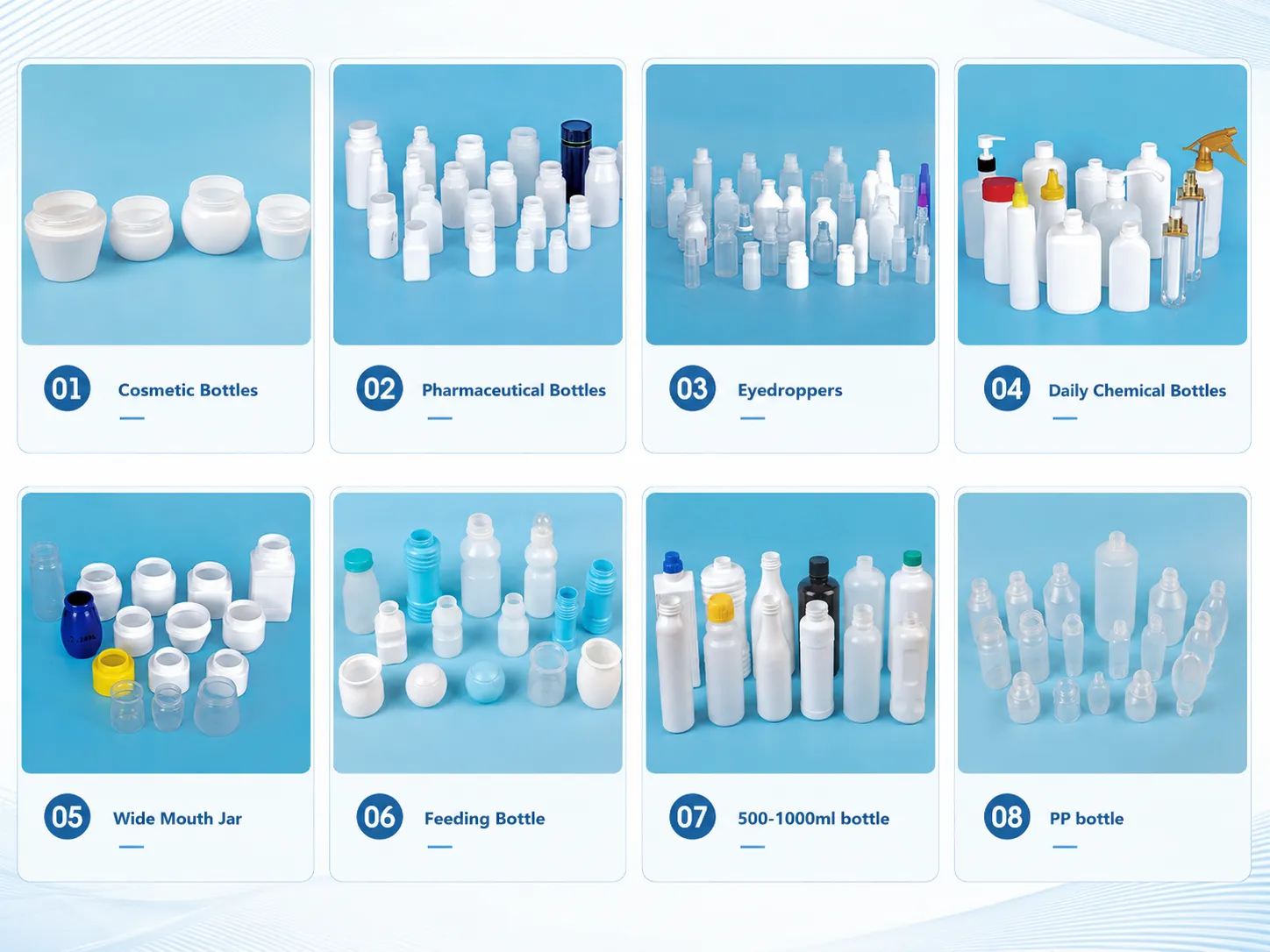
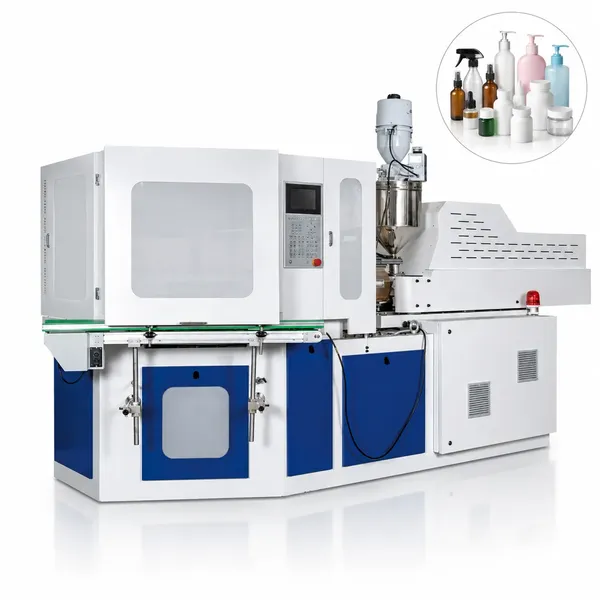
PS (polystyrene) injection blow molding produces the highest-clarity rigid containers available in IBM — crystal-clear PS IBM containers achieve water-clear transparency with a glass-like visual appearance that HDPE, PP and even ABS cannot match. Korea Ever-Power ZQ40 produces PS IBM containers at 10-250 ml for cosmetic, pharmaceutical, food supplement and laboratory applications where glass-alternative clarity combined with IBM’s precision neck geometry and zero-flash base deliver visual premium at competitive production cost.
KOREA EVER-POWER · ANSAN-SI, GYEONGGI-DO · JULY 2026
PROCESS REFERENCE · PS IBM KEY PARAMETERS
CLARITY
<1% haze
PS IBM wall haze at 0.6 mm — water-clear optical quality surpassing PP RCP (5-12%), LDPE (15-25%) and HDPE (20-35%)
BARREL TEMP
180-220°C
PS IBM barrel processing range — lower than ABS (210-240°C) and PP (210-245°C), enabling energy-efficient clear container IBM production
GLOSS
90-98 GU
PS IBM surface gloss at Ra 0.025 um mould polish — highest gloss of all IBM materials, exceeding ABS HG at 85-95 GU for optical display applications
PRIMARY MACHINE
ZQ40
Korea Ever-Power EP-ZQ40 — PS IBM benchmark for 10-100 ml crystal-clear containers at 8-12 cavities for cosmetic and pharmaceutical formats
SECTION 01
PS IBM Overview: Why Polystyrene for Crystal-Clear IBM
PS (polystyrene) is the only commercially available IBM material that achieves true water-clear transparency at standard IBM wall thicknesses — PS wall haze is typically below 1% at 0.6 mm versus PP RCP at 5-12% and ABS at 5-15% (tinted by pigment or surface diffusion). This optical property arises from PS’s amorphous polymer structure: PS has no crystalline domains to scatter light, producing a fully optically isotropic solid that transmits visible light with minimal scattering at both thin and thick IBM wall sections. The Korea Ever-Power IBM machine range handles PS IBM on the same ZQ40 and ZQ60 platforms used for HDPE, PP and ABS, requiring only barrel temperature and mould temperature parameter changes — PS IBM does not require dedicated machinery or specialized equipment beyond the standard Korea Ever-Power ZQ series.
WHY PS IS AMORPHOUS AND WHY THAT MATTERS FOR IBM CLARITY
Standard polystyrene (GPPS — general purpose polystyrene) is an atactic polymer: the phenyl side groups are randomly arranged along the polymer backbone, preventing chain packing into crystalline domains. Without crystalline domains, the solidified PS wall has no internal refractive index variation — light passes through without scattering at crystal-amorphous boundaries. Compare: HDPE (crystallinity 70-80%), PP (crystallinity 40-65%) and LDPE (45-60%) all scatter light at crystalline domain boundaries, producing their characteristic haze. PS and ABS are both amorphous — but ABS’s butadiene rubber phase (opaque rubbery particles) creates internal light scattering that prevents ABS from achieving PS-level transparency. PS IBM is thus the only common IBM thermoplastic that achieves water-clear transparency across all wall thicknesses in the 0.4-1.5 mm IBM production range.
SECTION 02
PS IBM vs PP vs ABS: Clarity and Gloss Comparison
| PROPERTY | PS IBM ★ | ABS IBM | PP RCP IBM | HDPE IBM |
|---|---|---|---|---|
| Wall haze (0.6mm) | <1% (water-clear) | Opaque (pigmented) | 5-12% translucent | 20-35% opaque |
| Surface gloss (60°) | 90-98 GU | 85-95 GU (HG) | Semi-gloss | Low gloss |
| Polymer structure | Amorphous (no crystals) | Amorphous + rubber | Semi-crystalline | Semi-crystalline |
| Food contact (direct) | Yes (GPPS, specific standards) | No (acrylonitrile) | Yes | Yes |
| Impact resistance | Brittle (GPPS) | High impact | Good | Good ESCR |
| Primary IBM application | Clear cosmetic/pharma/food | Luxury cosmetic opaque | Translucent cosmetic/pharma | Pharma/household rigid |
SECTION 03
PS IBM Processing Parameters
PS IBM PARAMETERS — 100ml CRYSTAL-CLEAR CONTAINER @ ZQ40
Pre-Drying
None required
GPPS is not hygroscopic — no pre-drying required before IBM barrel loading. HIPS (high-impact PS) also does not require pre-drying. No desiccant dryer needed for PS IBM production startup.
Barrel Temperature
180-220°C
PS processes at lower barrel temperature than ABS (210-240°C) and PP (210-245°C). Do not exceed 230°C: PS begins degradation producing styrene monomer vapour and yellowing above 230°C barrel temperature.
Mould Temperature
20-35°C
PS IBM mould temperature: cooler than ABS (55-70°C) but warmer than HDPE (18-26°C). At 20-35°C, PS solidifies rapidly while maintaining adequate mould surface contact for high-gloss transfer without the long cooling time of ABS.
Cycle Time
3.8-4.5 s (100ml)
PS IBM cycle time comparable to PP RCP at the same format. PS lower melt viscosity fills preform cavities rapidly at lower injection pressure than HDPE and PP, partially offsetting the cooling time at 20-35°C mould temperature.
PS IBM thermal stability caution: GPPS begins degrading above 230°C barrel temperature, producing styrene monomer vapour (workplace exposure limit: 20 ppm TWA) and progressive container yellowing. Korea Ever-Power maintains PS IBM nozzle temperature below 225°C maximum and ensures production area ventilation is adequate for Korean industrial hygiene standards. PS IBM barrel should be purged with HDPE or PP on shutdown to prevent residual PS degradation in the barrel between production runs.
SECTION 04
PS IBM Applications: Cosmetic, Pharmaceutical and Food
Cosmetic PS IBM Applications
Crystal-clear serum and essence vials
PS IBM 10-30 ml crystal-clear serum vials for Korean and US cosmetic brands where the formulation’s colour (gold, pink, amber) must be fully visible through the container wall — PS <1% haze at 0.6 mm wall vs PP RCP at 5-12% for the same format.
Display cosmetic bottles
PS IBM 50-150 ml display cosmetic bottles for retail shelf display requiring glass-like visual presence without glass fragility — PS IBM’s 90-98 GU gloss and water-clear body produces the glass bottle visual at IBM production economics and shatter-free handling.
Pharmaceutical and Food PS IBM
Food supplement clear jar
PS IBM 100-250 ml clear jars for US and Korean food supplement brands (vitamins, capsules, tablets) where product visibility through the container is a retail sales driver — PS IBM produces the wide-mouth clear jar that retail displays show product colour and texture as a quality signal.
Pharmaceutical counter display
PS IBM 30-100 ml clear pharmaceutical counter display containers for Korean and US OTC solid dose products (tablets, lozenges) where clear container and visible product contribute to Korean pharmacy counter presentation and US chain pharmacy planogram requirements.
SECTION 05
PS IBM Limitations and Material Compatibility
PS IBM Brittleness
GPPS is inherently brittle — notched Izod impact strength 10-20 J/m versus HDPE at 600-900 J/m and PP at 30-80 J/m. PS IBM containers at standard 0.6 mm wall will crack under Korean standard 1.2m drop test conditions when filled with water. PS IBM is therefore most suitable for: cosmetic display containers that remain on shelf rather than endure repeated consumer drop impacts; food supplement jars where the snap-lid closure limits bottle body exposure to drop; and retail counter display pharmaceutical containers at 30-100 ml where wall thickness can be increased to 0.8-1.0 mm to improve drop resistance without prohibitive material cost increase.
PS IBM Chemical Compatibility
PS is compatible with aqueous solutions (pH 4-10), alcohols at concentration below 20%, and most cosmetic and pharmaceutical aqueous formulations. PS is NOT compatible with: ketones (acetone, MEK), esters (ethyl acetate), aromatic solvents (toluene, xylene), and concentrated alcohols above 20% by volume. For Korean and US cosmetic formulations with alcohol content 5-15% (toner, essence), verify PS compatibility by 40°C/90-day immersion test before production commitment. PS is not suitable for solvent-based cosmetic formulations, nail polish remover, or industrial cleaning agents containing any of the PS-incompatible solvents listed above.
SECTION 06
ZQ40 PS IBM Production Economics
| FORMAT | 10-30 ml ★ | 50-100 ml ★ | 150-250 ml | NOTES |
|---|---|---|---|---|
| EP-ZQ40 ★ | 12 cav / ~28,000/hr | 8-10 cav / ~10,000/hr | 4-6 cav / ~5,000/hr | PS IBM benchmark machine. 10-100ml crystal-clear range. |
| EP-ZQ60 | 14-16 cav / ~38,000/hr | 12 cav / ~16,000/hr | 8-10 cav / ~8,000/hr | For PS IBM programmes requiring >20M units/year or 150-250ml format volumes |
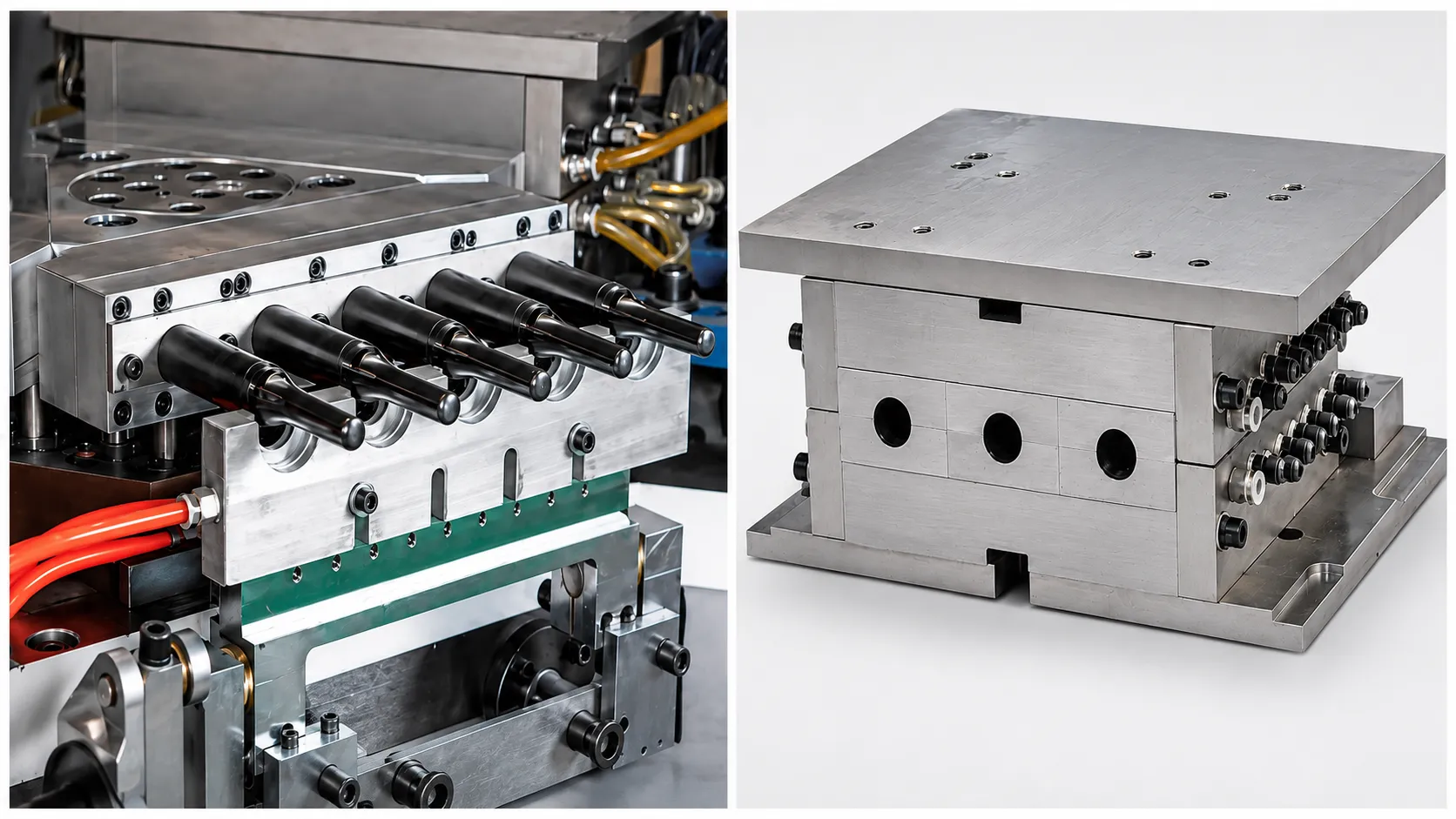
Korea Ever-Power offers PS IBM mould sets through the IBM mould catalogue, with PS-specific S136 stainless injection cavity inserts and Ra 0.025 um mirror cavity polish standard for crystal-clear PS container surface quality.
ENGINEERING FAQ
PS IBM — Engineering Questions
Q 01
Why does PS IBM achieve lower haze than PP RCP IBM despite both being used for clear container applications?
PS and PP RCP are both used for clear IBM containers but achieve fundamentally different clarity levels because of their polymer chain structures. PP RCP is a random copolymer of propylene with 2-5% ethylene comonomer — the ethylene disrupts PP crystalline domain formation, reducing PP RCP crystallinity to 30-45% versus homopolymer PP at 60-65%. This reduced crystallinity is why PP RCP (5-12% wall haze) is significantly clearer than PP homopolymer (15-30% haze). However, PP RCP still has 30-45% crystalline content, and the remaining crystalline domains scatter light at the crystal-amorphous boundaries, producing the 5-12% haze characteristic of PP RCP IBM. PS GPPS is fully amorphous (0% crystallinity) — there are no crystalline domains to scatter light anywhere in the PS IBM container wall. The result is PS IBM wall haze below 1% versus PP RCP at 5-12%. For Korean cosmetic and pharmaceutical brands requiring water-clear IBM containers (formulation colour fully visible through the container wall), PS IBM is the only option in the Korea Ever-Power ZQ series material range. PP RCP IBM’s 5-12% haze produces a slight diffusion that softens the formulation colour signal, which is acceptable for toner and serum brands that do not require pure product visibility but insufficient for crystal-display cosmetic or food supplement brands that make product visibility central to their retail presentation strategy.
Q 02
What is HIPS IBM and when should it be selected over GPPS IBM?
HIPS (High Impact Polystyrene) is a rubber-toughened version of GPPS where polybutadiene rubber particles are dispersed through the PS matrix during polymerisation. The rubber phase increases HIPS impact resistance to 80-150 J/m (notched Izod) versus GPPS at 10-20 J/m — approximately 5-8x improvement in drop resistance. The trade-off: the rubber particles scatter light, making HIPS inherently opaque. HIPS IBM containers cannot achieve the water-clear transparency of GPPS IBM. HIPS IBM is selected when: the container requires drop impact resistance comparable to HDPE or PP but with PS’s higher gloss (HIPS achieves 60-75 GU versus GPPS 90-98 GU — lower than GPPS but significantly higher than HDPE at 20-35 GU); the container application does not require transparency (opaque white or coloured cosmetic and pharmaceutical containers); or the Korean customer specifies PS material for regulatory or brand standard reasons but requires a container that passes Korean standard drop tests. For Korean cosmetic applications requiring both high gloss AND transparency, GPPS IBM remains the only PS option — HIPS achieves higher gloss than HDPE and PP but cannot match GPPS clarity. Korea Ever-Power processes both GPPS and HIPS IBM on ZQ40 with no machine hardware change — only process parameter adjustment (slightly higher barrel temperature for HIPS at 195-225°C versus GPPS at 180-220°C due to HIPS higher rubber phase viscosity contribution).
Q 03
Is PS IBM food contact approved for Korean and US market food supplement containers?
GPPS is approved for direct food contact under both Korean MFDS (Korean Ministry of Food and Drug Safety Plastic Container and Packaging Material Standards) and US FDA 21 CFR 177.1640 (polystyrene and rubber-modified polystyrene), subject to residual styrene monomer migration limits. The Korean MFDS residual styrene migration limit for food contact PS containers is 15 mg/kg food simulant (Korean standard GB-equivalent level). Food-contact grade GPPS produced for IBM container applications is formulated and processed to achieve residual styrene migration well below this limit (typically 1-5 mg/kg in aqueous simulant at 25°C/10 days) from virgin GPPS resin with no recycled content. For Korean food supplement clear jar IBM applications (tablets, capsules, vitamins — not direct aqueous food contact), PS IBM is a standard and widely accepted container material at 100-250 ml format. Korea Ever-Power’s PS IBM container pre-delivery documentation package includes GPPS resin food contact declaration, processing temperature record confirming barrel temperature below 230°C throughout production, and visual confirmation of crystal-clear appearance (absence of degradation yellowing) for each production batch.
Q 04
How does Korea Ever-Power handle changeover from HDPE or PP IBM to PS IBM on the same ZQ40?
ZQ40 changeover from HDPE or PP IBM to PS IBM follows a specific protocol because PS is highly sensitive to contamination — even trace HDPE or PP residue in the barrel produces opacity streaks in the PS container wall that immediately fail the crystal-clear specification. Korea Ever-Power PS IBM changeover protocol: Step 1 — Reduce barrel temperature from HDPE/PP processing range to PS range (180-220°C); allow 15-20 minutes for barrel temperature stabilisation. Step 2 — Purge barrel with PS resin: run 10-15 purge shots of PS at PS processing temperature until purge output is visually clear (no streaking, no colour contamination). PS purge shots are collected and inspected under 500 lux directional light for contamination visibility. Step 3 — Startup inspection: run 5-10 PS production shots, inspecting each container under 500 lux directional light at 45° angle against a dark background for: any opacity (residual HDPE/PP contamination), flow marks (barrel temperature too low or too high), yellowish tint (thermal degradation). Declare PS IBM production quality only after 5 consecutive defect-free containers per cavity. Step 4 — Adjust mould temperature: reduce mould temperature controller from HDPE (18-26°C) to PS (20-35°C) or from PP cosmetic (55-70°C) to PS (20-35°C). The PP-to-PS mould temperature reduction requires 20-30 minutes equilibration time on ZQ40. Korea Ever-Power recommends scheduling PS IBM immediately after HDPE IBM production (adjacent temperature ranges) rather than after PP cosmetic IBM (55-70°C mould) to minimise total changeover time.
Q 05
Can PS IBM containers be screen-printed or labelled for Korean retail cosmetic brand packaging?
PS IBM containers accept all standard Korean cosmetic container decoration methods used for PP and HDPE IBM containers, with some PS-specific surface energy considerations. Pressure-sensitive labels (PSL): PS IBM container surface energy (38-42 mN/m) is higher than HDPE (30-32 mN/m) and comparable to PP (35-40 mN/m) — standard Korean cosmetic PSL adhesives formulated for polyolefin surfaces provide adequate adhesion to PS IBM containers without corona pre-treatment for most label types. Screen print (UV-curable inks): PS IBM accepts UV-curable cosmetic screen inks with corona pre-treatment (raising PS surface energy to 44-50 mN/m). Corona treatment on PS IBM containers must be carefully controlled — excessive corona exposure (above 50 W/m²·min) can cause surface micro-crazing on PS that reduces clarity and gloss at the printed zone. Korea Ever-Power recommends PS IBM corona treatment at 40-45 W/m²·min for 3-5 seconds for Korean cosmetic screen print ink adhesion specification. Heat-shrink sleeve: PS IBM containers accept standard Korean cosmetic heat-shrink sleeve application at 90-120°C steam tunnel conditions without container deformation — PS Tg (glass transition temperature) of 95-100°C provides adequate heat resistance margin above standard sleeve tunnel temperatures. The advantage of PS IBM for heat-shrink sleeve applications: the crystal-clear PS body beneath the sleeve is visible through semi-transparent or window-cut shrink sleeves, enhancing the Korean retail display effect compared with HDPE or PP containers under the same sleeve design.
Q 06
What Korea Ever-Power ZQ40 mould specification is required for PS IBM crystal-clear container production?
PS IBM mould specification for crystal-clear container production requires stricter surface quality standards than HDPE or PP IBM mould sets because PS’s perfect surface replication fidelity transfers every mould cavity defect to the container exterior with optical clarity. Korea Ever-Power PS IBM mould standard: injection cavity and blow mould cavity polished to Ra 0.025 um (mirror finish, 5-step diamond compound sequence from 600 grit through 1 um diamond) in S136 stainless steel for corrosion resistance and sustained polish retention. The S136 stainless specification is required for PS IBM injection cavities — P20 steel at Rc 28-34 degrades polish faster than S136 at Rc 50-54 under PS production conditions, requiring more frequent re-polish intervals (P20: 2-3M cycles; S136: 5-8M cycles) to maintain the Ra 0.025 um surface needed for PS IBM <1% haze specification. Blow mould cavity for PS IBM: P20 or H13 steel at Ra 0.025 um polish — blow mould cavity polish has a significant but secondary effect on PS IBM body clarity because the blow station inflation pressure (4-8 bar) contacts the PS container exterior surface for only 0.5-1.0 seconds before the container is stripped. Korea Ever-Power recommends H13 blow mould cavity (Rc 44-48) for PS IBM crystal-clear programmes above 8M units/year to extend re-polish intervals and maintain sustained PS container gloss specification across the programme lifecycle.
PS IBM ENQUIRY · KOREA EVER-POWER
Planning Crystal-Clear PS IBM Container Production?
Korea Ever-Power provides GPPS and HIPS IBM container production on ZQ40 and ZQ60 with S136 Ra 0.025 um mirror-polish mould sets, pre-delivery crystal-clarity qualification and Korean food contact documentation for cosmetic, pharmaceutical and food supplement PS IBM programmes.
Editor: Cxm