PHARMACEUTICAL IBM BOTTLES · PP HDPE PCTG · GMP USP FDA KFDA · KOREA EVER-POWER ZQ
Injection Blow Molded Bottles
for Pharmaceutical Packaging
GMP requirements, material compliance and machine selection for pharmaceutical IBM bottle production — covering USP Class VI resin qualification, IQ/OQ/PQ validation, neck OD Cpk ≥1.33, regulatory documentation for Korean MFDS, EU Ph.Eur. and FDA 21 CFR markets, and Korea Ever-Power EP-ZQ series machine selection by annual production volume at 10–1000 ml format.
GMP IQ/OQ/PQ · USP Class VI · Cpk ≥1.33
ZQ80 · ZQ110 · ZQ135 · 12–18 Cavities @100ml
KOREA EVER-POWER · ANSAN-SI, GYEONGGI-DO · AUGUST 2026 · LAST UPDATED: AUGUST 2026
PHARMACEUTICAL IBM BOTTLE · KEY SPECIFICATION REFERENCE · AUGUST 2026
NECK OD TOLERANCE
±0.05 mm
IBM PP pharmaceutical neck OD repeatability across all cavities, Cpk ≥1.33 at n≥30 cavities × 20 batches. IBM advantage vs EBM: IBM neck is injection-formed with dimensional precision equivalent to injection moulding; EBM neck is pinch-formed with ±0.15–0.25 mm OD variation insufficient for pharmaceutical cap application torque consistency.
RESIN COMPLIANCE
USP Class VI
PP and HDPE IBM pharmaceutical bottle: USP <661> Class VI plastic container standard (acute systemic toxicity test, intracutaneous test, implantation test). EU Ph.Eur. 3.1.3 (polypropylene for containers). FDA 21 CFR 177.1520 (PP food contact, applicable to solid oral pharmaceutical packaging). Korea Ever-Power provides KOLAS-accredited Korean lab test reports for all pharmaceutical IBM resin grades.
PEAK CAVITY COUNT
18 @ 100 ml
EP-ZQ135 confirmed 18 cavities at 100 ml pharmaceutical PP/HDPE (35 g preform × 18 = 630 g within 650 g shot weight limit). Annual output: 193 million 100 ml pharmaceutical bottles per EP-ZQ135 unit at 3 shifts, 330 days. Highest single-machine pharmaceutical IBM output in the EP-ZQ series.
VALIDATION TIMELINE
15–26 days
IQ (3–5 days) + OQ (5–7 days) + PQ (7–14 days) = 15–26 days total qualification timeline for Korea Ever-Power EP-ZQ IBM machine at Korean pharmaceutical GMP facility. Machine + mould shipped pre-commissioned from Ansan-si to reduce on-site IQ duration. IQ/OQ documentation template provided.
SECTION 01
Why IBM Outperforms EBM for Pharmaceutical Primary Packaging: The Neck Precision Difference
Pharmaceutical primary packaging for solid oral and liquid oral products requires container dimensional precision that the bottle’s closure system — child-resistant cap, tamper-evident closure, pump dispenser, dropper assembly — is engineered to match. The container’s neck outer diameter (OD) is the interface dimension. Cap application torque, tamper-evident band activation force, dropper tip interference fit, and child-resistant closure actuation force are all calibrated to a specific neck OD within a tolerance of ±0.05–0.10 mm. Containers that fall outside this tolerance cause cap application failure on the pharmaceutical filling and capping line — a production quality event requiring line stoppage, bottle rejection and batch investigation.

IBM Neck Precision: Injection-Formed vs Pinch-Formed
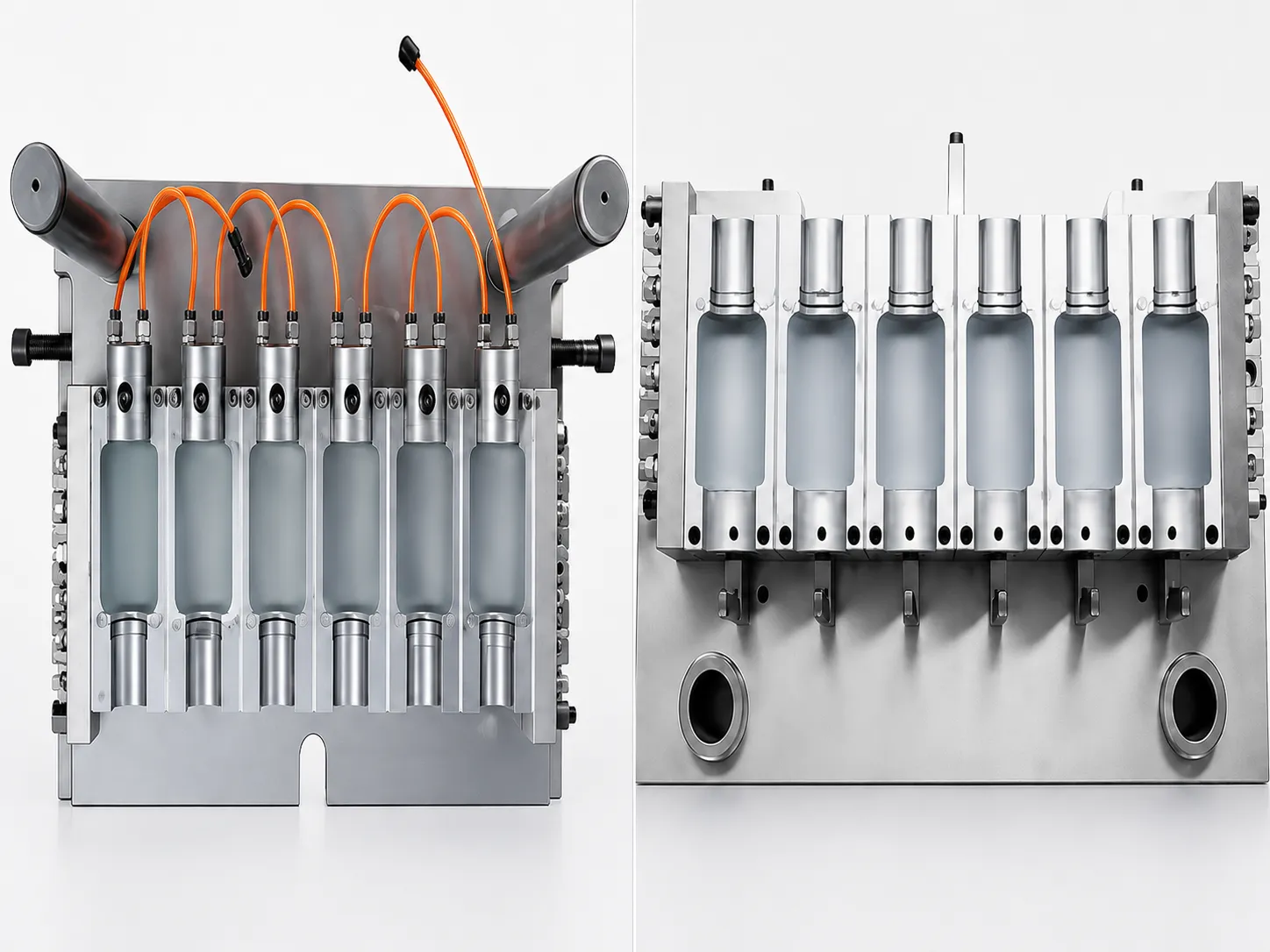
IBM neck is formed at Station 1 by injection into a precision-machined injection cavity and core rod at controlled temperature (200–220°C barrel, 15–25°C mould) and injection pressure (80–140 MPa). The neck OD, thread form, and internal bore are injection-moulded to the same dimensional precision as a standard injection-moulded component: OD repeatability ±0.02–0.05 mm across all cavities and all production batches. EBM (extrusion blow moulding) neck is pinch-formed between two mould halves from an extruded parison. Neck OD repeatability is ±0.15–0.25 mm — 3–5× more variation than IBM. At this variation level, pharmaceutical child-resistant caps engineered to ±0.05 mm OD tolerance fail to achieve consistent application torque, tamper-band activation and child-resistant actuation across all EBM bottles in a production batch.
No Body Parting Line: IBM vs EBM for Pharmaceutical Labelling
EBM pharmaceutical bottles have a body parting line — a raised ridge where the two blow mould halves meet during bottle forming. This parting line disrupts the smooth 360° label surface required for pharmaceutical wrap-around pressure-sensitive label (PSL) adhesion. Pharmaceutical PSL applied over an EBM parting line ridge does not achieve full adhesive contact at the ridge zone, creating a micro-void that (a) allows label edge lifting in high-humidity pharmaceutical storage and (b) fails tamper-evidence: a lifted label edge at the parting line is visually indistinguishable from intentional label removal, creating a pharmaceutical tamper-evidence compliance problem. IBM bottles have no body parting line — the body is formed by radial blow expansion from the IBM core rod in Station 2 against a closed blow mould cavity, producing a seamless body surface 360° for full-contact pharmaceutical PSL adhesion and clear tamper-evidence.
SECTION 02
Regulatory Framework: Market-by-Market Compliance Requirements for Pharmaceutical IBM Bottles
PHARMACEUTICAL IBM BOTTLE · REGULATORY COMPLIANCE BY MARKET
Korea MFDS (KGMP)
Korean Ministry of Food and Drug Safety GMP (KGMP), aligned with PIC/S GMP. IBM pharmaceutical bottle: food container plastic standard (overall migration ≤30 mg/L) + KP plastic container standard test (potassium permanganate consumption, non-volatile residue, heavy metals) from KOLAS-accredited laboratory. Korea Ever-Power provides NIFDS-accepted test reports. Machine IQ/OQ/PQ documentation accepted by Korean MFDS inspector for primary packaging validation.
EU — Ph.Eur. / EMA
EU Ph.Eur. 3.1.3 (PP containers) and 3.1.4 (PE containers). EMA guideline on plastic immediate packaging materials (EMEA/CVMP/261/99). Overall migration ≤10 mg/dm² (EU 10/2011). CE-marked IBM machine mandatory. Korea Ever-Power provides EU 10/2011 Declaration of Conformity for PP and HDPE IBM pharmaceutical bottles. GMP Annex 15 validation documentation supplied on request.
USA — FDA 21 CFR
FDA 21 CFR 211.94 (drug product containers and closures). Container suitability testing per USP <661> (plastic containers) and USP <1664> (extraction/leachable). PP: FDA 21 CFR 177.1520. HDPE: FDA 21 CFR 177.1520. PCTG: FDA 21 CFR 177.2490. cGMP container system documentation per 21 CFR Part 211. Korea Ever-Power provides FDA 21 CFR compliance letters for each resin grade used.
Japan — PMDA / JP
JP (Japanese Pharmacopoeia) container standards for plastic packaging. PMDA (Pharmaceuticals and Medical Devices Agency) GMP inspection includes container primary packaging system. PP IBM: JP plastic containers for pharmaceutical use tests (heavy metals, non-volatile residue, KMnO4 test equivalent). Korea-Japan FTA preferential tariff applies to Korea Ever-Power IBM pharmaceutical bottles for Japanese market pharmaceutical brand.
SECTION 03
Material Compliance Matrix: PP, HDPE and PCTG for Pharmaceutical IBM Bottles
| PARAMETER | PP (Homopolymer / RCP) | HDPE | PCTG (Eastman TX1001) | LDPE |
|---|---|---|---|---|
| Primary regulation | FDA 21 CFR 177.1520 Ph.Eur. 3.1.3 USP <661> Class VI |
FDA 21 CFR 177.1520 Ph.Eur. 3.1.4 USP <661> Class VI |
FDA 21 CFR 177.2490 EU 10/2011 authorised USP <661> test required |
FDA 21 CFR 177.1520 Ph.Eur. 3.1.4 USP <661> |
| IBM processing temp. | 200–240°C | 190–230°C | 240–258°C | 175–210°C |
| Optical clarity (haze) | Semi-translucent (RCP) to opaque (HPP). Haze 30–80% at 0.8mm wall. | Opaque. Not used for clarity applications. | Crystal-clear. Haze <2% at 0.5mm wall with S136 SPI A1 tooling (ASTM D1003). | Translucent–opaque. LDPE squeeze bottle for ophthalmic. |
| Chemical resistance | Excellent (acids, bases, alcohols, polar solvents). Limited for chlorinated solvents. | Excellent — broader than PP. Barrier to moisture and many organics. | Good (aqueous). Limited for ketones, esters, chlorinated solvents. Not for aggressive organic formulations. | Good (aqueous, mild acids). Squeeze-flexible for ophthalmic drop delivery. |
| Moisture barrier (WVTR) | 0.3–0.8 g·mm/m²/day at 38°C/90% RH — good for solid oral at 0.8mm wall | 0.05–0.15 g·mm/m²/day — best moisture barrier; preferred for moisture-sensitive solid oral tablets | 1.5–3.0 g·mm/m²/day — higher moisture transmission; requires desiccant for moisture-sensitive products | 0.8–1.5 g·mm/m²/day |
| Primary pharmaceutical use | Oral solid (tablet, capsule, lozenge), syrup oral liquid, veterinary | Oral solid (moisture-sensitive), topical cream/lotion, veterinary large-format | Ophthalmic dropper, liquid oral where content visibility matters, luxury dermal serum | Ophthalmic drop bottle (LDPE squeeze), wound wash, ear drops |
| Korea Ever-Power resin grade | LG Chem HP250J (HPP) / LG Chem FB3800 (RCP) — Korean MFDS food-grade registered | LG Chem SE800 or Hanwha TotalEnergies 5502 — Korean food-grade HDPE | Eastman TX1001 — FDA 21 CFR 177.2490, EU 10/2011 authorised | LG Chem MB9500 or equivalent food-grade LDPE |
SECTION 04
Dosage Form and Bottle Format Matching: IBM Bottle Design by Pharmaceutical Product Type
Oral Solid — Tablet, Capsule, Lozenge
Oral Liquid — Syrup, Suspension, Solution
Ophthalmic — Eye Drops, Wash, Gel
Topical — Cream, Lotion, Gel Pump
SECTION 05
Machine Selection by Annual Production Volume: EP-ZQ Pharmaceutical IBM Matrix
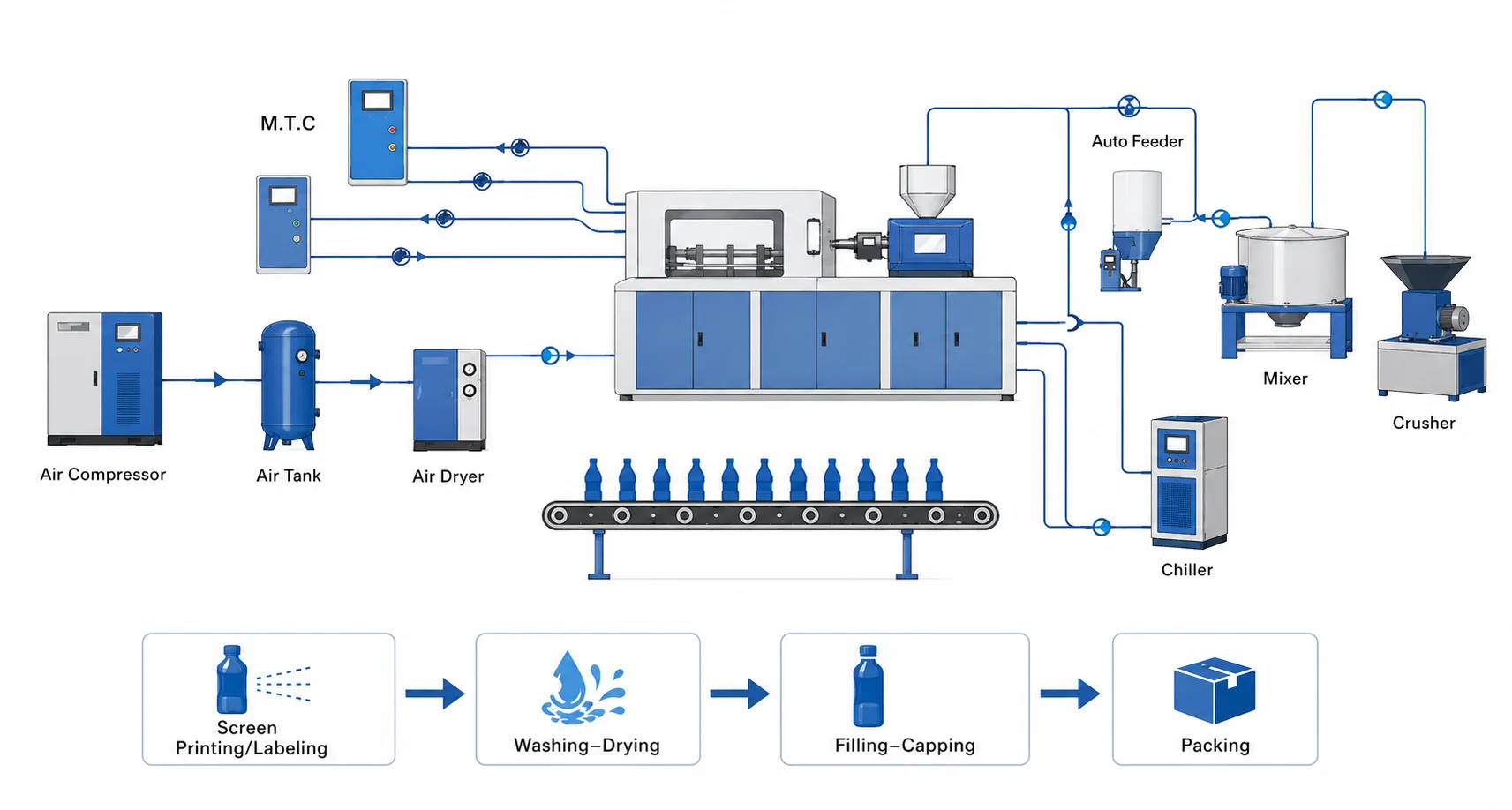
Machine selection for pharmaceutical IBM programmes is driven by three inputs: annual production volume target (bottles per year), primary bottle format (volume in ml and neck OD), and batch size relative to total annual volume. The matrix below maps annual volume to EP-ZQ model at the standard 100 ml pharmaceutical PP/HDPE oral solid format — the highest-volume single format in pharmaceutical IBM and the reference format for all capacity calculations.
EP-ZQ PHARMACEUTICAL IBM MACHINE SELECTION MATRIX · 100ml PP/HDPE ORAL SOLID · 35g PREFORM
| ANNUAL VOLUME | ZQ MODEL | CAVITIES @100ml | BOTTLES/HR | MACHINES REQUIRED | TOTAL SHOT WEIGHT |
|---|---|---|---|---|---|
| <50M bottles/year | ZQ80 | 12 | ~7,800 | 1 × ZQ80 | 12 × 35g = 420g < 466g limit ✓ |
| 50M–100M bottles/year | ZQ110 | 14 | ~9,100 | 1 × ZQ110 | 14 × 35g = 490g < 540g limit ✓ |
| 100M–200M bottles/year | ZQ135 | 18 | ~11,700 | 1 × ZQ135 | 18 × 35g = 630g < 650g limit ✓ |
| >200M bottles/year | 2 × ZQ135 | 36 total | ~23,400 | 2 × ZQ135 in parallel | 630g per machine < 650g ✓ |
Annual volume calculated at: 5.5 s total cycle at 100ml format, 3 shifts, 330 production days/year, 92% mechanical efficiency. Bottles/hr = cavities × 3,600 / 5.5 × 0.92. Source: Korea Ever-Power ZQ-series product specification data, August 2026.
SECTION 06
IQ/OQ/PQ Validation: Key Checkpoints for Pharmaceutical IBM Machine Qualification
IQ — INSTALLATION QUALIFICATION
3–5 Days · 23 Checklist Items
OQ — OPERATIONAL QUALIFICATION
5–7 Days · 18 Test Protocols
PQ — PERFORMANCE QUALIFICATION
7–14 Days · 6 Performance Criteria
ENGINEERING FAQ
Pharmaceutical IBM Bottle Engineering Questions
Why does IBM achieve ±0.05 mm neck OD precision when EBM can only achieve ±0.15–0.25 mm?
IBM neck OD precision derives from the injection moulding process used at Station 1. The neck is formed by injecting molten resin into a precision-machined closed cavity (injection cavity + core rod) under controlled temperature and pressure, producing a part whose OD is determined by the cavity steel dimensions — machined to ±0.01–0.02 mm. Process variation contributes an additional ±0.01–0.03 mm from thermal expansion and resin shrinkage, giving a total neck OD repeatability of ±0.02–0.05 mm across cavities and batches. EBM neck is pinch-formed between two mould halves from a softened parison. Parison diameter, wall thickness, and pinch force all vary with extruder output variation, resin MFR lot-to-lot variation, and mould alignment — contributing ±0.10–0.25 mm OD variation. EBM cannot close this gap by process optimisation; it is a fundamental consequence of the parison-pinch forming mechanism versus injection-cavity forming. This is the primary technical reason pharmaceutical packaging engineers specify IBM over EBM for all pharmaceutical container formats where closure application torque consistency is a GMP quality parameter.
What Korean MFDS documentation does Korea Ever-Power provide for pharmaceutical IBM bottle commercial supply?
Korea Ever-Power provides the following pharmaceutical IBM bottle documentation package for Korean MFDS (Ministry of Food and Drug Safety) registered pharmaceutical brand: (1) PP or HDPE resin CoA from LG Chem or Hanwha TotalEnergies confirming food-grade specification (grade, lot, MFR, density, additive list); (2) Korean food container plastic standard test report from NIFDS-accredited or KOLAS-accredited Korean testing laboratory (overall migration ≤30 mg/L in 4% acetic acid and n-heptane; KMnO4 consumption; non-volatile residue; heavy metals: Pb <1 ppm, Cd <0.5 ppm, Hg <0.1 ppm); (3) Production batch record with material lot traceability (resin lot, masterbatch lot if any, production date, ZQ machine number, mould number, QC weight check); (4) ISO 9001:2015 quality management certificate; (5) CE machine certificate. Documents retained at Ansan-si for 5 years and supplied in Korean for KFDA/MFDS submission on request. Full documentation package delivered at commercial programme commencement.
How does PP IBM bottle WVTR (water vapour transmission rate) compare with HDPE for moisture-sensitive tablets?
PP IBM bottle moisture barrier at 0.8 mm wall: WVTR 0.3–0.8 g·mm/m²/day at 38°C/90% RH (ASTM E96 Method B). HDPE IBM bottle at 0.8 mm wall: WVTR 0.05–0.15 g·mm/m²/day — approximately 5–10× better moisture barrier than PP. For context: USP <671> tight container specification requires <0.5 mg moisture gain/day per container for solid oral tablets. A 100 ml PP IBM bottle at 0.8 mm wall and 38°C/90% RH absorbs approximately 0.15–0.25 mg water/day through the container wall — passing USP tight container specification. A 100 ml HDPE IBM bottle at 0.8 mm wall absorbs approximately 0.02–0.05 mg water/day — significantly below specification. For most solid oral pharmaceutical tablets with moisture uptake threshold above 0.5 mg/day: PP IBM passes USP tight container. For highly moisture-sensitive products (silica gel-free requirement, sub-0.2 mg/day specification): HDPE IBM is recommended. Korea Ever-Power provides moisture permeation test data (ASTM E96) for both PP and HDPE IBM bottles at specific wall thickness and format on request.
Can EP-ZQ IBM machines be installed in Korean pharmaceutical GMP cleanrooms for direct bottle production in the clean zone?
Yes, with facility-specific assessment. EP-ZQ IBM machines operating in a pharmaceutical clean zone must satisfy additional GMP requirements beyond standard IBM machine installation: (a) machine surface material and finish: all external surfaces in contact with the clean zone air must be smooth, non-porous and cleanable; Korea Ever-Power can supply stainless steel and painted mild steel IBM machine external panel options for clean zone installation; (b) hydraulic fluid containment: the ZQ series European closed hydraulic system with booster clamping has low hydraulic fluid exposure risk versus open-circuit American IBM machines; Korea Ever-Power provides hydraulic fluid containment tray as standard for clean zone installations; (c) particle generation: compressed air blow-off venting from the blow station must be ducted outside the clean zone or fitted with HEPA filtration; Korea Ever-Power provides this as a clean zone modification; (d) machine height: EP-ZQ80 at 2.0 m and ZQ110 at 2.2 m qualify for typical Korean pharmaceutical Grade D clean zone ceiling heights of 2.7–3.5 m with adequate overhead service clearance. ZQ135 at 2.4 m requires minimum 3.0 m ceiling for the 0.6 m minimum service overhead. Contact Korea Ever-Power for a facility-specific clean zone installation assessment. See also the EP-ZQ series for full machine dimensions.
What neck OD and child-resistant closure standards apply to Korean pharmaceutical IBM tablet bottles?
Korean pharmaceutical oral solid tablet containers require child-resistant (CR) closures under Korean pharmaceutical packaging regulations aligned with USP <671> (containers for dispensing solid oral dosage forms) and Korean CR closure testing standard. The most common Korean pharmaceutical IBM tablet bottle neck standards: 28/410 continuous thread (28 mm OD, 410-series thread, 2-start) for 60–250 ml tablet containers — accommodates push-and-turn or squeeze-and-turn CR closure; 33/400 continuous thread (33 mm OD, 400-series thread) for 250–500 ml large tablet containers. Korea Ever-Power IBM neck OD target: 28.00 mm ±0.05 mm for 28/410 neck, 33.00 mm ±0.05 mm for 33/400 neck — within the cap supplier’s recommended IBM neck OD engagement specification. Cap application torque specification: 15–25 N·cm application torque for 28/410 PP CR cap at IBM PP 28mm neck — confirmed at Korea Ever-Power T1 trial with Korean CR closure supplier’s recommended application torque gauge. Korea Ever-Power can supply T1 trial IBM bottle samples (20–50 bottles per cavity) for Korean pharmaceutical brand’s cap supplier’s cap-on-bottle engagement verification before commercial tooling sign-off.
What is the IQ/OQ/PQ documentation format and what is the total pharmaceutical IBM programme timeline from mould approval to commercial supply?
Korea Ever-Power provides IQ/OQ/PQ documentation in the following format: machine IQ template (Word/PDF) covering 23 installation check items with acceptance criteria and space for test results and sign-off; OQ template covering 18 operational test protocols with acceptance criteria, test instrument calibration references, and pass/fail fields; PQ protocol template covering 6 performance criteria with sampling plan, measurement methods, acceptance criteria and statistical analysis fields (Cpk calculation from n≥30 cavities × 20 batches). Total pharmaceutical IBM programme timeline from approved 3D bottle CAD: mould manufacture 45–65 days (H13 SPI B1) or 55–80 days (S136 SPI A1 for PCTG ophthalmic); T1 trial and pharmaceutical brand approval 10–14 days; IQ/OQ/PQ validation at buyer’s facility 15–26 days; total from CAD approval to validated commercial supply: 70–120 days depending on mould steel specification, number of validation cycles and buyer’s internal approval schedule. Korea Ever-Power Ansan-si delivers machine and mould pre-commissioned (FAT-passed at Ansan-si) to reduce on-site IQ/OQ time.
For which pharmaceutical bottle formats does IBM provide no advantage over EBM, and when should EBM be chosen instead?
IBM provides no meaningful advantage over EBM for the following pharmaceutical bottle formats: (1) Large-format IV solution or irrigation containers (500 ml–5,000 ml, PP or PE, where filling-line cap OD tolerance is ±0.30–0.50 mm because large-format screw caps have wider engagement bands — EBM neck precision is adequate); (2) Collapsible ophthalmic ampoule units (PE, <5 ml single-dose squeeze format where pinch-neck geometry is intentionally non-critical — EBM is purpose-designed); (3) HDPE pharmaceutical jerricans (1–20 L veterinary or bulk pharmaceutical liquid, where neck OD tolerance is ±0.5 mm and EBM’s tooling cost advantage at large-format is decisive); (4) Aerosol pharmaceutical cans (aluminium, not polymer IBM at all). EBM should be selected when: container volume exceeds 1,000 ml consistently (IBM tooling and cycle cost per litre becomes uncompetitive above 1,000 ml); container geometry requires a parting-line feature for structural integrity (ribbed handle, complex grip geometry); maximum throughput per machine hour is the only KPI and neck precision is not a specification requirement. IBM should be selected for all pharmaceutical applications where closure application consistency, neck OD Cpk ≥1.33, parting-line-free label surface, or glass-clarity PCTG is a product requirement.
Where can I find detailed EP-ZQ machine specifications and individual model comparisons versus competing IBM machines?
The complete Korea Ever-Power EP-ZQ injection blow molding machine series provides full technical specifications for each model (ZQ40, ZQ60, ZQ80, ZQ110, ZQ135) including clamping force, screw diameter, maximum injection weight, platen dimensions, machine footprint, power, and confirmed cavity counts by bottle volume format. The IBM machine replacement guide contains 19 individual comparison pages matching each EP-ZQ model against Jomar IBM, SUMA iB, Uniloy UIB and Bloma IBM equivalents, with honest assessment of where each competing machine holds advantages. Both resources are maintained and updated at Korea Ever-Power Ansan-si engineering team, Gyeonggi-do, August 2026.
PHARMACEUTICAL IBM BOTTLE ENQUIRY · KOREA EVER-POWER
Planning a Pharmaceutical IBM Bottle Programme?
Korea Ever-Power provides PP, HDPE and PCTG pharmaceutical IBM bottle mould development, EP-ZQ production, Korean MFDS food container compliance documentation, IQ/OQ/PQ templates and GMP packaging OEM supply from Ansan-si, Gyeonggi-do.
Editor: Cxm