
Biaxial Orientation in PET Bottles — What It Is, Why It Matters, and How ISBM Achieves It
Pick up a clear PET water bottle and flex the wall between two fingers. Feel how it springs back without deforming. Now consider that the wall you are squeezing is less than 0.25 mm thick at its thinnest point, yet it holds its shape under the weight of the water above it, survives a one-metre drop onto a hard floor, and keeps carbonation under pressure for weeks. None of this is possible with PET in its natural amorphous state. It is the result of biaxial molecular orientation — the simultaneous alignment of polymer chains in two perpendicular directions — and it is the defining quality advantage of injection stretch blow moulding over every other bottle-making process.
This guide explains the physical mechanism of biaxial orientation in PET bottles: what happens at the molecular level during the stretch-blow cycle, which five measurable properties improve and by how much, how the stretch ratio controls orientation quality, and how an ISBM machine’s conditioning station and stretch rod parameters determine whether orientation is consistent across every bottle in a production run.
What Is Biaxial Orientation?
Polymer materials like PET consist of long molecular chains — in the case of polyethylene terephthalate, repeating units of ethylene glycol and terephthalic acid linked end-to-end into chains that may be thousands of repeat units long. In amorphous, unprocessed PET, these chains are arranged randomly in three dimensions, coiled and entangled like a bowl of spaghetti. This random arrangement gives amorphous PET its baseline properties: moderate tensile strength, relatively high haze, and modest gas barrier performance.
Orientation is the process of applying mechanical or pneumatic force to align these chains in a preferred direction while the polymer is above its Tg (approximately 80 °C for standard PET) — warm enough for chains to move, but cool enough that they lock in the new alignment when the temperature drops. Uniaxial orientation aligns chains in one direction (as in biaxially oriented PET film, where stretching occurs sequentially in machine direction then transverse direction). Biaxial orientation aligns chains simultaneously in two perpendicular directions — in the case of a bottle, the axial direction (vertical, along the bottle height) and the hoop direction (circumferential, around the bottle body).
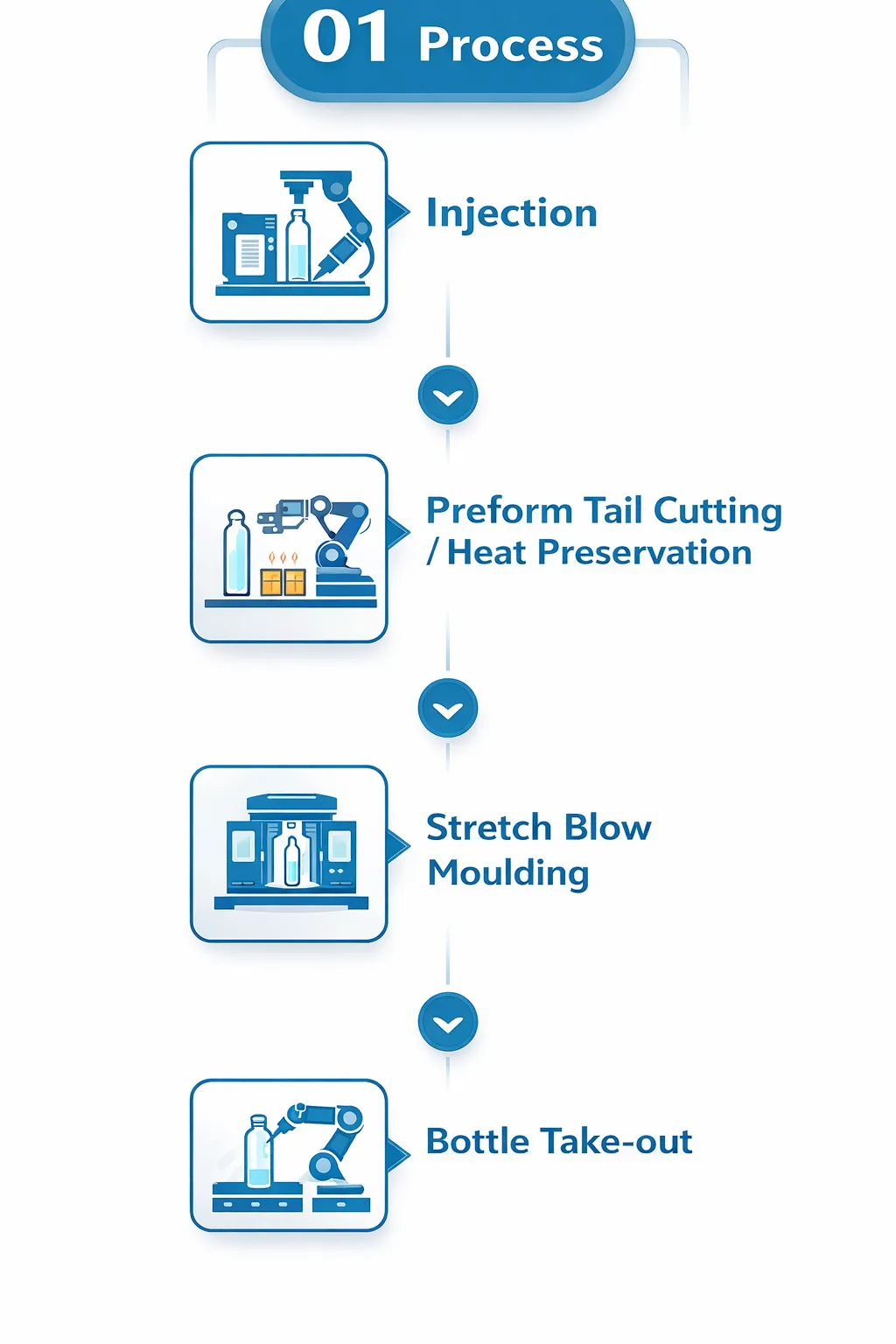
In ISBM, biaxial orientation is created by two simultaneous mechanical events at the blow station: the stretch rod descending axially at 300–400 mm/s to elongate the preform, and high-pressure air (2.0–3.5 MPa) expanding the preform radially against the cooled cavity wall. The chains that were randomly coiled in the amorphous preform are pulled simultaneously in both directions, straightening and aligning along the axial and hoop axes. When the cavity wall chills the bottle wall below Tg within milliseconds, the chains are locked in this aligned configuration — and the orientation-derived property improvements are permanently set into the material structure.
How Biaxial Orientation Differs From Crystallisation
Biaxial orientation and crystallisation are related but distinct phenomena, and confusing them leads to process errors. Orientation is the alignment of amorphous chain segments — it occurs rapidly (within the blow cycle) and can produce highly transparent bottles. Strain-induced crystallisation is a secondary event that follows orientation when the stretch ratio is high enough: the aligned chains pack into small crystalline domains (crystallites) that scatter light if they grow large enough to exceed the wavelength of visible light.
In cold-fill PET bottle production, the goal is to maximise orientation while minimising strain-induced crystallinity — because large crystallites cause haze. The blow cycle is designed to be fast (no extended mould dwell) so that the chilled cavity wall quenches the bottle wall before crystallite growth proceeds. In hot-fill PET production, controlled crystallinity development is deliberately induced during a heat-set dwell to provide thermal resistance — this is a specific modification of the standard ISBM cycle and is covered separately in the hot-fill bottle production guide.
Five Properties That Improve With Biaxial Orientation
The improvements that biaxial orientation delivers are not approximate or qualitative — they are measurable, reproducible, and directly linked to the chain alignment mechanism. Each property improvement has a specific physical explanation, and each has a direct commercial consequence for the packager and the brand.

1Tensile Strength — Thinner Walls, Lower Resin Cost
The most commercially significant property improvement from biaxial orientation is tensile strength. Amorphous, unoriented PET has a tensile strength of approximately 55–60 MPa. Biaxially oriented PET in a well-blown bottle achieves 80–90 MPa — an increase of 40–60%. The mechanism is straightforward: aligned chains are closer together than randomly coiled chains, and the van der Waals intermolecular forces between adjacent aligned chains are stronger than between randomly oriented ones. Under tensile load, the aligned chains distribute stress more efficiently along their backbone, and the network of chains transfers load more uniformly across the bottle wall cross-section.
The practical consequence is lightweighting. A biaxially oriented PET bottle can achieve the same structural performance — top-load strength, side-wall rigidity, burst pressure — at 20–30% less wall thickness than an unoriented equivalent. Since resin cost is typically the largest variable cost in PET bottle production, a 20–30% reduction in wall gauge across a production programme translates directly to a proportional reduction in resin consumption and cost per bottle. For a high-volume operation producing 500,000 bottles per month, the resin saving from proper biaxial orientation represents a substantial recurring cost advantage.
2Gas Barrier Properties — Extended Shelf Life
Gas barrier performance — the resistance of the bottle wall to CO₂ and O₂ permeation — is the second major beneficiary of biaxial orientation, and arguably the most important for beverage applications. Oriented polymer chains pack more densely than random ones, reducing the free volume between chain segments through which gas molecules must diffuse. This “tortuous path” effect means that a CO₂ molecule attempting to permeate through the bottle wall encounters more obstacles and a longer effective path length than in an amorphous wall of the same thickness.
The measured improvement is approximately 20–35% reduction in CO₂ permeation rate (expressed as shelf life percentage for carbonated soft drinks) relative to unoriented PET of equivalent weight. For oxygen barrier — critical for oxygen-sensitive beverages like juice, beer, and functional drinks where O₂ ingress causes flavour degradation — the improvement in oxygen transmission rate (OTR) is in a similar range. In practical terms, a well-oriented 500 ml PET bottle for carbonated mineral water retains carbonation to commercial specification (typically above 3.7 volumes of CO₂) for 6–12 weeks, versus 3–5 weeks for an equivalent amorphous-wall bottle.
3Optical Clarity — Haze Values Below 1%
The optical clarity of a biaxially oriented PET bottle — its glass-like transparency — is the property that is most immediately visible to consumers and most commercially important for premium cosmetics, K-Beauty packaging, pharmaceutical containers, and premium water brands. Amorphous, unoriented PET has a haze value of 2–5% (measured by ASTM D1003). A well-oriented ISBM-blown PET bottle achieves haze values below 1%, and PETG bottles regularly measure below 0.5% — genuinely indistinguishable from glass to the naked eye.
The mechanism is optical scattering at refractive index discontinuities. In amorphous PET, randomly oriented chain segments create micro-scale refractive index variations that scatter transmitted light, increasing haze. Oriented chains have a more uniform refractive index profile in the plane of the bottle wall, reducing scattering. This effect is reinforced by the density increase of orientation (denser packing reduces the frequency of refractive index discontinuities) and by the reduction in spherulitic crystallinity that good orientation control achieves. A bottle that hazes has been processed outside the correct orientation window — either underoriented (too little stretch) or overoriented past the strain-hardening point (too much stretch, promoting large crystallite growth).
4Drop Impact Resistance — Bottles That Survive the Filling Line
A biaxially oriented PET bottle has substantially higher drop impact resistance than an unoriented equivalent of the same weight. The mechanism is energy absorption through chain network deformation: when a biaxially oriented bottle strikes a hard surface, the aligned chain network distributes the impact stress rapidly across a large area of the bottle wall before any local failure initiates. The stress is dissipated as elastic deformation across the entire oriented structure rather than concentrated at a local weak point.
In drop testing (ASTM D2463 or equivalent), biaxially oriented PET bottles typically achieve a 50% failure height (the drop height at which 50% of bottles fail) two to three times higher than unoriented equivalents of the same design. For filling line operation — where bottles are conveyed, labeled, capped, and packed at high speed with unavoidable impacts — this difference in drop resistance translates directly to a lower in-process breakage rate and lower direct material loss.
5Top-Load Strength — Stackable in the Filling Line
Top-load strength — the compressive force a bottle can sustain axially before buckling — is critical for filling line operation, where bottles are closed under capping force and then conveyed in multi-layer stacks. An empty, uncapped PET bottle must sustain the capping force without deforming; a capped, filled bottle in a pallet stack must sustain the weight of bottles above it without the shoulder or base collapsing.
Biaxial orientation improves top-load performance through two mechanisms: the increase in wall tensile modulus (stiffness) and the geometric stability that comes from uniform wall thickness distribution. An unoriented PET wall with a thin spot at a shoulder radius will buckle at that point under top-load; an oriented wall with less than 0.05 mm thickness variation distributes the compressive load uniformly across the entire shoulder geometry, dramatically delaying the onset of buckling.
The Stretch Ratio — The Key Process Variable
The quality and degree of biaxial orientation achieved in a bottle is primarily controlled by two numbers: the axial stretch ratio (ASR) and the hoop stretch ratio (HSR). These are simple geometric ratios that describe how much the preform has been elongated in each direction during the blow cycle.
The Natural Stretch Ratio — Where Orientation Is Most Efficient
For any given resin, there is a temperature-dependent natural stretch ratio — the point at which the material transitions from strain-softening behaviour (easy to stretch, limited orientation development) to strain-hardening behaviour (resistance increases rapidly, maximum orientation efficiency). For standard bottle-grade PET at 110 °C, the natural stretch ratio is approximately ASR 3.0 and HSR 3.5. Designing a preform to blow near these natural stretch ratios achieves the maximum property improvement per gram of resin — bottles produced near the natural stretch ratio have the highest tensile strength, lowest haze, and best gas barrier for their wall gauge.
The natural stretch ratio is not fixed — it shifts with temperature. As preform temperature increases above the target window, the material becomes more fluid and the natural stretch ratio increases (it is easier to stretch further before strain-hardening). As temperature decreases toward Tg, the natural stretch ratio decreases and the material becomes stiffer and less orientable. This temperature sensitivity is why the ISBM conditioning station’s ±1 °C temperature control is not an arbitrary precision specification — it directly determines whether the preform arrives at the blow station at the correct temperature to achieve its target stretch ratios and orientation quality.
What Goes Wrong When Stretch Ratios Are Off
How ISBM Achieves Consistent Biaxial Orientation
Understanding what biaxial orientation is, and knowing the stretch ratios that produce it optimally, are necessary but not sufficient to produce consistently oriented bottles. The process parameters on the ISBM machine — conditioning station temperature, stretch rod speed, blow pressure ramp timing — must be set and held with precision across every cycle and every shift. This is where the one-step ISBM process has a structural advantage over two-step REHB: every variable that affects orientation is under the control of a single machine, a single operator, and a single set of process parameters.
The Conditioning Station — The Orientation Gatekeeper
No single element of ISBM machine design has a greater influence on biaxial orientation consistency than the temperature conditioning station. The conditioning station’s job is not merely to maintain the preform at a target temperature — it is to establish a specific, reproducible temperature profile across the preform wall before the preform reaches the blow station.
The ideal preform for maximum biaxial orientation in PET has:
- Body wall temperature: 105–115 °C — within PET’s optimal orientation window, where the material is rubbery enough for efficient chain alignment but stiff enough to maintain the oriented structure when blown
- Gate area (base): slightly warmer than the body to prevent understretch and base pearlescence
- Shoulder region: carefully profiled to achieve the correct ASR at the transition from preform body to neck
- Neck finish: below 60 °C — the heat deflection temperature of PET’s crystalline neck structure — to preserve thread geometry unchanged from injection
The ISBM conditioning station achieves this profile using a dual-surface system: a temperature-regulating barrel around the preform body (for external surface temperature control) and a temperature-regulating core inserted axially inside the preform (for internal surface and gate temperature control). The dual surfaces allow the conditioning station to establish the through-wall temperature gradient necessary to achieve uniform orientation across the full wall thickness. In two-step REHB, infrared lamp arrays heat only the preform’s external surface — the temperature gradient from surface to centre is steeper, conditioning time for thick preforms is longer, and the temperature profile is more sensitive to conveyor speed variations and ambient conditions.
Stretch Rod Speed and Timing — Controlling the Axial Component
The stretch rod controls the axial stretch ratio and, critically, the timing relationship between axial and hoop orientation. If the rod descends too slowly, the pre-blow air begins expanding the preform radially before sufficient axial stretch has occurred — producing a bottle with high HSR and low ASR, asymmetric mechanical properties, and potential base thinning. If the rod descends too quickly (above ~450 mm/s for standard PET), it can penetrate the preform wall and cause a breakthrough failure, or the adiabatic stress in the material can cause localised whitening at the rod tip contact point.
The correct rod speed for standard bottle-grade PET is 300–400 mm/s, timed so that the rod reaches its final position within 50–100 ms before the high-pressure blow phase reaches full pressure. This timing window ensures that the preform has been axially stretched to its target length before the radial expansion begins, producing a bottle where both ASR and HSR are within their target ranges simultaneously — the definition of balanced biaxial orientation.
Blow Pressure Ramp — Controlling the Hoop Component
The blow pressure profile — how quickly pressure rises from pre-blow (0.5–1.0 MPa) to high-pressure blow (2.0–3.5 MPa) — controls the rate and uniformity of radial expansion. A pressure ramp that is too steep (pressure rises too fast) can cause the preform wall to “jet” radially before the stretch rod has reached its final position, undercutting the axial orientation. A ramp that is too gradual allows the material to cool against the cavity wall in partial contact before full expansion — producing localised cold spots that appear as haze or wall thickness variation in the finished bottle.
On Korea Ever-Power machines, the blow pressure ramp profile is programmable in the machine controller — typically defined by a pre-blow pressure setpoint, a pre-blow duration, a transition timing, and a high-pressure setpoint. The optimal profile for each container design and preform specification is established during the commissioning process and is part of the stored recipe for each mould programme.
Biaxial Orientation in PETG, PC, and Tritan
PET is the most widely oriented resin in blow moulding, but the same biaxial orientation mechanism applies — with different temperature windows and stretch ratio targets — to PETG, polycarbonate (PC), and Tritan. The key difference is that these materials are less forgiving than PET: their stretch temperature windows are narrower, their sensitivity to temperature variation is higher, and the consequences of operating outside the window are more severe (haze, stress whitening, or structural failure).
PETG’s lower stretch temperature window (90–100 °C vs 105–115 °C for PET) is the most operationally significant difference. At the conditioning station, a PETG preform must be held 10–15 °C cooler than a PET preform of the same geometry. If the conditioning station temperature drifts above 102 °C on PETG, the material begins to develop strain-induced crystallinity during blowing, and the bottle wall hazes — the primary quality failure in PETG production. Because PETG cannot be quench-cooled as effectively as PET (its amorphous structure means it does not strain-crystallise sharply), temperature uniformity across the conditioning station is even more critical than for PET. This is why independent dual-surface conditioning with zone-by-zone temperature feedback — as used in Korea Ever-Power ISBM machines — is the enabling technology for consistent PETG bottle quality.
Measuring Orientation — How Quality Engineers Verify It
Process parameters set on the machine tell you what you intended to do. Measurement of the finished bottle tells you what actually happened. Three complementary techniques are used to verify that biaxial orientation has been achieved consistently in a production run.
Wall Thickness Mapping — The Most Practical Method
Wall thickness mapping is the most practical and widely used quality verification technique in ISBM production. A graduated sample of bottles from across the production run are sectioned at defined heights (typically base, lower body, equatorial plane, upper body, shoulder) and at multiple angular positions around the circumference, and wall thickness is measured at each point using an ultrasonic thickness gauge or a calibrated cross-section microscopy technique. The target for a well-oriented bottle is a maximum wall thickness variation of ±0.05 mm across all measurement points — a specification that ISBM consistently achieves and that two-step REHB can struggle to maintain on specialty resins.
Wall thickness mapping data also identifies the specific failure mode when orientation is suboptimal: a thick base with thin sidewalls indicates insufficient ASR (understretch); a thin base with thick shoulder indicates excessive ASR (overstretch); circumferential thickness variation at a given height indicates asymmetric preform temperature distribution at the conditioning station.
Intrinsic Viscosity (IV) Testing — Detecting Thermal Degradation
IV testing measures the molecular weight of the PET in the finished bottle wall relative to the input resin specification. An IV drop greater than 0.02–0.04 dl/g between input resin and finished bottle indicates thermal degradation — chain scission caused by processing at excessive temperature, moisture contamination in the preform, or extended residence time in the barrel. Significant IV drop reduces the molecular weight available for orientation, directly limiting the achievable tensile strength and gas barrier performance. IV testing is performed using dilute solution viscometry and is a standard incoming inspection check for pharmaceutical and premium beverage bottle production.
Polarised Light Analysis — Visualising the Orientation Field
Polarised light analysis provides a direct visual map of orientation distribution within the bottle wall. A thin section of the bottle wall is examined between crossed polarising filters; oriented polymer regions rotate the plane of polarisation and appear as bright birefringent areas, while isotropic (unoriented) regions remain dark. The pattern of birefringence directly reveals the spatial distribution of orientation — uniformly bright sections indicate well-distributed biaxial orientation; dark patches identify unoriented regions (likely corresponding to thick spots in the wall thickness map); and colour-gradient patterns in the birefringence image correspond to the orientation gradient across the wall thickness.
Implications for ISBM Machine Selection
The connection between machine specification and biaxial orientation quality is direct and quantifiable. Two machine parameters in particular have a first-order effect on orientation precision:
Injection Pressure — Shot Weight Repeatability and Preform Uniformity
The preform is the starting geometry for the entire orientation process. If the preform has wall thickness non-uniformity caused by shot weight variation or fill imbalance across cavities, that non-uniformity is amplified during blowing — a preform wall that is 5% thicker on one side will produce a blown bottle wall that is 15–20% thicker on that side, because the thicker region stretches less (lower local ASR and HSR) and therefore orients less than the thinner region.
Higher injection pressure enables more consistent melt fill — especially at high shot speeds and in multi-cavity tools where flow balance across cavities is critical. The HGY50-V3-EV fully electric ISBM machine delivers 210 MPa injection pressure versus 160 MPa on the hydraulic HGY50-V3 — a 31% increase that provides meaningfully better preform wall uniformity in multi-cavity configurations, particularly for thin-wall PETG and high-IV PET where melt viscosity is higher and fill pressure requirements are greater. The servo-electric drive also eliminates hydraulic oil temperature variation, which on hydraulic machines can shift injection pressure delivery by 5–8% between a cold start and steady-state operation — a variation that directly affects shot weight and preform wall distribution.
Conditioning Station Design — Temperature Uniformity for Specialty Resins
For specialty resins with narrow stretch temperature windows — PETG (±5 °C tolerance), Tritan (±3 °C tolerance before yellowing), and PC (high absolute temperature requiring precise barrel control at 155–175 °C) — the conditioning station’s temperature uniformity and dual-surface control capability become the determining factor in orientation quality. The HGY150-V3 mid-range ISBM machine features independent temperature-regulating barrel stroke (230 mm) and core stroke (250 mm) with separate fluid circuits — providing the through-wall temperature gradient control required for thick-wall PETG and Tritan preforms where single-surface infrared conditioning would produce centre-of-wall temperature non-uniformities that degrade orientation quality.
Summary — Biaxial Orientation Property Improvements at a Glance
◆ Key Takeaway
Biaxial orientation is not a side effect of the ISBM process — it is the mechanism by which ISBM bottles earn their commercial value. Stretch ratios within their target windows (ASR 2.5–4.0, HSR 2.5–5.0 for PET), preform temperature held within ±1 °C of the optimal stretch window, and stretch rod speed of 300–400 mm/s are the three variables that together determine whether every bottle in a run achieves the tensile strength, clarity, gas barrier, and wall uniformity that distinguish an ISBM container from everything else on the shelf.
Conclusion
Biaxial orientation is the engineering foundation of every quality advantage that ISBM containers have over other blow-moulded products. Tensile strength (+40–60%), wall uniformity (6× tighter), gas barrier (−20–35% permeation), clarity (haze below 1%), drop resistance (+100–200%), and top-load strength (+30–50%) — every one of these improvements originates from the same physical mechanism: aligned polymer chains packing more densely, interacting more strongly, and presenting a more uniform optical and mechanical profile than the randomly coiled chains in unoriented material.
The practical implication is that biaxial orientation quality is not guaranteed simply by using an ISBM machine. It is achieved — consistently, bottle after bottle across a production run — by holding preform temperature within the narrow stretch window, timing the stretch rod descent correctly relative to the blow pressure ramp, and designing the preform geometry so that the target stretch ratios match the natural stretch ratio of the resin at the conditioning temperature. These are process engineering disciplines, not machine settings that can be set once and forgotten. And they are precisely what differentiates an experienced ISBM process team from an operator simply running a machine.

About this article: Prepared by the Korea Ever-Power Technical Team. Tensile strength and haze improvement data are based on published biaxially oriented PET engineering literature (PETRA Technical Report TR-2011; Jabarin, S.A., “Biaxial Orientation of PET,” Polymer Engineering and Science, 1992) and Korea Ever-Power’s internal process validation data across PET, PETG, and Tritan production programmes. Stretch ratio targets and natural stretch ratio values are generalised for standard bottle-grade materials; specific preform designs may require adjustment based on IV, resin grade, and container geometry.
Related reading: What Is Injection Stretch Blow Moulding? — Process Guide | ISBM vs IBM vs Two-Step REHB — Process Comparison | How to Choose an ISBM Machine — 8 Specifications Explained
Editor: Cxm