Aoki / ASB ISBM Machine vs China-Made Alternatives — An Honest Comparison for Buyers
Every serious buyer of an ISBM machine eventually reaches the same comparison: Japanese-made machines from Aoki Industrial (also known as ASB or Stretch Blow Moulding machines bearing the ASB designation, sold through Nissei ASB) on one side, and China-made machines — including Korea Ever-Power — on the other. This comparison is not between a premium product and a cheap substitute. It is between two genuinely different propositions, each with specific strengths, and the right choice depends on a set of buyer-specific conditions that have nothing to do with national pride or generic quality assumptions.
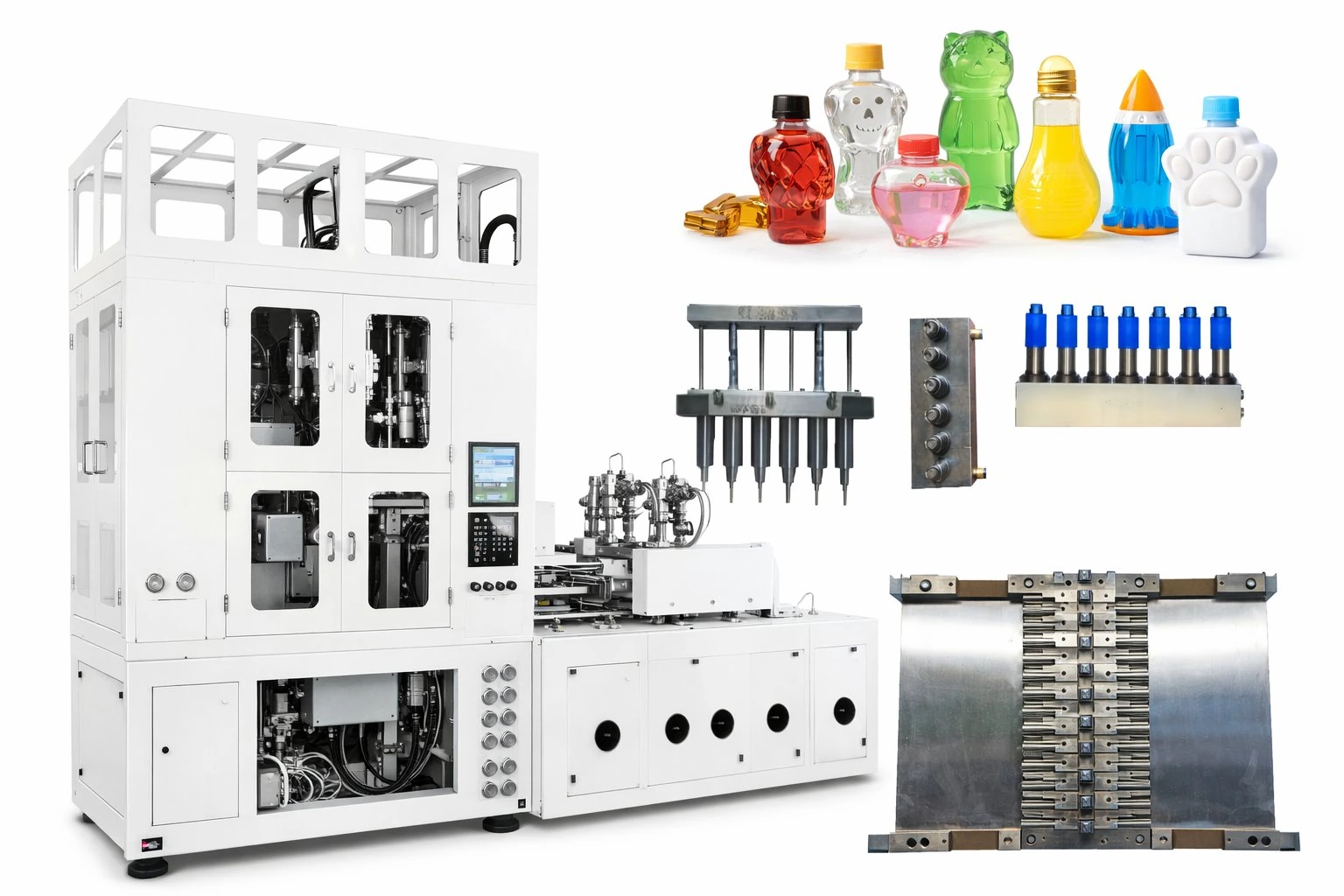
This article makes that comparison honestly. Aoki and ASB machines are the acknowledged benchmark of the global ISBM industry — a position they have earned through decades of process refinement, a global installed base, and an engineering culture that has produced some of the industry’s most important process innovations. China-made ISBM machine alternatives Ve ASB blow moulding machine alternatives — including Korea Ever-Power’s HGY series — offer a fundamentally different value proposition: 30–50% lower purchase price, mould compatibility with both the Aoki 100 Ve ASB-12M tooling standards that protects existing mould investment, local ISBM machine support in Korea, and fully electric drive technology matched to modern GMP and ESG requirements. As an injection stretch blow moulding machine manufacturer based in Hangzhou with a Korean-market service focus, Korea Ever-Power occupies a specific position in this comparison — and this guide explains where that position is strongest and where it is not.
Why Buyers Compare These Two Options
The Aoki / ASB versus China-made comparison is the most common equipment evaluation conversation in the Korean and Southeast Asian ISBM market. Three structural factors make it so:
Aoki and ASB machines are the installed base. The majority of ISBM machines currently operating in Korean cosmetic, pharmaceutical, and beverage factories are Japanese-made — Aoki or ASB machines installed during the 1990s and 2000s when China-made alternatives were not yet technically competitive. These machines are now reaching the end of their economic service life, or their operators are looking to expand capacity while controlling investment cost. When a replacement or second machine is evaluated, the Japanese brand is the natural comparison point because it is what the buyer already knows.
The quality gap has narrowed substantially. A China-made ISBM makinesi purchased in 2010 was a meaningfully different product from a Japanese machine of the same era — in conditioning station precision, injection pressure capability, mechanical rigidity, and process control sophistication. A China-made ISBM makinesi purchased in 2025 is a substantially closer product. Not identical — there are still differences in areas including parts supply chain depth, global service network coverage, and accumulated process database — but the production quality achievable on a well-specified China-made machine running a Korean cosmetic or pharmaceutical programme is not categorically different from what the Japanese machine achieves.
The price difference is real and large. A Japan-made Aoki ISBM machine or ASB machine at comparable specification to a Korea Ever-Power HGY series machine typically costs 60–100% more — not 10–20% more. At this magnitude of price difference, the question is not “is the Japanese machine slightly better?” but “is the Japanese machine sufficiently better to justify the price premium given my specific production requirements?”
What Aoki / ASB Machines Do Best
A balanced comparison requires an accurate picture of what the Japanese machines genuinely do better. There are three areas where the Aoki / ASB advantage is real and durable:
Decades of Accumulated Process Refinement
Aoki Industrial has been building ISBM machines since the 1970s and holds foundational patents in the three-station ISBM process. ASB (Nissei ASB Machine Co.) is similarly a company whose engineers have spent decades on a single technology — accumulating process knowledge, failure mode data, and design refinements that are embedded in their machines in ways that are difficult to replicate quickly. The conditioning station geometry, the rotary table index mechanism tolerance stacking, and the mould interface dimensioning of a current-generation Aoki or ASB machine reflect 50 years of iterative improvement. A China-made machine manufacturer in its 10th or 15th year of production simply has not had the time to accumulate the same depth of field experience. This is a genuine, quantifiable advantage — particularly in the conditioning station, where subtleties of barrel profile geometry and thermal management that only manifest after thousands of operating hours have been addressed in the Japanese machines through experience that China-made machines are still accumulating.
Global Parts Network and Long-Term Availability
Aoki and ASB maintain global spare parts networks that provide genuine assurance of parts availability across the machine’s 15–20 year service life. A buyer in Korea, Brazil, or the Netherlands can source spare parts with a predictable lead time and consistent quality through an authorised channel. For operations in markets far from East Asia — Europe, the Americas — the Japanese brands’ established global dealer and service networks are a meaningful operational advantage, because the alternative (sourcing parts from a Chinese manufacturer’s agent in the buyer’s region) has historically been less reliable in terms of parts accuracy and lead time. In Korea and nearby markets, where direct manufacturer relationships are more accessible, this advantage is reduced but not eliminated.
Strong Resale Value and Market Recognition
A 10-year-old Aoki or ASB machine retains meaningful resale value in the secondary market — in Korea, throughout Southeast Asia, and globally. Buyers of used ISBM equipment recognise the brand and have confidence in parts availability and process documentation. China-made machines, including Korea Ever-Power, have a less established secondary market position — though this is changing as the installed base grows and the machines demonstrate their service life performance. For buyers who factor resale value into the total cost of ownership calculation, the Japanese machines carry a financial advantage that partially offsets their higher initial cost.
What China-Made ISBM Machines Offer
The China-made ISBM machine manufacturer proposition has evolved substantially since the early 2000s. The following strengths are specific and current — not the generic “cheap but lower quality” framing that characterised the category a decade ago:
30–50% Lower Purchase Price — Compounding Capital Allocation
The price difference between a comparable Japan-made and China-made ISBM machine is not marginal — it is the difference between USD X and USD 0.5–0.7X, where X is the Japan machine price. For operations that are investing in multiple machines, or that are simultaneously investing in mould tooling, facility equipment, and working capital, the freed capital from choosing a China-made machine is a real business resource — it can fund an additional mould set, a second machine on a 24-month timeline, or additional product development. The question is not whether the price difference exists (it does) but whether the specific production requirements of the buyer’s programme make the price difference financially rational to pay.
Aoki 100 and ASB-12M Mould Compatibility — The Strategic Differentiator
For buyers who already have an existing Aoki or ASB mould set, or who are sourcing tooling from a Korean mould maker using these standards, mould compatibility with a China-made machine is the single most financially significant technical question. A mould set for a Korean cosmetic bottle programme — 1–4 cavities in PETG or Tritan — typically costs USD 15,000–40,000 per set. If the replacement China machine cannot accept this tooling, the mould cost must be written off or borne again, which dramatically narrows the price advantage of the China-made machine.
Korea Ever-Power has designed the HGY series specifically for this scenario. The HGY150-V3 accepts Aoki 100 tooling — the mould interface standard used in the larger-format Aoki machines that are the most common Japanese platform in Korean cosmetic and food packaging factories. The HGY50-V3 and HGY50-V3-EV accept ASB-12M tooling — the standard used in the Nissei ASB machines that dominate the Korean pharmaceutical and small-format cosmetic segment. An operation replacing an Aoki or ASB machine with an HGY series machine can run its existing mould sets immediately after commissioning — no tooling modification, no mould re-qualification, no transition cost for the container programme.
Local Engineering Support in Korea and Southeast Asia
Korea Ever-Power’s Korean-language service infrastructure — Korean HMI, Korean technical documentation, Korean-speaking commissioning engineers, and local spare parts stocking in Korea — directly addresses the service disadvantage that China-made machines have historically carried in the Korean market. An operation replacing a Japanese machine with a Korea Ever-Power machine is not trading a Japanese service network for a Chinese one — it is trading a Japanese service network for a Korean-oriented one, with on-site response available in Korean within 24–48 hours.
Fully Electric Drive Standard — GMP and ESG Ready
O HGY50-V3-EV tamamen elektrikli ISBM makinesi offers 210 MPa injection pressure, ±0.1 g shot weight repeatability, oil-free operation, and approximately 40% lower energy consumption versus the hydraulic equivalent — in a machine specification that directly addresses Korea’s growing GMP pharmaceutical and premium cosmetic production requirements. The current-generation Aoki and ASB machines offer electric drive options, but at price points that further increase the capital cost differential. For Korean pharmaceutical and cosmetic buyers whose primary reasons for choosing electric are GMP compliance and ESG energy reporting, the electric HGY50-V3-EV provides this capability at a price point that makes the total cost of ownership analysis decisively favourable.
The Mould Compatibility Advantage — Protecting Your Tooling Investment
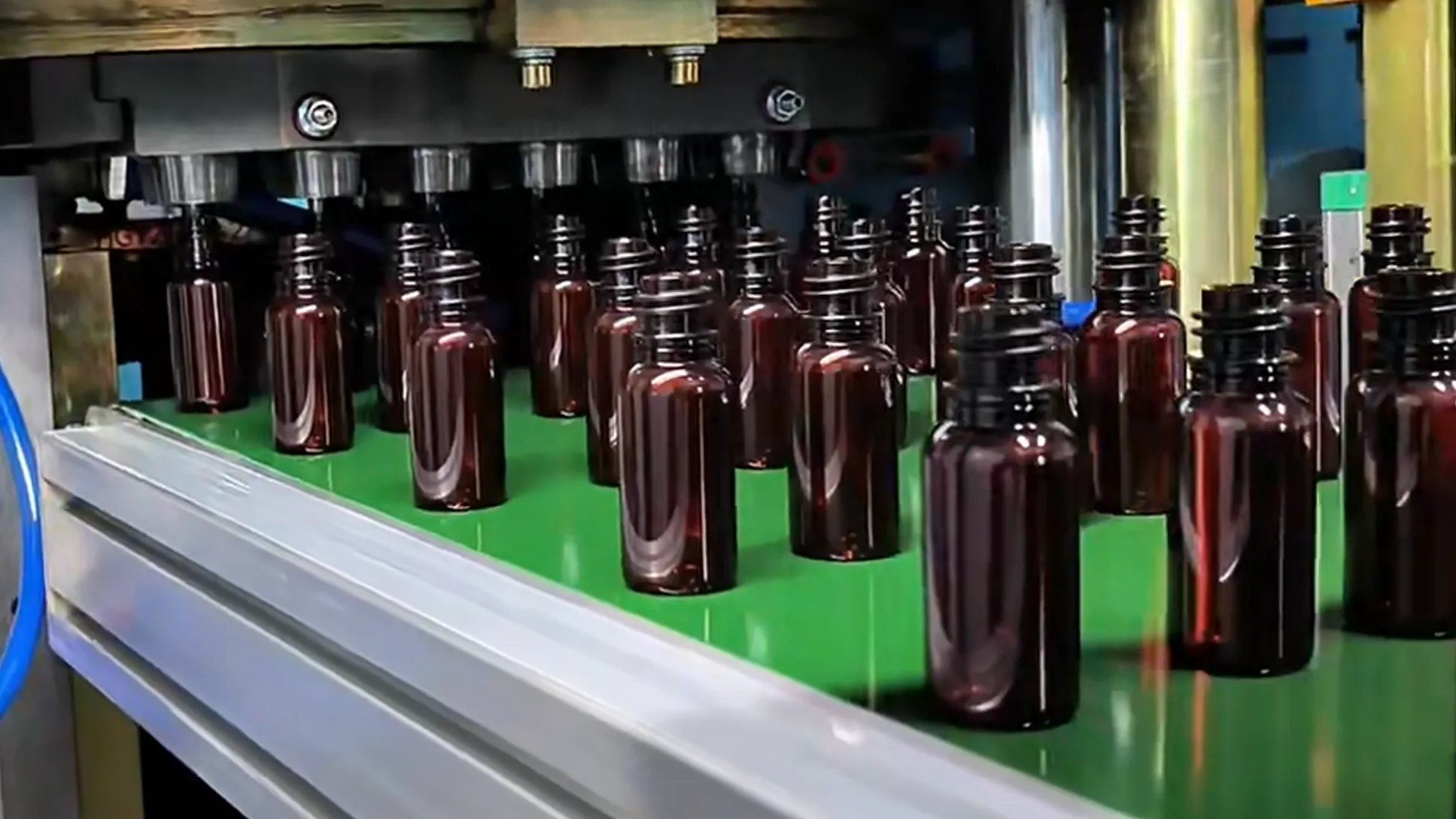
The mould compatibility question is so commercially important to buyers with existing tooling that it deserves a dedicated analysis. The total cost of ownership comparison between a Japan-made and China-made ISBM machine changes substantially when existing mould sets are factored in:
The scenario changes significantly when the buyer does not have existing tooling compatible with either standard. In this case, a new mould set must be built for whatever machine is purchased — and the mould cost is the same regardless of machine brand. The machine price differential then stands on its own, unmodified, and the total cost of ownership comparison becomes a straightforward calculation: machine price + operating cost over the planned service life + parts and service cost, on each side.
Seven-Dimension Comparison Table
Quality Verification Checklist for China-Made ISBM Machines
The quality of China-made ISBM machines varies more than the quality of Japan-made machines — because the China market includes a wider range of manufacturers at different levels of engineering investment and quality control maturity. The following checklist is applicable to any China-made ISBM machine purchase, including Korea Ever-Power, and any reputable supplier should be willing to support every item on it before contract signing:
● China-Made ISBM Machine — Pre-Purchase Quality Verification Checklist
Attend the FAT at the manufacturer’s facility. The FAT must run your actual container programme — your resin grade, your mould (or an equivalent), your target BPH. Run at least 200 bottles and measure wall thickness at five body heights on 10 bottles. Accept the machine only if wall thickness variation across the 10 bottles is below ±0.05 mm at each height. A supplier who offers a FAT without your mould and resin — “we’ll show you running a standard mould” — is not offering a meaningful FAT.
Ask the supplier to demonstrate barrel temperature stability by logging all zone temperatures for 60 minutes of continuous production. Acceptable result: all zones within ±2 °C of setpoint for the full 60 minutes, with no zone showing a trend (rising or falling) that suggests a control loop problem. For Tritan programmes, require ±1 °C as the acceptance criterion. Reject any machine that cannot demonstrate this stability under production conditions (not at idle).
Weigh 50 consecutive preforms and calculate the standard deviation and coefficient of variation (CV) of preform weight. Accept the machine if CV is below 0.5%. A machine with CV above 0.8% has a plasticisation consistency problem — typically a worn check ring or inconsistent back-pressure — that will manifest as variable bottle weight and wall thickness in production. Do not accept a machine on this criterion and assume it will improve after installation.
Ask for the bill of materials for: servo motors and drives (if electric), PLC brand and model, temperature controllers, hydraulic directional valves (if hydraulic). Acceptable components: servo motors from Mitsubishi, Siemens, Yaskawa, Fanuc, or Bosch Rexroth. PLCs from Siemens, Mitsubishi, or Omron. Temperature controllers from Autonics, Omron, or RKC. Hydraulic valves from Parker, Bosch Rexroth, or Yuken. Reject machines specifying unknown Chinese brand servo motors or PLC systems — not because Chinese components are universally inferior, but because parts availability, documentation quality, and manufacturer support depth for these components are unverifiable over the machine’s service life.
Request three reference customers who are running the same application as your programme — same industry (cosmetic, pharmaceutical, or beverage), same resin (PETG, Tritan, or PET), same approximate bottle format. Visit at least one reference site in person and ask the production manager (not the sales manager): What defects did you encounter in the first six months? What was the service response time when you had a problem? Are the bottles meeting your quality specification consistently? A supplier who cannot provide three references in your industry and resin category has not yet established a track record in your application.
When to Choose Each — A Decision Framework
The following framework is intended to help buyers identify the option that is objectively aligned with their specific situation, not to steer them toward either product on commercial grounds:
Choose Aoki / ASB When:
- You are supplying directly to a global brand (European cosmetics, Japanese pharmaceutical) who specifies Japan-made machine provenance in their supplier qualification
- Your production location is far from Korea or China (Europe, Americas) where local Korea Ever-Power service coverage is not yet established
- You require autoclave sterilisation capability (> 130 °C conditioning) for a specific pharmaceutical programme that current Korea Ever-Power machines do not yet support
- Resale value is a significant factor in your financial model and you need the highest achievable secondary market price
- Your programme volume justifies a machine that will run 24/7 for 20 years with zero flexibility on total cost — and the initial price premium is accepted within the capital budget
Choose Korea Ever-Power HGY When:
- You are operating in Korea or Southeast Asia and need Korean-language service, Korean HMI, and local parts availability
- You have existing ASB-12M or Aoki 100 mould tooling that you want to run on the replacement machine — eliminating mould transition cost
- Your programme is pharmaceutical or premium cosmetic and requires oil-free electric drive at a price point where the electric option is financially rational
- You are entering a new container format or application and want to preserve capital for mould tooling, second machine, or market development
- Your brand customers do not specify machine provenance in supplier qualification — they specify the bottle specification, and your quality system demonstrates that the machine meets it
- You want faster delivery (12–16 vs 16–24 weeks) or greater customisation flexibility in machine configuration
◆ Önemli Noktalar
The Aoki / ASB vs China-made comparison is not a quality question — it is a total cost of ownership and operational fit question. Aoki and ASB are the industry benchmark for a reason, and that reason does not evaporate when a China-made alternative costs less. What has changed is that the best China-made ISBM machine alternatives — including Korea Ever-Power’s HGY series with its ASB-12M Ve Aoki 100 mould compatibility — have closed the functional gap to a point where the price differential, the local support advantage, and the mould compatibility benefit are a complete and rational value proposition for the majority of Korean and Southeast Asian buyers. Know what you are buying, verify it with the FAT checklist above, and the decision framework will make the right choice clear.
Çözüm
The Aoki and ASB machines that set the global ISBM standard were built through decades of single-minded engineering focus on one process. That focus produced machines that are genuinely excellent, and the market’s respect for them is earned. The question for a Korean or Asian buyer in 2025 is not whether they are excellent — they are — but whether their excellence, at their price, is the right investment for a specific production programme, facility, and growth trajectory.
For a growing number of Korean pharmaceutical, cosmetic, and beverage packaging operations, the combination of 30–50% lower machine cost, ASB-12M or Aoki 100 mould compatibility that eliminates tooling transition cost, Korean-language service infrastructure, and fully electric drive capability at a commercially rational price point makes Korea Ever-Power’s HGY serisi 3 istasyonlu ISBM makineleri the objectively better total investment — not a compromise. Submit your bottle drawing, resin specification, and production volume target to Korea Ever-Power for a FAT-verifiable machine proposal with full mould compatibility confirmation.
Disclosure: Korea Ever-Power is one of the China-made ISBM machine suppliers described in this article. We have made every effort to present the comparison accurately and without bias, including acknowledging the genuine strengths of Aoki and ASB machines. Readers are encouraged to apply the FAT and quality verification checklist to Korea Ever-Power machines as rigorously as to any other supplier — we welcome the scrutiny and are confident in the outcome.
İlgili okuma: How to Choose an ISBM Machine — 8 Specifications | ISBM Machine Price — Total Cost of Ownership | ISBM Machine Maintenance Schedule
Editör: Cxm