Technical Deep Dive · Buyer Guide · Korean ISBM 2026

How to Choose an ISBM Machine:
10-Factor Korean Guide

Korean packaging producers who buy on price typically replace the machine in 4 years — or spend 3× the savings on quality failures and downtime. The right machine matches your bottle geometry, resin, volume, compliance, and market. These 10 factors determine which machine is right for you.

10 Structured Factors
Engineering + Commercial
Korean Market Calibrated


Production Capacity: Start with Annual Demand, Not Machine Speed
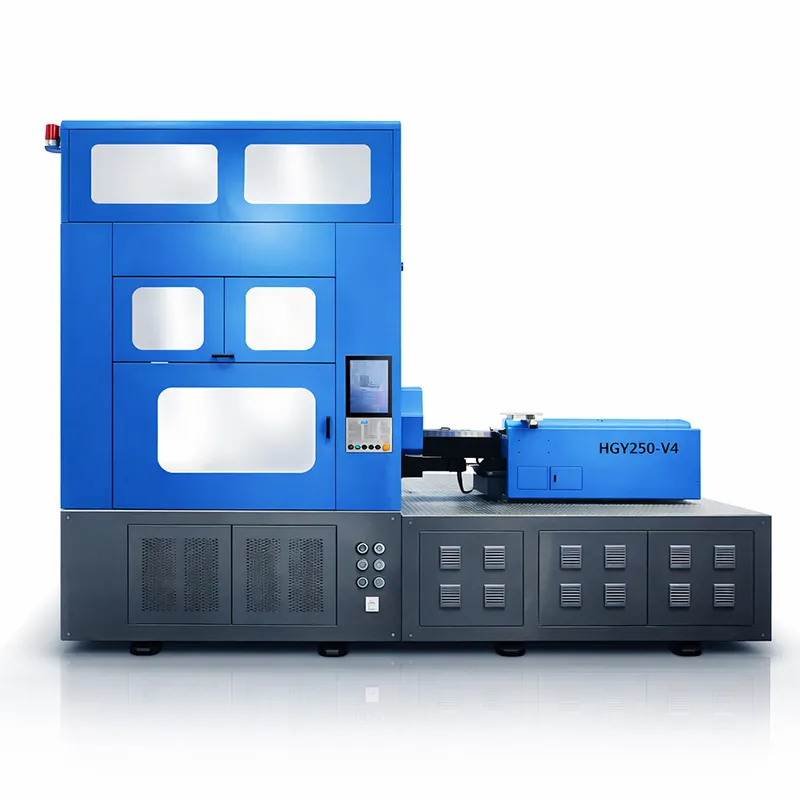
Injection Stretch Blow Moulding Machine HGY250-V4 — heavy-duty 4-station ISBM for Korean large-volume beverage and CSD production at 6-cavity 500ml PET, 27M+ units per year at 16-hour Korean production days
Injection Stretch Blow Moulding Machine HGY250-V4 — 250 kN injection clamping and 42-bar CSD blow circuit handle the structural demands of high-cavity-count large-format production that lighter platforms cannot sustain at volume.

Korean Capacity Calculation Formula

Required cycle time = Annual demand ÷ (Op-days × Hours/day × 3,600 × Cavities)

Example: 8M units/yr · 300 days · 16 h/day · 4 cavities → ≤ 11.6 s cycle

The most common Korean ISBM machine selection mistake is specifying machine speed (bottles per hour) rather than annual production requirement. Machine speed is a nominal figure; actual annual output depends on operating hours, changeover frequency, maintenance downtime, and OEE — factors not captured in the nameplate specification.

75–80%

Recommended utilisation target — never spec at 100%

±20%

Korean seasonal demand peak buffer required

16 h/day

Korean ISBM standard double-shift operation

Size the machine at 75–80% utilisation of theoretical capacity — not 100%. Korean premium brand contracts regularly include penalty clauses for delivery shortfall. The 射出延伸ブロー成形機 HGY250-V4 is sized for 75% utilisation targets of 20M–35M units/year, providing production headroom that protects Korean producers at their largest brand customer contracts.

Bottle Geometry and Neck Profile: Match Machine to Your Bottle

Not all ISBM machines can produce all bottle geometries. The machine’s injection clamping force, blow clamping force, stretch rod stroke, and blow nozzle bore diameter collectively define a geometric production envelope. Specifying outside this envelope produces either mechanical interference or inadequate structural quality.

Machine Model 音量 Max Neck Inj. Clamp Best-Fit Korean Application
HGY150-V4 / EV 10–500ml 38mm 150 kN K-Beauty cosmetic, pharma oral liquid, small food
HGY200-V4 30ml–2L 63mm 200 kN Still water, K-Beauty, personal care, functional drink
HGY250-V4 50ml–3L 86mm 250 kN CSD, wide-mouth supplement, large food jar, hot-fill
EP-BPET-70V4 10–300ml 38mm 70 kN Korean SME cosmetic, small-format pharmaceutical
HGYS280-V6 50ml–2L 63mm 280 kN High-volume Korean beverage, 6-station twin-injection

Geometry Verification Checklist — Get in Writing Before Purchase

Provide the exact bottle drawing (height, max OD, neck OD, volume) — request written confirmation it falls within the machine’s production envelope.

Confirm stretch rod end-point position for your specific bottle height — a rod that must travel further than the machine’s maximum stroke cannot produce your bottle.

Confirm blow nozzle bore diameter matches your neck inner bore — an oversized nozzle will not seal, causing blow pressure leakage and wall distribution failure.

Resin Compatibility: Know Your Material Before Choosing Your Machine

A machine calibrated for PET may not have adequate conditioning range for Tritan TX1001 (150–165°C vs PET’s 95–110°C), or adequate blow pressure for CSD petaloid base formation (42 bar vs still water’s 28 bar). Verify with sample bottles before purchase.

樹脂 Barrel (°C) Conditioning (°C) Blow (bar) Key Note
ペット 265–285 95–110 24–42 All platforms compatible. IV 0.78–0.86 dl/g.
PETG 255–275 85–95 28–34 EV servo mandatory for haze ≤1.5%.
トリタン 250–275 135–165 26–34 Verify conditioning cap ≥165°C before purchase — some machines cap at 130°C.
PP 220–245 120–145 24–30 Heated mould base insert required. Confirm platform includes this before purchase.

Korean buyer protocol: Request production samples in your specific resin grade from the machine supplier’s demonstration machine before purchase. Qualified Tritan baby bottle samples (haze ≤1.5%, 1.5m drop test pass) prove the machine can process your resin — not just claim it in a brochure.

Cavity Count: The Multiplier That Changes Everything

Each additional cavity adds KRW 8–25M tooling cost per cavity, requires greater injection clamping force, and demands tighter process uniformity. Balance output requirement against tooling investment and machine specification.

Annual Demand Recommended Cavities Strategic Note
Below 5M units 2-cavity Most cost-efficient tooling investment-to-output ratio for Korean SMEs
5M–15M units 4-cavity ★ Korean standard — balanced tooling-to-output economics
15M–35M units 6-cavity or 4+6-station HGY250-V4 or HGYS280-V6 platform
Above 35M units Multi-machine or 6-station 8+ EP-HGYS280-V6 or multi-line configuration

Korean multi-SKU producers (K-Beauty brands with 6–12 SKUs at 500K–2M units each) should spec the machine for their highest-volume single SKU at 4-cavity, and run smaller SKUs at 2-cavity on the same machine — the most flexible Korean multi-SKU ISBM strategy.

EV Servo vs Hydraulic: The Quality Precision Divide

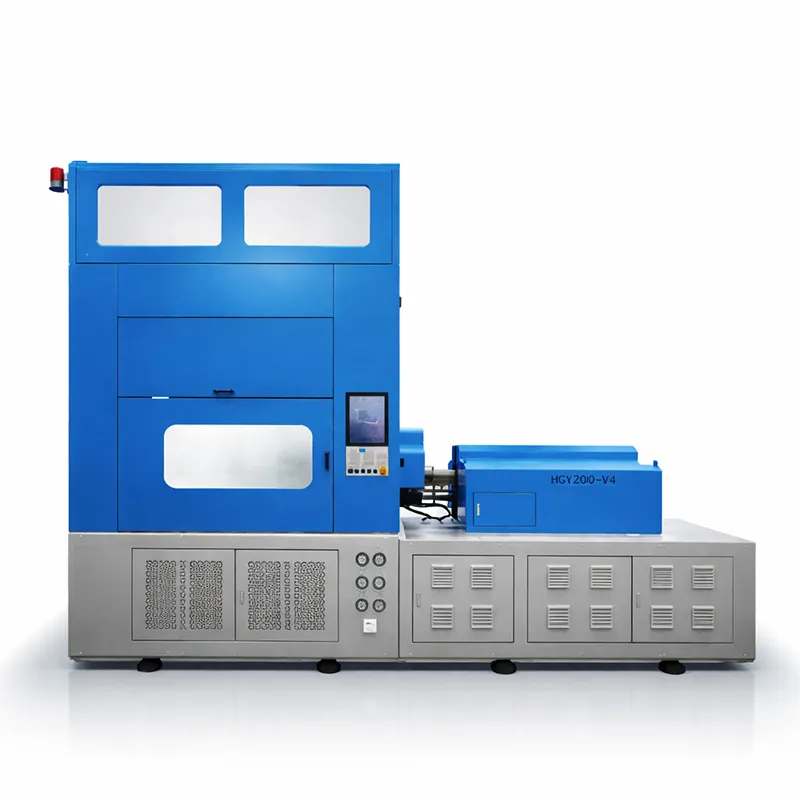
ISBM Machine HGY200-V4 EV servo — all-electric servo drive system providing ±0.05 second blow dwell precision and ±0.3°C conditioning temperature uniformity for Korean K-Beauty PETG haze ≤1.5% and Korean pharmaceutical AA compliance
ISBM Machine HGY200-V4 EV servo platform — ±0.05s blow dwell timing (vs ±0.3s hydraulic) and ±0.3°C conditioning uniformity (vs ±2°C hydraulic). For Korean K-Beauty haze ≤1.5% and pharmaceutical AA ≤10 μg/bottle, this is the threshold between compliance and non-compliance.

パラメータ 油圧 EV Servo ★
Blow dwell timing ±0.3 s ±0.05 s
Conditioning uniformity ±2°C ±0.3°C
Energy per 1,000 bottles 3.2–5.2 kWh 2.0–3.2 kWh
Cycle-by-cycle logging いいえ Yes — GMP ready
K-Beauty / Pharma suitability Not suitable All segments ✓
Machine purchase price より低い Medium–higher

Korean buyer rule: If your target market includes K-Beauty, pharmaceutical, infant/baby, or premium food, EV servo is not optional — it is the minimum specification. As Korean brand quality requirements continue to tighten, EV servo’s market segment coverage is expanding while hydraulic’s application range narrows annually.

Energy Specification: Calculate kWh Per 1,000 Bottles, Not Installed kW

Korean ISBM machine brochures list installed power (kW) — the total rated power of all motors and heaters. This number is meaningless for energy cost forecasting because installed kW measures peak draw, not operational draw. At Korean industrial electricity rates (KRW 112–168/kWh, 2026), every kWh/1,000 bottle difference across 20M units/year production represents KRW 2.2–3.4M annual electricity cost difference.

Request this data from suppliers — not installed kW

2.0–3.2

kWh per 1,000 bottles — EV Servo ISBM

3.2–5.2

kWh per 1,000 bottles — Hydraulic ISBM

KRW 2.24M

Annual energy savings at 10M units/year (EV vs Hydraulic)

Under Korean K-ETS (Emissions Trading Scheme), Korean producers who document energy consumption per unit of output are eligible for carbon credit allocation — a discipline that EV servo platforms with cycle-by-cycle data logging naturally support.

After-Sales Service and Parts Availability: The Factor That Determines Actual Uptime
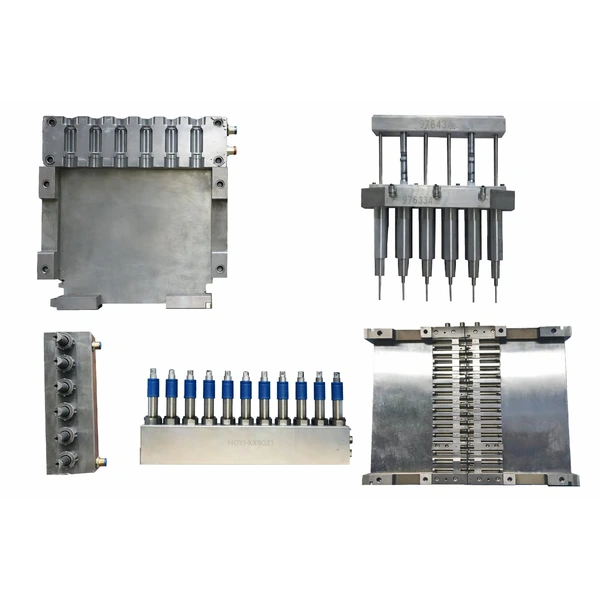
Korean ISBM machine mould tooling qualification — FAT (factory acceptance test) verifying cavity-to-cavity weight variation CV% ≤1.0% and neck OD ±0.04mm across all 4 cavities before machine shipment from Korean Ever-Power facility
Korean ISBM factory acceptance test — the FAT should run 8 consecutive hours at specified conditions with all parameters logged. A Korean ISBM purchase above KRW 250M should always include a formal FAT protocol. The cost (KRW 3–6M) is negligible against the risk of receiving a machine that does not perform as specified.

A Korean ISBM machine that achieves 85% theoretical OEE with adequate service becomes a 65% OEE machine without it. Evaluate these four after-sales criteria before purchase:

  1. 1

    Korean spare parts warehouse

    Critical wear parts (blow nozzle PTFE seals, conditioning heater elements, stretch rod bushings, check valve balls) must be available within 24–48 hours in Korea. Request the Korean spare parts stock list and warehouse location in writing before purchase.

  2. 2

    Korean-language service documentation

    Operators who cannot read the maintenance manual in Korean are structurally disadvantaged at performing tier-1 and tier-2 maintenance. Request Korean-language maintenance manuals, alarm code lists, and troubleshooting guides as a machine purchase deliverable — not an optional extra.

  3. 3

    Remote diagnostics capability

    EV servo ISBM machines with Ethernet remote access allow Korean Ever-Power service engineers to diagnose alarm conditions, review process logs, and guide operators through corrective actions remotely — reducing mean time to recovery (MTTR) by 60–80% for software-related and parameter-related issues.

  4. 4

    Written service response time guarantee

    Request written commitment: remote diagnostic response within 4 hours, on-site engineer in Korea within 48 hours for critical equipment failure. Suppliers who cannot commit to these service levels should not be selected for Korean pharmaceutical or brand-critical production.

Budget and ROI: Evaluate Total Investment, Not Machine Price Alone

The machine price is typically 55–70% of the total Korean ISBM investment. A KRW 220M machine purchase becomes KRW 310–380M total investment when all ancillary costs are included. Budget only the machine price and discover the rest at purchase order stage — a routine trap that adds 35–50% above initial budget.

Complete Korean ISBM Investment Breakdown

Machine purchase price
KRW 185–245M
Mould tooling set (4-cavity)
KRW 35–55M
Korean customs + VAT (if applicable)
KRW 15–30M
Installation, commissioning, training
KRW 12–22M
Initial spare parts kit
KRW 8–15M
KFDA compliance testing
KRW 4–8M
Total Investment
KRW 259–375M

K-Beauty / Pharma Payback

12–18 months

At KRW 45–85/bottle · 4M units/year

Commodity Beverage Payback

24–36 months

At KRW 28–42/bottle · 15M units/year

Compliance and GMP: Know Which Regulatory Framework Your Market Requires
Korean ISBM GMP compliance documentation — KFDA pharmaceutical container qualification, food contact migration test certificates, and GMP IQ/OQ/PQ validation protocol for Korean pharmaceutical and food packaging ISBM machine qualification
Korean ISBM compliance framework — KFDA food contact positive list confirmation, pharmaceutical container extract test, GMP IQ/OQ/PQ validation protocol, and lot-release documentation. The machine must support these through cycle-by-cycle process logging — a hardware capability of EV servo platforms that paper-based hydraulic production cannot adequately provide.
KFDA Category Migration Test Data Logging Additional Requirement
Standard food 60°C / 30 min Batch only Positive list resin confirmation
건강기능식품 (HFF) 70°C / 1h Cycle-by-cycle Stricter migration limits
의약품 (Pharma) KP-grade extract Mandatory ≥90 days GMP IQ/OQ/PQ · Lot release doc

Critical warning: Korean ISBM buyers who omit compliance specifications from the purchase order and then attempt pharmaceutical qualification after delivery consistently encounter 6–18 month delays while hardware gaps are addressed retroactively at significant additional cost. Specify EV servo cycle logging as a purchase requirement — not an afterthought.

Scalability: Design for Your 5-Year Production Requirement, Not Today’s

Korean ISBM machines have productive service lives of 12–18 years when maintained. Specifying a machine for today’s volume and ignoring growth projections forces either a second full machine purchase (KRW 200–400M) or market share loss from capacity constraint — both avoidable with 5-year planning.

Korean ISBM Scalability Planning Rule

PLATFORM

Specify the machine platform at 2× your current annual production requirement to give cavity-count and clamping headroom for growth through additional mould investment (KRW 30–60M) rather than additional machine investment (KRW 200–400M).

TOOLING

その EP-BPET-70V4 Compact 4-Station ISBM Machine exemplifies entry-level scalability — Korean SME producers start at 2-cavity and add up to 4-cavity tooling as volume grows, doubling output without machine replacement.

MULTI-SKU

Korean K-Beauty producers targeting 4–6 different brand SKUs should verify the machine platform can accommodate multiple mould sets simultaneously — some Korean ISBM platforms support rapid mould changeover with pre-warming external racks.

よくある質問

Q1 — How do I verify a Korean ISBM machine supplier’s specifications before purchase?

Four steps. (1) Factory visit and live demo — observe the specific machine running your bottle format at claimed cycle time; record cavity-to-cavity weight variation CV% ≤1.5% and haze on PETG samples. (2) Reference customer calls — request 3 Korean customer references at similar volume and application; call them directly to confirm actual operational performance. (3) Performance guarantee in contract — minimum output per day, maximum OEE floor at 12 months, energy consumption maximum at specified rate. (4) Third-party factory acceptance test (FAT) — engage a Korean packaging engineering consultant to observe and document the FAT: 8 consecutive production hours at specified conditions with all parameters logged. Korean ISBM purchases above KRW 250M should always include a formal FAT — the KRW 3–6M cost is negligible against the risk of receiving a non-performing machine.

Q2 — What is the minimum Korean production volume that justifies ISBM machine ownership versus outsourcing?

The break-even volume is application-specific and price-sensitive. For Korean commodity PET still water or beverage at contract packaging prices of KRW 28–38/bottle: owned ISBM is financially justified above approximately 8–12M units/year, where production cost savings (KRW 12–18/bottle below contract packaging cost) generate KRW 100–200M/year in margin contribution. For Korean K-Beauty PETG at contract packaging prices of KRW 65–120/bottle: owned ISBM is justified above approximately 3–5M units/year — the larger margin per bottle lowers the payback threshold. For Korean pharmaceutical: justified above approximately 5M units/year, but the compliance infrastructure investment (GMP qualification, KFDA facility registration at KRW 25–55M) must be included in the payback calculation.

Q3 — Should I buy a new Korean ISBM machine or a used/refurbished machine?

Used Korean ISBM machines carry three risks that new machine buyers do not face. Unquantified wear: a used machine may have 8–15M shots on its injection barrel, screw, and hot runner — near the service life threshold. Request minimum 3 years documented maintenance log and total shot count. Technology vintage: Korean ISBM machines older than 6–8 years typically lack EV servo drive systems and the cycle-by-cycle data logging required for Korean pharmaceutical GMP compliance; EV servo retrofit costs KRW 35–65M, often making total cost comparable to a new machine. Korean brand qualification: several K-Beauty and pharmaceutical brands require OEM documentation proving the machine was manufactured by a qualified ISBM manufacturer — a used machine may lack this chain-of-documentation. Recommendation: for pharmaceutical and K-Beauty, new machines are strongly preferred. For Korean commodity packaging without regulatory sensitivity, a well-documented used machine from a reputable Korean source can provide adequate value.

Q4 — What is the most common specification mistake Korean ISBM buyers make?

The most common mistake, by frequency: selecting hydraulic ISBM for cost reasons while planning to enter Korean K-Beauty or pharmaceutical markets. The decision logic is “hydraulic is 25% cheaper upfront, and we can improve quality through process discipline.” This logic fails because hydraulic ISBM’s ±2°C conditioning variation and ±0.3s blow dwell variation are hardware constraints — not correctable through operator discipline — that produce intrinsic quality variation above the specification tolerance for K-Beauty PETG haze ≤1.5% and pharmaceutical AA ≤10 μg/bottle. Korean producers who make this mistake typically discover it at first-article qualification, 8–12 months after machine installation. Correcting it — EV servo retrofit — costs KRW 35–65M plus 3–4 months downtime, eliminating the initial 25% savings entirely. Specify EV servo for any application requiring K-Beauty, pharmaceutical, or premium beverage compliance.

Q5 — How important is the Korean ISBM machine’s hot runner system in the purchase decision?

The hot runner system is one of the most consequential and least-evaluated Korean ISBM machine specifications. A poorly engineered hot runner (typical in budget alternatives) produces cavity-to-cavity weight variation CV% 2–4% and neck OD variation of ±0.10–0.15mm — both failing Korean K-Beauty and pharmaceutical incoming inspection. Evaluation criteria before purchase: (1) Request cavity-to-cavity weight variation data — minimum 20 consecutive shots, all cavities, at production conditions; target CV% ≤1.0%. (2) Request thermal imaging of the hot runner manifold during production — verify temperature uniformity across all nozzle tips, target ≤±2°C nozzle-to-nozzle at steady state. (3) Confirm hot runner steel grade and nozzle tip material — Korean pharmaceutical and K-Beauty require stainless steel hot runner nozzle tips (not standard carbon steel that corrodes in PETG and Tritan melt environments).

Q6 — How do I evaluate competing Korean ISBM machine offers on a like-for-like basis?

Use a standardised Request for Proposal (RFP) specifying: exact bottle drawing, target annual production volume, operating hours per day and days per year, quality specifications (haze, weight CV%, neck OD tolerance), regulatory compliance requirements (KFDA food/pharma/HFF, GMP IQ/OQ/PQ, data logging), and service requirements (response time, Korean spare parts, remote diagnostics). Ask each supplier to respond against each specification item with a binary “meets / does not meet” plus a measured specification value. Suppliers who respond with generic brochure text rather than specification-matched responses signal they have not technically evaluated your requirements. Weight the competitive evaluation: technical compliance (40%), production demonstration evidence (25%), Korean service capability (20%), 5-year TCO (15%). Machine price is the least predictive criterion of long-term production value — and the one most Korean buyers over-weight in their purchasing decision.

Machine Selection Support

Ready to Apply the 10-Factor Framework to Your Korean ISBM Purchase?

Korean Ever-Power engineering team will analyse your specific bottle geometry, resin type, annual volume, and compliance requirement against all 10 factors — and provide a machine recommendation with written specification confirmation before any purchase commitment.

Request Machine Selection Analysis

関連リソース


Mid-Range EV Servo
射出延伸ブロー成形機 HGY200-V4
EV servo ±0.3°C conditioning · Multi-resin PET / PETG / Tritan · Cycle-by-cycle process logging · Satisfies Factors 2, 3, 5, 6, 9 for K-Beauty and pharmaceutical applications.


Heavy-Duty High Output
射出延伸ブロー成形機 HGY250-V4
250 kN clamping for 6-cavity high-output · 42-bar CSD circuit · Wide-mouth 86mm neck · Satisfies Factors 1, 2, 4 for Korean large-volume and CSD applications.


編集者: Cxm


工場のVRツアー

タグ: