Botol Tetes Mata HDPE IBM:
Panduan Produksi Korea
Wadah oftalmik HDPE 10 ml Korea adalah format IBM farmasi dengan volume tertinggi di Korea dan salah satu yang paling menuntut secara teknis: presisi pemasangan tutup penetes pada ±0,05 mm, transparansi level isi pada dinding badan 0,30–0,40 mm, kepatuhan partikulat oftalmik KFDA, dan persyaratan volume tahunan ratusan juta unit yang menempatkan mesin ZQ110 dan ZQ135 di pusat ekonomi produksi kemasan oftalmik Korea.
Tutup Pipet Leher Presisi
Kualifikasi Oftalmologi KFDA
Korea Ever-Power Engineering Desk · Ansan-si · Juli 2026
IBM Oftalmologi Korea — Data Referensi
10 ml
Wadah oftalmik standar Korea — format IBM dengan permintaan tahunan tertinggi
500 juta+
Perkiraan permintaan tahunan wadah oftalmik di Korea — lensa kontak, mata kering, resep dokter
±0,05 mm
Toleransi diameter luar leher IBM — pemasangan tutup penetes memerlukan jendela ±0,06 mm.
~23.800/jam
ZQ135 dengan 30 rongga — output IBM oftalmologi Korea tertinggi dari satu mesin tunggal.
1. Korean Ophthalmic Market and IBM’s Role

Korea’s ophthalmic pharmaceutical market is among the largest and fastest-growing in East Asia. Three structural factors drive Korean ophthalmic container demand above what Korea’s population size alone would suggest: the world’s highest rate of contact lens wear per capita (approximately 42% of Korean adults aged 20–40 wear contact lenses, generating daily artificial tear and contact lens solution demand), the exceptionally high Korean screen time (Korean workers average 9.4 hours per day of screen exposure, driving rapidly growing dry-eye disease prevalence), and Korea’s nationally covered ophthalmic prescription reimbursement system (Korean National Health Insurance covers most ophthalmic prescription medications, lowering the price barrier to ophthalmic pharmaceutical use). These three factors together produce an estimated 500+ million annual ophthalmic container demand in Korea, split between prescription ophthalmic (antibiotics, anti-inflammatory, antiglaucoma), OTC artificial tears, and contact lens care products — all requiring 10 ml HDPE IBM containers.
IBM adalah standar proses wadah oftalmik Korea karena format oftalmik 10 ml secara unik mendapatkan manfaat dari setiap keunggulan teknis IBM secara bersamaan: leher cetakan injeksi pada ±0,05 mm (keterlibatan tutup penetes membutuhkan ±0,06 mm), tanpa flash (kepatuhan partikulat oftalmik KFDA), output multi-rongga hingga 30 rongga (ekonomi produksi pada permintaan tahunan 500 juta+ unit), dan dinding badan HDPE transparan pada 0,30–0,40 mm (inspeksi tingkat pengisian tanpa persyaratan transparansi). Tidak ada proses blow molding lain yang memberikan keempat keunggulan tersebut pada format 10 ml. Konteks yang lebih luas dari IBM untuk produksi farmasi Korea dibahas dalam panduan IBM farmasiArtikel ini secara khusus berfokus pada produksi wadah oftalmik HDPE 10 ml.
2. Spesifikasi Wadah Oftalmik HDPE 10 ml
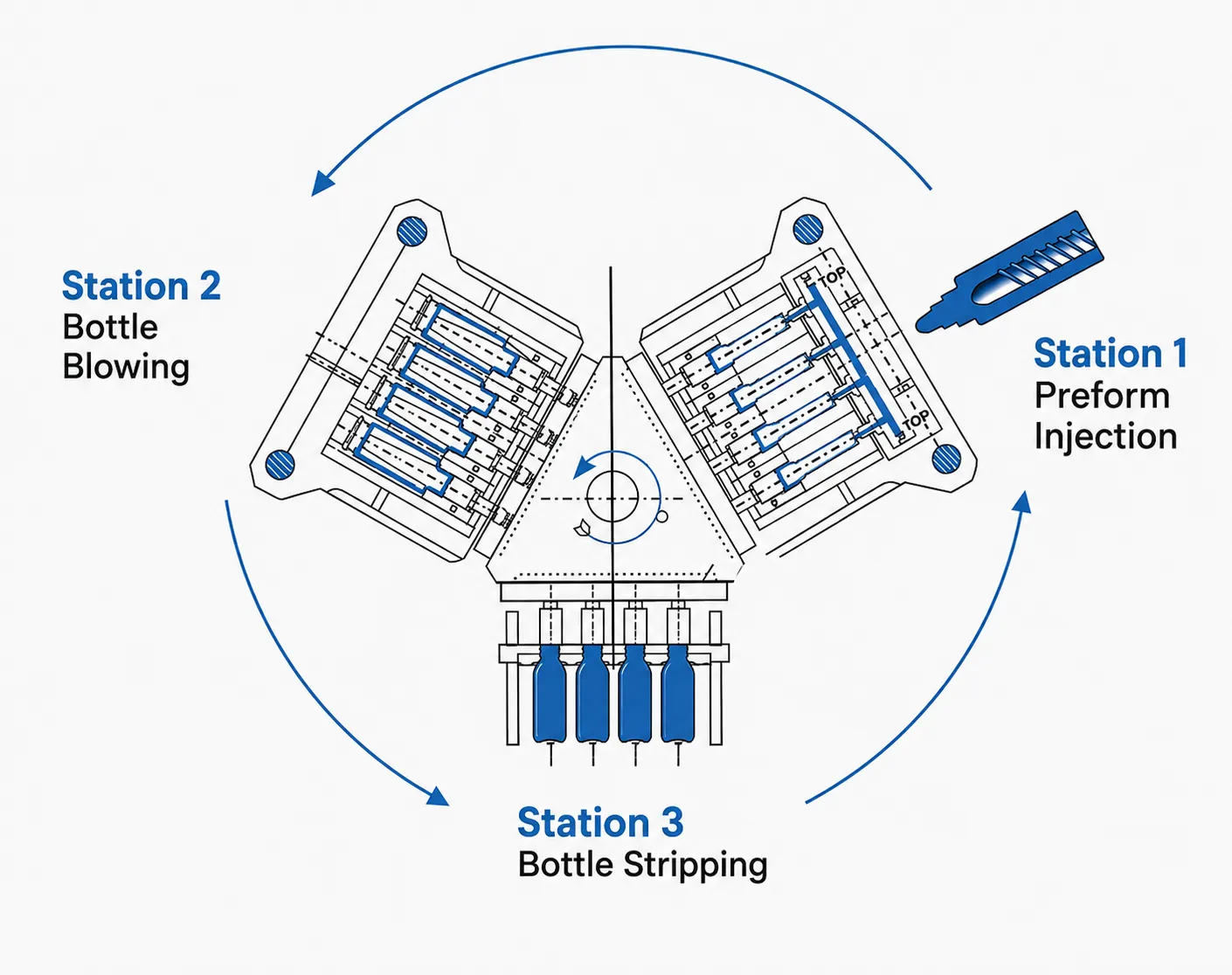
Wadah oftalmik HDPE 10 ml Korea mengikuti spesifikasi dimensi yang sangat terstandarisasi di seluruh merek farmasi Korea — standardisasi yang didorong oleh kompatibilitas dengan sistem tutup penetes yang dipasok oleh produsen tutup penetes Korea dan oleh spesifikasi lini pengisian farmasi Korea yang dioptimalkan untuk dimensi format oftalmik standar 10 ml.
| Dimensi | Spesifikasi | Dasar Fungsi/Persyaratan |
|---|---|---|
| finishing leher | 13/415 GPI | Antarmuka tutup penetes mata standar Korea — kompatibel dengan pemasok tutup penetes Korea dan tutup penetes mata CRC. |
| Toleransi diameter luar leher | 13,00 mm ±0,05 mm | Jendela toleransi pemasangan snap-fit tutup penetes — bawaan IBM, ±0,05 mm di semua rongga |
| Diameter Lubang | 9,0 mm ±0,04 mm | Diameter luar sisipan penetes — ditentukan oleh diameter luar batang inti pada cetakan injeksi IBM. |
| Tinggi kontainer | 42–52 mm | Kompatibilitas penjepit saluran pengisian Korea dan dimensi baki dispensing apotek Korea |
| Diameter maksimum badan | 22–28 mm | Jarak antar baris baki dosis tunggal untuk apotek Korea — maksimal 28 mm agar kompatibel dengan baki standar Korea. |
| Ketebalan dinding tubuh | 0,30–0,40 mm | Transparansi untuk inspeksi tingkat pengisian; ≤0,40 mm untuk transparansi HDPE yang memadai pada volume 10 ml. |
| Akurasi volume | 10,0 ml ±0,5 ml | Toleransi volume pengisian oftalmik KFDA Korea — posisi tanda pengisian pada wadah IBM harus mencerminkan toleransi ini pada suhu 23°C. |
| Berat botol | 2,5–4,5 g | HDPE IBM dengan ketebalan dinding badan 0,30–0,40 mm — lebih ringan daripada EBM yang setara; spesifikasi berat rongga ke rongga CV% ≤4% |
The 13/415 neck finish specification is critical for Korean ophthalmic IBM mould design: the 13 mm nominal neck OD and 415 thread count (15 threads per inch) are the international standard for ophthalmic dropper closures adopted by Korean ophthalmic pharmaceutical brands and Korean dropper cap manufacturers. IBM container moulds for Korean ophthalmic production must specify 13/415 neck inserts in the injection mould to the same dimensional accuracy as the Korean dropper cap tooling — ±0.02 mm on the neck OD at the injection mould neck cavity insert ensures that the finished IBM bottle’s ±0.05 mm neck OD tolerance is achieved with process margin on both sides of the dropper cap engagement window.
3. Presisi Leher IBM untuk Pengait Tutup Pipet
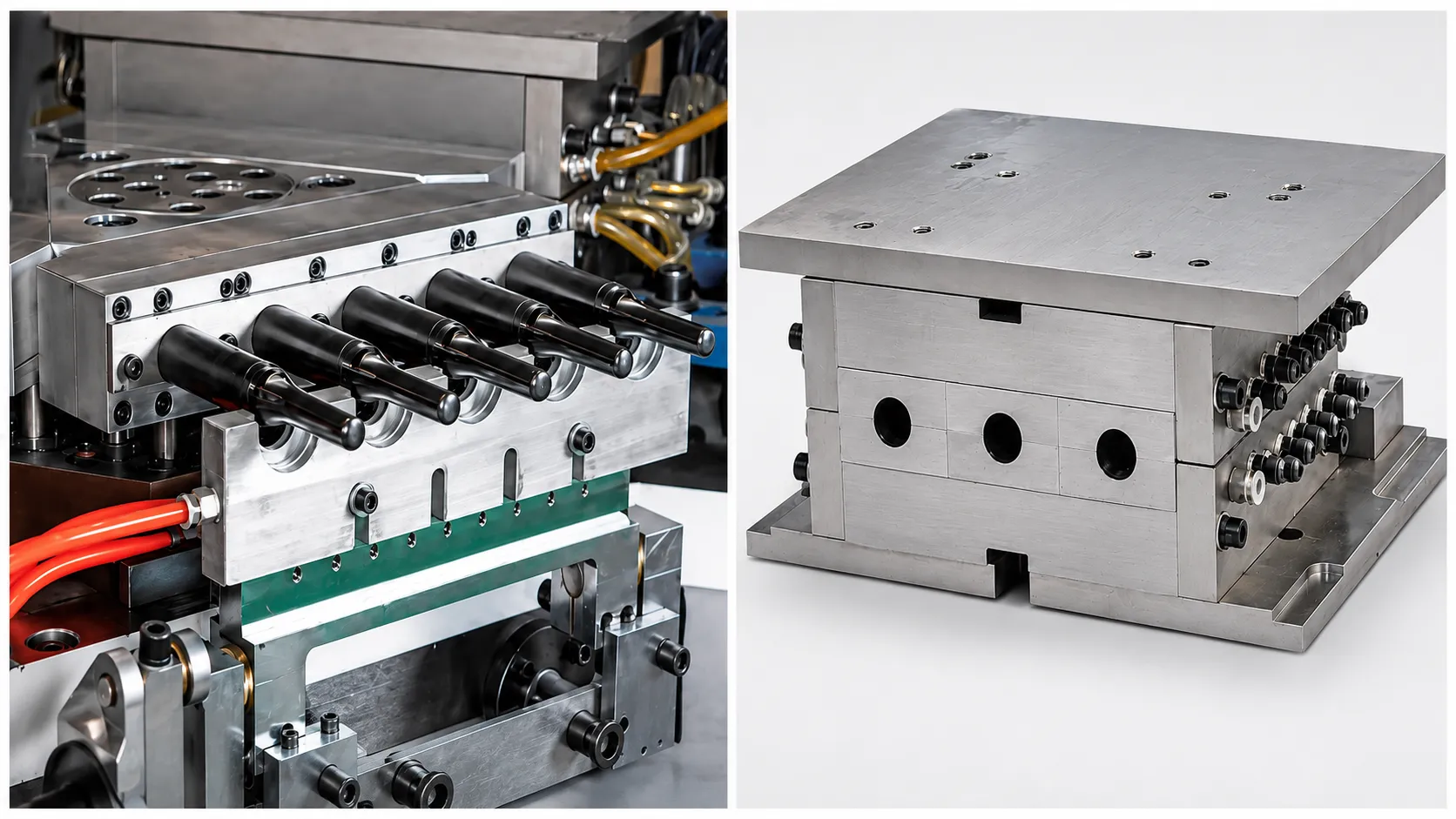
The Korean ophthalmic dropper cap system has two precision interface points with the IBM container neck: the outer snap-fit or thread engagement between the dropper cap skirt and the neck OD, and the inner bore engagement between the dropper insert’s controlled orifice body and the neck bore ID. Both interfaces require dimensional precision that IBM provides natively through its injection mould tooling and core rod mechanism.
Antarmuka Jepit Luar: Diameter Luar Leher ±0,05 mm
Korean ophthalmic dropper caps engage the IBM bottle neck at the 13 mm OD by a circumferential bead on the cap skirt that snaps over the neck’s retaining flange. This snap-fit engagement provides: tamper evidence (the bead breaks an induction seal or deforms the retaining flange on first opening), child resistance (some Korean ophthalmic CRC formats require push-and-turn action), and closure retention during Korean pharmacy dispensing handling (the cap must remain attached to the bottle when tapped on a Korean pharmacy dispensing tray). The snap-fit mechanism’s function depends on the interference between the cap bead inner diameter and the bottle neck flange OD — the designed interference is typically 0.08–0.15 mm (the cap bead is 0.08–0.15 mm smaller in diameter than the neck flange OD). With IBM’s ±0.05 mm neck OD tolerance, the interference varies between 0.08–0.15 mm ±0.05 mm across all cavities — always within the range where snap-fit engagement occurs without cap opening force being excessive for Korean pharmacists or patients. With EBM’s ±0.15–0.25 mm neck OD tolerance, the interference variation of ±0.15–0.25 mm would produce, at the low end, engagement that is either absent (cap falls off) or, at the high end, engagement that requires destructive force to open — neither acceptable in Korean ophthalmic pharmaceutical distribution.
Antarmuka Lubang Dalam: Lubang Sisipan Penetetes pada ±0,04 mm
The dropper insert — the controlled-orifice component that produces a consistent 25–35 microlitre drop volume per squeeze — seats inside the IBM bottle neck bore, with its outer body in contact with the bore inner surface. The drop volume delivered by the dropper insert depends on two factors: the orifice diameter (controlled by the dropper insert mould tooling) and the bore-insert interference fit (controlled by the IBM bore ID versus the dropper insert OD). If the IBM bore is too small (below nominal), the dropper insert compresses inward and distorts the orifice geometry — producing smaller drop volumes than specified. If the IBM bore is too large (above nominal), the dropper insert can tilt within the bore, creating asymmetric orifice orientation that produces erratic drop trajectory in Korean patient use. IBM’s core rod defines the bore ID at ±0.04 mm across all cavities through the direct mechanical relationship between the core rod OD and the bore it forms during injection — the bore is not blown, not stretched, not dependent on air pressure, and does not vary with process parameter fluctuation at the blow station.
4. Tingkat dan Proses Pengolahan HDPE untuk IBM Oftalmik
Bahan pelapis dinding (IBM) HDPE oftalmik Korea menggunakan spesifikasi resin yang lebih sempit daripada IBM farmasi umum — kombinasi dinding badan yang tipis (0,30–0,40 mm), jumlah rongga yang tinggi (20–30 rongga), jalur hot runner yang panjang, dan persyaratan ekstrak KFDA Korea menciptakan serangkaian spesifikasi yang mempersempit rentang grade HDPE yang dapat digunakan menjadi MI 0,3–0,5 pada 190°C/2,16 kg dan densitas 0,950–0,960 g/cm³ untuk sebagian besar aplikasi IBM oftalmik Korea.
Spesifikasi Tingkat Resin
- MI: 0,3–0,5 g/10 menit (190°C / 2,16 kg)
- Kepadatan: 0,950–0,960 g/cm³
- Aditif: Hanya yang termasuk dalam daftar positif KFDA
- Tanpa penstabil UV, tanpa bahan anti selip.
- Antioksidan: AO-1010 atau AO-168 ≤0,05%
- Diperlukan deklarasi kontak farmasi KFDA.
Parameter Pemrosesan (ZQ80/ZQ110)
- Barel: 175→195→210→215→215°C
- Tekanan injeksi: 90–130 MPa
- Waktu pengisian: 0,6–1,0 detik (dinding tipis)
- Tahan: Puncak 50–65%, 0,4–0,8 detik
- Tiup udara: 0,5–0,8 MPa
- Waktu hembusan: 0,7–1,2 detik
- Suhu cetakan: 12–22°C
Pemeriksaan Kualitas Kritis
- Diameter luar leher: 13,00 ±0,05 mm — semua rongga
- Diameter Lubang: 9,0 ±0,04 mm — semua rongga
- Berat botol: ±4% CV% di seluruh rongga
- Transparansi dinding: lulus pemeriksaan visual tingkat pengisian.
- Pengait tutup penetes: 100% pasang jepret pada saluran
- Partikulat: memenuhi standar oftalmologi KFDA
Interaksi antara transparansi dinding dan kualitas HDPE: Korean ophthalmic containers must allow Korean pharmacists and Korean patients to visually inspect the liquid fill level — a requirement that limits HDPE wall thickness to ≤0.40 mm at the body panel, where HDPE’s semi-crystalline structure transmits sufficient light at this thickness for fill-level judgement. At 0.50 mm body wall, standard HDPE at density 0.955 g/cm³ becomes opaque enough that fill-level inspection is unreliable. The 0.30–0.40 mm body wall is a design constraint that the IBM mould designer must achieve through the preform geometry and blow ratio — and that the IBM operator must verify in production through periodic wall thickness measurement at the minimum body wall location using ultrasonic gauge measurement.
5. Persyaratan Kualifikasi Wadah Oftalmik KFDA Korea
Persyaratan kualifikasi wadah farmasi oftalmik KFDA Korea lebih ketat daripada persyaratan wadah farmasi umum dalam dua area spesifik: standar kontaminasi partikulat dan durasi pengujian kompatibilitas. Persyaratan yang lebih ketat ini mencerminkan rute pemberian oftalmik — permukaan mata sangat sensitif terhadap partikel dan zat kimia, dan standar keamanan produk oftalmik KFDA Korea dikalibrasi sesuai dengan hal tersebut.
Standar Partikulat Oftalmik (KFDA / Farmakope Korea)
Korean Pharmacopoeia (KP) aligns with USP <790> for visible particulates in ophthalmic preparations and USP <788> for sub-visible particulate matter in ophthalmic preparations. For Korean IBM ophthalmic container qualification, particulate testing applies in two stages: container wash-extract testing (empty containers filled with purified water, agitated and examined for visible particulate and sub-visible particulate count) and filled product testing (Korean ophthalmic formulation filled into IBM containers examined at end of proposed shelf life). IBM container wash-extract particulate limits per KP ophthalmic container test: visible particles — absent (zero visible particles in wash extract when examined under Korean Pharmacopoeia visible inspection method); sub-visible particles per KP (aligned with USP <788>): ≤25 particles/ml ≥10 μm, ≤3 particles/ml ≥25 μm. IBM’s zero-flash production eliminates the most significant source of sub-visible particulate in blow-moulded pharmaceutical containers — the plastic fines generated by EBM flash trimming. Korea Ever-Power’s pharmaceutical IBM documentation package includes a reference statement on IBM’s zero-flash architecture for use in the Korean pharmaceutical container qualification documentation that addresses Korean KFDA questions on particle contamination prevention during container production.
Durasi Pengujian Kompatibilitas untuk Kontainer IBM Oftalmik
Korean KFDA ophthalmic pharmaceutical container compatibility testing requires a 24-month accelerated stability study at 40°C/75% RH — 12 months longer than the 12-month standard for most oral pharmaceutical container compatibility studies. The longer study period reflects the Korean KFDA position that ophthalmic formulations’ complex mixture of active ingredients, preservatives (benzalkonium chloride, thimerosal, or preservative-free buffer systems) and buffering agents creates a more complex extractable interaction profile with HDPE than simple aqueous solutions. Korean IBM ophthalmic packaging producers should plan for 24-month compatibility studies — which means beginning the filled container compatibility study immediately upon first IBM production at qualification conditions, so that the 24-month study result is available within the overall Korean ophthalmic product development timeline without delaying the KFDA submission.
6. Pengaturan Ruang Bersih IBM untuk Produksi Oftalmik Korea
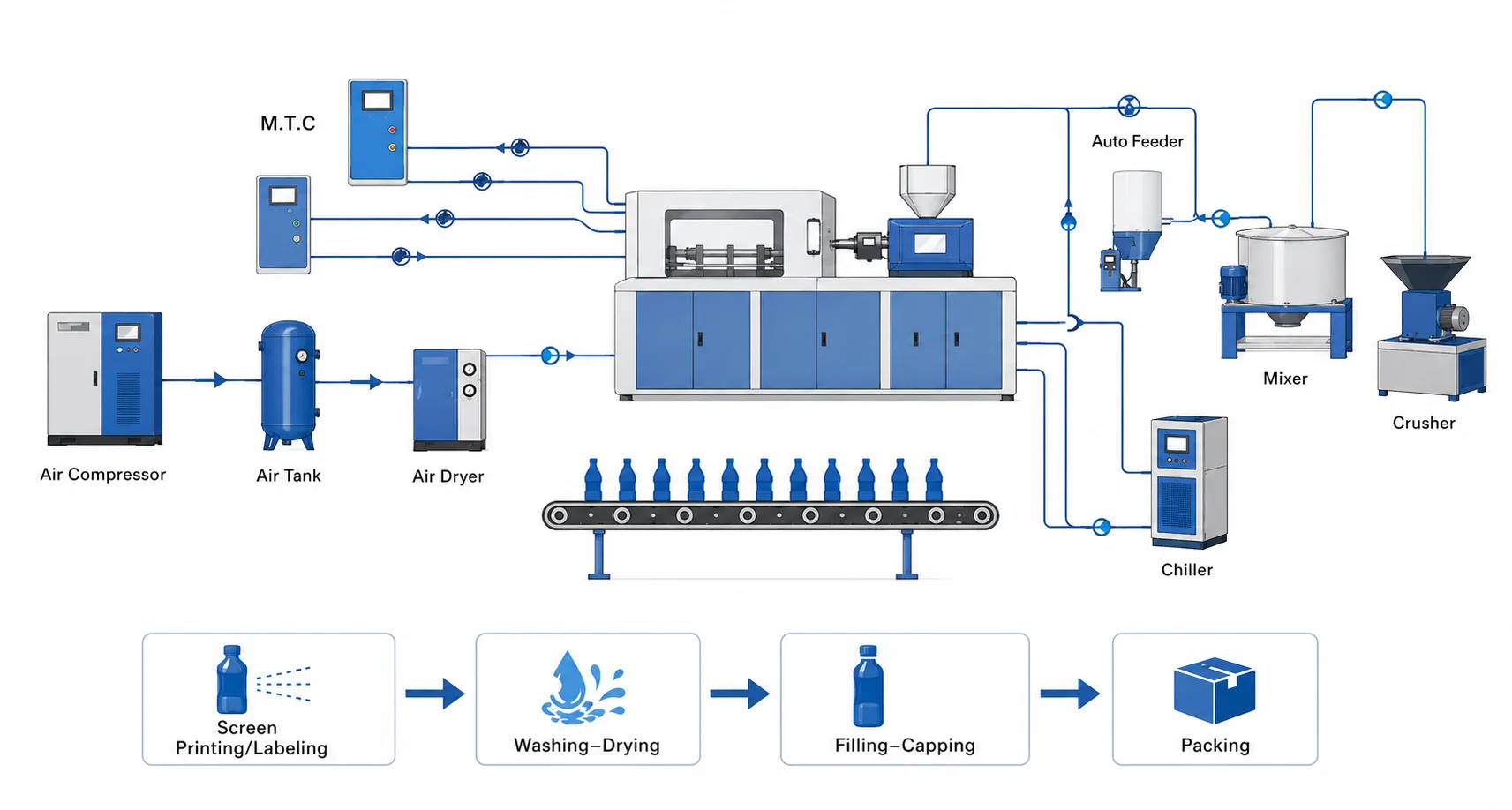
Produksi wadah IBM oftalmik Korea biasanya dilakukan di lingkungan ruang bersih ISO Kelas 8 (setara dengan GMP Grade D Korea). Persyaratan ruang bersih khusus untuk produksi wadah IBM oftalmik — berbeda dari pengaturan ruang bersih IBM farmasi umum yang dijelaskan dalam panduan IBM farmasi — mencerminkan sensitivitas partikulat yang lebih tinggi dari wadah oftalmik Korea.
- Pasokan udara HEPA di atas stasiun cetakan: The IBM machine’s mould area — where containers are formed and where the core rods deposit finished containers onto the output conveyor — should receive HEPA-filtered supply air at ≥0.45 m/s face velocity downward into the open mould area. This positive-pressure HEPA supply air prevents airborne particles from entering the open container mouth during the time between stripping (Station 3) and cap application at the downstream Korean pharmaceutical filling line. The HEPA enclosure over the mould station is specified as a separate engineering item in the Korean ophthalmic IBM cell design — Korea Ever-Power provides connection points and dimensional data for the HEPA enclosure installation on the ZQ machine outline drawings.
- Udara bertekanan bebas oli — wajib: Udara bertekanan yang digunakan untuk pencetakan tiup IBM pada wadah oftalmik Korea harus bebas minyak pada titik penggunaan — ISO 8573-1 Kelas 0 untuk aerosol minyak dan uap minyak. Kontaminasi minyak pada udara tiup IBM di stasiun peniupan akan bersentuhan dengan bagian dalam preform HDPE selama inflasi dan menjadi kontaminan yang dapat diekstraksi dalam wadah jadi. Produsen IBM oftalmik Korea harus menentukan kompresor ulir bebas minyak (bukan kompresor bolak-balik berpelumas minyak dengan filter hilir), dan harus memverifikasi status bebas minyak pada titik sambungan mesin dengan pemantauan partikulat dan uap minyak secara berkala sesuai dengan protokol pemantauan kualitas udara bertekanan farmasi Korea.
- Penutup HEPA pada konveyor keluaran: Wadah oftalmik Korea yang keluar dari mesin IBM di Stasiun 3 bergerak di atas konveyor keluaran sebelum dikumpulkan ke dalam kantong atau nampan untuk diangkut ke jalur pengisian farmasi Korea. Bagian konveyor ini juga harus tertutup HEPA untuk menjaga kebersihan wadah dari pintu keluar mesin IBM hingga titik pengumpulan. Penutup HEPA konveyor biasanya dipasang sebagai terowongan dengan udara suplai HEPA bertekanan positif dan pembuangan yang disaring di pintu keluar konveyor. Tanpa penutup konveyor, wadah oftalmik IBM Korea dapat mengakumulasi partikel udara selama perjalanan di konveyor yang kemudian mengendap di mulut wadah yang terbuka dan berkontribusi pada jumlah partikel sub-visual di dalam wadah yang terisi.
7. Analisis Ekonomi Jumlah Rongga pada IBM Oftalmologi Korea
Cavity count selection for Korean ophthalmic IBM is the highest-impact single investment decision — because the Korean ophthalmic container market’s 500M+ annual unit demand requires matching machine cavity count to annual production volume with enough precision that the machine runs at 70–90% utilisation (below 60% utilisation wastes capital; above 90% utilisation creates production risk from unscheduled maintenance). The following analysis compares three ZQ models for a Korean ophthalmic contract packaging factory with a specific annual volume requirement.
| Parameter | ZQ80 (20 rongga) | ZQ110 (24 rongga) | ZQ135 (30 rongga) |
|---|---|---|---|
| Botol/jam (88% efektif) | ~15,840 | ~19,000 | ~23,760 |
| Botol/Korea, 2 shift sehari (14 jam) | ~221,760 | ~266,000 | ~332,640 |
| Botol/tahun (250 hari) | ~55,4 juta | ~66,5 juta | ~83,2 juta |
| Mesin untuk 200 juta unit/tahun | 4 mesin | 3 mesin | 3 mesin (72% util.) |
| Kualifikasi KFDA diperlukan | 4 kualifikasi mesin | 3 mesin berkualitas | 3 kualifikasi mesin (terendah per unit) |
Tabel ekonomi jumlah rongga menunjukkan bahwa untuk perusahaan pengemas kontrak oftalmik Korea yang menargetkan 200 juta unit 10 ml per tahun, ZQ135 dengan 30 rongga membutuhkan jumlah mesin yang sama dengan ZQ110 dengan 24 rongga (3 mesin dalam kedua kasus) tetapi beroperasi pada utilisasi 72% dibandingkan 100% — memberikan ruang produksi untuk perawatan yang tidak terjadwal, waktu henti perubahan format, dan pertumbuhan permintaan tahunan tanpa memerlukan pembelian mesin keempat. Jumlah kualifikasi mesin KFDA Korea juga diminimalkan pada jumlah rongga yang lebih tinggi (3 kualifikasi pada ZQ135 dibandingkan 4 pada ZQ80) — setiap kualifikasi mesin mewakili jangka waktu pengujian 16–24 minggu dan biaya dokumentasi yang signifikan. Bagi fasilitas pengemasan kontrak oftalmik Korea yang ingin meminimalkan jumlah total kualifikasi mesin KFDA sambil mempertahankan redundansi produksi, ZQ135 atau ZQ110 jelas merupakan investasi yang tepat dibandingkan beberapa mesin ZQ80 dengan output tahunan yang setara. Korea Ever-Power EP-ZQ110 merupakan platform awal yang paling umum digunakan oleh perusahaan pengemas kontrak oftalmik Korea yang volume tahunannya berkisar antara 50 juta hingga 80 juta unit per mesin.
8. Pemilihan Seri ZQ untuk Produksi IBM Oftalmik Korea
Untuk produksi IBM oftalmik Korea, pemilihan antara model seri ZQ tidak hanya melibatkan tingkat output dan biaya modal, tetapi juga pertimbangan khusus farmasi: kualifikasi KFDA Korea terkait dengan model mesin dan jumlah rongga tertentu. Panduan berikut mempertimbangkan kendala khusus farmasi ini.
Startup Oftalmologi Korea / Produksi Percobaan → ZQ60 (14 rongga)
Volume tahunan di bawah 25 juta unit. Perusahaan rintisan farmasi Korea, uji coba lini produk oftalmik Korea, produksi percobaan CMO Korea untuk merek oftalmik internasional yang memasuki Korea. Investasi ZQ60 sesuai untuk volume di bawah 25 juta unit tetapi memerlukan perencanaan masa depan yang cermat: peningkatan dari ZQ60 ke ZQ80 untuk produk oftalmik Korea yang terdaftar di KFDA memerlukan pemberitahuan perubahan mesin KFDA Korea yang baru dan kualifikasi pada mesin baru — proses 3–6 bulan. Produsen kemasan oftalmik Korea yang mengantisipasi pertumbuhan hingga 30 juta+ unit dalam 3 tahun harus memesan ZQ80 sejak awal dan menerima pemanfaatan awal yang lebih rendah, menghindari biaya transisi kualifikasi.
Pabrik Oftalmologi Skala Menengah Korea → ZQ80 (20 rongga, 30 juta–55 juta unit/tahun)
The ZQ80’s dual hydraulic system (20–30% energy saving) and high-precision angle divider (standard at ZQ80+) make it the entry point for Korean ophthalmic production where energy efficiency and inter-cavity consistency are KFDA qualification requirements. At 20-cavity 10 ml production, ZQ80 produces approximately 55M ophthalmic bottles per Korean two-shift year — sufficient for Korean mid-scale pharmaceutical manufacturers serving Korean domestic ophthalmic market without export requirements.
Pabrik Oftalmologi Skala Besar Korea → ZQ110 / ZQ135 (55 juta–83 juta+ unit/tahun per mesin)
Perusahaan pengemas kontrak farmasi Korea yang melayani merek oftalmologi multinasional, eksportir farmasi Korea, dan produsen oftalmologi nasional Korea yang melayani rantai pasokan rumah sakit Korea dalam skala nasional — semuanya membutuhkan produksi ZQ110 atau ZQ135 untuk mencapai volume produksi dan efisiensi kualifikasi KFDA yang dibutuhkan oleh model bisnis mereka. rangkaian lengkap mesin cetak tiup injeksi Mencakup semua skala produksi oftalmologi Korea, mulai dari perusahaan rintisan hingga pasokan farmasi skala nasional.
Pertanyaan yang Sering Diajukan
Permintaan Informasi Oftalmologi IBM
Apakah Anda berencana memproduksi wadah oftalmik Korea untuk IBM?
Korea Ever-Power menyediakan desain cetakan IBM oftalmik 10 ml, dokumentasi kualifikasi KFDA Korea, perencanaan sel produksi ruang bersih, dan pemilihan mesin seri ZQ untuk kemasan farmasi oftalmik dan perawatan mata OTC Korea di semua volume produksi tahunan.
Sumber Daya Terkait
Mesin Cetak Tiup Injeksi EP-ZQ80
800 KN · 20 rongga dengan kapasitas 10 ml untuk cairan mata · Pembagi sudut + standar hidrolik ganda · ~55 juta wadah cairan mata Korea per tahun kerja dua shift di Korea.
Mesin Cetak Tiup Injeksi EP-ZQ135
1.350 KN · 30 rongga pada wadah oftalmik 10 ml · 6+N zona tabung · 37+37 KW · ~83 juta wadah oftalmik Korea per tahun — Skala rantai pasokan rumah sakit nasional Korea.
Pencetakan Tiup Injeksi HDPE: Panduan Proses Lengkap
Panduan lengkap pemrosesan IBM HDPE — pemilihan grade (MI 0.3–0.8), pengaturan suhu barel, spesifikasi ketebalan dinding, dan pemilihan seri ZQ untuk IBM farmasi dan bahan kimia rumah tangga.