
बीपीए-मुक्त बेबी बोतल निर्माण — ट्राइटन, पीसी और पीईटीजी के लिए आईएसबीएम मशीनें
Baby bottles carry a regulatory and reputational burden that no other blow-moulded container faces. The infant consuming from the bottle has a developing immune system, a higher fluid intake relative to body weight than an adult, and no ability to signal when something is wrong. This makes baby bottle manufacturing the application in which material safety, dimensional precision, contamination-free production, and structural performance under drop impact must all be met simultaneously — and where the consequences of failure are, uniquely, both regulatory and ethical.
The global pivot away from polycarbonate (PC) as the standard baby bottle resin — driven by BPA migration concerns that became public knowledge in the mid-2000s — created a commercial opportunity for alternative resins, particularly Eastman’s Tritan™ copolyester. Today, Tritan baby bottle manufacturing by injection stretch blow moulding has become the industry standard for premium baby bottles in Korea, Japan, and Western markets, and PETG is the standard for mid-tier baby bottles where Tritan’s cost is a constraint. A correctly specified baby bottle manufacturing machine — whether a BPA-free bottle machine for Tritan, or a baby bottle blow moulding line for PETG in higher-volume configurations — must address resin-specific processing requirements, wide-neck mould geometry, GMP documentation, and drop-resistance engineering simultaneously. This guide covers how to configure an ISBM machine for baby bottles correctly across all four dimensions, including the specific requirements for Tritan injection stretch blow moulding that most general ISBM guides overlook.

Why Baby Bottles Have the Strictest Packaging Requirements
The regulatory framework governing baby bottle materials is more stringent than for any other food-contact plastic container, for two reasons grounded in infant physiology and exposure science:
Higher Relative Exposure — Infant Fluid Intake vs Body Weight
An infant consuming formula at a typical rate of 150–180 ml per kilogram of body weight per day is exposed to plastic container leachates at a far higher dose per unit of body weight than an adult drinking from a PET water bottle. A 5 kg infant consuming 800 ml of formula per day from a 250 ml Tritan bottle has 3–4 bottle-contact hours per day at body temperature — a contact condition that maximises migration of any mobile compounds from the container material into the fluid.
This higher relative exposure is the regulatory basis for the specific migration limits (SML) applied to infant feeding articles that are significantly lower than those applied to general food-contact plastics. The European Union’s Regulation (EU) No 10/2011 on plastic materials and articles intended to contact food establishes an overall migration limit of 60 mg/kg of food for general food contact plastics — but infant bottles are subject to additional national and brand specifications that frequently require specific substance migration testing at or near the detection limit.
Regulatory Framework — What Baby Bottle Resins Must Satisfy
Baby bottle resins and the containers made from them must comply with, depending on the target market:
कोरिया (एमएफडीएस)
Korean Ministry of Food and Drug Safety standards for synthetic resin food-contact articles — comprehensive positive list of permitted substances with specific migration limits. BPA prohibited in baby bottles and sippy cups since 2012. Tritan and PETG are approved under the positive list system with compliance documentation required at market entry.
European Union
EU Regulation No 10/2011 (plastics FCM); Commission Directive 2011/8/EU restricting BPA in polycarbonate infant feeding bottles. Tritan has European Food Safety Authority (EFSA) authorisation as a food contact material; PETG grades must be assessed individually against the positive list.
United States (FDA)
FDA 21 CFR §177.1580 (polycarbonate resins) and §177.1315 (ethylene terephtalate polymers — covers PET, PETG, and related copolymers). BPA phased out from baby bottles by manufacturer decision after FDA 2012 review; formal prohibition not federally mandated but effectively universal in the market. Tritan compliance: Eastman has submitted FDA Food Contact Notification for Tritan grades used in infant articles.
The practical implication for baby bottle manufacturers is that resin selection must be documented through the supply chain — the resin grade used in production, its compliance documentation (TDS, migration test data, regulatory compliance certificates), and the manufacturing conditions (barrel temperature, residence time) must be captured in the production batch record. This documentation chain starts with the ISBM machine’s production data and runs through to the market authorisation file. For operations producing for regulated markets, selecting a machine that supports this documentation — barrel temperature logging, shot weight recording, batch time-stamping — is as important as the machine’s process capability.
The Three Safe Resins for Baby Bottle ISBM
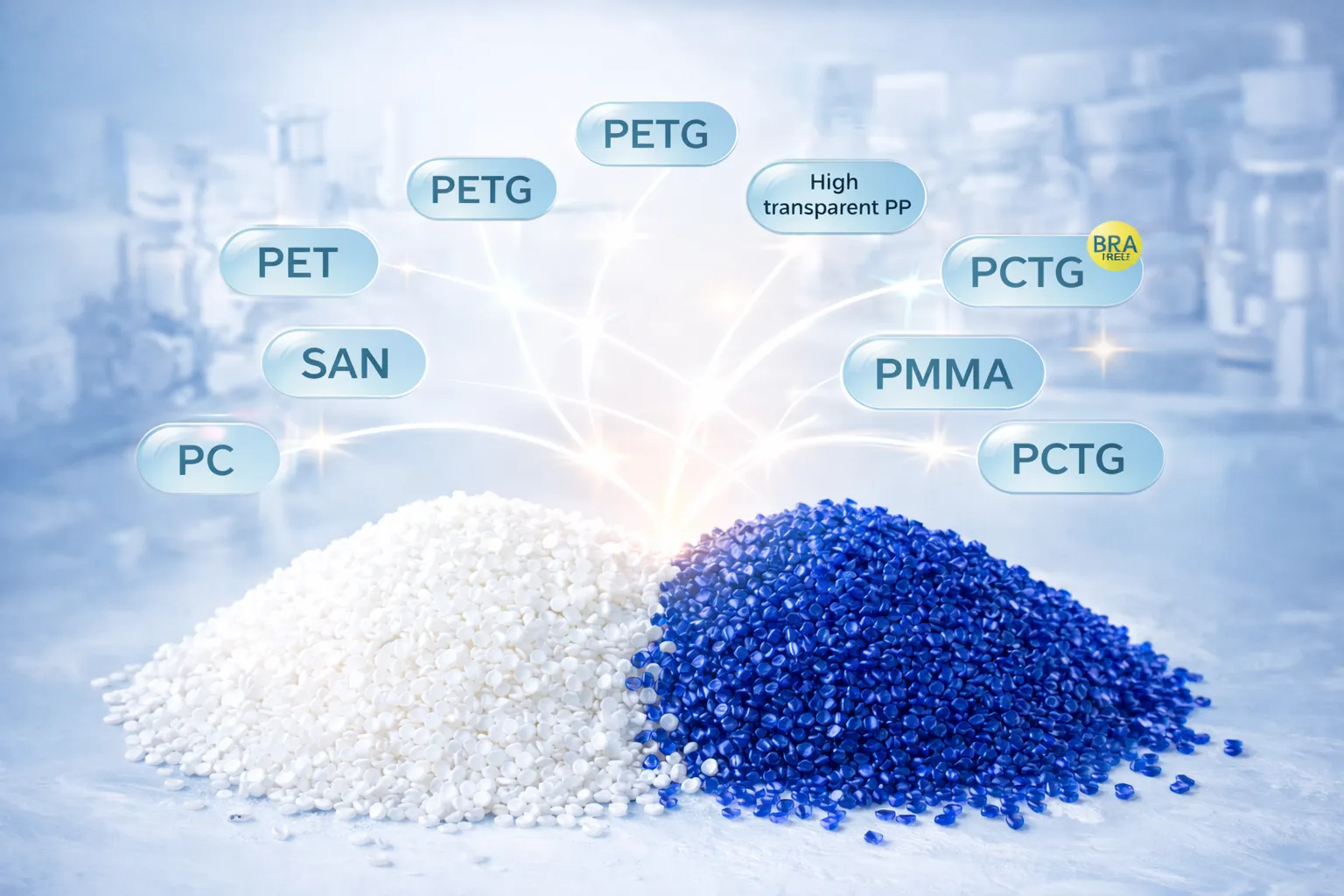
Tritan™ (Eastman) — The Premium BPA-Free Standard
Eastman Tritan™ copolyester has become the dominant resin in premium baby bottle manufacturing globally since the mid-2010s. Its commercial success rests on four properties that address both the regulatory and practical requirements of the baby bottle market simultaneously:
- BPA-free by composition — Tritan does not use bisphenol A as a monomer at any stage of its synthesis. This is a structural material property, not a processing achievement; it holds regardless of the production conditions or supplier.
- Glass transition temperature ~98 °C — Tritan maintains its shape in dishwashers (typically 60–70 °C cycle temperature) and in microwave sterilisation, unlike PETG (Tजी ~80 °C) which softens under sustained high-temperature cleaning.
- High impact resistance — Tritan’s toughness is significantly higher than both PET and PETG at equivalent wall gauge. Drop impact resistance — which defines the survival rate of bottles falling from feeding chairs and changing tables — is a critical consumer performance requirement for baby bottles, and Tritan delivers it consistently.
- Glass-like optical clarity — Tritan produces haze values below 0.5% in ISBM-blown bottles, matching PETG’s clarity performance and substantially exceeding PET.
The processing challenge specific to Tritan is its sensitivity to barrel temperature variation. If the barrel temperature in any zone exceeds the target by more than ±2–3 °C, Tritan begins to yellow — a colour change that is immediately visible in the finished bottle and constitutes a rejection. Because yellowing is caused by thermal degradation at a molecular level, it cannot be corrected by downstream processing; the degraded material must be purged and the batch scrapped. The ±1 °C barrel temperature control that the ISBM machine’s PID-controlled barrel heating system must maintain for Tritan production is therefore a hard machine requirement, not a performance aspiration.
PETG — The BPA-Free Mid-Tier Option
PETG (glycol-modified polyethylene terephthalate) is the BPA-free resin most widely used in mid-tier baby bottles — Korean domestic brands, private-label for retail, and markets where Tritan’s premium cost is a commercial constraint. PETG’s optical clarity is comparable to Tritan (haze below 0.5% in well-processed ISBM bottles) and its chemical resistance to cleaning agents and sterilisation solutions is good. Its primary limitation for baby bottles versus Tritan is its glass transition temperature — at Tजी ≈ 80 °C, PETG baby bottles are not recommended for repeated dishwasher cycles at temperatures above 65–70 °C, as sustained thermal exposure can cause slight dimensional distortion in the bottle neck finish. For parents using hand-washing or cold sterilisation (cold-water sterilising tablets), PETG performs entirely adequately; for parents relying on dishwasher or steam steriliser cycles at 60–70 °C, Tritan is the more durable choice.
PC (Polycarbonate) — Technically Superior, Commercially Declining
Polycarbonate was the original premium baby bottle resin — clear, rigid, autoclave-compatible, and highly impact-resistant. Its Tजी of approximately 147 °C makes it the most thermally stable of the three resins in daily use, and its optical clarity is exceptional. The problem is structural: PC is synthesised from bisphenol A (BPA), and while BPA migration from properly processed PC into food is extremely small (typically below detection limits in routine testing), the public perception of BPA risk in infant products has effectively eliminated PC from the consumer baby bottle market in Korea, Japan, and all Western markets. PC baby bottles remain in use in some professional medical and neonatal settings where autoclave sterilisation is required and the risk profile has been formally assessed — but for commercial baby bottle manufacturing targeting consumer markets, PC is no longer a viable resin choice regardless of the regulatory compliance data.
Processing Requirements — What Changes for Each Resin
The processing conditions required for Tritan, PETG, and PC in an आईएसबीएम मशीन are sufficiently different that a machine configured for one resin cannot run another without parameter changes — and in some cases, the machine must have specific hardware options fitted to process the target resin reliably. The table below summarises the key differences:
The most operationally significant difference between Tritan and PETG processing — and the one most likely to produce quality failures on a machine not properly configured for Tritan — is the ±1 °C barrel temperature control requirement. PETG tolerates ±2–3 °C variation across the barrel zones without visible quality impact in most production contexts. Tritan does not: a single zone running 3–4 °C above target for more than a few cycles produces visibly yellow-tinted preforms that will appear as yellow-cast baby bottles — a quality failure that is immediately detectable by any parent and will result in brand rejection.
The ISBM machine’s barrel temperature control system must use PID-controlled zone heaters with thermocouple feedback capable of maintaining setpoint to ±1 °C under production conditions (not just at steady-state idle). Korea Ever-Power’s HGY series machines meet this requirement across all barrel zones; buyers considering alternative suppliers should specifically request barrel temperature stability data under continuous production conditions, not just thermocouple accuracy specifications.
Why ISBM Is the Right Process for Baby Bottles
Baby bottles could theoretically be produced by two-step reheat blow moulding — but in practice, the application requirements push almost all premium baby bottle production toward one-step ISBM. Three specific characteristics of the one-step process align directly with baby bottle production requirements:
No Preform Storage — No Contamination Window
In two-step blow moulding, preforms are stored in bulk containers (gaylords) between injection and blowing — sometimes for hours, sometimes for days, in an uncontrolled environment. For standard beverage bottles, this is accepted as a practical production reality. For baby bottles, where the finished container may be in direct extended contact with infant formula at body temperature for hours each day, the contamination risk introduced by bulk preform storage — airborne particles, surface contact with other preforms, potential cross-contamination from adjacent materials — is a quality and regulatory exposure that many baby bottle brands refuse to accept.
ISBM’s one-step closed-loop process eliminates this exposure window entirely. The preform is injected and blown in the same machine, in the same cycle, without external handling. The bottle exits the machine having had contact only with the precision-machined mould surfaces and the process air — a dramatically shorter and more controlled contamination pathway than two-step production.
GMP-Compatible Electric Drive — Critical for Certified Production
Baby bottle manufacturers targeting regulated markets (Korea MFDS, EU, FDA) frequently operate in controlled production environments — not necessarily full ISO-classified cleanrooms, but areas with defined environmental monitoring, no hydraulic oil contamination sources, and documented equipment qualification. The fully electric ISBM machine’s oil-free architecture is directly compatible with this controlled environment requirement. The hydraulic machine’s oil contamination risk, while manageable in a standard production setting, introduces a contamination source that complicates GMP compliance documentation and requires ongoing monitoring to verify absence of oil on product surfaces.
Machine Selection for Baby Bottle Production
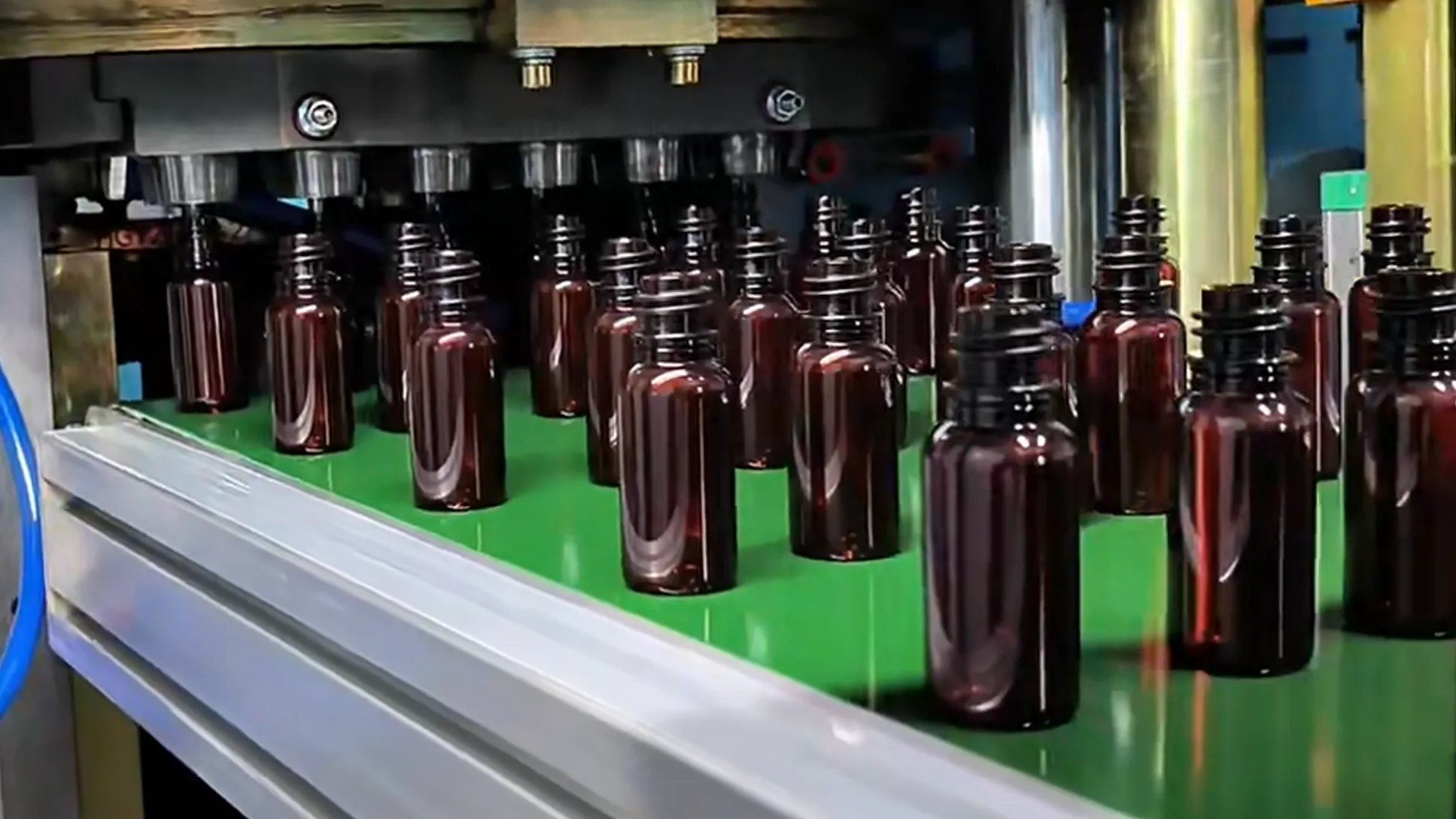
The two primary machine selection questions for baby bottle production are: which resin, and what is the preform weight? The answers determine both which machine platform is required and whether the fully electric drive variant is necessary.
The HGY150-V3 is the machine for large-format Tritan baby bottles — 250–330 ml wide-neck designs where the preform weight (reflecting Tritan’s thick walls and the large neck finish diameter) exceeds the HGY50’s 188 g injection capacity. Wide-neck baby bottle preforms are substantially heavier than narrow-neck preforms of the same internal volume, because the larger neck finish requires proportionally more material in the neck tooling zone. A 250 ml wide-neck Tritan baby bottle preform can weigh 220–260 g — well above the HGY50’s ceiling and comfortably within the HGY150-V3’s 315 g injection capacity.
Mould Design for Baby Bottles
Wide-Neck Finish — Avent-Style and NUK-Style Dimensions
The defining dimensional feature of baby bottles that distinguishes them from cosmetic or pharmaceutical containers is the wide neck finish. Standard beverage and cosmetic bottles use neck finishes of 18–48 mm outer diameter; baby bottles use neck finishes of 50–72 mm to accommodate the silicone nipple sleeve and its mounting ring. The two dominant market standards are:
Wide-Neck Standard — “Avent-Style”
Neck OD: ~61–63 mm
Used by Philips Avent, Medela, and numerous Korean and Asian baby bottle brands. The large neck diameter allows the nipple sleeve to be positioned further from the bottle axis, reducing the “dead space” of unused formula trapped around the nipple base. Preferred for wide-mouth feeding that reduces infant ingestion of air.
Standard-Neck Wide — “NUK-Style”
Neck OD: ~52–55 mm
Used by NUK, Munchkin, and brands targeting a narrower nipple geometry for a more natural feeding position. This neck finish is smaller than Avent-style but still significantly larger than standard pharmaceutical or cosmetic bottle necks, requiring dedicated wide-neck preform tooling and appropriate injection clamping force.
The wide-neck finish creates a specific injection clamping force requirement. A 61 mm neck finish preform cavity has a projected area approximately 8–10× larger than a standard 20 mm pharmaceutical preform cavity. At 160 MPa injection pressure, this produces a mould-opening force of 47–50 kN — which approaches the HGY50’s 50 kN injection clamp limit on a 1-cavity tool. A 2-cavity wide-neck tool at 61 mm neck would require approximately 95–100 kN of injection clamping, which exceeds the HGY50 entirely and requires the HGY150-V3’s 150 kN injection clamp. Wide-neck baby bottle mould design always requires a clamping force calculation based on the actual neck finish projected area before the machine platform is selected.
Drop Resistance Design — Engineering the Bottle to Survive a Metre Drop
Baby bottles are dropped — repeatedly, from feeding chairs, changing tables, and infant car seats, at heights of 0.6–1.0 m onto hard floor surfaces. The bottle must survive this abuse without cracking, because a cracked baby bottle in service is a safety hazard: it can produce sharp plastic edges, allow formula contamination, or — on impact — cause the contents to spray onto the infant.
Drop resistance is not achieved by increasing wall thickness alone — it is engineered through specific geometric choices in the bottle and mould design:
- Rounded shoulder transition: Sharp shoulder radii concentrate impact stress at the shoulder-to-body transition — the most common crack initiation point in drop testing. A shoulder radius of 15–25 mm (large relative to the bottle body diameter) distributes the impact force across a larger material volume, delaying crack initiation. Baby bottle moulds for Tritan and PETG routinely specify shoulder radii of 18–22 mm even on bottles where aesthetics would favour a sharper shoulder.
- Reinforced base dome: The base dome is the primary impact surface in a vertical drop and the secondary impact surface in a horizontal drop. A base dome thickness 20–30% greater than the body wall gauge, combined with a slightly convex dome profile rather than a flat base, distributes impact loading through the dome’s curvature rather than concentrating it at a flat centre point.
- Uniform body wall: Wall thickness variation in the body creates stress concentration at thin spots under impact. A body wall that varies by more than ±0.05 mm across a circumferential cross-section will consistently fail at the thinnest point in drop testing. This is why ISBM’s wall thickness consistency — typically ±0.04 mm from a well-designed tool — is a structural advantage in baby bottle production that is directly reflected in drop test survival rates.
Quality Testing for Baby Bottle Compliance
Baby bottle compliance requires testing at both the material level (resin compliance) and the container level (product compliance). The following tests are required or commercially expected for market access in Korea and major export markets:
The BPA migration test और यह thermal stability test are the two tests that most directly determine product compliance and the competitive positioning of the bottle in the market. A Tritan bottle that passes both without restriction can be marketed as “BPA-free, dishwasher-safe, steriliser-safe” — the three consumer quality claims that together define the premium baby bottle segment. A PETG bottle that passes BPA migration but fails the high-temperature dishwasher thermal stability test cannot make all three claims and is positioned in the lower-tier “hand-wash recommended” segment.
◆ मुख्य निष्कर्ष
Baby bottle manufacturing requires the combination of the right resin, the right machine configuration, and the right mould design — in a way that no other blow-moulded container demands simultaneously. Tritan for premium BPA-free, dishwasher-safe production requires ±1 °C barrel temperature control that is a hard machine requirement. Wide-neck formats require injection clamping force calculations before machine selection. GMP documentation for regulated market supply requires oil-free electric drive. And drop resistance is engineered through mould geometry, not wall thickness alone. ISBM — closed-loop, no preform handling, injection-formed neck, electric drive available — addresses all four requirements in a single machine architecture.
निष्कर्ष
The baby bottle market is the application where material science, regulatory compliance, product safety engineering, and manufacturing process capability converge most intensely in the blow moulding industry. Choosing the right resin — Tritan for the premium tier, PETG for the mid-market — determines the market positioning and the machine specification simultaneously. Selecting a machine with ±1 °C barrel temperature control and an oil-free electric drive option positions the manufacturer for both the highest quality output and the regulated market access that premium baby bottle brands require.
कोरिया एवर-पावर का HGY series 3-station ISBM machines — both the HGY50-V3-EV for PETG and multi-cavity Tritan programmes, and the HGY150-V3 for wide-neck, large-format Tritan baby bottles — are supplied with full technical documentation, mould DFM review, and commissioning support. Submit your bottle drawing, resin specification, neck finish standard (Avent-style / NUK-style / proprietary), and target market regulatory framework to receive machine recommendation and mould feasibility review within three business days.
इस लेख के बारे में: Prepared by the Korea Ever-Power Technical Team. Regulatory references (EU No 10/2011, FDA 21 CFR, MFDS standards) are cited for context; specific regulatory compliance requirements should be confirmed with the manufacturer’s regulatory affairs team or a qualified legal counsel for the target market. Tritan processing data is based on Eastman’s published processing guidelines and Korea Ever-Power’s Tritan production programme data.
संबंधित पठन सामग्री: ISBM Mould Design — Engineering Preform, Blow Cavity, and Core Pin | Cosmetic PET Bottle Manufacturing — K-Beauty ISBM Guide | Pharmaceutical PET Bottle Manufacturing — GMP-Compliant ISBM Production
संपादक: सीएक्सएम