HDPE øjendråbeflaske IBM:
Koreansk produktionsguide
Koreanske 10 ml HDPE oftalmiske beholdere er det farmaceutiske IBM-format med det højeste volumen i Korea og et af de mest teknisk krævende: præcision for indgreb med dråbehætte på ±0,05 mm, gennemsigtighed ved påfyldningsniveau på 0,30-0,40 mm husvæg, KFDA-overholdelse af oftalmiske partikler og årlige volumenkrav på flere hundrede millioner enheder, der placerer ZQ110- og ZQ135-maskinerne i centrum for den koreanske produktionsøkonomi inden for oftalmisk emballage.
Præcision på pipettehættehals
KFDA oftalmologisk kvalifikation
Korea Ever-Power Engineering Desk · Ansan-si · Juli 2026
Koreansk oftalmisk IBM — Referencedata
10 ml
Standard koreansk oftalmisk beholder — IBM-formatet med den højeste årlige efterspørgsel
500 millioner+
Anslået årlig koreansk efterspørgsel efter oftalmiske beholdere — kontaktlinser, tørre øjne, receptpligtig
±0,05 mm
IBM-hals OD-tolerance — indgreb med dropperhætte kræver et vindue på ±0,06 mm
~23.800/t
ZQ135 ved 30 hulrum — højeste output fra en enkelt maskine fra Korea med oftalmologisk IBM
1. Korean Ophthalmic Market and IBM’s Role

Korea’s ophthalmic pharmaceutical market is among the largest and fastest-growing in East Asia. Three structural factors drive Korean ophthalmic container demand above what Korea’s population size alone would suggest: the world’s highest rate of contact lens wear per capita (approximately 42% of Korean adults aged 20–40 wear contact lenses, generating daily artificial tear and contact lens solution demand), the exceptionally high Korean screen time (Korean workers average 9.4 hours per day of screen exposure, driving rapidly growing dry-eye disease prevalence), and Korea’s nationally covered ophthalmic prescription reimbursement system (Korean National Health Insurance covers most ophthalmic prescription medications, lowering the price barrier to ophthalmic pharmaceutical use). These three factors together produce an estimated 500+ million annual ophthalmic container demand in Korea, split between prescription ophthalmic (antibiotics, anti-inflammatory, antiglaucoma), OTC artificial tears, and contact lens care products — all requiring 10 ml HDPE IBM containers.
IBM er den koreanske standard for oftalmiske beholderprocesser, fordi det oftalmiske format på 10 ml unikt drager fordel af alle IBMs tekniske fordele samtidig: sprøjtestøbt hals ved ±0,05 mm (indgreb med dråbehætte kræver ±0,06 mm), nul flash (KFDA oftalmisk partikeloverholdelse), output fra flere kaviteter på op til 30 kaviteter (produktionsøkonomi ved et årligt behov på over 500 millioner enheder) og en gennemskinnelig HDPE-kavitetsvæg ved 0,30-0,40 mm (inspektion af fyldningsniveau uden krav til gennemsigtighed). Ingen anden blæsestøbningsproces leverer alle fire fordele ved 10 ml-formatet. Den bredere kontekst af IBM for koreansk farmaceutisk produktion er dækket i farmaceutisk IBM-guideDenne artikel fokuserer specifikt på produktion af 10 ml HDPE oftalmiske beholdere.
2. Specifikationer for 10 ml HDPE oftalmisk beholder
Koreanske 10 ml HDPE oftalmiske beholdere følger en bemærkelsesværdigt standardiseret dimensionsspecifikation på tværs af koreanske farmaceutiske mærker – standardisering drevet af kompatibilitet med dråbehættesystemer leveret af koreanske producenter af dråbehætter og af koreanske farmaceutiske påfyldningslinjespecifikationer, der er optimeret til standarddimensioner på 10 ml oftalmiske beholdere.
| Dimension | Specifikation | Funktion / Kravgrundlag |
|---|---|---|
| Halsfinish | 13/415 GPI | Standard koreansk oftalmisk dråbehættegrænseflade — kompatibel med koreanske dråbehætte- og CRC-leverandører af oftalmiske hætter |
| Tolerance for halsens yderdiameter | 13,00 mm ±0,05 mm | Tolerancevindue for snap-fit-indgreb på pipettehætte — IBM native, ±0,05 mm på tværs af alle hulrum |
| Borings-ID | 9,0 mm ±0,04 mm | Indgreb med ydre diameter på dropperindsats — defineret af kernestangens ydre diameter i IBM-sprøjtestøbeformen |
| Beholderhøjde | 42–52 mm | Kompatibilitet med griber til koreansk påfyldningslinje og dimensioner for koreansk apoteksdispenseringsbakke |
| Maksimal kropsdiameter | 22–28 mm | Rækkeafstand mellem enkeltdosisbakker på apoteker — maks. 28 mm for standard koreansk bakkekompatibilitet |
| Kropsvægtykkelse | 0,30–0,40 mm | Gennemsigtighed til inspektion af fyldningsniveau; ≤0,40 mm for tilstrækkelig HDPE-gennemsigtighed ved 10 ml volumen |
| Volumennøjagtighed | 10,0 ml ±0,5 ml | Koreansk KFDA oftalmisk fyldningsvolumenstolerance — fyldningsmærkets position på IBM-beholderen skal afspejle denne tolerance ved 23°C |
| Flaskevægt | 2,5–4,5 g | HDPE IBM med en karosserivæg på 0,30-0,40 mm — lettere end EBM-ækvivalent; vægt fra hulrum til hulrum CV% ≤4% specifikation |
The 13/415 neck finish specification is critical for Korean ophthalmic IBM mould design: the 13 mm nominal neck OD and 415 thread count (15 threads per inch) are the international standard for ophthalmic dropper closures adopted by Korean ophthalmic pharmaceutical brands and Korean dropper cap manufacturers. IBM container moulds for Korean ophthalmic production must specify 13/415 neck inserts in the injection mould to the same dimensional accuracy as the Korean dropper cap tooling — ±0.02 mm on the neck OD at the injection mould neck cavity insert ensures that the finished IBM bottle’s ±0.05 mm neck OD tolerance is achieved with process margin on both sides of the dropper cap engagement window.
3. IBM Neck Precision til indgreb med dropperhætte
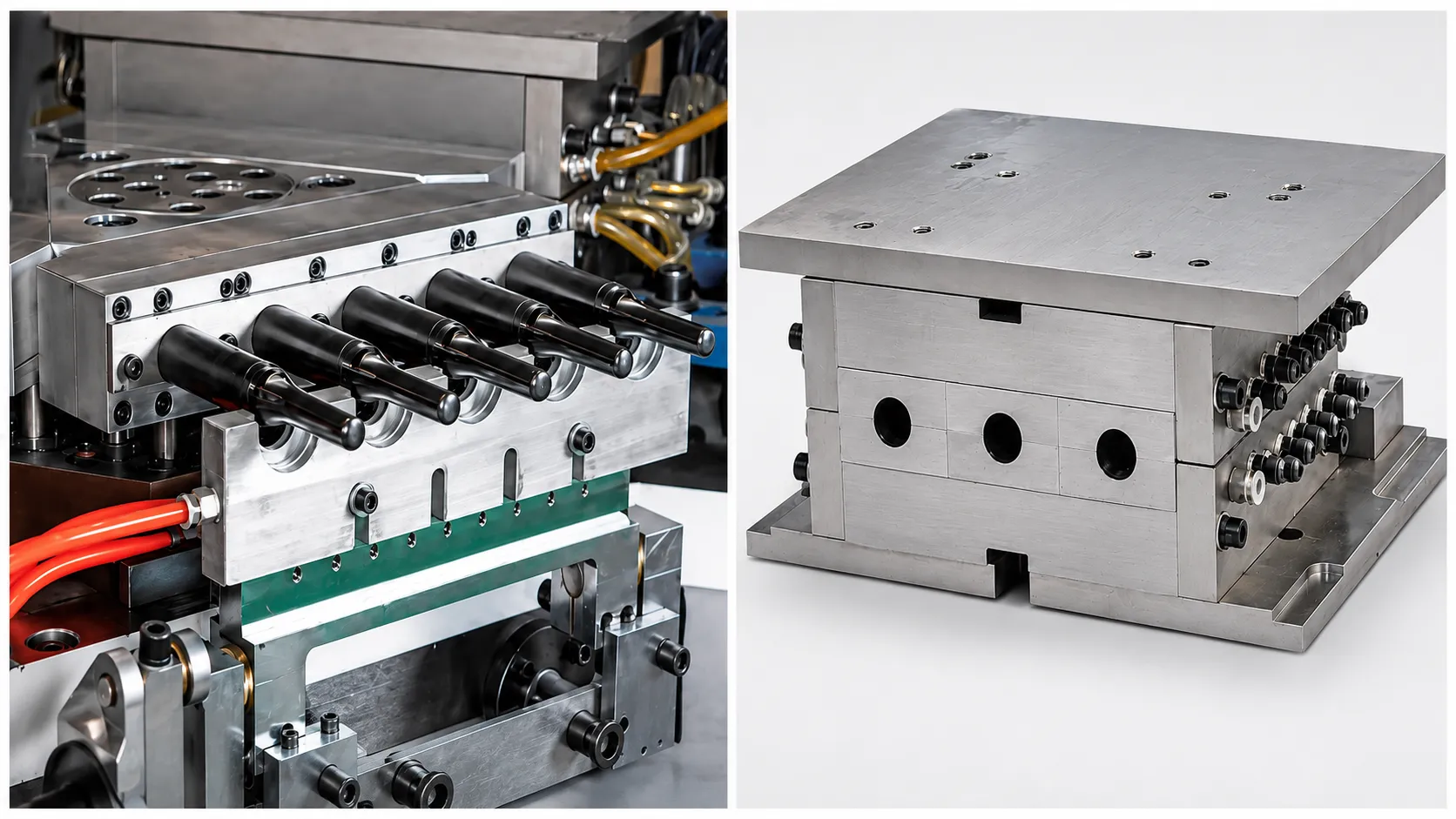
The Korean ophthalmic dropper cap system has two precision interface points with the IBM container neck: the outer snap-fit or thread engagement between the dropper cap skirt and the neck OD, and the inner bore engagement between the dropper insert’s controlled orifice body and the neck bore ID. Both interfaces require dimensional precision that IBM provides natively through its injection mould tooling and core rod mechanism.
Ydre klikforbindelse: Halsdiameter ±0,05 mm
Korean ophthalmic dropper caps engage the IBM bottle neck at the 13 mm OD by a circumferential bead on the cap skirt that snaps over the neck’s retaining flange. This snap-fit engagement provides: tamper evidence (the bead breaks an induction seal or deforms the retaining flange on first opening), child resistance (some Korean ophthalmic CRC formats require push-and-turn action), and closure retention during Korean pharmacy dispensing handling (the cap must remain attached to the bottle when tapped on a Korean pharmacy dispensing tray). The snap-fit mechanism’s function depends on the interference between the cap bead inner diameter and the bottle neck flange OD — the designed interference is typically 0.08–0.15 mm (the cap bead is 0.08–0.15 mm smaller in diameter than the neck flange OD). With IBM’s ±0.05 mm neck OD tolerance, the interference varies between 0.08–0.15 mm ±0.05 mm across all cavities — always within the range where snap-fit engagement occurs without cap opening force being excessive for Korean pharmacists or patients. With EBM’s ±0.15–0.25 mm neck OD tolerance, the interference variation of ±0.15–0.25 mm would produce, at the low end, engagement that is either absent (cap falls off) or, at the high end, engagement that requires destructive force to open — neither acceptable in Korean ophthalmic pharmaceutical distribution.
Indvendig boringsgrænseflade: Dropperindsatsåbning ved ±0,04 mm
The dropper insert — the controlled-orifice component that produces a consistent 25–35 microlitre drop volume per squeeze — seats inside the IBM bottle neck bore, with its outer body in contact with the bore inner surface. The drop volume delivered by the dropper insert depends on two factors: the orifice diameter (controlled by the dropper insert mould tooling) and the bore-insert interference fit (controlled by the IBM bore ID versus the dropper insert OD). If the IBM bore is too small (below nominal), the dropper insert compresses inward and distorts the orifice geometry — producing smaller drop volumes than specified. If the IBM bore is too large (above nominal), the dropper insert can tilt within the bore, creating asymmetric orifice orientation that produces erratic drop trajectory in Korean patient use. IBM’s core rod defines the bore ID at ±0.04 mm across all cavities through the direct mechanical relationship between the core rod OD and the bore it forms during injection — the bore is not blown, not stretched, not dependent on air pressure, and does not vary with process parameter fluctuation at the blow station.
4. HDPE-kvalitet og forarbejdning til oftalmologisk IBM
Koreansk oftalmisk HDPE IBM bruger en snævrere harpiksspecifikation end generel farmaceutisk IBM — kombinationen af tynd væg (0,30-0,40 mm), et højt antal kaviteter (20-30 kaviteter), lange varmekanalbaner og koreanske KFDA-krav til ekstraherbare materialer skaber et specifikationssæt, der indsnævrer det anvendelige HDPE-kvalitetsområde til MI 0,3-0,5 ved 190 °C/2,16 kg og en densitet 0,950-0,960 g/cm³ for størstedelen af koreanske oftalmiske IBM-applikationer.
Specifikation af harpikskvalitet
- MI: 0,3–0,5 g/10 min (190 °C / 2,16 kg)
- Densitet: 0,950–0,960 g/cm³
- Tilsætningsstoffer: Kun KFDA-positivliste
- Ingen UV-stabilisatorer, ingen slipmidler
- Antioxidant: AO-1010 eller AO-168 ≤0,05%
- KFDA-erklæring om farmaceutisk kontakt påkrævet
Behandlingsparametre (ZQ80/ZQ110)
- Tønde: 175→195→210→215→215°C
- Injektionstryk: 90–130 MPa
- Fyldningstid: 0,6–1,0 s (tyndvægget)
- Hold: 50–65% peak, 0,4–0,8 s
- Blæseluft: 0,5–0,8 MPa
- Blæsehold: 0,7–1,2 s
- Formtemperatur: 12–22°C
Kritiske kvalitetskontroller
- Hals-YD: 13,00 ±0,05 mm — alle hulrum
- Borings-ID: 9,0 ±0,04 mm — alle hulrum
- Flaskevægt: ±4% CV% på tværs af hulrummene
- Væggennemsigtighed: Bestå visuel kontrol af fyldningsniveau
- Tilslutning af pipettehætte: 100% kliklås online
- Partikelformet: bestå KFDA oftalmisk standard
Væggennemsigtighed og interaktion mellem HDPE-kvalitet: Korean ophthalmic containers must allow Korean pharmacists and Korean patients to visually inspect the liquid fill level — a requirement that limits HDPE wall thickness to ≤0.40 mm at the body panel, where HDPE’s semi-crystalline structure transmits sufficient light at this thickness for fill-level judgement. At 0.50 mm body wall, standard HDPE at density 0.955 g/cm³ becomes opaque enough that fill-level inspection is unreliable. The 0.30–0.40 mm body wall is a design constraint that the IBM mould designer must achieve through the preform geometry and blow ratio — and that the IBM operator must verify in production through periodic wall thickness measurement at the minimum body wall location using ultrasonic gauge measurement.
5. Koreanske KFDA-kvalifikationskrav til oftalmiske beholdere
De koreanske KFDA-kvalificeringskrav til oftalmiske farmaceutiske beholdere er strengere end de generelle krav til farmaceutiske beholdere på to specifikke områder: standarder for partikelforurening og varigheden af kompatibilitetstest. Disse strengere krav afspejler den oftalmiske administrationsvej — øjets overflade er meget følsom over for partikel- og kemiske påvirkninger, og de koreanske KFDA-sikkerhedsstandarder for oftalmiske produkter er kalibreret i overensstemmelse hermed.
Oftalmiske partikelstandarder (KFDA / Koreansk farmakopé)
Korean Pharmacopoeia (KP) aligns with USP <790> for visible particulates in ophthalmic preparations and USP <788> for sub-visible particulate matter in ophthalmic preparations. For Korean IBM ophthalmic container qualification, particulate testing applies in two stages: container wash-extract testing (empty containers filled with purified water, agitated and examined for visible particulate and sub-visible particulate count) and filled product testing (Korean ophthalmic formulation filled into IBM containers examined at end of proposed shelf life). IBM container wash-extract particulate limits per KP ophthalmic container test: visible particles — absent (zero visible particles in wash extract when examined under Korean Pharmacopoeia visible inspection method); sub-visible particles per KP (aligned with USP <788>): ≤25 particles/ml ≥10 μm, ≤3 particles/ml ≥25 μm. IBM’s zero-flash production eliminates the most significant source of sub-visible particulate in blow-moulded pharmaceutical containers — the plastic fines generated by EBM flash trimming. Korea Ever-Power’s pharmaceutical IBM documentation package includes a reference statement on IBM’s zero-flash architecture for use in the Korean pharmaceutical container qualification documentation that addresses Korean KFDA questions on particle contamination prevention during container production.
Kompatibilitetstestvarighed for oftalmiske IBM-containere
Korean KFDA ophthalmic pharmaceutical container compatibility testing requires a 24-month accelerated stability study at 40°C/75% RH — 12 months longer than the 12-month standard for most oral pharmaceutical container compatibility studies. The longer study period reflects the Korean KFDA position that ophthalmic formulations’ complex mixture of active ingredients, preservatives (benzalkonium chloride, thimerosal, or preservative-free buffer systems) and buffering agents creates a more complex extractable interaction profile with HDPE than simple aqueous solutions. Korean IBM ophthalmic packaging producers should plan for 24-month compatibility studies — which means beginning the filled container compatibility study immediately upon first IBM production at qualification conditions, so that the 24-month study result is available within the overall Korean ophthalmic product development timeline without delaying the KFDA submission.
6. IBM Cleanroom-opsætning til koreansk oftalmisk produktion
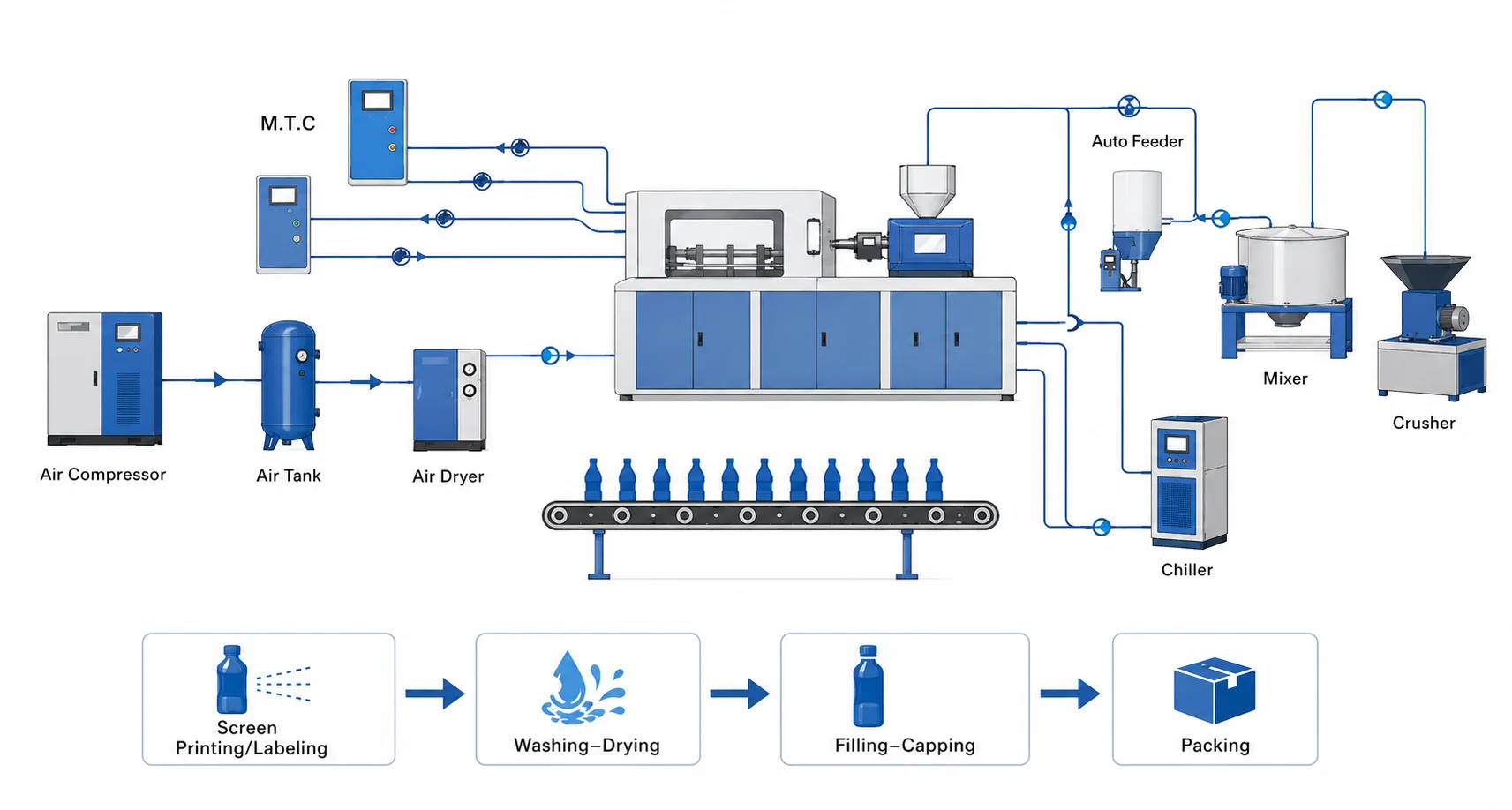
Koreansk produktion af oftalmiske IBM-beholdere udføres typisk i renrumsmiljøer i ISO-klasse 8 (svarende til koreansk GMP-kvalitet D). De specifikke renrumskrav til produktion af oftalmiske IBM-beholdere – som adskiller sig fra den generelle farmaceutiske IBM-renrumsopsætning, der er beskrevet i den farmaceutiske IBM-vejledning – afspejler den højere partikelfølsomhed i koreanske oftalmiske beholdere.
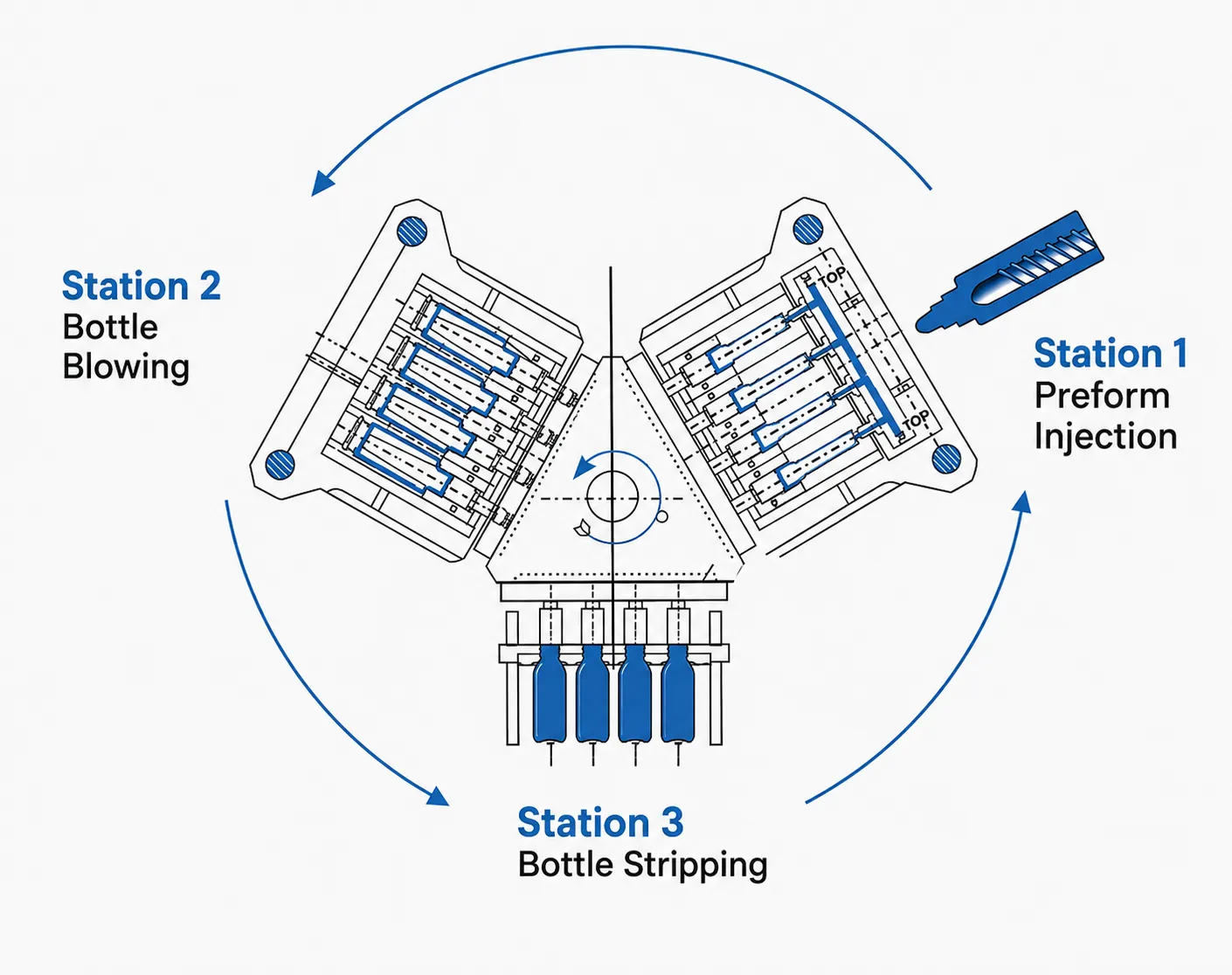
- HEPA-tilførselsluft over støbeformstation: The IBM machine’s mould area — where containers are formed and where the core rods deposit finished containers onto the output conveyor — should receive HEPA-filtered supply air at ≥0.45 m/s face velocity downward into the open mould area. This positive-pressure HEPA supply air prevents airborne particles from entering the open container mouth during the time between stripping (Station 3) and cap application at the downstream Korean pharmaceutical filling line. The HEPA enclosure over the mould station is specified as a separate engineering item in the Korean ophthalmic IBM cell design — Korea Ever-Power provides connection points and dimensional data for the HEPA enclosure installation on the ZQ machine outline drawings.
- Oliefri trykluft — obligatorisk: Trykluft, der anvendes til IBM-blæsestøbning af koreanske oftalmiske beholdere, skal være oliefri på brugsstedet — ISO 8573-1 Klasse 0 for olieaerosol og oliedamp. Oliekontaminering af IBM-blæseluften ved blæsestationen kommer i kontakt med HDPE-præformens indre under oppustning og bliver et ekstraherbart forurenende stof i den færdige beholder. Koreanske producenter af oftalmiske IBM skal specificere oliefri skruekompressorer (ikke oliesmurte stempelkompressorer med downstream-filtre) og skal verificere oliefri status ved maskinens tilslutningspunkt med regelmæssig overvågning af partikler og oliedamp i henhold til koreanske protokoller for overvågning af trykluftkvaliteten inden for farmaceutiske produkter.
- HEPA-indkapsling af udgangstransportør: Koreanske oftalmiske beholdere, der forlader IBM-maskinen ved Station 3, kører på et udgangstransportbånd, før de samles i poser eller bakker til transport til den koreanske farmaceutiske påfyldningslinje. Denne transportbåndssektion bør også være HEPA-indkapslet for at opretholde beholderens renlighed fra IBM-maskinens udgang til indsamlingsstedet. Transportbåndets HEPA-indkapsling er typisk installeret som en tunnel med HEPA-tilførselsluft med positivt tryk og en filtreret udstødning ved transportbåndets udgang. Uden et transportbåndsindkapsling kan koreanske oftalmiske IBM-beholdere akkumulere luftbårne partikler under transportbåndets transport, som derefter sætter sig i den åbne beholderåbning og bidrager til et mindre synligt partikelantal i den fyldte beholder.
7. Økonomi for kavitetsmåling for koreansk oftalmisk IBM
Cavity count selection for Korean ophthalmic IBM is the highest-impact single investment decision — because the Korean ophthalmic container market’s 500M+ annual unit demand requires matching machine cavity count to annual production volume with enough precision that the machine runs at 70–90% utilisation (below 60% utilisation wastes capital; above 90% utilisation creates production risk from unscheduled maintenance). The following analysis compares three ZQ models for a Korean ophthalmic contract packaging factory with a specific annual volume requirement.
| Parameter | ZQ80 (20 kav.) | ZQ110 (24 kav.) | ZQ135 (30 kav.) |
|---|---|---|---|
| Flasker/time (88% eff.) | ~15,840 | ~19,000 | ~23,760 |
| Flasker/Koreansk 2-holds vagt (14 timer) | ~221,760 | ~266,000 | ~332,640 |
| Flasker/år (250 dage) | ~55,4 mio. | ~66,5 mio. | ~83,2 mio. |
| Maskiner til 200 millioner enheder/år | 4 maskiner | 3 maskiner | 3 maskiner (72% betjeningsenhed) |
| KFDA-kvalifikationer kræves | 4 maskinkvaliteter | 3 maskinkvaliteter | 3 maskinkvaliteter (laveste pr. enhed) |
Tabellen over kavitetsantal viser, at for en koreansk oftalmisk kontraktpakker, der sigter mod 200 millioner årlige 10 ml enheder, kræver ZQ135 ved 30 kaviteter det samme antal maskiner som ZQ110 ved 24 kaviteter (3 maskiner i begge tilfælde), men kører med en udnyttelsesgrad på 72% versus 100% – hvilket giver produktionskapacitet til uplanlagt vedligeholdelse, nedetid ved formatændringer og årlig efterspørgselsvækst uden at kræve et fjerde maskinkøb. Antallet af koreanske KFDA-maskinkvalifikationer minimeres også ved det højere kavitetsantal (3 kvalifikationer ved ZQ135 versus 4 ved ZQ80) – hver maskinkvalifikation repræsenterer 16-24 ugers testtidslinje og betydelige dokumentationsomkostninger. For koreanske oftalmiske kontraktpakkerfaciliteter, der søger at minimere deres samlede antal KFDA-maskinkvalifikationer, samtidig med at produktionsredundansen opretholdes, er ZQ135 eller ZQ110 klart den rigtige investering i forhold til flere ZQ80-maskiner med tilsvarende årlig produktion. Korea Ever-Power EP-ZQ110 er den mest almindelige startplatform for koreanske oftalmiske kontraktpakkere, hvis årlige volumen ligger i intervallet 50 millioner-80 millioner enheder pr. maskine.
8. Udvælgelse af ZQ-serien til koreansk oftalmisk IBM-produktion
For koreansk oftalmisk IBM-produktion involverer valget mellem ZQ-seriens modeller ikke kun produktionshastighed og kapitalomkostninger, men også en farmaceutisk specifik overvejelse: den koreanske KFDA-kvalifikation er knyttet til den specifikke maskinmodel og antallet af kaviteter. Følgende vejledning tager højde for denne farmaceutisk specifikke begrænsning.
Koreansk oftalmologisk startup / prøveproduktion → ZQ60 (14 hulrum)
Årligt volumen under 25 millioner enheder. Koreanske farmaceutiske startup-virksomheder, pilotprojekter med koreanske oftalmiske produktlinjer, koreansk CMO-testproduktion for internationale oftalmiske mærker, der kommer ind i Korea. ZQ60-investeringen er passende til volumener under 25 millioner enheder, men kræver omhyggelig fremtidig planlægning: opgradering fra ZQ60 til ZQ80 for et eksisterende KFDA-registreret koreansk oftalmisk produkt kræver en ny koreansk KFDA-maskineændringsmeddelelse og kvalificering af den nye maskine - en proces på 3-6 måneder. Koreanske producenter af oftalmiske emballager, der forventer at vokse til 30+ millioner enheder inden for 3 år, bør tage ZQ80 i brug fra starten og acceptere den indledende lavere udnyttelsesgrad og dermed undgå kvalificeringsovergangsomkostningerne.
Koreansk mellemstor oftalmologi → ZQ80 (20 hulrum, 30-55 millioner enheder/år)
The ZQ80’s dual hydraulic system (20–30% energy saving) and high-precision angle divider (standard at ZQ80+) make it the entry point for Korean ophthalmic production where energy efficiency and inter-cavity consistency are KFDA qualification requirements. At 20-cavity 10 ml production, ZQ80 produces approximately 55M ophthalmic bottles per Korean two-shift year — sufficient for Korean mid-scale pharmaceutical manufacturers serving Korean domestic ophthalmic market without export requirements.
Koreansk storskala oftalmologi → ZQ110 / ZQ135 (55 millioner–83 millioner+ enheder/år pr. maskine)
Koreanske farmaceutiske kontraktpakkere, der betjener multinationale oftalmiske mærker, koreanske farmaceutiske eksportører og koreanske nationale oftalmiske producenter, der betjener koreanske hospitalsforsyningskæder på nationalt plan — kræver alle ZQ110- eller ZQ135-produktion for at opnå de outputvolumener og KFDA-kvalificeringseffektivitet, som deres forretningsmodel kræver. fuldt udvalg af sprøjtestøbemaskiner dækker alle koreanske oftalmiske produktionsskalaer fra opstart til national farmaceutisk levering.
Ofte stillede spørgsmål
Oftalmisk IBM-forespørgsel
Planlægger produktion af koreanske oftalmiske beholdere med IBM?
Korea Ever-Power leverer design af 10 ml oftalmiske IBM-støbeforme, koreansk KFDA-kvalifikationsdokumentation, planlægning af renrumsproduktionscelle og maskinudvælgelse i ZQ-serien til koreansk oftalmisk farmaceutisk emballage og håndkøbs-øjenplejeemballage i alle årlige produktionsvolumener.
Relaterede ressourcer
EP-ZQ80 sprøjtestøbemaskine
800 KN · 20 hulrum ved 10 ml oftalmisk · Vinkeldeler + dobbelt hydraulisk standard · ~55 millioner koreanske oftalmiske beholdere pr. koreansk toholdsår.
EP-ZQ135 sprøjtestøbemaskine
1.350 KN · 30 hulrum ved 10 ml oftalmisk · 6+N cylinderzoner · 37+37 KW · ~83 millioner koreanske oftalmiske beholdere pr. år — skala for den koreanske nationale hospitalsforsyningskæde.
HDPE-sprøjtestøbning: Komplet procesvejledning
Fuld HDPE IBM-bearbejdningsvejledning — valg af kvalitet (MI 0,3-0,8), opsætning af tøndetemperatur, specifikation af vægtykkelse og valg af ZQ-serie til farmaceutisk og husholdningskemikalie-IBM.