ISBM Agricultural Spray Bottle
Production: Korean Guide
Korean 농약 (agrochemical) container production is governed by some of the most specific packaging regulations in Korean manufacturing — the 농약관리법 (Pesticide Control Act) prescribes container approval requirements, mandatory markings, and collection obligations that ISBM packaging producers must build into their production qualification from day one. This guide provides the complete technical framework for Korean ISBM agricultural spray bottle production — from material chemistry to regulatory compliance to Korean container deposit system readiness.
Chemical Resistance Matrix
빈용기보증금 Compliance
Korean Agricultural ISBM Container Market Reference — 2026
KRW 1.2T
Korean 농약 (agrochemical) retail market 2025
250ml–2L
Korean ISBM agricultural container volume range
KRW 100–300
빈용기 보증금 deposit per container ≥ 300ml
1.0–1.5mm
Target body wall thickness for Korean agricultural ISBM (vs 0.25mm beverage)
1. Pasar Kemasan Pertanian Korea dan Peran Kompetitif ISBM
Pasar bahan kimia pertanian Korea—yang bernilai 1,2 triliun KRW pada tahun 2025 di seluruh bidang herbisida (제초제), insektisida (살충제), fungisida (살균제), dan pengatur pertumbuhan (생장조정제)—membutuhkan sekitar 85 juta unit wadah setiap tahunnya dalam kisaran 250ml–2L untuk distribusi ritel dan pasokan pertanian. Wadah PET dan PP ISBM semakin mendapatkan pangsa pasar dari kaca (yang mengalami penurunan pesat karena persyaratan keselamatan pekerja pertanian dan daur ulang di Korea) dan dari HDPE (yang masih dominan untuk formulasi berbasis minyak tetapi mulai digantikan oleh PET ISBM untuk formulasi berbasis air di mana presisi dimensi ISBM memungkinkan merek agrokimia Korea untuk melakukan standardisasi pada satu jenis penutup di berbagai lini produk).
Keunggulan spesifik ISBM untuk wadah pertanian Korea adalah konsistensi dimensi, berat, dan penghalang kimia yang ditingkatkan orientasinya. ISBM PET dengan ketebalan dinding 1,0–1,5 mm mencapai ketebalan dinding CV% ≤ 10% di keempat rongga — memastikan luas permukaan kontak kimia yang konsisten, tingkat ekstraksi yang dapat diprediksi, dan integritas torsi penutupan yang andal yang ditentukan oleh tim QA merek agrokimia Korea dalam persyaratan kualifikasi wadah mereka. Pengurangan berat 40–50% dibandingkan dengan kaca semakin dihargai dalam distribusi pertanian Korea karena peraturan RDA (농촌진흥청, Administrasi Pembangunan Pedesaan) Korea secara bertahap menghapus wadah kaca sekali pakai dalam rantai pasokan pertanian Korea pada tahun 2027 di bawah implementasi 자원순환법 (Undang-Undang Sirkulasi Sumber Daya) Korea.
Kompleksitas teknis pasar wadah pertanian Korea bagi produsen ISBM Korea berasal dari tiga faktor yang saling terkait: keragaman kimia formulasi agrokimia Korea (mulai dari herbisida cair pada pH 3 hingga insektisida pembawa minyak bumi), persyaratan persetujuan wadah khusus dari sistem regulasi Korea (dokumentasi registrasi 농약관리법, daftar persetujuan material wadah RDA Korea), dan program deposit wadah Korea (빈용기 보증금 제도) yang mengharuskan pilihan desain wadah — penandaan identifikasi material, pen embossan jumlah deposit, penutup yang kompatibel dengan pengembalian — untuk dimasukkan ke dalam spesifikasi wadah ISBM sebelum pembuatan cetakan.
2. Korean 농약관리법 Container Regulatory Framework: What ISBM Producers Must Document
Undang-Undang Pengendalian Pestisida Korea (농약관리법, UU No. 15806) dan peraturan pelaksanaannya (농약 등의 안전성 심사에 관한 규정) menetapkan persyaratan wajib untuk wadah pestisida yang harus dipenuhi oleh produsen kemasan ISBM Korea sebelum wadah mereka dapat digunakan untuk produk agrokimia terdaftar di Korea. Persyaratan ini berlaku untuk dokumentasi kualifikasi produksi produsen kemasan — bukan hanya untuk label produk merek agrokimia.
Korean RDA (농촌진흥청) container material approval: Wadah untuk produk pestisida terdaftar di Korea harus menggunakan bahan dari daftar bahan wadah yang disetujui oleh Badan Pengawas Obat dan Makanan Korea (RDA). Untuk wadah ISBM: PET (polietilen tereftalat) termasuk dalam daftar yang disetujui untuk formulasi berbasis air; PP (polipropilen) termasuk dalam daftar yang disetujui untuk formulasi berbasis minyak dan konsentrat yang dapat diemulsikan. PETG tidak secara eksplisit tercantum untuk wadah agrokimia Korea — produsen ISBM Korea tidak boleh menggunakan PETG untuk aplikasi agrokimia tanpa konsultasi terlebih dahulu dengan RDA Korea, karena sensitivitas PETG terhadap pelarut organik menimbulkan risiko kompatibilitas kimia dengan formulasi pestisida konsentrat yang dapat diemulsikan yang belum dinilai oleh RDA Korea untuk PETG.
Mandatory Korean agrochemical container markings (농약관리법 시행규칙 별표 3): Every Korean agricultural container must bear: (1) Korean resin identification code (삼각형 내 숫자: 1 for PET, 5 for PP) moulded into the container base — minimum 6mm triangle height; (2) Net volume marking moulded into the container (not label-printed) at the nominal fill level — for Korean volume accuracy, the ISBM container at 23°C must hold the declared volume within +2%/−0% tolerance; (3) Korean RDA container approval number (용기·포장 인증번호) embossed on the container shoulder or base — this approval number is issued after the Korean RDA reviews the container material, dimensional, and chemical compatibility documentation; (4) Hazard classification symbol in accordance with Korean GHS (화학물질의 분류·표지에 관한 세계조화시스템, K-GHS) requirements, if applicable to the specific agrochemical product.
UN certification for Korean agrochemical dangerous goods: Korean agrochemical concentrate formulations classified as dangerous goods under Korean Act on Dangerous Goods Safety Management (위험물 안전관리법) require containers meeting UN certification standards — specifically UN 3H1 (HDPE) or UN 3H2 (HDPE with composite) for liquids, or the equivalent PET classification where applicable. For Korean ISBM PET containers of concentrated agrochemical dangerous goods: UN certification tests under UN Recommendations on the Transport of Dangerous Goods include drop test, stacking test, hydraulic pressure test, and leakproofness test. Korean ISBM agricultural producers targeting the concentrated pesticide market (rather than the consumer-strength diluted product market) must obtain UN certification through a Korean Accredited Testing Body (한국산업표준인증원, KAS). Water-based diluted consumer-strength Korean agricultural products (already diluted to end-use concentration before bottling) typically do not require UN certification — this is the segment where Korean ISBM PET has greatest penetration.
3. Material Selection: PET and PP for Korean Agrochemical ISBM Containers
Pemilihan material wadah pertanian ISBM Korea pada dasarnya berbeda dari pemilihan material ISBM minuman atau kosmetik Korea — keputusan tersebut didorong terutama oleh sistem pelarut formulasi agrokimia dan agresivitas kimia terhadap polimer, bukan oleh kejernihan optik atau estetika taktil. Tiga material yang dapat diproses ISBM Korea yang relevan adalah: PET, PP, dan (untuk aplikasi yang sangat spesifik) PC — dengan PETG secara khusus dikecualikan dari aplikasi agrokimia Korea.
PET for Korean agricultural ISBM: PET (IV 0.78–0.84 dl/g, UV-stabilised grade) is the preferred Korean ISBM material for water-based Korean agrochemical formulations including: aqueous herbicide solutions (glyphosate, 2,4-D, glufosinate at water-based formulation concentrations), water-dispersible granule (WDG) diluents, aqueous fungicide solutions (mancozeb, propiconazole water-based), and water-soluble pouch outer packaging that holds a dry concentrate inside. Korean agricultural PET ISBM uses higher-IV resin than Korean beverage ISBM (IV 0.82–0.86 versus 0.78–0.82 for beverage) to maximise the molecular orientation achieved during blow — higher orientation improves chemical resistance by reducing the diffusion coefficient of agrochemical molecules through the PET wall, particularly important for acidic aqueous formulations (pH 3–5) that can slowly hydrolyse PET at the inner wall surface over the Korean 24-month agricultural product shelf life.
PP for Korean agricultural ISBM: PP ISBM (menggunakan platform ISBM Korea dengan sisipan dasar cetakan berpemanas dan stasiun pengkondisian yang mampu mencapai suhu 120–145°C) adalah pilihan yang tepat untuk konsentrat emulsi (EC) agrokimia Korea dan formulasi berbasis minyak di mana pelarut pembawa (biasanya pelarut hidrokarbon aromatik C9–C11, sikloheksanon, atau metil naftalena) akan menyebabkan retak tegangan pada PET selama masa simpan produk. Ketahanan pelarut organik PP yang unggul — dari tulang punggung non-polarnya dan kurangnya ikatan ester yang dapat terhidrolisis — menjadikannya pilihan ISBM Korea yang tepat untuk insektisida organofosfat pekat (klorpirifos EC, diazinon EC), insektisida piretroid dalam pembawa aromatik (siperemetrin 10% EC, deltametrin EC), dan konsentrat fungisida emulsi Korea.
Why PETG is excluded from Korean agricultural ISBM: Komonomer glikol PETG menciptakan kerentanan khusus terhadap pembawa pelarut organik yang digunakan dalam formulasi agrokimia EC Korea — kimia polimer berbasis ester yang sama yang membuat PETG rentan terhadap retak tegangan dari formulasi kosmetik Korea dengan kandungan etanol tinggi membuatnya bahkan lebih rentan terhadap pembawa pelarut aromatik dalam agrokimia EC Korea. Produsen ISBM Korea yang mengganti PET dengan PETG dalam aplikasi pertanian untuk mendapatkan kejernihan optik melakukannya dengan risiko tinggi kegagalan wadah akibat tegangan dalam masa simpan produk. Perbandingan teknis pemilihan material selengkapnya ada di [tautan]. Korean ISBM PET vs PETG resin selection guide.
4. Chemical Resistance: Korean Agrochemical Formulation Categories and Container Compatibility
Korean agrochemical formulations span a wide range of chemical environments — from mildly acidic aqueous solutions that PET handles comfortably to concentrated organic solvent carriers that require PP. Understanding the formulation category is the prerequisite for correct Korean ISBM material selection; requesting the full formulation composition (active ingredient, solvent system, co-formulants, pH) from the Korean agrochemical brand before finalising the material specification is non-negotiable.
| Korean Agrochemical Category | Formulation Type | PELIHARAAN | PP | Key Consideration |
|---|---|---|---|---|
| Herbicide (제초제) — glyphosate, 2,4-D, glufosinate | SL (solution), SG (granule) | ✓ Luar Biasa | ✓ Luar Biasa | Water-based pH 3–5. PET preferred for cost and clarity. 24-month shelf life compatible at ambient storage. |
| Fungicide (살균제) — mancozeb, propiconazole, tebuconazole | WP (wettable powder) SC (suspension) | ✓ Good–Excellent | ✓ Luar Biasa | Aqueous suspension (SC): PET compatible. EC format with organic solvent carrier: PP required. Verify formulation carrier before specifying PET for EC fungicide. |
| Insecticide (살충제) — pyrethroid (cypermethrin, deltamethrin) | EC (emulsifiable concentrate) | ⚠ Verify solvent | ✓ Luar Biasa | Aromatic hydrocarbon solvents (xylene, Solvesso) in Korean EC pyrethroid formulations cause PET stress cracking within 3–6 months. PP is the correct ISBM choice for EC insecticides. |
| Insecticide — organophosphate (chlorpyrifos, diazinon) | EC (emulsifiable concentrate) | ✗ Tidak cocok | ✓ Luar Biasa | Organophosphate EC carriers are strongly incompatible with PET — Korean RDA container approval for organophosphate EC requires PP ISBM or HDPE containers. No exceptions. |
| Growth regulator (생장조정제) — gibberellin, ethephon, mepiquat | SL (solution) | ✓ Luar Biasa | ✓ Luar Biasa | Aqueous solution at low concentration. Ethephon (2-chloroethylphosphonic acid) is strongly acidic (pH 1.5–2.5 as supplied) — verify PET compatibility with 12-month accelerated storage at 40°C before commercial commitment. |
Korean agrochemical chemical compatibility testing protocol for Korean ISBM containers: minimum 12-week accelerated compatibility test at 40°C (Korean summer ambient equivalent), measuring: wall thickness loss rate at contact surface (target ≤ 5% over 12 weeks), tensile strength retention (target ≥ 90% of baseline), chemical permeation through the ISBM wall (active ingredient concentration loss in the formulation from migration through the container wall, target ≤ 2% at 12 weeks), and container dimensional change (target: neck OD change ≤ 0.1mm, height change ≤ 0.5%). Korean RDA container approval applications must include the compatibility test results from a Korean accredited laboratory.
5. UV Stability for Korean Outdoor Agricultural Storage Conditions
Korean agricultural containers are stored and used in outdoor environments that create significantly more demanding UV exposure conditions than Korean retail or pharmaceutical packaging — Korean farm supply stores are often corrugated metal roof structures without UV shielding, Korean agricultural cooperative (농협) distribution centres store product outdoors under tarpaulin between April and October, and Korean farmers store agrochemical bottles on open farm shelving exposed to Korean solar radiation of 4.8–5.8 kWh/m²/day (among the highest in East Asia at Korean latitude of 33–38°N).
UV radiation affects Korean ISBM agricultural containers through two mechanisms: (1) polymer chain degradation (UV-induced photo-oxidation that yellows and embrittles the PET container wall, reducing mechanical integrity and chemical barrier); and (2) agrochemical active ingredient photodegradation (UV transmission through the container wall that photo-deactivates UV-sensitive Korean agrochemical active ingredients including pyrethroids, certain herbicides, and biological fungicides).
UV protection strategy for Korean ISBM PET agricultural containers:
- UV-stabilised PET resin grade: Tentukan jenis PET dengan paket penstabil UV (penstabil cahaya amina terhambat, HALS, dan aditif penyerap UV) untuk ISBM pertanian Korea — PET minuman standar tanpa penstabil UV akan menguning dan menjadi rapuh secara mekanis setelah 6–12 bulan terpapar sinar UV di luar ruangan Korea. Pilihan resin ISBM PET pertanian Korea meliputi jenis PET industri Eastman dan jenis PET yang distabilkan UV dari pemasok resin domestik Korea (SK Chemicals dan Huvis keduanya menawarkan jenis PET yang distabilkan UV yang telah divalidasi untuk penggunaan wadah pertanian Korea).
- Pigmented containers for UV-sensitive actives: Produk agrokimia piretroid dan biologis Korea yang terdegradasi di bawah sinar UV harus dikemas dalam wadah ISBM Korea yang buram atau berpigmen pekat — PET ISBM berwarna kuning (menggunakan masterbatch kuning berbasis besi) memblokir sekitar 95% sinar UV di bawah 400nm; PP ISBM putih (berpigmen titanium dioksida) memblokir hampir semua cahaya tampak dan UV. Tentukan warna wadah yang tepat dengan tim formulasi merek agrokimia Korea, yang seharusnya memiliki data fotostabilitas untuk bahan aktifnya.
- Korean agricultural UV exposure testing: Korean RDA container approval applications for Korean outdoor agricultural use require UV accelerated ageing testing per ISO 4892-2 (Xenon arc lamp, 300–400nm, 340nm irradiance 0.51 W/m², 500 hours minimum) confirming tensile strength retention ≥ 80% and no visible cracking or yellowing above ΔE 5 on the NCS colour scale after 500-hour exposure.
6. Korean 빈용기 보증금 Container Deposit Compliance: Design Requirements
Sistem penyimpanan kontainer pertanian Korea — 빈용기 보증금 제도 (Sistem Penyimpanan Kontainer Kosong) — dikelola oleh Korea Agro-Fisheries and Food Trade Corporation (한국농수산식품유통공사, aT) berdasarkan Undang-Undang Korea tentang Sirkulasi Sumber Daya Peralatan dan Kendaraan Listrik dan Elektronik (전기·전자제품 및 자동차의 자원순환에 관한 법률) dan peraturan Tingkat Pengembalian Wadah Pestisida Korea. Bagi produsen ISBM Korea, sistem penyimpanan menciptakan tiga persyaratan desain khusus yang harus diintegrasikan ke dalam spesifikasi cetakan:
- Deposit amount moulded-in identification: Korean agricultural containers ≥ 300ml must have the deposit amount (KRW 100, 200, or 300 depending on container volume category) embossed directly into the container surface as a moulded feature — not as a label. The ISBM mould must include this embossed marking in the container body design. Deposit amounts (2026 Korean schedule): containers 300ml–500ml: KRW 100; containers 500ml–2L: KRW 200; containers above 2L: KRW 300.
- Resin identification code: Korean 재활용 identification triangle with resin number (1 for PET, 5 for PP) moulded into the container base — minimum triangle height 6mm as specified in Korean KS M ISO 1043 standard, visible after container is emptied and rinsed at the Korean agricultural cooperative (농협) collection point.
- Rinsability design: Korean agricultural deposit system containers must be rinseable with water to below 1 ppm active ingredient concentration after 3 rinsing cycles — the Korean RDA rinsability specification. Korean ISBM containers designed for rinsability: avoid internal dead zones (no internal ribs that trap agrochemical residue), ensure neck inner diameter ≥ 22mm (allowing rinse water to flow freely from neck to base), and avoid ISBM gate zone designs that create an internal raised ridge at the bottle base that prevents complete drainage of rinsing water.
Produsen ISBM Korea yang memasok pelanggan kontainer pertanian Korea yang ingin mengakses jaringan distribusi Koperasi Pertanian Korea (농협) harus memberikan sertifikat persetujuan kontainer RDA Korea (용기·포장 인증서) dan konfirmasi kelayakan program deposit kepada pelanggan merek agrokimia Korea mereka — keduanya dikeluarkan setelah peninjauan RDA Korea terhadap gambar spesifikasi cetakan dan dokumentasi material. Kerangka kerja pemilihan cetakan 9 faktor yang memandu keputusan desain cetakan untuk kontainer pertanian Korea (termasuk fitur timbul deposit, identifikasi resin, dan kemampuan bilas) terdapat dalam Panduan pemilihan cetakan ISBM Korea.
7. Tamper Evidence and Safety Feature Engineering for Korean Agricultural ISBM
Wadah pertanian Korea untuk produk pestisida terdaftar harus memiliki fitur pengaman yang memastikan wadah tersebut belum dibuka sejak pengisian di fasilitas produsen agrokimia Korea. Undang-Undang Pertanian Korea (Korean 농약관리법) mewajibkan adanya bukti pengaman pada semua wadah pestisida yang dijual di saluran ritel Korea, dan klasifikasi bahaya GHS Korea (K-GHS) untuk wadah agrokimia kategori toksisitas akut 1–3 mewajibkan fitur penutup tahan anak (CRC) tambahan pada wadah yang mungkin dapat diakses oleh anak-anak di rumah tangga pedesaan Korea.
Korean ISBM agricultural tamper evidence options and their production design implications:
- Breakband (breakaway band) closure: The most common Korean agricultural tamper evidence method — a plastic ring moulded as part of the screw cap that breaks irreversibly when the cap is first opened. The ISBM container design must accommodate the breakband by including a moulded-in retaining bead or ledge on the neck below the thread end — this feature is moulded into the ISBM neck insert and must be included in the mould design specification. Korean agricultural breakband closure thread profile: standard Korean agricultural containers use 28/400 or 38/400 GPI thread with a 4mm retaining bead below the thread finish.
- Induction heat seal liner: An induction-heat-bonded foil liner applied over the container neck after filling — provides hermetic seal in addition to tamper evidence. Korean agrochemical brands using induction seal require ISBM neck finishes with flat sealing surface (GPI F217 style neck liner land) — a flat, smooth, and level sealing surface at the top of the neck that allows the induction seal foil to bond uniformly without gaps. ISBM neck insert surface quality for induction seal: Ra ≤ 0.05μm at the sealing surface, flatness ≤ 0.1mm TIR across the sealing land width.
- Korean child-resistant closure (CRC) compatibility: Bahan kimia pertanian beracun akut yang diklasifikasikan K-GHS Korea memerlukan penutup tahan anak sesuai standar KS M ISO 8317. Wadah ISBM Korea untuk aplikasi CRC menggunakan leher wadah 38/400 atau 45/400 dengan tutup CRC tekan dan putar (P&T) yang memerlukan tekanan ke bawah dan putaran secara bersamaan untuk membukanya — gerakan yang dianggap intuitif oleh pekerja pertanian dewasa Korea tetapi tidak dapat dilakukan dengan andal oleh anak-anak Korea di bawah 5 tahun. Leher wadah ISBM Korea untuk wadah CRC memerlukan toleransi dimensi yang lebih ketat (±0,06 mm diameter luar leher) daripada wadah pertanian standar, karena fungsi tutup CRC bergantung pada kesesuaian tutup dengan leher wadah — terlalu ketat dan pengguna dewasa Korea tidak dapat membukanya, terlalu longgar dan fungsi CRC gagal dalam pengujian KS M ISO 8317 Korea.
8. Production Design: Wall Thickness, Volume Range, and Korean Agricultural ISBM Specification
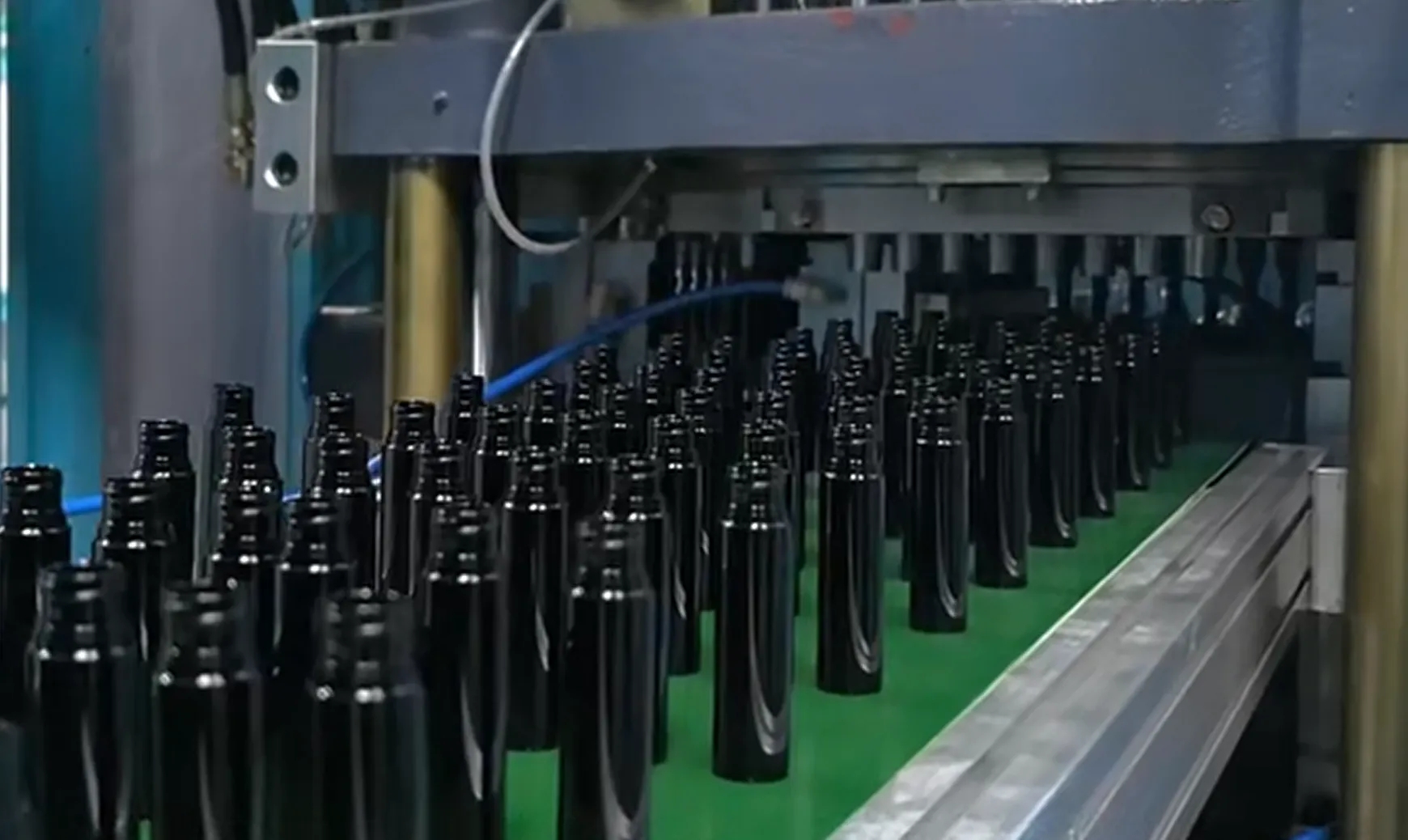
Korean ISBM agricultural container production — 500ml PET (left) and 1L PET (right) for Korean herbicide distribution. Body wall 1.2mm versus Korean beverage 0.25mm (4.8× heavier wall) provides chemical barrier, UV resistance, and the mechanical robustness to survive Korean farm supply chain handling — steel-shelved Korean agricultural cooperative stores, metal-floored Korean delivery trucks, and Korean farm corrugated metal storage floors where containers are occasionally dropped from 1.5–2m height.
Desain produksi wadah pertanian ISBM Korea berbeda dari ISBM minuman Korea dalam tiga parameter mendasar: ketebalan dinding, profil leher, dan tekanan tiup. Masing-masing didorong oleh persyaratan spesifik aplikasi — penghalang kimia, torsi penutupan, dan kekokohan struktural — bukan oleh minimalisasi berat atau estetika.
Korean agricultural ISBM wall thickness specification: Body wall target 1.0–1.5mm (versus Korean beverage 0.22–0.28mm). The heavier wall serves three functions simultaneously: improved chemical barrier (diffusion path length for active ingredient migration through the wall is proportional to wall thickness, so 1.2mm wall has 5× the barrier of 0.25mm beverage wall); UV resistance (more polymer mass absorbs more UV before reaching the contained product); and mechanical robustness (Korean agricultural Korean distribution chain drop resistance — a 500ml PET agricultural bottle at 1.2mm wall absorbs the energy of a 1.5m corner drop onto Korean concrete agricultural cooperative flooring without leakage, where a 0.25mm beverage wall would split). To produce 1.2mm average body wall in Korean ISBM, the preform wall must be proportionally heavier than the standard beverage preform — Korean agricultural ISBM preforms typically weigh 28–35g for a 500ml container versus 14–18g for a Korean 500ml beverage preform.
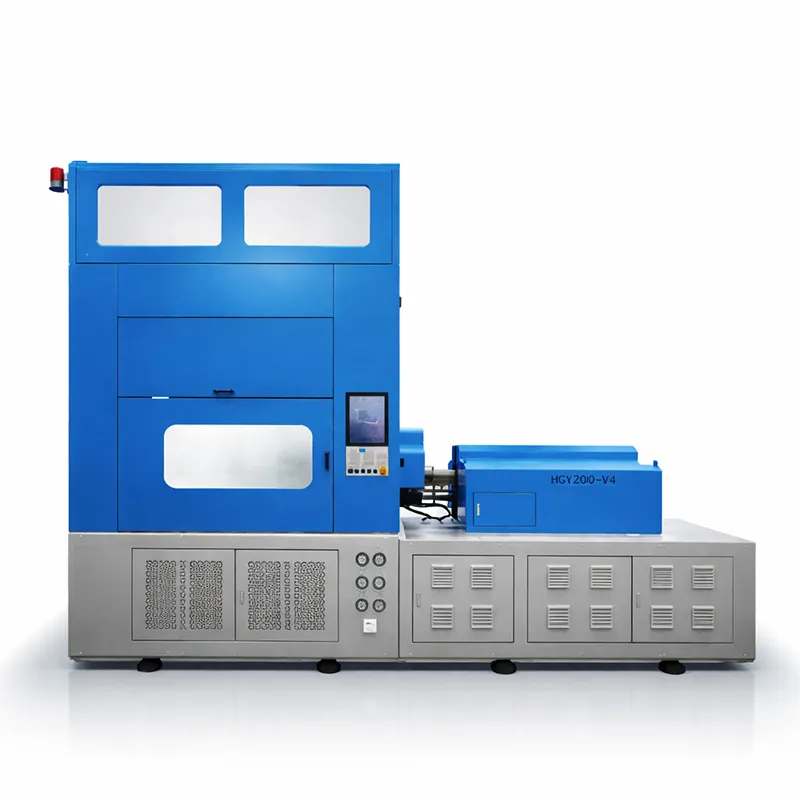
Korean agricultural ISBM neck profile: Wide-mouth necks (28/400, 38/400, 45/400 GPI finish) are standard for Korean agricultural containers — wider necks reduce the flow resistance when Korean farmers pour concentrated formulations from the bottle into mixing equipment, and they accommodate Korean agricultural CRC closures that are physically larger than Korean beverage closures. Wide-mouth Korean ISBM requires machines with injection clamping force appropriate for the larger preform gate area — the Korean Ever-Power HGY200-V4 (200 kN injection clamping, 63mm maximum neck) is the standard platform for Korean 28–38mm agricultural neck production; the HGY250-V4 (250 kN, 86mm maximum neck) covers Korean 45mm and above agricultural wide-mouth formats.
Korean agricultural ISBM blow pressure: The heavier-wall Korean agricultural ISBM preform requires higher pre-blow and high-blow pressure than Korean beverage production to achieve complete mould contact and orientation at the heavier wall. Korean agricultural ISBM blow pressure targets: pre-blow 7–9 bar (versus 6–8 bar beverage); high-blow 28–34 bar (versus 24–28 bar beverage). The Korean Ever-Power Rangkaian Mesin ISBM 4 Stasiun Semua platform mendukung tekanan tiup tinggi hingga 40 bar, memberikan ruang gerak yang memadai untuk produksi kontainer pertanian berdinding tebal Korea tanpa mendekati tekanan nominal maksimum mesin — beroperasi pada tekanan nominal 70–80% daripada 95–100%, yang secara signifikan memperpanjang masa pakai segel PTFE katup tiup di lingkungan produksi pertanian Korea dengan siklus yang lebih tinggi.
Pertanyaan yang Sering Diajukan
Agricultural Container Support
Korean Agricultural ISBM Container — Korean RDA Approval Documentation, Chemical Compatibility Testing, or 빈용기 보증금 Design Support?
Korean Ever-Power provides agricultural ISBM container documentation packages for Korean RDA approval, UV-stabilised PET and PP resin selection for Korean agrochemical formulations, and 빈용기 보증금 mould design compliance review.
Sumber Daya Terkait
Mesin Cetak Tiup Peregang Injeksi HGY200-V4
250ml–1L Korean agricultural container · UV-stabilised PET and PP · 200 kN injection clamping for 28/400 wide-mouth agricultural neck · Korean RDA qualification documentation support.
Mesin Cetak Tiup Peregang Injeksi HGY250-V4
1L–3L Korean agricultural container · Wide-mouth 86mm neck for Korean 1L CRC agricultural formats · Heavy-wall PP for Korean EC insecticide concentrate · Korean UN certification test support.
Mesin Cetak Tiup Peregang Injeksi HGY650-V4
Produksi kontainer pertanian Korea berkapasitas tinggi · Skala pasokan koperasi pertanian Korea (농협) bervolume besar · PET tahan UV untuk puncak produksi herbisida musiman di Korea · Kualifikasi desain kontainer Korea (빈용기보증금) sepenuhnya.