ISBM Agricultural Spray Bottle
Production: Korean Guide
Korean 농약 (agrochemical) container production is governed by some of the most specific packaging regulations in Korean manufacturing — the 농약관리법 (Pesticide Control Act) prescribes container approval requirements, mandatory markings, and collection obligations that ISBM packaging producers must build into their production qualification from day one. This guide provides the complete technical framework for Korean ISBM agricultural spray bottle production — from material chemistry to regulatory compliance to Korean container deposit system readiness.
Chemical Resistance Matrix
빈용기보증금 Compliance
Korean Agricultural ISBM Container Market Reference — 2026
KRW 1.2T
Korean 농약 (agrochemical) retail market 2025
250ml–2L
Korean ISBM agricultural container volume range
KRW 100–300
빈용기 보증금 deposit per container ≥ 300ml
1.0–1.5mm
Target body wall thickness for Korean agricultural ISBM (vs 0.25mm beverage)
1. Korejsko tržište poljoprivredne ambalaže i konkurentska uloga ISBM-a
Korejsko tržište poljoprivrednih hemikalija – procijenjeno na 1,2 biliona KRW u 2025. godini za herbicide (제초제), insekticide (살충제), fungicide (살균제) i regulatore rasta (생장조정제) – zahtijeva približno 85 miliona kontejnera godišnje u rasponu od 250 ml do 2 litre za maloprodaju i distribuciju poljoprivrednim proizvodima. ISBM PET i PP kontejneri dobijaju na udjelu u odnosu na staklo (koje brzo opada zbog zahtjeva za sigurnost i recikliranje poljoprivrednih radnika u Koreji) i HDPE (koji je i dalje dominantan za formulacije na bazi ulja, ali ustupa mjesto PET ISBM-u za formulacije na bazi vode, gdje dimenzijska preciznost ISBM-a omogućava korejskim agrohemijskim brendovima da standardizuju jedan tip zatvarača za više proizvodnih linija).
Specifične prednosti ISBM-a za korejske poljoprivredne kontejnere su dimenzionalna konzistentnost, težina i hemijska barijera poboljšana orijentacijom. ISBM PET sa stijenkom tijela od 1,0–1,5 mm postiže debljinu stijenke CV% ≤ 10% u sve četiri šupljine – osiguravajući konzistentnu površinu kemijskog kontakta, predvidljive nivoe ekstrakcije i pouzdan integritet zatvaranja od obrtnog momenta do brtvljenja koji timovi za kontrolu kvalitete korejskih agrohemijskih brendova specificiraju u svojim zahtjevima za kvalifikaciju kontejnera. Smanjenje težine 40–50% u odnosu na staklo sve se više cijeni u korejskoj poljoprivrednoj distribuciji, jer korejski RDA (농촌진흥청, Uprava za ruralni razvoj) propisi postepeno ukidaju staklene kontejnere za jednokratnu upotrebu u korejskim poljoprivrednim lancima snabdijevanja do 2027. godine u okviru implementacije korejskog Zakona o cirkulaciji resursa (자원순환법).
Tehnička složenost korejskog tržišta poljoprivrednih kontejnera za korejske proizvođače ISBM-a proizilazi iz tri faktora koji se međusobno preklapaju: hemijske raznolikosti korejskih agrohemijskih formulacija (od vodenih herbicida pri pH 3 do insekticida na bazi nafte), specifičnih zahtjeva korejskog regulatornog sistema za odobravanje kontejnera (dokumentacija za registraciju 농약관리법, korejska lista odobrenja materijala za kontejnere RDA) i korejskog programa depozita za kontejnere (빈용기 보증금 제도) koji zahtijeva da se izbori dizajna kontejnera - oznake za identifikaciju materijala, utiskivanje iznosa depozita, zatvarači kompatibilni s povratom - ugrade u specifikaciju ISBM kontejnera prije proizvodnje kalupa.
2. Korean 농약관리법 Container Regulatory Framework: What ISBM Producers Must Document
Korejski Zakon o kontroli pesticida (농약관리법, Zakon br. 15806) i njegovi provedbeni propisi (농약 등의 안전성 심사에 관한 규정) utvrđuju obavezne zahtjeve za spremnike za pesticide koje korejski proizvođač ISBM ambalaže mora ispuniti prije nego što se njegov spremnik može koristiti za agrohemijske proizvode registrovane u Koreji. Ovi zahtjevi se primjenjuju na dokumentaciju o kvalifikaciji proizvodnje proizvođača ambalaže - ne samo na etiketu proizvoda agrohemijskog brenda.
Korean RDA (농촌진흥청) container material approval: Kontejneri za korejske registrovane pesticide moraju koristiti materijale sa liste materijala za kontejnere odobrene od strane korejske RDA. Za ISBM kontejnere: PET (polietilen tereftalat) je na odobrenoj listi za vodene formulacije; PP (polipropilen) je na odobrenoj listi za formulacije na bazi ulja i emulzionih koncentrata. PETG nije eksplicitno naveden za korejske agrohemijske kontejnere — korejski proizvođači ISBM-a ne bi trebali koristiti PETG za agrohemijske primjene bez prethodnih konsultacija sa korejskim RDA, jer osjetljivost PETG-a na organska rastvarača stvara rizike od hemijske kompatibilnosti sa formulacijama pesticida na bazi emulzionih koncentrata koje korejski RDA nije procijenio za PETG.
Mandatory Korean agrochemical container markings (농약관리법 시행규칙 별표 3): Every Korean agricultural container must bear: (1) Korean resin identification code (삼각형 내 숫자: 1 for PET, 5 for PP) moulded into the container base — minimum 6mm triangle height; (2) Net volume marking moulded into the container (not label-printed) at the nominal fill level — for Korean volume accuracy, the ISBM container at 23°C must hold the declared volume within +2%/−0% tolerance; (3) Korean RDA container approval number (용기·포장 인증번호) embossed on the container shoulder or base — this approval number is issued after the Korean RDA reviews the container material, dimensional, and chemical compatibility documentation; (4) Hazard classification symbol in accordance with Korean GHS (화학물질의 분류·표지에 관한 세계조화시스템, K-GHS) requirements, if applicable to the specific agrochemical product.
UN certification for Korean agrochemical dangerous goods: Korean agrochemical concentrate formulations classified as dangerous goods under Korean Act on Dangerous Goods Safety Management (위험물 안전관리법) require containers meeting UN certification standards — specifically UN 3H1 (HDPE) or UN 3H2 (HDPE with composite) for liquids, or the equivalent PET classification where applicable. For Korean ISBM PET containers of concentrated agrochemical dangerous goods: UN certification tests under UN Recommendations on the Transport of Dangerous Goods include drop test, stacking test, hydraulic pressure test, and leakproofness test. Korean ISBM agricultural producers targeting the concentrated pesticide market (rather than the consumer-strength diluted product market) must obtain UN certification through a Korean Accredited Testing Body (한국산업표준인증원, KAS). Water-based diluted consumer-strength Korean agricultural products (already diluted to end-use concentration before bottling) typically do not require UN certification — this is the segment where Korean ISBM PET has greatest penetration.
3. Material Selection: PET and PP for Korean Agrochemical ISBM Containers
Izbor korejskog ISBM materijala za poljoprivredne kontejnere fundamentalno se razlikuje od odabira korejskog ISBM materijala za pića ili kozmetiku - odluka se prvenstveno zasniva na sistemu rastvarača agrohemijske formulacije i hemijskoj agresiji prema polimeru, a ne na optičkoj jasnoći ili taktilnoj estetici. Tri korejska ISBM materijala koja se mogu prerađivati su relevantna: PET, PP i (za vrlo specifične primjene) PC - pri čemu je PETG posebno isključen iz korejskih agrohemijskih primjena.
PET for Korean agricultural ISBM: PET (IV 0.78–0.84 dl/g, UV-stabilised grade) is the preferred Korean ISBM material for water-based Korean agrochemical formulations including: aqueous herbicide solutions (glyphosate, 2,4-D, glufosinate at water-based formulation concentrations), water-dispersible granule (WDG) diluents, aqueous fungicide solutions (mancozeb, propiconazole water-based), and water-soluble pouch outer packaging that holds a dry concentrate inside. Korean agricultural PET ISBM uses higher-IV resin than Korean beverage ISBM (IV 0.82–0.86 versus 0.78–0.82 for beverage) to maximise the molecular orientation achieved during blow — higher orientation improves chemical resistance by reducing the diffusion coefficient of agrochemical molecules through the PET wall, particularly important for acidic aqueous formulations (pH 3–5) that can slowly hydrolyse PET at the inner wall surface over the Korean 24-month agricultural product shelf life.
PP for Korean agricultural ISBM: PP ISBM (korištenjem korejskih ISBM platformi sa zagrijanim umetcima za bazu kalupa i stanicom za kondicioniranje sposobnom za 120–145°C) je odgovarajući izbor za korejske agrohemijske emulzibilne koncentrate (EC) i formulacije na bazi ulja gdje bi nosač rastvarača (obično C9–C11 aromatični ugljikovodični rastvarači, cikloheksanon ili metil naftalen) mogao uzrokovati pucanje PET-a pod naponom tokom roka trajanja proizvoda. PP-ova superiorna otpornost na organska rastvarača - zbog svoje nepolarne osnove i nedostatka esterskih veza koje se mogu hidrolizovati - čini ga ispravnim korejskim ISBM izborom za koncentrovane organofosfatne insekticide (klorpirifos EC, diazinon EC), piretroidne insekticide u aromatičnom nosaču (cipermetrin 10% EC, deltametrin EC) i korejske emulzibilne fungicidne koncentrate.
Why PETG is excluded from Korean agricultural ISBM: PETG-ov glikolni komonomer stvara specifičnu osjetljivost na organske nosače rastvarača koji se koriste u korejskim EC agrohemijskim formulacijama - ista polimerna hemija na bazi estera koja čini PETG podložnim pucanju pod naponom od korejskih kozmetičkih formulacija s visokim udjelom etanola čini ga još osjetljivijim na aromatične nosače rastvarača u korejskim EC agrohemijskim formulacijama. Korejski proizvođači ISBM-a koji zamjenjuju PET PET-om u poljoprivrednim primjenama kako bi postigli optičku jasnoću to čine s visokim rizikom od oštećenja spremnika uzrokovanog naponom unutar roka trajanja proizvoda. Potpuno tehničko poređenje odabira materijala nalazi se u Korean ISBM PET vs PETG resin selection guide.
4. Chemical Resistance: Korean Agrochemical Formulation Categories and Container Compatibility
Korean agrochemical formulations span a wide range of chemical environments — from mildly acidic aqueous solutions that PET handles comfortably to concentrated organic solvent carriers that require PP. Understanding the formulation category is the prerequisite for correct Korean ISBM material selection; requesting the full formulation composition (active ingredient, solvent system, co-formulants, pH) from the Korean agrochemical brand before finalising the material specification is non-negotiable.
| Korean Agrochemical Category | Formulation Type | PET | PP | Key Consideration |
|---|---|---|---|---|
| Herbicide (제초제) — glyphosate, 2,4-D, glufosinate | SL (solution), SG (granule) | ✓ Odlično | ✓ Odlično | Water-based pH 3–5. PET preferred for cost and clarity. 24-month shelf life compatible at ambient storage. |
| Fungicide (살균제) — mancozeb, propiconazole, tebuconazole | WP (wettable powder) SC (suspension) | ✓ Good–Excellent | ✓ Odlično | Aqueous suspension (SC): PET compatible. EC format with organic solvent carrier: PP required. Verify formulation carrier before specifying PET for EC fungicide. |
| Insecticide (살충제) — pyrethroid (cypermethrin, deltamethrin) | EC (emulsifiable concentrate) | ⚠ Verify solvent | ✓ Odlično | Aromatic hydrocarbon solvents (xylene, Solvesso) in Korean EC pyrethroid formulations cause PET stress cracking within 3–6 months. PP is the correct ISBM choice for EC insecticides. |
| Insecticide — organophosphate (chlorpyrifos, diazinon) | EC (emulsifiable concentrate) | ✗ Nije prikladno | ✓ Odlično | Organophosphate EC carriers are strongly incompatible with PET — Korean RDA container approval for organophosphate EC requires PP ISBM or HDPE containers. No exceptions. |
| Growth regulator (생장조정제) — gibberellin, ethephon, mepiquat | SL (solution) | ✓ Odlično | ✓ Odlično | Aqueous solution at low concentration. Ethephon (2-chloroethylphosphonic acid) is strongly acidic (pH 1.5–2.5 as supplied) — verify PET compatibility with 12-month accelerated storage at 40°C before commercial commitment. |
Korean agrochemical chemical compatibility testing protocol for Korean ISBM containers: minimum 12-week accelerated compatibility test at 40°C (Korean summer ambient equivalent), measuring: wall thickness loss rate at contact surface (target ≤ 5% over 12 weeks), tensile strength retention (target ≥ 90% of baseline), chemical permeation through the ISBM wall (active ingredient concentration loss in the formulation from migration through the container wall, target ≤ 2% at 12 weeks), and container dimensional change (target: neck OD change ≤ 0.1mm, height change ≤ 0.5%). Korean RDA container approval applications must include the compatibility test results from a Korean accredited laboratory.
5. UV Stability for Korean Outdoor Agricultural Storage Conditions
Korean agricultural containers are stored and used in outdoor environments that create significantly more demanding UV exposure conditions than Korean retail or pharmaceutical packaging — Korean farm supply stores are often corrugated metal roof structures without UV shielding, Korean agricultural cooperative (농협) distribution centres store product outdoors under tarpaulin between April and October, and Korean farmers store agrochemical bottles on open farm shelving exposed to Korean solar radiation of 4.8–5.8 kWh/m²/day (among the highest in East Asia at Korean latitude of 33–38°N).
UV radiation affects Korean ISBM agricultural containers through two mechanisms: (1) polymer chain degradation (UV-induced photo-oxidation that yellows and embrittles the PET container wall, reducing mechanical integrity and chemical barrier); and (2) agrochemical active ingredient photodegradation (UV transmission through the container wall that photo-deactivates UV-sensitive Korean agrochemical active ingredients including pyrethroids, certain herbicides, and biological fungicides).
UV protection strategy for Korean ISBM PET agricultural containers:
- UV-stabilised PET resin grade: Navedite PET vrstu s paketom UV stabilizatora (svjetlosni stabilizator na bazi ometan amina, HALS i koaditiv za UV apsorber) za korejski poljoprivredni ISBM — standardni PET za pića bez UV stabilizacije žuti i postaje mehanički krhak nakon 6-12 mjeseci izlaganja korejskom vanjskom UV zračenju. Korejske opcije poljoprivrednog PET ISBM smole uključuju Eastmanove industrijske PET vrste i UV-stabilizirane PET vrste korejskih domaćih dobavljača smole (SK Chemicals i Huvis nude UV-stabilizirane PET vrste validirane za upotrebu u korejskim poljoprivrednim kontejnerima).
- Pigmented containers for UV-sensitive actives: Korejski piretroid i biološki agrohemijski proizvodi koji se razgrađuju pod UV zračenjem trebaju biti pakovani u neprozirne ili jako pigmentirane korejske ISBM posude - ćilibarni ISBM PET (korištenjem ćilibarne masterbatch na bazi željeza) blokira približno 95% UV svjetlosti ispod 400 nm; bijeli ISBM PP (pigmentirani titan dioksidom) blokira gotovo svu vidljivu i UV svjetlost. Navedite tačnu boju posude s timom za formulaciju korejskog agrohemijskog brenda, koji bi trebao imati podatke o fotostabilnosti za svoj aktivni sastojak.
- Korean agricultural UV exposure testing: Korean RDA container approval applications for Korean outdoor agricultural use require UV accelerated ageing testing per ISO 4892-2 (Xenon arc lamp, 300–400nm, 340nm irradiance 0.51 W/m², 500 hours minimum) confirming tensile strength retention ≥ 80% and no visible cracking or yellowing above ΔE 5 on the NCS colour scale after 500-hour exposure.
6. Korean 빈용기 보증금 Container Deposit Compliance: Design Requirements
Korejski sistem depozita poljoprivrednih kontejnera — 빈용기 보증금 제도 (Sistem depozita praznih kontejnera) — upravlja Korejska korporacija za agro-ribarstvo i trgovinu hranom (한국농수산식품유킬 Korean Resource Act, aT유킬 Promet električne i elektronske opreme i vozila (전기·전자제품 및 자동차의 자원순환에 관한 법률) i korejski propisi o povratu kontejnera za pesticide. Za korejske proizvođače ISBM-a, depozitni sistem stvara tri specifična zahtjeva dizajna koji moraju biti integrirani u specifikaciju kalupa:
- Deposit amount moulded-in identification: Korean agricultural containers ≥ 300ml must have the deposit amount (KRW 100, 200, or 300 depending on container volume category) embossed directly into the container surface as a moulded feature — not as a label. The ISBM mould must include this embossed marking in the container body design. Deposit amounts (2026 Korean schedule): containers 300ml–500ml: KRW 100; containers 500ml–2L: KRW 200; containers above 2L: KRW 300.
- Resin identification code: Korean 재활용 identification triangle with resin number (1 for PET, 5 for PP) moulded into the container base — minimum triangle height 6mm as specified in Korean KS M ISO 1043 standard, visible after container is emptied and rinsed at the Korean agricultural cooperative (농협) collection point.
- Rinsability design: Korean agricultural deposit system containers must be rinseable with water to below 1 ppm active ingredient concentration after 3 rinsing cycles — the Korean RDA rinsability specification. Korean ISBM containers designed for rinsability: avoid internal dead zones (no internal ribs that trap agrochemical residue), ensure neck inner diameter ≥ 22mm (allowing rinse water to flow freely from neck to base), and avoid ISBM gate zone designs that create an internal raised ridge at the bottle base that prevents complete drainage of rinsing water.
Korejski proizvođači ISBM-a koji snabdijevaju korejske kupce poljoprivrednih kontejnera i žele pristupiti distributivnoj mreži Korejske poljoprivredne zadruge (농협) moraju svojim kupcima korejskih agrohemijskih marki dostaviti certifikat o odobrenju kontejnera od strane Korejske RDA (용기·포장 인증서) i potvrdu o podobnosti za program depozita - oboje se izdaje nakon što korejska RDA pregleda crteže specifikacija kalupa i dokumentaciju materijala. Okvir za odabir kalupa od 9 faktora koji vodi odluke o dizajnu kalupa za korejske poljoprivredne kontejnere (uključujući utiskivanje depozita, identifikaciju smole i karakteristike ispiranja) nalazi se u Korejski vodič za odabir ISBM kalupa.
7. Tamper Evidence and Safety Feature Engineering for Korean Agricultural ISBM
Korejski poljoprivredni kontejneri za registrovane pesticide moraju imati sigurnosne oznake koje potvrđuju da kontejner nije otvaran od punjenja u pogonu korejskog proizvođača agrohemikalija. Korejski 농약관리법 zahtijeva zaštitu od neovlaštenog otvaranja na svim korejskim kontejnerima za pesticide u maloprodajnim kanalima, a korejska GHS klasifikacija opasnosti (K-GHS) za kontejnere akutne toksičnosti agrohemikalija kategorije 1-3 zahtijeva dodatne oznake zatvaranja otporne na djecu (CRC) na kontejnerima koji mogu biti dostupni korejskoj djeci u korejskim ruralnim domaćinstvima.
Korean ISBM agricultural tamper evidence options and their production design implications:
- Breakband (breakaway band) closure: The most common Korean agricultural tamper evidence method — a plastic ring moulded as part of the screw cap that breaks irreversibly when the cap is first opened. The ISBM container design must accommodate the breakband by including a moulded-in retaining bead or ledge on the neck below the thread end — this feature is moulded into the ISBM neck insert and must be included in the mould design specification. Korean agricultural breakband closure thread profile: standard Korean agricultural containers use 28/400 or 38/400 GPI thread with a 4mm retaining bead below the thread finish.
- Induction heat seal liner: An induction-heat-bonded foil liner applied over the container neck after filling — provides hermetic seal in addition to tamper evidence. Korean agrochemical brands using induction seal require ISBM neck finishes with flat sealing surface (GPI F217 style neck liner land) — a flat, smooth, and level sealing surface at the top of the neck that allows the induction seal foil to bond uniformly without gaps. ISBM neck insert surface quality for induction seal: Ra ≤ 0.05μm at the sealing surface, flatness ≤ 0.1mm TIR across the sealing land width.
- Korean child-resistant closure (CRC) compatibility: Korejske agrohemikalije akutne toksičnosti klasifikovane prema K-GHS standardu zahtijevaju zatvarače otporne na djecu prema KS M ISO 8317 standardu. Korejski ISBM kontejneri za CRC primjene koriste završetak vrata 38/400 ili 45/400 sa CRC čepom koji se otvara i gura (P&T) i zahtijeva istovremeni pritisak prema dolje i rotaciju za otvaranje - pokret koji odrasli korejski poljoprivredni radnici smatraju intuitivnim, ali ga korejska djeca mlađa od 5 godina ne mogu pouzdano izvesti. Korejski ISBM završeci vrata za CRC kontejnere zahtijevaju užu dimenzijsku toleranciju (±0,06 mm vanjski promjer vrata) od standardnih poljoprivrednih kontejnera, jer funkcija CRC čepa ovisi o interferencijskom prianjanju čepa na vrat - preusko je i odrasli korejski korisnici ga ne mogu otvoriti, a prelabavo i CRC funkcija ne prolazi korejsko KS M ISO 8317 testiranje.
8. Production Design: Wall Thickness, Volume Range, and Korean Agricultural ISBM Specification
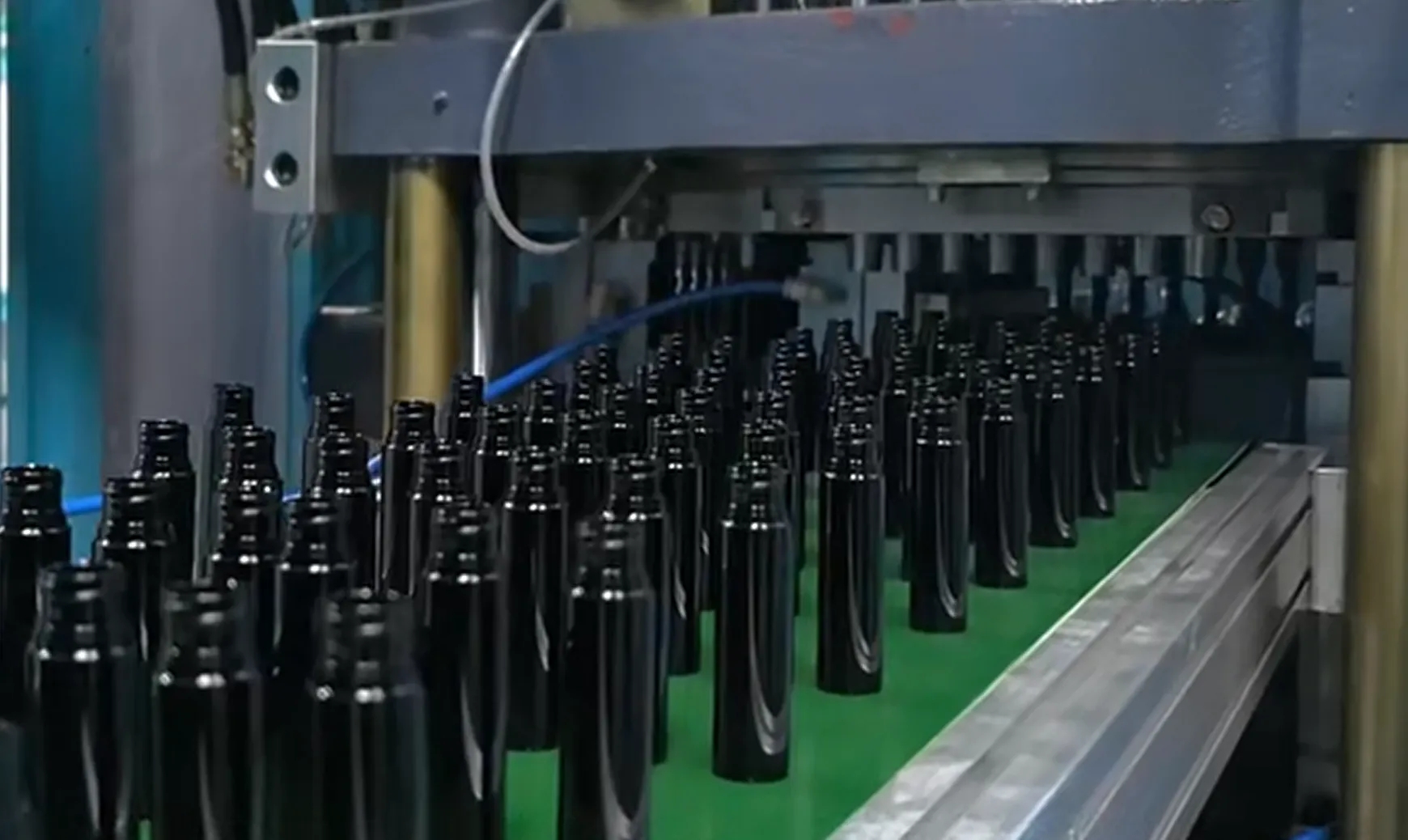
Korean ISBM agricultural container production — 500ml PET (left) and 1L PET (right) for Korean herbicide distribution. Body wall 1.2mm versus Korean beverage 0.25mm (4.8× heavier wall) provides chemical barrier, UV resistance, and the mechanical robustness to survive Korean farm supply chain handling — steel-shelved Korean agricultural cooperative stores, metal-floored Korean delivery trucks, and Korean farm corrugated metal storage floors where containers are occasionally dropped from 1.5–2m height.
Dizajn korejskih ISBM poljoprivrednih kontejnera za proizvodnju pića razlikuje se od korejskih ISBM-ova za proizvodnju pića u tri osnovna parametra: debljini stijenke, profilu grla i pritisku duvanja. Svaki od njih je vođen specifičnim zahtjevima primjene - hemijskom barijerom, momentom zatvaranja i strukturnom robusnošću - a ne minimiziranjem težine ili estetikom.
Korean agricultural ISBM wall thickness specification: Body wall target 1.0–1.5mm (versus Korean beverage 0.22–0.28mm). The heavier wall serves three functions simultaneously: improved chemical barrier (diffusion path length for active ingredient migration through the wall is proportional to wall thickness, so 1.2mm wall has 5× the barrier of 0.25mm beverage wall); UV resistance (more polymer mass absorbs more UV before reaching the contained product); and mechanical robustness (Korean agricultural Korean distribution chain drop resistance — a 500ml PET agricultural bottle at 1.2mm wall absorbs the energy of a 1.5m corner drop onto Korean concrete agricultural cooperative flooring without leakage, where a 0.25mm beverage wall would split). To produce 1.2mm average body wall in Korean ISBM, the preform wall must be proportionally heavier than the standard beverage preform — Korean agricultural ISBM preforms typically weigh 28–35g for a 500ml container versus 14–18g for a Korean 500ml beverage preform.
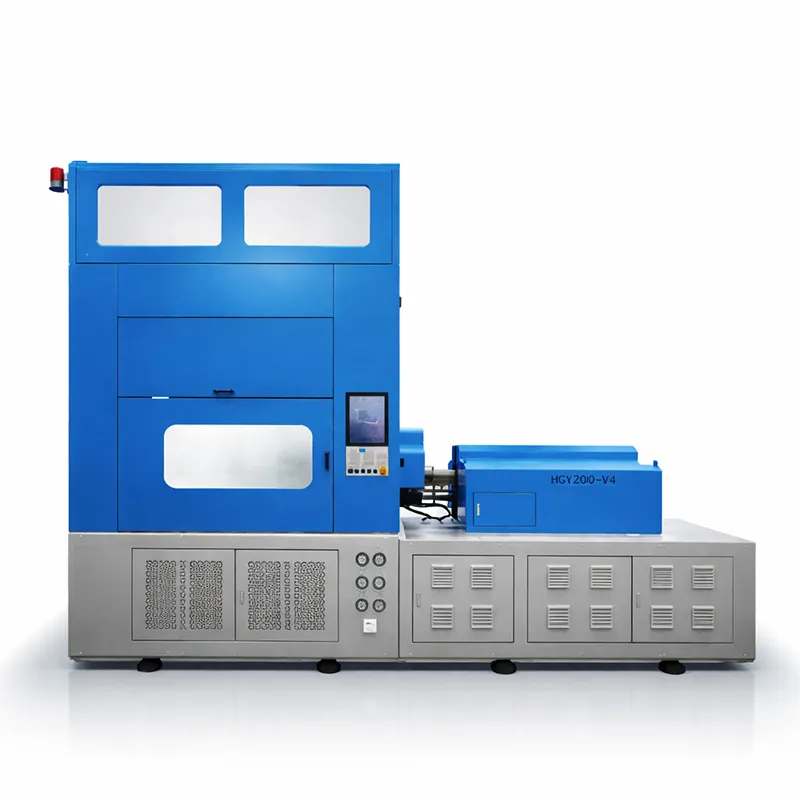
Korean agricultural ISBM neck profile: Wide-mouth necks (28/400, 38/400, 45/400 GPI finish) are standard for Korean agricultural containers — wider necks reduce the flow resistance when Korean farmers pour concentrated formulations from the bottle into mixing equipment, and they accommodate Korean agricultural CRC closures that are physically larger than Korean beverage closures. Wide-mouth Korean ISBM requires machines with injection clamping force appropriate for the larger preform gate area — the Korean Ever-Power HGY200-V4 (200 kN injection clamping, 63mm maximum neck) is the standard platform for Korean 28–38mm agricultural neck production; the HGY250-V4 (250 kN, 86mm maximum neck) covers Korean 45mm and above agricultural wide-mouth formats.
Korean agricultural ISBM blow pressure: The heavier-wall Korean agricultural ISBM preform requires higher pre-blow and high-blow pressure than Korean beverage production to achieve complete mould contact and orientation at the heavier wall. Korean agricultural ISBM blow pressure targets: pre-blow 7–9 bar (versus 6–8 bar beverage); high-blow 28–34 bar (versus 24–28 bar beverage). The Korean Ever-Power Asortiman ISBM mašina sa 4 stanice Sve platforme podržavaju visoki pritisak duvanja do 40 bara, pružajući adekvatan prostor za proizvodnju poljoprivrednih kontejnera s debelim zidovima u Koreji bez približavanja maksimalnom nazivnom pritisku mašine - radeći na 70–80% nazivnog pritiska umjesto 95–100%, što značajno produžava vijek trajanja PTFE zaptivke ventila za duvanje u okruženju korejske poljoprivredne proizvodnje s višim ciklusom.
Često postavljana pitanja
Agricultural Container Support
Korean Agricultural ISBM Container — Korean RDA Approval Documentation, Chemical Compatibility Testing, or 빈용기 보증금 Design Support?
Korean Ever-Power provides agricultural ISBM container documentation packages for Korean RDA approval, UV-stabilised PET and PP resin selection for Korean agrochemical formulations, and 빈용기 보증금 mould design compliance review.
Povezani resursi
Mašina za brizganje i istezanje duvanjem HGY200-V4
250ml–1L Korean agricultural container · UV-stabilised PET and PP · 200 kN injection clamping for 28/400 wide-mouth agricultural neck · Korean RDA qualification documentation support.
Mašina za brizganje i istezanje duvanjem HGY250-V4
1L–3L Korean agricultural container · Wide-mouth 86mm neck for Korean 1L CRC agricultural formats · Heavy-wall PP for Korean EC insecticide concentrate · Korean UN certification test support.
Mašina za brizganje i istezanje duvanjem HGY650-V4
Visokoproduktivna proizvodnja poljoprivrednih kontejnera u Koreji · Kooperativna opskrba velikim volumenom korejskog 농협 proizvoda · UV-stabilizirani PET za vrhunac sezonske proizvodnje herbicida u Koreji · Potpuna kvalifikacija dizajna kontejnera za korejski 빈용기보증금.