ABS IBM · PLASTIK TEKNIK · RA 0,05 UM GLOSSY · KOREA EVER-POWER ZQ SERIES
ABS IBM:
Plastik Rekayasa Panduan Produksi Kontainer
Pencetakan tiup injeksi ABS menghadirkan kinerja plastik teknik ke produksi wadah — menggabungkan hasil akhir permukaan mengkilap seperti cermin, stabilitas dimensi, dan ketahanan benturan dari terpolimer akrilonitril-butadiena-stirena dengan geometri leher presisi IBM dan arsitektur tanpa sisa cetakan. Panduan ini mencakup sifat material ABS IBM, protokol pengeringan awal yang wajib, aplikasi wadah kosmetik dan industri Korea, parameter pemrosesan, dan ekonomi produksi seri ZQ untuk wadah ABS IBM berukuran 5-500 ml.
KOREA EVER-POWER · ANSAN-SI, GYEONGGI-DO · JULI 2026
REFERENSI PROSES · PARAMETER KUNCI ABS IBM
PENYELESAIAN PERMUKAAN
Ra 0,05 µm
Eksterior ABS IBM mengkilap seperti cermin — kualitas permukaan terbaik di antara termoplastik IBM pada polesan cetakan yang setara.
PENGERINGAN AWAL
80°C / 4-6 jam
Pengeringan desikan wajib — Kelembapan ABS di atas 0,05% menyebabkan cacat permukaan berupa garis-garis perak pada semua wadah.
SUHU TABUNG
210-240°C
Kisaran pemrosesan barel terpolimer ABS — lebih tinggi dari HDPE dan sebanding dengan suhu operasi PP IBM.
KILAP @ 60°
85-95 GU
Badan wadah ABS kelas HG IBM — Spesifikasi toko serba ada minimal 85 GU untuk merek kosmetik mewah Korea.
BAGIAN 01
Ikhtisar Aplikasi dan Material ABS IBM
ABS adalah satu-satunya termoplastik rekayasa dalam produksi rutin IBM — menggabungkan ketahanan kimia akrilonitril, ketangguhan benturan butadiena, dan kilap permukaan stirena dalam satu terpolimer yang diproses IBM menjadi wadah dengan eksterior berkualitas cermin yang tidak dapat dicapai oleh HDPE dan PP. Wadah ABS IBM ditentukan di mana pun merek kosmetik Korea membutuhkan kilap cermin Ra 0,05 µm dari ABS kelas HG atau di mana pun aplikasi industri membutuhkan wadah dengan ketahanan kimia yang unggul terhadap lingkungan alkali atau pelarut ringan dibandingkan dengan bahan poliolefin komoditas IBM.
| APLIKASI | FORMAT | KUALITAS ABS | MODEL ZQ | PROPERTI UTAMA |
|---|---|---|---|---|
| Kosmetik mewah Korea ★ | 10-100 ml | HG (kilap tinggi) | ZQ40-ZQ60 | Kilap cermin 85-95 GU, warna Delta E 1.0, toko serba ada Korea |
| Botol pompa alas bedak Korea | 15-50 ml | HG | ZQ40 | Leher pompa tanpa udara ±0,04 mm, badan sudut R 3-5 mm |
| Botol reagen industri | 50-250 ml | Tujuan umum | ZQ40-ZQ60 | Tahan terhadap alkali pH 7-12, stabilitas dimensi, tutup jepret |
| Diagnostik / laboratorium | 5-50 ml | Tahan api | ZQ40 | Stabilitas dimensi, ketahanan kimia, autoklaf (FR ABS terbatas) |
BAGIAN 02
Protokol Pra-Pengeringan ABS IBM dan Pencegahan Garis Perak
PROTOKOL PENGERINGAN ABS IBM — LANGKAH DEMI LANGKAH
Langkah 1 — Memuat Pengering
Masukkan pelet ABS ke dalam pengering hopper desikan pada titik pengaturan suhu 80°C. Pengisian hopper maksimum: kapasitas 75% untuk memastikan sirkulasi udara kering panas yang memadai melalui lapisan pelet ABS. Kedalaman lapisan pelet ABS: maksimum 400 mm untuk pengering desikan aliran tembus standar.
Langkah 2 — Keringkan selama 4-6 Jam
Waktu pengeringan minimum pada suhu 80°C: 4 jam untuk ABS kualitas K-beauty Korea; maksimum 6 jam untuk batch yang diketahui terpapar kelembapan lingkungan yang tinggi. Jangan melebihi suhu 80°C — pengeringan di atas 85°C dalam waktu lama akan menyebabkan perubahan warna pada pelet ABS.
Langkah 3 — Verifikasi Titik Embun
Ukur titik embun udara keluar pengering desikan sebelum memulai produksi IBM. Persyaratan: titik embun udara keluar di bawah -40°C. Ini memastikan lapisan desikan aktif dan kelembapan ABS di bawah 0,05%. Jangan memulai produksi ABS IBM jika titik embun di atas -30°C.
Langkah 4 — Inspeksi Saat Memulai
Lakukan 5-10 kali uji coba awal setelah pengisian tabung ABS. Periksa setiap wadah uji coba awal di bawah cahaya terarah 500 lux untuk melihat adanya garis-garis perak. Nyatakan kualitas produksi hanya setelah 5 kali uji coba awal berturut-turut tanpa garis-garis perak dari semua rongga.
Protokol pembersihan saat penghentian ABS: Saat penghentian produksi IBM, bersihkan seluruh isi tabung dengan HDPE (3-5 kali semprotan) sebelum pendinginan. Sisa ABS dalam tabung pendingin mengalami degradasi oksidatif termal yang lambat — menghasilkan bercak perubahan warna cokelat atau hitam pada batch ABS berikutnya yang memerlukan pembersihan lebih lama untuk dihilangkan. Pembersihan dengan HDPE jauh lebih murah daripada membuang produksi ABS pada tingkat spesifikasi wadah kosmetik mewah Korea.
BAGIAN 03
Parameter Pemrosesan ABS IBM dan Suhu Cetakan
PARAMETER ABS IBM vs HDPE DAN PP — WADAH 30ml @ ZQ40
| PARAMETER | ABS (kosmetik) | PP RCP (kosmetik) | HDPE (rumah tangga) |
|---|---|---|---|
| Pengeringan awal | 80°C / 4-6 jam wajib | Tidak diperlukan | Tidak diperlukan |
| Suhu barel | 210-240°C | 210-245°C | 195-220°C |
| Suhu cetakan | 55-70°C | 55-70°C (kosmetik) | 18-26°C |
| Waktu siklus (30 ml) | 4,5-5,5 detik | 4,5-5,5 detik | 3,8-4,5 detik |
| Kilap permukaan | 85-95 GU (cermin) | Semi-kilap (5-12% haze) | Buram (kabut 20-35%) |
Persyaratan suhu cetakan ABS 55-70°C membedakan IBM kosmetik ABS dari IBM HDPE rumah tangga (18-26°C) dan IBM HDPE industri (18-26°C) pada mesin ZQ yang sama. Cetakan hangat memungkinkan lelehan ABS tetap bersentuhan dengan permukaan rongga cetakan cukup lama untuk transfer kilap sempurna dari rongga cetakan tiup yang dipoles cermin Ra 0,025 µm ke bagian luar wadah ABS. Pada suhu cetakan 18-26°C, ABS mendingin terlalu cepat saat kontak — mencegah replikasi permukaan penuh dan menghasilkan permukaan ABS yang sedikit bergaris atau kusam yang ditolak oleh merek kosmetik mewah Korea pada inspeksi QA masuk. Panduan pemrosesan IBM PP yang mencakup parameter barel dan cetakan khusus PP ada di Panduan materi PP IBM.
BAGIAN 04
Aplikasi Kontainer ABS IBM: Kosmetik dan Industri
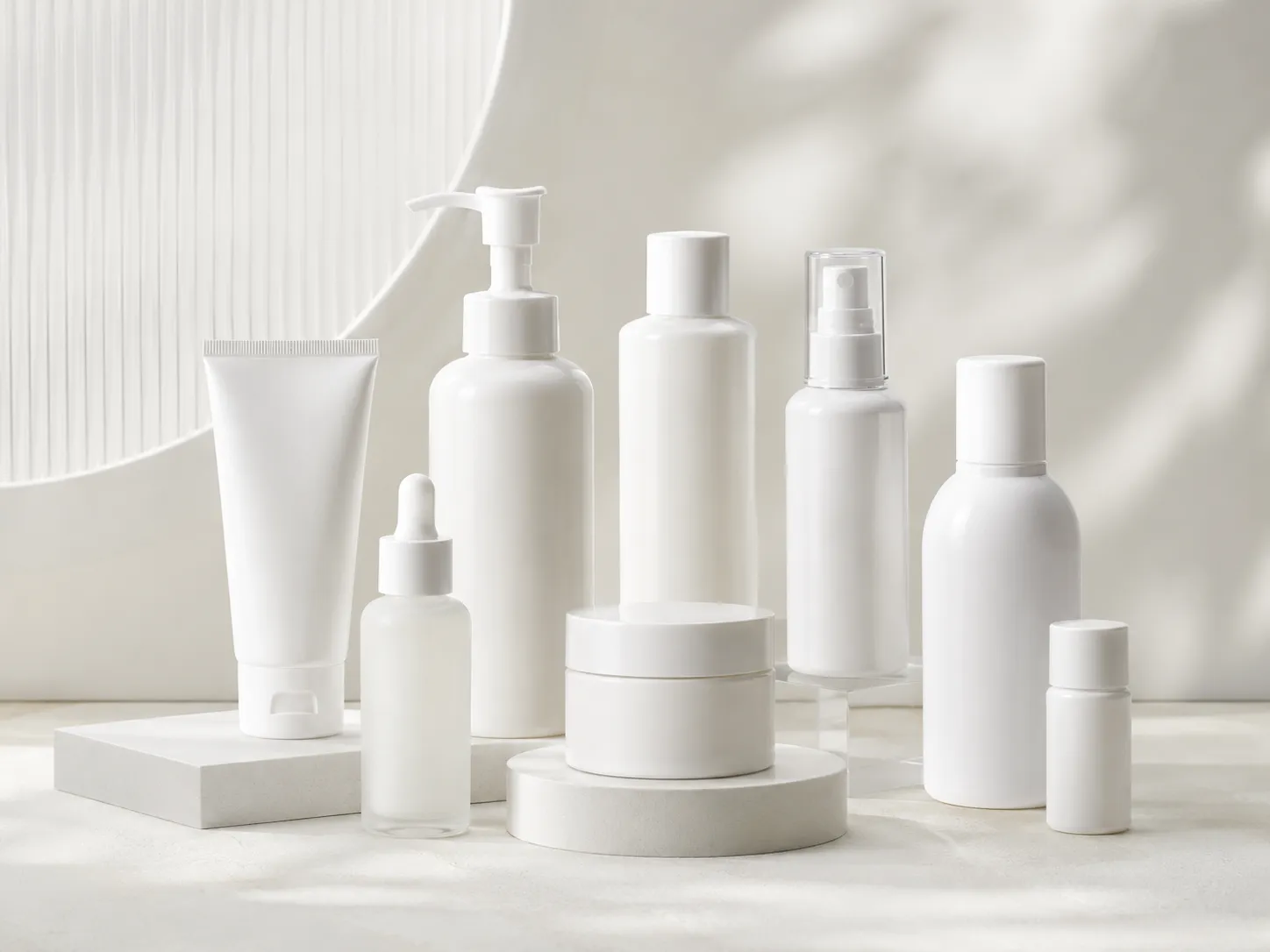
Kosmetik Mewah Korea ABS IBM
Putih seperti cermin (buram)
Masterbatch TiO2 3-5% dalam ABS HG — putih bersih dan klinis pada 85-95 GU untuk kemasan merek perawatan kulit mewah Korea. Warna ABS IBM kosmetik mewah Korea yang paling umum.
Hitam doff
Karbon hitam 0,5-1% + zat pengencer silika 0,5-1,5% — 5-20 GU hasil akhir matte pada suhu cetakan yang lebih rendah (55-65°C). Kemasan alas bedak mewah Korea dan merek perawatan pria Korea.
Efek metalik
Pigmen metalik (serpihan aluminium 0,5-1%) dalam cetakan ABS pada suhu 55-70°C menghasilkan kilau metalik yang berkilauan pada kemasan set hadiah mewah Korea dan wadah koleksi liburan K-beauty Korea.
Aplikasi ABS Industri IBM
Reagen dan wadah laboratorium
Botol reagen ABS IBM berukuran 50-250 ml untuk reagen alkali laboratorium (pH 7-12), larutan buffer, dan penyimpanan reagen diagnostik. Stabilitas dimensi ABS IBM (di bawah suhu layanan 80°C) lebih unggul daripada HDPE untuk penandaan volume laboratorium yang presisi pada badan wadah.
Wadah industri dengan tutup jepret
Wadah industri ABS IBM dengan sistem penutup snap-fit untuk pengumpulan sampel laboratorium Korea, pengambilan sampel lingkungan Korea, dan penyimpanan sampel kontrol kualitas industri Korea. Presisi geometri snap-fit ABS IBM (±0,05 mm) memastikan penguncian yang aman.
Rumah perangkat diagnostik
Wadah ABS IBM untuk kit reagen diagnostik in vitro (IVD) Korea — wadah ABS IBM bervolume kecil (5-30 ml) untuk penyimpanan reagen laboratorium klinis Korea yang membutuhkan stabilitas dimensi, ketahanan kimia, dan ABS berkode warna untuk identifikasi komponen kit IVD Korea.
BAGIAN 05
ABS vs PP vs HDPE: Perbandingan Pemilihan Material IBM
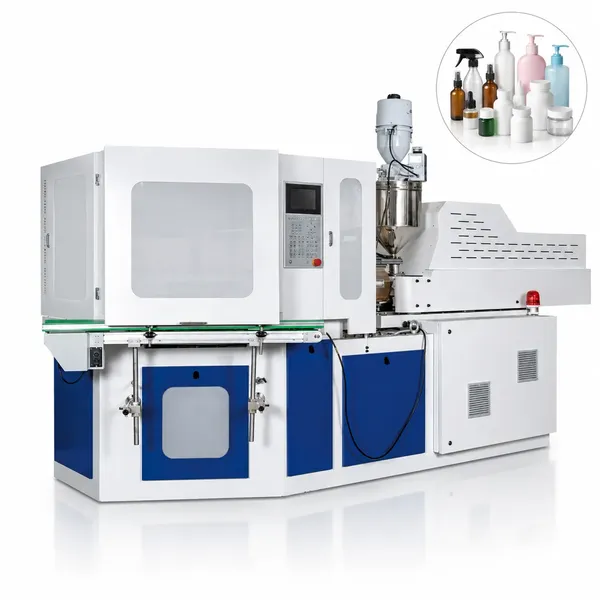
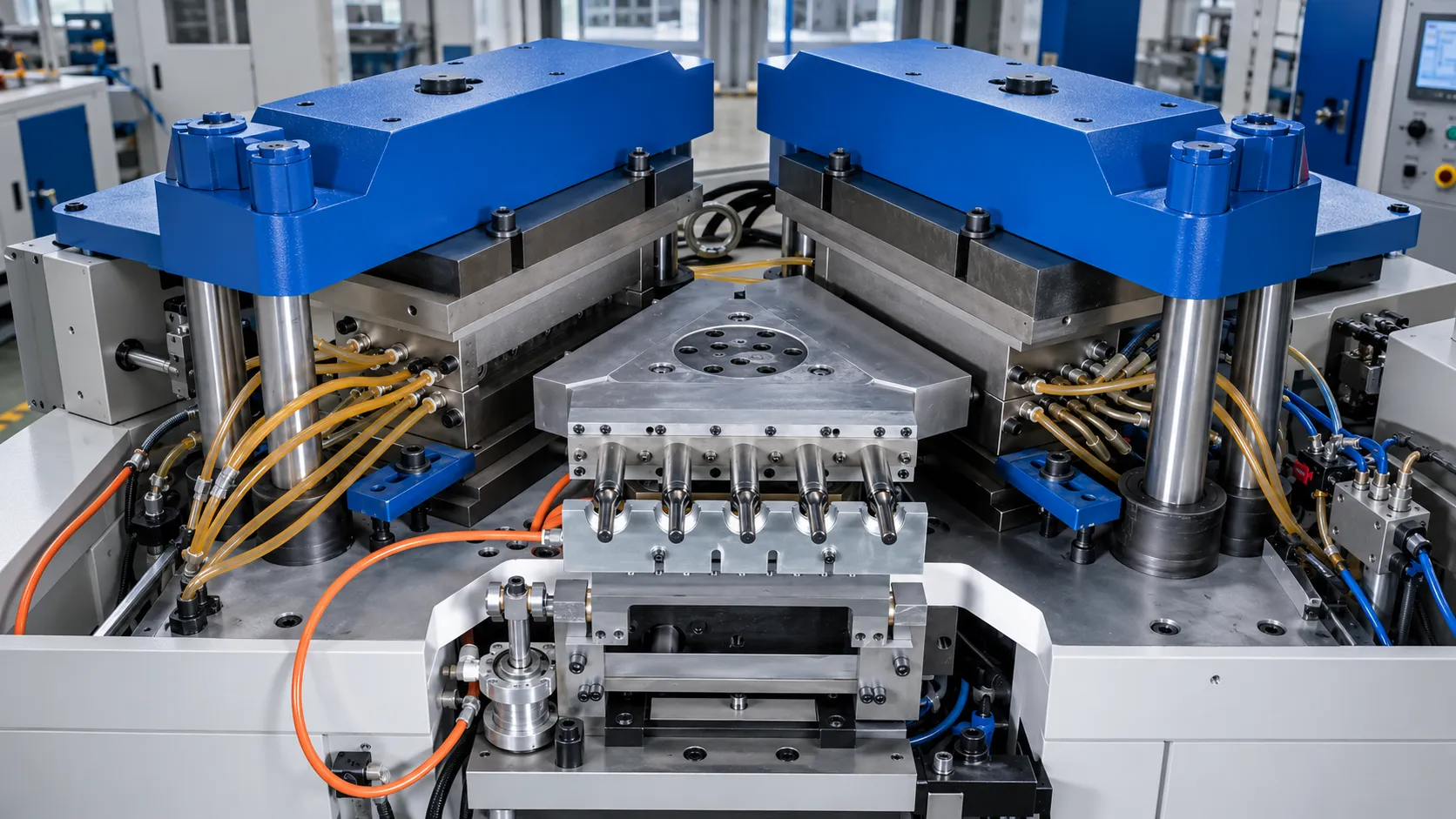
Korea Ever-Power ZQ40 menangani ABS, PP, dan HDPE IBM dalam proses produksi khusus dengan pergantian material — ABS IBM kosmetik mewah Korea (cermin buram), PP RCP IBM toner K-beauty Korea (transparan), dan HDPE IBM produk rumah tangga dan farmasi Korea (kaku buram) semuanya pada platform ZQ40 yang sama melalui pergantian material dan suhu antar proses produksi.
| KRITERIA | ABS IBM | PP RCP IBM | HDPE IBM |
|---|---|---|---|
| Kilap permukaan | Cermin 85-95 GU | Semi-kilap (5-12% haze) | Buram (kabut 20-35%) |
| Pengeringan awal diperlukan | Ya (80°C / 4-6 jam) | TIDAK | TIDAK |
| Kontak dengan makanan/kosmetik | Kosmetik boleh, TIDAK untuk makanan. | Keduanya baik-baik saja | Keduanya baik-baik saja |
| Resistensi alkali | Sangat baik (pH 7-12) | Baik (pH 7-11) | Baik (pH 7-13) |
| Ketahanan terhadap asam | Terbatas (serangan pH <5) | Sangat baik (pH 1-14) | Sangat baik (pH 1-14) |
| Aplikasi utama IBM | Kosmetik mewah Korea, lab | Perawatan kulit transparan ala K-beauty | Farmasi, rumah tangga, makanan |
BAGIAN 06
Pemilihan Seri ZQ untuk ABS IBM
| MODEL ZQ | 5-30 ml ★ (kav/jam) | 50-100 ml (kav/jam) | 150-250 ml (kav/jam) | PROFIL |
|---|---|---|---|---|
| EP-ZQ40 ★ | 7-9 / ~14,000 | 5-7 / ~7,500 | 3-4 / ~3,000 | Spesialis kosmetik mewah Korea ABS — tolok ukur IBM 5-100 ml |
| EP-ZQ60 | 10-12 / ~19,000 | 8-10 / ~12,000 | 5-6 / ~6,000 | ABS OEM kosmetik mewah Korea bervolume tinggi, ABS IBM industri dengan kapasitas 100-250 ml |
FAQ TEKNIK
ABS IBM — Pertanyaan Teknik
Pertanyaan 01
Apa alasan molekuler mengapa ABS IBM mencapai kilap permukaan yang lebih tinggi daripada HDPE dan PP pada polesan cetakan yang identik?
ABS IBM mencapai kilap permukaan yang lebih tinggi daripada HDPE dan PP pada polesan rongga cetakan tiup yang identik (Ra 0,025 µm) karena tiga alasan yang saling terkait yang berakar pada struktur terpolimer ABS. Keakuratan replikasi permukaan: Lelehan ABS pada suhu 210-240°C memiliki viskositas leleh yang lebih rendah daripada lelehan HDPE dan PP yang sebanding pada suhu pemrosesannya masing-masing, memungkinkan lelehan ABS mengalir ke dalam dan mereplikasi fitur permukaan skala mikro pada rongga cetakan pada tingkat sub-mikron selama injeksi preform. Lelehan HDPE dan PP, dengan viskositas leleh yang lebih tinggi, tidak mereplikasi fitur mikro rongga dengan akurat — menghasilkan permukaan yang sedikit lebih bertekstur bahkan dari polesan cetakan yang sama. Mekanisme pemadatan: HDPE dan PP adalah polimer semi-kristalin yang mengkristal dari lelehan — selama kristalisasi, domain kristalin terbentuk dan tumbuh di permukaan cetakan, menghasilkan kekasaran mikro pada permukaan wadah yang sesuai dengan struktur kristalin. ABS bersifat amorf (tidak memiliki domain kristalin) — ia mengeras sebagai permukaan halus seperti kaca tanpa kekasaran mikro domain kristalin, sehingga mempertahankan kilap rongga cetakan pada permukaan wadah akhir. Sinergi cetakan hangat: ABS pada suhu cetakan 55-70°C tetap meleleh di permukaan cetakan lebih lama daripada HDPE pada 18-26°C atau PP pada 55-70°C, memungkinkan aliran permukaan dan pengembangan kilap yang lebih lengkap. Kombinasi mekanisme pengerasan amorf, viskositas leleh rendah, dan kontak cetakan hangat menghasilkan kualitas permukaan cermin Ra 0,05 µm yang membuat wadah ABS IBM secara visual lebih unggul daripada HDPE dan PP IBM pada tingkat pemolesan cetakan yang sama.
Pertanyaan 02
Mengapa ABS tidak cocok untuk aplikasi kontak makanan meskipun telah disetujui untuk kontak kosmetik?
ABS tidak disetujui untuk kontak langsung dengan makanan dalam peraturan plastik kontak makanan MFDS Korea atau EU EC 10/2011 karena dua alasan yang berkaitan dengan komposisi terpolimer ABS. Migrasi monomer akrilonitril: komponen akrilonitril ABS dapat mengalami depolimerisasi pada suhu tinggi, melepaskan monomer akrilonitril residu. Akrilonitril diklasifikasikan sebagai karsinogen potensial (Grup 2A, IARC) — baik peraturan plastik makanan MFDS Korea maupun EU EC 10/2011 menetapkan batas migrasi akrilonitril pada 0,02 mg/kg simulan makanan, yang beberapa jenis ABS lampaui dalam pengujian kontak makanan yang dipercepat pada 40°C/10 hari dalam simulan makanan berlemak (etanol 95%). Fase karet butadiena: partikel karet butadiena dalam ABS tidak tercantum sebagai bahan kontak makanan yang disetujui dalam peraturan MFDS Korea atau EU untuk penggunaan kontak langsung dengan makanan. ABS disetujui untuk kontak kosmetik Korea berdasarkan peraturan wadah Undang-Undang Kosmetik MFDS Korea karena batas migrasi kontak kosmetik Korea untuk turunan akrilonitril dan butadiena ditetapkan pada tingkat toleransi yang lebih tinggi daripada peraturan kontak makanan Korea — mencerminkan paparan yang lebih rendah dan terputus-putus dari penggunaan produk kosmetik dibandingkan dengan konsumsi makanan. Untuk aplikasi wadah IBM Korea di mana kontak kosmetik dan makanan diperlukan (wadah penggunaan ganda), PP atau HDPE IBM adalah pilihan material yang tepat, karena keduanya disetujui MFDS Korea untuk kontak langsung dengan makanan tanpa kekhawatiran batas migrasi.
Pertanyaan 03
Apa saja cacat ABS IBM yang disebabkan oleh suhu barel yang tidak tepat dan bagaimana cara memperbaikinya?
Penyimpangan suhu barel ABS IBM menghasilkan lima jenis cacat spesifik dengan protokol koreksi yang sesuai. Suhu terlalu rendah (di bawah 200°C): tembakan pendek (pengisian preform tidak lengkap) dan bekas aliran permukaan pada bagian luar wadah di zona gerbang preform — tingkatkan suhu barel dengan penambahan 5°C hingga bekas aliran hilang. Suhu terlalu tinggi (di atas 245°C): degradasi termal ABS menghasilkan bintik-bintik perubahan warna cokelat, bau terbakar, penurunan kilap permukaan (warna kekuningan pada bagian luar wadah) dan kerapuhan dinding wadah — segera kurangi suhu barel, bersihkan barel dengan 5-8 tembakan, periksa penghilangan perubahan warna sebelum melanjutkan produksi. Ketidakseragaman suhu (gradien zona 1 ke nosel tidak tepat): bekas las dan garis aliran pada badan luar wadah akibat homogenitas lelehan yang tidak konsisten saat injeksi — verifikasi semua titik pengaturan pengontrol suhu zona barel dan kalibrasi PID, pastikan suhu nosel berada di zona tertinggi (200-240°C untuk ABS). Kelembapan sisa (kegagalan pengeringan awal): garis-garis perak terlepas dari suhu barel — hentikan produksi segera, bersihkan barel dengan ABS kering, verifikasi titik embun pengering desikan di bawah -40°C sebelum memulai kembali. Gradien suhu yang tajam pada nosel (nosel terlalu dingin): cacat bercak gerbang pada dasar wadah (lingkaran kusam atau kasar pada zona gerbang injeksi dasar IBM) — tingkatkan suhu nosel agar sesuai dengan titik pengaturan zona nosel barel dan verifikasi pengoperasian pita pemanas nosel.
Pertanyaan 04
Bagaimana Korea Ever-Power mempertahankan polesan cetakan ABS IBM selama program produksi yang panjang?
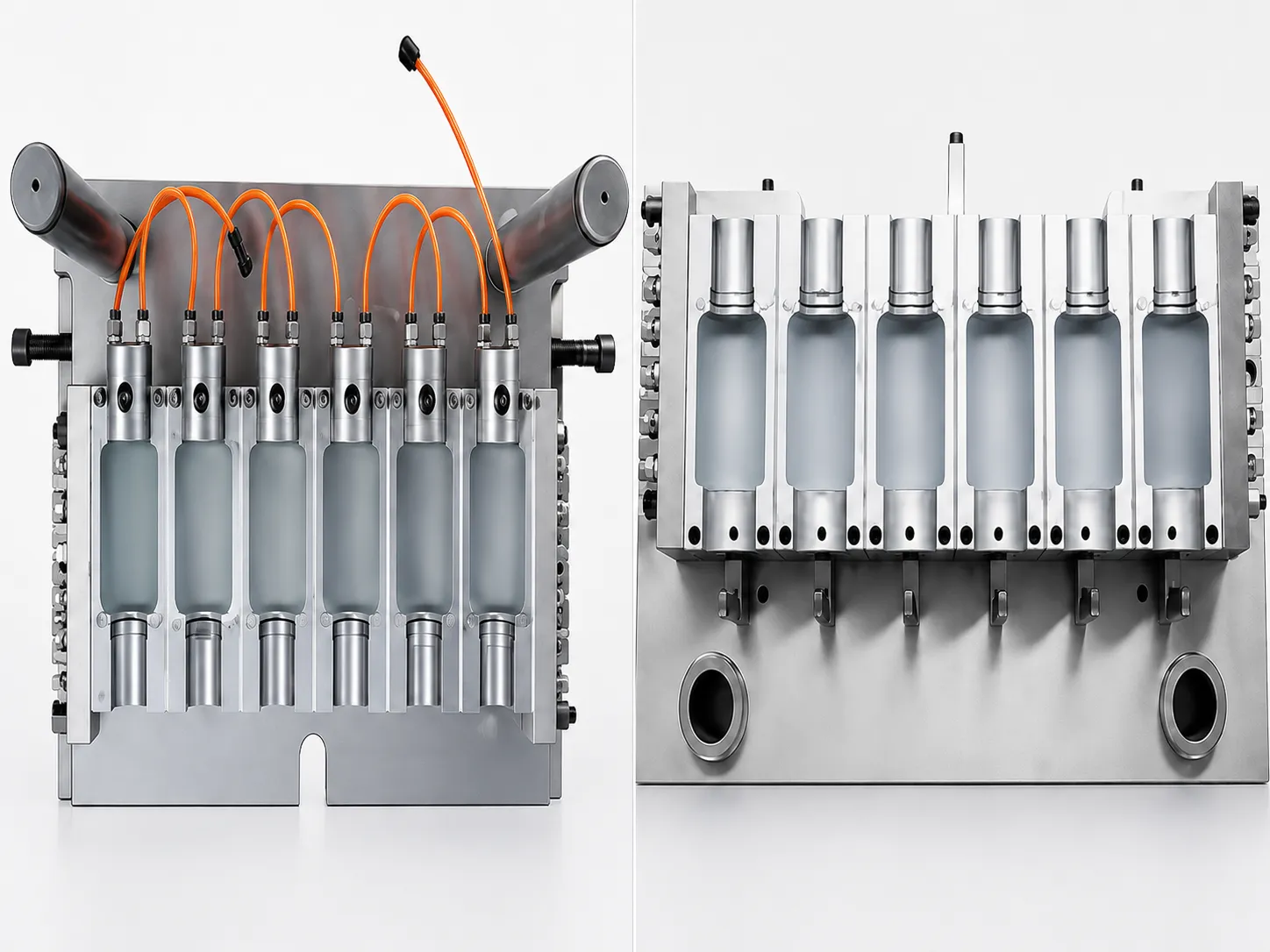
Pemeliharaan poles cetakan ABS IBM adalah proses terstruktur yang diterapkan oleh Korea Ever-Power sebagai layanan standar untuk program produksi jangka panjang merek kosmetik mewah Korea. Rongga cetakan tiup (baja P20 atau S136, poles cermin awal Ra 0,025 um) mengalami degradasi perlahan selama siklus produksi karena keausan mikro akibat kontak aliran leleh ABS, tekanan siklus termal (pemanasan hingga 55-70°C dan pendinginan antar siklus) dan kontaminasi partikel keras sesekali dari aglomerat masterbatch. Protokol pemeliharaan cetakan ABS IBM Korea Ever-Power: (1) pengukuran kilap produksi di bagian luar wadah pada 500 lux setiap 500.000 siklus atau interval inspeksi merek Korea — jika kilap turun di bawah 82 GU, cetakan tiup ditandai untuk dipoles ulang; (2) Pemolesan ulang rongga cetakan tiup (senyawa intan, urutan tingkatan 5 langkah dari 600 grit hingga intan 3 µm) mengembalikan rongga ke Ra 0,025 µm — pemolesan ulang memerlukan cetakan tiup untuk dilepas dari mesin ZQ dan dikirim ke ruang perkakas Korea Ever-Power selama 2-3 hari; (3) Sisipan leher cetakan injeksi (stainless steel S136, Ra 0,025 µm) dipoles ulang secara bersamaan dengan cetakan tiup untuk mempertahankan kilap permukaan penyegelan leher; (4) Frekuensi pemolesan ulang untuk kosmetik mewah Korea ABS IBM: biasanya setiap 3-5 juta siklus produksi untuk set cetakan program berkelanjutan — menghasilkan biaya pemolesan ulang yang dapat diprediksi yang dimasukkan Korea Ever-Power dalam penetapan harga program merek kosmetik mewah Korea.
Pertanyaan 05
Apa urutan peralihan ABS IBM yang benar saat beralih dari produksi PP ke ABS pada ZQ40?
Urutan peralihan PP ke ABS pada ZQ40 mengikuti protokol khusus untuk mencegah kontaminasi PP dalam produksi ABS dan untuk mempersiapkan barel untuk kebutuhan pengeringan ABS. Langkah 1 — Verifikasi pengeringan ABS: pastikan ABS telah berada di pengering desikan pada suhu 80°C selama minimal 4 jam sebelum memulai peralihan — pengeringan ABS berjalan paralel dengan produksi PP pada proses produksi sebelumnya sehingga ABS siap saat produksi PP berakhir. Langkah 2 — Bersihkan barel dengan ABS: dengan barel pada suhu PP (210-245°C), mulai masukkan ABS dari hopper pengering desikan dan jalankan 3-5 kali pengisian barel ABS pada suhu PP untuk membersihkan PP dari barel. Suhu barel PP dan ABS cukup tumpang tindih (keduanya dalam kisaran 210-240+°C) sehingga tidak diperlukan penyesuaian suhu barel selama pembersihan. Langkah 3 — Stabilkan barel pada parameter ABS: sesuaikan titik pengaturan suhu zona barel ke profil ABS (zona 1: 210°C, zona 2-3: 225°C, nozzle: 235°C untuk ABS kosmetik IBM Korea). Langkah 4 — Sesuaikan suhu cetakan: jika beralih dari PP kosmetik IBM (cetakan 55-70°C) ke ABS kosmetik IBM (cetakan 55-70°C), tidak diperlukan penyesuaian suhu cetakan — ABS dan PP kosmetik IBM menggunakan rentang suhu cetakan yang identik, sehingga sangat menyederhanakan peralihan PP ke ABS dibandingkan dengan beralih dari HDPE rumah tangga (18-26°C) ke ABS kosmetik (55-70°C). Langkah 5 — Inspeksi awal: jalankan 5-10 tembakan awal ABS di bawah inspeksi arah 500 lux untuk garis-garis perak, bercak gerbang, dan konsistensi warna. Nyatakan kualitas produksi ABS IBM setelah 5 tembakan bebas cacat berturut-turut dari semua rongga.
Pertanyaan 06
Berapakah spesifikasi ketebalan dinding ABS IBM untuk wadah kosmetik mewah Korea?
Spesifikasi ketebalan dinding wadah kosmetik mewah Korea berbahan ABS IBM menyeimbangkan persyaratan kekakuan struktural untuk presentasi pajangan di department store Korea dengan persepsi berat wadah yang dinilai oleh konsumen mewah Korea sebagai indikator kualitas kemasan. Standar ketebalan dinding ABS IBM berdasarkan format: Wadah mewah Korea 5-15 ml (botol pompa tanpa udara, vial serum mata): minimum 0,65 mm — ABS dengan ketebalan 0,65 mm memberikan rasa kokoh seperti kaca yang ditentukan oleh merek serum dan krim mata mewah Korea untuk persepsi konsumen premium Korea; konsumen Korea menilai kemasan mewah ABS IBM dengan meremasnya perlahan antara ibu jari dan jari telunjuk — wadah yang lentur dengan tekanan jari ringan dianggap berkualitas lebih rendah daripada dinding ABS kaku yang tidak menghasilkan defleksi pada gaya pemeriksaan konsumen Korea. Wadah foundation dan krim mata mewah Korea 15-50 ml: dinding badan minimum 0,70 mm, dengan bahu minimum 0,75 mm — integritas struktural bahu di bawah penumpukan ritel Korea dan penanganan perakitan set hadiah Korea. Kemasan krim wajah mewah Korea 50-100 ml IBM: ketebalan dinding minimum 0,75 mm pada bagian badan, 0,80 mm pada bagian bahu — format yang lebih besar membutuhkan dinding yang lebih tebal untuk mempertahankan kesan mewah ABS yang kokoh pada diameter badan kemasan 55-75 mm. Ketebalan minimum ini diverifikasi oleh pengukuran ketebalan dinding ultrasonik Korea Ever-Power pada kemasan uji produksi di 8 titik per rongga sebelum persetujuan pengiriman merek mewah Korea.
ABS IBM ENQUIRY · KOREA EVER-POWER
Merencanakan Produksi Kontainer ABS IBM?
Korea Ever-Power menyediakan produksi kontainer ABS IBM pada ZQ40 dan ZQ60 dengan kualifikasi kilap Ra 0,05 µm, verifikasi protokol pra-pengeringan, manajemen warna Delta E 1.0, dan paket dokumentasi merek kosmetik mewah Korea.
Editor: Cxm