
PERALATAN BANTU IBM · PENDINGIN · PENGERING · KONVEYOR · PEMUAT OTOMATIS · KOREA EVER-POWER
Lini Produksi IBM
Peralatan Bantu Panduan untuk Seri ZQ
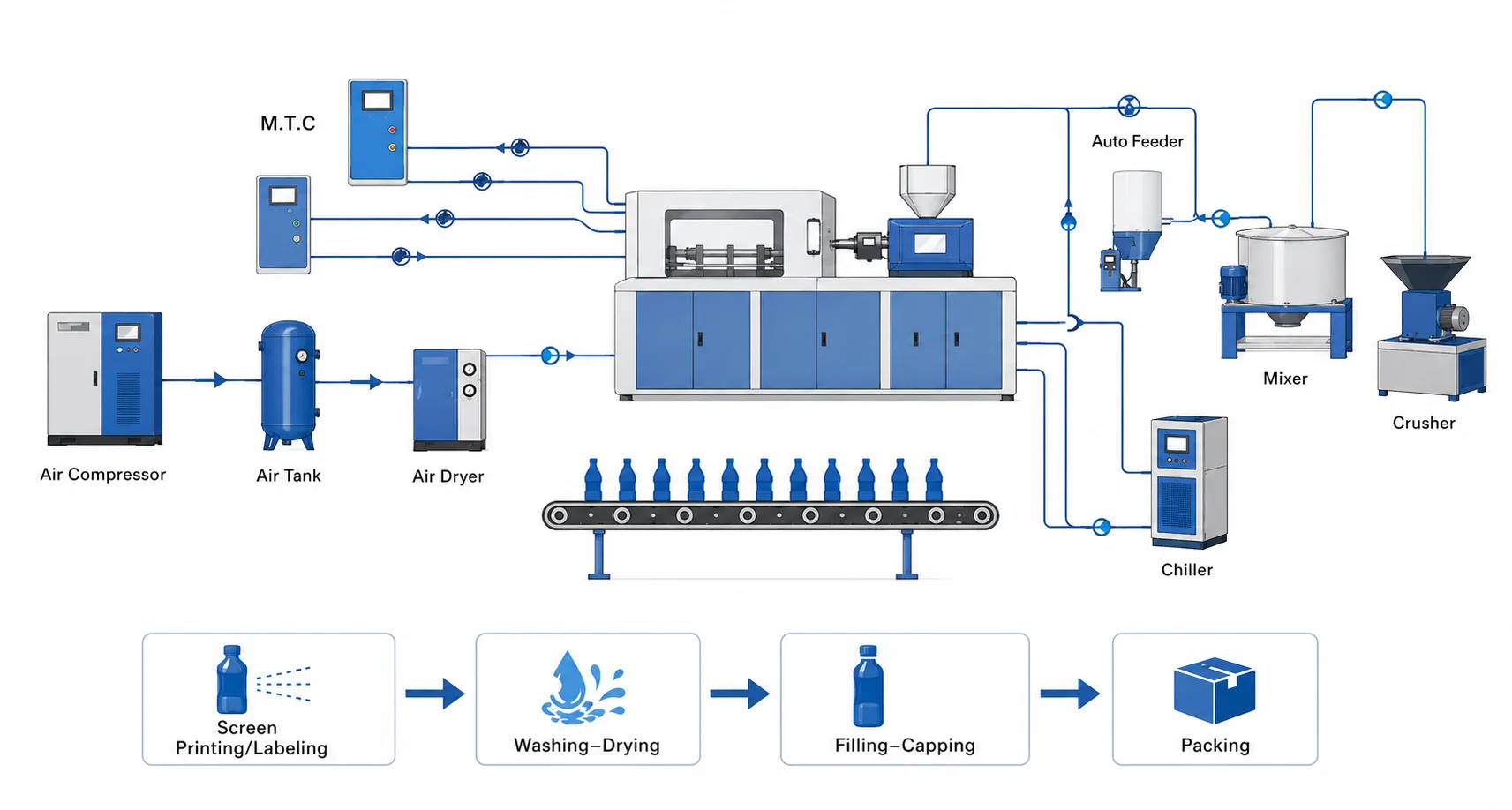
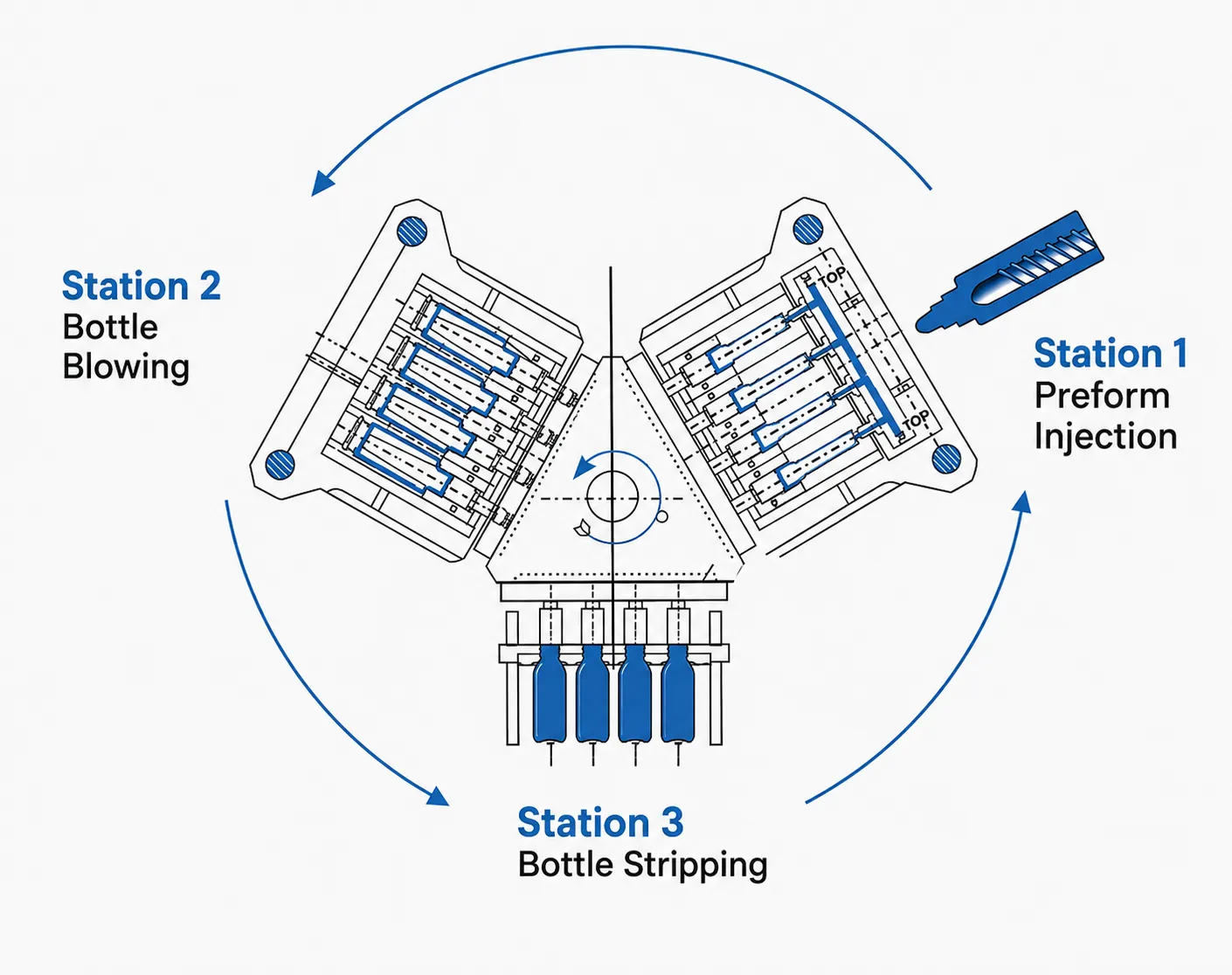
Mesin IBM seri ZQ Ever-Power Korea membutuhkan empat sistem bantu untuk beroperasi sebagai lini produksi IBM yang lengkap: pendingin cetakan, sistem pengeringan material, konveyor keluaran, dan pemuat material otomatis. Memilih dan menentukan setiap sistem bantu dengan benar untuk model mesin IBM dan format kontainer akan menentukan konsistensi hasil produksi, kualitas kontainer, dan keandalan operator. Panduan ini mencakup spesifikasi setiap sistem bantu untuk perencanaan lini produksi IBM ZQ40 hingga ZQ135.
Pemuat Otomatis • ZQ40–ZQ135
Spesifikasi Lini Produk IBM Lengkap
KOREA EVER-POWER · ANSAN-SI, GYEONGGI-DO · JULI 2026
SISTEM BANTU IBM · REFERENSI SPESIFIKASI CEPAT
PENDINGIN CETAKAN
10–18°C
Target suhu air pendingin cetakan: 10-15°C untuk IBM PP/HDPE standar; 12-18°C untuk IBM toples bermulut lebar. Kapasitas pendingin: 5 kW (ZQ40) hingga 25 kW (ZQ135). ΔT masuk-keluar ≤2°C pada cetakan.
PENGERING BAHAN
PP: 80°C/2 jam
Pengering hopper udara panas: PP/HDPE pada suhu 80°C selama minimal 2 jam. PCTG memerlukan pengering dehumidifikasi pada suhu 85°C/4-6 jam dengan titik embun ≤−40°C. Kapasitas pengering: 25kg (ZQ40) hingga 200kg (ZQ135) per batch
KONVEYOR KELUARAN
Lebar sabuk: 200–500 mm
Lebar konveyor sabuk: 200 mm (ZQ40, botol kecil) hingga 500 mm (ZQ135, toples besar). Kecepatan sabuk dapat disesuaikan 5-25 m/menit. Panjang konveyor biasanya 1,5-3,5 m ke tempat pengumpulan atau stasiun pengemasan.
PEMUAT OTOMATIS
Venturi vakum
Loader venturi vakum memindahkan pelet PP/HDPE kering dari hopper pengering di lantai ke hopper leher mesin ZQ IBM. Kapasitas: 30-200 kg/jam. Siklus: pemuatan berdasarkan waktu atau pemicu sensor level untuk menjaga pengumpanan barel ZQ.
BAGIAN 01
Chiller Pendingin Cetakan: Pemilihan dan Spesifikasi berdasarkan Model ZQ
Unit pendingin cetakan (chiller) adalah unit bantu IBM yang paling penting untuk kualitas kontainer — suhu air pendingin cetakan secara langsung mengontrol laju kristalisasi PP atau HDPE, yang menentukan kejernihan dinding kontainer, stabilitas dimensi, dan waktu siklus produksi. Korea Ever-Power's Mesin IBM seri ZQ Mesin ZQ40 hingga ZQ135 memerlukan pendingin udara atau air khusus yang ukurannya disesuaikan dengan beban panas cetakan masing-masing mesin, laju aliran sirkuit pendingin cetakan, dan kisaran suhu air pendingin yang ditargetkan. Menggunakan pendingin atau pasokan air fasilitas yang ukurannya kurang memadai (di atas 18°C) alih-alih pendingin khusus adalah masalah kualitas produksi IBM yang paling umum yang dihadapi Korea Ever-Power di instalasi pelanggan baru — menghasilkan kontainer dengan kekeruhan berlebihan (PP), deformasi dasar (HDPE), dan waktu siklus yang lebih lama yang secara langsung mengurangi output dan profitabilitas IBM.
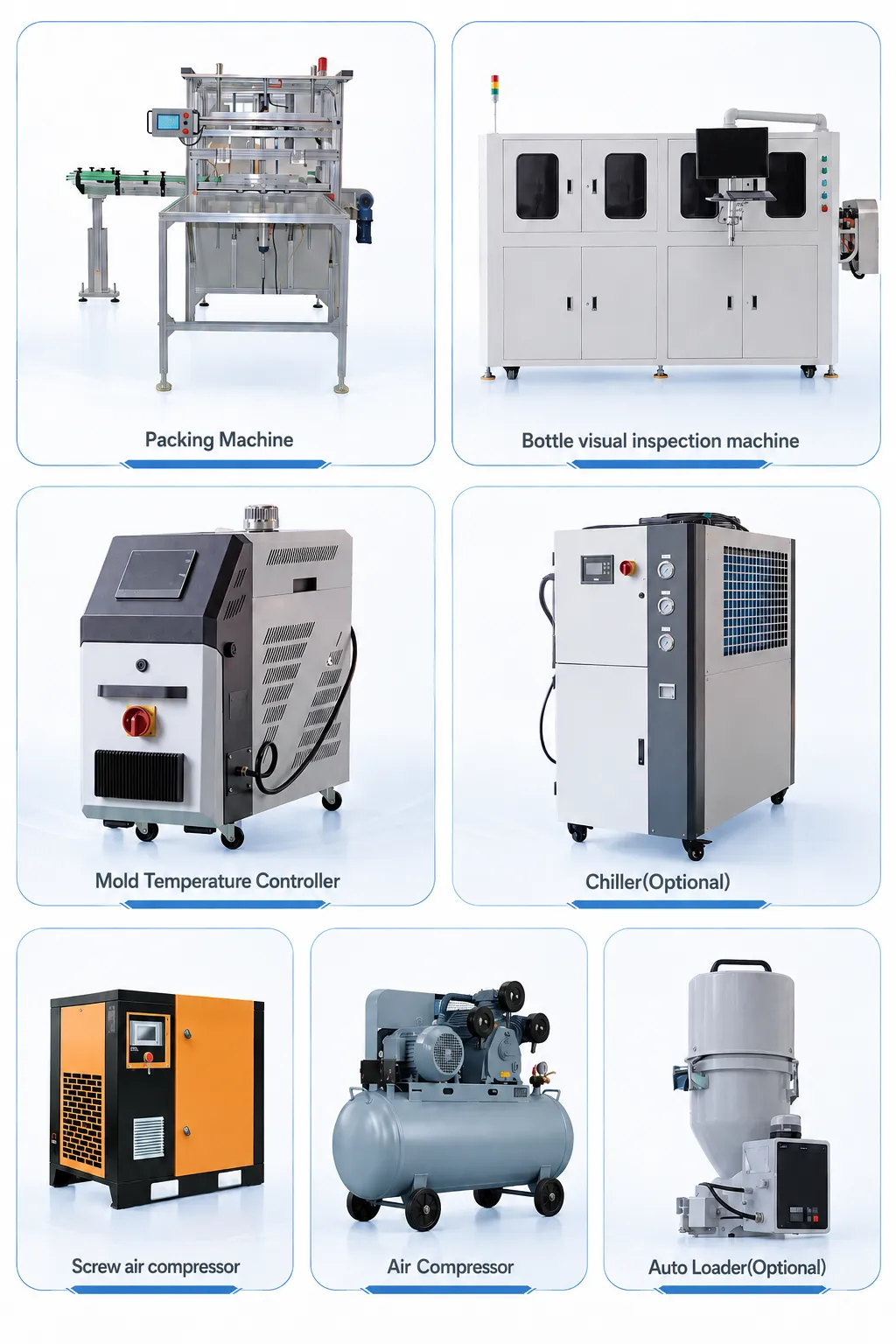
| MODEL ZQ | KAPASITAS PENDINGIN | LAJU ALIRAN (L/menit) | SUHU TARGET (°C) | JENIS PENDINGIN |
|---|---|---|---|---|
| ZQ40 | 5–8 kW | 8–15 | 10–15 | Kompresor tunggal berpendingin udara |
| ZQ60 | 8–12 kW | 12–20 | 10–15 | Kompresor tunggal berpendingin udara |
| ZQ60HE | 8–12 kW | 12–20 | 10–15 | Berpendingin udara atau bebas oli (farmasi) |
| ZQ80 | 12–18 kW | 20–35 | 10–16 | Berpendingin udara, kompresor ganda |
| ZQ110 | 18–28 kW | 30–50 | 10–16 | Pendingin udara atau pendingin air ganda |
| ZQ135 | 25–40 kW | 40–65 | 10–18 | Berpendingin air (lebih disukai untuk ZQ135) |
Aturan penting dalam menentukan ukuran chiller: Korea Ever-Power menentukan ukuran chiller IBM sebesar 1,5 kali beban panas cetakan yang dihitung untuk memberikan margin kapasitas terhadap suhu lingkungan musim panas Korea (hingga 35°C di pabrik-pabrik Korea pada bulan Juli-Agustus), variasi beban panas cetakan antar format produksi, dan penurunan efisiensi chiller seiring kenaikan suhu lingkungan. Chiller yang ukurannya terlalu kecil dan beroperasi dengan kapasitas penuh di musim panas Korea akan gagal mempertahankan suhu air pendingin 10-15°C, menghasilkan wadah yang tidak sesuai spesifikasi dan memaksa pengurangan kecepatan siklus.
BAGIAN 02
Sistem Pengeringan Material: Pengering Udara Panas vs Pengering Dehumidifikasi
Pengering Hopper Udara Panas (Standar PP/HDPE)
Pengering hopper udara panas adalah alat bantu pengeringan standar untuk material PP dan HDPE IBM pada mesin Korea Ever-Power ZQ. PP dan HDPE adalah polimer non-higroskopis yang tidak menyerap kelembapan atmosfer ke dalam rantai polimer — kelembapan permukaan dari kelembapan penyimpanan dihilangkan dengan sirkulasi udara panas 80°C dengan waktu tinggal minimal 2 jam di dalam hopper. Spesifikasi pengering udara panas untuk ZQ40: kapasitas hopper 25 kg (kira-kira 2-3 jam throughput PP pada tingkat produksi ZQ40), suhu tetap 80°C, aliran udara 200 m³/jam. ZQ60: hopper 50 kg, 80°C, 350 m³/jam. ZQ80/ZQ110: hopper 100 kg, 80°C, 500 m³/jam. ZQ135: hopper 150-200 kg, 80°C, 700 m³/jam. Pengeringan PP yang berlebihan lebih dari 4 jam pada suhu 80°C atau di atas 100°C menyebabkan degradasi termal PP (menguning, peningkatan MFR) — HMI mesin ZQ dari Korea Ever-Power menyediakan kontrol suhu pengering dan alarm waktu berlebih untuk mencegah pengeringan PP yang berlebihan di lokasi produksi pelanggan Korea.
Pengering Dehumidifikasi (PCTG/PC Wajib)
PCTG, PC, dan PET adalah polimer higroskopis yang menyerap kelembapan atmosfer ke dalam rantai polimer — sehingga memerlukan pengering dehumidifikasi yang memasok udara pada titik embun ≤−40°C untuk menghilangkan kelembapan yang terikat pada polimer sebelum pemrosesan IBM. Pengering udara panas tidak dapat mencapai udara pasokan dengan titik embun −40°C dan sama sekali tidak cocok untuk IBM PCTG. Spesifikasi pengering dehumidifikasi untuk IBM PCTG ZQ40: kapasitas hopper 15 kg, suhu pengeringan 85°C, waktu tinggal 4-6 jam pada udara pasokan dengan titik embun −40°C. PCTG ZQ60: hopper 30 kg, 85°C, 4-6 jam. Investasi pengering dehumidifikasi jauh lebih tinggi daripada pengering udara panas — tetapi tidak dapat dinegosiasikan untuk IBM PCTG atau PC: PCTG yang tidak dikeringkan menghasilkan wadah IBM dengan garis-garis perak di permukaan (penyebaran kelembapan), penurunan berat molekul, dan penurunan kejernihan akibat hidrolisis polimer selama pemrosesan barel IBM. Korea Ever-Power menetapkan pengering dehumidifikasi dengan regenerasi desikan menara ganda pada pesanan mesin ZQ40 atau ZQ60 PCTG IBM.
BAGIAN 03
Konveyor Keluaran: Desain dan Integrasi untuk Produksi IBM
Pemilihan Lebar Sabuk Konveyor
Lebar sabuk konveyor keluaran IBM ditentukan oleh diameter wadah maksimum (atau diameter botol untuk aplikasi bermulut lebar) dan jumlah wadah yang diharapkan berdampingan di sabuk dari produksi multi-rongga. Lebar sabuk konveyor standar Korea Ever-Power berdasarkan mesin dan format ZQ: ZQ40 (botol kecil 30-100ml): sabuk 200mm menampung 6-10 wadah berdampingan dari produksi ZQ40 6-10 rongga. ZQ60 (100-350ml): sabuk 300mm. ZQ80/ZQ110 (300-750ml): sabuk 400mm. ZQ135 (botol bermulut lebar 750ml-1L): sabuk 500mm. Konveyor IBM untuk botol bermulut lebar juga memerlukan rel pemandu masuk konveyor di stasiun pengupasan ZQ untuk mengarahkan botol tegak di sabuk (wadah IBM untuk botol harus bergerak tegak; botol berleher sempit dapat bergerak menyamping).
Kecepatan dan Panjang Konveyor
Kecepatan sabuk konveyor keluaran IBM harus cukup tinggi untuk membersihkan wadah dari stasiun pengupasan sebelum siklus produksi berikutnya memasukkan wadah baru, tetapi tidak terlalu tinggi sehingga wadah terbalik atau macet di ujung pengumpulan. Spesifikasi kecepatan konveyor IBM standar Korea Ever-Power: 8-12 m/menit untuk IBM format kecil (ZQ40, botol 30-100ml) di mana laju siklus tertinggi (8-12 wadah/siklus × 1 siklus/4s = 2-3 wadah/detik per titik masuk sabuk). 5-8 m/menit untuk IBM format besar (ZQ135, botol atau toples 1L) di mana laju siklus yang lebih rendah dan area dasar wadah yang lebih besar menentukan pemuatan sabuk. Panjang konveyor keluaran IBM: 1,5-2,5m untuk ZQ40/ZQ60 yang menghubungkan stasiun pengupasan ke tempat pengumpulan di stasiun operator produksi; 2,5-3,5m untuk ZQ80/ZQ110/ZQ135 dengan panjang tambahan untuk integrasi stasiun kualitas inline (pemeriksaan berat, pemeriksaan visual).
BAGIAN 04
Pemuat Material Otomatis: Spesifikasi dan Pengoperasian
Pengoperasian Pengangkut Otomatis Venturi Vakum
Laras mesin ZQ IBM menerima pelet PP atau HDPE dari corong tenggorokan yang dipasang langsung pada lubang pemasukan laras mesin. Tanpa pengisi otomatis, operator harus mengisi ulang corong tenggorokan secara manual setiap 15-60 menit (frekuensi tergantung pada kapasitas mesin ZQ dan volume corong tenggorokan) — tugas yang membutuhkan banyak tenaga dan menyebabkan kekurangan pasokan pelet secara berkala jika operator sedang sibuk dengan tugas lain. Pengisi otomatis IBM standar dari Korea Ever-Power adalah tipe venturi vakum: generator venturi (terhubung ke udara terkompresi pada 4-6 bar) menciptakan hisapan yang mengalirkan pelet PP/HDPE dari corong pengering di lantai melalui selang fleksibel berdiameter luar 32-50 mm ke corong tenggorokan mesin ZQ. Pengisi otomatis dipicu oleh sensor level di corong tenggorokan ZQ: ketika level pelet turun di bawah sensor, venturi aktif untuk siklus pengisian terjadwal (biasanya 10-30 detik) untuk mengisi ulang corong tenggorokan. Pengumpan otomatis menghilangkan pekerjaan pemuatan material manual dan memastikan pengumpanan barel ZQ yang berkelanjutan untuk shift produksi IBM tanpa pengawasan.
Integrasi Dosis Masterbatch Warna
Program warna wadah IBM (putih buram, PP berpigmen) memerlukan penambahan masterbatch yang tepat di corong leher mesin ZQ. Korea Ever-Power mengintegrasikan doser masterbatch gravimetrik pada corong leher ZQ di samping auto loader: doser menimbang pelet masterbatch per tembakan dan menambahkannya ke aliran pelet PP/HDPE yang masuk ke dalam laras ZQ dengan persentase masterbatch yang dikontrol secara tepat (biasanya 1,5-3,0% berdasarkan berat). Akurasi dosis gravimetrik ±0,1% penambahan masterbatch memungkinkan warna yang konsisten (CIE L*a*b* ±2 unit) di seluruh batch produksi tanpa penimbangan masterbatch manual. Korea Ever-Power menentukan kapasitas doser gravimetrik (throughput doser yang sesuai dengan tingkat konsumsi material ZQ pada kecepatan produksi puncak) pada pesanan mesin ZQ untuk program warna IBM pada pelanggan merek kosmetik dan suplemen makanan Korea.
BAGIAN 05
Paket Peralatan Bantu Seri ZQ berdasarkan Model Mesin
PAKET PERLENGKAPAN TAMBAHAN LENGKAP MODEL ZQ — STANDAR PP/HDPE IBM
Paket ZQ40
Lini standar IBM
Pendingin udara 6 kW • Pengering udara panas 25 kg/80°C • Venturi pemuat otomatis 30 kg/jam • Konveyor sabuk 200 mm/2,0 m • Total luas area tambahan: 2,5 × 1,2 m di samping ZQ40
Paket ZQ60 / ZQ60HE
Lini produk IBM kelas menengah
Pendingin udara 10 kW • Pengering udara panas 50 kg/80°C (atau pengering dehumidifikasi 30 kg/85°C untuk PCTG) • Pemuat otomatis 60 kg/jam • Konveyor sabuk 300 mm/2,5 m • Luas area: 3,2 × 1,5 m
Paket ZQ80 / ZQ110
Lini IBM format besar
Pendingin udara 20 kW • Pengering udara panas 100 kg/80°C • Pemuat otomatis 100 kg/jam • Konveyor sabuk 400 mm/3,0 m • Luas area: 4,0 × 1,8 m zona tambahan di samping ZQ80/ZQ110
Paket ZQ135
Garis IBM format Max
Pendingin air 35 kW • Pengering udara panas 200 kg/80°C • Pemuat otomatis 150 kg/jam • Konveyor sabuk 500 mm/3,5 m • Luas area: zona tambahan 5,0 × 2,0 m. Menara pendingin eksternal diperlukan untuk pendingin air ZQ135
BAGIAN 06
Tata Letak Pabrik dan Perencanaan Utilitas untuk Sistem Bantu IBM
Persyaratan Utilitas Pabrik Korea
Korea Ever-Power menetapkan sambungan utilitas berikut untuk paket tambahan ZQ IBM lengkap pada instalasi pabrik Korea. Udara terkompresi: pasokan stabil 6 bar dengan aliran minimum 200 L/min untuk venturi auto loader ZQ40 dan stasiun tiup; 400 L/min untuk ZQ60/ZQ110; 600 L/min untuk ZQ135. Udara terkompresi harus bebas minyak dan disaring hingga 5 μm untuk venturi auto loader guna mencegah kontaminasi minyak pada selang pengangkut material PP/HDPE. Pasokan listrik: sirkuit tiga fasa 380-440V khusus untuk chiller (terpisah dari sirkuit mesin ZQ — arus lonjakan start-up kompresor chiller adalah 3-5× arus kerja dan tidak boleh berbagi sirkuit mesin ZQ). Pasokan air untuk chiller berpendingin air (opsi ZQ110/ZQ135): air menara 20-35°C pada 30-60 L/min, menara pendingin loop tertutup atau header air dingin fasilitas. Saluran pembuangan lantai: saluran pembuangan kondensat chiller dan saluran pembuangan sirkuit air pendingin di zona tambahan untuk akses pemeliharaan pabrik Korea.
Denah Lantai Lini Produksi IBM
Denah lantai lini produksi IBM Ever-Power ZQ40 standar Korea: Mesin ZQ40 (luas 3,5 × 1,3 m) dengan ruang akses operator 1,0 m di semua sisi; pendingin ditempatkan di belakang ZQ40 (unit 0,8 × 0,6 m) dengan pipa air pendingin di saluran kabel setinggi lantai; hopper pengering di atas dudukan barel ZQ40 atau di dudukan lantai terpisah di samping ZQ40 dengan koneksi selang auto loader fleksibel ke leher ZQ40; konveyor keluaran memanjang dari stasiun pengupasan ZQ40 menuju posisi pengumpulan operator atau meja pengemasan. Total luas lantai sel produksi ZQ40: minimal 5,0 × 3,0 m. Sel produksi ZQ60: 6,5 × 3,5 m. Sel produksi ZQ135: 10,0 × 5,5 m termasuk ruang menara pendingin. Korea Ever-Power menyediakan gambar denah lantai AutoCAD untuk sel produksi ZQ IBM milik pelanggan Korea pada tahap pemesanan mesin, memungkinkan tim teknik sipil dan listrik pabrik Korea untuk merencanakan instalasi utilitas sebelum pengiriman mesin ZQ.
FAQ TEKNIK
Peralatan Bantu IBM — Pertanyaan Teknik
Pertanyaan 01
Bisakah satu unit pendingin (chiller) melayani beberapa mesin ZQ IBM di pabrik yang sama di Korea?
Ya — satu unit pendingin (chiller) dapat melayani beberapa mesin ZQ IBM di pabrik Korea jika kapasitas pendingin tersebut dirancang untuk beban panas cetakan gabungan dari semua mesin ZQ yang beroperasi secara bersamaan, dan jika laju aliran pendingin dan pipa distribusi air pendingin dirancang untuk mempertahankan suhu cetakan target (10-15°C) di setiap saluran masuk cetakan mesin ZQ secara bersamaan tanpa gangguan suhu antar mesin. Aturan penentuan ukuran pendingin multi-mesin Korea Ever-Power: jumlahkan beban panas cetakan dari semua mesin ZQ pada puncak produksi simultan, kalikan dengan faktor keamanan 1,5, dan tentukan satu unit pendingin pusat atau bank pendingin dengan kapasitas tersebut. Sistem distribusi air pendingin manifold dengan katup kontrol aliran individual dan sensor suhu di setiap saluran masuk/keluar cetakan mesin ZQ memastikan setiap mesin ZQ menerima air pendingin target 10-15°C secara independen dari kondisi operasi mesin lain. Untuk fasilitas produksi IBM Korea dengan 3-10 mesin ZQ berbagai format (ZQ40, ZQ60, ZQ80), bank pendingin sentral yang terdiri dari 2-3 modul dengan kontrol lead-lag memberikan redundansi: jika satu modul pendingin memerlukan perawatan, modul yang tersisa akan tetap memasok pendinginan ke produksi IBM Korea dengan kapasitas yang berkurang, bukan kehilangan pendinginan total. Korea Ever-Power merekomendasikan pendingin sentral dengan distribusi manifold untuk fasilitas produksi IBM Korea dengan 3 mesin ZQ atau lebih, yang memberikan skala ekonomi yang lebih baik dibandingkan pendingin individual per mesin ZQ dengan biaya redundansi yang lebih rendah.
Pertanyaan 02
Apa penyebab deformasi dasar kontainer IBM dan bagaimana pendingin mencegahnya?
Deformasi dasar wadah PP IBM (panel dasar tenggelam ke dalam, dasar tidak rata pada suhu ruangan setelah produksi) adalah salah satu masalah kualitas IBM yang paling umum di pabrik-pabrik Korea, dan secara langsung disebabkan oleh pendinginan cetakan yang tidak memadai di zona rongga dasar cetakan tiup. Dasar wadah IBM adalah zona terakhir yang mengembang selama langkah tekanan tiup — material PP di dasar adalah zona terpanas di rongga cetakan tiup pada saat pelepasan. Jika pendinginan rongga dasar cetakan tiup tidak mencukupi (air pendingin di atas 16°C, atau laju aliran terlalu rendah untuk mendinginkan zona dasar dalam waktu penahanan tiup), dasar PP dilepaskan saat masih di atas suhu kristalisasi PP (125-135°C untuk homopolimer PP). Dasar yang panas kemudian mengalami deformasi di bawah tekanan atmosfer dan gravitasi selama 10-30 detik pertama setelah pelepasan, menghasilkan cekungan ke dalam yang terlihat pada wadah yang terisi dan berdiri di jalur pengemasan produksi pelanggan Korea. Pencegahan: Desain rongga dasar cetakan tiup Korea Ever-Power mencakup sirkuit pendingin dasar khusus dengan saluran pendingin berdiameter 8-10 mm yang mengelilingi geometri pin dasar, yang disuplai pada suhu 10-13°C dari pendingin IBM. Suhu pendingin di bawah 13°C pada saluran masuk sirkuit dasar cetakan tiup merupakan parameter kritis untuk integritas dasar wadah PP IBM pada kondisi produksi standar Korea ZQ40/ZQ60. Insinyur komisioning mesin ZQ Korea Ever-Power memverifikasi suhu dasar cetakan tiup pada saat pelanggan Korea memulai produksi, menyesuaikan suhu dan laju aliran pendingin hingga deformasi dasar dipastikan tidak terjadi di semua rongga sebelum menyerahkan produksi kepada tim produksi pelanggan Korea.
Pertanyaan 03
Apa yang terjadi jika bahan PP tidak dikeringkan sebelum produksi ZQ IBM?
Kemasan PP IBM yang tidak dikeringkan di mesin ZQ menghasilkan beberapa cacat kemasan yang tingkat keparahannya meningkat seiring dengan kadar air permukaan PP dan waktu penyimpanan dalam barel. Pada PP yang tidak dikeringkan ringan (kelembapan penyimpanan di atas 701 TP3T RH selama kurang dari 24 jam tanpa pengeringan): uap air permukaan menguap di dalam barel dan menghasilkan tanda garis-garis perak kecil pada bagian luar kemasan IBM (terlihat sebagai garis-garis perak halus yang sejajar dengan arah aliran pada badan kemasan). Garis-garis perak ini merupakan cacat visual yang menyebabkan penolakan kemasan oleh pelanggan merek kosmetik Korea pada pemeriksaan QC saat masuk. Pada PP yang tidak dikeringkan sedang (penyimpanan musim panas Korea dengan kelembapan tinggi tanpa pengeringan): kadar air di atas 500 ppm menghasilkan rongga gelembung yang terlihat di dinding kemasan PP IBM — gelembung internal kecil yang mengurangi kekuatan dinding kemasan dan menghasilkan bintik-bintik kabur pada bagian luar kemasan saat pemeriksaan pencahayaan ritel Korea. Pada PP yang sangat tidak kering (karung PP yang terkena hujan atau kelembapan sangat tinggi tanpa pengeringan): kadar air di atas 1.000 ppm menyebabkan degradasi hidrolitik PP di dalam barel ZQ (peningkatan MFR, menguning) dan menghasilkan wadah IBM dengan garis perak yang parah, dinding yang lemah, dan kemungkinan short shot di mana lelehan PP tidak mengisi rongga preform injeksi sepenuhnya. Pelatihan startup pelanggan Korea Ever-Power di Korea menekankan kepatuhan terhadap protokol pengeringan PP sebagai persyaratan kontrol proses IBM prioritas tertinggi untuk tim produksi Korea, dengan menyediakan suhu set pengering, waktu tinggal, dan perhitungan throughput material untuk setiap mesin ZQ dan jenis PP pada saat commissioning di Korea.
Pertanyaan 04
Bisakah konveyor keluaran IBM terintegrasi dengan jalur pengemasan otomatis atau lengan robot untuk otomatisasi produksi di Korea?
Konveyor keluaran IBM Korea Ever-Power dirancang dengan titik akhir integrasi otomatisasi untuk perluasan lini produksi Korea di luar mesin IBM. Integrasi otomatisasi standar yang tersedia di ujung keluaran konveyor IBM Korea Ever-Power: integrasi timbangan cek: pemeriksa berat inline (Korea Ever-Power merekomendasikan timbangan konveyor Mettler-Toledo atau yang setara dengan Korea) yang dipasang di ujung keluaran konveyor mengukur berat setiap kontainer IBM (atau berat batch berdasarkan jumlah), dengan lengan pengalih penolakan untuk menolak kontainer yang tidak sesuai spesifikasi sebelum pengemasan. Integrasi inspeksi visual: sistem visi kamera inline (lihat artikel inspeksi visual IBM S02) yang dipasang di atas atau di samping ujung keluaran konveyor untuk pengukuran OD leher, deteksi cacat permukaan badan, dan inspeksi dasar sebelum pengemasan otomatis pelanggan merek Korea. Integrasi pengambilan dan penempatan robot: lengan robot 6 sumbu (robot pasar Korea: Hyundai Robotics, Doosan Robotics, Fanuc Korea) di ujung keluaran konveyor melakukan orientasi kontainer otomatis dan pengemasan baki untuk program IBM Korea bervolume tinggi, menghilangkan posisi operator pengemasan manual. Korea Ever-Power menyediakan spesifikasi penghenti ujung konveyor IBM dan meja akumulasi kontainer untuk integrasi robot pick-and-place Korea — meja akumulasi memungkinkan kecepatan pengambilan robot menjadi asinkron dari kecepatan produksi IBM, mencegah kendala waktu siklus robot membatasi kecepatan produksi mesin ZQ. Otomatisasi lini produksi IBM lengkap untuk pelanggan merek Korea (mesin ZQ + konveyor + timbangan cek + visi + pengemasan robot) tersedia sebagai proyek lini IBM turnkey Korea Ever-Power dengan manajemen proyek satu sumber mulai dari FAT mesin hingga instalasi pabrik Korea, komisioning, dan pelatihan operator.
Pertanyaan 05
Perubahan peralatan bantu apa saja yang dibutuhkan saat beralih dari PP ke PCTG pada mesin ZQ40 yang sama?
Pengalihan program produksi IBM ZQ40 dari PP ke PCTG memerlukan perubahan peralatan bantu dalam tiga sistem: penggantian pengering (kritis), penyesuaian suhu pendingin, dan pengurangan kecepatan konveyor. Penggantian pengering: pengering hopper udara panas PP harus diganti dengan pengering dehumidifikasi dengan udara suplai titik embun −40°C sebelum IBM PCTG dapat dimulai. Ini memerlukan unit pengering dehumidifikasi kedua yang dipasang di samping ZQ40 untuk program PCTG (praktik terbaik untuk fasilitas produksi IBM Korea yang secara teratur menjalankan PP dan PCTG), atau penyewaan atau peminjaman pengering dehumidifikasi untuk periode program PCTG. Menjalankan PCTG melalui pengering udara panas PP menghasilkan wadah IBM yang sangat cacat (garis-garis perak, kejernihan buruk, gelembung permukaan) akibat degradasi hidrolitik PCTG yang tidak dikeringkan. Suhu pendingin: IBM PCTG di ZQ40 memerlukan air pendingin cetakan yang lebih dingin (8-12°C dibandingkan standar PP 10-15°C) untuk mencapai pembekuan PCTG yang cepat di rongga injeksi dan mencegah preform PCTG menempel pada batang inti. Korea Ever-Power menyesuaikan suhu set chiller ZQ40 ke 8-10°C untuk PCTG IBM dan memverifikasi kualitas pelepasan batang inti rongga injeksi sebelum produksi. Suhu barel: Profil suhu barel ZQ40 berubah dari PP IBM (220-235°C) ke PCTG IBM (240-275°C) — waktu pemanasan barel dari suhu PP ke PCTG: sekitar 20-30 menit pada kapasitas pemanasan barel ZQ40. Korea Ever-Power menyediakan protokol peralihan ZQ40 PP-ke-PCTG (pembersihan barel, peningkatan suhu, urutan pergantian pengering) sebagai bagian dari pelatihan pelanggan ZQ40 pada saat commissioning pabrik Korea untuk pelanggan yang merencanakan program IBM PP/PCTG material ganda.
Pertanyaan 06
Apakah Korea Ever-Power memasok peralatan bantu IBM sebagai bagian dari pembelian mesin ZQ atau secara terpisah?
Korea Ever-Power menawarkan peralatan bantu IBM baik sebagai bagian dari paket mesin ZQ (direkomendasikan untuk pelanggan IBM Korea baru yang membangun lini produksi IBM pertama mereka) maupun sebagai item yang ditawarkan secara terpisah (untuk pelanggan IBM Korea berpengalaman yang sudah memiliki peralatan bantu dari instalasi lini IBM sebelumnya atau yang lebih memilih untuk mendapatkan komponen bantu tertentu secara lokal). Paket mesin IBM ZQ lengkap (direkomendasikan): Korea Ever-Power menawarkan mesin ZQ + set cetakan + pendingin + pengering (udara panas atau pengering udara sesuai spesifikasi) + pemuat otomatis + konveyor sebagai satu paket lini produksi IBM dengan instalasi dan pengoperasian terintegrasi di pabrik pelanggan Korea. Pendekatan paket ini memastikan semua spesifikasi peralatan bantu sesuai dengan model mesin ZQ dan format kontainer IBM oleh teknisi aplikasi Korea Ever-Power, menghilangkan risiko ketidaksesuaian kapasitas pendingin, jenis pengering yang salah, atau konveyor yang terlalu kecil yang kadang-kadang dialami pelanggan Korea ketika mendapatkan peralatan bantu secara independen dari pemasok mesin plastik lokal Korea. Pengadaan peralatan bantu terpisah: Pelanggan IBM Korea yang memiliki instalasi IBM yang sudah ada (meningkatkan dari mesin IBM pesaing ke seri ZQ, atau menambahkan mesin ZQ ke fasilitas IBM Korea yang sudah ada) mungkin sudah memiliki pendingin, pengering, dan konveyor dengan ukuran yang sesuai dan ingin menggunakan kembali peralatan bantu yang sudah ada dengan mesin ZQ yang baru. Tim penjualan Korea Ever-Power di Korea akan meninjau spesifikasi peralatan bantu yang ada terhadap persyaratan mesin ZQ dan memberikan saran tentang kompatibilitas sebelum pemesanan mesin ZQ. Teknisi instalasi Korea Ever-Power memverifikasi kinerja peralatan bantu yang ada pada saat pengoperasian awal mesin ZQ di pabrik Korea dan memberikan rekomendasi untuk peningkatan peralatan bantu jika ditemukan kesenjangan kinerja selama kualifikasi pengoperasian awal.
PERMINTAAN BANTUAN IBM · KOREA EVER-POWER
Merencanakan Lini Produksi IBM Lengkap?
Korea Ever-Power menyediakan paket lengkap lini produksi ZQ IBM termasuk pendingin, pengering, pemuat otomatis, dan konveyor, dengan gambar tata letak pabrik, spesifikasi utilitas, dan instalasi siap pakai untuk pelanggan IBM di Korea dan global.
Editor: Cxm