
GUIDE D'ACHAT
ISBM à 3, 4 ou 6 postes : quelle architecture convient le mieux à votre production ?
Choisir le mauvais nombre de stations ISBM condamne votre usine à une situation économique défavorable pour les dix prochaines années : factures énergétiques plus élevées pour la 30%, cycles de production plus longs pour la 20% ou limitations du nombre de cavités freinant votre croissance. Ce guide explique précisément dans quelles conditions chaque architecture est la plus avantageuse, en s’appuyant sur des données de référence d’usines coréennes pour la période 2024-2025.
Dans ce guide
- Pourquoi le nombre de stations est la décision la plus sous-analysée
- Architecture à 3 stations : la rapidité au détriment de la flexibilité de la forme
- Architecture à 4 stations : la norme équilibrée
- Architecture à 6 stations : Double injection pour un volume élevé
- Tableau comparatif direct
- Cadre décisionnel : 4 questions à poser
- Études de cas d'usines coréennes
- Erreurs courantes de sélection du nombre de stations
- Conclusion et prochaines étapes
1. Pourquoi le nombre de stations est la décision ISBM la plus sous-analysée
Interrogez un acheteur coréen d'emballages évaluant une presse ISBM sur les spécifications les plus importantes, et les réponses se concentreront presque toujours sur une liste restreinte : force de fermeture de l'injecteur, marque du servomoteur, automate programmable, consommation électrique totale et temps de cycle. Le nombre de stations (3, 4 ou 6) est généralement considéré comme secondaire, un critère secondaire plutôt qu'un facteur déterminant dans le choix de la machine. Or, cet ordre de priorité est erroné. Le nombre de stations est en réalité la décision architecturale la plus cruciale lors de l'achat d'une presse ISBM, car il détermine les limites supérieures du temps de cycle, la flexibilité en matière de formes de bouteilles, l'optimisation de l'espace au sol et les économies d'énergie pour toute la durée de vie de la machine.
Voici pourquoi le nombre de stations est si important. Chaque station d'un cycle rotatif ISBM réalise une phase de la séquence de production : injection, conditionnement, soufflage, évacuation. Une machine à 3 stations regroupe deux phases en une seule station afin de réduire le temps de cycle. Une machine à 4 stations utilise une station par phase pour un contrôle optimal du processus. Une machine à 6 stations duplique la station d'injection pour une production en parallèle. Chaque configuration induit des compromis fondamentalement différents entre vitesse, flexibilité de forme et rendement par cycle, compromis qui ne peuvent être modifiés par des réglages de processus ou des mises à niveau auxiliaires après l'installation de la machine.
Choisir une machine avec un nombre de postes inadapté à votre production vous expose à des limitations permanentes. Une machine à 3 postes, initialement conçue pour une ligne de production de flacons cosmétiques ovales, produit des flacons aux angles fins qui échouent aux tests de chute. Aucun réglage du processus ne peut corriger ce problème, car l'architecture de la machine ne prévoit pas d'étape de conditionnement thermique. Une machine à 4 postes, choisie pour une ligne de production de boissons à très haut volume, produit des flacons acceptables, mais avec un débit inférieur de 20 à 25 % à celui d'une machine à 6 postes occupant la même surface au sol, ce qui pénalise durablement la rentabilité de l'unité. Une machine à 6 postes, choisie pour un petit sous-traitant d'embouteillage de produits cosmétiques, offre un débit que l'installation ne peut exploiter, tout en engendrant des coûts d'investissement et une consommation énergétique supérieurs aux besoins.
La question du nombre de stations est étroitement liée aux objectifs de volume et aux exigences géométriques des bouteilles. Les bouteilles rondes destinées à la production de boissons à grand volume sont économiquement viables avec une configuration à 3 stations. Les flacons asymétriques haut de gamme des cosmétiques coréens nécessitent une architecture à 4 stations. La production à très grand volume d'un seul produit justifie une double injection à 6 stations. Un choix judicieux du nombre de stations dès l'achat permet aux usines coréennes d'éviter des années d'inefficacité de production qu'aucun expert en procédés ne peut identifier a posteriori. Pour une vue d'ensemble des éléments sous-jacents, veuillez consulter [lien vers la section correspondante]. physique des procédés ISBM, consultez notre guide technique complet.
2. Architecture à 3 stations : la rapidité au détriment de la flexibilité de la forme
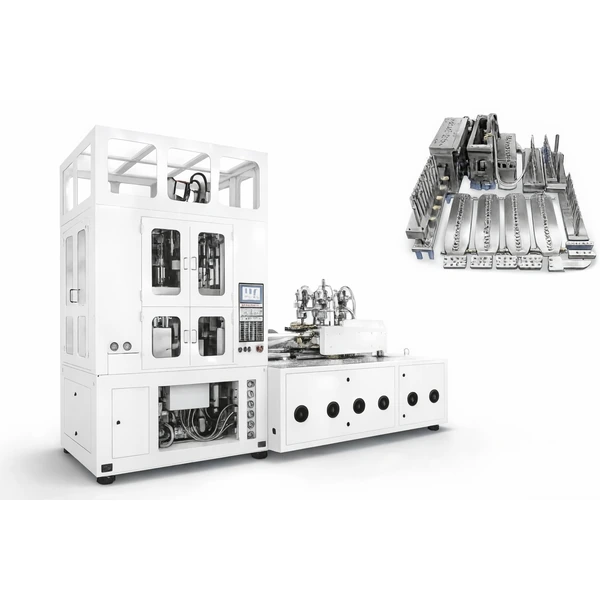
La configuration à 3 stations combine l'injection, l'étirage-soufflage et l'extraction en trois positions rotatives, supprimant ainsi une station de conditionnement thermique dédiée. La préforme passe directement de l'injection au soufflage sans étape de profilage thermique séparée, la chaleur résiduelle de l'injection assurant le transfert du polymère jusqu'à la phase d'étirage. Cette simplification architecturale permet un gain de 3 à 5 secondes par cycle par rapport aux conceptions à 4 stations, soit une augmentation du débit horaire de 15 à 22 % pour les bouteilles de géométrie compatible.
Avantage du temps de cycle
Pour une bouteille d'eau standard de 500 ml avec un outillage à 6 cavités, une machine à 3 stations offre des temps de cycle de 11 à 13 secondes, contre 14 à 16 secondes pour des configurations équivalentes à 4 stations. Sur une journée de production de 20 heures, cela représente environ 3 200 bouteilles supplémentaires par cavité et par jour, ce qui constitue une valeur économique substantielle pour les embouteilleurs de boissons opérant avec des marges serrées sur les références d'eau et de boissons gazeuses courantes. Machine ISBM à 3 stations BPET-94V3 est la mise en œuvre phare de cette architecture, avec une force de serrage par injection de 785 KN, la meilleure du secteur, pour la classe à 3 stations.
Limitations géométriques
L'absence d'une étape de conditionnement thermique constitue la principale limite de l'architecture à 3 stations. Sans station dédiée au chauffage différentiel des préformes, la machine ne peut compenser les taux d'étirage inégaux qui se produisent lors de la production de flacons ovales, à faces planes ou aux contours marqués. Les géométries complexes engendrent des angles fins qui ne résistent pas aux tests de chute, et aucun réglage du processus ne permet de corriger ce problème sur les équipements à 3 stations. Cette architecture fonctionne parfaitement pour les flacons ronds aux géométries simples, mais peine à gérer les formes asymétriques qui prédominent dans le secteur des emballages cosmétiques haut de gamme.
Applications les plus adaptées
Les machines à 3 postes excellent dans la production à grand volume de bouteilles rondes. Les embouteilleurs régionaux coréens de boissons, produisant eau, jus et sodas en formats standard (500 ml, 1 l, 1,5 l, 2 l), tirent le meilleur parti des plateformes à 3 postes. Les bouteilles de produits chimiques ménagers, les flacons de sirop pharmaceutique ronds et les bonbonnes d'huile en vrac sont également compatibles avec ce type de machine. Les embouteilleurs coréens de Daegu et d'Ulsan ont standardisé leurs lignes d'embouteillage d'eau sur des équipements à 3 postes depuis 2023, suite à une analyse des coûts par bouteille démontrant une réduction de 18 à 22 % du coût de production unitaire par rapport aux configurations équivalentes à 4 postes pour les bouteilles rondes.
3. Architecture à 4 stations : La norme équilibrée
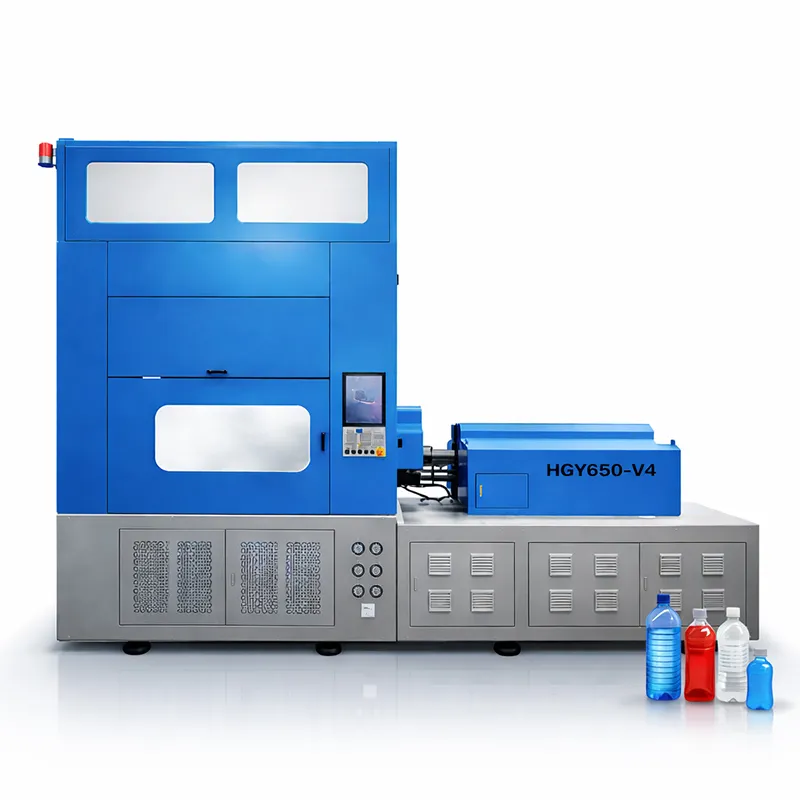
La configuration à 4 stations intègre une station de conditionnement thermique dédiée entre l'injection et le soufflage, créant ainsi un cycle rotatif d'injection, de conditionnement, d'étirage-soufflage et d'évacuation. Cette étape supplémentaire permet à la machine de produire des flacons cosmétiques haut de gamme de la K-beauty, des flacons pharmaceutiques aux cols complexes, et tout autre flacon où l'uniformité de l'épaisseur de paroi prime sur la rapidité du cycle. Sur le marché coréen de l'emballage, l'architecture à 4 stations est la norme pour les applications cosmétiques, pharmaceutiques, alimentaires et de moyennes séries.
Avantages d'une station de conditionnement physique dédiée
La station de conditionnement thermique applique un chauffage différentiel à des zones spécifiques de la préforme, adaptant la distribution de température aux taux d'étirement requis par la géométrie du flacon final. Pour les flacons cosmétiques ovales, où les angles s'étirent davantage que les faces planes, la station maintient les angles à une température légèrement supérieure afin de permettre une plus grande déformation sans étirer excessivement les faces planes. Cette capacité de chauffage différentiel est ce qui permet la production de flacons asymétriques haut de gamme pour les cosmétiques coréens, avec une épaisseur de paroi uniforme — une capacité que les machines à 3 stations ne peuvent tout simplement pas reproduire, quelle que soit la sophistication du réglage du processus.
Gère les géométries complexes
Les flacons ovales, les flacons rectangulaires à faces planes, les distributeurs de lotion aux contours marqués, les flacons pharmaceutiques à col complexe et les pots cosmétiques asymétriques nécessitent tous une architecture à 4 stations pour garantir la conformité aux tests de chute et la régularité dimensionnelle. Machine ISBM à 4 stations HGY150-V4 est la plateforme standard de volume moyen pour les entreprises coréennes de produits de remplissage cosmétiques et pharmaceutiques sous contrat, tandis que la plateforme plus lourde BPET-125V4 Poste de travail robuste à 4 stations Elle peut manipuler des bocaux alimentaires à large ouverture et des bidons d'eau de 5 litres grâce à sa force de serrage par injection de 685 KN.
Applications les plus adaptées
L'architecture à 4 postes est la norme pour le remplissage à façon de produits cosmétiques haut de gamme (flacons PETG et PCTG pour la K-beauty), les flacons de collyre pharmaceutiques, la production de biberons (Tritan et PCTG), les pots alimentaires à large ouverture (148 mm pour le kimchi, le gochujang et le miel), les lignes de production de boissons de volume moyen aux formes complexes, et toute application où l'homogénéité de l'épaisseur des parois est essentielle. Les entreprises coréennes de remplissage à façon de produits cosmétiques à Ansan, Suwon et Seongnam exploitent majoritairement des flottes à 4 postes, car cette architecture correspond mieux à leurs exigences de production pour les campagnes multi-références que les configurations à 3 ou 6 postes.
4. Architecture à 6 stations : double injection pour un volume élevé
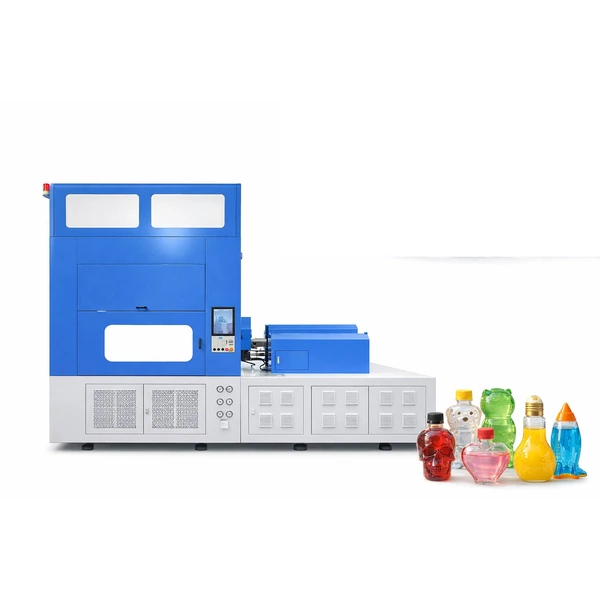
La configuration à 6 stations est une innovation relativement récente qui ajoute une seconde station d'injection parallèle à l'architecture de base à 4 stations. Deux préformes sont moulées par injection simultanément sur des positions opposées du carrousel rotatif, puis transitent par des stations communes de conditionnement, de soufflage et d'évacuation. Cette approche à double injection double efficacement le débit horaire d'une plateforme conventionnelle à 4 stations tout en partageant la même infrastructure de soufflage, de conditionnement et d'évacuation, améliorant considérablement la rentabilité unitaire pour la production en grande série d'articles mono-référence.
Explication des stations d'injection parallèles
Deux vis de plastification distinctes fonctionnent en parallèle, chacune alimentant sa propre station d'injection positionnée de part et d'autre du carrousel rotatif. Cette architecture parallèle permet de réaliser deux fois par rotation du carrousel l'étape de processus la plus lente (l'injection, qui dure de 5 à 7 secondes, soit la plus longue du cycle ISBM), mais avec deux préformes produites par rotation au lieu d'une. Il en résulte un débit horaire environ 70 % supérieur à celui d'une machine équivalente à 4 stations occupant la même surface au sol, faisant de la version 6 stations la solution de production à haut volume la plus compacte du marché.
Économie du gain de débit
Pour un flacon de sérum de beauté coréen de 150 ml, fabriqué avec un outillage à 8 cavités, une machine à 4 stations produit environ 1 900 flacons par heure, tandis qu'une machine à 6 stations en produit 3 250 par heure, à surface au sol égale. Pour les usines coréennes produisant de 5 à 30 millions de flacons par an pour une même référence, le gain de productivité se traduit directement par le remplacement de deux machines à 4 stations par une seule machine à 6 stations, pour un coût d'investissement total représentant 65 à 70 % de celui-ci. Les économies d'espace sont encore plus importantes : une machine à 6 stations occupe environ 60 % de la surface totale de deux machines à 4 stations, un avantage non négligeable pour les usines coréennes qui paient des loyers commerciaux élevés.
Applications les plus adaptées
Les machines à 6 stations excellent dans la production de moyennes et grandes séries d'articles mono-référence, où l'efficacité du débit et l'encombrement au sol sont deux facteurs essentiels. Le fleuron d'Ever-Power Machine ISBM à 6 stations HGYS280-V6 Cette architecture constitue la référence. Ses applications typiques incluent les lignes de production de boissons (eau/jus de 500 ml ou 1 L) à raison de plus de 10 millions de bouteilles par référence et par an, la production pharmaceutique à très grande échelle de médicaments sans ordonnance et la production de cosmétiques coréens (produits phares à succès) à plus de 3 millions d'unités par an. La configuration à 6 stations n'est pas adaptée au remplissage à façon de plusieurs références, où la fréquence des changements de format réduit considérablement les gains de productivité, ni aux applications haut de gamme à faible volume, où le coût d'investissement dépasse le retour sur investissement escompté.
5. Tableau comparatif direct
Le tableau comparatif ci-dessous résume les principaux compromis entre les architectures à 3, 4 et 6 stations, d'après des données de référence réelles d'usines coréennes installées entre 2024 et 2025. Tous les chiffres de débit et de temps de cycle correspondent à une production comparable de bouteilles d'eau de 500 ml avec un nombre de cavités équivalent.
| Attribut | Station à 3 étages | Station à 4 étages | 6-Station |
|---|---|---|---|
| Durée du cycle (500 ml, 6 cavités) | 11-13 secondes | 14-16 secondes | 8 à 10 secondes (efficaces) |
| Débit horaire | 1 800 à 2 000 bph | 1 500 à 1 700 bph | 2 800 à 3 300 barils par heure |
| Flexibilité géométrique de la bouteille | Rond seulement | Toutes les formes | Toutes les formes |
| Empreinte au sol (typique) | ~12 m² | ~15 m² | ~18 m² |
| Coût relatif du capital | 0,85× | 1,00× (ligne de base) | 1,75-1,90× |
| Énergie pour 1 000 bouteilles | 28-32 kWh | 32-38 kWh | 26-30 kWh |
| Plage typique du nombre de caries | 4-8 | 4-12 | 8-24 |
| Point d'équilibre du volume (SKU) | 3 à 15 millions par an | 1 à 10 millions par an | 5 à 30 millions par an |
| Temps de changement | 2 à 3 heures | 3 à 4 heures | 4 à 6 heures |
6. Cadre décisionnel : 4 questions à se poser
Notre équipe d'ingénieurs a accompagné des centaines d'acheteurs coréens et est-asiatiques dans le choix du nombre de stations. La décision se résume invariablement à quatre questions, auxquelles il faut répondre dans l'ordre. En y répondant, on obtient avec une grande certitude la configuration optimale.
Question 1 : Quel est votre volume de production annuel par UGS ?
Pour une production inférieure à 3 millions de bouteilles par an et par référence, une architecture à 4 postes est préférable. Entre 3 et 15 millions de bouteilles, une architecture à 3 postes est recommandée pour les bouteilles rondes, et à 4 postes pour les formes complexes. Au-delà de 15 millions de bouteilles pour une seule référence, une architecture à 6 postes est généralement plus avantageuse économiquement. Le volume pertinent est celui par référence, et non le volume total de l'usine : une usine produisant 5 références à 4 millions d'unités chacune fonctionne avec une architecture à 4 postes, et non à 6 postes, car chaque référence, prise individuellement, correspond à une architecture à 4 postes.
Question 2 : Quelle est la complexité de la forme de votre bouteille ?
Les flacons ronds à profil symétrique peuvent être traités avec n'importe quel nombre de stations. Les flacons ovales, à faces plates ou aux contours marqués nécessitent une architecture à 4 ou 6 stations pour l'étape de conditionnement thermique. Les géométries asymétriques extrêmement complexes (par exemple, les flacons sculpturaux haut de gamme des cosmétiques coréens) peuvent nécessiter une architecture à 4 stations, car le temps de conditionnement plus long disponible compense l'avantage de débit d'une architecture à 6 stations pour ces formes complexes. La règle : en cas de doute sur la complexité de la forme, privilégiez une architecture à 4 stations.
Question 3 : De quelle surface au sol disposez-vous ?
Les usines coréennes fonctionnent souvent avec des contraintes d'espace très réduites, notamment dans la région métropolitaine de Séoul où les loyers de l'immobilier commercial sont élevés. Pour les acheteurs produisant plus de 10 millions de bouteilles par an et disposant d'une surface limitée, une architecture à 6 postes devient particulièrement intéressante, car une seule machine remplace deux sur la même surface. Pour ceux disposant d'une surface importante, deux machines à 4 postes peuvent parfois égaler le débit d'une machine à 6 postes pour un coût d'investissement légèrement inférieur, si l'usine exploite déjà plusieurs machines en parallèle.
Question 4 : À quelle fréquence changez-vous vos références ?
Les entreprises de remplissage à façon qui effectuent 3 à 5 changements de référence par semaine subissent une perte de productivité proportionnellement plus importante sur les machines à 6 postes, où le changement prend 4 à 6 heures, contre 2 à 3 heures sur les plateformes à 3 postes. Pour les opérations à forte cadence de changement, une architecture à 4 postes offre un meilleur compromis entre débit et efficacité de changement que les deux extrêmes. Pour les productions en grande série, où une même référence est produite en continu pendant des semaines ou des mois entre les changements (cas typique des bouteilles d'eau ou des médicaments en vente libre), le temps de changement sur 6 postes est amorti sur les volumes de production si importants qu'il devient économiquement négligeable.
7. Études de cas d'usines coréennes
Trois installations récentes chez des clients coréens illustrent comment le cadre décisionnel présenté ci-dessus s'applique à des scénarios de production réels. Chaque cas correspond à un nombre de stations spécifique adapté aux besoins opérationnels réels de l'acheteur.
Cas A : Embouteilleur de boissons régional de Daegu — Victoire à 3 stations
Une entreprise d'embouteillage de boissons de taille moyenne basée à Daegu, produisant 18 millions de bouteilles de 500 ml par an pour la distribution régionale d'eau et de jus de fruits, a évalué fin 2024 une architecture à 3 postes de production par rapport à une architecture à 4 postes. Les bouteilles étaient de forme ronde standard avec un col PCO 1881, et la production était continue pendant des campagnes de 3 mois entre les changements de référence. Le cadre de décision a clairement orienté la décision vers une architecture à 3 postes : volume élevé de production par référence, forme ronde simple et changements de format peu fréquents. La plateforme BPET-94V3 installée en janvier 2025 offre désormais un débit supérieur de 20 % et un coût énergétique par bouteille inférieur de 18 % par rapport à l'alternative à 4 postes initialement envisagée.
Cas B : Ansan K-Beauty Contract Filler — Victoire à 4 postes
Un sous-traitant d'Ansan, gérant des campagnes de K-beauty pour 12 marques différentes, produit chaque mois 6 à 8 références de flacons de sérum de 50 ml et 150 ml, soit un volume typique de 30 000 à 80 000 unités par référence et par campagne. Les flacons présentent des formes variées : ovales, rectangulaires et asymétriques, selon les spécifications des marques. Les changements hebdomadaires de références et la complexité des formes ont rendu impossibles les solutions à 3 postes (limitations de forme) et à 6 postes (temps de changement trop long). La plateforme HGY150-V4 à 4 postes, installée en 2023, répond désormais à l'ensemble des besoins de production sous contrat du site, avec des changements hebdomadaires respectant les tolérances industrielles.
Cas C : Usine pharmaceutique d'Incheon — Victoire à 6 stations
Une usine de conditionnement pharmaceutique d'Incheon, produisant 24 millions de flacons de 150 ml de médicaments sans ordonnance par an pour un client multinational, a évalué mi-2024 les configurations à 4 et 6 postes. L'usine produisait ce seul SKU en continu, avec des changements de format trimestriels. Le débit à 6 postes a permis d'éliminer le besoin d'une seconde machine à 4 postes, générant une économie d'environ 280 000 USD en investissement et réduisant l'emprise au sol de l'usine de 40 %. La plateforme HGYS280-V6, installée en novembre 2024, assure désormais la production annuelle complète sur une seule ligne. Le temps de changement de format est amorti grâce aux importants volumes de production trimestriels, devenant ainsi négligeable dans le calcul du coût par flacon.
 |
 |
 |
 |
8. Erreurs courantes de sélection du nombre de stations
Dans des centaines d'évaluations de clients coréens, nous constatons que les quatre mêmes erreurs de sélection du nombre de stations reviennent fréquemment. Chacune d'elles engendre des limitations opérationnelles permanentes qui ne peuvent être résolues qu'en remplaçant la machine. Par conséquent, repérer ces erreurs avant l'achat est la décision la plus judicieuse qu'un acheteur coréen puisse prendre.
Erreur n° 1 : Choisir une station à 3 positions pour des géométries complexes
Les acheteurs coréens optent parfois pour une architecture à 3 stations en raison de gains de temps de cycle, sans vérifier la compatibilité avec les formes spécifiques de leurs bouteilles. L'usine met la machine en service, lance la première production et constate que les bouteilles aux géométries complexes échouent aux tests de chute à cause de coins trop fins dus à un conditionnement thermique insuffisant. Les seules solutions sont alors de repenser la géométrie pour une forme ronde plus simple (souvent refusée par les marques) ou de remplacer la machine. Il est donc impératif de vérifier la compatibilité de la géométrie des bouteilles avec l'architecture à 3 stations avant tout achat.
Erreur n° 2 : Surdimensionnement des postes de production à 6 stations pour une production multi-SKU
Les entreprises coréennes de remplissage sous contrat justifient parfois l'achat de machines à 6 postes en se basant sur des projections de volume de pointe qui supposent une production continue d'un seul SKU. Or, après l'installation, elles constatent que leur cycle de rotation réel des SKU impose des changements de format de 4 à 6 heures, ce qui réduit considérablement les gains de productivité. La machine à 6 postes offre un débit réel inférieur à celui d'une machine équivalente à 4 postes, tout en coûtant 75 % plus cher. Il est donc essentiel de toujours calculer le débit ajusté des changements de format en fonction de cycles de rotation réalistes des SKU, et non en se basant sur des projections de volume de pointe.
Erreur n° 3 : Sous-dimensionner un système à 4 stations pour un volume élevé de produits mono-référence.
Les embouteilleurs de boissons produisant plus de 20 millions de bouteilles par an et par référence optent parfois pour une architecture à 4 postes, par habitude ou par préférence du fournisseur, passant ainsi à côté du gain de débit offert par une architecture à 6 postes. Ce gain permettrait de réduire le coût unitaire de 30 à 40 % sur la durée de vie de la machine. Il est toujours recommandé d'évaluer la rentabilité d'une architecture à 6 postes lorsque le volume annuel de production d'une seule référence dépasse 15 millions de bouteilles.
Erreur n°4 : Négliger les contraintes d’espace au sol
Il arrive que les acheteurs optent pour deux machines à quatre postes pour une production à grande échelle, en supposant disposer d'un espace suffisant en usine, pour ensuite se heurter à des coûts d'agrandissement lors de leur installation. Une architecture à six postes permet d'obtenir un débit équivalent sur une surface au sol réduite de 40 %. Pour les usines de la région métropolitaine de Séoul, en Corée du Sud, où l'expansion immobilière commerciale coûte entre 10 et 15 millions de wons coréens par mètre carré, cette optimisation de l'espace génère des économies indirectes substantielles, au-delà de la simple comparaison du coût des machines.
9. Conclusion et prochaines étapes
Le nombre de stations est la décision architecturale la plus déterminante lors de l'achat d'une machine ISBM. Le cadre de décision est clair une fois qu'on a examiné les quatre questions essentielles : volume par référence, géométrie des bouteilles, contraintes d'espace au sol et fréquence de changement de format. Une machine à 3 stations convient aux bouteilles rondes à haut volume avec des changements de format peu fréquents. Une machine à 4 stations est adaptée aux géométries complexes ou au remplissage à façon de plusieurs références. Enfin, une machine à 6 stations est idéale pour la production de très grands volumes d'une seule référence, où le débit et l'espace au sol sont primordiaux.
Pour les acheteurs coréens évaluant l'acquisition d'une machine ISBM, le nombre de stations mérite une attention particulière, plus que toute autre spécification figurant sur la fiche technique du fournisseur. Toutes les spécifications machine ultérieures — force de serrage de l'injection, spécifications des servomoteurs, fonctionnalités de l'automate programmable — découlent de la décision relative au nombre de stations. Un nombre de stations correctement défini permet de définir naturellement le reste du processus de spécification ; en revanche, un nombre incorrect est irrémédiable, même avec des spécifications plus sophistiquées.
Ever-Power propose une gamme complète de systèmes d'embouteillage, avec une compatibilité native avec les moules, pour ses trois architectures : BPET-94V3 (3 stations), HGY150-V4 et BPET-125V4 (4 stations) et HGYS280-V6 (6 stations), son modèle phare. Notre équipe d'ingénieurs coréens vous accompagne dans le choix de la solution la plus adaptée à votre production, en vous proposant une analyse détaillée du coût par bouteille. Indiquez-nous les spécifications de vos bouteilles, votre volume annuel cible, la complexité géométrique et votre cycle de rotation des références, et nous vous ferons parvenir une recommandation détaillée sous 48 heures.
Points clés à retenir
- Le nombre de stations est la décision architecturale la plus importante lors de l'achat d'une machine ISBM — plus importante que toute autre spécification.
- L'architecture à 3 stations gagne en vitesse (cycles plus rapides 15-22%) mais seulement pour les géométries de bouteilles rondes ; manque de conditionnement thermique pour les formes complexes.
- L'architecture à 4 stations est la norme équilibrée pour le remplissage à façon de produits cosmétiques, pharmaceutiques et multi-SKU en Corée, grâce à une étape de conditionnement dédiée.
- L'architecture à 6 stations offre un débit ~70% supérieur à celui d'une architecture à 4 stations pour la production d'une seule référence supérieure à 15 millions de bouteilles par an, pour un coût d'investissement environ 1,75 fois plus élevé.
- Le cadre de décision en 4 questions : volume annuel par UGS, complexité géométrique des bouteilles, contraintes d’espace au sol, fréquence de changement d’UGS.
- Il est essentiel de bien définir le nombre de stations dès l'achat ; aucune spécification sophistiquée en aval ne peut compenser les pertes dues à une architecture inadaptée.
Vous ne savez pas quel nombre de stations convient à votre production ?
Partagez les spécifications de vos bouteilles, votre volume annuel cible, leur complexité géométrique et votre cycle de rotation des références. Notre équipe d'ingénieurs coréens vous fournira sous 48 heures une recommandation concernant le nombre de postes de production, accompagnée d'une analyse du coût par bouteille.
Éditeur: Cxm