
INGEN FLASH · INGEN TRIMNING · IBM PROCES FORDEL · KOREA EVER-POWER
Zero Flash IBM:
Ingen trimning Vejledning til containerproduktion
Zero flash is one of IBM’s three structurally inherent process advantages — it eliminates the EBM base pinch-trim operation and all its downstream consequences: trim labour cost, trim equipment capital, flash regrind scrap, flash particle contamination inside the container, and the trim witness mark on the container exterior. This guide quantifies the zero flash advantage across Korean pharmaceutical, food and personal care IBM applications.
Ingen trimning
Nul flashkontaminering
KOREA EVER-POWER · ANSAN-SI, GYEONGGI-DO · JULI 2026
SYSTEMREFERENCE · ZERO FLASH IBM vs EBM FLASH TRIM IMPACT
FLASH PRODUCERET
Nul
IBMs strukturelle basis — ingen klemme svejsning, ingen trimning, ingen flash på nogen containerbase
EBM BASE FLASH
3–15 mm
Basisflashfinnebredde, der kræver sekundær trimning på hver EBM-container
TRIMNINGSARBEJDE SPARET
1 operatør
Pr. 2-4 EBM-maskiner — IBM fjerner trimningsstationen helt
TAB VED FLASH-GENSLIBNING
2–8%
EBM flashvægt som % af beholdervægt — HDPE tabt til genformaling eller skrot
SEKTION 01
Hvad er Flash, og hvorfor EBM producerer det
EBM-FLASHDANNELSE — HVORFOR DET ER STRUKTURELT UUNDGÅELIGT VED EKSTRUDERING BLÆSESTØBNING
Parison Ekstrudering
EBM ekstruderer et hult plastrør (parison) fra matricehovedet. Parisonen er et åbent rør - det har en åben bundende, der hænger under blæseformen. Parisonens diameter og vægtykkelse kontrolleres, men varierer langs dens længde på grund af variationer i ekstrudatets svulmning.
Lukning af blæseform = Flash
Blæseformen lukker sig og klemmer parisonen i dens nederste ende for at danne beholderbundens svejsning. De to formhalvdele klemmer parisonmaterialet sammen – materialet inde i formhulrummet danner beholderbunden; materialet uden for formhulrummet klemmes fladt og bliver bundens flashfinne. Denne flashdannelse er uundgåelig: hver EBM-beholder kræver en klemme for at forsegle bunden.
Trimningsoperation påkrævet
Efter blæsestøbning skal basens flashfinne fjernes i en sekundær trimningsoperation. I automatiserede EBM-linjer fjerner en trimmekniv ved beholderens bund flashen, når beholderen forlader blæsestøbeformen. I manuelle eller halvautomatiske linjer trimmer en operatør flashen manuelt. Trimningsoperationen tilføjer: udstyrsomkostninger, lønomkostninger, cyklustid, flashskrot og - afgørende - risikoen for flashrester inde i beholderen.
EBM-basens flashfinnedimensioner ved en 200 ml HDPE-husholdningsbeholder: 3-8 mm bred × 0,5-1,5 mm tyk × beholderens bunds omkredslængde. Flashvægt: 0,8-2,5 g pr. beholder = 3-8% beholdervægt. Ved 10 millioner beholdere/år: 8-25 tons flash-HDPE pr. år til bortskaffelse eller omformulering.
Flash er ikke en EBM-procesfejl – det er en uundgåelig konsekvens af EBM's parison-pinch-arkitektur. Alle EBM-beholdere, der nogensinde er produceret, har flash. EBM-industrien har optimeret flashvægt (tyndere flash = mindre materialespild) og trimautomatisering (inline-trim = lavere lønomkostninger), men har ikke og kan ikke eliminere flash – fordi flashdannelse er den mekanisme, hvormed EBM forsegler beholderbunden. Ingen EBM-procesoptimering, ingen dyeprogrammering, ingen parisonprogrammering kan undgå det grundlæggende pinch-and-seal-trin, der skaber flash.
IBM produces zero flash — not as a quality achievement or process optimisation result, but as a structural consequence of IBM’s injection moulding architecture. Understanding why IBM is inherently flash-free requires understanding how IBM forms the container base, which is explained in the IBM process guide.
AFSNIT 02
IBM-arkitektur, der eliminerer Flash
Injektionsforseglet — ingen klemme nødvendig
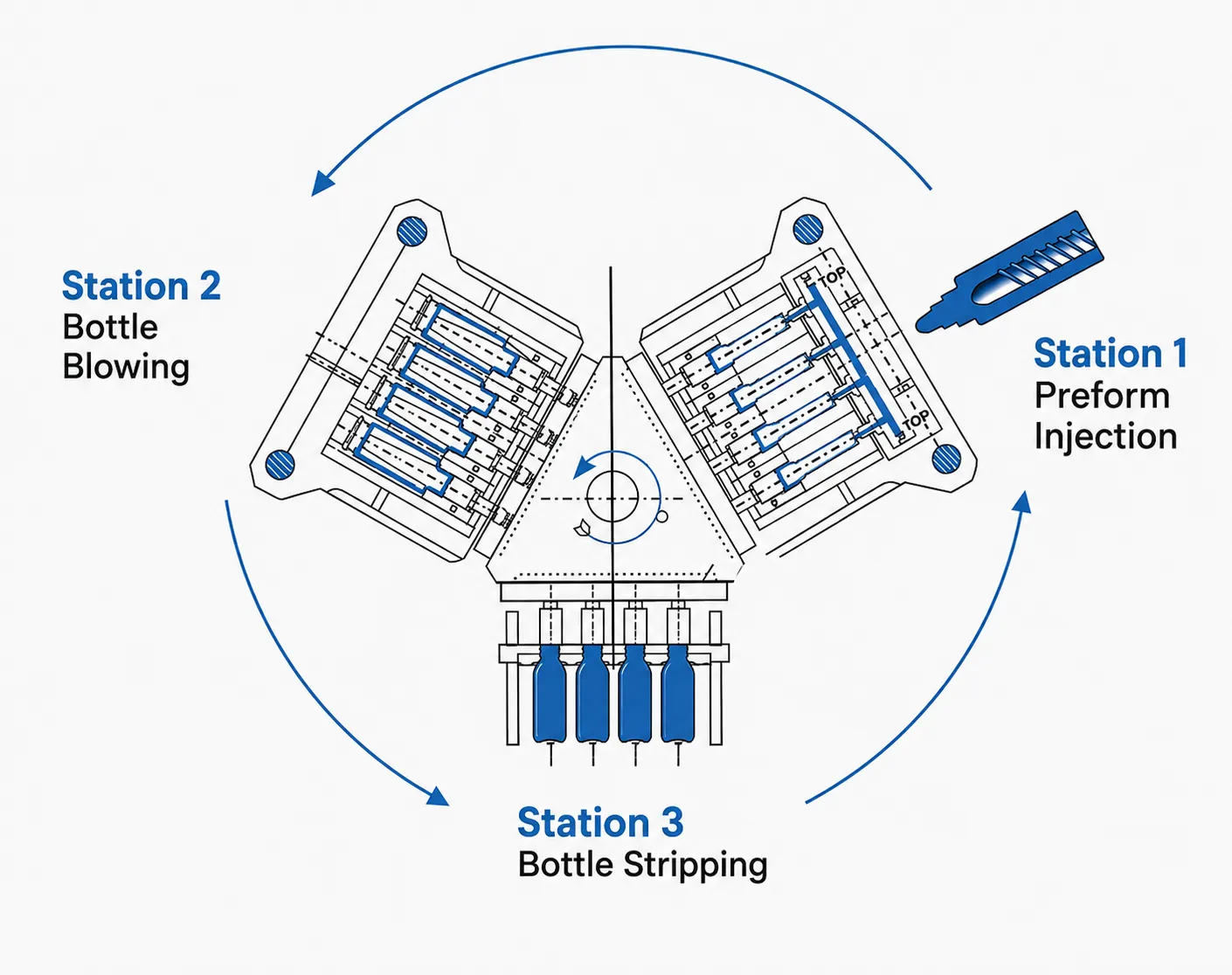
IBM’s core rod tip seals the preform base during injection moulding at Station 1. The core rod tip is the male side of the injection gate — molten HDPE is injected around the core rod and fills the preform cavity from neck to base, with the core rod tip acting as the base mould. The result is a closed-bottom preform tube with an injection-formed solid base. This base never needs pinching — it was formed closed during injection. At Station 2, blow air enters through a bore in the core rod tip and inflates the preform body outward, leaving the injection-formed base in place. Result: a container with a smooth, weld-free, flash-free base with only a small injection gate vestige at the interior base centre — not visible from the exterior.
Klemmesvejset — flash uundgåelig
EBM’s extruded parison is an open-ended tube — it has no sealed base when it exits the die. The blow mould must mechanically pinch the parison shut at its bottom end to seal the container base. The pinch creates: (1) a base weld line — a structurally weaker zone compared to the surrounding container wall; (2) base flash — the HDPE squeezed beyond the mould parting line forms a fin that must be trimmed; (3) trim debris — flash trimming produces HDPE particles that can fall inside the container through the open top (before capping at the filling line).
The base weld is structurally weaker than the container sidewall — base weld failure is the most common EBM container drop-impact failure mode. IBM’s injection-formed base has no weld and does not fail in this mode.
The IBM container base exterior — viewed from below — shows a smooth, continuous HDPE surface with no parting line, no weld mark and no trim witness. The only visible feature is the injection gate point at the base centre interior: a small circular mark (typically 1.5–3.0 mm diameter) at the core rod blow air exit point. This gate vestige is flush with or slightly recessed below the surrounding base surface — never protruding, never sharp, and never contacting the container’s fill contents.
AFSNIT 03
Kvantificerede besparelser i produktionsomkostninger
Fordelen ved nul flash-effekter omsættes til kvantificerbare produktionsomkostningsbesparelser i enhver IBM-produktionsskala. Den følgende omkostningsanalyse bruger koreanske IBM-produktionsparametre ved 200 ml HDPE-husholdningskemikaliebeholdere som referenceformat — beregningerne skaleres proportionalt for andre beholderstørrelser.
| OMKOSTNINGSKATEGORI | EBM (med beklædning) | IBM (nul flash) | IBM SPARINGSGRUNDLAG |
|---|---|---|---|
| Trim udstyrskapital | KRW 15-30 mio. pr. linje | Nul | Integration af trimmeknivenhed + transportbånd er ikke påkrævet ved IBM-produktionslinje |
| Udskiftning af trimblad | 200.000–500.000 KRW/måned | Nul | Ingen trimning af klinger, ingen slibeservice, ingen nedetid for klingerskift |
| Trim operatørens arbejdskraft | 1 operatør pr. 2-4 EBM-maskiner | Nul | IBM-operatør overvåger maskine + output — intet dedikeret personale til trimstationen |
| Flash HDPE-affald | 3–8% containervægt | Nul | 100% injiceret HDPE bliver til beholder — ingen omkostninger til hurtig omformaling eller bortskaffelse |
| Flash-genopslibningsbehandling | Genkværnskapital + drift | Nul | Farmaceutiske og fødevarebaserede IBM kan ikke bruge genformaling — EBM flash er rent skrot i disse applikationer |
| Containerinspektion for flash | Tilføjet inspektionsstation | Nul | Ingen inspektion af base flash-trimning kræves — basekvaliteten er en del af IBM-processen |
BESPARELSE PÅ PRODUKTIONSUDGIFTER UDEN FLASH — ZQ60 IBM vs. TILVÆRENDE EBM @ 200 ml HDPE, 20 MILLIONER ENHEDER/ÅR
Trimudstyr
20 millioner KRW sparet
Engangskapital
Årlig arbejdskraft
Sparet 28 mio. KRW/år
0,5 trimoperatør × 56 mio. KRW/år
Flash HDPE-skrot
Sparet 18 mio. KRW/år
4% × 20M × 4g/indhold × KRW 2.800/kg
Klinger + Vedligeholdelse
Sparet 4 mio. KRW/år
Udskiftning af trimmeklinge + nedetid
Samlet årlig besparelse
KRW ~50 mio./år
≈ KRW 2,5 pr. container ved 20 mio./år
AFSNIT 04
Nul flash-interiør — Eliminering af kontaminering
Den mest kommercielt betydningsfulde konsekvens af EBM-flash er ikke den synlige ydre flashfinne – det er det usynlige flashrester, som trimningen aflejrer inde i beholderen. Forståelsen af kontamineringsmekanismen forklarer, hvorfor farmaceutiske og koreanske fødevaremærker specificerer IBM-containere af kvalitetsmæssige årsager, der går ud over produktionsomkostningerne.
Lynfinbrud under trimning
Når trimmekniven berører den nederste flashfinne, genererer skærefunktionen mikropartikler af HDPE ved skærekanten. På automatiserede EBM-trimmestationer genereres disse partikler ved trimmepunktet - cirka 5-20 mm fra den åbne beholdertop (før låget påsættes ved påfyldningslinjen). Ved EBM-produktionshastigheder (500-2.000 beholdere/minut) skaber luftstrømmen omkring trimmestationen turbulens, der kan føre HDPE-mikropartikler opad i den åbne beholderhals. Partikelstørrelser genereret af HDPE-knivtrimning: 20-500 μm i diameter, usynlige for det blotte øje. Disse partikler kan ikke detekteres ved standard visuel inspektion ved 500 lux - de er kun delvist synlige under normale produktionsinspektionsforhold.
Lynfastgørelse til beholderens indre
EBM-baseflash, der ikke er rent trimmet – en tilstand, der opstår, når trimmeknive er slidte eller forkert justerede – efterlader en resterende flashtag fastgjort til basens svejsezone. Under transport af beholderen fra EBM-maskinen til påfyldningslinjen (typisk via transportbånd, akkumuleringsbord og bulkemballage) kan denne resterende flashtag rive sig løs fra svejsezonen. Hvis taggen river sig løs, efter at beholderen er fyldt og lukket – som det kan ske ved gentagne fald- og stødpåvirkninger under distribution – bliver flashtaggen til en fritflydende HDPE-partikel inde i den fyldte beholder. Dette er en produktkontamineringshændelse, der kræver tilbagekaldelse af et koreansk produkt i henhold til det koreanske ministerium for fødevare- og lægemiddelsikkerhedsregler, hvis beholderen er et lægemiddel eller en fødevare.
Strukturel basis — ingen beskæring, ingen partikler
IBM-containere har ingen trimningsoperation – der er ingen trimmekniv, ingen trimningsstation og ingen flashpartikler genereret på noget tidspunkt i IBM-produktionsprocessen. IBM-containerens indre er dannet udelukkende af kernestangens overflade (glat, poleret, ingen partikelgenererende operationer) og præformlegemet, der er oppustet udad – begge operationer er indeholdt i den lukkede IBM-maskine uden partikelgenerering. IBM-containere forlader Station 3 som færdige, forseglede containere uden efterfølgende operationer, der kan generere indvendige forurenende stoffer, før containerne når den koreanske påfyldningslinje.
AFSNIT 05
Zero Flash i koreansk farmaceutisk IBM

Det koreanske farmaceutiske firma IBM har de strengeste kvalitetskrav til nul-flash af alle IBM-applikationer – fordi de koreanske KFDA GMP-regler klassificerer HDPE-flashpartikler i en farmaceutisk beholder som en potentiel patientsikkerhedsrisiko (kontaminering af fremmedlegemer), der, hvis de findes i et fyldt farmaceutisk produkt, kræver en koreansk produkttilbagekaldelse og en koreansk KFDA-kontamineringsundersøgelse.
Koreansk KP-partikelstandard
Den koreanske farmakopé (KP) generelle meddelelse om oftalmiske præparater kræver grænseværdier for subsynlige partikler: ≤ 25 partikler/ml ≥ 10 μm og ≤ 3 partikler/ml ≥ 25 μm pr. USP-tilpasset specifikation. IBM-beholdere uden afskårne partikler opfylder denne standard uden beholdervask. EBM-beholdere, der anvendes til koreanske oftalmiske præparater, skal gennemgå en 100% luftskylnings- eller vandskylningsoperation på den koreanske farmaceutiske påfyldningslinje for at reducere partikelniveauer - en operation, som IBM-beholdere ikke kræver, hvilket sparer cirka 15-25 millioner KRW i skylleudstyr og 8-12 millioner KRW/år i forbrugs- og vedligeholdelsesomkostninger på en typisk koreansk oftalmisk IBM-påfyldningslinje.
Koreansk KFDA GMP-dokumentation
For Korean pharmaceutical GMP qualification, the Container Technical File (CTF) must document the container production process including any particle-generating operations. IBM’s production process description in the Korean CTF contains no trim operation — the absence of trim is a documented quality advantage that simplifies the Korean pharmaceutical brand’s contamination risk assessment (PFMEA) for the primary container. Korean KFDA GMP inspectors assess primary container contamination risk as part of pharmaceutical GMP facility inspections — IBM’s documented zero-trim architecture is a straightforward risk elimination that EBM-with-trim cannot achieve.
AFSNIT 06
Nul flash i koreansk mad IBM
Korean Ministry of Food and Drug Safety (MFDS) food container regulations require that food contact containers are free from foreign material contamination — a Korean food safety regulation that makes EBM trim flash debris inside a food container a Korean MFDS regulatory violation. IBM’s zero flash production is a structural Korean MFDS food contact compliance advantage for Korean food packaging IBM producers who supply Korean MFDS-registered food brands.
Korean soy sauce is filled at pH 4.5–5.0 at Korean automated filling lines running at 80–120 bottles per minute. At this filling speed, any HDPE particle inside the soy sauce container before filling is immediately dispersed into the soy sauce at fill — making post-fill particle detection and removal impossible. Korean soy sauce brands specify IBM containers (via their Korean container supplier’s IBM equipment) specifically to eliminate the EBM flash contamination risk. A single Korean food contamination event involving plastic particle detection in a Korean soy sauce lot at Korean retail requires: Korean product recall at an estimated cost of KRW 300–600M, Korean MFDS contamination investigation (3–6 months), and potential Korean brand reputation damage. The zero flash advantage of IBM makes this event structurally impossible.
Korean premium honey IBM containers (bear-shaped and jar-shaped, 150–500 ml) are a zero-flash IBM application where the absence of a base trim mark is a visible quality indicator for Korean premium honey consumers. Korean honey brands selling at KRW 15,000–50,000 per 500 ml at Korean department store food halls specify IBM containers for three zero-flash reasons: (1) no base trim witness mark — the Korean consumer examines the bear or jar bottom as part of premium product evaluation; (2) no flash debris in honey — Korean premium honey is consumed directly without filtration; (3) the clean IBM base appearance signals manufacturing quality at the Korean premium price point. The household chemical IBM guide covers how IBM’s zero flash advantage applies to daily chemical containers as a cost and quality advantage, but the IBM-guide til husholdningsbrug adresserer også kontamineringsrisikoen i husholdningskemikalier.
AFSNIT 07
Zero Flash i koreansk personlig pleje og kosmetik IBM
In Korean personal care and cosmetic IBM, zero flash provides a different type of advantage: appearance quality at the container base and body. Korean premium brand packaging acceptance inspection is conducted under directional lighting conditions that reveal trim witness marks that are invisible under diffuse light — making IBM’s zero-trim base appearance a Korean premium brand acceptance criterion in its own right.
GRUNDLÆGGENDE UDSEENDE · IBM vs EBM VED KOREANSK PREMIUM MÆRKEACCEPTANSINSPEKTION
INSPEKTIONSFUNKTION
Basissvejselinje
Trim vidnemærke
Bundplanhed
Basishjørners radius
Basisoverfladefinish
IBM (Zero Flash)
Ingen — sprøjtestøbt base, ingen svejsning
Ingen — ingen trimning udført
Flad — sprøjtestøbt base præcision
Sharp R som designet — blæseformhulrum
Glat — overfladen af blæseformens hulrum
EBM (med trim)
Til stede — synlig under 45° retningsbestemt lys
Til stede — afskæringskant synlig ved bunden
Variabel — svejsezonen kan forårsage en let bøjning af basen
Afrundet ved svejsezonen på grund af klemmemekanik
Lidt ru ved skærekanten
Koreanske premium-kosmetikmærker (premium-ansigtscreme, luksuriøse body butter-beholdere, K-beauty-gavesætemballage) er de strengeste kunder hos IBM med et nul-flash-udseende. Koreanske inspektører for godkendelse af kosmetikemballage undersøger beholderens bund nedefra ved hjælp af et retningsbestemt lys på 500-1.000 lux ved en indfaldsvinkel på 45° - den samme synsvinkel, som koreanske stormagasinhylder skaber, når en forbruger tager et produkt op og inspicerer det nedefra. Under disse forhold er svejselinjer og kantmærker på EBM-basen synlige som hævede lineære mærker og en uregelmæssig overfladetekstur i midten af basen - træk, som koreanske kvalitetsteams for luksuskosmetikmærker dokumenterer som kosmetiske defekter og bruger til at afvise EBM-beholdere som ikke-overensstemmende med standarderne for premium-mærkeemballage.
AFSNIT 08
ZQ60 — Zero Flash-platform til koreansk mellemstor IBM
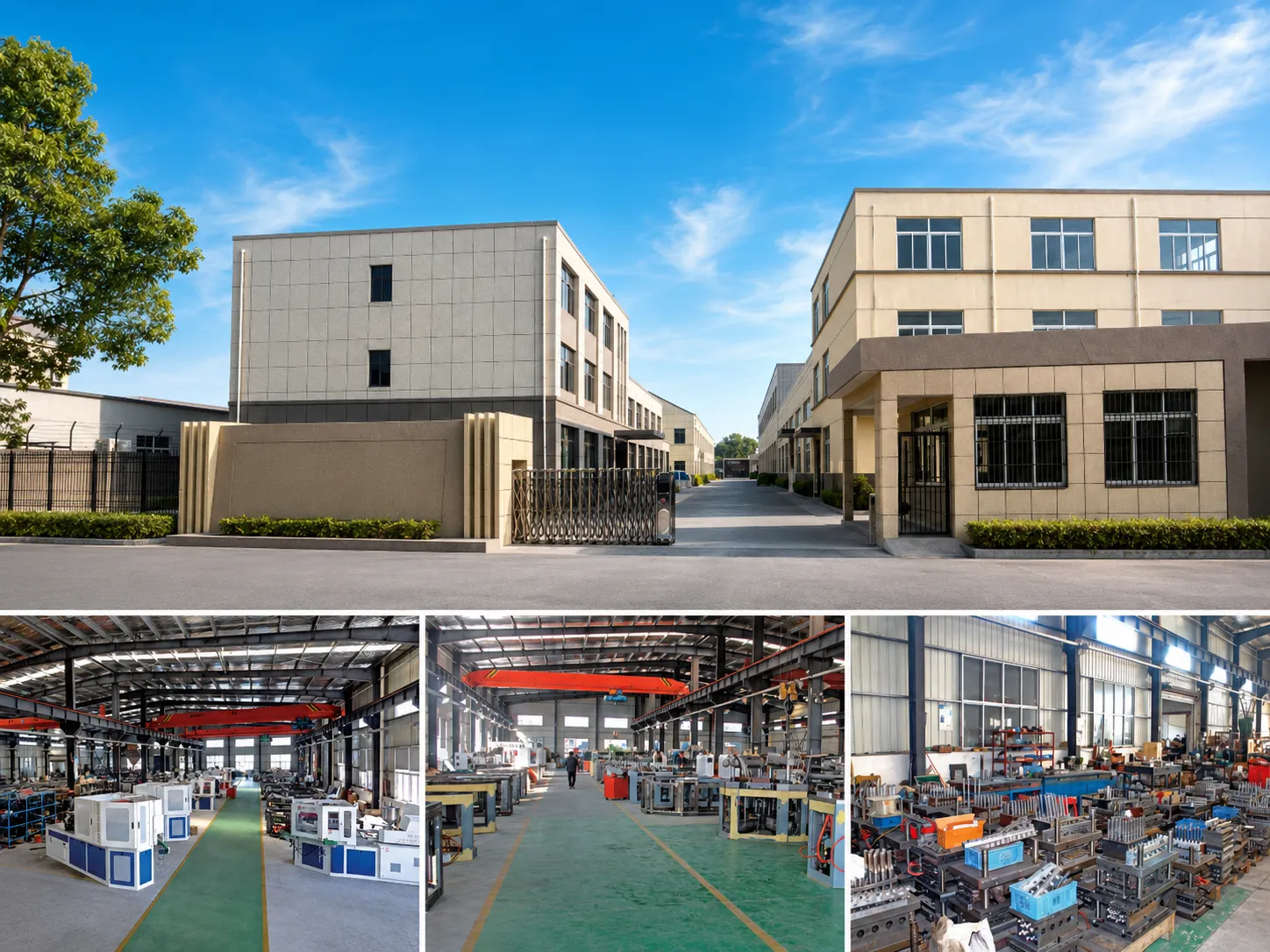
De EP-ZQ60 er den mest almindelige koreanske Ever-Power IBM-maskine til koreansk IBM-produktion i mellemstore mængder til fødevarer, husholdningsartikler og personlig pleje i formatområdet 100-300 ml - et volumenområde, hvor fordelen ved nul flash giver den største relative besparelse i produktionsomkostninger i forhold til EBM, fordi det også er i dette formatområde, at EBM-trimningsoperationer er mest arbejdskrævende (lille kropsdiameter × lang baseflashfinneperimeter = højere trimningsarbejde pr. enhed end beholdere i store formater).
35–40%
Besparelse af gulvareal i produktionscelle sammenlignet med sammenlignelig EBM-linje med trimstation
KRW 50 mio.
Estimeret årlig nul flashbesparelse ved 20 millioner enheder/år 200 ml HDPE-fødevarebeholder
Nul
Risikoen for flashkontaminering i IBMs produktionshistorik for farmaceutiske og fødevarebeholdere
100%
Udnyttelse af HDPE-materiale — al injiceret polymer bliver til beholder, intet bliver til flash-skrot
INGENIØR OFTE STILLEDE SPØRGSMÅL
Zero Flash IBM — Ingeniørspørgsmål
Producerer IBM absolut ingen flash nogen steder på containeren – inklusive halsområdet?
IBM produces no flash at any point on the container exterior that requires trimming. The clarification is important: IBM does produce a small injection gate vestige at the container base interior — a circular mark 1.5–3.0 mm in diameter at the core rod blow air tip point where the HDPE injection gate froze off. This gate vestige is: (1) on the interior base, not the exterior; (2) flush with or slightly recessed below the surrounding base surface — it is not a protrusion; (3) not trimmed because it requires no trimming — it is a smooth, non-sharp injection moulding gate mark with no particle-generating characteristics; and (4) not visible from the container exterior. At the neck area: IBM has a neck parting line from the injection mould’s two-piece neck insert — a fine line at the neck OD surface at the mould parting plane. This neck parting line is extremely fine (typically 0.03–0.08 mm mark width) and requires no trimming. It is distinct from EBM’s body parting line (which runs the full length of the container body) — IBM’s neck parting line is limited to the neck zone only (3–8 mm height on the neck cylinder), and is the only parting mark on the entire container. Summary: IBM produces no flash requiring trimming at any point on the container. The gate vestige and neck parting line are cosmetic features inherent to the injection moulding process — not flash, not trim debris, not quality defects.
Kan EBM eliminere flash gennem procesoptimering — tyndere parison, strammere klemgeometri?
EBM flash cannot be eliminated through process optimisation — it can only be minimised. The theoretical minimum EBM flash is a pinch weld of zero width, which would require the two blow mould halves to close with zero clearance between them at the pinch zone — a physically impossible condition because the mould steel must have some clearance to avoid metal-to-metal contact wear. In practice, optimised EBM base pinch geometry achieves minimum flash weights of approximately 0.5–1.0 g for a 200 ml HDPE container — an improvement over unoptimised EBM flash (2.5–5.0 g) but not zero. Even at minimum flash weight, the EBM base weld line is present (it is the structural scar from the pinch closure regardless of flash weight), the trim operation is still required (0.5 g flash still requires trimming), and the trim particle contamination risk is still present (the trim operation at any flash weight generates HDPE micro-particles at the cut edge). Tighter parison programming and die geometry optimisation reduce flash weight and improve base weld quality — they do not and cannot eliminate flash as a structural EBM process feature. IBM’s zero flash advantage is not a manufacturing quality difference between better and worse processes; it is an architectural difference between processes that require base pinching (EBM, all blow-mould processes using parisons) and IBM, which does not.
Er IBM-indsprøjtningsportens rester i containerens bund et problem med hensyn til fødevaresikkerhed for koreanske MFDS'er?
No — the IBM injection gate vestige at the container base interior is not a Korean MFDS food safety concern, and has not been cited as a food safety issue in Korean MFDS food container registration or inspection documentation. The gate vestige is a smooth HDPE surface feature — not a particle, not a protrusion and not a material that differs from the surrounding HDPE base material. It is formed during injection as part of the continuous HDPE base wall — the vestige is the same HDPE polymer as the rest of the container, fully bonded to the base surface, with no potential to detach as a particle. By contrast, EBM trim flash debris is a detached HDPE particle produced by mechanical cutting during the trim operation — it is a physically separate piece of HDPE that is not bonded to the container and can migrate inside the filled container. Korean MFDS food container contamination regulations are specifically concerned with foreign particles that can detach and contaminate the food contents — the IBM gate vestige does not meet this criterion. Korean pharmaceutical KFDA GMP contamination regulations apply the same logic: the IBM gate vestige is a continuous surface feature, not a particle. Korea Ever-Power’s pharmaceutical IBM container technical file documentation explicitly addresses the injection gate vestige, confirming its material identity (same HDPE polymer as the container), its bonded nature (no detachment risk), and its location (base interior, away from the fill content zone for all standard container orientations). This confirmation has been accepted by all Korean pharmaceutical brand QA teams who have reviewed Korea Ever-Power IBM container technical files without requesting further testing or documentation regarding the gate vestige.
Tillader zero flash IBM højere brugshastigheder for HDPE-genslibning end EBM for samme kvalitetsniveau?
Zero flash IBM eliminates one category of internal regrind consideration that complicates EBM regrind management: flash regrind quality. In EBM, the base flash is a different thermal history HDPE than the container wall — the flash zone was subject to higher shear stress (pinch compression) and longer thermal exposure (parison heat + compression heat) than the container body wall. This means EBM flash regrind has a different melt index and oxidative history than the virgin HDPE feedstock, and adding flash regrind to the virgin HDPE feed changes the regrind blend’s MI and thermal stability in ways that can affect container quality. For pharmaceutical and food IBM, EBM flash regrind cannot be used because: (1) Korean KFDA pharmaceutical container qualification specifies the HDPE grade and resin grade — adding regrind constitutes a material change requiring a Korean KFDA change notification; and (2) Korean MFDS food contact regulations do not permit the use of post-production HDPE regrind in food contact containers without separate regulatory review. IBM’s zero flash production eliminates this complication entirely for pharmaceutical and food applications — there is no IBM flash to manage. For household and personal care IBM (where regrind use is permissible), IBM’s absence of flash regrind means the only regrind consideration is production purge material (from machine startup and colour change purging) — a much smaller and more controlled regrind stream than EBM flash, typically 0.2–0.5% of production volume versus EBM flash at 3–8%.
How does zero flash IBM affect the container’s carbon footprint and Korean ESG reporting?
IBM’s zero flash production reduces the container’s Scope 3 embodied carbon footprint versus EBM in three measurable ways. First, material efficiency: 100% of injected HDPE becomes the container — zero flash means zero waste HDPE. At EBM, 3–8% of HDPE becomes flash that is either regrind (with its additional processing energy) or scrap. For a Korean food brand producing 20 million 200 ml HDPE containers per year at 4 g average weight: EBM flash waste at 5% = 4 tonnes of HDPE per year that IBM does not produce. At 2.3 kg CO₂ equivalent per kg HDPE (HDPE cradle-to-gate carbon factor), this 4 tonnes flash elimination equals approximately 9.2 tonnes CO₂e saved annually — directly attributable to IBM’s zero flash process. Second, energy efficiency: EBM flash requires either regrind processing energy (extrusion + pelletising at ~0.3–0.5 kWh/kg) or disposal energy. IBM eliminates this downstream energy requirement entirely. Third, Korean ESG documentation: Korean brands publishing Scope 3 packaging carbon footprint data in their Korean ESG reports can directly attribute the IBM flash elimination to their packaging carbon reduction programme — with the flash weight eliminated and the HDPE carbon factor as simple, auditable inputs. Korean food and personal care brands submitting to Korean Environment Ministry’s green product certification (환경표지 GR 인증) increasingly report IBM container zero flash material efficiency as a manufacturing sustainability criterion in their product certification documentation.
Hvad er den korrekte måde at verificere, at en IBM-containerleverandør rent faktisk bruger IBM i stedet for EBM?
Korean buyers can verify IBM versus EBM container production through three inspection methods that require no laboratory equipment. First, base inspection: examine the container base from below under directional light (a torch at 45° incidence is sufficient). IBM base characteristics: smooth, weld-free, flat base with a small circular gate mark (1.5–3.0 mm diameter) at the centre. EBM base characteristics: a visible linear weld mark running across the base centre (the pinch weld line), with slight material raised at the weld zone visible under directional light; a trim cut edge at the base perimeter where the flash was removed (a slight discontinuity in the base-to-sidewall corner radius). Second, base corner inspection: the EBM base-to-sidewall corner shows a slight flat zone at the two positions where the blow mould halves met at the base pinch — IBM’s base corners are uniformly radiused around the full base perimeter. Third, base parting line trace: stand the container on a flat surface and rotate it 360° under directional light at the base zone. EBM containers show a slightly elevated line running across the base from the two parting line positions; IBM containers show no line — the base surface is continuous. For Korean pharmaceutical and food procurement teams, these visual verification methods are sufficient to confirm IBM versus EBM production at incoming container inspection, without requiring machine records or production documentation from the container supplier.
IBM-FORESPØRGELSE MED NUL FLASH · KOREA EVER-POWER
Planlægger du produktion af IBM-containere med nul flash?
Korea Ever-Power leverer produktion af IBM-containere uden flash til farmaceutiske produkter, fødevarer, husholdninger og personlig pleje. Alle maskiner i Korea Ever-Power ZQ-serien leverer strukturelt flashfri beholdere uden behov for sekundær trimning.