
TECHNICAL GUIDE · IBM MACHINE CONFIGURATION · KOREA EVER-POWER
Injection Blow Molding
Cavity Count Selection Guide
Cavity count is the single highest-leverage specification in IBM machine selection — it determines annual output per machine, capital per unit of capacity, KFDA qualification cost and production flexibility. This guide shows exactly how to calculate the correct cavity count for Korean pharmaceutical, household chemical and cosmetic IBM production at any annual volume.
ZQ40 → ZQ135 Range
Korean Factory Economics
KOREA EVER-POWER · ANSAN-SI, GYEONGGI-DO · JULY 2026
SYSTEM REFERENCE · ZQ SERIES CAVITY COUNT PARAMETERS
MAX CAVITIES @ 10ml
30
ZQ135 flagship · ~23,800 bottles/hr
CYCLE TIME (dry)
4.0 s
All ZQ models · 4-second dry cycle
TARGET UTILISATION
70–85%
Korean 2-shift annual production target
EFFICIENCY FACTOR
88%
Applied to rated output for capacity planning
SECTION 01
Why Cavity Count Is the Critical IBM Specification
In IBM machine selection, cavity count is the primary decision — more consequential than machine clamping force, barrel size or control system specification — because cavity count at a given container format directly determines: annual output per machine-year, capital cost per unit of annual capacity, number of KFDA pharmaceutical qualifications required per production target, and the Korean factory’s production scheduling flexibility. Getting cavity count correct at machine order eliminates the most expensive mistake in Korean IBM investment: either under-specifying cavity count (the machine cannot achieve the required annual output, forcing purchase of a second machine) or over-specifying cavity count (the machine runs below 50% utilisation, producing an unacceptable return on capital).
IBM’s output is structurally different from EBM — in EBM, output rate is primarily determined by cycle time (which varies with machine size and container weight); in IBM, cycle time is essentially fixed at 4 seconds dry across the ZQ series regardless of model, so output is almost entirely determined by the number of cavities running simultaneously. A ZQ40 at 9 cavities and a ZQ135 at 30 cavities both run approximately 4-second cycles — the ZQ135 produces 3.33× more bottles per hour not because it runs faster, but because it produces 3.33× more bottles per cycle. This means cavity count is literally equivalent to production capacity in IBM — every cavity added is a fixed increment of output rate, not an improvement in cycle speed.
Korean IBM investment decisions that anchor on machine clamping force (KN) or machine model number without verifying the specific cavity count available at their container format routinely produce sizing errors. A ZQ110 at 1,100 KN can run 24 cavities at 10 ml pharmaceutical, but only 6–8 cavities at 500 ml household chemical — two entirely different output rates from the same machine. This guide provides the calculation framework and reference data that Korean IBM producers need to specify cavity count correctly for their specific container format, annual volume and Korean factory shift schedule.
SECTION 02
The IBM Cavity Count Formula
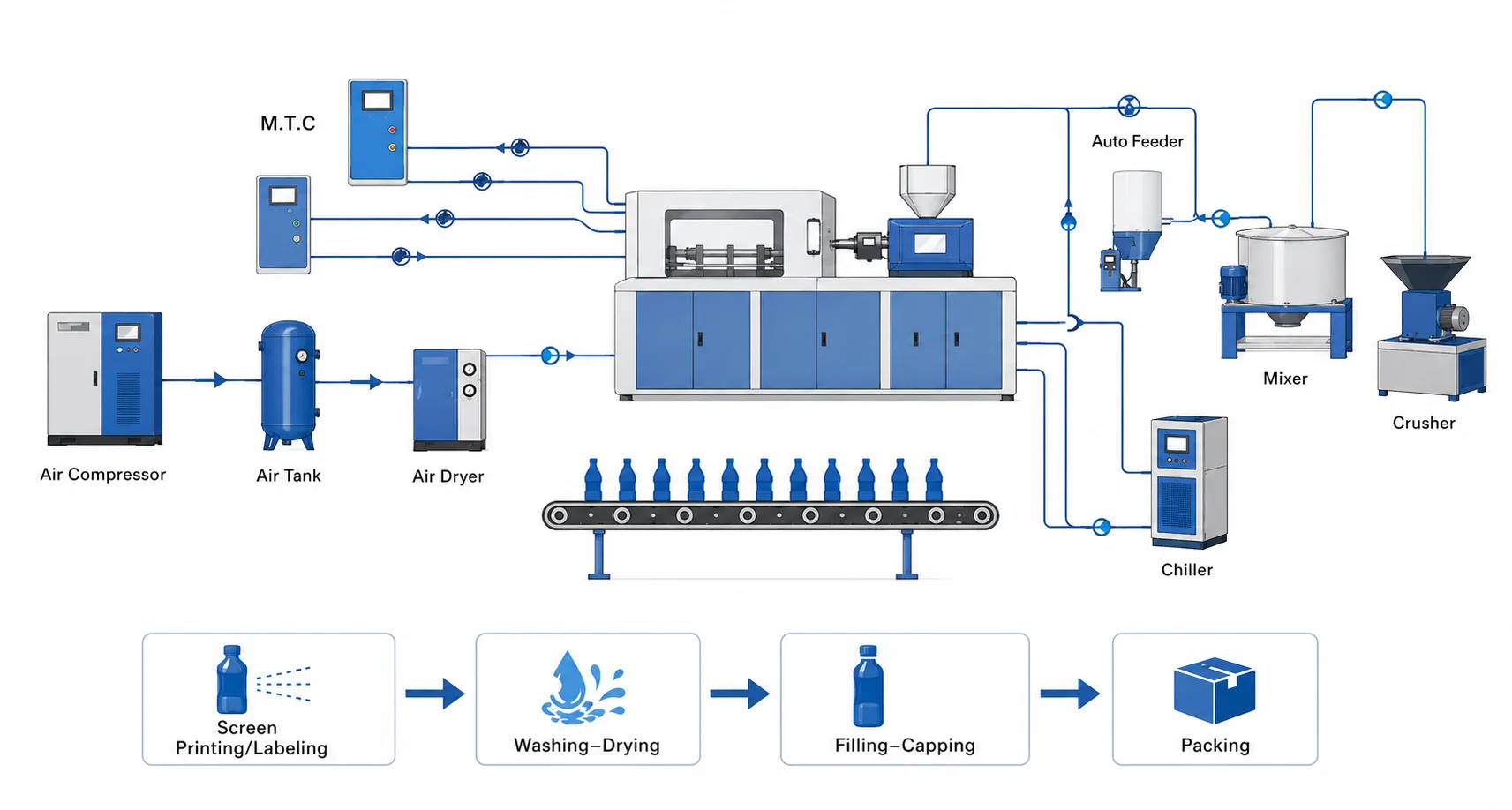
CALCULATION FRAMEWORK · IBM CAPACITY PLANNING
STEP 1 — REQUIRED ANNUAL VOLUME
Determine units required per year including seasonal peak buffer. Add 15–20% to base annual volume for Korean retail promotional demand and production maintenance downtime buffer.
STEP 2 — KOREAN FACTORY SHIFT HOURS
Korean 2-shift = 14 productive hours/day × 250 production days = 3,500 hours/year. Korean 3-shift = 21 hours/day × 250 days = 5,250 hours/year. Use 2-shift as the planning basis unless Korean labour conditions confirm 3-shift availability.
STEP 3 — CAVITY COUNT FORMULA
N = V_annual ÷ (3,600 ÷ T_cycle × E × H_annual)
N = minimum cavities required
V_annual = annual unit target
T_cycle = 4.0 s (ZQ series)
E = 0.88 (88% efficiency)
H_annual = 3,500 h (2-shift)
STEP 4 — UTILISATION CHECK
Round N up to the next available ZQ cavity count. Confirm machine utilisation = V_annual ÷ (N × 793/hr × 3,500 h) is between 65% and 85%. Below 65%: downgrade to fewer cavities. Above 90%: upgrade to more cavities.
Korean pharma · 10 ml ophthalmic · 40M units/year · 2-shift
INPUT
V = 40,000,000
T = 4.0 s · E = 0.88
H = 3,500 hr
CALCULATION
N = 40M ÷ (793 × 3,500)
N = 40M ÷ 2,775,500
N = 14.4 → round up to 20
RESULT
ZQ80 at 20 cavities
Capacity: 55.4M/yr
Utilisation: 72% ✓
HEADROOM
+15.4M units/yr
available for growth
without new machine
SECTION 03
ZQ Series Cavity Count Reference Table
The following table gives the complete cavity count reference for Korea Ever-Power’s ZQ series at the four most common Korean production formats. Annual capacity figures assume Korean 2-shift operation (3,500 productive hours/year) at 88% mechanical efficiency and 4.0 s dry cycle.
| ZQ MODEL | CLAMP (KN) | 10 ml Cav · M units/yr |
30 ml Cav · M units/yr |
100 ml Cav · M units/yr |
500 ml Cav · M units/yr |
|---|---|---|---|---|---|
| EP-ZQ40 Entry · 3+N zones |
400 | 9 ~19.8M |
6 ~13.2M |
4 ~8.8M |
2–3 ~4.4–6.6M |
| EP-ZQ60 Standard · 3+N zones |
600 | 14 ~30.8M |
9 ~19.8M |
5–6 ~11.0–13.2M |
3–4 ~6.6–8.8M |
| EP-ZQ80 Dual-hyd · Angle div. · 3+N |
800 | 20 ~44.0M |
12–14 ~26.4–30.8M |
8–10 ~17.6–22.0M |
5–6 ~11.0–13.2M |
| EP-ZQ110 Dual-hyd · 65mm screw · 4+N |
1,100 | 24 ~52.8M |
16–18 ~35.2–39.6M |
12–14 ~26.4–30.8M |
6–8 ~13.2–17.6M |
| EP-ZQ135 Flagship · 70mm · 6+N · 37+37KW |
1,350 | 30 ~66.0M |
20–22 ~44.0–48.4M |
14–16 ~30.8–35.2M |
8 ~17.6M |
Annual capacity: 3,500 hr/yr (2-shift) × 88% efficiency × (3,600 ÷ 4.0 s) × cavities
SECTION 04
Factors That Limit Maximum Cavity Count
Maximum cavity count at a given container format is constrained by three independent machine limits — all three must be satisfied simultaneously. The binding constraint is whichever is reached first as cavity count increases.
Clamping Force
Platen Size
Shot Weight
ZQ Range
400–1,350 KN
ZQ40 → ZQ135 clamping range
Key Dimension
> 60 mm
Body diameter where platen limits first
Risk Format
> 1.0 mm
Wall at 500 ml approaching shot limit
Maximum injection clamping force (KN) divided by the per-cavity projected area at injection pressure. At a 10 ml HDPE pharmaceutical preform, the per-cavity clamping requirement is approximately 35–45 KN — allowing 9 cavities on a ZQ40 (400 KN) and 30 cavities on a ZQ135 (1,350 KN).
Larger container body = larger preform projected area = fewer cavities available per KN of rated clamping force
The ZQ turret platen physically limits the maximum footprint of the injection mould. Cavity count is also limited by the geometric arrangement on the platen — cavities must have sufficient centre-to-centre spacing to allow cooling channels and mould structural integrity between adjacent cavities.
Wide-body containers (body diameter > 60 mm) become platen-limited before they reach the clamping force limit of the same ZQ model
The screw injection unit has a maximum shot weight per cycle — total HDPE or PP injected across all cavities simultaneously. At large container formats with heavy wall, total shot weight may exceed the ZQ model’s rated barrel capacity before clamping force or platen area is fully utilised.
Heavy-wall containers (> 1.0 mm body at 500 ml) approach shot weight limits at fewer than 8 cavities on ZQ110 — verify shot weight calculation before specifying cavity count at large formats
The binding constraint at any given format is whichever of the three limits is reached first. All three must be verified independently — do not assume clamping force is always the primary constraint at every container format and ZQ model combination.
SECTION 05
Pharmaceutical IBM Cavity Count Planning

Korean pharmaceutical IBM cavity count planning has a constraint that non-pharmaceutical IBM does not: the cavity count is locked to the KFDA qualification. Each cavity in the IBM mould set is individually documented in the Korean KFDA pharmaceutical container qualification — changing cavity count after initial KFDA approval requires a container change notification. This regulatory lock-in makes it critically important to specify the correct cavity count at the outset of Korean pharmaceutical IBM production rather than upgrading later.
The fuller pharmaceutical IBM context is covered in the pharmaceutical IBM guide. The pharmaceutical cavity count decision rule: specify the cavity count that produces 70–80% utilisation at the projected Year 3 annual volume — not the Year 1 volume. Korean pharmaceutical production ramp-up typically adds 15–25% annual volume in Years 2–4 as Korean KFDA qualification for the pharmaceutical brand completes and Korean market demand builds. Qualifying at Year 1 cavity count produces a machine that is 90%+ utilised by Year 3 and requires either a qualification upgrade or a second machine — both more expensive than specifying one cavity count higher at initial qualification.
PHARMACEUTICAL CAVITY COUNT DECISION MATRIX · 10 ml OPHTHALMIC
YEAR 3 TARGET
< 25M
→ ZQ60 · 14 cav
30.8M cap · 81% util.
YEAR 3 TARGET
25–38M
→ ZQ80 · 20 cav
44.0M cap · 57–86% util.
YEAR 3 TARGET
38–50M
→ ZQ110 · 24 cav
52.8M cap · 72–95% util.
YEAR 3 TARGET
> 50M
→ ZQ135 · 30 cav
66.0M cap · 76%+ util.
SECTION 06
Household Chemical and Cosmetic Cavity Count Planning

Household chemical and cosmetic IBM cavity count planning differs from pharmaceutical in two key ways: there is no regulatory lock-in to a specific cavity count (KFDA pharmaceutical qualification does not apply), and format change frequency is higher — Korean household chemical contract packaging factories change mould sets 8–15 times per year per machine, versus 2–4 times for Korean pharmaceutical IBM machines. This means cavity count for household chemical and cosmetic IBM should also be optimised for mould change efficiency, not only for annual output.
500 ml SHAMPOO / HOUSEHOLD CHEMICAL
~9.5–12.6M/yr
~15.8–18.9M/yr
~18.9–25.2M/yr
~25.2M/yr
★ Most common Korean shampoo IBM configuration
100 ml ABS COSMETIC JAR
~11.0–13.2M/yr
~15.4–17.6M/yr
~22.0–26.4M/yr
~26.4–30.8M/yr
★ Korean K-Beauty national brand OEM standard
SECTION 07
Multi-Format Machine Cavity Count Strategy
Korean IBM contract packaging factories that run multiple container formats on the same machine — the most common commercial IBM deployment in Korea — must optimise cavity count not for a single format but for the weighted annual volume across all formats sharing machine time. A ZQ80 running 6 formats per year at different cavity counts has a single clamping force and platen size that constrains the maximum cavity count for each format independently; the machine selection must satisfy the binding constraint across all planned formats.
| Format | Annual Units | Min Cavities (calc.) | ZQ80 Available | Prod. Hours Needed | Machine Util. |
|---|---|---|---|---|---|
| 10 ml ophthalmic | 20,000,000 | 7.2 → 20 cav | 20 cav | 1,263 h | 36% |
| 100 ml CRC medicine | 8,000,000 | 2.9 → 10 cav | 10 cav | 1,009 h | 29% |
| 500 ml shampoo | 12,000,000 | 4.3 → 6 cav | 6 cav | 2,222 h | 63% |
| TOTAL | ZQ80 ✓ | 4,494 h | 128% |
⚠ CAPACITY CONFLICT: Total required production hours (4,494 h) exceeds Korean 2-shift annual hours (3,500 h). This format portfolio requires either a ZQ110 (adding cavity count headroom on the ophthalmic format to reduce ophthalmic hours) or a second ZQ80 dedicated to the shampoo format. Korea Ever-Power’s application engineers run this multi-format analysis for Korean contract packaging factories as part of the pre-order consultation.
SECTION 08
Capital and KFDA Qualification Cost per Cavity
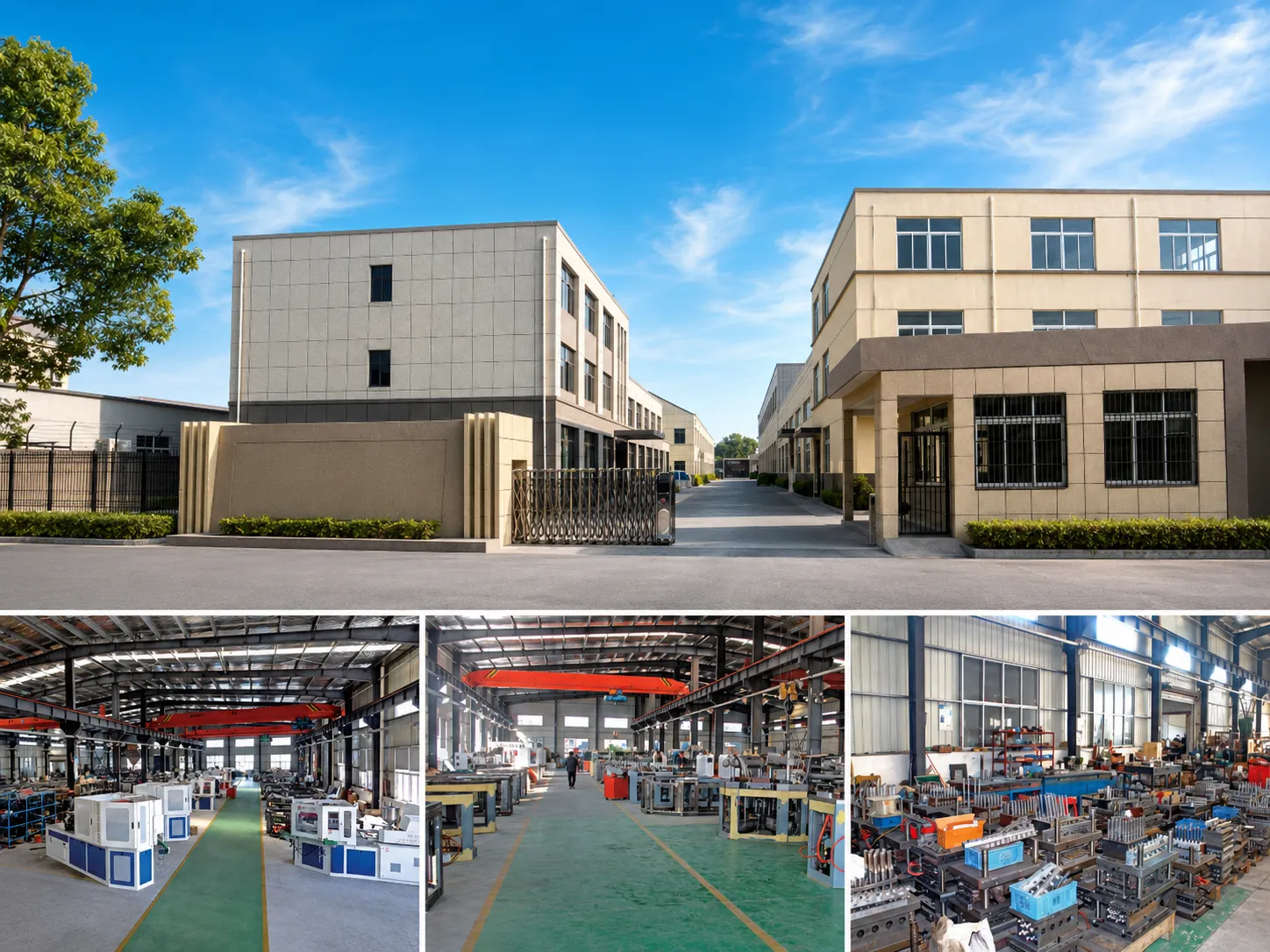
The capital cost analysis for IBM cavity count selection should compare machine cost plus mould cost per unit of annual capacity — not machine cost alone. Higher cavity count moulds cost more per set, but the additional mould cost per cavity is far less than the machine cost per unit of capacity improvement achievable by stepping up to the next ZQ model. Adding 4 cavities to a ZQ80 mould (from 16 to 20 cavities at 10 ml) costs significantly less than the step from ZQ80 to ZQ110 — yet produces the same output improvement as a smaller ZQ110 configuration. The correct question is always: at what cavity count does the current ZQ model saturate, and is additional output available from more cavities on the same model before stepping up?
| Configuration | Annual Capacity | Pharma KFDA Quals | Relative Capital Index | Capital per 1M units |
|---|---|---|---|---|
| 3× ZQ40 · 9 cav · 10ml | 59.4M | 3 quals | 3.0× | Highest |
| 2× ZQ80 · 20 cav · 10ml | 88.0M | 2 quals | 2.0× | Medium |
| 1× ZQ135 · 30 cav · 10ml ★ | 66.0M | 1 qual | 1.0× | Lowest |
| 1× ZQ110 · 24 cav · 10ml | 52.8M | 1 qual | 1.2× | Low |
★ Optimal for Korean pharmaceutical producers requiring 50M+ annual ophthalmic units — minimum capital per unit of capacity plus minimum KFDA qualification events. Korea Ever-Power’s EP-ZQ80 provides the best cost-efficiency entry point for Korean producers in the 40–55M unit range.
ENGINEERING FAQ
Cavity Count Engineering Questions
Why does increasing IBM cavity count not increase cycle time?
IBM’s 4-second cycle time is determined by the longest sequential process step across the 3 stations — typically the blow cooling dwell at Station 2 for HDPE pharmaceutical thin-wall containers. Adding cavities increases the number of simultaneous operations at each station but does not lengthen any individual station’s process time, because all cavities at a given station operate simultaneously (they are all mounted on the same platen that closes and opens together). A 9-cavity mould at ZQ40 and a 30-cavity mould at ZQ135 both take approximately the same 4-second total cycle — the platen closes and opens once per cycle regardless of cavity count. The only process factor that changes with cavity count is injection fill time: more cavities means more total shot weight, which may require marginally longer fill time at very high cavity counts on marginal barrel capacities — but Korea Ever-Power’s ZQ series barrel sizing ensures this is not a limitation at the rated cavity counts shown in the reference table.
What happens to IBM quality when cavity count is maximised near the machine limit?
Operating at maximum rated cavity count for a given ZQ model and container format does not inherently reduce quality — Korea Ever-Power’s ZQ series machines are rated at the cavity counts in the reference table under standard Korean pharmaceutical production conditions, meaning these cavity counts are validated production configurations rather than theoretical limits. Quality risk occurs when cavity count exceeds the machine’s rated limit for a format — typically driven by a Korean customer requesting more cavities than the standard configuration to reduce mould investment. At above-rated cavity counts, three quality risk factors emerge: hot runner gate imbalance (more gates at the same manifold pressure produces greater flow variation across the outer versus inner gates of the runner tree); injection clamping margin reduction (less margin against flash at any gate if injection pressure peaks above the per-cavity average); and mould cooling inadequacy (more cavities in the same platen footprint means less cooling channel area per cavity, increasing cycle-to-cycle temperature variation and dimensional variation). Korea Ever-Power does not approve above-rated cavity counts on ZQ series machines — the rated cavity count is the engineering design point verified by Korea Ever-Power’s process engineers at production conditions. Requests for above-rated cavity count at a given format are addressed by recommending the next ZQ model.
Can a ZQ series IBM machine run different cavity counts on the same machine at different times?
Yes — this is one of IBM’s key commercial advantages for Korean contract packaging factories. The ZQ machine’s machine parameters (injection pressure, barrel temperatures, blow air pressure, cycle timing) are set independently for each mould set, stored as named production recipes in the ZQ control system, and recalled by the operator when a mould set is changed. A ZQ80 that runs a 20-cavity 10 ml pharmaceutical mould set for two shifts, then changes to a 6-cavity 500 ml shampoo mould set, then changes to a 10-cavity 100 ml cosmetic jar mould set — recalls three separate production recipes and operates at different cavity counts, cycle parameters and material temperatures for each format without reconfiguring any machine hardware. The only hardware change during format change is the three-component mould set (injection mould, blow mould, stripping tool) and, if the material changes, the barrel purge between materials. Korea Ever-Power’s ZQ control system stores up to 99 named production recipes, supporting the multi-format Korean contract packaging operations that represent the majority of Korean IBM commercial production environments.
How does the ZQ series dual hydraulic system affect cavity count planning at ZQ80 and above?
Korea Ever-Power’s dual hydraulic system (standard on ZQ80, ZQ110 and ZQ135) uses two independent hydraulic circuits — one dedicated to the injection phase and one dedicated to the blow and stripping phases — that operate simultaneously rather than sequentially. This parallel operation has two direct effects on cavity count planning. First, it eliminates the pressure cross-contamination between injection and blow circuits that occurs in single-circuit competitor IBM machines: on single-circuit machines, the hydraulic system must fully complete the injection phase before transitioning to blow phase, and residual injection pressure fluctuation can affect the blow air pressure consistency between cavities. At high cavity counts (20–30), this cross-contamination on single-circuit machines produces inter-cavity weight standard deviation of 5–8% — above the ±4% CV% limit for Korean pharmaceutical IBM containers. Korea Ever-Power’s dual hydraulic system produces inter-cavity weight standard deviation of 2–4% at full rated cavity count — within pharmaceutical specification. Second, the dual hydraulic system delivers 20–30% energy saving versus single-circuit machines at equivalent rated cavity count — documented in Korean customer factory energy measurements — because the dual circuit operates each pump at its optimal efficiency point rather than requiring one pump to serve both the high-pressure injection phase and the lower-pressure blow phase alternately. This energy saving compounds with cavity count: at 30 cavities on the ZQ135, the 20–30% energy saving versus a single-circuit 30-cavity competitor machine saves approximately 15,000–25,000 kWh per Korean two-shift year at full utilisation, reducing Korean factory electricity cost by approximately KRW 2.5–4.0M per year per machine.
What is the IBM mould cost per cavity and how does it scale with ZQ model?
IBM mould cost scales with cavity count approximately linearly per cavity for the injection mould and blow mould components — doubling the cavity count roughly doubles the mould cost, though with some fixed cost amortisation for hot runner manifold design and mould base. The per-cavity mould cost for Korean pharmaceutical 10 ml HDPE IBM moulds (S136 stainless steel, pharmaceutical-grade finish) is approximately KRW 2.5–4.0M per cavity for the complete three-component mould set (injection mould + blow mould + stripping tool), meaning a 20-cavity ZQ80 pharmaceutical mould set costs approximately KRW 50–80M and a 30-cavity ZQ135 mould set costs approximately KRW 75–120M. The per-cavity mould cost decreases slightly at higher cavity counts because the hot runner manifold’s engineering cost is fixed regardless of gate count above 12 cavities — the 19th and 20th gate cost less to add than the 1st and 2nd gate on the same manifold. This means that maximising cavity count within a given ZQ model (using all available clamping force and platen area) produces the lowest capital cost per unit of annual capacity, because the additional mould cost per added cavity is less than the machine stepping cost at the ZQ model boundary. Korea Ever-Power provides itemised mould cost estimates at specific cavity counts for Korean customers evaluating the trade-off between higher-cavity same-model moulds and lower-cavity next-model machines.
What is the correct IBM utilisation range for Korean pharmaceutical versus Korean household chemical factories?
Target IBM machine utilisation differs between Korean pharmaceutical and Korean household chemical factories due to their different operational profiles. For Korean pharmaceutical IBM factories, target utilisation is 65–80% at full annual production. Below 65%: capital is underutilised and the per-unit cost of amortising the machine and the KFDA qualification is too high. Above 85%: there is insufficient scheduled downtime for Korean GMP equipment maintenance, KFDA-required periodic process verification, and cavity inspection without affecting the production plan. Korean pharmaceutical IBM machines are also typically dedicated to single-product or single-format production for entire campaigns (weeks to months at a time), reducing the format-change downtime that household chemical IBM machines carry. For Korean household chemical IBM factories, target utilisation is 70–85% across all formats combined, with individual format campaigns of 1–5 production days per format change. Korean household chemical IBM machines can tolerate higher utilisation (up to 85%) because their format change and maintenance windows are planned with more scheduling flexibility than pharmaceutical GMP production — a Korean household chemical IBM machine can be pulled for mould change or maintenance without KFDA notification. Above 90% utilisation on a household chemical IBM machine creates Korean OEM supply risk: Korean national brands require 100% on-time delivery performance from their Korean OEM packaging suppliers, and a machine at 90%+ utilisation has no capacity buffer to absorb demand spikes (Korean promotional events, Korean seasonal launches) without customer service failures. Korea Ever-Power’s pre-order consultation includes a production scenario analysis that maps the Korean customer’s specific annual volume forecast and format portfolio against each ZQ model’s capacity. The full injection blow molding machine range — ZQ40 through ZQ135 — covers every Korean IBM cavity count requirement from 9 cavities at startup pharmaceutical scale to 30 cavities at national-supply pharmaceutical and FMCG scale, verifying that the proposed machine and cavity count produces target utilisation in the 70–85% zone across the 5-year planning horizon.
CAVITY COUNT CONSULTATION · KOREA EVER-POWER
Calculate the Right Cavity Count for
Your Korean IBM Production
Korea Ever-Power’s application engineers provide cavity count calculation, annual volume analysis, KFDA qualification strategy and ZQ series machine selection for every Korean IBM application from startup pharmaceutical to national-scale household chemical production.