PROBLEEMOPLOSSING
Verkleuring en troebeling van PET-flessen: oorzaken en diagnosehandleiding
Door troebeling en witverkleuring kan de dagelijkse productie van PET-flessen in één nacht met 10 tot 201 ton worden afgekeurd. De oorzaak is vrijwel nooit direct vast te stellen met alleen een visuele inspectie. Deze handleiding beschrijft de drie verschillende witverkleuringsmechanismen, hun specifieke diagnostische kenmerken en de meetbare procesparameters die Koreaanse productie-ingenieurs als eerste moeten aanpassen voor elk type defect.
In deze handleiding
- De drie verschillende smogmechanismen
- Voorvormtemperatuur: De hoofdoorzaak van de #1
- Analyse van tekortkomingen in de rekverhouding
- Problemen met vochtgehalte en intrinsieke viscositeit van PET
- Diagnose van wit worden van de basispool
- IR-verwarmingsprofiel en zoneoptimalisatie
- Invloed van schimmeltemperatuur
- Stapsgewijs diagnostisch stroomschema
- Casestudies van Koreaanse fabrieken
- Conclusie
1. De drie verschillende smogmechanismen

Doelhelderheid van PET-flessen — de basislijn waartegen amorfe, parelmoerachtige en spanningsverblekingsdefecten worden vastgesteld.
De meeste productie-ingenieurs gebruiken 'troebeling' als één enkele term. In werkelijkheid ontstaat de witte aanslag op PET-flessen door drie mechanisch verschillende defecten, elk met een eigen oorzaak en verschillende procescorrecties. Het verkeerd identificeren van het mechanisme betekent dat de verkeerde procesvariabele wordt gecorrigeerd, waardoor het eigenlijke defect onopgelost blijft en er nieuwe defecten ontstaan in het gecorrigeerde gebied. Een Koreaanse drankenbottelaar in Ansan, die maandelijks 4 miljoen flessen produceert, kan zich geen diagnose op basis van vallen en opstaan veroorloven. De eerste diagnostische stap is altijd het vaststellen welk van de drie mechanismen de troebeling veroorzaakt.
De drie mechanismen zijn amorfe waas (lichtverstrooiing door onvoldoende uitgerekte PET-ketens), parelmoerwitte verkleuring (microkristallisatie door oververhitting) en spanningswitte verkleuring (mechanische spanningsscheuren langs moleculaire uitlijningslijnen). Elk mechanisme produceert visueel verschillende defectpatronen, concentreert zich in verschillende zones van de fles en vereist verschillende procesaanpassingen. De onderstaande diagnosekaarten leggen uit hoe u elk mechanisme op uw productielijn kunt identificeren.
TYPE 1
Amorfe nevel (bewolkt, uniforme doorschijnendheid)
Uiterlijk: melkachtige, troebele doorschijnendheid die gelijkmatig over de hele fles is verdeeld. Licht schijnt erdoorheen, maar wordt verstrooid, waardoor de fles een matte uitstraling krijgt in plaats van kristalhelderheid. Het defect treft doorgaans de hele fles, niet slechts plaatselijke zones. Oorzaak: onvoldoende biaxiale rek tijdens het blazen, waardoor willekeurig georiënteerde PET-ketens ontstaan die licht verstrooien als mistdruppels.
Typische trigger: De voorvorm was te koud bij het binnenkomen van het blaasstation, de timing van de strekstang was niet optimaal, of het ontwerp van de voorvorm was te klein in verhouding tot het flesvolume.
TYPE 2
Parelwitte glans (Iriserend, Glanzend)
Uiterlijk: glinsterende, parelmoerachtige witheid met een subtiele iriserende verschuiving bij rotatie in het licht. Concentreert zich doorgaans bij de basispool, de overgang van hals naar schouder of in de restanten van de poort. Oorzaak: sferulitische kristallisatie van PET wanneer het polymeer te langzaam afkoelt door het kristallisatievenster van 120-180 °C, of wanneer de oppervlaktetemperatuur van de preform hoger is dan 115 °C.
Typische trigger: Het IR-verwarmingsprofiel is te agressief in bepaalde zones, de matrijskoeling is onvoldoende in de getroffen gebieden, de verblijftijd van het voorvormstuk tussen de IR-uitgang en het blaasstation is te lang.
TYPE 3
Stressverbleking (plaatselijke strepen of lijnen)
Uiterlijk: scherpe witachtige strepen of lijnen langs de moleculaire uitlijningsrichtingen, meestal verticale strepen op de fleswand of radiale lijnen bij de schouder. Het defect verergert bij buig- of knijptesten. Oorzaak: gelokaliseerde mechanische spanning overschrijdt de elastische vervormingslimiet van reeds uitgelijnde polymeerketens, waardoor microholtes ontstaan die licht verstrooien.
Typische trigger: Te snel spannen van de stang, verkeerde timing van de luchtstroom, asymmetrische verwarming van de voorvorm waardoor ongelijke uitzetting ontstaat, of problemen met de wanddikteverdeling als gevolg van de geometrie van de voorvorm.
Correcte identificatie van het mechanisme maakt de juiste procesaanpassing mogelijk. De rest van deze handleiding behandelt elke categorie van grondoorzaken, de specifieke procesparameters die eraan ten grondslag liggen en de aanpassingsbereiken die Koreaanse productie-ingenieurs als eerste zouden moeten proberen.
2. Voorvormtemperatuur: De hoofdoorzaak van de #1
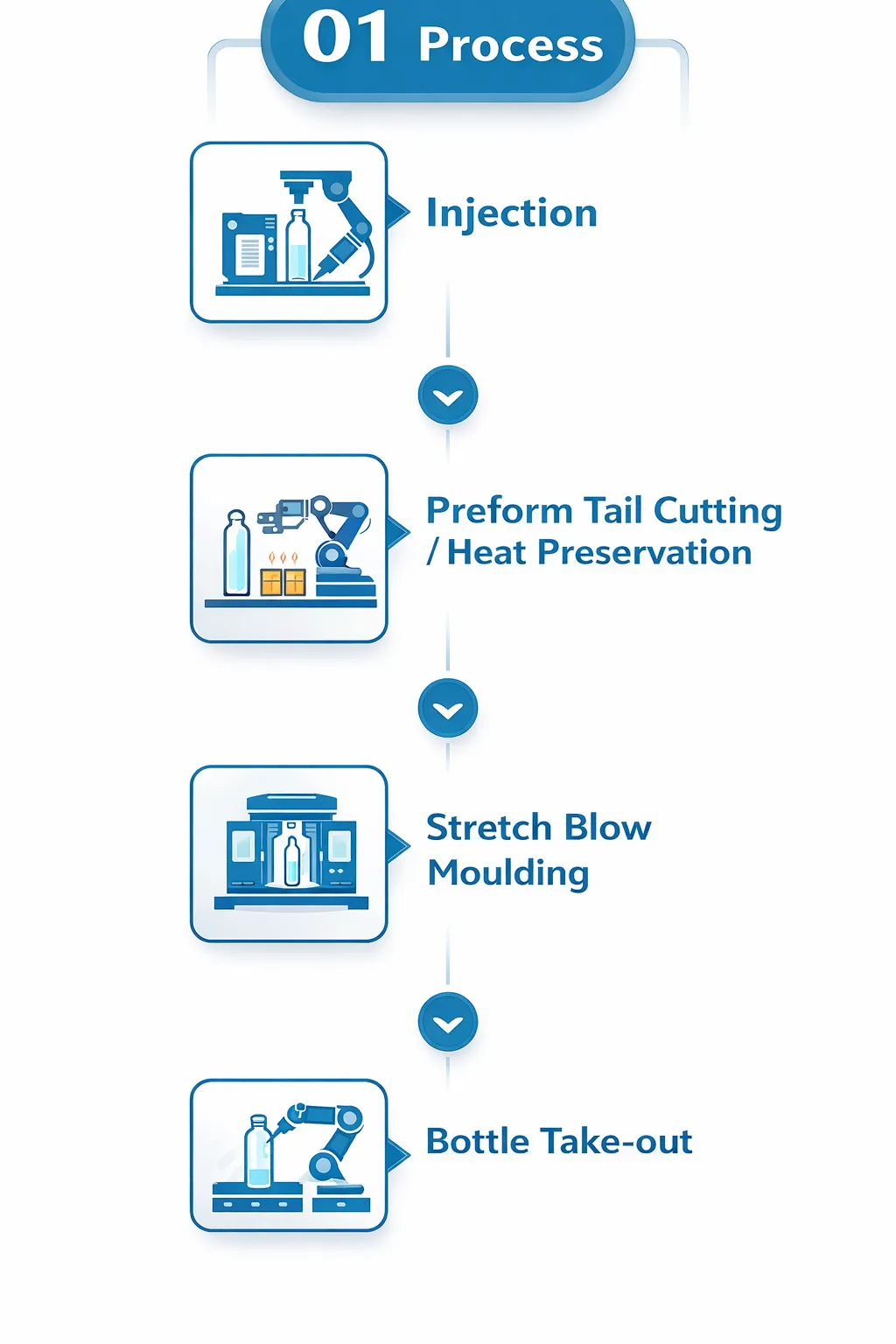
ISBM-voorvormconditioneringssequentie — de oppervlaktetemperatuur moet bij aanvang van het blaasstation tussen de 100 en 110 °C blijven.
De oppervlaktetemperatuur van de voorvorm bij het blaasstation is de meest bepalende variabele voor de helderheid van de fles. PET heeft een optimaal verwerkingsbereik van 100-110 °C oppervlaktetemperatuur bij aanvang van het blaasproces. Beneden de 100 °C is het polymeer te stijf voor volledige rek, wat resulteert in amorfe troebelheid (type 1). Boven de 115 °C begint het polymeer met sferulitische kristallisatie, wat leidt tot parelmoerwitte verkleuring (type 2). Het temperatuurbereik van 10 °C is onvergeeflijk – veel troebelheidsdefecten in Korea vinden hier hun oorsprong.
Diagnostische referentie voor temperatuurzones:
- ▸Beneden 95°C: Ernstige onderstrekking, amorfe waas type 1, risico op afkeuring bij barsten.
- ▸95-99°C: randzone, gedeeltelijk amorfe waas, inconsistente wandverdeling
- ▸100-110°C: optimaal verwerkingsvenster, heldere flessen, volledige biaxiale oriëntatie
- ▸111-114°C: randzone, lichte oppervlakteverzachting, risico op plaatselijke parelmoerglans
- ▸Boven 115°C: Kristallisatie begint, gegarandeerd parelmoerwitmakend effect (type 2).
Voor ISBM-machines met één stap, waaronder onze HGY150-V4 Bij de HGY250-V4-platforms verlaat de voorvorm het injectiestation en koelt af tot blaastemperatuur tijdens de indexeerrotatie. De conditioneringstijd is ingebouwd in de machinearchitectuur. Voor de meting van de oppervlaktetemperatuur van de voorvorm dient een gekalibreerde IR-pyrometer te worden gebruikt, gericht op het midden van de flesbody van de voorvorm bij de ingang van het blaasstation. Koreaanse operators in de fabrieken in Ansan en Incheon registreren deze meting doorgaans elke shift en waarschuwen bij afwijkingen van meer dan ±2 °C.
!
Waarschuwing voor seizoensgebonden temperatuurschommelingen
De omgevingstemperatuur in Koreaanse fabrieken schommelt 25°C tussen de zomer (gemiddeld 32°C in juli in Daegu) en de winter (gemiddeld -3°C in januari in de regio Seoul). Conditioneringsprofielen voor voorvormen die in het voorjaar zijn gekalibreerd, zullen halverwege de zomer 3-5°C afwijken van de streefwaarde. Stel de profielen van de IR-verwarmingszones bij elke driemaandelijkse kalibratie opnieuw af om de nauwkeurigheid te behouden.
3. Analyse van tekortkomingen in de rekverhouding
Voor volledige helderheid van PET is een totale biaxiale rek van ongeveer 12 tot 14 vereist (axiale verhouding vermenigvuldigd met de ringverhouding). De Koreaanse productie van drankflessen streeft doorgaans naar een axiale rek van 2,5-3,0 en een ringverhouding van 4,0-4,5, wat resulteert in een totale rek van 10-13,5. Onvoldoende totale rek leidt tot willekeurig georiënteerde polymeerzones die licht verstrooien, waardoor amorfe waas van type 1 ontstaat, zelfs bij de juiste temperatuur van de voorvorm. Deze vorm van falen komt het meest voor bij nieuwe flesontwerpen waarbij de geometrie van de voorvorm niet correct is afgestemd op het uiteindelijke flesvolume.
AXIAAL
Axiale verhouding lager dan 2,5×
Bij een axiale rek van minder dan 2,5 keer ontstaat er troebelheid die zich concentreert in het verticale middengedeelte van de fles. Veelvoorkomende oorzaken zijn: een te lange voorvorm ten opzichte van de hoogte van de afgewerkte fles (waardoor de mechanische rek minder effectief is), een rekstang die niet volledig uitrekt, of een mismatch in de verhouding tussen de hoogte van de voorvorm en de hoogte van de fles. Dit kan worden verholpen door de lengte van de voorvorm te verkorten of de geometrie van de basisstang aan te passen om een grotere effectieve rek mogelijk te maken.
HOEPEL
Hoepelverhouding lager dan 4,0×
Een rek van de ring onder de 4,0× veroorzaakt een waas die geconcentreerd is rond de omtrek van de fles, vooral zichtbaar in de buikzone. Oorzaak: de buitendiameter van de voorvorm is te groot ten opzichte van de maximale diameter van de fles. Dit kan worden verholpen door de buitendiameter van de voorvorm te verkleinen (doorgaans 22-28 mm voor drankflessen van 500 ml) of de diameter van de fles te vergroten, indien het ontwerp van het merk dit toelaat.
ASYMMETRISCH
Ongelijkmatige wanddikteverdeling
Een ongelijke wanddikte in de omtrekrichting veroorzaakt plaatselijke waas aan de dikkere zijde en plaatselijke verdunning of scheuren aan de dunnere zijde. De hoofdoorzaak: asymmetrische verwarming van de voorvorm (één IR-zone is heter dan de tegenoverliggende zijde), een gebogen voorvorm die het blaasstation binnenkomt, of een te groot restant van de injectiepoort van de voorvorm waardoor er een asymmetrische stroming ontstaat. Dit kan worden verholpen door de vermogensverdeling van de IR-zones opnieuw in balans te brengen en te controleren of de geometrie van de voorvorm aan de specificaties voldoet.
Voor gedetailleerde berekeningen van de afmetingen van voorvormen, zie onze handleiding voor het ontwerpen van voorvormenVeranderingen in de geometrie van de voorvorm vereisen investeringen in een nieuwe matrijs. Daarom moeten de Koreaanse fabrieksteams de hypothese over de rekverhouding met metingen verifiëren voordat ze overgaan tot aanpassingen aan de matrijs.
4. Problemen met vocht en intrinsieke viscositeit van PET
PET-hars moet vóór injectie worden gedroogd tot een restvochtgehalte van minder dan 50 ppm (0,005%). Onvoldoende droging veroorzaakt hydrolyse tijdens het smeltproces, waardoor polymeerketens breken en de intrinsieke viscositeit (IV) afneemt. Een lagere IV resulteert in een zwakkere smeltsterkte, een slechte helderheid van de voorvorm en de vorming van acetaldehyde, wat de helderheid van de fles aantast. Veel Koreaanse fabrieken met een continue productie onderschatten de onderhoudscyclus van de droger, waardoor vocht kan wegdrijven en de helderheid van de fles gedurende enkele weken geleidelijk afneemt.
Checklist voor PET-vocht- en IV-diagnostiek:
- ✓Meet de binnenkomende PET-hars IV (deze moet 0,80-0,84 dl/g zijn voor flessenkwaliteit).
- ✓Controleer of het dauwpunt van de droger gedurende 4-6 uur onder de -40°C blijft voordat de productie begint.
- ✓Controleer of het vochtgehalte van de hars aan de uitlaat van de droger lager is dan 50 ppm (Karl Fischer-titratie).
- ✓Controleer de leeftijd van het droogmiddelbed in de droger (vervang het elke 24 maanden in het vochtige zomerklimaat van Korea).
- ✓Meet de intraveneuze concentratie na injectie (moet ≥ 0,76 dl/g zijn, intraveneus verlies < 0,05).
- ✓Controleer of de isolatie van de droogtrechter intact is (warmteverlies versnelt het terugtrekken van vocht).
Een IV-verlies van meer dan 0,08 dl/g van hars naar afgewerkte fles is een betrouwbare indicator voor overmatige vochthydrolyse of degradatie van de droogkamer door oververhitting. Het vochtige Koreaanse klimaat tijdens het moessonseizoen van juni tot september versnelt de vochtopname als het dauwpunt van de droger zelfs maar marginaal afwijkt. Producenten van K-beautyflessen in Suwon en specialisten in farmaceutische flessen in Daejeon scherpen hun onderhoudsschema's voor de drogers juist tijdens deze periode aan.
5. Diagnose van het bleken van de basispool
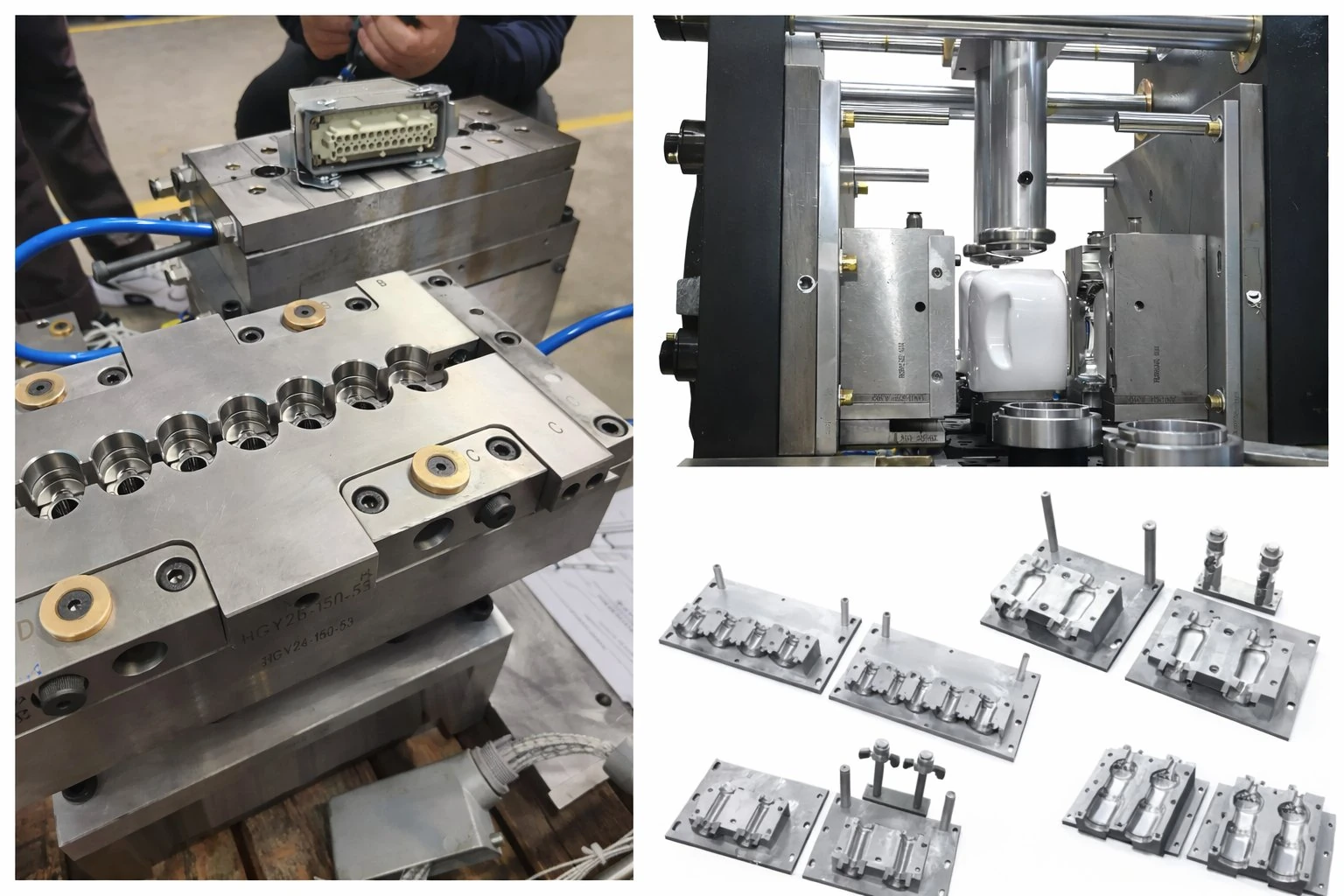
ISBM-matrijsbasisinzetstuk met koelkanalen — onvoldoende koeling van de basis veroorzaakt parelmoerwitte verkleuring bij de poortresten.
Een specifiek troebelingspatroon verdient speciale diagnostische aandacht: witte aanslag geconcentreerd aan de onderkant van de fles (het aanspuitpuntgebied), terwijl de rest van de fles helder blijft. Dit is bijna altijd een parelmoerachtige witte aanslag van type 2, veroorzaakt door onvoldoende koeling van het restant van het aanspuitpunt. De onderkant bevat restmateriaal van het aanspuitpunt afkomstig van de injectie, dat langzamer afkoelt dan de dunne fleswand, waardoor kristallisatie tijdens de koelcyclus mogelijk is.
OPLOSSING 1
Controle van het koelkanaal van de basisvorm
Koelkanalen in de basisvorm leiden gekoeld water (doorgaans 8-12 °C) door het basisinzetstuk. Kalkafzetting in de koelkanalen vermindert de warmteoverdracht en zorgt ervoor dat de kristallisatietemperatuur aanhoudt. Spoel de koelkanalen van de basisvorm elke 6 maanden door met een ontkalkingsmiddel en controleer of de oppervlaktetemperatuur van het basisinzetstuk tijdens de productie onder de 25 °C blijft. Combineer dit met een adequaat gedimensioneerde industriële koelinstallatie voor een constante koelcapaciteit.
OPLOSSING 2
Vermindering van de dikte van poortrestanten
De diameter van de poort in de voorvorm heeft een directe invloed op de hoeveelheid poortresten in de afgewerkte fles. Een poort van 1,5 mm laat ongeveer 3-4 mm poortresten achter; een poort van 1,2 mm laat 2-3 mm resten achter met een merkbaar betere bodemhelderheid. Het verkleinen van de poortdiameter vereist aanpassing van de hotrunner-tip en nieuwe aanpassing van de mal op maatmaar pakt de onderliggende oorzaak aan in plaats van alleen het symptoom te bestrijden.
OPLOSSING 3
Optimalisatie van de basisgeometrie van de strekstang
De geometrie van de punt van de rekstang bepaalt hoe het basisgedeelte van de voorvorm in de matrijsbodem wordt gedrukt tijdens het rekken. Een scherpe of agressieve stangpunt zorgt voor een ongelijkmatige verdeling van het basismateriaal met dikke zones die kristalliseren. Afgeronde stangpunten verdelen het materiaal gelijkmatiger, waardoor een constante wanddikte in de overgangszone van de basis behouden blijft. Controleer of het profiel van de punt van de rekstang overeenkomt met de specificaties van de geometrie van de flessenbodem.
6. IR-verwarmingsprofiel en zoneoptimalisatie
Moderne ISBM-machines gebruiken infraroodverwarmingselementen met meerdere zones om het temperatuurprofiel van de voorvorm over de gehele lengte te regelen. Elke zone stelt onafhankelijk het vermogen in om te compenseren voor verschillen in de geometrie van de voorvorm: een dikkere bodem vereist meer energie, een dunnere romp minder. Onjuiste zoneprofielen creëren plaatselijke hete of koude plekken die leiden tot plaatselijke waasvorming. Zone-onbalans is een van de meest voorkomende oorzaken van terugkerende waasvorming op volwassen productielijnen.
Diagnostische procedure voor IR-verwarming:
- ▸Controleer of elke IR-buis functioneert; defecte buizen verminderen het zonevermogen met 10-15% per buis.
- ▸Reinig de oppervlakken van de IR-reflector maandelijks — stofophoping vermindert de efficiëntie met 8-12% per 1000 uur.
- ▸Meet de oppervlaktetemperatuur van het voorvormstuk bij elke zone-uitgang met een gekalibreerde pyrometer.
- ▸Controleer de gelijkmatigheid van de rotatie van de voorvorm tijdens de IR-passage (ongelijkmatige rotatie veroorzaakt asymmetrische verwarming).
- ▸De balanszone zorgt ervoor dat het temperatuurprofiel overeenkomt met het profiel van de wanddikte van het voorvormstuk.
- ▸Monitor de omgevingsomstandigheden — veranderingen in de HVAC-installatie beïnvloeden de effectieve IR-absorptie.
Het is een veelvoorkomende fout om de juiste timing voor het vervangen van infraroodbuizen te kiezen. Kwarts-IR-buizen verliezen geleidelijk aan vermogen na ongeveer 8000 bedrijfsuren. In een Koreaanse fabriek die 24/7 draait, is de nuttige levensduur van een IR-buis na ongeveer 10-12 maanden verstreken. Door preventieve vervanging van IR-buizen volgens een vast schema in te plannen in plaats van pas wanneer ze defect raken, wordt geleidelijke onderverhitting van de voorvorm voorkomen, wat de afkeuringspercentages voor waasvorming geleidelijk verhoogt.
7. Invloed van de matrijstemperatuur
De temperatuur van de blaasvorm bepaalt hoe snel de vers uitgerekte fles afkoelt tegen de vormwand. De streeftemperatuur van het vormoppervlak ligt tussen 8 en 18 °C, die wordt gehandhaafd door circulatie van gekoeld water via geïntegreerde koelkanalen. Een te lage temperatuur (onder 5 °C) veroorzaakt thermische schokken die leiden tot spanningsverbleking (Type 3). Een te hoge temperatuur (boven 25 °C) zorgt ervoor dat kristallisatiezones blijven bestaan, wat resulteert in parelmoerverbleking (Type 2). Het temperatuurbereik van 10 °C ligt ruim binnen de mogelijkheden van moderne koelinstallaties, maar vereist een juiste dimensionering voor continue productie met een hoge cyclusfrequentie.
De dimensionering van de koelinstallatiecapaciteit is vaak de hoofdoorzaak van geleidelijke temperatuurschommelingen in de matrijs. Naarmate het productievolume toeneemt (meer holtes, snellere cycli), neemt de warmtetoevoer naar de matrijs toe, terwijl de bestaande koelinstallatie dezelfde capaciteit behoudt. Tijdens de hete zomermaanden in Busan en Incheon, wanneer de omgevingstemperatuur van het koelwater stijgt, werkt de koelinstallatie op de grens van zijn capaciteit en loopt de temperatuur van het matrijsoppervlak op. Veel Koreaanse fabrieken die met 4-6 holtes werken, hebben een upgrade van de koelinstallatiecapaciteit nodig naar 15-251 TP3T boven de nominale warmteafvoerbehoefte om rekening te houden met seizoensschommelingen en toekomstige schaalvergroting.
!
Koreaanse zomerkoeler belastingwaarschuwing
De omgevingsomstandigheden in de fabrieken van Ansan en Incheon in juli en augustus kunnen de temperatuur van het koelwater opdrijven van 12 °C in het voorjaar tot 18-20 °C midden in de zomer. Het temperatuurverschil tussen koelinstallatie en matrijs daalt evenredig, de oppervlaktetemperatuur van de matrijs stijgt met 3-5 °C en het aantal defecten door waasvorming neemt seizoensgebonden toe met 2-41 ton. Plan daarom preventief onderhoud aan de koelinstallaties en controleer de capaciteit vóór de piek in de Koreaanse zomerproductie.
8. Stapsgewijs diagnostisch stroomschema
Wanneer er rookontwikkeling optreedt op een voorheen goed functionerende productielijn, moeten Koreaanse productie-ingenieurs de volgende stappen in de aangegeven volgorde doorlopen. Elke stap isoleert de hoofdoorzaak of sluit deze uit van de lijst met mogelijke oorzaken voordat naar de volgende stap wordt overgegaan.
1
Identificeer het type mist (visuele classificatie)
Inspecteer representatieve defecte flessen bij daglicht en onder gerichte verlichting. Classificeer ze als Type 1 amorf (gelijkmatig troebel), Type 2 parelmoer (iriserende glans) of Type 3 stress (gelokaliseerde strepen). De type-identificatie bepaalt de volgende diagnostische stap.
2
Meet de temperatuur van het voorvormstuk bij het blaasstation.
Gebruik een gekalibreerde IR-pyrometer om de oppervlaktetemperatuur in het midden van het voorvormlichaam te meten. Streef naar 100-110 °C. Bij metingen buiten dit bereik is het profiel van de IR-verwarming of de zonebalans direct aangewezen als oorzaak. Bij metingen binnen het bereik kunt u doorgaan naar stap 3.
3
Controleer de temperatuur van het matrijsoppervlak.
Contactthermometer of infrarood oppervlaktepyrometer op de matrijs tijdens gebruik. Streeftemperatuur 8-18 °C. Een temperatuur buiten dit bereik duidt op problemen met de koelcapaciteit of het koelkanaal. Controleer het basisinzetstuk apart — de basistemperatuur moet lager zijn dan 25 °C voor parelmoerlak type 2 bij de pool.
4
Test het vochtgehalte en de IV-waarde van PET-hars.
Karl Fischer-vochtmeting op hars bij de uitlaat van de droger (streefwaarde <50 ppm). Laboratorium-IV-meting op zowel de binnenkomende hars als de afgewerkte fles (streefwaarde IV-verlies < 0,05 dl/g). Een afwijking van de specificaties duidt op een probleem met het onderhoud van de droger of de vochtverwerking.
5
Controleer de berekening van de rekverhouding.
Meet de afmetingen van de voorvorm en de afmetingen van de afgewerkte fles. Bereken de axiale verhouding (fleslengte / voorvormlengte) en de ringverhouding (maximale buitendiameter fles / buitendiameter voorvorm). De streefwaarde voor de totale verhouding moet ≥ 10 zijn. Lage waarden duiden op een geometrische mismatch van de voorvorm, waardoor aanpassing van de matrijs nodig is.
6
Neem contact op met de technische ondersteuning van de fabrikant.
Als de stappen 1-5 de oorzaak niet aan het licht brengen, neem dan contact op met het technische team van de machinefabrikant. Koreaanse Ever-Power-klanten krijgen 24-48 uur diagnostische ondersteuning op locatie van regionale technische centra in de regio's Seoul, Busan en Daegu.
9. Casestudies van Koreaanse fabrieken

Koreaanse ISBM-productiefaciliteiten — diagnostische lessen uit de installaties in Gimhae, Suwon en Daejeon
Drie recente diagnostische casussen van Ever-Power-installaties in Korea illustreren hoe deze principes in de productiepraktijk worden toegepast.
Casestudy 1 · Gimhae Beverage Bottler
Seizoensgebonden basisbehandeling voor het bleken van de wenkbrauwen (2 miljoen flessen van 500 ml per maand)
Symptoom: In juli verscheen er een parelmoerachtige verkleuring van type 2 aan de basis van de fles, die ongeveer 8% van de productie trof. De fles zelf bleef helder.
Diagnose: De temperatuur van het koelwater in de koelmachine was gestegen van 11 °C in het voorjaar naar 17 °C midden in de zomer. De temperatuur van het basisinzetstuk steeg van 18 °C naar 28 °C, waarmee de kristallisatiedrempel bij de poortrestanten werd overschreden.
Oplossing: De koelcapaciteit is verhoogd naar 25%, het koelwater wordt omgeleid via een extra warmtewisselaar. Het percentage basisverblekingsdefecten daalde binnen 72 uur tot onder de 0,5%.
Casestudy 2 · Suwon K-Beauty Contract Filler
Gelijkmatige waas op serumflesjes van 150 ml
Symptoom: Op de nieuwe serumfles van 150 ml (SKU) is een amorfe waas van type 1 verschenen. De vorige 120 ml SKU met dezelfde voorvorm leverde heldere flessen op.
Diagnose: De voorvorm met een buitendiameter van 24 mm was te groot voor de nieuwe fles met een diameter van 38 mm. De ringverhouding daalde naar 3,8×, onder de minimale drempel van 4,0× voor een volledig biaxiale oriëntatie.
Oplossing: Nieuwe voorvorm met een buitendiameter van 21 mm, vervaardigd met behulp van speciaal gereedschap, met een ringverhouding van 4,5x. De helderheid van de fles is hersteld tot de premium K-beauty standaard.
Casestudy 3 · Daejeon Pharmaceutical Bottler
Type 3 Stress Whitening oogdruppels in flesjes van 15 ml.
Symptoom: Na drie weken stabiele productie verschenen verticale, witmakende strepen op de flessenwand. Het afkeuringspercentage steeg in tien dagen tijd van 11 TP3T naar 61 TP3T.
Diagnose: De servoaandrijving van de strekstang vertoonde intermitterende schommelingen in de snelheidsregeling: de stang versnelde sneller dan het polymeer van de voorvorm kon vloeien, waardoor spanningsconcentratiebanden ontstonden.
Oplossing: De servoaandrijvingsencoder is vervangen en de PID-afstelling is opnieuw gekalibreerd. Het profiel van de reksnelheid is gecontroleerd met een oscilloscoop. Het defectpercentage is na hervatting teruggebracht tot onder de 0,8%.
10. Conclusie
Verbleking en troebeling van PET-flessen zijn oplosbare defecten zodra het juiste mechanisme is geïdentificeerd. De meeste problemen met troebelheid op Koreaanse productielijnen vinden hun oorsprong in een van de volgende vijf hoofdoorzaken: onjuiste temperatuur van de voorvorm, onvoldoende rekverhouding, vocht- of IV-degradatie van het PET-materiaal, onvoldoende koeling van de basispool of een onevenwicht in de IR-verwarmingszone. Een systematische diagnostische procedure isoleert de oorzaak binnen 2-3 uur, in plaats van dagenlang proberen en afstellen.
Koreaanse productie-ingenieurs in Ansan, Busan, Daejeon en Incheon die werken aan terugkerende rookontwikkelingsdefecten, moeten beginnen met het correct classificeren van het type rookontwikkeling, het meten van belangrijke procesparameters ten opzichte van de streefwaarden en het in volgorde uitsluiten van mogelijke oorzaken. De meeste defecten worden binnen de eerste drie diagnostische stappen verholpen. Escalatie naar de technische ondersteuning van de fabrikant moet worden voorbehouden aan gevallen waarin alle meetbare parameters binnen de specificaties vallen, maar de defecten aanhouden.
Belangrijkste conclusies van de mistdiagnose
- ✓Classificeer eerst het type waas: amorf (uniform), parelmoerachtig (glanzend) of gelokaliseerd (plaatselijke strepen).
- ✓De temperatuur van de voorvorm moet bij de ingang van het blaasstation binnen het bereik van 100-110 °C blijven.
- ✓Een totale rekverhouding van 10 of hoger is vereist voor volledige biaxiale oriëntatie.
- ✓Een vochtgehalte van PET-hars lager dan 50 ppm voorkomt hydrolyse-gerelateerd IV-verlies.
- ✓Vormoppervlak 8-18°C met basisinzetstuk <25°C voorkomt parelmoerwitte vlekken.
- ✓De vraag naar koelinstallaties in Korea tijdens de zomer vereist een capaciteitsmarge van 15-251 TP3T ten opzichte van de basislijn in het voorjaar.
- ✓Kwarts-IR-buizen moeten preventief worden vervangen na elke 8.000 bedrijfsuren.
- ✓Een systematisch diagnostisch proces isoleert de hoofdoorzaak binnen 2-3 uur, in tegenstelling tot dagenlang proberen en fouten maken.
Heeft u deskundige hulp nodig bij de diagnose van smog?
Stuur ons foto's van uw defectpatroon, de huidige temperatuur en rekverhouding van het voorvormmateriaal, en het machinemodel. Ons Koreaanse engineeringteam levert binnen 24 uur een diagnoseverslag met specifieke aanpassingsaanbevelingen. Indien de parameteraanpassingen het defect niet verhelpen, sturen we ook een technicus ter plaatse.