
ABS IBM · ENGINEERING PLASTIC · RA 0.05 UM GLOSS · KOREA EVER-POWER ZQ SERIES
ABS IBM:
Engineering Plastic Panduan Produksi Kontainer
ABS injection blow molding brings engineering plastic performance to container production — combining the mirror-gloss surface finish, dimensional stability and impact resistance of acrylonitrile-butadiene-styrene terpolymer with IBM’s precision neck geometry and zero-flash architecture. This guide covers ABS IBM material properties, mandatory pre-drying protocol, Korean cosmetic and industrial container applications, processing parameters and ZQ series production economics for ABS IBM containers at 5-500 ml.
KOREA EVER-POWER · ANSAN-SI, GYEONGGI-DO · JULI 2026
PROCESS REFERENCE · ABS IBM KEY PARAMETERS
SURFACE FINISH
Ra 0.05 um
ABS IBM mirror-gloss exterior — best surface quality among IBM thermoplastics at equivalent mould polish
PRE-DRYING
80°C / 4-6 jam
Mandatory desiccant drying — ABS moisture above 0.05% causes silver streak surface defect on all containers
SUHU TABUNG
210-240°C
ABS terpolymer barrel processing range — higher than HDPE and comparable to PP IBM operating temperatures
GLOSS @ 60°
85-95 GU
HG-grade ABS IBM container body — Korean luxury cosmetic brand minimum 85 GU department store specification
BAGIAN 01
ABS IBM Applications and Material Overview
ABS is the only engineering thermoplastic in routine IBM production — combining acrylonitrile chemical resistance, butadiene impact toughness and styrene surface gloss in a single terpolymer that IBM processes into containers with mirror-quality exteriors that HDPE and PP cannot achieve. ABS IBM containers are specified wherever Korean cosmetic brands require the Ra 0.05 um mirror gloss of HG-grade ABS or wherever industrial applications require a container with superior chemical resistance to alkaline or mild solvent environments versus commodity polyolefin IBM materials.
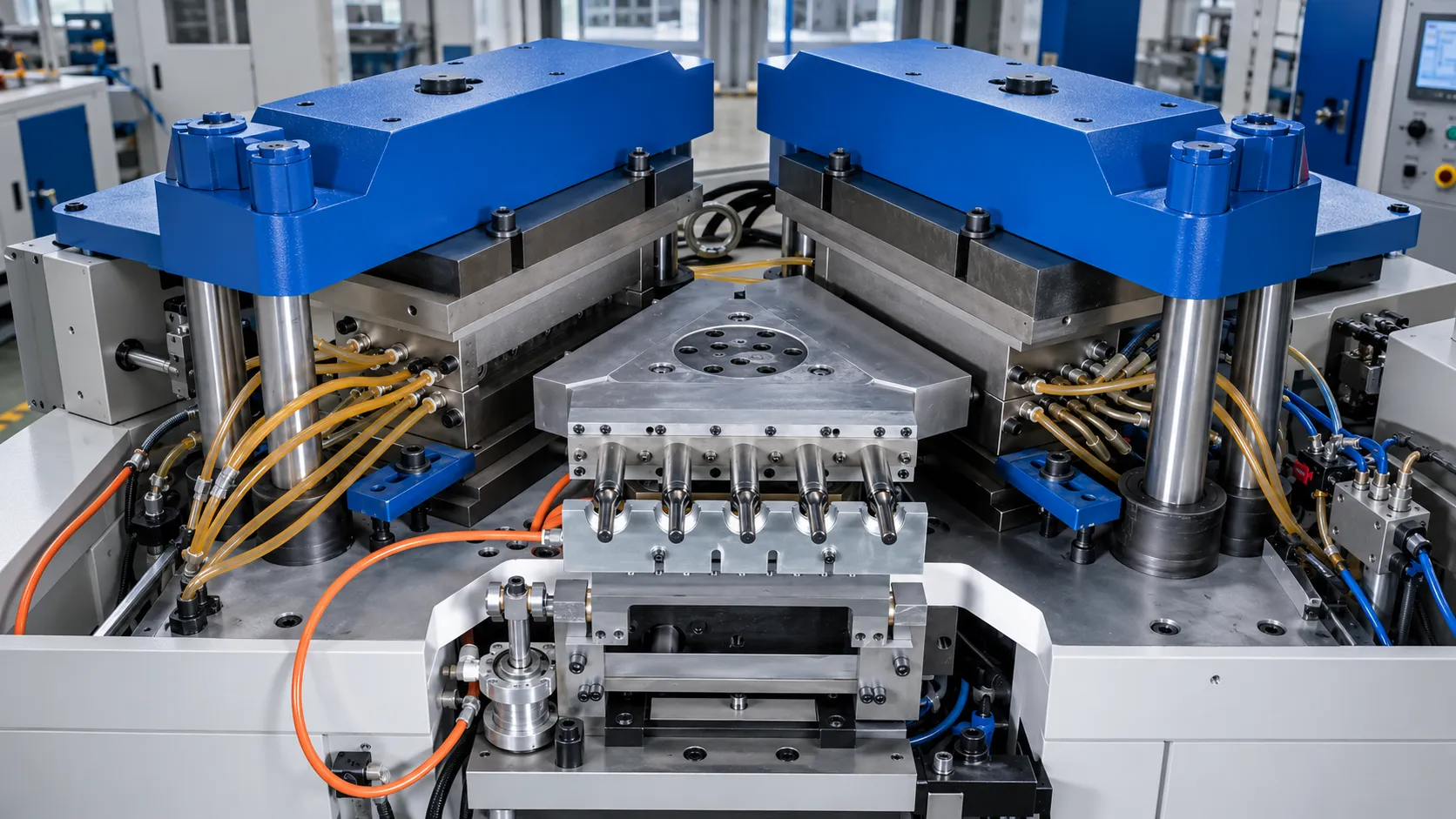
| APLIKASI | FORMAT | ABS GRADE | MODEL ZQ | KEY PROPERTY |
|---|---|---|---|---|
| Korean luxury cosmetic ★ | 10-100 ml | HG (high gloss) | ZQ40-ZQ60 | Mirror gloss 85-95 GU, Delta E 1.0 colour, Korean dept store |
| Korean foundation pump bottle | 15-50 ml | HG | ZQ40 | Airless pump neck ±0.04 mm, angular body R 3-5 mm |
| Industrial reagent bottle | 50-250 ml | General purpose | ZQ40-ZQ60 | Alkaline resistance pH 7-12, dimensional stability, snap-cap |
| Diagnostic / laboratory | 5-50 ml | Flame retardant | ZQ40 | Dimensional stability, chemical resistance, autoclave (FR ABS limited) |
BAGIAN 02
ABS IBM Pre-Drying Protocol and Silver Streak Prevention
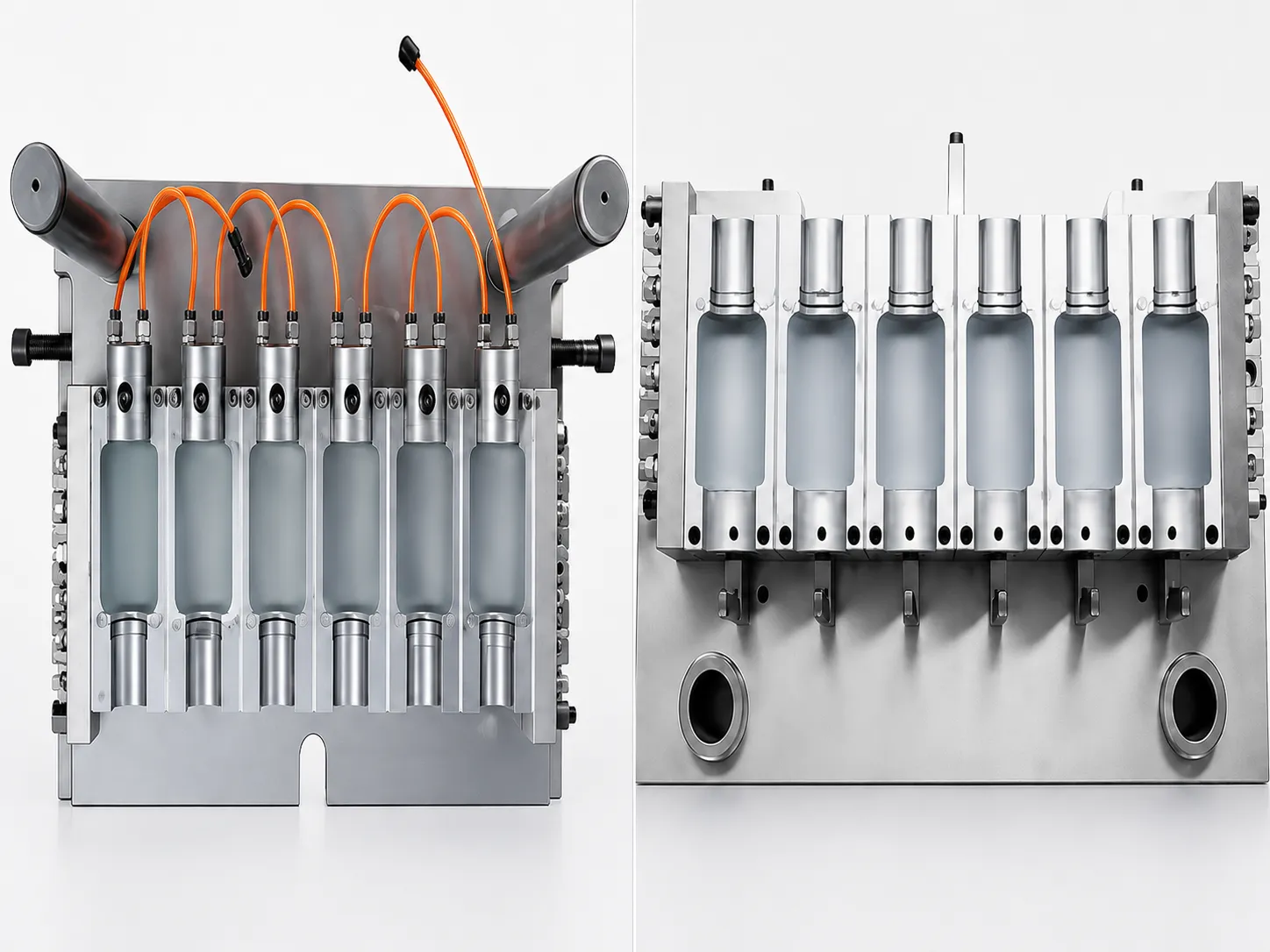
ABS IBM DRYING PROTOCOL — STEP-BY-STEP
Step 1 — Load Dryer
Load ABS pellets into desiccant hopper dryer at 80°C setpoint. Maximum hopper fill: 75% capacity to ensure adequate hot dry air circulation through ABS pellet bed. ABS pellet bed depth: maximum 400 mm for standard throughflow desiccant dryer.
Step 2 — Dry 4-6 Hours
Minimum drying time at 80°C: 4 hours for Korean K-beauty grade ABS; 6 hours maximum for batches with known high ambient moisture exposure. Do not exceed 80°C — drying above 85°C for extended periods discolours ABS pellets.
Step 3 — Verify Dew Point
Measure desiccant dryer exit air dew point before starting IBM production. Required: exit air dew point below -40°C. This confirms the desiccant bed is active and the ABS moisture below 0.05%. Do not start ABS IBM production if dew point is above -30°C.
Step 4 — Startup Inspection
Run 5-10 startup shots after ABS barrel loading. Inspect each startup container under 500 lux directional light for silver streaks. Only declare production quality after 5 consecutive silver-streak-free startup shots from all cavities.
ABS shutdown purge protocol: On IBM production shutdown, purge the barrel completely with HDPE (3-5 shots) before cooling. Residual ABS in a cooling barrel undergoes slow thermal oxidative degradation — producing brown or black discolouration spots in the next ABS startup batch that require extended purging to eliminate. HDPE purge is significantly cheaper than wasting ABS production at Korean luxury cosmetic container specification level.
BAGIAN 03
ABS IBM Processing Parameters and Mould Temperature
ABS IBM PARAMETERS vs HDPE AND PP — 30ml CONTAINER @ ZQ40
| PARAMETER | ABS (cosmetic) | PP RCP (cosmetic) | HDPE (household) |
|---|---|---|---|
| Pengeringan awal | 80°C / 4-6 h mandatory | Tidak diperlukan | Tidak diperlukan |
| Suhu barel | 210-240°C | 210-245°C | 195-220°C |
| Suhu cetakan | 55-70°C | 55-70°C (cosmetic) | 18-26°C |
| Cycle time (30 ml) | 4.5-5.5 s | 4.5-5.5 s | 3.8-4.5 s |
| Surface gloss | 85-95 GU (mirror) | Semi-gloss (5-12% haze) | Opaque (20-35% haze) |
The ABS 55-70°C mould temperature requirement distinguishes ABS cosmetic IBM from both household HDPE IBM (18-26°C) and industrial HDPE IBM (18-26°C) on the same ZQ machine. Warm mould allows the ABS melt to remain in contact with the mould cavity surface long enough for complete gloss transfer from the Ra 0.025 um mirror-polished blow mould cavity to the ABS container exterior. At 18-26°C mould temperature, ABS quenches too rapidly on contact — preventing full surface replication and producing the slightly streaked or dull ABS surface that Korean luxury cosmetic brands reject at incoming QA inspection. The PP IBM processing guide covering PP-specific barrel and mould parameters is at the Panduan materi PP IBM.
BAGIAN 04
ABS IBM Container Applications: Cosmetic and Industrial
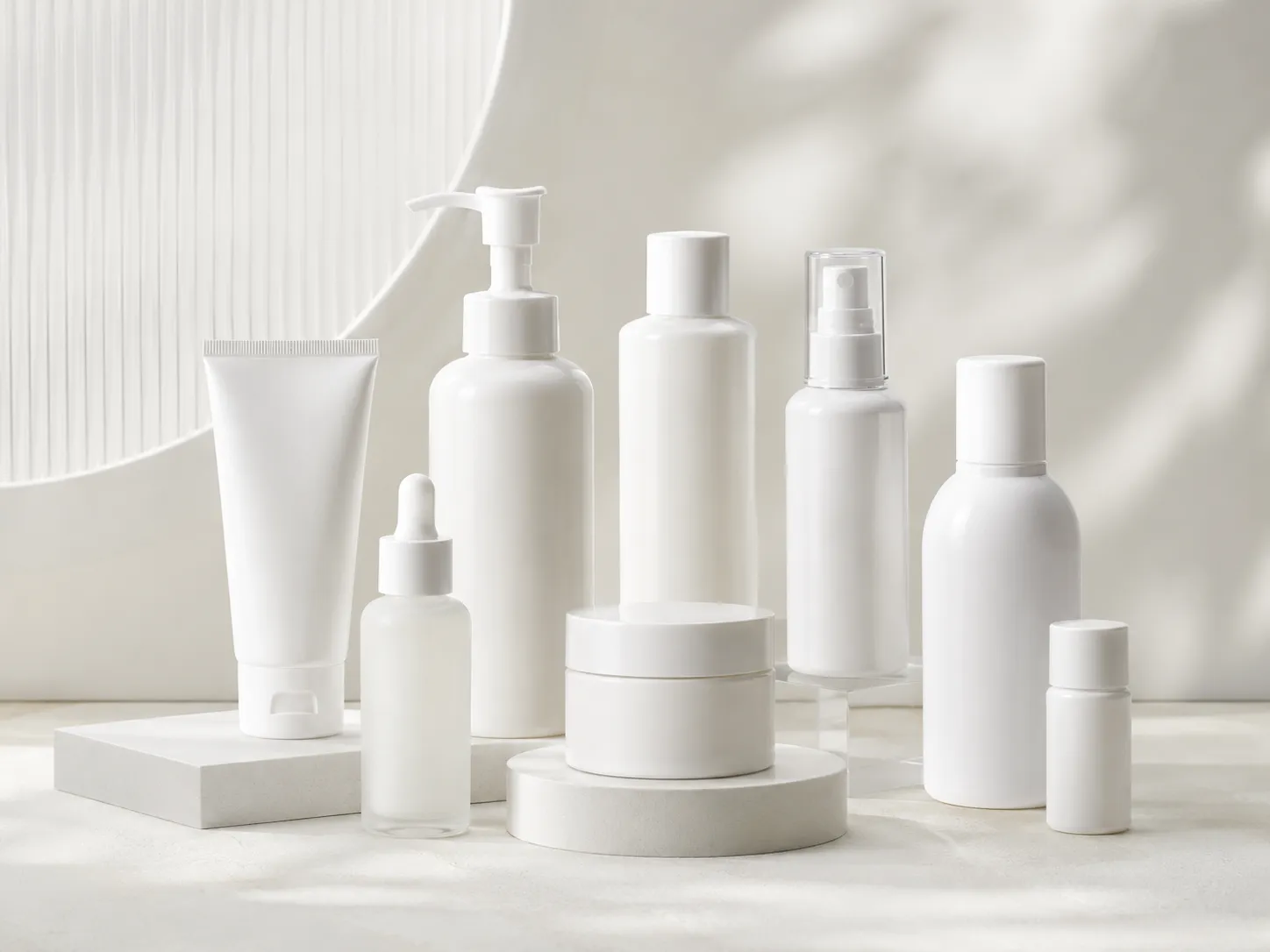
Korean Luxury Cosmetic ABS IBM
Mirror white (opaque)
TiO2 3-5% masterbatch in ABS HG — clean clinical white at 85-95 GU for Korean luxury skincare brand packaging. Most common Korean luxury cosmetic ABS IBM colour.
Matte black
Carbon black 0.5-1% + silica matting agent 0.5-1.5% — 5-20 GU matte finish at lower mould temp (55-65°C). Korean luxury foundation and Korean men’s grooming brand packaging.
Metallic effect
Metallic pigment (aluminium flake 0.5-1%) in ABS at 55-70°C mould — produces a sparkling metallic sheen on Korean luxury gift set packaging and Korean K-beauty holiday collection containers.
Industrial ABS IBM Applications
Reagent and laboratory containers
ABS IBM reagent bottles at 50-250 ml for laboratory alkaline reagents (pH 7-12), buffer solutions and diagnostic reagent storage. ABS IBM dimensional stability (below 80°C service temperature) superior to HDPE for precision laboratory volume marks on container body.
Industrial snap-top containers
ABS IBM industrial containers with snap-fit closure systems for Korean laboratory sample collection, Korean environmental sampling and Korean industrial quality control sample storage. ABS IBM snap-fit geometry precision (±0.05 mm) ensures secure snap engagement.
Diagnostic device housings
ABS IBM containers for Korean in-vitro diagnostic (IVD) reagent kits — small-volume (5-30 ml) ABS IBM containers for Korean clinical laboratory reagent storage requiring dimensional stability, chemical resistance and colour-coded ABS for Korean IVD kit component identification.
BAGIAN 05
ABS vs PP vs HDPE: IBM Material Selection Comparison
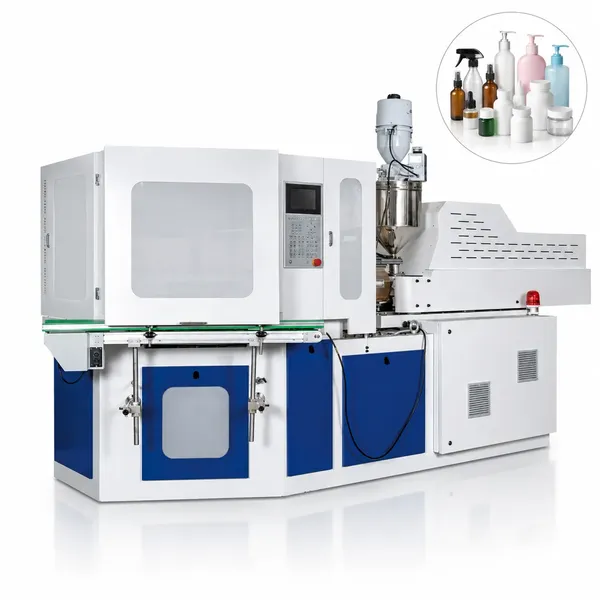
Korea Ever-Power ZQ40 handles ABS, PP and HDPE IBM in dedicated production runs with material changeover — ABS IBM Korean luxury cosmetic (opaque mirror), PP RCP IBM Korean K-beauty toner (translucent), and HDPE IBM Korean household and pharmaceutical (opaque rigid) all on the same ZQ40 platform through material and temperature changeover between production runs.
| KRITERIA | ABS IBM | PP RCP IBM | HDPE IBM |
|---|---|---|---|
| Surface gloss | Mirror 85-95 GU | Semi-gloss (5-12% haze) | Opaque (20-35% haze) |
| Pengeringan awal diperlukan | Yes (80°C / 4-6 h) | TIDAK | TIDAK |
| Food/cosmetic contact | Cosmetic OK, NOT food | Both OK | Both OK |
| Alkaline resistance | Excellent (pH 7-12) | Good (pH 7-11) | Good (pH 7-13) |
| Acid resistance | Limited (pH <5 attack) | Excellent (pH 1-14) | Excellent (pH 1-14) |
| Aplikasi utama IBM | Korean luxury cosmetic, lab | K-beauty translucent skincare | Pharma, household, food |
BAGIAN 06
ZQ Series Selection for ABS IBM
| MODEL ZQ | 5-30 ml ★ (cav/hr) | 50-100 ml (cav/hr) | 150-250 ml (cav/hr) | PROFIL |
|---|---|---|---|---|
| EP-ZQ40 ★ | 7-9 / ~14,000 | 5-7 / ~7,500 | 3-4 / ~3,000 | Korean luxury cosmetic ABS specialist — 5-100 ml IBM benchmark |
| EP-ZQ60 | 10-12 / ~19,000 | 8-10 / ~12,000 | 5-6 / ~6,000 | High-volume Korean luxury cosmetic ABS OEM, industrial ABS IBM at 100-250 ml |
FAQ TEKNIK
ABS IBM — Engineering Questions
Pertanyaan 01
What is the molecular reason ABS IBM achieves higher surface gloss than HDPE and PP at identical mould polish?
ABS IBM achieves higher surface gloss than HDPE and PP at identical blow mould cavity polish (Ra 0.025 um) for three interconnected reasons rooted in the ABS terpolymer structure. Surface replication fidelity: ABS melt at 210-240°C has a lower melt viscosity than comparable HDPE and PP melts at their respective processing temperatures, allowing the ABS melt to flow into and replicate micro-scale surface features on the mould cavity at the sub-micron level during preform injection. HDPE and PP melts, with higher melt viscosities, do not replicate cavity micro-features as faithfully — producing slightly more textured surfaces even from the same mould polish. Solidification mechanism: HDPE and PP are semi-crystalline polymers that crystallise from the melt — during crystallisation, crystalline domains nucleate and grow at the mould surface, producing a micro-roughness at the container surface corresponding to the crystalline structure. ABS is amorphous (no crystalline domains) — it solidifies as a smooth glassy surface without crystalline domain micro-roughness, preserving the mould cavity gloss in the final container surface. Warm mould synergy: ABS at 55-70°C mould temperature stays molten at the mould surface longer than HDPE at 18-26°C or PP at 55-70°C, allowing more complete surface flow-out and gloss development. The combination of amorphous solidification mechanism, low melt viscosity and warm mould contact produces the Ra 0.05 um mirror surface quality that makes ABS IBM containers visually superior to HDPE and PP IBM at the same mould polish level.
Pertanyaan 02
Why is ABS not suitable for food contact applications despite being approved for cosmetic contact?
ABS is not approved for direct food contact in Korean MFDS or EU EC 10/2011 food contact plastic regulations for two reasons related to ABS’s terpolymer composition. Acrylonitrile monomer migration: the acrylonitrile component of ABS can undergo depolymerisation at elevated temperatures, releasing residual acrylonitrile monomer. Acrylonitrile is classified as a potential carcinogen (Group 2A, IARC) — both Korean MFDS food plastic regulations and EU EC 10/2011 set acrylonitrile migration limits at 0.02 mg/kg food simulant, which some ABS grades exceed in accelerated food contact testing at 40°C/10 days in fatty food simulant (95% ethanol). Butadiene rubber phase: the butadiene rubber particles in ABS are not listed as approved food contact materials in Korean MFDS or EU regulations for direct food contact use. ABS is approved for Korean cosmetic contact under Korean MFDS Cosmetics Act container regulations because Korean cosmetic contact migration limits for acrylonitrile and butadiene derivatives are set at higher tolerance levels than Korean food contact regulations — reflecting the lower and intermittent exposure from cosmetic product use versus food consumption. For Korean IBM container applications where both cosmetic and food contact are required (dual-use container), PP or HDPE IBM is the correct material choice, as both are Korean MFDS approved for direct food contact without migration limit concerns.
Pertanyaan 03
What ABS IBM defects are caused by incorrect barrel temperature and how are they corrected?
ABS IBM barrel temperature deviations produce five specific defect types with corresponding correction protocols. Too low temperature (below 200°C): short shots (incomplete preform fill) and surface flow marks on the container exterior at the preform gate zone — increase barrel temperature by 5°C increments until flow marks disappear. Too high temperature (above 245°C): ABS thermal degradation producing brown discolouration spots, burnt smell, degraded surface gloss (yellowish cast on container exterior) and embrittlement of container wall — immediately reduce barrel temperature, purge barrel with 5-8 shots, inspect for discolouration elimination before resuming production. Temperature non-uniformity (zone 1-to-nozzle gradient incorrect): weld marks and flow lines on container exterior body from inconsistent melt homogeneity at injection — verify all barrel zone temperature controller set-points and PID calibration, confirm nozzle temperature is highest zone (200-240°C for ABS). Residual moisture (pre-drying failure): silver streaks regardless of barrel temperature — stop production immediately, purge barrel with dry ABS, verify desiccant dryer dew point below -40°C before restarting. Sharp temperature gradient at nozzle (nozzle too cold): gate blush defect at container base (dull or rough circle at the IBM base injection gate zone) — increase nozzle temperature to match barrel nozzle zone setpoint and verify nozzle heater band operation.
Pertanyaan 04
How does Korea Ever-Power maintain ABS IBM mould polish over extended production programmes?
ABS IBM mould polish maintenance is a structured process that Korea Ever-Power implements as a standard service for Korean luxury cosmetic brand long-term production programmes. The blow mould cavity (P20 or S136 steel, Ra 0.025 um initial mirror polish) degrades slowly over production cycles due to micro-wear from ABS melt flow contact, thermal cycling stress (heating to 55-70°C and cooling between cycles) and occasional hard particle contamination from masterbatch agglomerates. Korea Ever-Power’s ABS IBM mould maintenance protocol: (1) production gloss measurement at container exterior at 500 lux every 500,000 cycles or Korean brand inspection interval — if gloss drops below 82 GU, the blow mould is flagged for re-polishing; (2) blow mould cavity re-polishing (diamond compound, 5-step grade sequence from 600 grit to 3 um diamond) returns the cavity to Ra 0.025 um — re-polishing requires the blow mould to be removed from the ZQ machine and sent to Korea Ever-Power’s toolroom for 2-3 days; (3) injection mould neck insert (S136 stainless, Ra 0.025 um) re-polished simultaneously with the blow mould to maintain neck sealing land gloss; (4) re-polishing frequency for Korean luxury cosmetic ABS IBM: typically every 3-5 million production cycles for continuous programme mould sets — producing a predictable re-polishing cost that Korea Ever-Power includes in Korean luxury cosmetic brand programme pricing.
Pertanyaan 05
What is the correct ABS IBM changeover sequence when switching from PP to ABS production on ZQ40?
The ZQ40 PP-to-ABS changeover sequence follows a specific protocol to prevent PP contamination in ABS production and to prepare the barrel for ABS drying requirements. Step 1 — Verify ABS drying: confirm ABS has been in the desiccant dryer at 80°C for minimum 4 hours before starting changeover — the ABS drying runs in parallel with PP production on the preceding production run so ABS is ready when PP production ends. Step 2 — Purge barrel with ABS: with the barrel at PP temperature (210-245°C), begin ABS feed from the desiccant dryer hopper and run 3-5 barrel shots of ABS at PP temperature to purge PP from the barrel. The PP and ABS barrel temperatures overlap sufficiently (both 210-240+°C range) that no barrel temperature adjustment is needed during purge. Step 3 — Stabilise barrel at ABS parameters: adjust barrel zone temperature setpoints to ABS profile (zone 1: 210°C, zones 2-3: 225°C, nozzle: 235°C for Korean cosmetic ABS IBM). Step 4 — Adjust mould temperature: if switching from PP cosmetic IBM (55-70°C mould) to ABS cosmetic IBM (55-70°C mould), no mould temperature adjustment is needed — ABS and PP cosmetic IBM use identical mould temperature ranges, significantly simplifying the PP-to-ABS changeover versus switching from household HDPE (18-26°C) to ABS cosmetic (55-70°C). Step 5 — Startup inspection: run 5-10 ABS startup shots under 500 lux directional inspection for silver streaks, gate blush and colour consistency. Declare ABS IBM production quality after 5 consecutive defect-free shots from all cavities.
Pertanyaan 06
What is the ABS IBM wall thickness specification for Korean luxury cosmetic containers?
Korean luxury cosmetic ABS IBM container wall thickness specification balances the structural rigidity requirement of the Korean department store display presentation against the container weight perception that Korean luxury consumers assess as a packaging quality indicator. ABS IBM wall thickness standards by format: 5-15 ml Korean luxury container (airless pump bottle, eye serum vial): minimum 0.65 mm — ABS at 0.65 mm provides the firm, glass-like feel that Korean luxury serum and eye cream brands specify for Korean premium consumer perception; Korean consumers assess ABS IBM luxury packaging by squeezing gently between thumb and forefinger — containers that flex at light finger pressure are perceived as lower quality than the rigid ABS wall that produces no deflection at Korean consumer examination force. 15-50 ml Korean luxury foundation and eye cream jar: minimum 0.70 mm body wall, with shoulder minimum 0.75 mm — shoulder structural integrity under Korean retail stacking and Korean gift set assembly handling. 50-100 ml Korean luxury face cream IBM container: minimum 0.75 mm at body, 0.80 mm at shoulder — the larger format requires thicker wall to maintain the rigid ABS luxury presentation feel at container body diameters of 55-75 mm. These minimums are verified by Korea Ever-Power ultrasonic wall thickness measurement on production trial containers at 8 points per cavity before Korean luxury brand delivery approval.
ABS IBM ENQUIRY · KOREA EVER-POWER
Planning ABS IBM Container Production?
Korea Ever-Power provides ABS IBM container production on ZQ40 and ZQ60 with Ra 0.05 um gloss qualification, pre-drying protocol verification, Delta E 1.0 colour management and Korean luxury cosmetic brand documentation package.
Editor: Cxm