
ISBM vs IBM vs Two-Step Reheat Blow Moulding — Which Process Is Right for You?
Three processes dominate plastic bottle manufacturing: injection stretch blow moulding (ISBM), injection blow moulding (IBM), og two-step reheat stretch blow moulding (REHB). All three start with injected plastic and end with a hollow container. Beyond that, they diverge completely — in process architecture, capital investment, bottle quality, throughput economics, and the applications each serves best.
Choosing the wrong process is an expensive mistake. An IBM machine cannot produce a 500 ml PET water bottle. A two-step REHB line producing 5,000 bottles per day is economically absurd. And an ISBM machine is the wrong tool for a single-SKU water bottler producing 50 million units per month. This guide cuts through the confusion with a precise technical and economic comparison of all three, so you can identify the right process for your specific production requirements before committing to equipment.
The Three Processes at a Glance
Before examining each process in detail, here is a concise summary of how the three differ in process steps, mechanical approach, and commercial application:
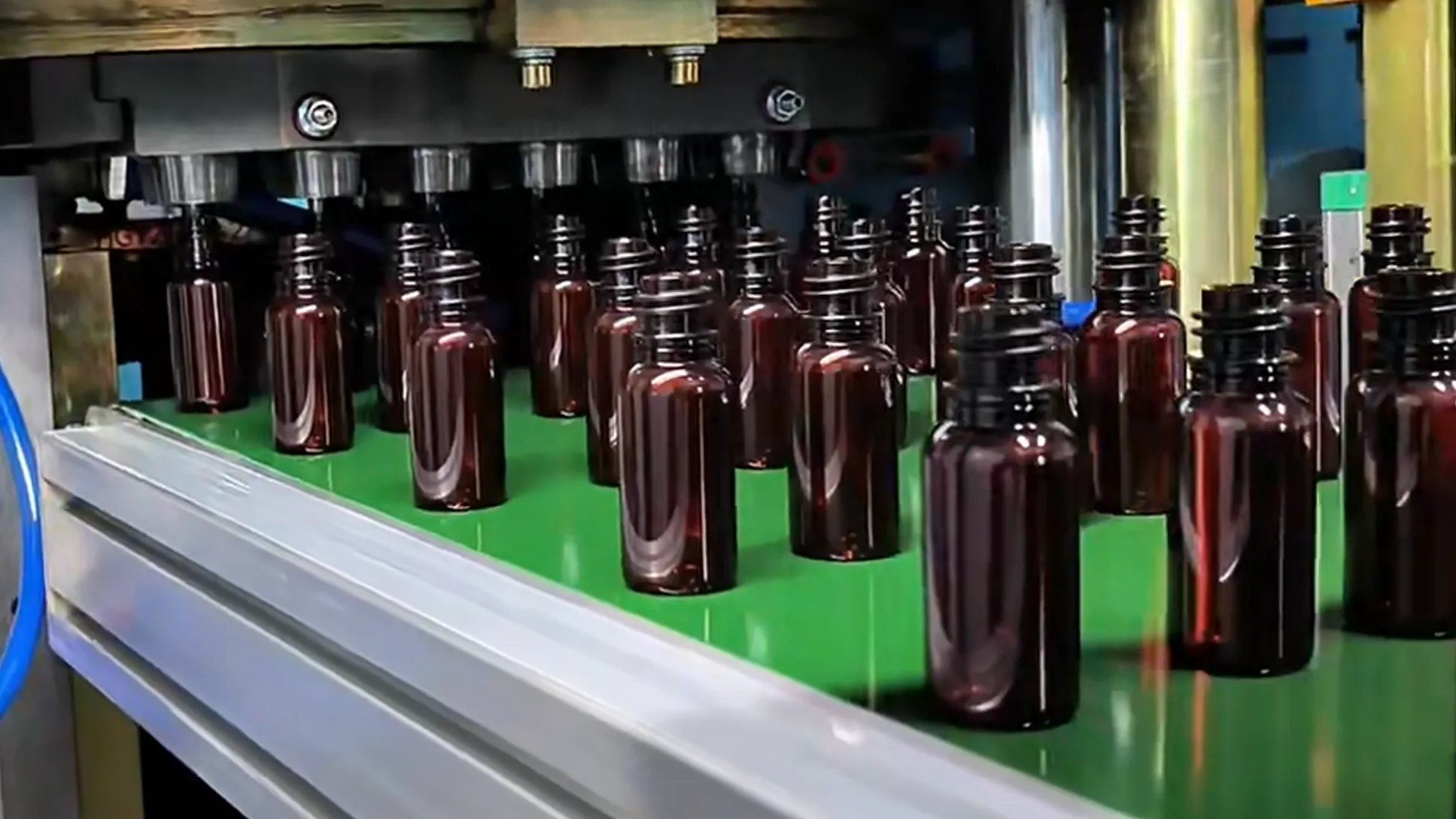
What Is Injection Blow Moulding (IBM)?
Injection blow moulding is the oldest of the three processes and the simplest mechanically. A two-station or three-station machine injects molten resin around a core rod to form a parison (essentially a thick preform), transfers that parison still on the core rod to the blow station, and expands it with compressed air into the final container shape. There is no stretch rod — the air alone inflates the parison.
The IBM Process — What Happens Inside the Machine
The core rod is the defining element of IBM. It is machined to the exact internal profile of the finished container’s neck finish and body, and the parison forms around it. When the parison is transferred to the blow station and inflated, it is already attached to the core rod’s neck geometry — which is why IBM produces extremely accurate neck finishes without flash or parting-line marks. This is IBM’s primary engineering strength.
The inflation itself, however, is purely pneumatic — no mechanical rod stretches the parison axially before or during blowing. The polymer chains are displaced radially by air pressure but not oriented biaxially. The result is a container with amorphous or weakly oriented walls, lower tensile strength per unit wall thickness, and higher haze compared to ISBM products in the same resin.
What IBM Does Well
- Precise neck finish formation — the core rod geometry defines the neck directly; no separate core pin as in ISBM. IBM consistently produces neck threads within ±0.05–0.10 mm without a dedicated neck-cooling system.
- Small, opaque containers — 5–100 ml HDPE or LDPE pharmaceutical vials, eye ointment tubes, and nasal spray bottles are the classic IBM application. The lower wall strength is not a limitation when containers are small, thick-walled, and opaque.
- No residual stress issues — because IBM does not stretch the polymer, there are no stretch-ratio constraints. IBM can produce very short, wide containers (aspect ratios below 1.5:1) that ISBM cannot handle efficiently.
- Single-machine simplicity — IBM requires only one compact machine and one operator, with a simple process set-up compared to the multi-parameter control of ISBM.
What IBM Cannot Do
IBM’s constraints are structural, not incidental. Because no biaxial orientation occurs:
- Transparent PET bottles with glass-like clarity are not achievable by IBM. The unoriented PET wall hazes above very thin gauges. ISBM’s biaxially oriented PET achieves haze values below 1%; IBM PET typically runs 3–8%.
- Lightweight thin-wall containers require biaxial tensile strength that IBM walls cannot provide at the same weight. An IBM bottle achieving equivalent top-load and side-wall strength to an ISBM bottle of the same volume must use 20–40% more resin.
- Containers above ~500 ml are impractical in IBM. The blow-up ratio from parison to finished body is limited by the absence of mechanical stretch — large-volume IBM containers have uneven wall distribution and structural weakness at the base-body transition.
- PETG and Tritan are rarely processed by IBM because their value proposition is optical clarity and chemical resistance — properties that only fully develop in ISBM’s biaxially oriented structure.
What Is Two-Step Reheat Blow Moulding (REHB)?
To-trins REHB — also called SBM (stretch blow moulding) or reheat blow — splits the ISBM process into two entirely separate operations on two separate machines.
Step 1 — Preform Injection on a Dedicated Injection Machine
A high-cavitation injection moulding machine (typically 8–96 cavities) produces standardised preforms at very high rates — a 72-cavity machine running a 12-second cycle produces 21,600 preforms per hour. These preforms are cooled, inspected, bulk-packaged in large cardboard boxes or gaylords, and either stored on-site or shipped to a separate blowing facility. The preform injection machine can run 24/7 on a single resin and preform design, optimised entirely for injection cycle time and material cost.
Step 2 — Reheat and Blow on a Separate Machine
The stored preforms are fed into a rotary or linear reheat blow machine, where infrared lamp arrays heat them from ambient temperature (20–25 °C) to the blow temperature (100–115 °C for PET). The machine then stretches and blows each preform using a stretch rod and high-pressure air — the same biaxial orientation mechanism as ISBM. High-volume REHB machines (Sidel, Krones, Husky) run 24 to 72 cavities at outputs of 20,000–100,000 bottles per hour.
The Preform Storage Problem
The gap between Step 1 and Step 2 is where two-step REHB introduces quality risks that ISBM avoids entirely. During bulk storage and handling:
- Surface scratches and scuff marks accumulate from preform-to-preform contact in bulk containers — these surface defects survive the blow cycle and appear as visible marks in transparent bottles.
- Particulate contamination from the storage environment deposits on preform surfaces and inside the preform body, transferring to the inside of the blown bottle.
- Moisture absorption (PET is hygroscopic) increases the preform’s moisture content during storage. PET reheated above its Tg with elevated moisture content undergoes hydrolytic degradation — chain scission that reduces molecular weight, increases intrinsic viscosity drop, and visibly hazes the bottle wall. Even properly dried, stored preforms pick up meaningful moisture in humid environments within 24 hours.
For commodity beverage production, these risks are managed — not eliminated — by handling protocols, storage controls, and drying systems. For pharmaceutical packaging, K-Beauty cosmetics, or any application where bottle surface and clarity are premium requirements, they represent an inherent structural disadvantage of the two-step approach.
Where Two-Step REHB Makes Economic Sense
Despite its quality limitations relative to ISBM, two-step REHB dominates global PET bottle production by volume for one straightforward reason: at very high single-SKU volumes, the economics are unbeatable. A dedicated preform injection machine running 48 cavities at 15 seconds produces 11,500 preforms per hour at a variable cost that approaches the theoretical minimum for the resin price. A dedicated REHB blowing machine at 36 cavities produces 9,000 bottles per hour continuously. The combined system, running 24/7 on a single preform and bottle design, achieves a per-bottle cost structure that no ISBM machine — limited to 1–6 cavities per shot — can compete with at equivalent volume.
The breakeven point is roughly 1–3 million bottles per month on a single SKU, depending on the container format and resin price. Below that volume, or across a multi-SKU programme, ISBM’s lower capital entry, single-machine simplicity, and superior quality make it the more economical choice.
What Is One-Step ISBM?
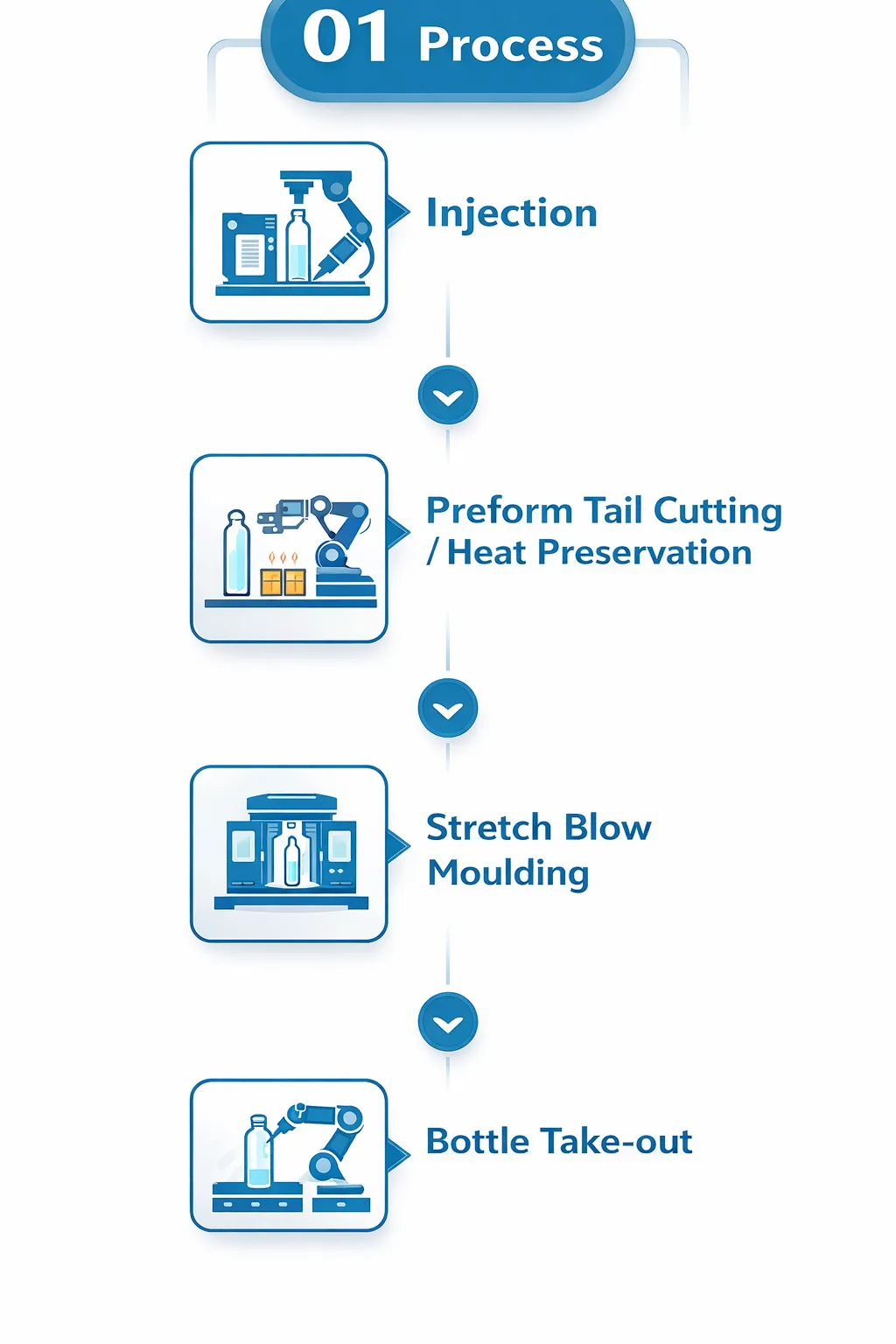
Injection stretch blow moulding integrates all production steps — preform injection, temperature conditioning, biaxial stretch-blow, and ejection — inside a single rotary machine. The preform is never stored, never handled between stations, and never reheated from ambient. It leaves the injection station at ~270 °C and arrives at the blow station at ~110 °C, the entire thermal journey managed by the conditioning station’s dual-surface temperature control.
How ISBM Combines All Steps Without Compromise
The critical design insight in ISBM is that the conditioning station is not a reheat system — it is a temperature profile shaping system. The preform enters conditioning still carrying the heat of injection; the station’s job is to establish the correct temperature differential between the preform body (target: 105–115 °C for PET, where biaxial orientation occurs efficiently) and the neck finish (target: below the heat deflection temperature, where the thread geometry must be preserved unchanged). This differential conditioning is what ISBM achieves and two-step REHB’s infrared lamps cannot replicate with the same precision, particularly for thick-wall preforms where the temperature gradient from surface to centre requires controlled time and contact heat — not radiant energy.
The Role of Biaxial Orientation
Like two-step REHB, ISBM uses a stretch rod — which is why both processes produce biaxially oriented bottles and IBM does not. The orientation quality (and therefore the property improvements it delivers) depends on reaching the correct stretch temperature window, applying the stretch rod at the correct speed (300–400 mm/s for PET), and matching the blow pressure ramp to the material’s orientation response. ISBM’s conditioning station temperature precision gives it a structural advantage over REHB in controlling this window, particularly for PETG (90–100 °C, a narrower window than PET) and Tritan (100–115 °C, sensitive to ±2 °C variation).
Head-to-Head Comparison — ISBM vs IBM vs Two-Step REHB
When ISBM Is the Clear Choice
ISBM is not merely a substitute for the other two processes at lower volumes — in several application areas it is the only process that can deliver the required product quality at any volume.
Premium Cosmetics and K-Beauty Packaging
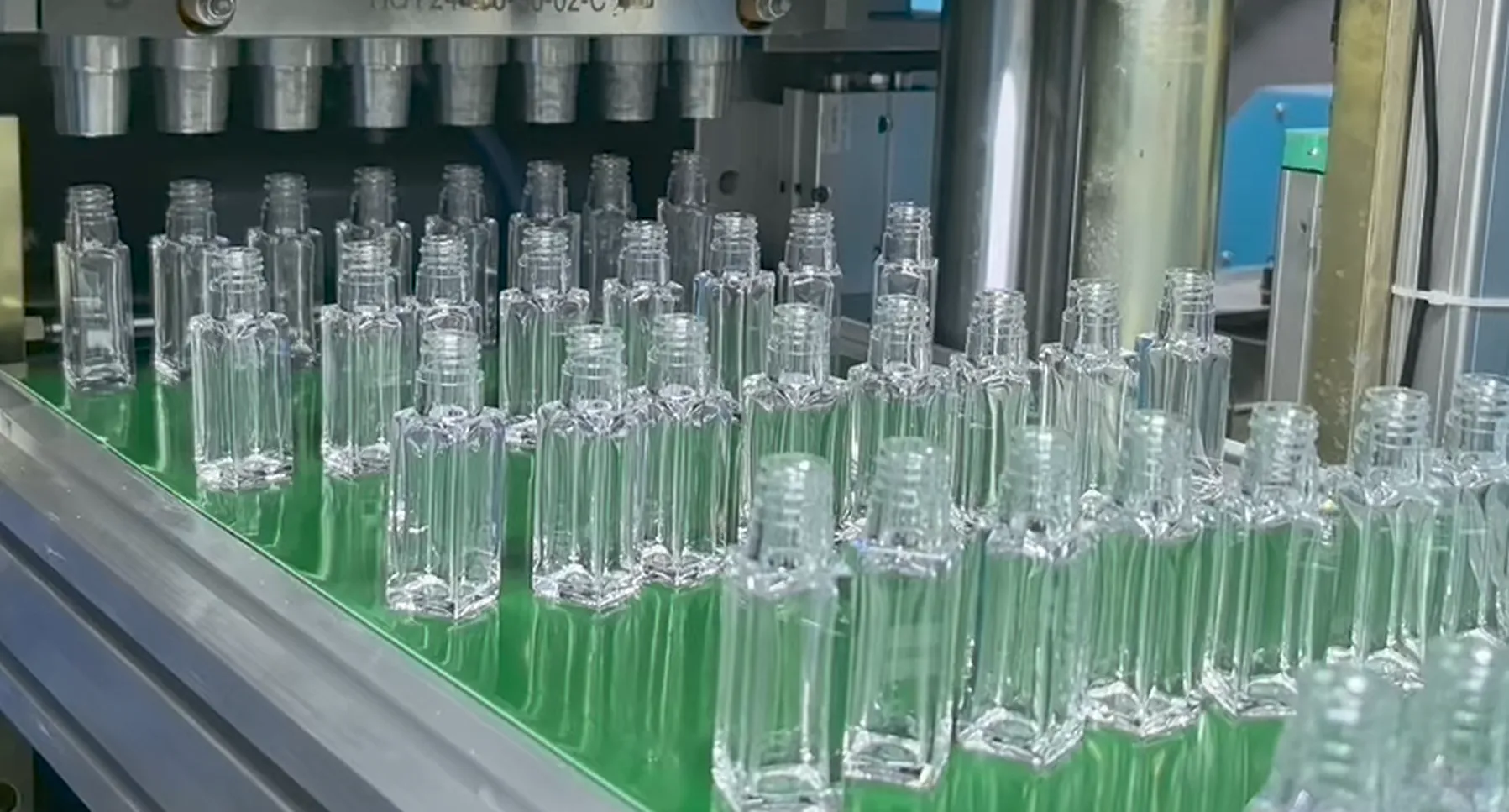
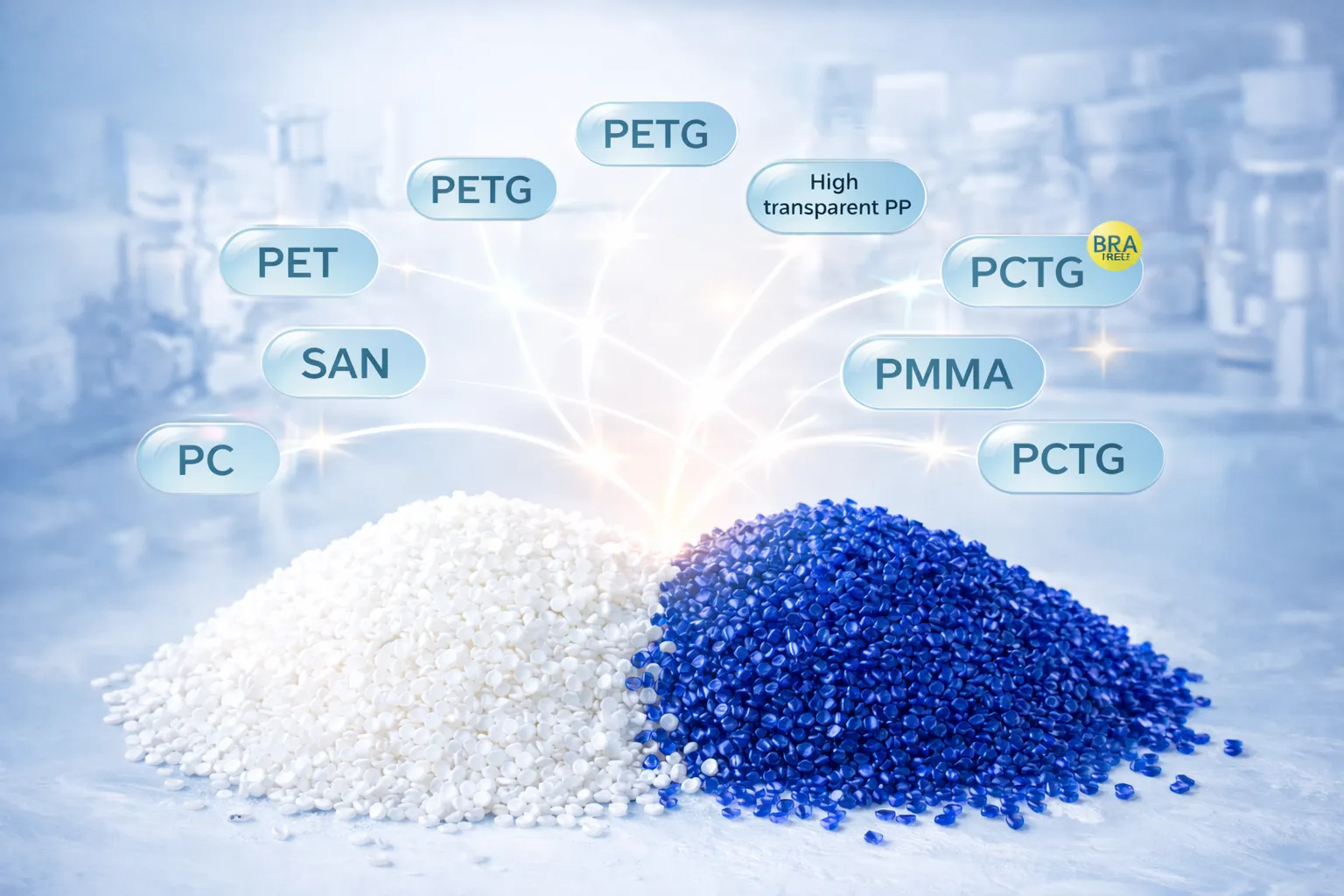
Korean cosmetic brands — and the premium global cosmetics market — require bottle surfaces that are genuinely flawless. A serum bottle with a single hairline scratch on its PETG surface will be rejected at the brand’s incoming inspection. PETG clarity in a two-step system is compromised by moisture uptake during preform storage (PETG is more hygroscopic than standard PET). IBM cannot produce PETG in meaningful gauge reductions without haze. Only ISBM — with its closed-loop one-step handling and dual-surface conditioning precision — reliably delivers the surface quality and optical clarity that premium cosmetics packaging requires.
The same logic extends to container geometry: K-Beauty brands frequently specify oval, faceted, or asymmetric bottle shapes that require precise wall distribution control. ISBM’s stretch rod speed and blow pressure profiling provide this control; two-step REHB’s infrared heating introduces temperature non-uniformities around complex preform geometries that require complex lamp profile tuning to compensate.
Pharmaceutical and Medical Packaging
GMP compliance in pharmaceutical packaging places specific requirements on the production environment and the container production process that eliminate two-step REHB as a practical option for most pharmaceutical applications. Handling preforms between machines, through storage, and through sorting and orientation systems introduces unacceptable contamination risk in a GMP-classified cleanroom. Bringing a preform storage and transport system into a classified space is technically possible but logistically complex and expensive.
ISBM’s one-step enclosed process produces containers in a controlled environment without inter-machine handling. With an electric-drive machine (no hydraulic oil, no oil mist), the production environment remains clean and documentable. Neck finish precision (±0.05 mm) meets the tolerances required for pharmaceutical dropper assemblies and pump dispensers where leakage is a regulatory failure, not merely a quality defect.
Baby Bottles and Food-Grade Containers
BPA-free Tritan and PETG baby bottles are ISBM’s territory for a simple reason: these materials require the precision temperature conditioning that only ISBM’s dual-surface station delivers, and the zero-contamination production path that only the one-step process guarantees. A Tritan baby bottle produced via two-step REHB faces moisture absorption during preform storage (Tritan must be dried below 0.01% moisture before processing), surface handling in an environment shared with other resins, and infrared reheating that is less precise than contact conditioning for thick Tritan preforms. For a product category with zero tolerance for contamination or material property inconsistency, ISBM is the appropriate process choice regardless of volume.
Multi-SKU Production and Flexible Operations
Any operation producing more than three or four different container formats benefits structurally from ISBM’s mould changeover economics. On a two-step REHB line, a SKU change requires switching both the preform inventory (and draining/discarding the preform supply in the buffer) and the blow mould set — a changeover that typically takes 2–4 hours and may require preform specification changes that take days to source. On an ISBM machine, a mould change takes 20–35 minutes for an experienced crew and requires no external supply chain changes — the machine simply runs a new preform design from its own injection unit. For a packaging operation producing 10–20 different container formats across its customer base, this flexibility has direct economic value in scheduling density and responsiveness to customer demands.
When Two-Step REHB Is the Right Choice
Two-step REHB dominates the global PET bottle market by volume, and for good reason: at the right scale, its economics are simply unbeatable. The case for REHB is specific and quantifiable:
REHB Is the Right Process When All Three of These Are True:
① Single SKU (or very few SKUs) — the preform inventory and line are dedicated to one container design without frequent changeover
② Volume > 1–3 million bottles per month on that SKU — where the high-cavitation blow machine’s output fully justifies its capital cost
③ Surface quality and GMP cleanliness are not primary requirements — the application is commodity beverage, standard personal care, or general-purpose food packaging where the two-step handling risks are managed by volume-based quality sampling
Outside these three conditions, two-step REHB’s apparent cost advantage erodes quickly. Multi-SKU changeover costs, preform inventory working capital, dedicated storage space, the second machine capital and operating cost, and the logistics infrastructure to move preforms from injection to blowing are all costs that do not appear in a simple per-bottle calculation but are real elements of the total cost of ownership.
When IBM Is the Right Tool
IBM occupies a specific and well-defined niche where its lack of biaxial orientation is not a disadvantage:
- Small HDPE and LDPE pharmaceutical vials (5–60 ml) — where opacity is acceptable, the container is squeezable, and IBM’s precise neck finish without a separate neck core pin is an engineering advantage for complex dropper and spray assemblies.
- Opaque personal care packaging — deodorant sticks, shampoo bottles in opaque PP, and similar containers where clarity is not required and the low capital cost and compact footprint of an IBM machine are the primary selection criteria.
- Very low volume, very high neck precision — specialty medical device containers in small quantities where the IBM’s neck forming accuracy meets the tolerance requirement at lower tooling cost than an ISBM preform mould.
IBM is not growing as a process share in the industry — its application range is gradually being captured by small ISBM machines at the top (where clarity and biaxial strength are valued) and by injection moulding with separate assembly at the bottom (for very small, complex-geometry containers). It remains, however, the economically correct choice for its core niche.
Cost Comparison — Capital, Operating, and Per-Bottle Economics
Capital Cost Structure
Capital cost comparisons between the three processes must account for the complete line required to produce finished bottles, not just the machine purchase price:
Operating Cost Per 1,000 Bottles
Operating cost comparisons are sensitive to local energy prices, labour rates, and volume, but the directional relationships are consistent:
- Energy: ISBM uses 15–25% less energy than two-step REHB per bottle (no reheat cycle). Fully electric ISBM (HGY50-V3-EV) reduces machine energy draw by a further 40% compared to hydraulic ISBM. IBM energy consumption is low in absolute terms due to small machine scale but high per unit wall volume due to absence of lightweighting from biaxial orientation.
- Labour: Both ISBM and IBM require a single operator per machine. Two-step REHB requires operators at both machines plus personnel for the preform handling and storage system — typically 1.5–2.5× the ISBM labour cost for equivalent output.
- Resin: ISBM’s biaxial orientation allows 15–25% lighter bottles for equivalent structural performance — a direct resin cost reduction per unit. IBM’s unoriented walls require more resin for the same performance. REHB achieves similar lightweighting to ISBM once orientation quality is comparable.
- Reject rate: ISBM typically runs at 98–99.5% yield in steady-state production. Two-step REHB reject rates include preform quality losses (scuff, contamination, moisture-damaged clarity) plus blow station rejects — total reject rates of 2–5% are common on multi-SKU operations with frequent preform changeovers.
Breakeven Analysis — Where ISBM and REHB Cross
The crossover point where two-step REHB becomes more economical than ISBM on a per-bottle basis occurs when the REHB system’s higher cavitation (and therefore lower labour and overhead per bottle) outweighs its higher capital, energy, and operating overhead. This breakeven falls at roughly 1–3 million bottles per month for a single container format, but varies significantly by:
- Container size (larger containers favour ISBM longer, as REHB’s cavitation advantage narrows)
- Local electricity cost (high electricity markets extend ISBM’s advantage from energy efficiency)
- SKU count (each additional SKU reduces REHB’s economic advantage due to changeover cost)
- Quality requirements (premium segments where REHB reject rates are higher shift the crossover upward)
Decision Checklist — Six Questions to Identify Your Process
Answer these six questions about your production programme. The pattern of answers points clearly to the right process.
◆ Vigtig konklusion
Choose ISBM when surface quality, clarity, GMP compliance, or resin flexibility is a primary requirement — or when you produce multiple SKUs. Choose two-step REHB only when you have a single high-volume SKU above ~2 million units/month in a standard (non-cleanroom) environment. Choose IBM only for small opaque containers (HDPE/LDPE/PP) where biaxial strength and clarity are not required.
Konklusion
The three blow moulding processes are not interchangeable alternatives on a cost-per-bottle spectrum — they are purpose-built for fundamentally different production contexts. IBM is the right tool for small opaque containers where neck precision matters more than wall strength or clarity. Two-step REHB is the right tool when single-SKU volume is high enough to justify two machine lines and preform logistics infrastructure. ISBM is the right tool for everything in between: multiple SKUs, premium surface quality, GMP environments, non-PET resins, and volumes from 10,000 to several million units per month.
For most producers in the cosmetics, pharmaceutical, baby product, and premium beverage sectors in Korea and Asia, the relevant question is not om ISBM is the correct process — it almost always is — but which machine specification, cavity configuration, and drive type best matches their specific container programme. The Korea Ever-Power 3-station ISBM range covers hydraulic and fully electric platforms from 188 g to 315 g injection capacity, supporting 1–6 cavities and containers up to 250 mm in height — with mould compatibility across the ASB-12M and Aoki 100 standards to protect existing tooling investments.
Explore the HGY Series — Korea Ever-Power 3-Station ISBM Machines
188 g · 160 MPa · 1–6 cavities
ASB-12M compatible · 3,000 kg
183 g · 210 MPa · Oil-free
−40% energy · GMP-ready
HGY50-V3 · V3-EV · HGY150-V3
Compare specs side by side
Om denne artikel: Prepared by the Korea Ever-Power Technical Team. Process economics data is directional and based on industry benchmarks; actual costs vary by local electricity rates, labour, resin price, and production scale. Bottle property comparisons (tensile strength, haze) are based on published PET orientation literature and Korea Ever-Power process validation data.
Relateret læsning: What Is Injection Stretch Blow Moulding? — Complete Technical Guide | How to Choose an ISBM Machine — 8 Specifications Explained | ISBM Machine Price Guide
Redaktør: Cxm