
What Is Injection Blow Molding?
Complete IBM Guide
Injection blow molding is the process that produces HDPE pharmaceutical containers, PP cosmetic jars, and ABS packaging with the most precise neck finish in blow molding — because the neck is injection moulded, not blown. This guide explains how the 3-station IBM process works, which materials it processes, where it outperforms extrusion blow molding and ISBM, and how Korean packaging factories select the right IBM machine for their production requirements.
IBM vs EBM vs ISBM
Korean IBM Machine Selection
Korea Ever-Power Engineering Desk · Ansan-si · July 2026
Injection Blow Molding — Key Process Reference
3 Stations
Injection → Blow → Stripping — concurrent operation every cycle
Zero Flash
No trimming, no parting-line seam — 100% material to finished bottle
1–2,000 ml
Bottle volume range — 10 ml eye drops to 2 L household containers
Up to 30
Max cavities at 10 ml — ZQ135 flagship — ~27,000 bottles per hour
1. Definition: What Is Injection Blow Molding?
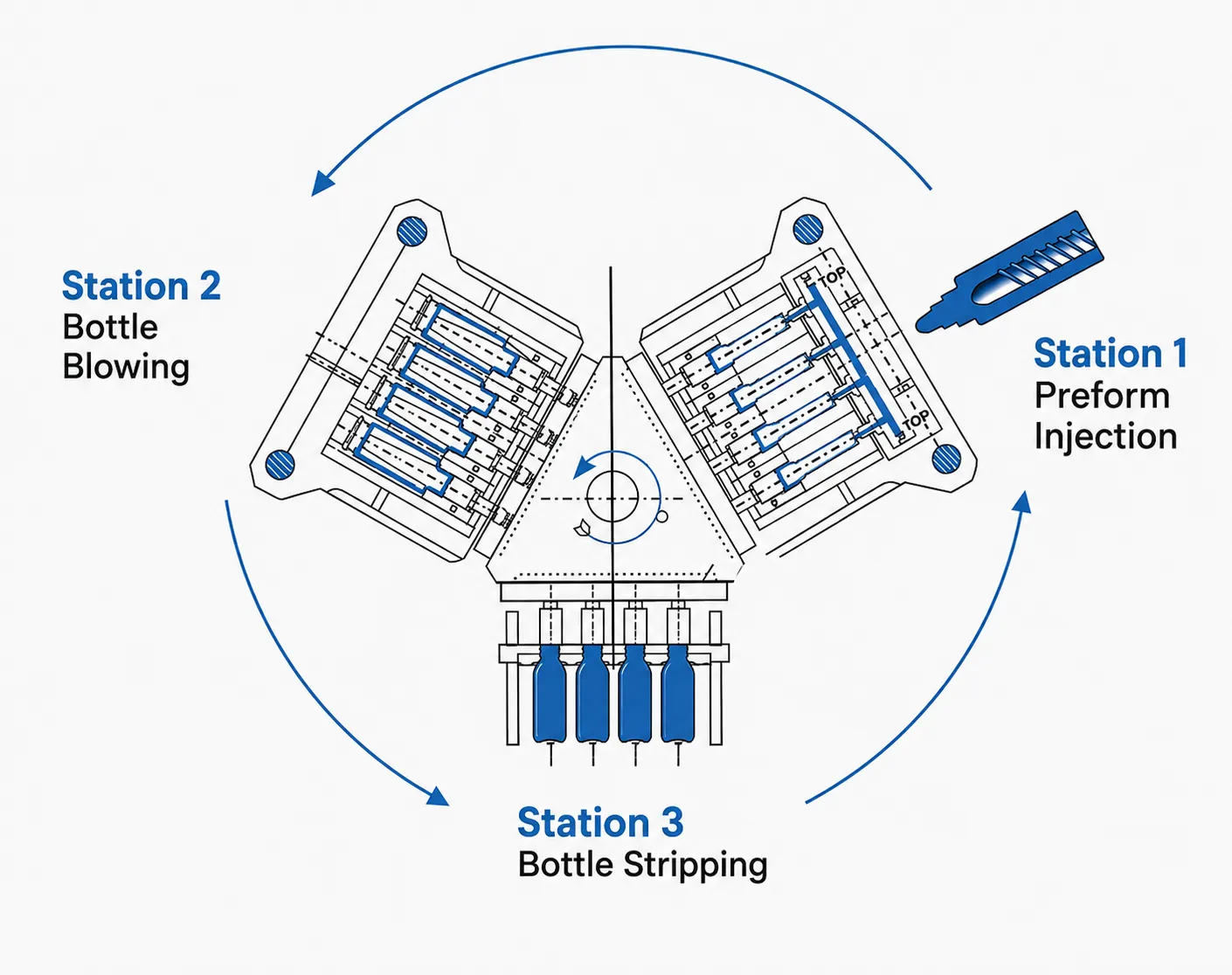
Injection blow molding is a one-step plastic bottle manufacturing process that combines injection molding and blow molding in a single machine cycle. A preform — a thick-walled test-tube-shaped piece of resin — is first injection molded around a core rod at Station 1, then transferred on the rod to Station 2 where blow air inflates it against a blow mould cavity to form the finished bottle, then transferred to Station 3 where it is stripped from the rod and deposited onto the output conveyor. All three stations operate simultaneously on every cycle, making injection blow molding one of the most productive single-step packaging processes available to Korean container manufacturers.
The defining technical characteristic of injection blow molding is that the bottle neck is injection moulded — not blown. Because the core rod passes through the neck area during both injection and blow, the neck geometry is formed by the injection mould at Station 1 and is never deformed by blow pressure. This produces injection-moulded neck precision: thread OD tolerance of ±0.05 mm or better, consistent across every cavity in the mould, on every cycle. For Korean pharmaceutical packaging requiring CRC (child-resistant closure) engagement at ±0.06 mm neck OD tolerance, or Korean household chemical closures requiring consistent thread engagement across millions of units per shift, injection-moulded neck precision is the technical capability that positions injection blow molding as the preferred process over extrusion blow molding at these volume and tolerance requirements.
Injection blow molding was developed commercially in the 1950s as a response to the limitations of extrusion blow molding — specifically the flash that EBM generates at the parting line, the dimensional variation that EBM produces at the neck, and the trim operation that EBM requires after every cycle. IBM eliminates all three: zero flash, precision neck, no post-production trimming. These advantages drove IBM’s adoption in Korean pharmaceutical container manufacturing in the 1980s and 1990s, and the same advantages continue to define IBM’s position in Korean packaging today, now at cavity counts up to 30 per machine for the largest Korean pharmaceutical production lines.
2. How the 3-Station IBM Process Works
Station 1 — Preform Injection
At Station 1, the injection mould closes around the core rods — precision steel mandrels that define the interior geometry of the preform and, critically, the interior surface of the bottle neck. Molten resin is injected through the hot runner system to fill all cavities simultaneously. The injection mould forms the complete neck geometry (thread profile, thread OD, bore diameter, sealing surface) with the dimensional accuracy of injection tooling — tolerances that no other blow molding process can match at production speed. The injection clamping force at Station 1 holds the mould closed against injection pressure; on Korea Ever-Power’s ZQ series, this ranges from 400 KN on the ZQ40 to 1,350 KN on the ZQ135 — sized to support cavity counts from 9 to 30 at 10 ml format without flash at the neck parting line.
Turret Indexing — Transfer with High-Precision Angle Divider
After the injection phase, the blow mould opens and the rotary turret — which carries all core rods simultaneously — lifts, rotates 120 degrees, and lowers to position each rod at the next station. On Korea Ever-Power’s ZQ80, ZQ110 and ZQ135 machines, a high-precision angle divider coordinates the mould opening motion with the turret lift, allowing these two mechanical events to overlap rather than executing fully sequentially. This overlap reduces the effective time lost between phases and ensures each rod registers to the correct station position with the same angular precision on every cycle — producing consistent cavity-to-cavity weight and dimensional performance that is directly measurable in production quality data.
Station 2 — Blow Moulding
At Station 2, the blow mould closes around the preform on the core rod. Compressed air (typically 0.7–1.2 MPa) enters through the core rod and inflates the preform against the blow mould cavity walls. Because the preform carries residual heat from the injection phase, and because the core rod holds the neck in its final geometry throughout, the blow phase produces the finished bottle body while the neck remains unchanged from its injection-moulded form. Blow clamping force ranges from 80 KN on the ZQ40 to approximately 180 KN on the ZQ135, matching the blow mould projected area at each cavity count.
Station 3 — Stripping and Output
At Station 3, finished bottles are stripped from the core rods and deposited onto the output conveyor. The stripping station applies a controlled force through the stripping mechanism to release the bottle from the rod without surface marking or neck deformation. At 30-cavity output on the ZQ135, 30 finished bottles are deposited per cycle — at the 4-second cycle time that is standard across the ZQ series, this is approximately 7.5 bottles per second to the output conveyor, requiring conveyor speed and accumulation capacity planning that Korea Ever-Power’s installation teams address during production cell layout.
3. Materials Processed by Injection Blow Molding
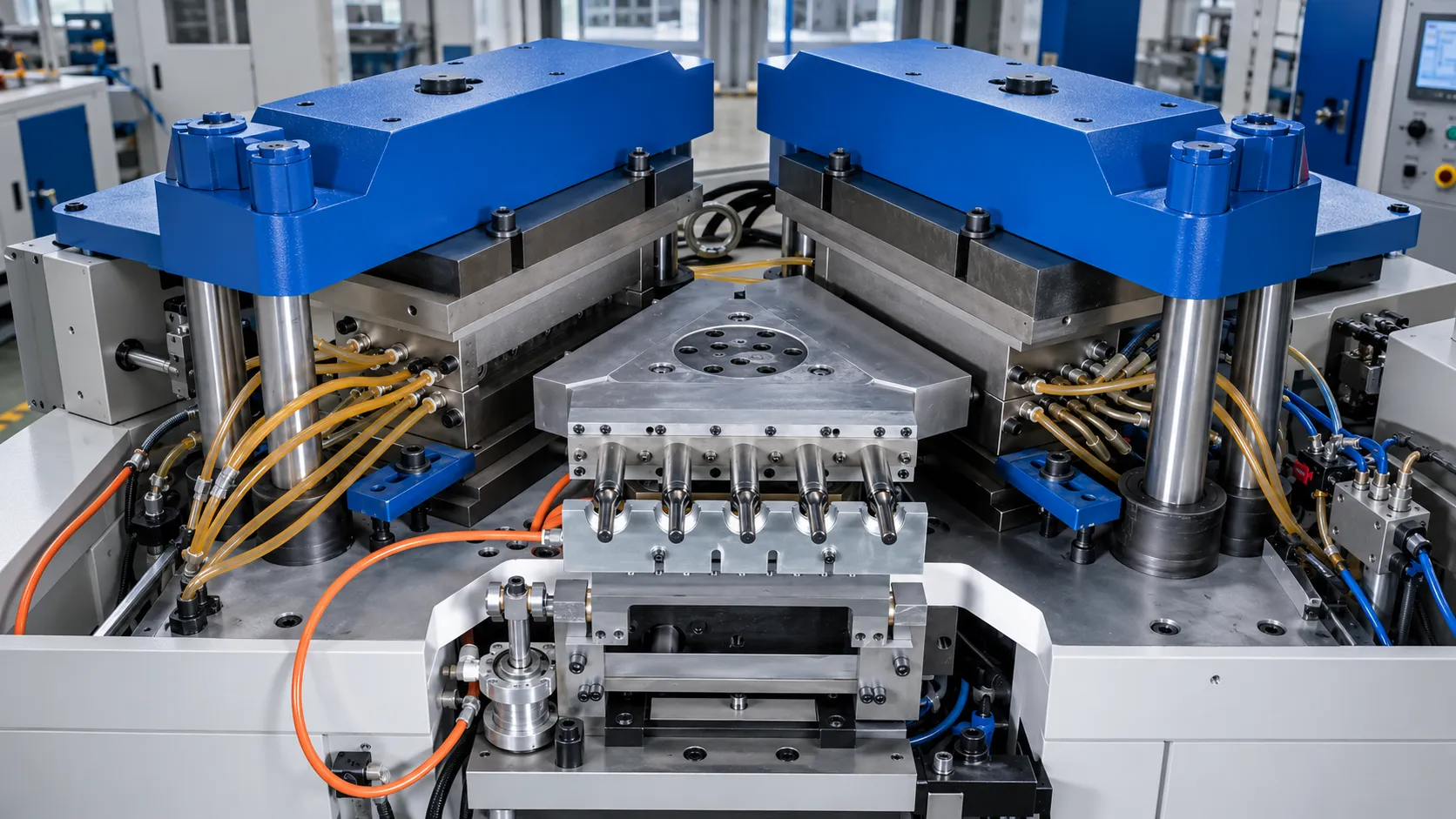
Injection blow molding processes a wider range of thermoplastics than injection stretch blow molding (ISBM), because IBM does not require the molecular orientation that ISBM achieves in PET. IBM is compatible with any thermoplastic that can be injection moulded at the preform stage and retains sufficient heat and flexibility for blow inflation at Station 2.
| Material | Barrel Temp (°C) | Primary IBM Applications | Key Advantage |
|---|---|---|---|
| HDPE | 170–220 | Pharmaceutical bottles, eye drops, oral liquid, household chemical | Chemical resistance, FDA/KFDA compliance, low extractables |
| PP | 200–250 | CRC medicine bottles, hot-fill containers, condiment jars | Heat resistance, chemical resistance, autoclavable grades |
| ABS | 220–250 | Cosmetic jars, cream containers, wide-mouth packaging | Rigid, high-impact, excellent surface finish for decoration |
| PS | 180–240 | Dairy bottles, probiotic containers, ampoules, medical | Transparency, stiffness, food contact compliance |
| LDPE | 160–200 | Squeeze bottles, dropper bottles, ointment tubes | Flexibility, squeeze dispensing, soft touch |
| EVA | 155–180 | Specialty soft containers, flexible pharmaceutical packaging | Rubber-like flexibility, excellent low-temperature performance |
| PCTG | 240–265 | Premium cosmetic containers, clarity packaging, spirits bottles | Glass-like clarity, chemical resistance, FDA food contact |
Material versatility is one of injection blow molding’s commercial advantages over ISBM: the same IBM machine platform processes HDPE, PP, ABS and PS by adjusting barrel zone temperatures, screw speed and back pressure, without mechanical modification. A Korean pharmaceutical factory running HDPE eye drop bottles on a Monday and PP CRC medicine bottles on a Thursday uses the same IBM machine, the same mould change procedure, and the same operator training for both materials — a production flexibility that ISBM, which processes primarily PET, cannot offer across this material range.
4. IBM vs Extrusion Blow Molding: Key Technical Differences
Extrusion blow molding (EBM) is the most widely used blow molding process globally — large-format HDPE containers (jerricans, industrial drums, automotive tanks) and most consumer-size shampoo bottles produced before the mid-2000s used EBM. IBM occupies a different and more precise segment of the container market, and the two processes are not competitive in their core applications. Understanding where IBM is clearly superior to EBM — and where EBM retains its advantages — prevents Korean factories from choosing the wrong process for their specific container requirements.
| Comparison Criterion | Injection Blow Molding (IBM) | Extrusion Blow Molding (EBM) |
|---|---|---|
| Neck finish precision | Injection-moulded ±0.05 mm OD | Blown ±0.15–0.25 mm OD |
| Flash / trim generation | Zero flash — no trimming | Flash generated at base and neck — trim station required |
| Material utilisation | 100% — no scrap | 85–93% — flash is scrap or regrind |
| Wall thickness control | Excellent — preform defines wall distribution | Moderate — parison programming required for uniformity |
| Max bottle volume | Up to 2,000 ml (typical) | Up to 1,000 litres and above |
| Handle integration | Not possible in standard IBM | Yes — integral handles in EBM mould |
| Production output at 10 ml | Up to 27,000/hour (30 cavities) | Lower — typically 1–6 cavities for 10 ml format |
| Korean pharmaceutical GMP compliance | Excellent — injection neck standard | Requires additional neck validation |
The IBM vs EBM decision for Korean factories is straightforward when the container requires pharmaceutical-grade neck precision (IBM) or requires an integral handle or exceeds 2,000 ml (EBM). The challenging decision is in the middle range — small-to-medium HDPE household chemical containers where both processes are technically capable. In this range, IBM’s zero-flash advantage (no trim station, no scrap, lower operating cost) often justifies the higher IBM machine investment versus EBM, particularly for Korean factories producing at the 5–8 cavity 500 ml volumes where IBM output exceeds EBM output and IBM’s net material cost per bottle is lower when flash regrind costs are included.
5. Injection Blow Molding Applications by Industry

Pharmaceutical Packaging
IBM is the dominant process for Korean pharmaceutical HDPE and PP containers at small formats (1–100 ml). Eye drop bottles (10 ml HDPE), oral liquid vials (30 ml PP), syrup bottles (100 ml HDPE), CRC medicine bottles (100 ml PP) and unit-dose ampoules are all produced by injection blow molding — the injection-moulded neck produces the closure engagement precision that Korean KFDA GMP qualification requires. IBM’s zero-flash production eliminates the contamination risk from flash particles that trim-based EBM production introduces in cleanroom pharmaceutical environments.

Household Chemical and Food Packaging
Korean shampoo bottles, conditioner containers, body wash packaging and liquid detergent containers are produced by injection blow molding at 250–1,000 ml. IBM’s zero-flash production eliminates the trim station that EBM requires and reduces net material cost per bottle when regrind management is included. Korean food-grade injection blow molded containers include wide-mouth jars for honey, condiment and cooking oil at 250–500 ml, where IBM’s injection-moulded wide-mouth neck produces consistent closure seal across all cavities simultaneously. Wide-mouth jar production is a specific IBM native capability that ISBM machines cannot match at the same cavity counts.
Beyond pharmaceutical and household chemical applications, injection blow molding serves Korean cosmetic packaging (ABS cream jars, PCTG premium lotion bottles, PS ampoule-style serum vials), Korean food packaging (PP hot-fill containers, HDPE cooking oil bottles, food-grade wide-mouth jars), and Korean industrial containers (HDPE reagent bottles, PP chemical storage containers). The common thread across all IBM applications is the injection-moulded neck — the design requirement that pushes Korean packaging specifiers toward IBM regardless of the product category. When the closure requires consistent thread OD across all cavities and across all production shifts — whether the closure is a pharmaceutical CRC cap, a household chemical pump dispenser, or a wide-mouth food jar lid — injection blow molding is the process that reliably delivers that consistency at volume.
6. IBM vs ISBM: Choosing the Right Blow Molding Technology
Injection blow molding (IBM) and injection stretch blow molding (ISBM) share the same defining characteristic — an injection-moulded neck — but they serve different materials and produce different bottle physics. Understanding the IBM vs ISBM distinction prevents the costly mistake of investing in the wrong platform. Korea Ever-Power manufactures both: the ZQ series IBM machines and the HGY series ISBM machines, available in the 4-Station ISBM Machine range.
| Factor | IBM (ZQ Series) | ISBM (HGY Series) |
|---|---|---|
| Primary materials | HDPE, PP, ABS, PS, LDPE, EVA, PCTG | PET, PETG, Tritan, PC, PP, PCTG |
| Bottle wall structure | Amorphous — no axial stretching | Biaxially oriented — glass-like PET clarity |
| HDPE pharmaceutical bottle | Native application | Not standard |
| Crystal-clear PET cosmetic serum | Not standard | Native application |
| Wide-mouth jar | Excellent — IBM native | Achievable with 4-station conditioning |
| Zero flash | Yes | Yes |
| Max cavities at 10 ml | Up to 30 (ZQ135) | Up to 12 (HGY series) |
The IBM vs ISBM decision resolves on material. If the Korean factory produces HDPE and PP containers — pharmaceutical, household chemical, food-grade — IBM is the correct platform. If the factory produces crystal-clear PET or PETG cosmetic bottles, premium serum ampoules or CSD-resistant PET beverage containers — ISBM is the correct platform. Korean factories producing both product lines run both platforms in parallel, each serving its native material. Korea Ever-Power can advise on the correct combination during pre-purchase technical discussion.
7. IBM Machine Selection: ZQ Series Guide for Korean Factories
Korea Ever-Power’s injection blow molding machine range — the ZQ series — spans five models from the compact ZQ40 to the flagship ZQ135, covering every Korean IBM production scale from startup contract packaging to mega-scale pharmaceutical manufacturing. Each model is defined by its injection clamping force and maximum cavity count at 10 ml format. The ZQ80, ZQ110 and ZQ135 additionally include two premium features as standard: a high-precision angle divider for improved cycle repeatability, and a dual hydraulic system for 20–30% energy saving versus single-circuit competitors.
| Model | Clamping Force | Max Cavities @10ml | Total Power | Primary Korean Application |
|---|---|---|---|---|
| EP-ZQ40 | 400 KN | 9 | 20 KW | Small pharmaceutical startup, Korean CMO trial production, specialty formats |
| EP-ZQ60 | 600 KN | 14 | 37 KW | Korean mid-scale pharmaceutical, cosmetic jars, household chemical |
| EP-ZQ80 | 800 KN | 20 | 55 KW | Korean large pharmaceutical, Korean national brand household chemical |
| EP-ZQ110 | 1,100 KN | 24 | 80 KW | Korean large-scale pharmaceutical contract packaging, major Korean FMCG |
| EP-ZQ135 | 1,350 KN | 30 | 95 KW | Korean mega-scale pharmaceutical, national brand household chemical at highest volume |
The EP-ZQ60 is the most widely adopted ZQ model for Korean mid-scale pharmaceutical and cosmetic IBM production — the 14-cavity 10 ml and 3-cavity 500 ml configurations cover the most common Korean pharmaceutical contract packaging formats and household chemical container volumes that Korean national brand OEM factories produce. Korean factories whose annual 10 ml container production is below 50 million units typically find the ZQ60 the economically correct starting investment; those above 50 million units evaluate the ZQ80 or ZQ110 based on their specific cavity count and format requirements.
8. IBM in Korean Manufacturing: Market Position and Growth Drivers
Korean injection blow molding is driven by three converging market forces that are each growing independently and reinforcing each other. First, Korean pharmaceutical volume growth: Korea’s pharmaceutical market — one of East Asia’s most regulated and quality-conscious — requires HDPE and PP pharmaceutical containers at precision standards that Korean KFDA qualification enforces. IBM is the only process that routinely passes Korean GMP container qualification for CRC pharmaceutical containers without additional neck finish processing. Korean pharmaceutical production growth, driven by Korean pharmaceutical export to Southeast Asian and US markets, directly increases Korean IBM machine demand.
Second, the Korean replacement of extrusion blow molding in household chemical packaging: Korean household chemical brands have been replacing EBM shampoo and cleaning product containers with IBM containers for the past decade. The IBM replacement is driven by IBM’s higher output per machine at small-to-medium cavity counts (8-cavity 500 ml IBM versus 4-cavity 500 ml EBM at the same cycle time), IBM’s zero-flash production economics (no trim station, no regrind), and Korean retailer QA requirements for dimensional consistency across packaging pallets that IBM’s injection-moulded neck precision satisfies more reliably than EBM.
Third, Korean government energy efficiency requirements: Korea’s industrial electricity pricing structure and the Korean government’s industrial energy efficiency programme have increased Korean packaging factory operators’ attention to machine-level energy consumption. Korea Ever-Power’s dual hydraulic IBM machines — the ZQ80, ZQ110 and ZQ135 — consume 20–30% less electricity per bottle produced than single-circuit competitor machines at equivalent output, a saving that Korean factory operators can document and include in Korean industrial energy efficiency reporting. For Korean factories participating in Korean government energy efficiency incentive programmes, this documented saving directly affects qualifying score and subsidy calculation. The combination of zero-flash material efficiency and 20–30% energy saving on the dual hydraulic ZQ models represents a compelling economics case for Korean IBM investment at every scale from startup pharmaceutical contract packaging to national brand consumer goods manufacturing.
Frequently Asked Questions
IBM Machine Enquiry
Ready to Select Your Injection Blow Molding Machine?
Korea Ever-Power’s engineering team provides IBM machine selection consultation, cavity count analysis and production cell layout planning for Korean pharmaceutical, household chemical and cosmetic packaging factories at all production scales.
Related Resources
EP-ZQ80 Injection Blow Molding Machine
800 KN · 20 cavities at 10 ml · Standard angle divider and dual hydraulic · 20–30% energy saving · Korean pharmaceutical and household chemical IBM platform.
EP-ZQ110 Injection Blow Molding Machine
1,100 KN · 24 cavities at 10 ml · 4+N barrel zones · 22+22 KW dual hydraulic · Korean large-scale pharmaceutical contract packaging IBM platform.
EP-ZQ40 Injection Blow Molding Machine
400 KN · 9 cavities at 10 ml · 3.5-second cycle · Compact 3.5×1.3×1.7 m footprint · Korean pharmaceutical startup and specialty format IBM platform.