IBM vs ISBM: Choosing the Right
Blow Molding Process
IBM and ISBM share the same defining advantage — an injection-moulded neck — but diverge at the blow station in ways that determine which materials they can process, what bottle properties they achieve, and which Korean packaging applications each process serves. The wrong process choice is costly at every level: mould investment, material compatibility, output rate and product quality. This guide shows exactly where IBM and ISBM separate, and gives Korean packaging engineers a clear decision framework for each production scenario.
HDPE vs PET Material Decision
Korean Application Mapping
Korea Ever-Power Engineering Desk · Ansan-si · July 2026
IBM vs ISBM — Shared Foundation and Key Divergence
Both: Zero Flash
Neither process generates flash — both produce 100% net-shape bottles
Both: Injection Neck
Both form the neck by injection — ±0.05 mm OD precision on every cycle
IBM: HDPE · PP · ABS
IBM processes the non-orientation-dependent commodity thermoplastics
ISBM: PET · PETG · PC
ISBM processes orientation-responsive materials for crystal clarity and barrier
1. IBM and ISBM: Shared Foundation, Key Divergence
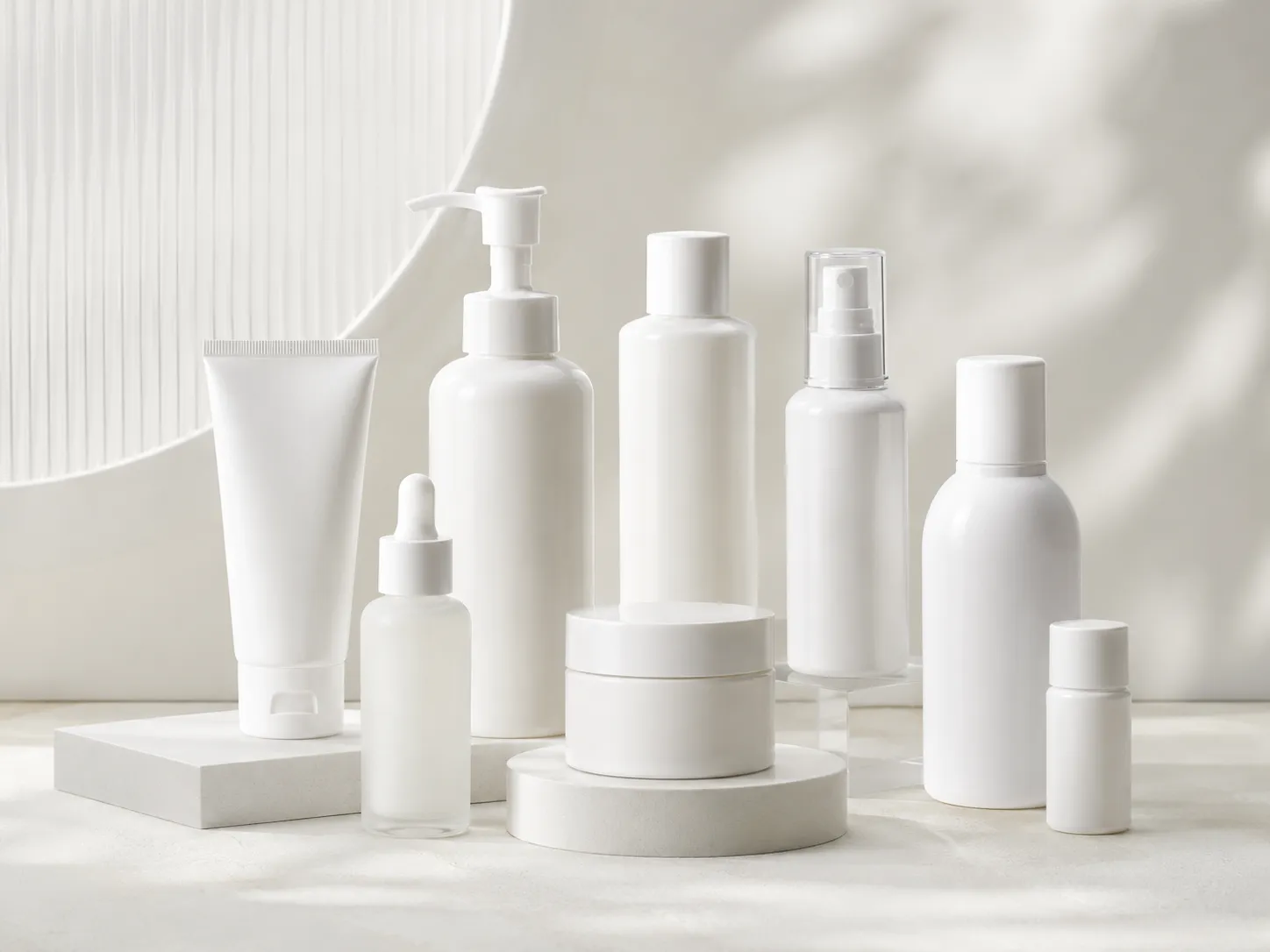
IBM (injection blow molding) and ISBM (injection stretch blow molding) are the only two blow molding processes that produce bottles with injection-moulded necks. This shared characteristic gives both processes a precision advantage over extrusion blow molding that is the most commercially significant feature in pharmaceutical and premium cosmetic packaging. Korean pharmaceutical CRC containers, Korean pump-dispenser cosmetics and Korean food jars that require consistent closure engagement across millions of production cycles all benefit from this injection-moulded neck precision — regardless of which of the two processes produces the bottle body.
The divergence between IBM and ISBM occurs at the blow station. In IBM, the preform on the core rod is inflated by air pressure alone — it expands radially to fill the blow mould cavity without any axial stretching of the polymer chains. In ISBM, a stretch rod extends into the preform before and during the blow phase, mechanically stretching the preform axially (downward) at the same time that blow air inflates it radially. This biaxial stretching — stretching in two directions simultaneously — fundamentally changes the structure of the bottle wall for materials that respond to orientation. For PET, biaxial stretching produces crystal clarity, gas barrier and high strength-to-weight ratio that amorphous (unoriented) PET cannot achieve. For HDPE and PP, biaxial stretching produces no useful improvement — these materials do not require orientation to achieve their functional properties, and the additional process complexity of the stretch rod is unnecessary.
The IBM vs ISBM decision is therefore, at its core, a material decision. Korean factories producing HDPE pharmaceutical containers, PP household chemical bottles and ABS cosmetic jars use IBM — because their materials do not require orientation and IBM’s higher cavity counts and simpler process architecture serve them more efficiently. Korean factories producing crystal-clear PET serum ampoules, PET cosmetic bottles and PETG premium packaging use ISBM — because PET without orientation is cloudy and weak, and ISBM’s biaxial stretch is what makes PET perform as a glass substitute. This material-driven decision resolves the IBM vs ISBM question for approximately 85% of Korean packaging applications without any further analysis.
2. The Material Decision: HDPE and PP vs PET
Why IBM Materials Do Not Need Orientation
HDPE, PP, ABS, PS and LDPE achieve their functional properties through their molecular chemistry, not through orientation. HDPE’s chemical resistance to Korean pharmaceutical active ingredients, PP’s heat resistance for Korean hot-fill food containers, ABS’s rigidity and impact strength for Korean cosmetic jars, and PS’s optical transparency for Korean dairy ampoules are all inherent material properties that exist without any orientation of the polymer chains. When these materials are injection blow moulded, the amorphous (non-oriented) wall they produce is functionally correct — the bottle performs exactly as required for its Korean packaging application. Adding a stretch rod to process HDPE in an ISBM-style would not improve HDPE’s chemical resistance, heat resistance or mechanical properties in any commercially meaningful way; HDPE simply does not respond to biaxial orientation the way PET does.
Why PET Requires Orientation — and Why ISBM Provides It
Amorphous PET without biaxial orientation is semi-transparent, brittle, and has moderate gas barrier properties. It is not the glass-substitute premium packaging material that Korean cosmetic and beverage brands specify. Biaxial orientation transforms amorphous PET into crystal PET through a specific mechanism: when PET is stretched in two directions simultaneously at a temperature between its glass transition (Tg ~80°C) and its crystallisation temperature (~130°C), the polymer chains align in the stretch directions and form crystalline regions. These orientation crystallites — constituting 25–35% of the wall volume at optimal ISBM conditions — produce three simultaneous property improvements. First, optical clarity: the aligned crystallites scatter light less than amorphous PET, producing the glass-like transparency that Korean luxury cosmetic and fragrance brands specify. Second, gas barrier: crystalline regions have near-zero gas diffusion coefficient, creating a tortuous path for oxygen, CO₂ and aroma molecules attempting to permeate through the wall — essential for Korean CSD beverage and Korean oxygen-sensitive food packaging. Third, mechanical strength: oriented crystallites resist crack propagation across the wall, improving drop-impact resistance and top-load compression strength per unit of wall thickness — allowing lighter PET bottles for Korean beverage at equivalent structural performance to heavier amorphous PET.
| Property | IBM — HDPE/PP/ABS | ISBM — Biaxial PET |
|---|---|---|
| Optical clarity | Opaque or translucent (material-dependent) | Glass-like — haze ≤1.5% |
| Chemical resistance | Excellent for pharma actives, oils, acids | Good for aqueous — limited for high-ethanol |
| Gas barrier (O₂) | Low to moderate | High — crystalline structure reduces permeation |
| Wide-mouth jar capability | Excellent — IBM native | Achievable with 4-station conditioning |
| Min. volume | 1 ml | ~10 ml (stretch rod stability) |
| Max cavities at 10 ml | Up to 30 (ZQ135) | Up to 12 (HGY series) |
| Korean pharma GMP | Native — HDPE pharma containers | Achievable — PP pharma, PETG medical |
3. What the Stretch Rod Changes at Station 2
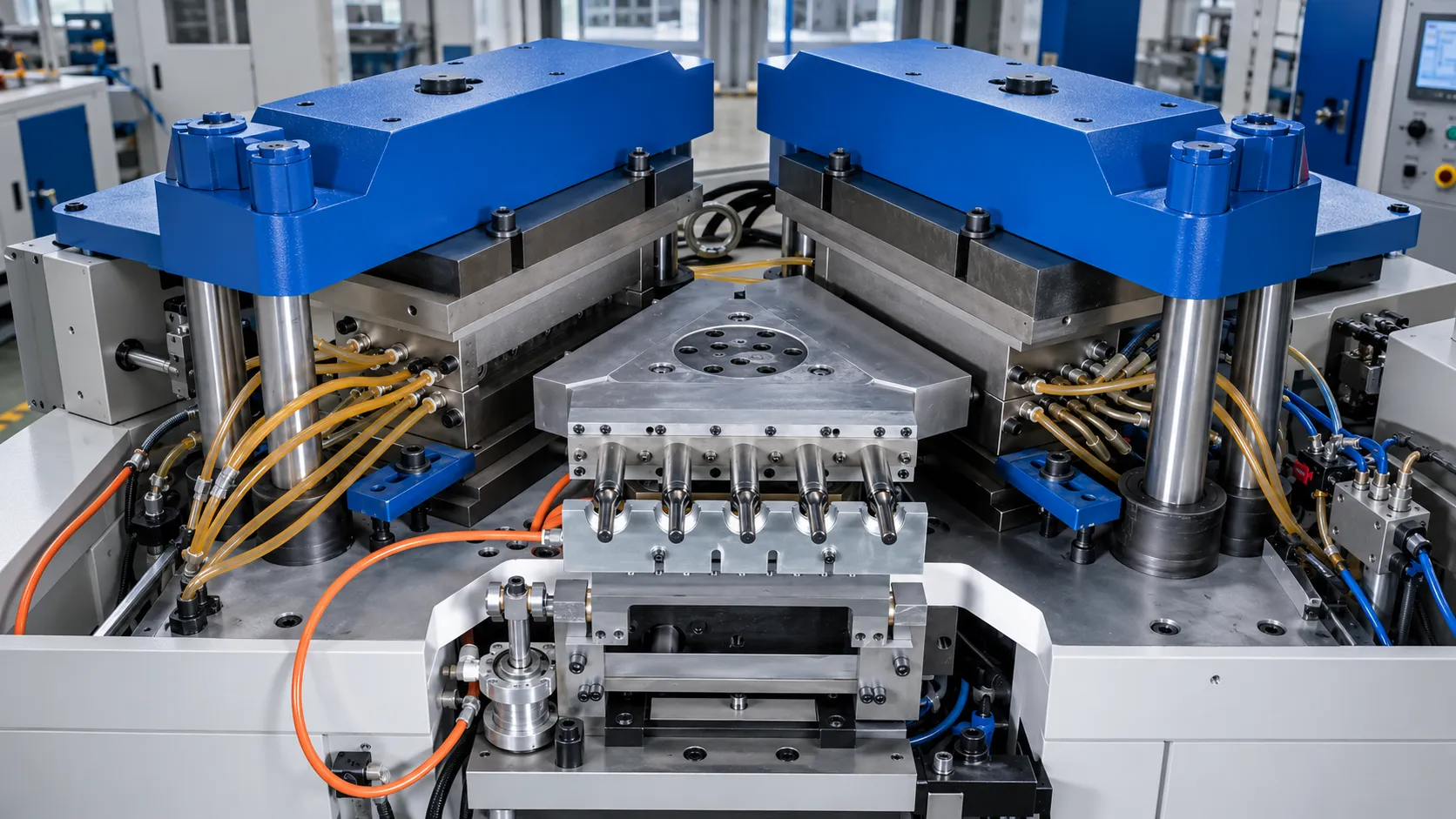
The stretch rod is the mechanical element that physically separates ISBM from IBM. In ISBM, the stretch rod descends into the preform at the blow station before blow air is introduced, mechanically elongating the preform axially at a controlled stretch ratio (typically 2.5–3.5× for PET) while the machine simultaneously introduces pre-blow air to begin radial expansion. The stretch rod tip maintains contact with the inside of the preform base throughout the blow phase, ensuring that the axial stretch continues as the preform expands radially — achieving biaxial stretch ratios of 4.5–5.5× combined in premium ISBM PET production.
The stretch rod’s presence imposes requirements on the preform geometry that IBM preforms do not have. ISBM preforms for PET must be designed to maintain uniform temperature along their length before stretching — uneven temperature causes the stretch to localise at the warmest (lowest viscosity) zone rather than distributing uniformly, producing thin spots in the finished bottle wall. The conditioning station on 4-station ISBM machines (an additional station between injection and blow not present on standard 3-station ISBM) allows the preform to be reheated and temperature-profiled before the blow station — giving the operator precise control over the temperature gradient along the preform that determines stretch uniformity in the finished bottle. IBM’s 3-station architecture has no conditioning station: the preform goes directly from injection to blow, using the residual injection heat. This works correctly for HDPE and PP (which do not require precise orientation temperature control) but cannot achieve the temperature uniformity required for high-quality PET biaxial orientation in IBM machines designed for HDPE and PP.
For Korean packaging engineers, this means that an IBM machine designed for HDPE pharmaceutical containers is not a viable platform for crystal-clear PET cosmetic bottles — not because IBM cannot mechanically process PET, but because IBM’s process architecture cannot achieve the temperature control and stretch rod mechanism that PET orientation requires to produce commercially acceptable haze and mechanical properties. Similarly, an ISBM machine designed for PET cosmetic bottles is not the correct choice for HDPE pharmaceutical containers — the PET-optimised temperature ranges and stretch rod mechanism that ISBM requires are unnecessary complexity for HDPE, and the ISBM machine’s maximum cavity count (12 for the HGY series) is significantly below IBM’s 30-cavity ceiling at pharmaceutical 10 ml format.
4. Output Rate, Cavity Count and Volume Range
IBM and ISBM produce different output rates at the same container format because they serve different cavity count architectures. IBM’s pharmaceutical-targeted multi-cavity approach (up to 30 cavities at 10 ml) produces the highest IBM output in the Korea Ever-Power range; ISBM’s PET-targeted architecture at up to 12 cavities for small formats serves a different output scale. At mid-to-large formats (100 ml+), the cavity count difference narrows and the machines operate at more comparable output rates.
IBM at 10 ml (ZQ series)
- ZQ40: 9 cavities → ~7,100 bottles/hour
- ZQ60: 14 cavities → ~11,100 bottles/hour
- ZQ80: 20 cavities → ~15,800 bottles/hour
- ZQ110: 24 cavities → ~19,000 bottles/hour
- ZQ135: 30 cavities → ~23,800 bottles/hour
ISBM at 10 ml (HGY series)
- HGY150-V4: 6–8 cavities → ~5,400–7,200 bottles/hour
- HGY200-V4: 8–12 cavities → ~7,200–10,800 bottles/hour
- HGY250-V4: up to 12 cavities → ~10,800 bottles/hour
- Note: ISBM 10ml is less common — PET ISBM is typically ≥30ml for serum formats
Volume range also differs: IBM’s effective range is 1–2,000 ml, with the 1 ml lower limit making IBM the only blow molding process for Korean micro-pharmaceutical containers. ISBM’s practical lower limit is approximately 10–15 ml for the HGY series (smaller than this, stretch rod stability at the reduced preform diameter makes consistent orientation difficult). At the 10 ml format — the most common Korean pharmaceutical ophthalmic container size — IBM at 30 cavities outproduces ISBM at 12 cavities by approximately 2.2 to 1, making IBM the unambiguous process choice for Korean pharmaceutical volume production at small formats.
5. Korean Application Mapping: IBM vs ISBM by Industry
| Korean Application | IBM | ISBM | Deciding Factor |
|---|---|---|---|
| HDPE pharmaceutical containers (10–100ml) | ✓ IBM | — | HDPE does not need orientation · IBM: up to 30 cavities · GMP native |
| Crystal-clear PET cosmetic serum (15–50ml) | — | ✓ ISBM | PET requires biaxial orientation for haze ≤1.5% clarity |
| ABS wide-mouth cosmetic cream jar (50–250ml) | ✓ IBM | — | ABS does not require orientation · Wide-mouth IBM native capability |
| Korean shampoo / conditioner HDPE (250–1,000ml) | ✓ IBM | — | HDPE native IBM · Higher cavity count than ISBM at 500ml |
| Korean PET mineral water / CSD (330–500ml) | — | ✓ ISBM | PET clarity and CO₂ barrier require biaxial orientation |
| Korean food wide-mouth jar HDPE/PP (100–500ml) | ✓ IBM | Secondary | HDPE/PP wide-mouth IBM native · ISBM possible for PETG clarity formats |
| Korean luxury fragrance bottle PET (30–100ml) | — | ✓ ISBM | Crystal PET clarity and ethanol resistance require biaxial orientation |
6. Wide-Mouth Jars: IBM’s Native Advantage Over ISBM
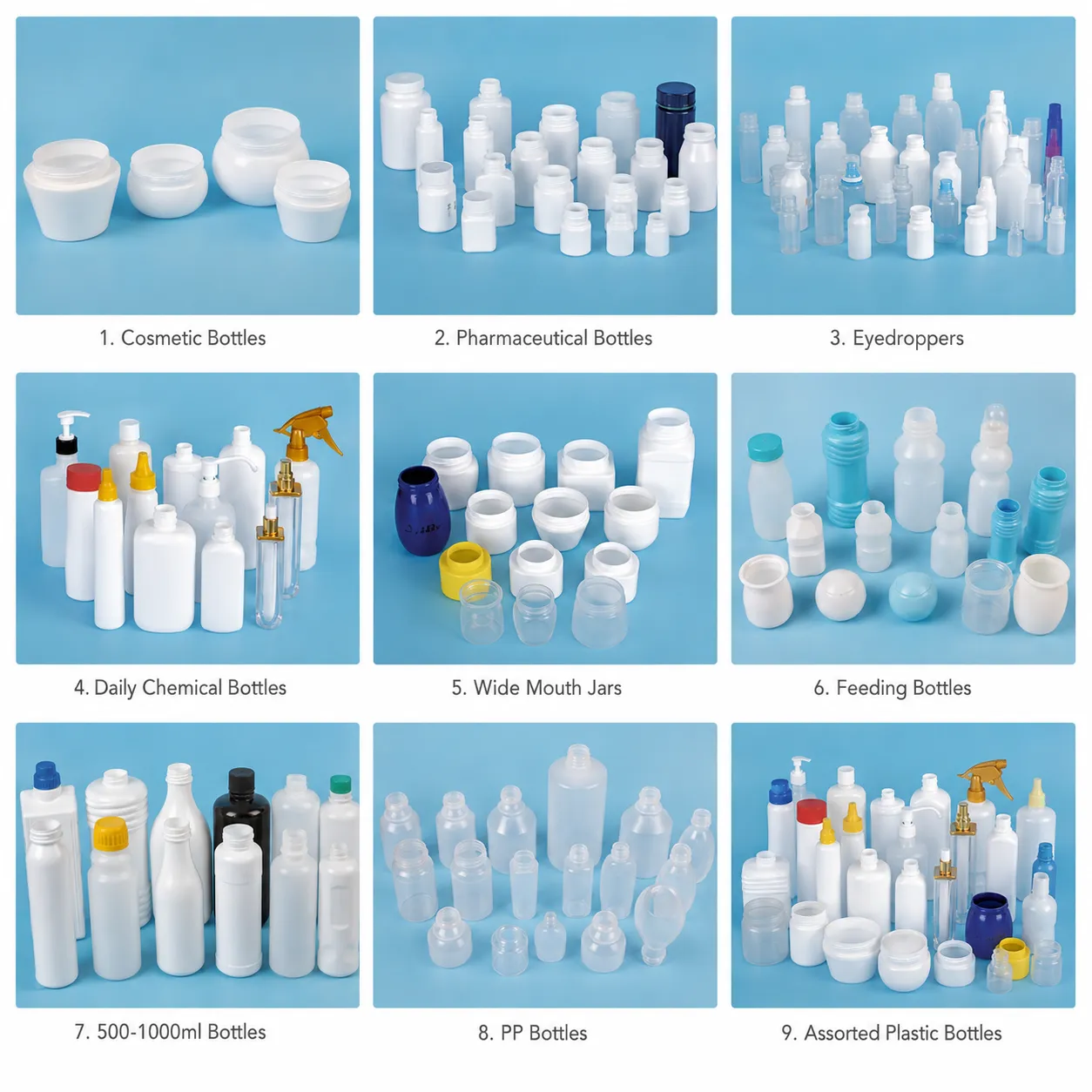
Wide-mouth jars — containers where the neck inner diameter is ≥30 mm and the ratio of mouth diameter to body diameter is ≥0.5 — are IBM’s most unambiguous advantage over standard 3-station ISBM. In IBM, the core rod defines the neck geometry and the preform is inflated radially to fill the blow mould body cavity. Wide-mouth jars simply require a larger core rod and a wider blow cavity — there is no process constraint on how wide the mouth can be relative to the body. Korea Ever-Power’s ZQ series IBM machines produce wide-mouth jars at 8-cavity 250 ml in ABS and PP as routine production formats, and at 5-cavity 500 ml and 3-cavity 1,000 ml for Korean food-grade HDPE wide-mouth container production.
Standard 3-station ISBM machines face a geometric constraint on wide-mouth production: the stretch rod must be retracted from inside the bottle after the blow phase, and as the mouth diameter approaches the body diameter, the stretch rod’s retraction path becomes constrained by the wide neck — particularly for containers with shoulder profiles that narrow significantly below the wide mouth. This constraint requires 4-station ISBM machines (with a dedicated conditioning station that allows wider preforms to be conditioned at higher temperatures to reduce stretch resistance) for wide-mouth PET container production, adding machine cost and complexity versus IBM’s native wide-mouth architecture. For Korean ABS and PP wide-mouth cosmetic jars, IBM at lower machine cost, higher cavity count and without the conditioning station investment is the commercially superior choice. The EP-ZQ80 at 10-cavity 250 ml ABS wide-mouth jar is the most common Korean K-Beauty cream jar IBM configuration — the 1,100 KN clamping force at this cavity count prevents flash at the wide-mouth parting line at standard ABS injection pressure.
7. Korean Cosmetics: The IBM-ISBM Overlap Zone

Korean cosmetics is the product sector where IBM and ISBM are most commonly misunderstood to be alternatives rather than complements. The confusion arises because Korean K-Beauty cosmetic packaging uses both processes for products that sit on the same Korean department store shelf. A Korean serum ampoule in crystal-clear PET (ISBM) sits next to a Korean cream in an opaque ABS wide-mouth jar (IBM) in the same product lineup — both are cosmetic packaging, both have injection-moulded necks, and both are produced by Korea Ever-Power. The process that produced each container is determined entirely by the container’s material specification, not by the cosmetic product category.
For Korean cosmetic packaging engineers specifying a new product line, the process decision follows the material: ABS, PP or PCTG opaque jars → IBM; crystal-clear PET or PETG serum ampoules → ISBM. The only genuine process overlap in Korean cosmetics is PCTG containers — PCTG can be processed in both IBM (as a non-oriented container with good clarity) and ISBM (as an oriented container with higher clarity). For PCTG, the choice is output rate (IBM’s higher cavity count) versus clarity (ISBM’s orientation-enhanced transparency). Korean cosmetic brands whose PCTG container specification requires haze ≤1.5% need ISBM; those whose specification accepts haze ≤3% can use IBM and benefit from IBM’s higher output rate and lower machine cost per unit.
8. Decision Framework and Running Both Platforms
The IBM vs ISBM decision simplifies to a single primary question and one secondary question for Korean factories. The primary question resolves the process for 90% of applications without further analysis.
Primary Question: What is the container material?
HDPE, PP, ABS, PS, LDPE, EVA → IBM. These materials do not require orientation; IBM’s higher cavity counts serve them more efficiently than ISBM.
PET, PETG, Tritan, PC (transparent) → ISBM. These materials require biaxial orientation to achieve their characteristic clarity, barrier and strength properties; ISBM’s stretch rod is structurally necessary.
Secondary Question: Is the container a wide-mouth jar or a small-format (<10 ml) container?
Wide-mouth jar (mouth/body ratio ≥0.5) in any material → IBM preferred. IBM’s native wide-mouth capability avoids the conditioning station complexity that ISBM wide-mouth requires.
Less than 10 ml in any transparent material → IBM only. ISBM cannot reliably process formats below 10–15 ml; IBM at 1 ml is the only option.
Korea Ever-Power manufactures both the ZQ series injection blow molding machines and the HGY series 4-station ISBM machines. Korean packaging factories whose product range spans HDPE pharmaceutical containers and crystal-clear PET cosmetic bottles — a common profile for Korean contract packaging companies serving both pharmaceutical and cosmetic clients — operate both platforms on the same Korean factory floor. The shared infrastructure between IBM and ISBM (compressed air, cooling water, 380V electrical supply, Korean safety guarding standards) makes co-location straightforward. Operator training tracks are separate — IBM and ISBM process parameters differ significantly — but Korea Ever-Power provides integrated training for Korean factories commissioning both platforms simultaneously. For a Korean contract packaging factory adding its second process type (adding IBM to an existing ISBM line, or adding ISBM to an existing IBM line), Korea Ever-Power’s applications engineering team provides a combined production planning consultation covering machine placement, utility distribution, mould management and the production scheduling logic for alternating both process types across the same Korean production calendar.
Frequently Asked Questions
IBM and ISBM Enquiry
Choosing Between IBM and ISBM for Your Korean Packaging Line?
Korea Ever-Power manufactures both the ZQ series IBM machines and the HGY series ISBM machines. Our application engineers provide combined IBM vs ISBM selection analysis, material compatibility review and production cell planning for Korean packaging factories at all scales.
Related Resources
EP-ZQ60 Injection Blow Molding Machine
600 KN · 14 cavities at 10 ml · Korean mid-scale pharmaceutical and household chemical IBM platform · Zero flash · 3+N barrel zones.
EP-ZQ135 Injection Blow Molding Machine
1,350 KN · 30 cavities at 10 ml · 6+N barrel zones · 37+37 KW dual hydraulic · Korean mega-scale pharmaceutical IBM — 83M units per year per machine.
IBM vs EBM: 12 Key Differences
12-factor comparison of injection blow molding and extrusion blow molding — neck precision, flash, wall thickness, output rate, Korean pharmaceutical GMP and factory economics.