
IBM WALL THICKNESS · BLOW RATIO · WALL DISTRIBUTION · KOREA EVER-POWER ZQ SERIES
IBM Wall Thickness Guide:
Container Wall Engineering Reference
IBM container wall thickness is determined by the preform wall, blow ratio and material at each zone of the container body — from the injection-formed neck through the blown shoulder, body and base. This guide covers minimum wall specifications by material and format, blow ratio calculation, wall distribution measurement methods and the wall engineering decisions that determine IBM container structural performance, cosmetic quality and filling line compatibility across the Korea Ever-Power ZQ series product range.
كوريا إيفر باور · مدينة أنسان، مقاطعة غيونغي · يوليو 2026
ENGINEERING REFERENCE · IBM WALL THICKNESS KEY VALUES
PHARMA MINIMUM
0.55 mm
HDPE/PP IBM pharmaceutical 5-30 ml — minimum wall at body zone for Korean MFDS container integrity
COSMETIC MINIMUM
0.60 مم
PP/HDPE IBM cosmetic 10-100 ml — Korean K-beauty brand standard body wall minimum for consumer feel
LUXURY ABS MINIMUM
0.65 mm
ABS IBM luxury cosmetic — minimum wall for Korean dept store rigid feel consumer assessment at finger-squeeze test
INDUSTRIAL MINIMUM
0.80 mm
HDPE IBM industrial 200-500 ml — stacking load, repeated handling and Korean retail shelf column compression minimum
القسم 1
IBM Wall Thickness Fundamentals
IBM container wall thickness is not a single value — it varies by zone (neck, shoulder, body, base) because the IBM process produces each zone differently. The neck and base are injection-moulded at the preform wall thickness with essentially no subsequent material stretching. The shoulder and body are blown from the preform, with the blow inflation ratio determining how much the preform wall thins to produce the final container wall at each blown zone. Understanding wall thickness requires understanding both the preform geometry and the blow ratio at every container zone.
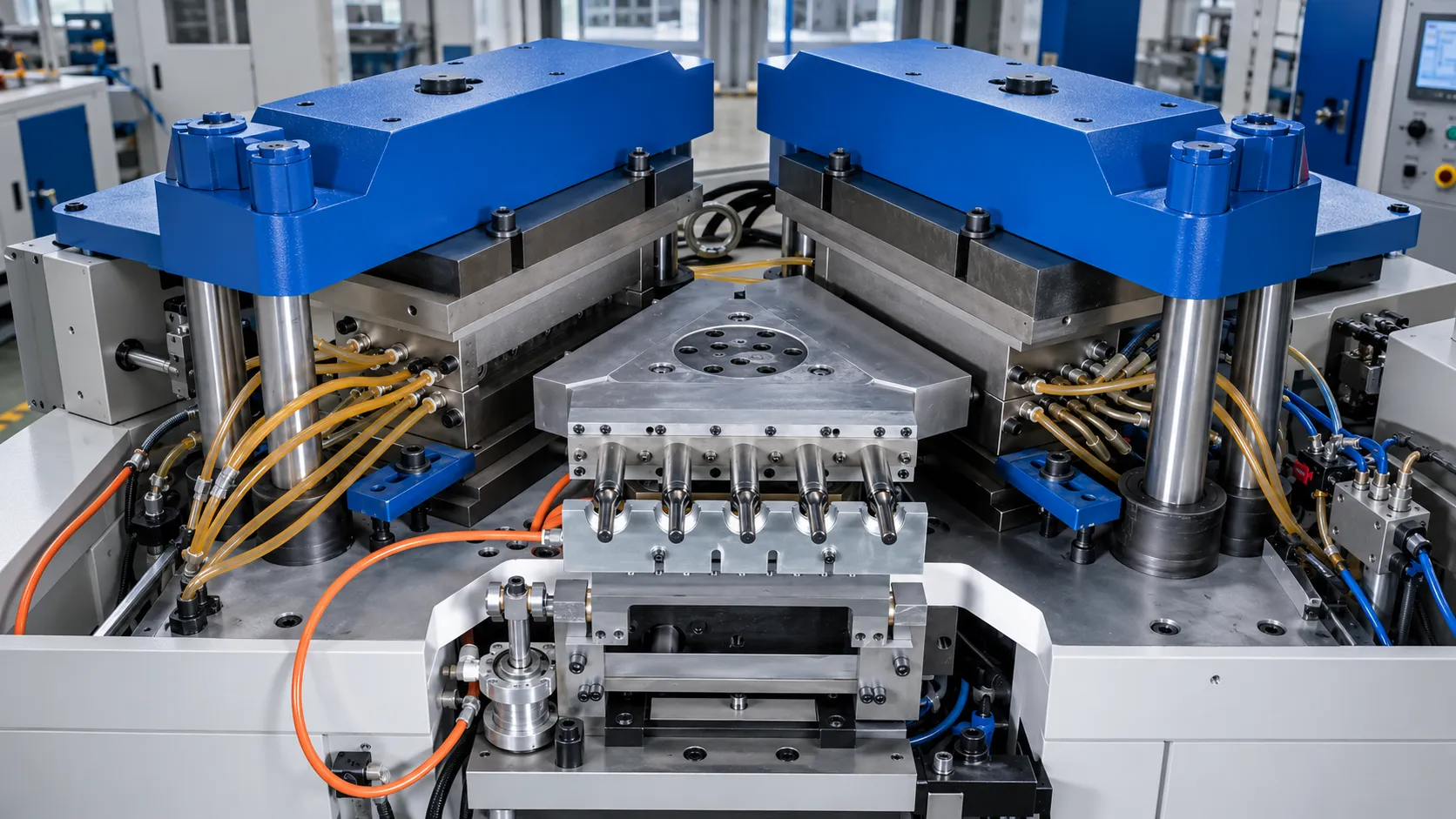
IBM CONTAINER WALL ZONES — CHARACTERISTICS AND TYPICAL THICKNESS RANGES
منطقة الرقبة
Injection-moulded. Wall equals preform neck wall (typically 1.2-3.0 mm for thread and sealing land zones). No blow inflation. Thickest zone of container.
Thread engagement: 1.5-3.0 mm. Sealing land: 1.0-1.8 mm.
منطقة الكتف
Blown from preform shoulder. Higher blow ratio than body (preform OD to container shoulder OD transition). Thinnest zone risk. Must exceed minimum wall specification.
Typical: 0.50-0.90 mm finished. Preform shoulder biased thicker to compensate.
منطقة الجسم
Blown from preform body at body blow ratio. IBM body blow ratio is the primary determinant of finished body wall thickness. Target wall is specified here for each application.
Typical: 0.55-1.20 mm finished depending on format and application.
المنطقة الأساسية
Injection-moulded base. Wall equals preform base wall (1.5-4.0 mm). No blow inflation. IBM base provides flat, stable container base with zero flash trim line.
Base wall: 1.5-4.0 mm. Gate mark: ±0.1 mm raised nub (accepted by all Korean container standards).
القسم 02
Blow Ratio and Preform Wall Calculation
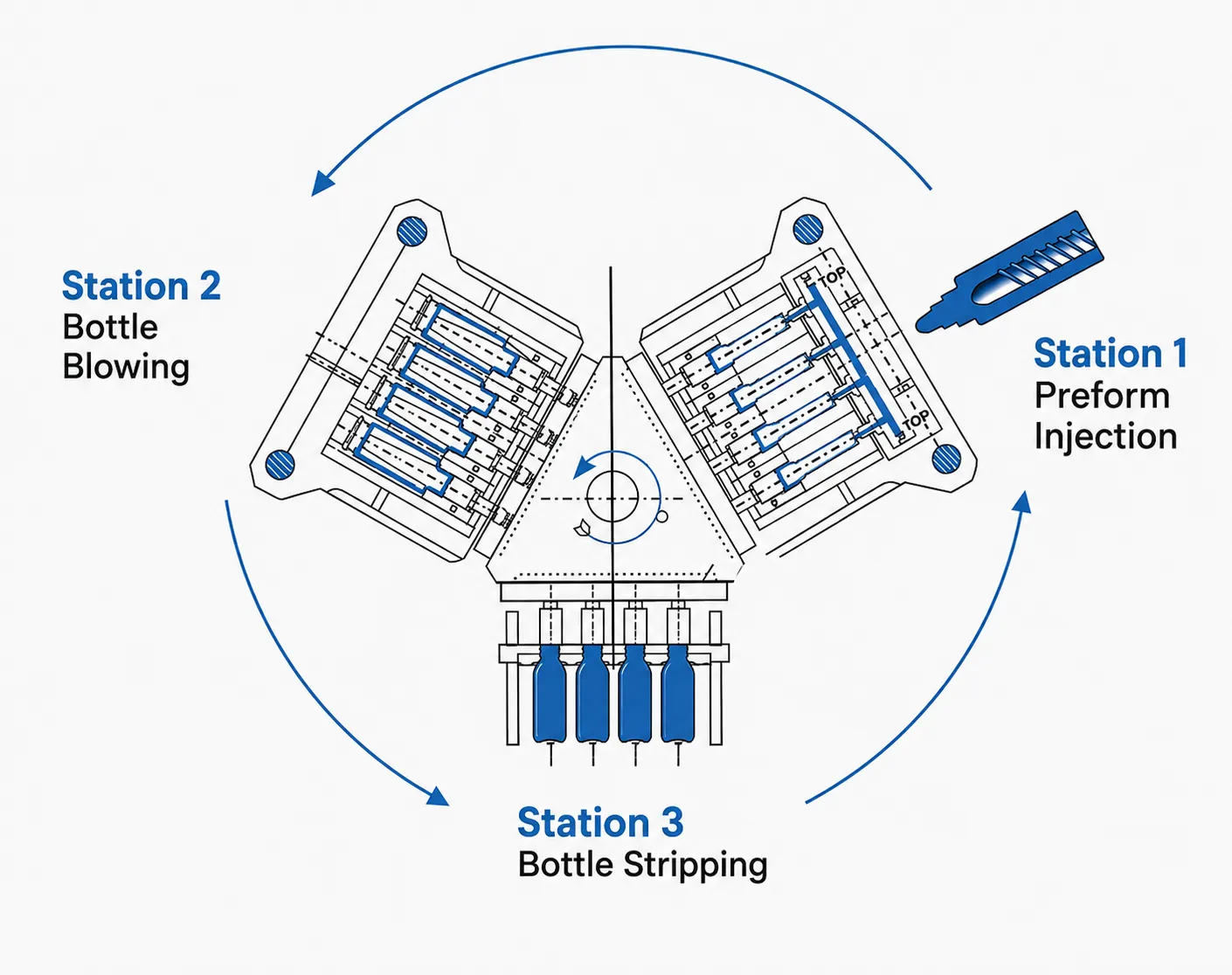
BLOW RATIO AND PREFORM WALL CALCULATION — KEY RELATIONSHIPS
Body Blow Ratio Formula
BR = Dₛ / Dₚ
Dₛ = container body OD (mm). Dₚ = preform body OD (mm). IBM body OD = preform OD on core rod at blow station. Typical IBM body BR: 1.0x to 2.5x.
Finished Wall from Preform Wall
tᵢ = tₚ / BR
tᵢ = finished container body wall (mm). tₚ = preform body wall (mm). Example: preform wall 1.0 mm at BR 1.6x = finished wall 0.625 mm.
Required Preform Wall
tₚ = tᵢ × BR
Used in mould design to set preform wall for target finished wall. Example: target wall 0.65 mm at BR 1.8x = preform wall 1.17 mm (round up to 1.20 mm for design margin).
Shoulder Blow Ratio
BRₛ = Dₛ / Dₙ
Dₙ = neck OD. Shoulder BR is always higher than body BR since the shoulder expands from the narrow neck OD to the full body OD. Shoulder zone requires additional preform wall bias to prevent shoulder thinning below minimum.
| تنسيق الحاوية | BODY BR | PREFORM WALL | FINISHED WALL | ملحوظات |
|---|---|---|---|---|
| 5 ml serum vial (OD 14mm, neck 13mm) | 1.08x | 0.65-0.70 mm | 0.60-0.65 mm | Near 1:1 body blow. Shoulder BR is high (neck 13mm to body 14mm over short height) |
| 30 ml eye cream jar (OD 42mm, neck 38mm) | 1.25x | 0.85-0.90 mm | 0.68-0.72 mm | Wide-mouth jar. Lower BR than standard bottle. ABS cosmetic IBM standard. |
| 100 ml toner bottle (OD 45mm, neck 24mm) | 1.88x | 1.10-1.20 mm | 0.58-0.64 mm | Typical Korean cosmetic toner IBM. PP RCP IBM at mould 55-70°C. |
| 250 ml lotion pump bottle (OD 62mm, neck 24mm) | 2.58x | 1.80-1.95 mm | 0.70-0.75 mm | Highest BR in Korean cosmetic IBM range. Thick preform needed to hit 0.70 mm minimum at body. |
القسم 03
Minimum Wall Specifications by Material and Application
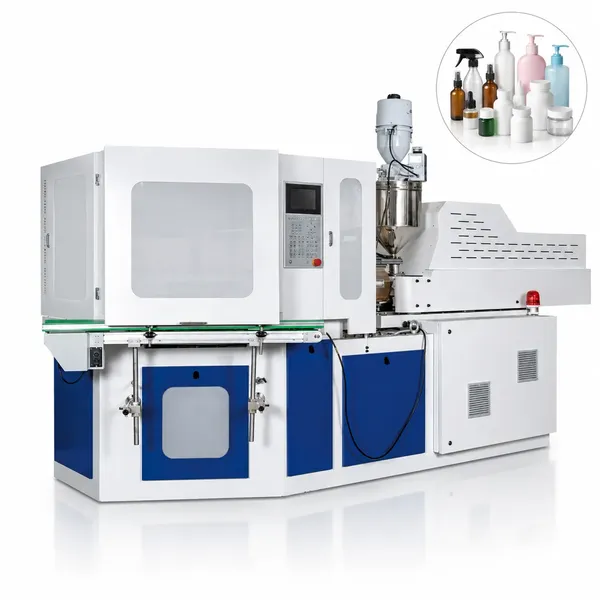
Korea Ever-Power ZQ40 verifies minimum wall thickness at production trial using ultrasonic wall thickness gauge on 3 containers per cavity at 8 measurement points per container before Korean customer delivery approval. Minimum wall verification is a mandatory Korea Ever-Power pre-delivery quality protocol for all IBM container production, with wall report issued as part of the standard Korea Ever-Power quality documentation package. The IBM machine selection guide covering ZQ model output data is at the IBM machine selection guide.
| MATERIAL | PHARMA (5-30 ml) | COSMETIC (10-100 ml) | PUMP BOTTLE (150-500 ml) | INDUSTRIAL (100-500 ml) |
|---|---|---|---|---|
| البولي إيثيلين عالي الكثافة | 0.55 mm | 0.60 مم | 0.70-0.80 مم | 0.80-1.00 mm |
| PP RCP | 0.55 mm | 0.55-0.65 mm | 0.65-0.75 mm | 0.75-0.90 mm |
| أب | غير متوفر | 0.65-0.70 mm | 0.70-0.80 مم | 0.75-1.00 mm |
| البولي إيثيلين منخفض الكثافة | 0.55-0.65 mm | 0.60-0.70 mm | 0.70-0.80 مم | 0.75-0.90 mm |
| EVA / PHA / PLA | 0.55-0.65 mm | 0.55-0.65 mm | 0.65-0.75 mm | 0.75-0.90 mm |
القسم 04
Wall Distribution Across IBM Container Zones
شركة آي بي إم wall distribution is the pattern of wall thickness variation from neck to base across all container zones. An ideal IBM container has uniform body wall at the target thickness, with adequate shoulder wall above the minimum, and injection-formed neck and base at preform wall thickness. Non-uniform wall distribution — specifically shoulder thinning at the shoulder-body transition zone — is the primary IBM structural defect that causes container failure during Korean filling line capping, Korean retail stacking and Korean consumer handling.
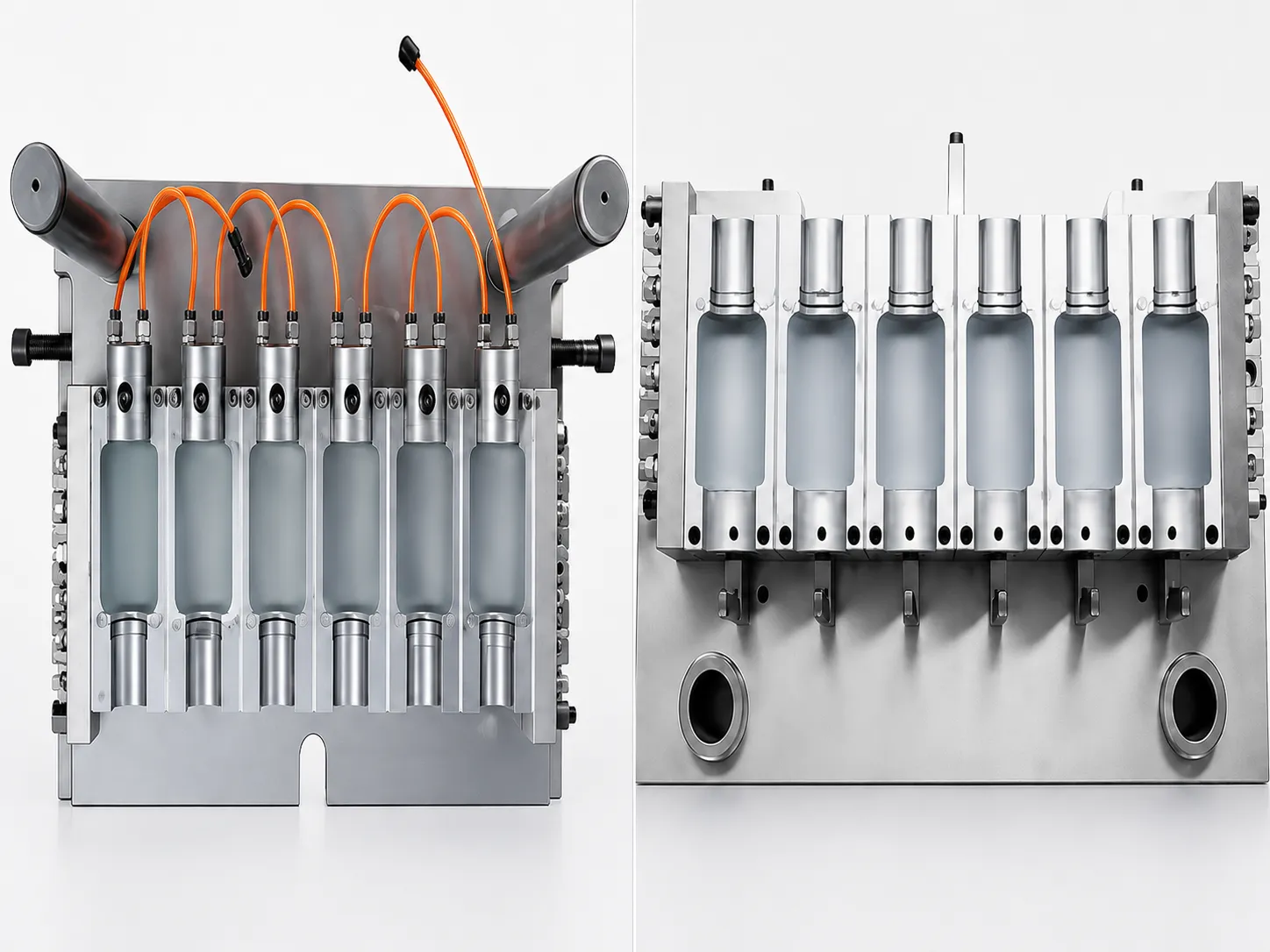
IBM WALL DISTRIBUTION TARGET SPECIFICATION — 100ml TONER BOTTLE PP RCP (body OD 45mm, neck 24mm)
Neck (injection)
1.80 mm
Thread zone. No blow inflation.
Shoulder (blown)
0.62-0.70 mm
Highest risk zone. Preform shoulder biased +30% vs body preform wall.
Body mid (blown)
0.60-0.68 mm
Target zone. 1.15 mm preform wall ÷ 1.88 BR = 0.61 mm nominal.
Base (injection)
2.20 mm
Injection-formed. Full base stability.
القسم 5
Wall Thickness Measurement Methods
Ultrasonic Wall Gauge (Production)
Non-destructive. Probe applied to container exterior surface — ultrasonic pulse reflected from inner wall surface, time-of-flight converted to wall thickness using material acoustic velocity. Accuracy ±0.02 mm for HDPE, PP, ABS at 0.5-3.0 mm wall range. Korea Ever-Power standard: measure 8 points per container (4 axial heights x 2 diametrically opposed radial positions) per cavity at pre-delivery production trial. Fastest method for production QC at 3 containers per cavity.
Cross-Section Destructive Cut (Development)
Destructive. Container sectioned at specific axial heights with diamond or carbide saw, then wall measured with calibrated optical microscope or calibrated digital caliper under magnification. Accuracy ±0.01 mm for all IBM materials. Used at mould qualification stage and when ultrasonic gauge cannot resolve thin walls below 0.45 mm. Korea Ever-Power performs destructive cross-section on 2 containers per cavity at initial mould qualification trial to map complete wall distribution profile before confirming mould design.
Weight-Based Estimation (Screening)
Non-destructive. Container weight measured on 0.001 g precision balance. Weight divided by material density x container surface area gives average wall thickness estimate. Accuracy ±0.05-0.10 mm (average only, no zone information). Useful for rapid production monitoring of container weight consistency as a proxy for average wall consistency. Korea Ever-Power uses weight measurement as an ongoing production batch QC screening method between the detailed ultrasonic measurements taken at production trial and periodic QC audits.
القسم 6
IBM Wall vs EBM Wall: Structural Performance Comparison
IBM’s injection-formed base and neck provide structural advantages versus EBM containers that directly affect Korean filling line and Korean retail performance. The IBM vs EBM comparison covering the full process and application context is at the IBM vs EBM comparison guide.
| STRUCTURAL CRITERION | شركة آي بي إم | الطب المبني على البراهين |
|---|---|---|
| Base structural integrity | Injection-formed, 1.5-4.0 mm, no weld line | Pinch weld, thinned zone, stress concentration |
| Neck wall consistency | مصبوب بالحقن بقطر خارجي ±0.05 مم | Blown ±0.15-0.30 mm OD |
| Body wall variation | ±10-15% at body zone | ±20-35% at body zone |
| Minimum achievable wall (body) | 0.45-0.55 mm (pharmaceutical IBM) | 0.55-0.75 mm typical (EBM wall variation risk at thinner walls) |
| ESCR performance | Superior (no weld line stress concentration) | Lower (pinch weld stress concentration site for ESCR initiation) |
أسئلة وأجوبة في الهندسة
Wall Thickness IBM — Engineering Questions
س 01
What is the maximum blow ratio IBM can achieve while maintaining minimum wall specification?
IBM maximum blow ratio depends on material, preform wall thickness and minimum wall specification. For HDPE and PP RCP IBM, the practical maximum body blow ratio is approximately 2.8-3.0x when the preform body wall is designed sufficiently thick (2.0-2.2 mm) to maintain the minimum 0.70 mm finished wall at the 2.8x BR. Above 3.0x body BR, material orientation effects in the blown wall (biaxial stress whitening in HDPE, orange-peel surface texture in PP) become unacceptable for Korean cosmetic brand quality standards. ABS IBM maximum blow ratio is 2.0-2.2x — ABS higher rigidity and lower elongation at break means ABS preform walls crack or produce stress whitening at blow ratios above 2.2x. LDPE and EVA IBM achieve the highest blow ratios (up to 3.5-4.0x for LDPE at pharmaceutical small formats) because their high elongation and low elastic modulus allow the preform wall to stretch without stress whitening or cracking. The practical limit for Korean cosmetic IBM at commercially acceptable wall quality is 2.5x body BR for PP/HDPE and 2.0x for ABS — exceeding these limits requires either a thicker preform (adding material cost and cycle time) or accepting a smaller body OD relative to neck OD in the container design.
س 02
How does Korea Ever-Power compensate for shoulder thinning in tall narrow IBM containers?
Korea Ever-Power addresses shoulder thinning in tall narrow IBM containers (serum vials, toner bottles with high OD/height aspect ratio) through three preform design techniques applied in combination. Shoulder wall bias: the preform injection mould is designed with a tapered shoulder zone where the preform wall is 20-35% thicker at the shoulder than at the body. This extra shoulder preform wall compensates for the higher shoulder blow ratio — the shoulder blows thinner per unit preform wall but starts with more preform wall, producing a finished shoulder wall close to the target body wall. Gate-side bias: in IBM preform design, the gate (injection point at the base) introduces a slight axial wall gradient where the preform wall is slightly thicker at the gate end (base) and thinner at the open end (neck). For tall containers, the gate-side bias can be adjusted to push more material toward the shoulder zone by modifying the core rod taper angle. Shoulder radius engineering: the preform shoulder transition radius (the curved zone where the preform body transitions to the neck at the shoulder) is designed with a specific radius to control the rate of preform wall thinning during blow inflation. A larger shoulder radius (12-18 mm for a 100 ml toner bottle) distributes the shoulder blow inflation over a longer transition height, reducing the localised thinning at the shoulder-body junction that produces the weakest zone in Korean cosmetic IBM containers.
س 03
Why is the IBM base wall always thicker than the body wall and what is the minimum acceptable base wall?
The IBM base wall is always thicker than the body wall because the base is injection-moulded at the preform base wall thickness without any subsequent blow inflation — the base preform wall (1.5-4.0 mm) remains essentially unchanged from injection to the finished container. The body wall is the preform body wall thinned by the blow ratio. IBM base wall thickness serves four structural functions. First, base flatness: the thick injection-formed base provides the geometric flatness (base flatness ±0.15 mm specification for Korean cosmetic IBM) that IBM containers require for stability on Korean cosmetic filling lines and Korean retail display. A thinner base would deflect under container internal pressure and filling line conveyor vibration. Second, gate mark accommodation: the IBM injection gate is located at the container base centre — the gate nub (raised ±0.1 mm injection gate mark) sits within the base thickness without affecting base flatness. Third, ESCR base performance: HDPE IBM pharmaceutical and household containers require adequate base wall thickness to resist ESCR at the base zone where formulation pooling can concentrate surfactant stress on the container base wall. Fourth, drop impact resistance: the thick injection base resists drop impact at the base-body junction (the highest-stress zone in a dropped container). Minimum acceptable base wall: 1.5 mm for Korean cosmetic IBM containers at 10-100 ml; 2.0 mm for Korean pharmaceutical HDPE IBM; 2.5-3.0 mm for Korean industrial HDPE IBM at 200-500 ml. Below these minimums, base deflection under Korean filling line vacuum-capping pressure or Korean retail stacking load produces visible container base distortion.
س 04
What body wall thickness does Korea Ever-Power specify for Korean MFDS ophthalmic LDPE IBM containers and why?
Korea Ever-Power specifies 0.55-0.65 mm body wall for Korean MFDS ophthalmic LDPE IBM containers at 5-15 ml format. This specification is set by four LDPE ophthalmic functional requirements rather than by minimum IBM wall capability (which could produce walls as thin as 0.35 mm for LDPE at small formats). Elastic recovery: LDPE at 0.55-0.65 mm wall produces 95%+ elastic recovery after 30% volume displacement squeeze at 23°C — the multi-use ophthalmic container return-to-shape property that prevents air ingress at the dropper tip. Below 0.50 mm, LDPE recovery time increases to 1.5-2.0 seconds (above the 1.0 second Korean MFDS elastic recovery specification). Drop impact: Korean MFDS ophthalmic container 1.2m drop test requires the container to survive without body fracture at ambient temperature. LDPE at 0.55 mm wall passes the 1.2m drop test at 23°C; LDPE at 0.45 mm wall fails the drop test at lower ambient temperatures (10°C Korean winter pharmacy dispensing conditions). Consumer squeeze force feel: Korean pharmacist and Korean patient assessment of ophthalmic LDPE IBM containers at Korean pharmacy dispensing — containers perceived as too soft (below 0.55 mm) are associated with lower quality product perception by Korean pharmacists. Sterilisation integrity: LDPE IBM ophthalmic containers subjected to EtO sterilisation must maintain dimensional integrity at sterilisation conditions (temperature 55°C, pressure cycles). LDPE at 0.55 mm wall maintains dimensional stability through EtO sterilisation; LDPE below 0.50 mm may deform under EtO sterilisation pressure cycling.
س 05
How does wall thickness affect IBM container cycle time and what is the practical thickness-speed trade-off?
IBM container wall thickness directly affects cycle time through the cooling time component: thicker preform walls require longer cooling time at the injection station before the preform is sufficiently solidified to transfer to the blow station without distortion. The relationship is approximately proportional to the square of preform wall thickness — doubling the preform wall quadruples the cooling time required, significantly increasing cycle time and reducing ZQ machine output per hour. In practical Korean IBM production, the preform body wall range is typically 0.80-2.20 mm for Korean cosmetic and pharmaceutical containers — producing body blow ratios of 1.0-2.6x at the target container OD. Within this range, a 0.20 mm increase in preform wall thickness (e.g. from 1.00 to 1.20 mm) increases IBM cycle time by approximately 0.3-0.5 seconds (6-10% at a 5.0 s base cycle) due to extended injection station cooling time. The practical trade-off for Korean IBM production: increasing preform wall from the minimum required for the target finished wall adds unnecessary material cost (higher shot weight) and reduces ZQ machine output per hour. Korea Ever-Power engineers the preform wall to the minimum required for each container format and application, balancing finished wall specification, material cost and ZQ machine cycle time optimisation. Over-engineering the preform wall — a common mistake in IBM container development — adds 10-20% unnecessary material cost and 8-15% cycle time penalty, reducing ZQ machine annual container output by a proportional amount and increasing Korean customer container unit cost unnecessarily.
س 06
What cavity-to-cavity wall variation is acceptable across a ZQ40 multi-cavity IBM tool?
Korea Ever-Power accepts cavity-to-cavity body wall variation of ±0.08 mm across a ZQ40 multi-cavity IBM tool set (8-12 cavities for small formats) as the production quality standard, measured at the mid-body point by ultrasonic gauge on 3 containers per cavity at pre-delivery trial. This ±0.08 mm cavity-to-cavity variation standard reflects the injection moulding process variation sources: slight preform shot weight variation between cavities (±2% weight = ±0.02 mm wall contribution at 1.5x BR), minor cavity dimension variation from mould manufacturing tolerances (±0.03 mm on P20 steel injection mould at Korea Ever-Power toolroom specification), and hot runner or cold runner melt flow imbalance between cavities (±0.03 mm wall contribution for an 8-cavity tool with balanced runner system). For Korean pharmaceutical IBM where wall consistency directly affects Korean MFDS drop volume specification or elastic recovery specification, Korea Ever-Power tightens the cavity-to-cavity wall variation to ±0.05 mm on request — achieved through hot runner flow balancing simulation during mould design, individual cavity weight verification at production trial (all cavities within ±1.5% of mean shot weight), and ultrasonic wall measurement at 3 axial heights per cavity rather than 1. Korean luxury cosmetic ABS IBM brands specifying colour consistency across cavities at Delta E ≤1.0 also benefit from the tighter ±0.05 mm cavity wall specification, as wall thickness variation causes colour depth variation through the container body in pigmented ABS IBM containers (thicker wall = deeper colour; variation above ±0.08 mm produces visible colour variation between cavities in opaque white or matte black ABS containers).
IBM WALL THICKNESS ENQUIRY · KOREA EVER-POWER
Need IBM Wall Thickness Engineering Support?
Korea Ever-Power provides IBM wall thickness engineering for new container designs — preform wall calculation, blow ratio analysis, wall distribution simulation and ultrasonic measurement verification for all ZQ series IBM materials and formats.
المحرر: Cxm