
ORIGIN-LEVEL COMPARISON
Korean vs Chinese ISBM Machines: Quality, Cost and Delivery Reality
Chinese ISBM manufacturers have scaled capacity aggressively in the past decade, offering competitive pricing that attracts cost-sensitive buyers globally. Korean manufacturers occupy a distinct middle position between Japanese premium and Chinese budget segments. This guide examines quality, cost, and delivery across the two manufacturing origins.
TL;DR — Quick Summary
Chinese ISBM typically costs 30-40% less than Korean equivalents with comparable delivery timelines. Korean platforms offer measurable advantages on precision manufacturing tolerances (±0.02mm vs ±0.05-0.08mm typical Chinese), full-servo energy efficiency, and integrated Japanese-format mould compatibility. For commodity beverage applications with established operators, Chinese platforms can deliver adequate results. For premium applications (K-beauty, pharmaceutical), export markets with tight quality specifications, and ASB-12M or AOKI 250 mould compatibility requirements, Korean platforms are typically preferred.
In This Comparison
- Market Context: The Three-Tier ISBM Market
- Chinese ISBM: Strengths and Positioning
- Korean ISBM: Quality-Cost Balance
- Quality Comparison: Measurable Metrics
- Total Cost of Ownership Analysis
- Application-Specific Selection Guide
- Supply Chain & Service Considerations
- Frequently Asked Questions
- Conclusion
1. Market Context: The Three-Tier ISBM Market
The global ISBM equipment market has stratified into three distinct tiers over the past two decades. Japanese manufacturers (Nissei, AOKI) occupy the premium tier characterized by 40+ year heritage, global service infrastructure, and price premium reflecting brand and reliability investment. Korean manufacturers occupy the mid-tier characterized by precision engineering comparable to Japanese quality at meaningfully different pricing. Chinese manufacturers occupy the cost-leader tier characterized by lowest capital cost with variable quality depending on specific manufacturer.
Chinese ISBM manufacturing capacity has expanded dramatically since 2015, driven by domestic demand from Chinese beverage, cosmetic, and household chemical production plus export ambitions. Leading Chinese ISBM manufacturers include dozens of producers in Guangdong, Zhejiang, and Jiangsu provinces, ranging from established exporters (some operating 15-20+ years) to newer entrants competing primarily on price.
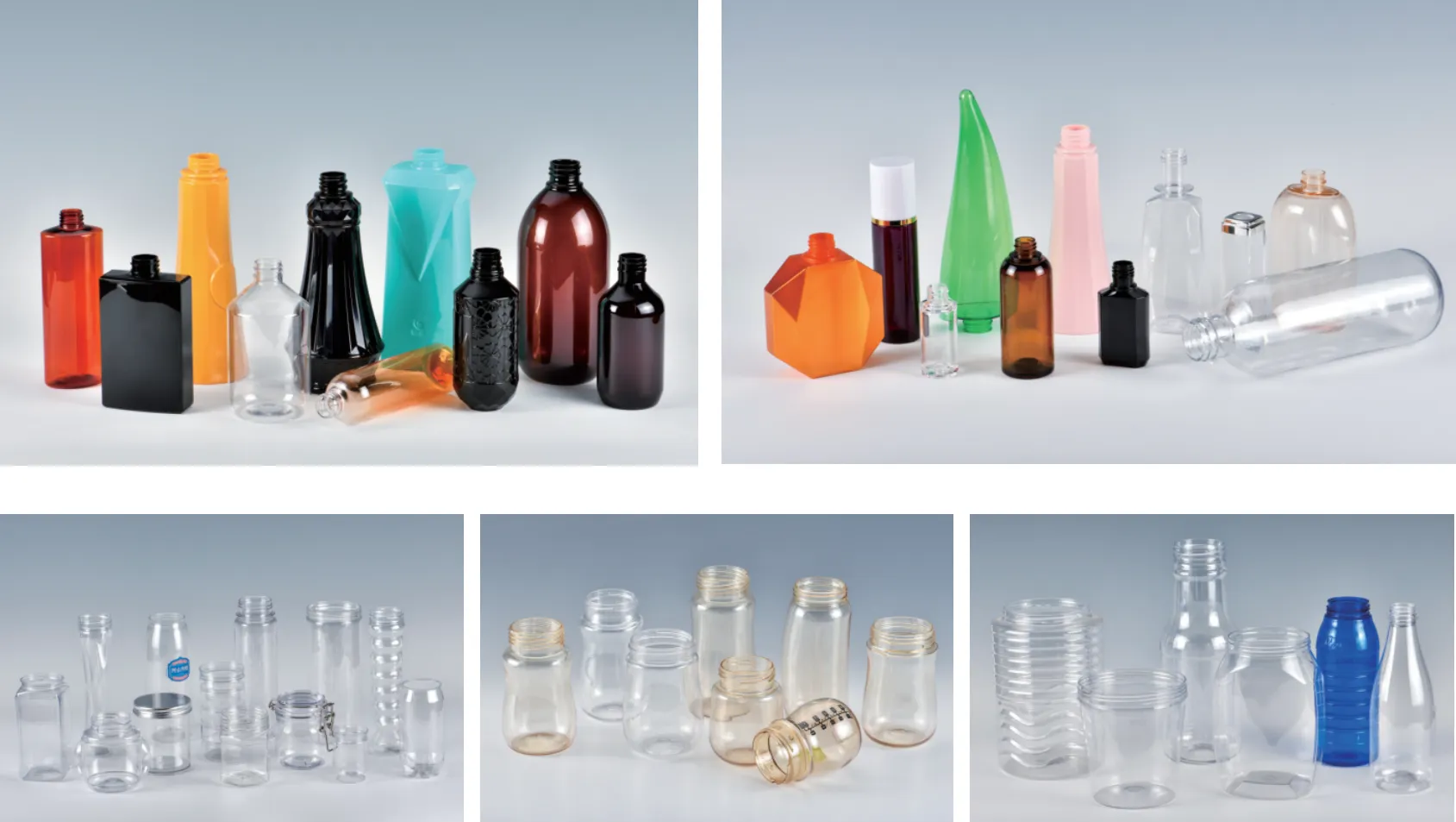
The quality range within the Chinese tier is substantial. Top-tier Chinese manufacturers approach Korean quality levels with selective component sourcing (German servo drives, Japanese PLCs) and controlled manufacturing. Budget-tier Chinese manufacturers use locally-sourced components throughout and compete purely on price, with quality variance measurably higher. Buyers evaluating Chinese alternatives must distinguish carefully between these sub-tiers.
2. Chinese ISBM: Strengths and Positioning
Chinese ISBM manufacturers offer genuine strengths for specific buyer profiles. Capital cost is the most obvious: Chinese platforms typically price 30-50% below Korean equivalents and 50-70% below Japanese equivalents. For cost-sensitive operators with established ISBM experience, capable in-house engineering, and tolerance for quality variance, this pricing enables capacity expansion that premium equipment would not economically justify.
Delivery can be competitive. Top-tier Chinese manufacturers deliver standard platforms in 8-12 weeks, comparable to Japanese and slightly longer than Korean manufacturers. Custom engineering can extend Chinese delivery beyond Korean comparable timelines due to deeper manufacturing queue.
Chinese manufacturers also serve the growing domestic Chinese beverage market effectively, particularly for commodity mineral water, RTD tea, and household chemical applications. For producers serving Chinese domestic brands with Chinese quality expectations, Chinese equipment integrates seamlessly with local supply chains and service expectations.
3. Korean ISBM: Quality-Cost Balance
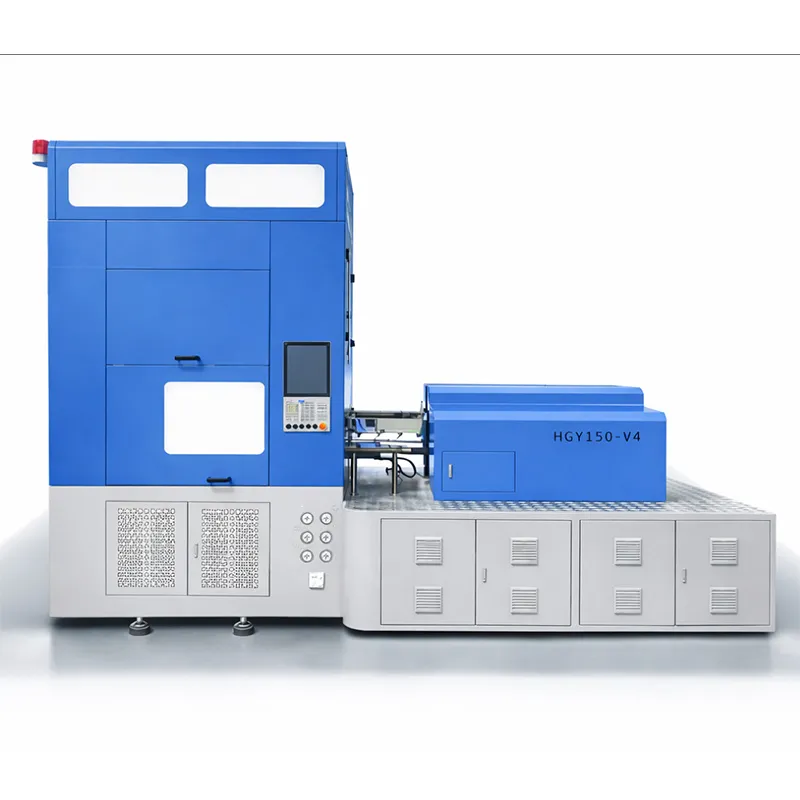
Korean ISBM manufacturing leverages three structural advantages that translate to measurable engineering outcomes. First, the Korean precision manufacturing ecosystem developed through semiconductor and automotive industries produces machining tolerances consistently tighter than most Chinese alternatives. Korean component tolerance of ±0.02mm is standard; Chinese equivalents typically range ±0.05-0.08mm depending on manufacturer tier.
Second, Korean manufacturers consistently source premium components globally. Japanese PLCs, German servo drives, Swiss linear bearings, and Korean-manufactured hot runners represent standard configuration. This contrasts with Chinese budget-tier platforms that use locally-sourced equivalents. Top-tier Chinese manufacturers match Korean component sourcing but at pricing that approaches Korean capital cost.
Third, Korean manufacturers specialize in Japanese-format mould compatibility. Both ASB-12M and AOKI 250 standards are natively supported by Korean platforms, preserving existing mould inventory for operators transitioning from Japanese equipment. Chinese manufacturers typically do not prioritize this compatibility; retrofit engineering for Japanese mould compatibility on Chinese platforms can void warranty and introduce performance variance.
4. Quality Comparison: Measurable Metrics
Quality claims carry little weight without measurable benchmarks. The following comparison uses specifications that can be verified through machine inspection and field performance data.
| Quality Metric | Chinese (Typical) | Korean (Typical) |
|---|---|---|
| Mould interface tolerance | ±0.05-0.08mm | ±0.02mm |
| Cycle time stability | ±0.4-0.6 sec | ±0.2 sec |
| Scrap rate (mature production) | 1.5-3.0% | 0.5-1.2% |
| Energy consumption (per 1000 bottles) | ~18-24 kWh | ~14-18 kWh |
| Uptime (mature production) | 92-96% | 96-98% |
| Typical machine lifespan | 8-12 years | 12-18 years |
The scrap rate difference is the most economically meaningful quality metric. Moving from 2.5% Chinese-typical scrap rate to 0.8% Korean-typical scrap rate on a 10 million bottle line saves approximately 306 million KRW annually. This operational savings can justify the capital premium over 3-4 years of production.
5. Total Cost of Ownership Analysis
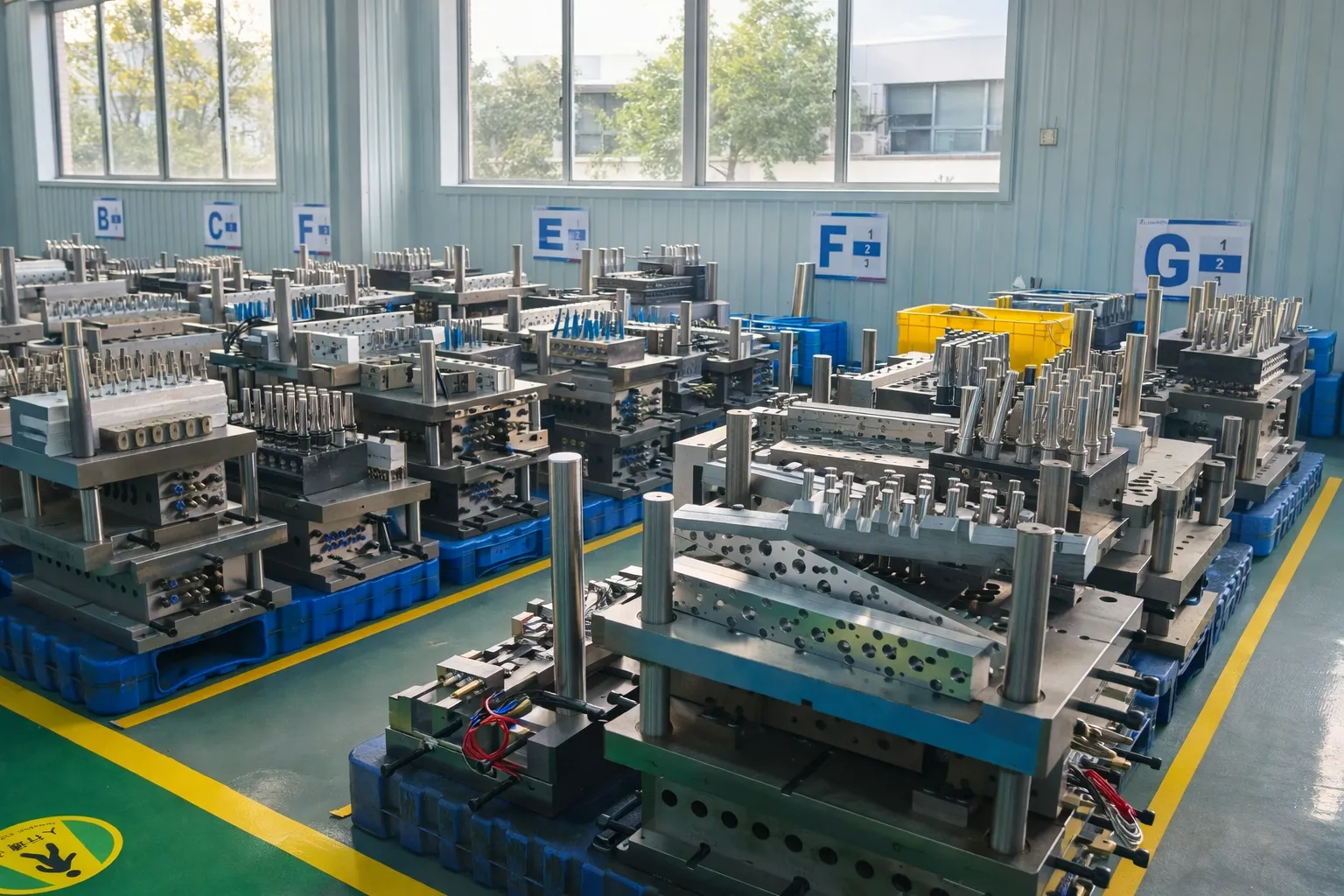
Capital cost is the dimension where Chinese platforms lead most clearly. Total cost of ownership across 7-year production horizon tells a more complete story.
| Cost Dimension (7-year) | Chinese Budget | Korean Mid-Tier |
|---|---|---|
| Capital cost | ~60-65% of Korean | Baseline 100% |
| Energy cost (7-year) | +25-35% above Korean | Baseline |
| Scrap cost (7-year) | 2-3x Korean baseline | Baseline |
| Maintenance & parts | Variable (cheap parts, frequent) | Predictable, premium quality |
| Residual value after 7 years | Minimal | 25-35% of original |
| 7-year TCO (all-in) | ~85-95% of Korean | Baseline |
The 7-year TCO gap between Chinese and Korean platforms narrows significantly after accounting for operational costs. For many applications, Korean TCO is competitive or superior despite higher capital cost. For commodity applications with simple bottle specifications and excellent in-house engineering capability, Chinese platforms can deliver meaningful TCO advantage.
6. Application-Specific Selection Guide
Rather than universal winner-take-all comparison, different applications fit different manufacturing origins.
| Application Profile | Preferred Origin | Rationale |
|---|---|---|
| Premium K-beauty duty-free | Korean | Precision + mould compatibility |
| Pharmaceutical GMP production | Korean | Quality consistency + audit trail |
| Export beverage for EU/US market | Korean | Certification & quality consistency |
| Chinese domestic beverage | Chinese | Local supply chain integration |
| Household chemical commodity | Either tier-appropriate | Price sensitivity vs quality tolerance |
| ASB-12M or AOKI 250 replacement | Korean | Native mould compatibility |
| Budget capacity expansion (experienced op) | Chinese top-tier | Capital optimization priority |
7. Supply Chain & Service Considerations
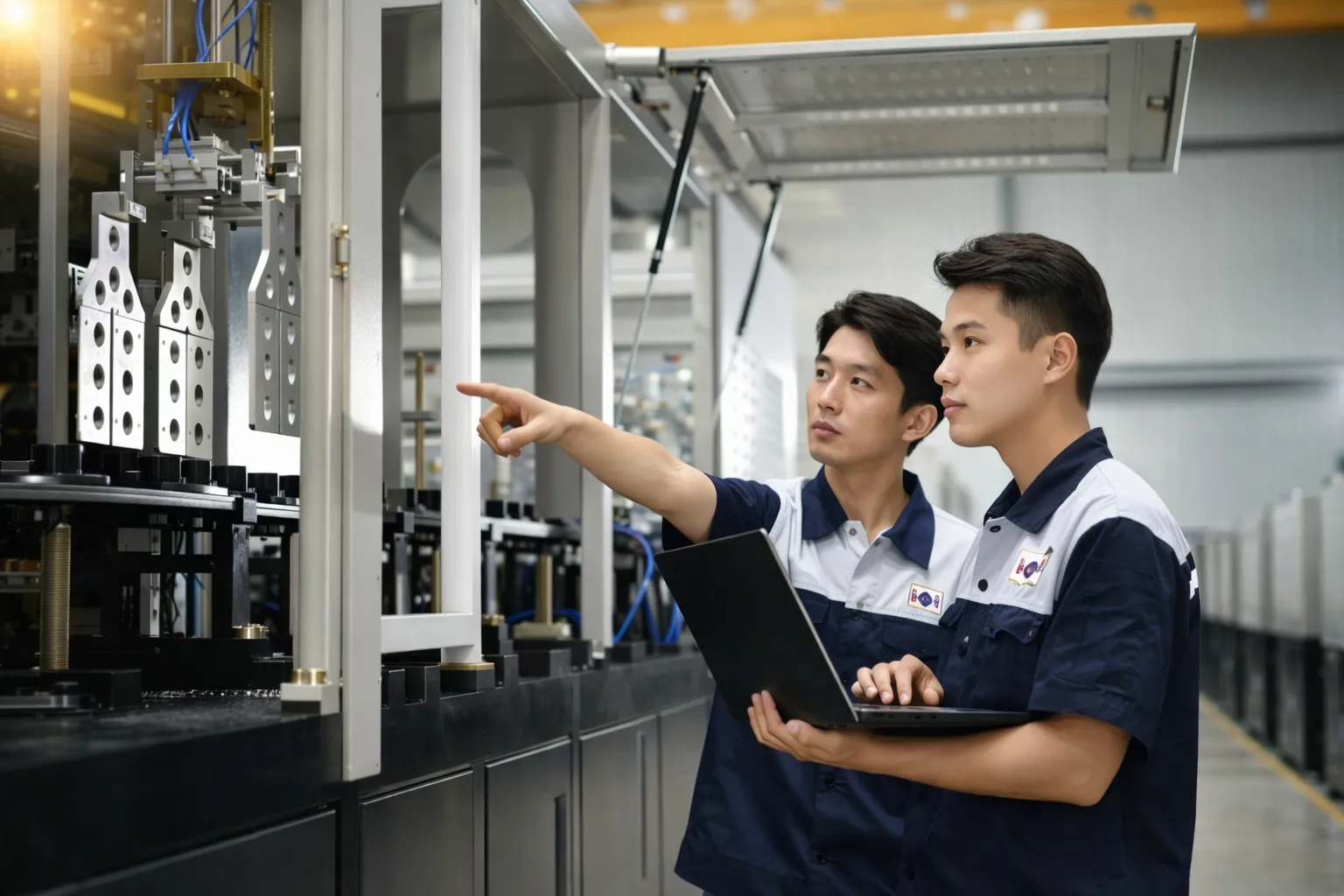
Supply chain and service quality differ meaningfully between Korean and Chinese manufacturers. Korean ISBM manufacturers typically operate centralized assembly in Korea with global service through regional partners. Chinese ISBM manufacturers operate similarly with domestic assembly and regional service networks, though service capability outside China is more variable by specific manufacturer.
Language and cultural factors affect working relationships. Korean manufacturers typically offer English, Korean, and increasingly Japanese engineering documentation. Chinese manufacturers vary widely with language capability, with top-tier exporters matching Korean documentation quality while budget-tier suppliers limit documentation to Chinese and basic English.
Spare parts supply chains favor Korean manufacturers for operators in Korea, Japan, Southeast Asia, and export-facing markets. Korean manufacturers maintain parts inventory for delivery within 24-72 hours globally. Chinese spare parts typically require 5-15 day international shipping from central inventory. For production-critical applications, this delivery gap represents meaningful operational risk.
8. Frequently Asked Questions
Q: How do I distinguish top-tier from budget-tier Chinese manufacturers?
Evaluate three indicators. First, component sourcing: top-tier Chinese manufacturers use German/Japanese/Swiss components (verify on spec sheet); budget-tier uses Chinese local components. Second, export history: top-tier has 10+ years of international installations; budget-tier primarily serves domestic China. Third, reference customers: top-tier provides access to installations in mature markets (EU, US, Korea); budget-tier limits references to developing markets. Price point roughly triples between budget and top-tier Chinese manufacturers.
Q: Can Chinese platforms handle K-EPR rPET compliance requirements?
Top-tier Chinese platforms with full-servo architecture handle 10-30% rPET content with appropriate parameter adjustment. Budget-tier Chinese platforms often struggle with rPET processing due to less precise parameter control, producing higher scrap rates at 30%+ rPET content. For Korean producers specifically, full-servo architecture (standard on Korean platforms, optional premium on Chinese) is increasingly necessary as K-EPR mandates scale toward 30% by 2030.
Q: What is the typical warranty coverage difference?
Korean manufacturers typically offer 12-24 month standard warranty with extended options. Top-tier Chinese manufacturers offer comparable 12-18 month warranty. Budget-tier Chinese warranty is typically 6-12 months with significant exclusions. Warranty claim processing also differs: Korean manufacturers typically dispatch engineering support within 48 hours; Chinese response time varies by manufacturer tier and geography.
Q: For export to EU or US markets, does origin affect buyer acceptance?
Yes for certain sectors. Pharmaceutical, cosmetic, and premium beverage buyers serving EU and US markets increasingly specify non-Chinese equipment for supply chain diversification and quality audit simplification. Korean origin is accepted as Asian alternative without the supply chain concerns sometimes raised regarding Chinese origin. For commodity applications, origin is less material to export buyer acceptance.
Q: What applications should still consider Chinese alternatives seriously?
Three profiles favor Chinese evaluation. First, producers serving Chinese domestic beverage market where supply chain integration matters. Second, cost-sensitive commodity applications (household chemical, basic water bottle) where operator experience compensates for platform precision variance. Third, capacity expansion for existing Chinese-equipped operations where fleet consistency simplifies training and maintenance. For all other applications, Korean platforms typically deliver superior total cost outcome.
9. Conclusion
Korean and Chinese ISBM manufacturers serve different market segments with genuinely different value propositions. Chinese platforms lead on capital cost with competitive delivery, making them appropriate for cost-sensitive commodity applications with experienced operators. Korean platforms balance precision engineering, Japanese-format mould compatibility, full-servo energy efficiency, and responsive service at capital cost between Japanese premium and Chinese budget tiers.
For premium applications, export markets, pharmaceutical/cosmetic quality requirements, or ASB-12M/AOKI 250 mould compatibility, Korean manufacturers including Ever-Power offer compelling value. For commodity domestic applications with established operators and cost optimization priority, top-tier Chinese platforms deserve serious evaluation alongside Korean alternatives.
Comparing Korean vs Chinese ISBM Options?
Share your application profile, bottle specification, production volume, and export market requirements. Our Korean engineering team returns detailed Korean platform options alongside objective comparison notes for Chinese alternatives you may be evaluating.
Editor: Cxm