HAIR CARE IBM · K-BEAUTY PERSONAL CARE · HDPE SURFACTANT ESCR · KOREA EVER-POWER
Shampoo Bottle IBM:
HDPE Hair Care Container Guide
Korean K-beauty hair care packaging — shampoo, conditioner, hair treatment and body wash — is IBM’s largest daily-chemical format family by annual unit volume. IBM’s pump dispenser neck precision, surfactant ESCR compliance and zero-parting-line body surface address the three specific quality requirements that separate Korean premium hair care IBM from commodity EBM shampoo bottle production. This guide covers HDPE grade selection, pump neck engineering, surfactant ESCR and ZQ110 production economics for Korean hair care IBM.
Surfactant ESCR ≥ 300 h
Zero Parting Line on Body
KOREA EVER-POWER · ANSAN-SI, GYEONGGI-DO · JULY 2026
SYSTEM REFERENCE · HDPE SHAMPOO BOTTLE IBM PARAMETERS
FORMAT RANGE
150–500 ml
Korean hair care IBM volume range — travel to salon size
PUMP NECK OD
±0.05 mm
24/410 or 28/410 — pump stem retention spring engagement
SURFACTANT ESCR
≥ 300 h
F50 in 10% SLES solution — Korean premium shampoo contact requirement
ZQ110 OUTPUT @ 300ml
~5,400/hr
6 cavities · ~18.9M units/year Korean 2-shift benchmark
SECTION 01
Korean K-Beauty Hair Care Market and IBM
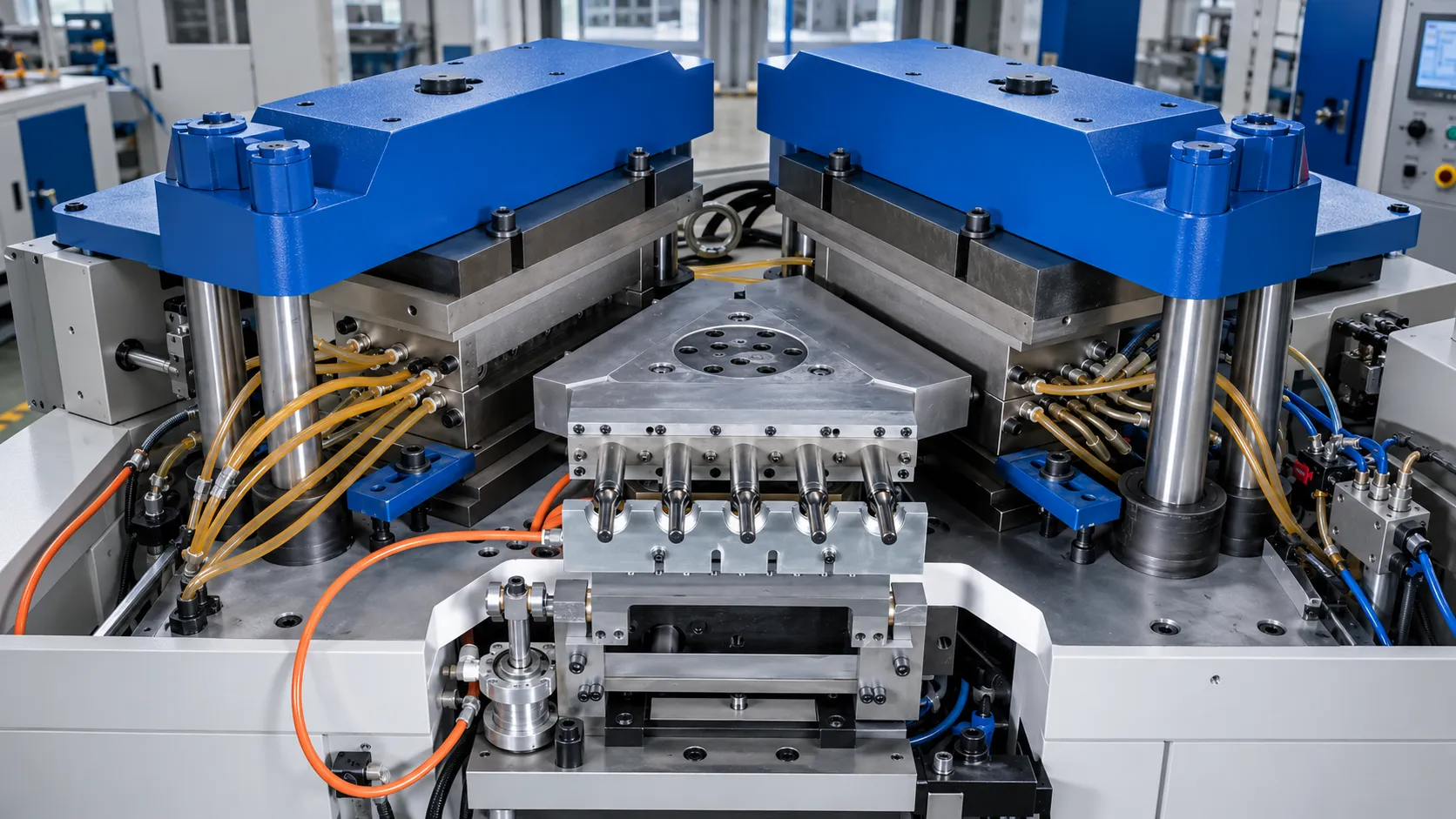
The Korean K-beauty hair care market — Korean shampoo, Korean conditioner, Korean hair treatment and Korean body wash — is the largest single application category for daily-chemical HDPE IBM containers by annual unit volume in Korea. Korean hair care packaging IBM covers a volume range of 150–500 ml with three dominant dispensing systems (pump dispenser, flip-top, disc-top) and two primary surface quality tiers (Korean premium K-beauty hair care with no visible body seam, Korean mass-channel hair care with standard surface). IBM competes with EBM and injection stretch blow moulding (ISBM) for Korean hair care container production — IBM is positioned between EBM (lower tooling cost, lower surface quality, cannot meet pump neck OD tolerance) and ISBM (higher clarity for PET/PCTG, oriented barrier, higher tooling cost) as the optimal process for Korean premium HDPE hair care containers at annual volumes of 5–50M units per format.
IBM’s three specific advantages for Korean K-beauty hair care containers — pump neck OD ±0.05 mm, zero parting line on bottle body, and surfactant ESCR-compliant HDPE processing — directly address the three quality failure modes that Korean hair care brand packaging QA teams reject in EBM bottles: pump stem retention failure (EBM OD variation causes 2–8% of pump stems to fail secure engagement), parting line visibility on premium bottle body (rejected by Korean department store and duty-free hair care brand acceptance inspection), and surfactant-induced stress cracking at the bottle shoulder (underdensity HDPE EBM bottles in contact with Korean sulfate-free shampoo formulations). The household chemical IBM guide covers the broader HDPE IBM household application; this guide focuses specifically on the hair care container IBM requirements that distinguish it from general household chemical IBM production. See the household chemical IBM guide for the broader household application context.
SECTION 02
Shampoo Bottle Body Geometry and IBM Machine Constraints
Shampoo bottle body geometry creates a specific IBM machine constraint not present in pharmaceutical or food IBM: large body diameter. Korean premium shampoo bottles at 300–500 ml typically specify oval or rectangular body cross-sections with maximum body widths of 70–90 mm — dimensions that make the platen footprint per cavity, rather than clamping force per cavity, the binding constraint on the ZQ110 at these formats.
IBM MACHINE CONSTRAINT ANALYSIS · SHAMPOO BOTTLE FORMATS ON ZQ110
150–200 ml Oval
Body width: 55–65 mm
Clamping force binding constraint — 40–50 KN per cavity at HDPE injection. ZQ110 at 1,100 KN accommodates 22–27 cavities on clamping force alone; platen limits to 14–18 cavities at this body width. 14 cavities is the ZQ110 practical maximum at 200 ml oval shampoo.
300 ml Oval ★ Most Common
Body width: 65–75 mm
Platen binding constraint at this body width — the 65–75 mm oval body footprint, with adequate centre-to-centre spacing (15–20 mm), limits the ZQ110 platen to 6–8 cavities before clamping force is reached. 6 cavities is the production standard for 300 ml Korean shampoo on ZQ110.
500 ml Wide Body
Body width: 75–90 mm
Platen binding constraint dominant — the 75–90 mm wide body at 500 ml limits ZQ110 to 4–6 cavities. The shot weight at 500 ml (approximately 22–28 g HDPE) also approaches ZQ110 shot weight limits at 6 cavities. 4 cavities is the safe production standard for 500 ml wide-body Korean shampoo on ZQ110.
★ 300 ml oval shampoo at 6 cavities on ZQ110 is the Korean K-beauty hair care IBM benchmark configuration. At Korean 2-shift, 88% efficiency, 3,500 hr/year: ~18.9M annual units per ZQ110 machine — covering most Korean national brand shampoo OEM annual volumes per SKU.
The centre-to-centre spacing requirement between adjacent cavities — minimum 15 mm for structural integrity of the mould steel between adjacent blow cavities at 300 ml body dimensions — is the primary engineering constraint that Korea Ever-Power’s IBM mould design team optimises in the shampoo bottle mould layout. Oval body cross-sections are preferred over circular bodies for Korean premium shampoo at equal volume because the oval cross-section reduces the maximum body width (and therefore the platen footprint per cavity) while maintaining the larger volume — a geometry optimisation that allows one additional cavity per ZQ110 platen versus the equivalent-volume circular body design.
SECTION 03
Pump Dispenser Neck — IBM Precision Requirements
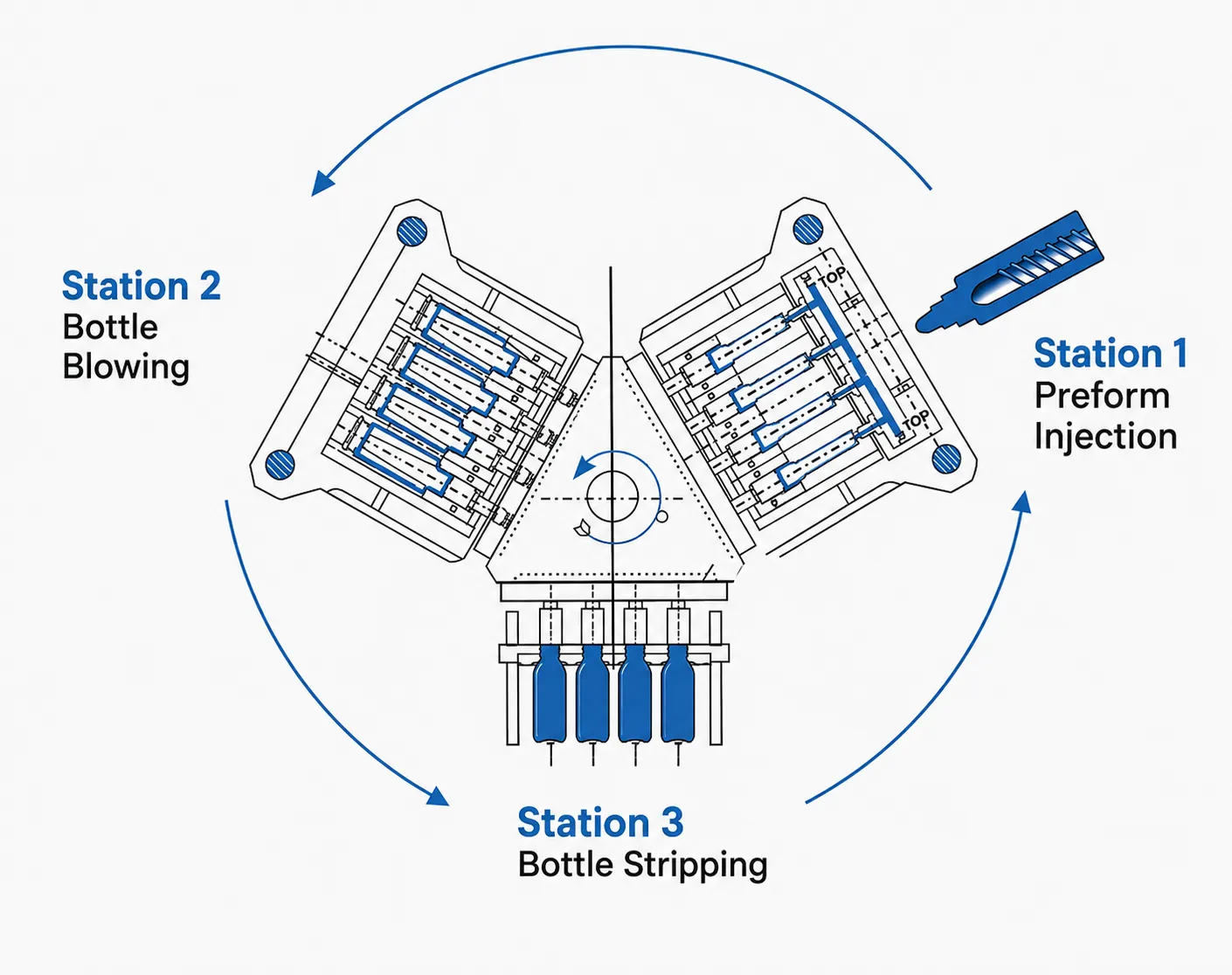
Korean premium hair care pump dispensers — the lotion pump style used on Korean shampoo and conditioner — engage the bottle neck through two features: the GPI thread (which the pump’s locking ring threads onto for attachment) and the pump stem retention bead or shoulder (which the pump mechanism’s spring-loaded stem seats against to maintain the pump head’s dispensing height). IBM’s ±0.05 mm neck OD precision on both features ensures consistent pump engagement across all production cavities and production batches.
| NECK FINISH | IBM OD TOLERANCE | PUMP ENGAGEMENT | BOTTLE VOLUME | KOREAN APPLICATION |
|---|---|---|---|---|
| 24/410 GPI | ±0.05 mm | Pump locking ring + retention bead | 150–200 ml | Korean travel-size shampoo, Korean salon sample, Korean subscription box hair care |
| 28/410 GPI ★ | ±0.05 mm | Pump locking ring + retention bead | 200–500 ml | Korean premium shampoo/conditioner — national brand standard pump neck |
| 28/400 GPI | ±0.05 mm | Flip-top or disc-top cap | 200–400 ml | Korean mid-tier shampoo with flip-top, Korean hair treatment jar-bottle |
| 38/400 GPI | ±0.05 mm | Wide screw cap | 300–500 ml | Korean hair treatment mask, Korean deep conditioning pack, Korean scalp serum wide-mouth |
★ 28/410 is the Korean national standard pump neck for premium shampoo and conditioner. Korean pump dispenser manufacturers (Cosmobeauty, Samwon, Yuyao Zhenyu, and Korean GCMI-equivalent) all produce lotion pumps for the 28/410 neck finish as their primary Korean hair care production volume item.
Pump retention bead vs pharmaceutical CRC bead: The IBM neck retention bead for Korean hair care pump dispensers is mechanically similar to the CRC engagement bead but dimensionally different — the pump retention bead is a shallow annular ridge (typically 0.4–0.8 mm bead height, OD nominal ±0.05 mm) that the pump spring clips over during pump insertion, rather than the deeper push-and-turn CRC bead (0.8–1.5 mm height). Korea Ever-Power’s IBM injection mould neck insert is machined to produce the specific pump retention bead geometry from the Korean pump supplier’s engagement drawing — the same shrinkage compensation calculation and step-gauge OD measurement protocol used for CRC beads applies equally to pump retention beads, ensuring the pump clips securely to the HDPE IBM bottle neck at the Korean filling line’s automated pump insertion speed (typically 40–80 pumps per minute).
SECTION 04
HDPE Grade and Surfactant ESCR Selection
Korean shampoo and conditioner formulations are among the most aggressive ESCR environments in HDPE IBM packaging — significantly more demanding than pharmaceutical or food contact conditions. Korean hair care formulations contain surfactant systems at 10–20% total concentration: sodium laureth sulphate (SLES), sodium lauryl sulphate (SLS), cocamidopropyl betaine, disodium laureth sulfosuccinate, and conditioner-specific cationic surfactants (cetrimonium chloride, behentrimonium chloride). These surfactants attack the amorphous regions of HDPE at the bottle body surface, initiating stress cracking at the body shoulder zone where residual moulding stresses concentrate.
PRODUCT TYPE
SURFACTANT CONC.
ESCR F50 REQUIRED
HDPE MI / DENSITY
⚠ KOREAN SULPHATE-FREE SHAMPOO ESCR TRAP: Korean K-beauty sulphate-free shampoo formulations use mild surfactant systems (cocamidopropyl betaine, sodium cocoyl isethionate, disodium laureth sulfosuccinate) at 8–14% concentration — significantly lower individual surfactant concentration than standard Korean SLES shampoo. However, sulphate-free formulations typically contain higher concentrations of silicone conditioning agents (dimethicone 1–3%), plant oil extracts (argan oil, camellia oil, 0.5–2%), and alcohol-based fragrance carriers (ethanol 1–3%) that collectively produce an aggressive ESCR environment different from SLES alone. Do not reduce HDPE density specification for Korean sulphate-free formulations based only on the lower surfactant concentration — verify ESCR in the specific sulphate-free formulation using the actual production IBM container at 23°C immersion test. The HDPE IBM processing guide details the ESCR test methods and HDPE grade verification protocol.
SECTION 05
IBM Processing Parameters for Hair Care Containers
| PARAMETER | 150–200 ml (MI 0.4–0.6) | 300 ml ★ (MI 0.3–0.5) | 400–500 ml (MI 0.3–0.4) |
|---|---|---|---|
| Barrel metering zone | 200–215°C | 198–212°C | 196–210°C |
| Injection nozzle | 210–222°C | 208–220°C | 205–218°C |
| Injection pressure | 100–135 MPa | 105–145 MPa | 110–150 MPa |
| Blow air pressure | 0.55–0.80 MPa | 0.60–0.85 MPa | 0.65–0.90 MPa |
| Blow dwell time | 1.0–1.6 s | 1.4–2.0 s | 1.6–2.4 s |
| Total cycle time | 4.0–5.0 s | 4.5–5.5 s | 5.0–6.5 s |
Shoulder wall thinning — the primary IBM quality risk at 300–500 ml: Korean shampoo bottle shoulder geometry (the curved transition zone from the wide body to the narrower neck) is the IBM wall distribution challenge at 300–500 ml formats. The blow ratio (body diameter ÷ preform OD) at the shoulder zone can reach 4–6× at the outer shoulder of wide oval bodies — high enough to produce localised wall thinning below 0.4 mm if the preform wall distribution is not correctly engineered. Korea Ever-Power’s shampoo bottle preform design uses shoulder-zone preform wall bias (thicker preform wall at the shoulder-zone preform length) to compensate for the higher shoulder blow ratio, targeting minimum shoulder wall ≥ 0.5 mm across all cavities. Shoulder wall measurement at 4 angular positions (matching the oval bottle’s long-axis, short-axis and 45° diagonal positions) is included in the Korea Ever-Power pre-delivery qualification report for all 300+ ml Korean shampoo IBM mould sets.
SECTION 06
Korean Hair Care Container Format Range
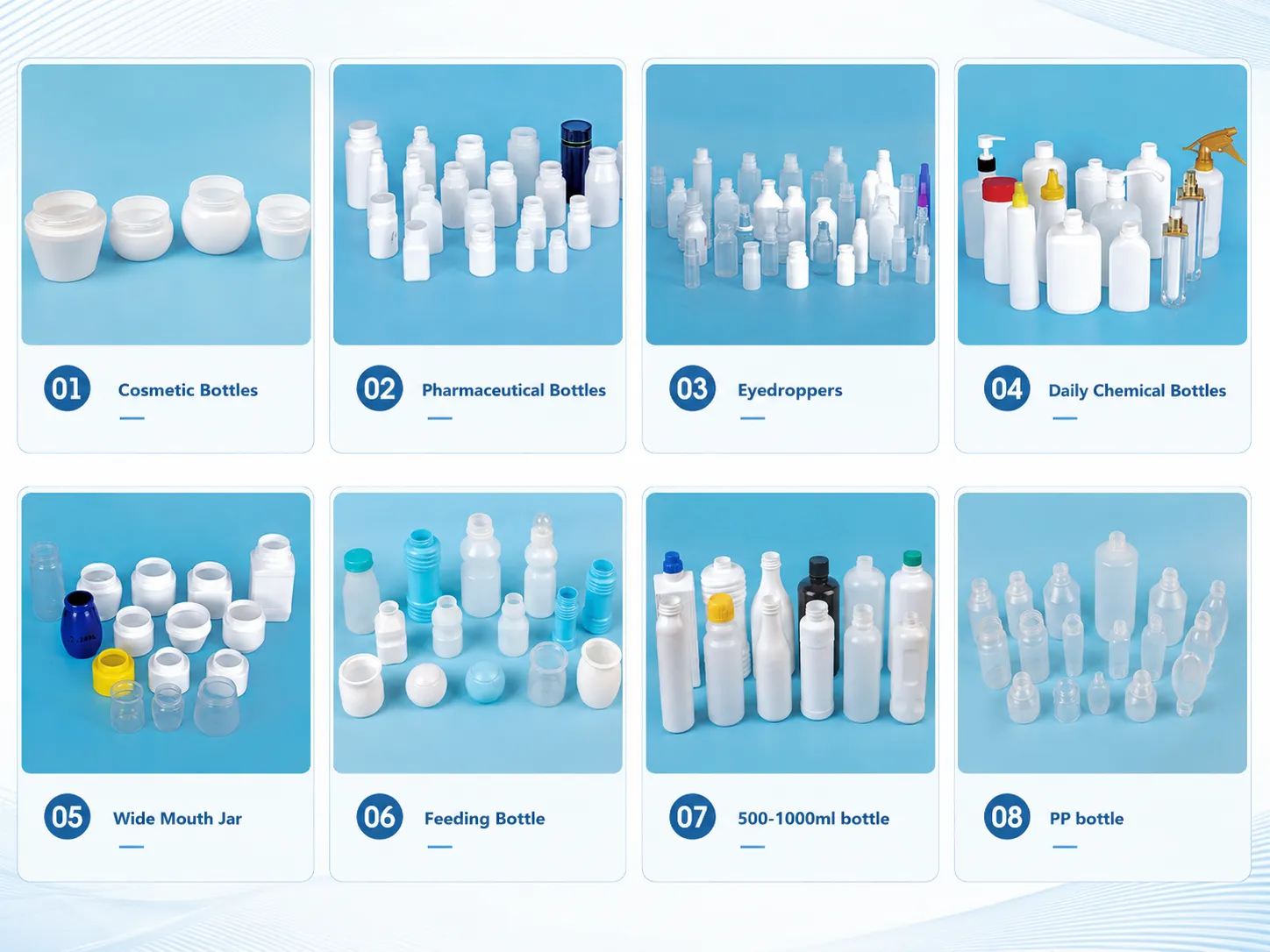
| FORMAT | VOLUME | NECK / CLOSURE | ZQ110 CAVITIES | KOREAN APPLICATION |
|---|---|---|---|---|
| Travel-size shampoo | 150–200 ml | 24/410 Pump | 10–14 | Korean hotel amenity, Korean subscription box, Korean duty-free travel kit |
| Shampoo standard ★ | 300 ml | 28/410 Pump | 6 | Korean national brand shampoo — retail standard OEM format |
| Conditioner | 300–400 ml | 28/410 Pump | 5–6 | Korean conditioner and hair mask — matched body shape to shampoo (same mould family) |
| Hair treatment | 200–300 ml | 38/400 Wide cap | 6–8 | Korean hair mask, Korean protein treatment, Korean scalp serum wide-opening |
| Body wash | 400–500 ml | 28/410 Pump | 4–5 | Korean body wash premium, Korean shower gel, Korean moisturising body cleanser |
★ Korean national brand shampoo standard format: 300 ml oval pump bottle at 6 cavities on ZQ110 = ~18.9M/year per machine. Korean shampoo and conditioner are typically produced as a matched pair on the same mould family — shampoo bottle and conditioner bottle share the same body shape and neck finish, with differentiation only in colour (typically a brand colour code: shampoo = primary, conditioner = secondary) and fill volume (shampoo 300 ml, conditioner often 300 or 400 ml).
SECTION 07
Body Surface, Drop-Impact and K-Beauty Acceptance Requirements
Korean K-beauty premium hair care brand acceptance inspection assesses three body surface quality criteria that IBM’s blow mould-controlled body surface consistently passes and EBM’s parting-line body surface frequently fails at Korean premium tier.
IBM blow mould parting line is located at the container base — outside the visible body panel that Korean acceptance inspectors assess under 1,000 lux directional lighting at 45° incidence. The IBM bottle body has no visible seam from shoulder to base. EBM shampoo bottles have a parting line running vertically through the body’s widest point — highly visible on oval and rounded-rectangle Korean shampoo body shapes because the seam interrupts the smooth curvature that Korean K-beauty premium packaging designers specify. Korean premium tier (AmorePacific Mise en Scene, LG H&H Elastine, Aekyung Kerasys) rejects EBM bottles at Korean acceptance inspection for this criterion.
Korean premium shampoo bottles commonly specify embossed brand logos, ingredient icons or decorative patterns on the bottle body. IBM’s blow mould cavity machined with the embossed geometry transfers the embossing onto the HDPE bottle body during the blow phase — producing sharp, consistent embossed detail (typically 0.3–0.8 mm depth, 0.2 mm minimum radius on design corners) across all cavities. EBM can emboss from the blow mould cavity but produces lower dimensional fidelity (rounded corners, inconsistent depth across cavities due to parison thickness variation at the emboss zone) — Korean brand logo embossing with sharp 90° corners requires IBM’s injection-preform wall consistency at the emboss zone.
Korean hair care bottles are used in Korean shower environments where drops from 1–1.2 m height onto Korean ceramic tile floors are normal use conditions. Korean premium brand drop-impact specification: no cracking, no base deformation, no pump neck damage at 1 m drop onto ceramic tile at 23°C, filled to 90% nominal volume, 3 consecutive drops. IBM’s uniform wall (±5% CV) ensures the bottle base and shoulder wall thickness meets the minimum wall specification at all angular positions — IBM bottles consistently pass the 3-drop test at 0.5 mm minimum wall. EBM bottles with ±15–20% wall variation can produce localised thin zones at the base corner (below 0.35 mm) that fail the drop-impact test — requiring EBM producers to specify heavier average wall (0.8–1.0 mm vs IBM’s 0.5–0.7 mm) to compensate, increasing resin cost by 20–30%.
SECTION 08
ZQ Series Selection for Korean Hair Care IBM Production
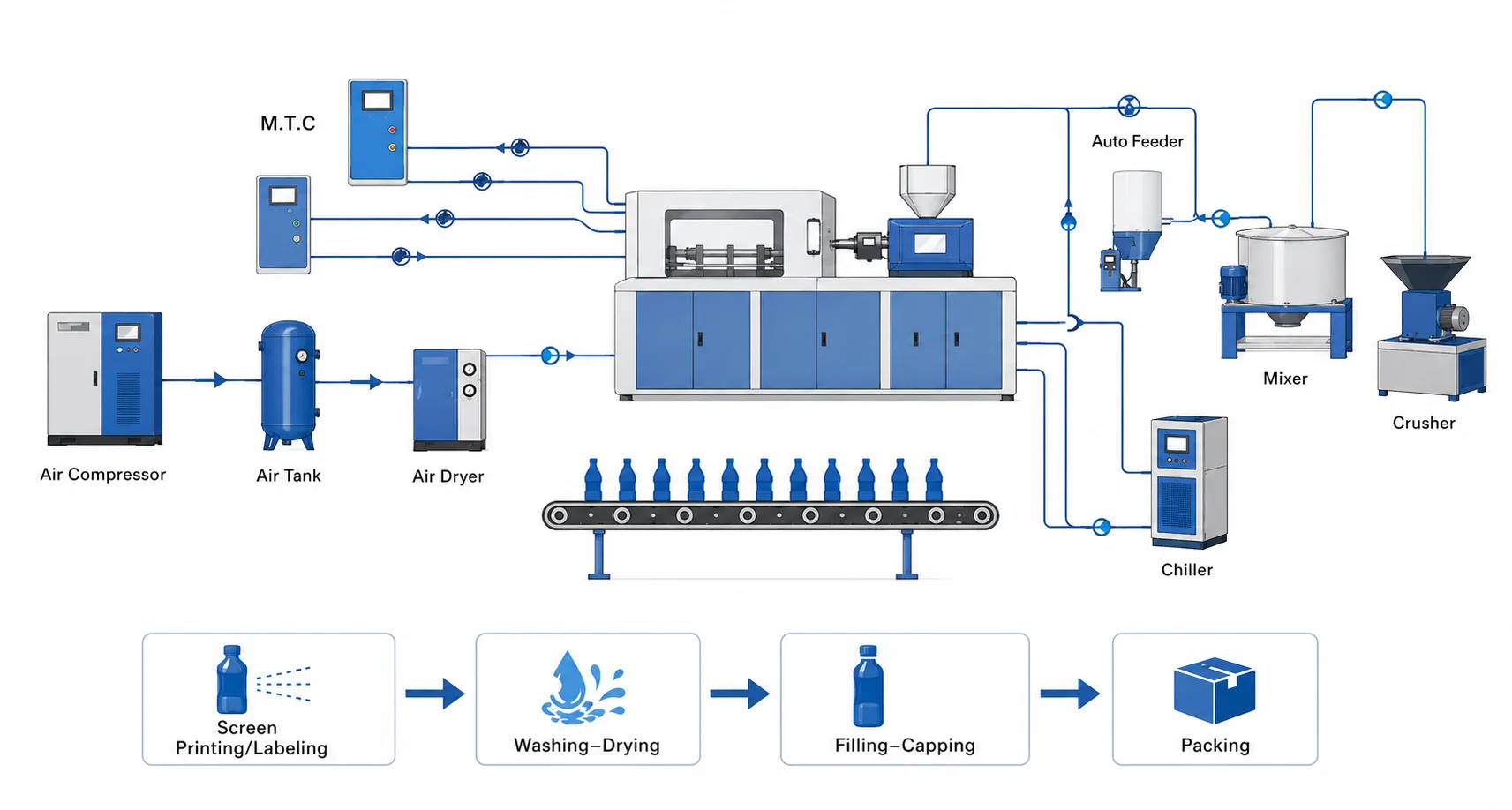
ZQ SELECTION MATRIX · SHAMPOO IBM @ 300ml OVAL (HDPE MI 0.4, DENSITY 0.958)
| ZQ MODEL | CAV @ 300ml | BOTTLES/HR | ANNUAL CAP. | KOREAN HAIR CARE PROFILE |
|---|---|---|---|---|
| EP-ZQ60 | 3–4 | ~2,160–2,880 | ~7.6–10.1M | Korean indie K-beauty startup, Korean subscription-box brand, limited collection launch |
| EP-ZQ110 ★ | 6 | ~5,400 | ~18.9M | Korean national brand K-beauty hair care OEM — the benchmark platform |
| EP-ZQ135 | 8 | ~7,200 | ~25.2M | Korean major hair care conglomerate OEM, Korean supermarket private label at scale |
★ EP-ZQ110 at 6 cavities, 5-second cycle — the Korean K-beauty hair care IBM benchmark. Covers ~18.9M annual 300 ml shampoo units in Korean 2-shift production. The ZQ110’s 22+22 KW dual hydraulic system handles the higher injection pressure required for MI 0.3–0.5 HDPE at 300 ml with stable cycle time and consistent cavity-to-cavity balance across the 6-cavity mould layout.
ENGINEERING FAQ
Shampoo Bottle IBM — Engineering Questions
Can IBM produce Korean shampoo bottles with a matched shampoo-and-conditioner set that looks identical from the outside?
Yes — IBM’s most common Korean K-beauty hair care production configuration is a matched shampoo and conditioner bottle pair produced on the same ZQ110 machine with two mould sets sharing the same body geometry. The shampoo and conditioner bottles use the same blow mould cavity design (same body height, body shape, shoulder curve, base profile and neck finish) with the only physical difference being the body wall colour (a different colour masterbatch in the HDPE — shampoo in the brand’s primary colour, conditioner in a secondary colour) and, if volumes differ, the preform shot weight. Korean hair care brands specify matched pairs because Korean consumers purchase shampoo and conditioner together as a set — packaging visual continuity between the two bottles at Korean retail shelf display is a Korean brand equity requirement. Korea Ever-Power produces matched shampoo-conditioner IBM mould sets as a standard paired order — the two blow moulds share the same cavity geometry drawing with only the body label panel zone depth (shampoo: 0.8 mm label zone depth recess; conditioner: 0.6 mm recess, to visually differentiate the two bottles’ label areas while maintaining the same external body silhouette) and the same Korea Ever-Power dimensional qualification report format covering both mould sets. Production on the ZQ110 machine alternates between shampoo and conditioner mould sets during the Korean filling line’s production schedule — typically 3–5 days on shampoo mould, 3–5 days on conditioner mould, with a 2-hour mould change between formats.
What body colour options are available for Korean IBM shampoo bottles and how are they colour-matched?
Korean K-beauty hair care IBM shampoo bottles are produced in four colour category options with different HDPE masterbatch requirements. First, opaque solid colour (the most common Korean premium option): colour masterbatch at 0.5–2.5% loading in HDPE — Korean brand Pantone reference matched to deltaE ≤ 1.5 at production conditions. White opaque is the most requested Korean K-beauty clean beauty shampoo colour, requiring TiO₂ masterbatch at 1.5–2.5% at the IBM body wall thickness for full opacity; Korean brands targeting purity and clean beauty positioning specify white opaque most frequently. Second, translucent (semi-transparent): low masterbatch loading (0.1–0.5% tint), HDPE body is semi-transparent so product formulation colour is visible through the wall — Korean brands with visually distinct shampoo formulations (blue tint, gold tint, pearlescent formula) use this option for product differentiation at Korean retail. Third, metallic effect: pearlescent masterbatch (mica-based, 0.3–0.8%) produces a silver, gold or rose-gold metallic sheen on the HDPE body — popular for Korean premium gift sets and Korean duty-free special editions. Fourth, natural/cream white translucent: no masterbatch or very low tint, HDPE’s natural milky appearance — used by Korean natural and organic K-beauty brands as a clean packaging aesthetic. IBM colour stability across production batches is confirmed by Korean brand colour acceptance — production lots are measured with a 45/0° spectrophotometer at the start of each batch, and production continues if colour deltaE from the approved standard lot is within ±1.5. IBM’s consistent barrel temperature and cycle time produce batch-to-batch colour stability at Cpk ≥ 1.33 for deltaE versus reference standard — a consistency that Korean K-beauty packaging QA teams cite as one reason they specify IBM over EBM for premium opaque shampoo bottles.
How does IBM handle Korean shampoo bottle production when the Korean brand requires a rectangular cross-section body?
Rectangular cross-section shampoo bottles — flat-panel bottles with defined front and back panels, sharp corner radii (typically R 3–8 mm) and flat label panels — are achievable in IBM but require careful preform geometry design to avoid the wall thinning challenge that rectangular cross-sections create. The challenge: when a cylindrical preform is blown into a rectangular blow mould cavity, the material at the mould corner zones must travel further to reach the corner than it does at the flat panel faces — producing corner zones thinner than flat-panel zones if the preform is not designed to compensate. Korea Ever-Power’s approach: (1) corner-biased preform wall profile using a slightly non-circular preform cross-section that places more material at the corner blow directions; (2) minimum corner radius R ≥ 5 mm on the blow mould cavity geometry — radii below R 3 mm produce wall thinning below 0.3 mm that fails Korean drop-impact tests; (3) corner wall measurement at 4 angular positions per cavity in the pre-delivery qualification report. Korean brands specifying rectangular shampoo IBM should communicate the minimum corner radius to Korea Ever-Power’s mould design team before machining — changing corner radius after mould production requires cavity welding and re-machining that adds 2–3 weeks to the mould qualification timeline.
What is the correct ESCR test for verifying a new Korean shampoo formulation against IBM HDPE bottle performance?
For a new Korean shampoo formulation, the preferred ESCR verification method is a formulation-specific filled container static immersion test rather than the standard ASTM D1693 Igepal surrogate test. Protocol: (1) produce 30 IBM containers per cavity from the target HDPE grade; (2) fill with the actual Korean shampoo formulation at 95% fill volume; (3) seal with the production pump at Korean filling line application torque; (4) store horizontally at 50°C for 1,000 hours; (5) inspect at 250 h, 500 h and 1,000 h for surface crazing, wall thinning or deformation at the shoulder and base corner zones. Pass: no craze or visible damage at any inspection interval. This formulation-specific test is more representative than the Igepal surrogate because Korean sulphate-free shampoos and silicone conditioners have ESCR aggressiveness that Igepal does not fully capture. Korea Ever-Power recommends conducting this test on Korea Ever-Power IBM container samples during Korean product development — 12–16 weeks before launch — so ESCR failure is identified at HDPE grade selection stage, not after the mould set has been produced.
Is PP a viable alternative to HDPE for Korean premium shampoo IBM bottles?
PP is technically viable for Korean shampoo IBM but specified less frequently than HDPE for three reasons. First, PP IBM shampoo bottles feel stiffer and lighter than HDPE at the same wall thickness — the “soft squeeze” tactile quality that Korean consumer research identifies as premium is a function of HDPE’s lower flexural modulus (0.7–1.4 GPa vs PP’s 1.4–2.0 GPa). Second, PP masterbatch colour matching at IBM conditions requires more extensive approval trials because PP’s higher processing temperature causes more colour shift in heat-sensitive pigments, making Korean brand colour specs (deltaE ≤ 1.5) harder to maintain batch-to-batch. Third, PP ESCR in surfactant environments is not meaningfully better than HDPE — both stress-crack, through different mechanisms, eliminating the principal reason one might switch from HDPE to PP. PP is chosen for Korean shampoo IBM in three cases: crystal-clear bottles where PP’s lower IBM haze (8–15% vs HDPE’s 20–35%) justifies the switch; natural/organic brands for ESG recyclability positioning; and hot-fill hair treatments filled above HDPE’s HDT (above 75°C).
How does IBM production cost compare to ISBM for Korean premium shampoo bottles at 300 ml?
IBM HDPE and ISBM PET compete for Korean premium shampoo at 300 ml. ISBM PET advantages: superior transparency (haze below 2% vs HDPE’s 20–35%), higher oxygen/water vapour barrier for volatile fragrance stability, and lighter container weight at equivalent structural performance. IBM HDPE advantages: HDPE resin 30–50% lower cost per kg than PET; IBM 6-cavity mould sets cost approximately 60–70% of equivalent ISBM 4-piece mould sets; and HDPE ESCR ≥ 300 h in 10% SLES versus PET which has no meaningful ESCR (PET can absorb fragrance components causing clarity degradation over Korean 24-month shelf life). Korean K-beauty brands specifying HDPE shampoo at 300 ml at 5–20M annual volume typically choose IBM over ISBM because total production cost (resin + mould depreciation + machine depreciation) is 15–25% lower for IBM HDPE at this volume range, and IBM HDPE’s zero parting line and colour opacity meet Korean premium acceptance criteria without the ISBM PET price premium.
HAIR CARE IBM ENQUIRY · KOREA EVER-POWER
Planning Korean K-Beauty Hair Care IBM Container Production?
Korea Ever-Power provides HDPE shampoo IBM mould design with pump neck precision, shoulder wall engineering, Korean K-beauty colour approval support and ZQ110 machine selection for Korean hair care IBM at all annual production volumes.