PERSONAL CARE · DAILY CHEMICAL · IBM CAPACITY PLANNING · 10ML–1000ML · KOREA EVER-POWER ZQ
IBM Bottles for
Προσωπική Φροντίδα και
Καθημερινή Χημική: Capacity
Planning from 10 ml to 1,000 ml
Shampoo, body wash, conditioner, hand lotion, liquid soap and hand sanitiser: each has a different bottle volume, neck OD, wall weight, cavity count requirement and annual production planning model. This guide provides the complete capacity planning framework for IBM personal care and daily chemical bottles from 10 ml travel format to 1,000 ml salon-size, with PP and HDPE resin selection, Korea Ever-Power EP-ZQ machine matching and annualised output calculations.
PP HDPE · 10ml–1,000ml · EP-ZQ40–ZQ135
ΚΟΡΕΑ EVER-POWER · ΑΝΣΑΝ-ΣΙ, ΓΚΙΕΟΝΓΚΙ-ΝΤΟ · ΑΥΓΟΥΣΤΟΣ 2026 · ΤΕΛΕΥΤΑΙΑ ΕΝΗΜΕΡΩΣΗ: ΑΥΓΟΥΣΤΟΣ 2026
PERSONAL CARE IBM · CAPACITY PLANNING REFERENCE · AUGUST 2026
ΕΥΡΟΣ ΕΝΤΑΣΗΣ
10–1,000 ml
10–30 ml: travel size, hotel amenity, sample sachet; 50–200 ml: personal use retail; 250–500 ml: household standard; 750–1,000 ml: salon and institutional. Each range requires different EP-ZQ model, cavity count and wall weight specification.
PEAK DAILY CHEM OUTPUT
~193M / year
EP-ZQ135 at 18 cavities / 100 ml PP daily chemical (33 g preform, 5.5 s cycle, 3 shifts, 330 days, 90% efficiency). For shampoo 250 ml at ZQ135 14-cavity: ~115M/year. For 500 ml body wash at ZQ135 10-cavity: ~91M/year.
DOMINANT RESIN
PP HPP/RCP
PP is the dominant daily chemical IBM resin: broad chemical resistance to surfactants, alkaline formulations and ethanol; USP Class VI; widest processing window (200–240°C); standard H13 SPI B1 tooling; no pre-drying; lowest cost of all IBM resins at KRW 1,400–1,800/kg. HDPE for hand sanitiser (EtOH barrier) and heavy-duty cleaner (chemical resistance).
IBM ADVANTAGE OVER EBM
No Parting Line
IBM personal care bottles have no body parting line — the ridge on EBM bottles that affects label adhesion and direct-print registration. IBM also achieves neck OD ±0.05 mm (pump dispenser snap-in consistency) versus EBM ±0.15–0.25 mm. For premium personal care with pump dispensers, IBM is the process of choice.
ΤΜΗΜΑ 01
Personal Care IBM: Market Segments, Volume Format Requirements and Korean Regulatory Context
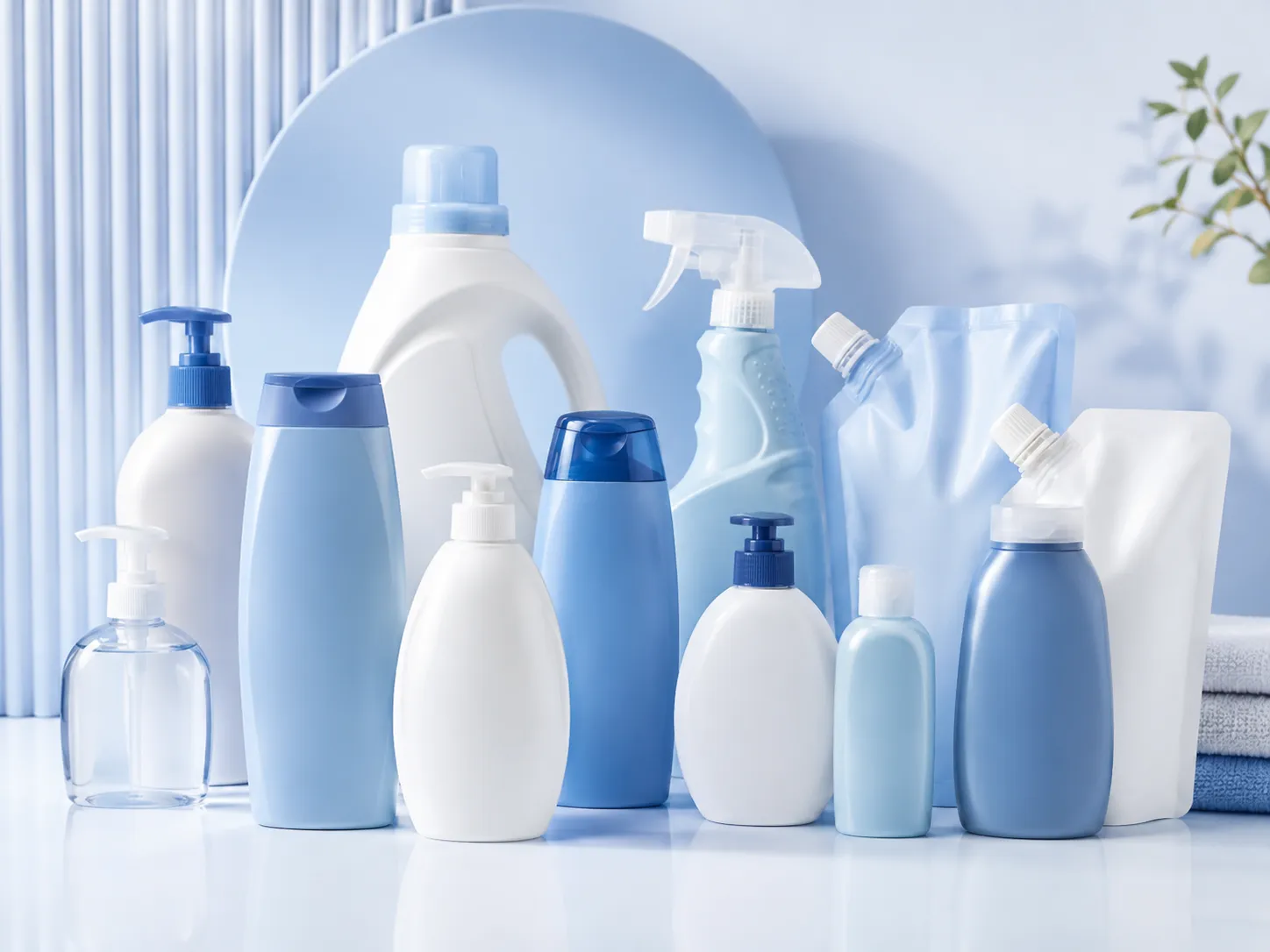
Personal care and daily chemical IBM covers five distinct market segments, each with a characteristic volume range, neck finish, wall weight and annual production volume per SKU. Matching the correct EP-ZQ machine model and cavity count to each segment’s format mix is the foundation of a capacity planning exercise. Korean personal care contract manufacturers (CMO) supplying global brands from Korean facilities (LG H&H, Amorepacific, Aekyung CMO supply chain) typically produce 50–500 million bottles per SKU per year — volumes at which IBM multi-cavity production economics are strongly favourable over EBM or single-cavity IBM.
Travel & Hotel Amenity
Volume range: 10–50 ml
Neck OD: 18–24 mm
Product: Shampoo, conditioner, shower gel, lotion, hand lotion
Annual vol. per SKU: 50–500 million (hotel amenity programmes)
IBM machine: ZQ40–ZQ60 (9–14 cavities at 10 ml; 6–10 cavities at 30 ml)
Key spec: Leak-tight at 24 mm 20/410 snap cap; label surface ±0.05 mm uniformity for inkjet batch coding
Personal Use Retail
Volume range: 50–200 ml
Neck OD: 20–28 mm
Product: Facial wash, toner (PP RCP), hand sanitiser (HDPE), hand lotion, serum (PCTG for luxury)
Annual vol. per SKU: 20–200 million (Korean retail; 50M+ for global brands)
IBM machine: ZQ60–ZQ110 (8–18 cavities)
Key spec: Pump neck 24/410 snap-in at ±0.05 mm; pressure test at 100 kPa for 60 s
Household Standard
Volume range: 250–500 ml
Neck OD: 24–38 mm
Product: Shampoo, body wash, conditioner, liquid hand soap
Annual vol. per SKU: 30–150 million (Korean market; 100M+ for Aekyung/LG H&H scale)
IBM machine: ZQ80–ZQ135 (5–14 cavities at 250 ml; 3–10 cavities at 500 ml)
Key spec: PP HPP for pump consistency; HDPE for high-ethanol sanitiser (>70% EtOH)
Salon & Institutional
Volume range: 750–1,000 ml
Neck OD: 28–38 mm
Product: Salon shampoo, professional conditioner, institutional liquid soap
Annual vol. per SKU: 5–30 million (salon and institutional — lower volume per SKU)
IBM machine: ZQ135 (6–8 cavities at 750–1,000 ml) or ZQ80 (3–4 cavities at 1,000 ml)
Key spec: Body stiffness: PP HPP minimum 0.9 mm wall at 1,000 ml to resist pump-down deformation
ΤΜΗΜΑ 02
Why IBM Outperforms EBM for Premium Personal Care Packaging
EBM (Extrusion Blow Molding) is the dominant process for commodity personal care bottles in Korea and globally — HDPE and PP EBM handles the majority of shampoo bottle production by volume. But for premium personal care packaging where pump dispensers, direct-print UV inkjet, retail shelf aesthetics and dimensional consistency at high closure engagement speed matter, IBM has decisive technical advantages that justify its modestly higher unit cost relative to EBM.
| ΠΑΡΑΜΕΤΡΟΣ | IBM — EP-ZQ Series | EBM — Typical Korean Commodity |
|---|---|---|
| Γραμμή χωρισμού σώματος | None — 360° seamless body | Visible parting line on bottle body (pinch-off point) |
| Ανοχή εξωτερικής διαμέτρου λαιμού | ±0.05 mm (injection-formed) | ±0.15–0.25 mm (blow-formed, variable) |
| Pump dispenser snap-in | Consistent force ±5% across all cavities — zero line stoppages from neck OD variation | Snap-in force variation ±20–35% — 2–5% line stoppage rate from oversized/undersized necks |
| Direct-print UV inkjet | 360° print surface at ±0.10 mm body OD uniformity — full-register print possible | Parting-line ridge disrupts print registration; body OD variation ±0.30–0.50 mm at EBM pinch-off |
| Wall thickness CV | CV ≤5% circumferential (symmetric radial blow from uniform parison) | CV 8–18% (EBM parison sag and die-gap variation; thinner at pinch-off seam) |
| Material waste (flash) | Zero flash — IBM produces finished bottles with no trim or regrind required | 2–8% flash at pinch-off point — requires trimming, regrind; regrind limits recycled-content claims |
| Unit cost vs IBM | +5–15% vs EBM at equal format (mould and machine investment; no flash offset) | Baseline — lower unit cost at commodity shampoo scale (500 ml HDPE EBM) |
IBM unit cost premium vs EBM is recovered within 3–6 months at premium personal care retail pricing (KRW 8,000–25,000 per unit) through elimination of pump dispenser line stoppages, direct-print setup time and label waste from parting-line surface defects. At commodity shampoo volume (>200M/year per SKU), EBM remains economical where pump dispenser consistency and surface aesthetics are not brand requirements.
ΤΜΗΜΑ 03
Product-by-Product IBM Specification: Shampoo, Body Wash, Lotion, Liquid Soap and Hand Sanitiser
PRODUCT-BY-PRODUCT IBM SPECIFICATION · KOREA EVER-POWER EP-ZQ · PERSONAL CARE / DAILY CHEMICAL
| ΠΡΟΪΟΝ | Τόμος | Neck OD / Finish | Ρητίνη | Wall (mm) | Μοντέλο ZQ | Κοιλότητες | Key Closure / Spec |
|---|---|---|---|---|---|---|---|
| Shampoo — travel | 30 ml | 24 mm / 20/410 | PP RCP | 0.60–0.70 | ZQ60 | 12 | Flip-top snap cap or disc-top; hotel amenity LoC label |
| Shampoo — retail | 250 ml | 28 mm / 28/410 | PP HPP | 0.75–0.90 | ZQ110 | 10 | Flip-top or pump dispenser; pressure test 100 kPa/60s |
| Shampoo — salon | 1.000 ml | 38 mm / 38/400 | PP HPP | 0.90–1.10 | ZQ135 | 8 | Pump or foamer; stiffness ≥ 0.9 mm wall for pump load |
| Body wash — retail | 400 ml | 28 mm / 28/410 | PP HPP | 0.80–0.95 | ZQ135 | 10–12 | Pump dispenser 28/410; neck OD ±0.05 mm for consistent snap |
| Hand lotion — retail | 100 ml | 24 mm / 24/410 | PP RCP | 0,65–0,80 | ZQ110 | 14 | Pump or lotion disc-top; semi-translucent PP RCP aesthetics |
| Υγρό σαπούνι χεριών | 250 ml | 28 mm / 28/410 | PP RCP | 0.75–0.90 | ZQ110 | 10 | Pump dispenser; alkali-resistant PP for soap base pH 9–11 |
| Hand sanitiser | 60 ml | 20 mm / 20/410 | HDPE | 0.70–0.85 | ZQ80 | 14 | HDPE required for 70%+ EtOH; flip-top or pump; WVTR barrier |
| Hand sanitiser — desk | 250 ml | 28 mm / 28/410 | HDPE | 0.80–0.95 | ZQ110 | 8 | HDPE pump; higher EtOH barrier vs PP; office/hospital format |
ΤΜΗΜΑ 04
Capacity Planning: Volume Format × Cavity Count × Annual Output Matrix
Annual output for each volume format and machine model is calculated from the standard IBM production planning formula: Annual output = n × (3,600 / cycle time) × 22.5 h/shift × 3 shifts/day × 330 days/year × 0.90 efficiency. Cycle time increases with bottle volume (larger preform requires longer cooling at blow station). The matrix below covers the standard daily chemical formats from 30 ml travel to 1,000 ml salon across all applicable EP-ZQ models.
| ΤΟΜΟΣ | Μοντέλο ZQ | Κοιλότητες | Κύκλος (ες) | Μπουκάλια/ώρα | Μπουκάλια/ημέρα (3 βάρδιες) | Ετήσιο (330 ημέρες) |
|---|---|---|---|---|---|---|
| 30 ml | ZQ60 | 12 | 4.5 s | ~9,600 | ~634,000 | ~172M |
| 100 ml | ZQ110 | 14 | 5,5 δευτ. | ~8,400 | ~556,000 | ~150 εκατομμύρια |
| 100 ml | ZQ135 | 18 | 5,5 δευτ. | ~10,800 | ~714,000 | ~193 εκατομμύρια |
| 250 ml | ZQ110 | 10 | 6.0 s | ~6,000 | ~396,000 | ~107M |
| 250 ml | ZQ135 | 14 | 6.0 s | ~8,400 | ~555,000 | ~150 εκατομμύρια |
| 500 ml | ZQ135 | 10 | 6,5 δευτ. | ~5,100 | ~337,000 | ~91 εκατομμύρια |
| 1.000 ml | ZQ135 | 8 | 7,5 δευτ. | ~3,500 | ~231,000 | ~63 εκατομμύρια |
Annual output = n × (3,600/t) × 22.5 h/shift × 3 shifts × 330 days × 0.90 efficiency. Cavity counts from Korea Ever-Power ZQ confirmed specification at standard PP daily chemical preform weight. Cycle times are production-validated at Ansan-si; actual cycle may vary ±0.5 s depending on wall weight and specific bottle geometry. Source: Korea Ever-Power, Ansan-si, August 2026.
ΤΜΗΜΑ 05
Resin and Chemical Compatibility: PP vs HDPE for Daily Chemical Formulation Types
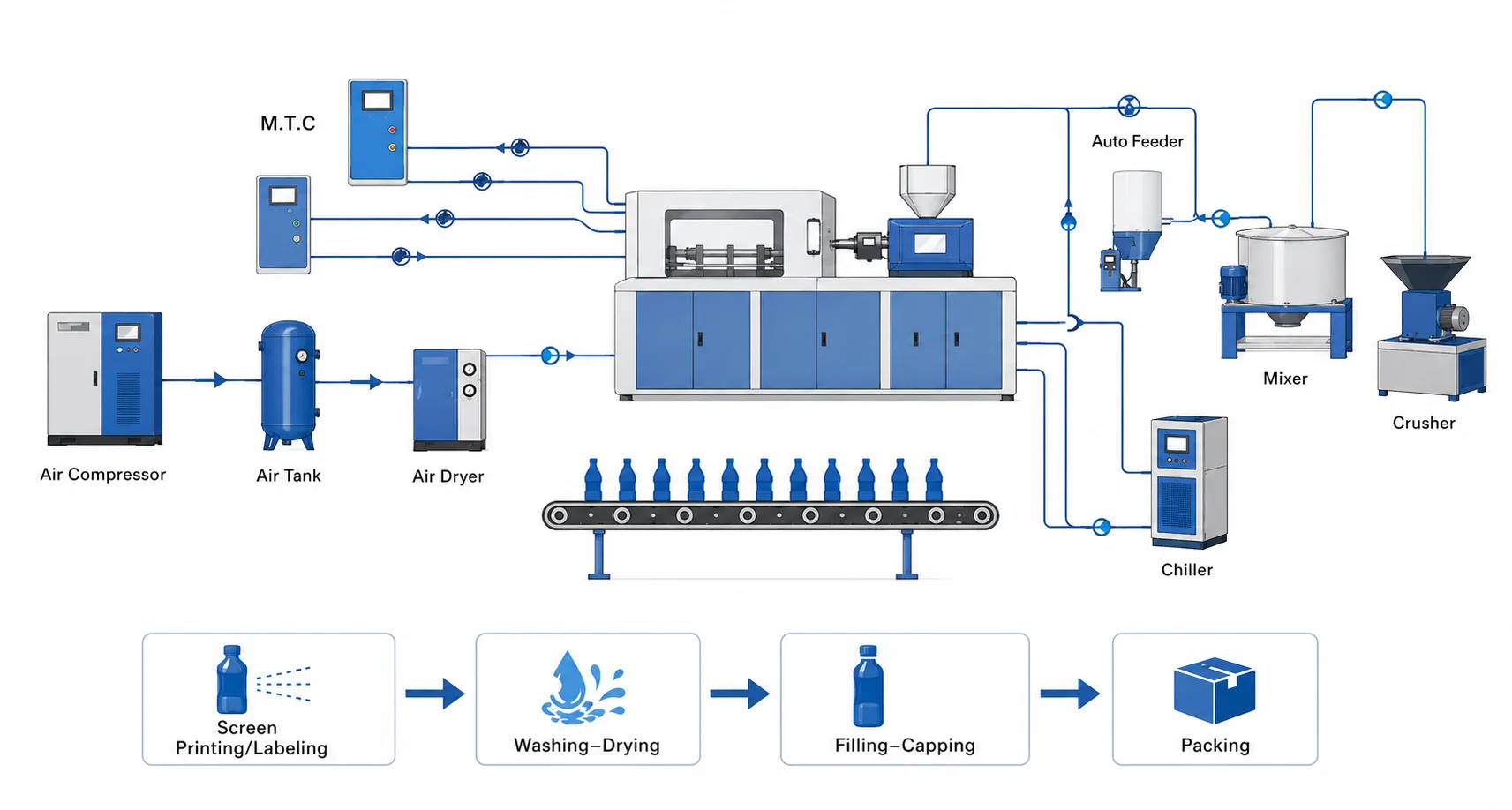
| FORMULATION TYPE | PP IBM | HDPE IBM | Recommended Resin & Rationale |
|---|---|---|---|
| Shampoo / conditioner (pH 4–7, anionic surfactant) | ✓ Εξαιρετικό | ✓ Εξαιρετικό | PP preferred for pump dispenser (semi-transparent PP RCP optional; broader PP grade range; slightly lower cost). HDPE acceptable but offers no chemical advantage for shampoo at pH 4–7. |
| Liquid soap / hand wash (pH 8–11, alkaline) | ✓ Εξαιρετικό | ✓ Εξαιρετικό | PP recommended. Both PP and HDPE are resistant to alkaline soap base at pH ≤11. Above pH 11 (industrial cleaner): specify HDPE (PP stress-crack risk at pH >12 with surfactant). |
| Hand sanitiser (60–80% ethanol) | ⚠ Limited (swelling risk) | ✓ Recommended | HDPE required. PP shows swelling in concentrated ethanol (60–80% EtOH) at 25°C: volume swell 3–8% over 12-month shelf life, causing thread deformation and cap engagement failure. HDPE shows <0.2% swelling in 80% EtOH at 25°C. All hand sanitiser IBM must be HDPE. |
| Body lotion / cream emulsion (O/W, pH 5–7) | ✓ Εξαιρετικό | ✓ Καλό | PP RCP preferred (semi-translucent body allows cream colour to show through at thin wall; slightly softer feel for pump dispenser actuation). HDPE acceptable where WVTR barrier matters for cream moisture stability. |
| Hair colour / bleach (peroxide ≤12%) | ⚠ Test required | ✓ Προτιμώμενο | HDPE preferred for oxidative bleach and peroxide formulations (HDPE shows lower oxidative degradation than PP under H₂O₂ at ≤12%). Run 6-week accelerated stability (40°C) before commercial launch in either resin. |
| Toning / facial essence (water-alcohol ≤40% EtOH) | ✓ Acceptable | ✓ Προτιμώμενο | At EtOH ≤40%: PP shows borderline swelling (0.5–2% at 40% EtOH, 25°C); HDPE is safer (<0.2% swelling). For toner/essence IBM: HDPE or run PP at EtOH ≤25% only. Above 40% EtOH: HDPE mandatory. |
ΤΜΗΜΑ 06
EP-ZQ Machine Selection Guide for Personal Care IBM: Match Volume Mix to Machine Model
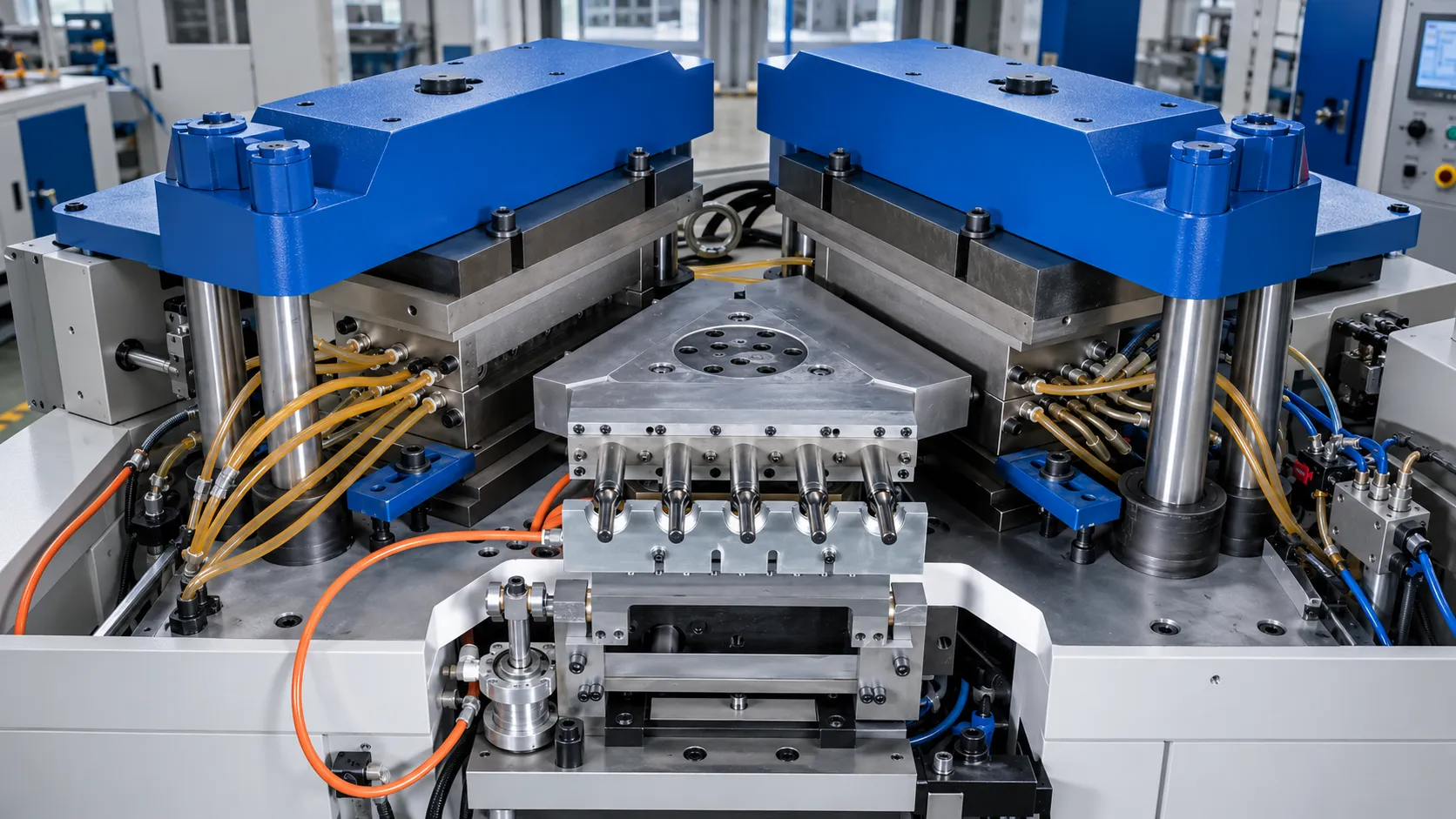
EP-ZQ40
400 kN · 190–260 g · 480 mm platen
Personal care application: 10–30 ml travel and hotel amenity (shampoo, conditioner, shower gel sachets); 10–15 ml dropper vials for precision skincare samples
Cavity counts: 10 ml = 9 cavities; 30 ml = 8 cavities
Annual output @30ml: ~114M/year (8 cavities, 4.5 s cycle, 3 shifts)
Best fit for: Hotel amenity CMO producing high-volume travel size; personal care sample programme for Korean beauty brand launch
EP-ZQ60
600 kN · 260–383 g · 600 mm platen
Personal care application: 30–100 ml personal use retail (hand lotion, facial wash, travel shampoo conditioner); 60 ml hand sanitiser (HDPE)
Cavity counts: 30 ml = 12; 60 ml = 10; 100 ml = 8
Annual output @100ml: ~96M/year (8 cavities, 5.5 s cycle)
Best fit for: Mid-tier Korean personal care brand producing 50–150M per SKU at 100 ml retail format
EP-ZQ80
800 kN · 466 g · 800 mm platen
Personal care application: 60–250 ml personal use and household (facial wash pump 100 ml, hand sanitiser 60 ml HDPE, liquid soap 200 ml); HDPE barrier containers
Cavity counts: 60 ml = 14; 100 ml = 12; 250 ml = 8
Annual output @250ml: ~86M/year (8 cavities, 6.0 s cycle)
Best fit for: HDPE hand sanitiser 60 ml at volume (post-COVID institutional supply); facial cleanser pump bottle 100 ml
EP-ZQ110
1,100 kN · 540 g · 1,100 mm platen
Personal care application: 100–500 ml household shampoo, conditioner, body wash, liquid soap. Premium brand pump dispenser range (100–250 ml at high cavity count).
Cavity counts: 100 ml = 14; 250 ml = 10; 500 ml = 8
Annual output @250ml: ~107M/year (10 cavities, 6.0 s cycle)
Best fit for: Korean mass-market shampoo 250 ml (Aekyung, Kerasys, LG H&H CMO supply) at 100–200M/year per SKU
EP-ZQ135
1,350 kN · 650 g · 1,300 mm platen
Personal care application: Highest-output single-machine daily chemical IBM: 100 ml at 18 cavities (193M/year); 250 ml at 14 cavities (150M/year); 500 ml at 10 cavities (91M/year); 1,000 ml salon size at 8 cavities (63M/year).
Best fit for: Large Korean daily chemical CMO producing multiple SKUs at 100M+ per year; global brand Korean manufacturing hub requiring maximum output per machine footprint (5.5 × 2.0 × 2.4 m).
Multi-format flexibility: ZQ135 can switch between 250 ml shampoo mould and 500 ml body wash mould with 4–8 hour changeover — same machine serves multiple SKUs across production planning calendar.
Συχνές ερωτήσεις σχετικά με τη μηχανική
Personal Care IBM Capacity Planning Questions
Can IBM produce wide-body shampoo bottles (body OD 80–100 mm) at 250 ml volume?
IBM body OD is constrained by the mandrel withdrawal geometry: the maximum body OD is approximately 2.5–3.0× the neck OD. For a 250 ml shampoo bottle with 28 mm neck (28/410 pump fit): maximum body OD ≈ 70–84 mm. A wide-body shampoo bottle at 90–100 mm body OD with 28 mm neck would require body OD/neck OD = 3.2–3.6× — at or above the IBM mandrel withdrawal limit. Options for wide-body 250 ml shampoo: (a) widen the neck to 38 mm (matching the body OD ratio to 2.4–2.6×, within IBM range) — requires 38/400 pump dispenser instead of standard 28/410; (b) reduce body OD to ≤84 mm at 28 mm neck (design adjustment); (c) accept EBM for the wide-body format where IBM dimensional constraints cannot be met. Korea Ever-Power Ansan-si reviews bottle 3D CAD for IBM feasibility at no cost — submit the bottle geometry for mandrel extraction feasibility confirmation before tooling specification.
Why is HDPE mandatory for hand sanitiser IBM at 60–80% ethanol and what exactly happens to PP?
PP (polypropylene) in contact with concentrated ethanol (60–80% EtOH, as in WHO-formula hand sanitiser and Korean MFDS-registered alcohol-based hand rub) shows environmental stress cracking (ESC) and volume swell over a 6–12 month contact period. The mechanism: ethanol penetrates the amorphous regions of semicrystalline PP, swells the polymer matrix, and at the interface between amorphous and crystalline regions generates stress concentrations under the residual moulding stresses and cap thread engagement stresses. Volume swell in PP at 70% EtOH/25°C: approximately 3–8% mass uptake at 6 months (ASTM D543, immersion test). This volume swell deforms the 28/410 pump dispenser neck thread, causing thread engagement to tighten or loosen — either stripping the thread during cap removal or making the pump impossible to activate. The Korean consumer complaint: pump won’t dispense or is stuck after 3–6 months. HDPE in identical conditions: <0.2% mass uptake at 70% EtOH/25°C — negligible thread deformation, pump dispenser function maintained through 24-month shelf life. HDPE’s chemical resistance to ethanol is due to its higher crystallinity (70–80% vs PP 40–60%) and the absence of methyl side chains that create accessible free volume for ethanol penetration in PP. Korea Ever-Power produces HDPE hand sanitiser IBM bottles in ZQ60 (60 ml, 10 cavities) and ZQ80 (60 ml, 14 cavities; 250 ml, 8 cavities) for Korean MFDS-registered alcohol hand rub manufacturers.
What is the cycle time difference between PP and HDPE IBM at equal volume on the same machine?
At equal bottle volume and equal wall weight, HDPE IBM typically has a shorter cycle time than PP IBM by 0.3–0.8 s at 100–500 ml formats. The reason: HDPE has a higher thermal conductivity than PP (0.44–0.52 W/m·K for HDPE versus 0.17–0.22 W/m·K for PP) and a higher crystallisation rate from melt (HDPE crystallisation temperature 115–130°C; PP 100–120°C). Higher thermal conductivity means HDPE preform solidifies faster in the injection cavity and at the blow mould cooling stage — directly reducing the cooling dwell time at Station 2. In production at Ansan-si: 100 ml PP HPP IBM cycle 5.5 s; 100 ml HDPE IBM cycle 4.8–5.2 s at equivalent wall weight and mould cooling temperature. Practically, the cycle time advantage of HDPE partially offsets its lower cavity count relative to larger-barrel ZQ models — at 60 ml HDPE on ZQ80 (14 cavities, 4.5 s cycle): 11,200 bph; 60 ml PP on ZQ80 (14 cavities, 4.8 s cycle): 10,500 bph. The HDPE cycle advantage is real but modest — not a primary selection factor over chemical compatibility.
How many EP-ZQ machines does a Korean daily chemical CMO need to produce 500 million shampoo bottles per year at 250 ml?
500 million × 250 ml shampoo bottles per year. From the capacity planning table: ZQ135 at 14 cavities / 250 ml = 150M bottles/year per machine. Number of machines required: 500M / 150M = 3.33 → 4 machines (Korea Ever-Power ZQ135 × 4 to cover 500M with headroom for maintenance and grade changeover). Machine footprint: 4 × ZQ135 at 5.5 × 2.0 m = 44 m² machine area, plus service access (1.5 m all sides) = approximately 144 m² dedicated production floor space. Alternative with ZQ110: ZQ110 at 10 cavities / 250 ml = 107M/year per machine. Machines: 500M / 107M = 4.7 → 5 machines. ZQ135 solution (4 machines) requires less total floor space and fewer machines than ZQ110 solution (5 machines) for the same annual output. Korea Ever-Power recommends ZQ135 for new Korean daily chemical CMO at ≥300M/year per SKU scale.
How does IBM compare to PET ISBM for a 250 ml liquid soap bottle — should we use PP IBM or PET ISBM?
For 250 ml liquid soap: PP IBM is the correct choice over PET ISBM for four reasons. (1) Chemical compatibility: PP is excellent with alkaline soap base at pH 8–11; PET ISBM bottles are also chemically compatible at this pH but have no advantage. (2) Neck OD precision: pump dispenser snap-in requires ±0.05 mm neck OD. PP IBM achieves ±0.05 mm; PET 2-stage ISBM achieves ±0.10–0.20 mm (reheat variation — see IBM vs ISBM article). For a premium pump liquid soap dispenser at Korean household or hotel channel, PP IBM neck precision eliminates pump snap-in line stoppages. (3) Body aesthetics: PP IBM produces a 250 ml bottle with no parting line — compatible with premium paper-label and direct-print aesthetics. PET ISBM also has minimal body parting line (bottom pinch-off only) — comparable body aesthetics. (4) Production economics at Korean CMO scale: PP IBM ZQ135 10-cavity at 250 ml: 107M/year per machine. PET 2-stage ISBM at 250 ml: 15,000–40,000 bph (single ISBM machine, much higher output per machine at commodity scale). PET ISBM unit cost lower at very high volume (>500M/year per SKU). For liquid soap at 50–200M/year and pump dispenser neck precision requirement: PP IBM is the correct process.
Can Korea Ever-Power produce certified BPA-free, phthalate-free PP IBM bottles for Korean eco-label programmes?
Yes. PP IBM bottles from Korea Ever-Power Ansan-si are inherently BPA-free — PP is a polyolefin with no bisphenol A in its polymer structure or production process. Korea Ever-Power issues a standard BPA-free declaration for all PP IBM bottles. Phthalate-free: PP IBM does not use phthalate plasticisers (PP is a semicrystalline polymer that does not require plasticisers; phthalates are used in PVC, which Korea Ever-Power does not process). Korea Ever-Power can issue a phthalate-free declaration for PP IBM bottles based on resin supplier certification (LG Chem, Lotte Chemical, or Hanwha Solutions PP HP-series all carry phthalate-free certification). For Korean eco-label programmes: Korea Environmental Industry and Technology Institute (KEITI) eco-label for plastic packaging requires the following documentation that Korea Ever-Power can supply: (a) polymer composition declaration (PP resin only, no blends or additives beyond colorant); (b) Korean food container plastic standard test report (KOLAS-accredited lab, non-volatile residue, KMnO4 consumption, heavy metals <1 ppm); (c) PCR (Post-Consumer Recycled) content statement if PCR PP is incorporated (Korea Ever-Power can source PCR PP for specified programmes). Korea Ever-Power can also provide ISCC PLUS (International Sustainability and Carbon Certification) certification documentation for bio-based PP IBM bottles from Korean ISCC-certified production, relevant for Korean brands targeting EU Sustainable Products Regulation compliance.
What wall weight specification should be used for a 500 ml PP shampoo IBM bottle for structural integrity under pump-down?
Pump-down deformation is the progressive ovalisation or side-wall collapse of a shampoo bottle as the pump dispenser creates internal vacuum during content withdrawal. At 500 ml PP HPP IBM bottle: minimum wall thickness for pump-down resistance at full 500 ml content level to empty: 0.80 mm average body wall (minimum local thickness at thin body section ≥0.65 mm). At 0.80 mm average wall (PP HPP, flexural modulus 1,500 MPa, 500 ml bottle body OD approximately 65–70 mm at 28/410 neck): side-wall collapse load >15 N (manual pump actuation force 8–12 N) — no pump-down deformation visible to the consumer. At 0.70 mm average wall: side-wall collapse load ≈10–12 N — borderline; potential consumer-perceptible side-wall flex at partial fill when content level drops below 50%. At 0.60 mm average wall: side-wall collapse load <8 N — noticeable deformation at pump actuation; unacceptable for premium shampoo channel. Korea Ever-Power recommends 0.80–0.95 mm average body wall for 500 ml PP HPP IBM shampoo bottles with pump dispenser. This wall weight translates to preform weight approximately 55–65 g (500 ml PP HPP at 0.90 mm average wall, density 0.905 g/cm³, bottle surface area ~270 cm²): n₂ = ⌊650/60⌋ = 10 cavities on ZQ135.
Where can I access the EP-ZQ machine specifications and IBM machine comparison guide?
Full EP-ZQ series specifications — clamping force, shot weight, platen dimensions, power, machine footprint and confirmed cavity counts at each volume format — are available on the Korea Ever-Power EP-ZQ injection blow molding machine pages. For buyers evaluating EP-ZQ against existing Jomar IBM, SUMA iB, Uniloy UIB or Bloma IBM machines for personal care or daily chemical production: the Οδηγός αντικατάστασης μηχανημάτων IBM provides direct model-pair comparisons with cavity count, energy consumption and production rate data. For capacity planning support specific to your daily chemical SKU mix, annual volume and facility ceiling height: contact Korea Ever-Power Ansan-si via the contact page for a 48-hour feasibility and machine selection report at no cost.
PERSONAL CARE IBM · KOREA EVER-POWER
Plan Your Personal Care IBM Capacity with Korea Ever-Power
Send Korea Ever-Power your bottle format mix (10–1,000 ml), annual volume per SKU and formulation type. Korea Ever-Power Ansan-si returns a machine model recommendation, cavity count, annual output and tooling cost estimate within 48 hours.
Επιμέλεια: Cxm